DataFrames in a Box
Use a DataFrame when your data has columns you want to select, filter or transform. This page shows how to work with those columns in a box and how to keep their types across separate runs. For a first look at values and plots in Field, start with Looking at Data.
Field boxes can use Kotlin DataFrame with its compiler plugin switched on, so a frame's columns are typed members you can name directly:
:::static
import org.jetbrains.kotlinx.dataframe.api.*

val people = dataFrameOf("name", "age")(
    "Alice",
    15,
    "Bob",
    30,
    "Cara",
    45,
)

people.age // resolves. Not people["age"], not a cast, not a generated file.
You can write people.age directly. The plugin reads the dataFrameOf("name", "age")(...) call at compile time, works out the schema it produces, and gives the expression a type whose members are its columns. There is no @DataSchema in your project, no build step, and nothing on disk to keep in sync.
The typing does not survive from one execution to the next on its own; typed(), below, carries it across.
The shape that works: derive and consume in one execution
Within one execution, a chain of calls just works. Every step re-types the frame, so the next step can name the columns the previous one produced:
:::static
import org.jetbrains.kotlinx.dataframe.api.*

val people = dataFrameOf("name", "age")(
    "Alice",
    15,
    "Bob",
    30,
    "Cara",
    45,
)

// `age` inside the lambda resolves against the *input* schema.
// `decade` afterwards resolves against the schema `add` RETURNS.
val adults = people.filter { age >= 18 }.add("decade") { age / 10 }

println("names:  " + people.name.toList())
println("kept:   " + adults.name.toList())
println("decade: " + adults.decade.toList())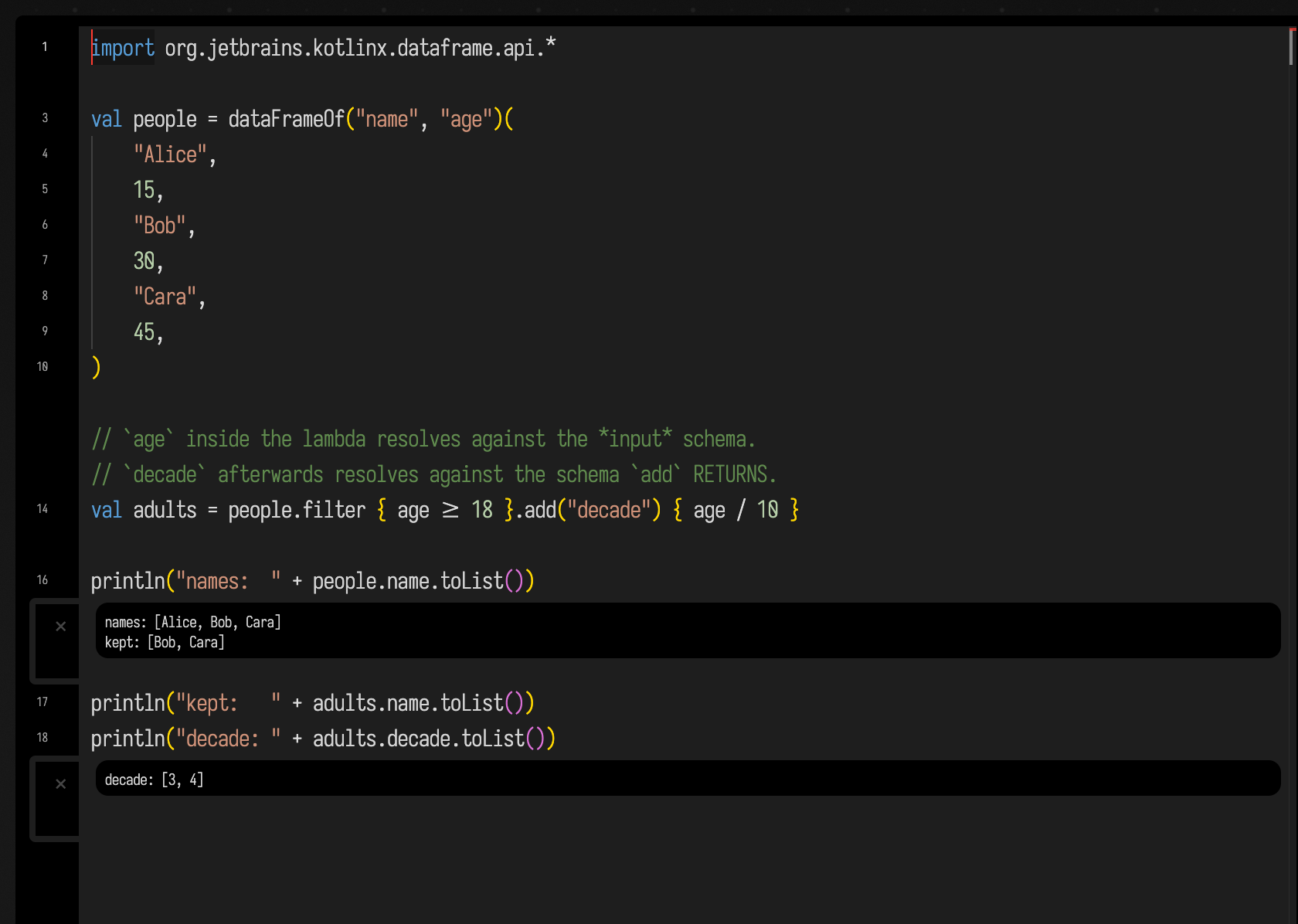
decade is not in the source data and is not declared anywhere. The plugin reads the add("decade") { … } call and adds the column to the frame's type.
Where the boundary falls
Typed columns do not survive a compile boundary. Declare val df = dataFrameOf("a","b")(1,2) in one snippet, read df.a in the next, and the frame comes back as DataFrame<Any> with an empty compile-time schema. In live coding you load data once and then work with it over many runs, so you need typed().
Why the boundary is there
The plugin hangs off FirFunctionCallRefinementExtension, an extension point the Kotlin
compiler itself describes as "highly unstable and not recommended to use". At a call to a
@Refine-annotated function it statically interprets the arguments, computes the resulting
schema, and rewrites the call: call() becomes
run { class Token; class Scope; call() as DataFrame<Token> }. Token and Scope are
local classes (the extension runs at body-resolve and cannot create top-level
declarations), and the column accessors are not declarations at all: they are a per-call-site
local type plus an implicit extension receiver. A local class cannot appear in the type of a
snippet's property, so the type decays as soon as the frame is stored in a val that
outlives the expression.
DataFramePluginSpike.kt holds both halves: the call rewrite and the
ReturnTypeBasedReceiverInjector that supplies the receiver at :27, and probeAcrossSnippets at
:147, which is what prints the <empty compile time schema> result at :161.
A @DataSchema interface shared between boxes with sharedTypes(...) does not help either: you can cast the frame to that type, but people.age still does not resolve. Use typed() in the box that needs the columns.
Why a shared @DataSchema gets no accessors
The accessors come from TopLevelExtensionsGenerator, which asks K2's predicate-based provider
for everything annotated @DataSchema, and that provider indexes source declarations only. A
@DataSchema compiled into a directory on the classpath, which is what sharedTypes produces,
is invisible to it.
Kotlin DataFrame also ships ImportedSchemasGenerator plus ImportedSchemasService, gated on
the plugin's schemasPath option pointing at a directory of schema JSON from a build-time
generator. Field does not wire it. The mechanism is read in DataFramePluginSpike.kt:171;
typed() does the same job without the build step.
typed(): the way across
DataFrame<T>.typed(name) (DataFrameSchemas.kt:50) reads the frame's columns at run time, when the data has already been loaded, and writes a schema for them into the calling box's preamble:
:::static
val people =
    dataFrameOf("name", "age")(
            "Alice",
            15,
            "Bob",
            30,
            "Cara",
            45,
        )
        .typed("People")

/*
…and this appears in the box's preamble:
@org.jetbrains.kotlinx.dataframe.annotations.DataSchema
interface People { val `name`: kotlin.String; val `age`: kotlin.Int }
*/
From then on People is an ordinary source declaration in that box, so people.cast<People>().age resolves in every later execution.
Calling typed() on every run is cheap and safe. The preamble only re-evaluates lines that changed, so a re-run with unchanged columns costs nothing; a re-run with a changed schema rewrites the old declaration instead of accumulating a second one. Unlike sharedTypes, nothing is loaded into a classloader, so changing the columns and re-running simply redeclares the interface.
The three design choices
| choice | why | where |
|---|---|---|
| The preamble, not an inline eval. | typed() runs inside the box's engine, and the compile dispatcher is a single thread, so evaluating another snippet from there risks deadlock. The preamble is the existing channel for "source this box should have compiled first". |
DataFrameSchemas.kt:31 |
| Unchanged schemas are free. | checkPreambleAndExecute only evaluates preamble lines that changed, so re-running a box whose columns are the same costs nothing. |
DataFrameSchemas.kt:34 |
| Replace by name, not append. | Matching is on the interface <name> { prefix rather than the whole line, so a re-run with a changed set of columns rewrites the declaration instead of accumulating a second one. |
DataFrameSchemas.kt:100 |
Flat value columns get their real element type. A column group or frame column would need a nested interface, so it is declared Any?: you still get the column, but not its shape. The log names which ones landed that way (DataFrameSchemas.kt:67). Calling typed() with no box in context logs a warning and does nothing (DataFrameSchemas.kt:58).
One execution, two halves: the //%- marker
typed() writes to the preamble, so it looks as though you have to run the box twice. You do not, if you split the box with a //%- marker. A typed() call in the first half has already published its schema by the time the second half is compiled:
:::static
import org.jetbrains.kotlinx.dataframe.api.*

val people =
    dataFrameOf("name", "age")(
            "Alice",
            15,
            "Bob",
            30,
            "Cara",
            45,
        )
        .typed("Peach")

// Run the first fragment to publish Peach into the preamble before compiling the cast.
//%-
val p = people.cast<Peach>()
println("ages:   " + p.age.toList())
println("adults: " + p.filter { age >= 18 }.name.toList())
Delete the //%- and the box stops compiling: with a single fragment, the schema is written only after that fragment has been compiled, so Peach does not exist yet.
Why: setup blocks re-run before each fragment
Field re-runs a box's setup blocks (preamble, introduction, attic) before every //%- fragment, not once per execution: runLaunchSetupBlocks(box) sits inside the fragment loop (execution.kt:1427, defined at execution.kt:1539). A typed() call in the first fragment has already written its schema to the preamble, and that preamble re-compiles before the second fragment runs, so the schema is available.
Once it has run, the second half is independently re-runnable: select those lines, run them as often as you like, and the frame is never reloaded.
Looking at a frame: .h and .h2
A DataFrame renders through the value visualizer like any other value. Field registers it with ValuePrinterRegistry and H2ValueRegistry (DataFrameVisualizer.kt:62, DataFrameVisualizer.kt:69).
.h works on a frame, a column, a row and a GroupBy:
:::static
import org.jetbrains.kotlinx.dataframe.api.*

val people = dataFrameOf("name", "city", "age")(
    "Alice",
    "Berlin",
    15,
    "Bob",
    "Berlin",
    30,
    "Cara",
    "Lisbon",
    45,
    "Dev",
    "Lisbon",
    22,
)

display("frame", people.h) // a Table, plus a shape line
display("column", people.columns()[2].h) // one column, plus its element type
display("row", people[0].h) // label/value facts
display("grouped", people.groupBy("city").h) // how many groups, keyed by what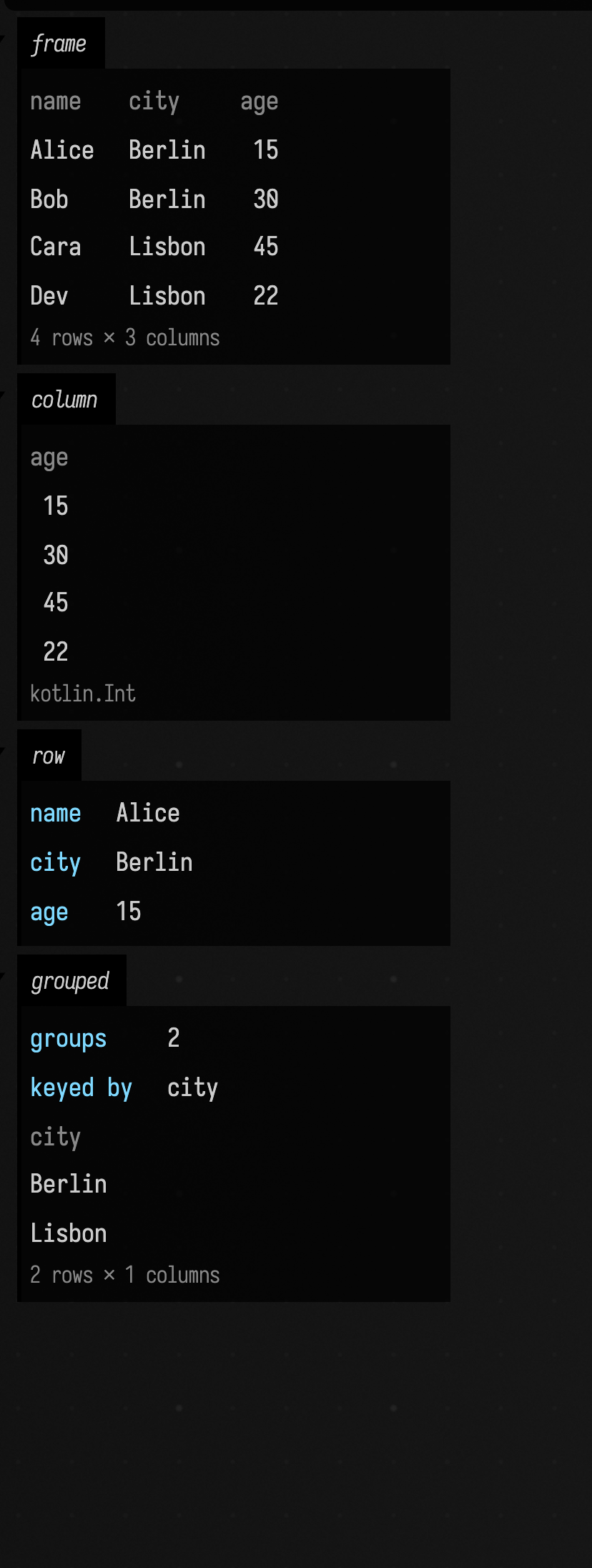
All four are drawn with the same table() and facts() that draw every other table in Field.
The compact form costs the same at any size
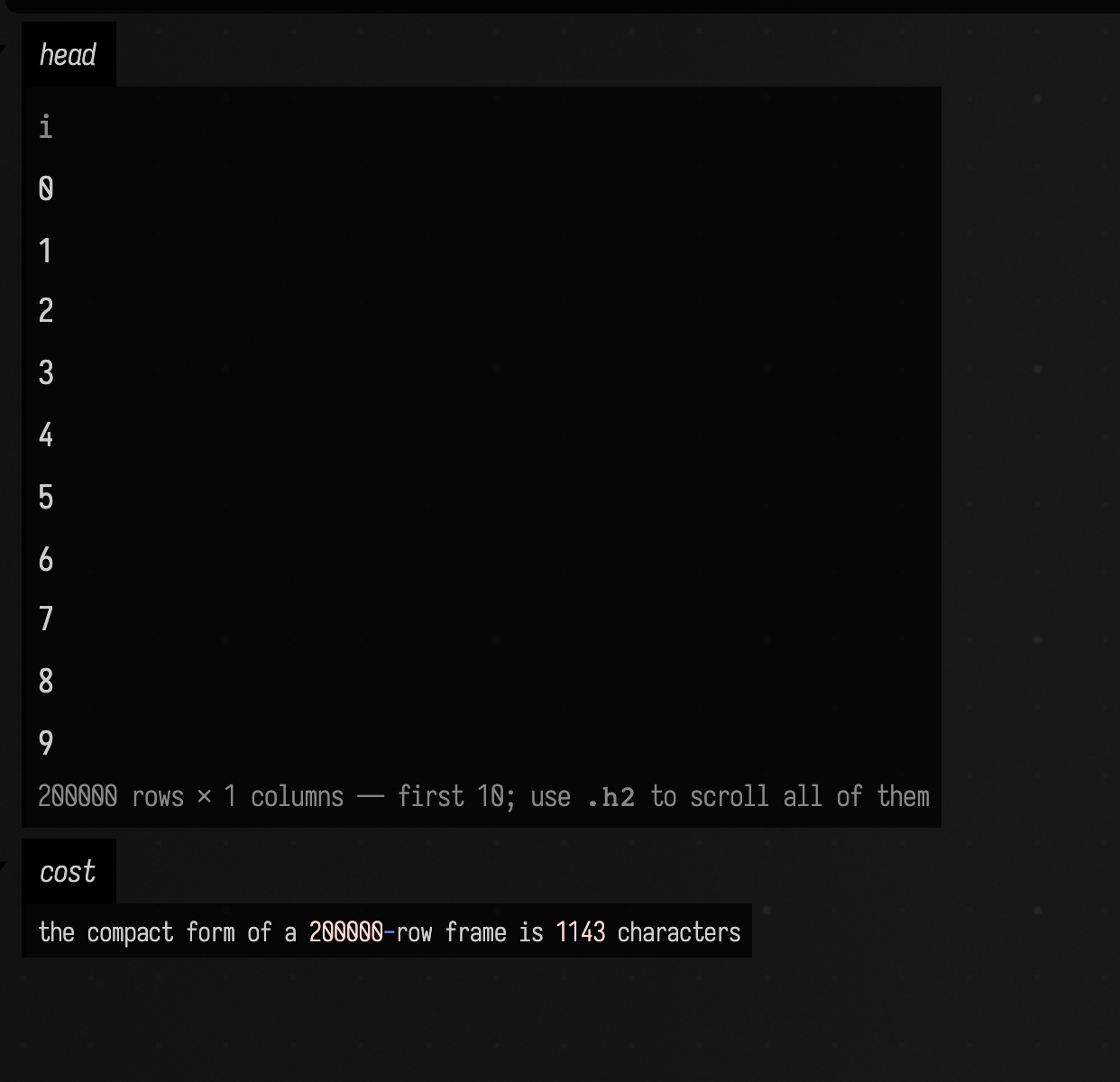
The compact .h form shows the first 10 rows (DataFrameVisualizer.kt:51) and says how many it is hiding. It reads them cell by cell, by index (DataFrameVisualizer.kt:119), so printing a very large frame costs what printing ten rows costs, and you can leave a large frame as a box's last expression.
:::static
import org.jetbrains.kotlinx.dataframe.api.*

// 200,000 rows. A spread argument is one the plugin cannot statically interpret,
// so this frame is schema-less — the point here is the RENDERING cost.
val big = dataFrameOf("i")(*Array(200_000) { it })

val compact = big.h
display("head", compact)
display(
    "cost",
    ("the compact form of a " + big.rowsCount() + "-row frame is " + compact.length + " characters").h,
)
Agents: the test behind this
kotlin.dataframe-visualizer.smoke renders a 5,000-row and a 200,000-row frame and fails unless their compact forms differ by
no more than 40 characters (DataFrameVisualizerSmokeTest.kt:137). The comparison is what catches a
rendering that is linear in rows with a small constant, since that would pass a plain size ceiling at
5,000 rows. There is a ceiling too: under 4,000 characters, no last row
(DataFrameVisualizerSmokeTest.kt:105).
.h2 scrolls the frame itself
.h2 opens the frame in the h2 explorer, which you can scroll through the whole frame. Field keeps the frame itself on the server and builds only the rows you are looking at (DataFrameVisualizer.kt:154), so a large frame scrolls as quickly as a small one.
:::static
import org.jetbrains.kotlinx.dataframe.api.*

/*
15,000 rows, and nothing below pages them: `.h2` hands the whole FRAME to the
explorer, which asks for the window it is showing and for nothing else. A spread
argument is one the plugin cannot statically interpret, so this frame is
schema-less — what is on show here is the rendering, not the typing.
*/
val n = 15_000
val big = dataFrameOf("i", "sq")(
    *Array<Any?>(n * 2) { k ->
        val r = k / 2
        if (k % 2 == 0) r else r.toLong() * r
    },
)

display("scroller", big.h2)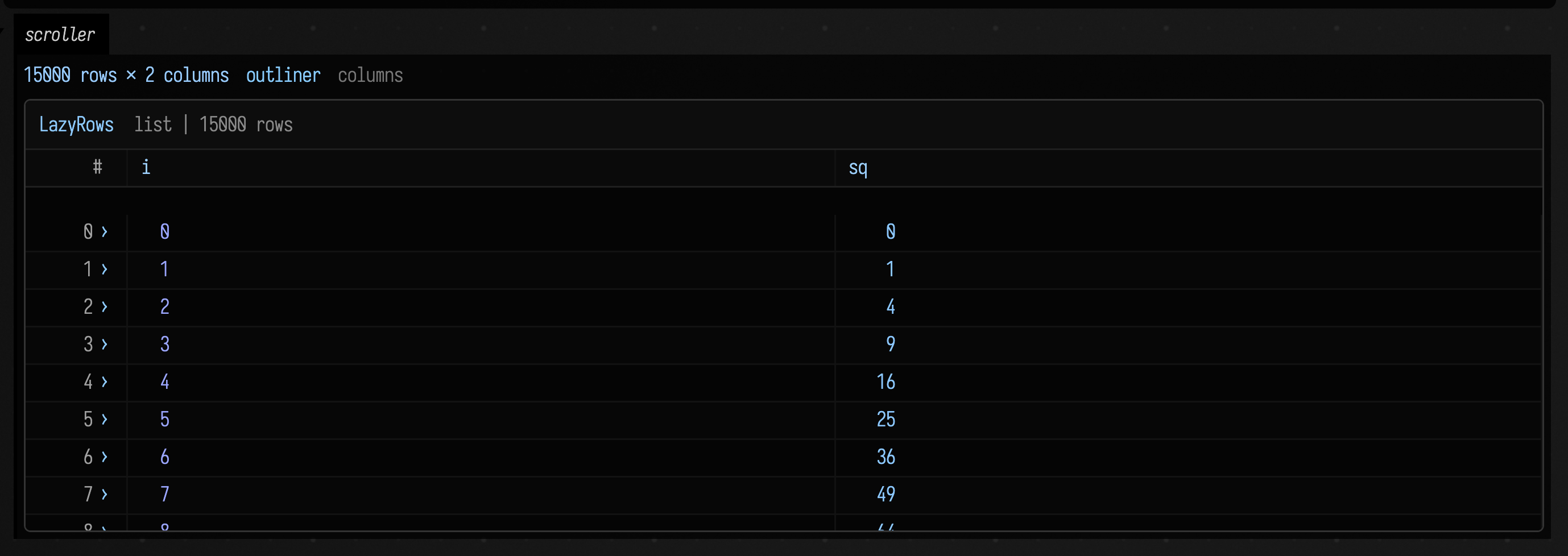
The header gives the frame's full shape, 15000 rows × 2 columns. The rows are shown as a table with one column per frame column, in the frame's order (h2explorer.kt:261).
A frame inside another value, such as a list of frames or a data class with a frame field, expands the same way.
How .h2 reaches the explorer
The .h2 output is an <iframe> onto /h2-explorer?root=h2-<token> (h2explorer.kt:849),
and the explorer asks for its windows over the /ws __h2_explorer__ channel. That is a
different path from /lazy-value-fragment, which renderListContinuation
(ValueVisualizer.kt:2345) serves
when a value is expanded in place.
Switches, and the version pin
| what | how |
|---|---|
| Turn the plugin off for this JVM | -Dafield.dataframePlugin=false (KotlinInterface2.kt:2996) |
| Point at a different plugin jar | -Dafield.dataframePlugin.jar=<path> (KotlinInterface2.kt:3000) |
| Default jar location | libs/dataframe-plugin.jar, git-lfs tracked |
The DataFrame runtime is pinned to 1.0.0-Beta4, the version the plugin was built against.
The plugin jar and the version pin
The plugin jar carries its own copy of the DataFrame runtime, so putting it beside the real
dataframe-core dependency would put two copies of DataFrame in front of box code
(KotlinInterface2.kt:2974).
-Xplugin loads it in the compiler's own plugin classloader, while the runtime goes on the
classpath normally (build.gradle.kts:999).
The plugin was built from Field's Kotlin fork, whose libs.versions.toml names that runtime
version, and the plugin reads the runtime's API at compile time. Moving to a released
DataFrame 1.0 means re-syncing the fork and rebuilding the plugin. The wiring and the probes are
in dev_docs/DATAFRAME_PLUGIN.md.
Where to go next
dataframe_typed_columnsin the Agent Transcript Gallery: a four-box example you can replay.- Visualizers, Displays, and Little Instruments: everything else
.hand.h2can draw. - Charts as FLines:
DataFrame.chart()plots a frame. - Kotlin in the Head and Running code in a box: snippets, fragments and preambles.
Known limits
- A frame's inferred type does not carry from one execution to the next. Use
typed(). - A
@DataSchemashared withsharedTypesgives you the type but no column accessors. Usetyped()in the box that needs the columns. - Column groups and frame columns come back from
typed()asAny?. - The plugin uses a compiler extension point that the Kotlin compiler documents as unstable, so a Kotlin upgrade can break it.