Loris: partial tracks and resynthesis
Loris turns a recording into evolving sinusoidal partials with a noise-bandwidth envelope. Analyze a WAV, inspect its trajectories, change them, and render them back to sound. Analysis and synthesis run offline, in a small native program that Field starts for you, so nothing here runs in real time.
Build the worker once with ./gradlew buildLorisNative (setup below). In a Kotlin box, start with
the committed film-dialogue sample, or replace the path with your own WAV:
import kotlinx.coroutines.*
import kotlinx.coroutines.future.await

val client = cached { LorisClient() }
val source = "%docs/assets/subharmonic_sound/notld-barbara-source.wav".path
display("status", "Starting Loris…")
prop<LorisResult>(analyzed)
go {
    try {
        val result =
            client
                .analyzeWavAsync(
                    source,
                    options = LorisOptions(resolutionHz = 35.0, windowWidthHz = 80.0),
                    onProgress = { stage -> if (isActive) display("status", stage) },
                )
                .await()
        analyzed = result
        display(
            "partials and sound",
            result.visualizationHtml(
                LorisViewOptions(syncGroup = "my-partials"),
            ),
        )
        display("provenance", result.provenance)
    } catch (cancelled: CancellationException) {
        throw cancelled
    } catch (failure: Throwable) {
        markdown("error", "Loris failed: ${(failure.message ?: failure.toString()).md}")
    }
}
%docs is the folder of documentation files that ships with Field. For your own recording, use "~/Downloads/recording.wav".path, or "recording.wav".path for
the document's files/ directory. See Files and paths.
The box owns the coroutine: Stop or rerun cancels its current native future, and progress from an ended run is ignored. The shared client and durable native cache are retained.
The returned LorisModel retains the native, irregular breakpoint times. Each partial has an ID,
a label, and points with time in seconds, frequency in Hz, linear amplitude, phase in radians,
and bandwidth between 0 and 1 (how noisy the partial is), and all of it is ordinary data your code
can read. Analyzing a WAV reads its left channel. For a different channel or your own mix, pass a
mono FloatArray to analyzeAsync(samples, rate). The samples are analyzed as they are, with no
normalization or resampling.
The plot runs from 0 Hz up to half the sample rate (24 kHz for a 48 kHz file) on an ERB axis, a scale that spaces frequencies roughly as the ear does. The Full band and 80–4000 Hz detail buttons change the view without analyzing again, and the axis menu also offers linear Hz and cents. The analyzer itself ignores anything below 20 Hz by default. A cents axis cannot reach zero, so it starts at a positive frequency.
Listen alongside the tracks
This source is 13.5 seconds of Night of the Living Dead (1968), a public-domain film: Johnny and Barbara speaking in the cemetery. The source is the same mono 48 kHz excerpt used in Subharmonic Synthesis.
The plot below shows the analysis of that recording, with players for the source and for its reconstruction. Playing either one moves the cursor across the partial map, hovering a track shows its values, and clicking a track moves both players to that time. The wheel zooms around the playhead, dragging pans, and all time returns to the whole excerpt. The two players do not play together, so you can switch between them to compare.
:::static
display("source, partials, reconstruction", LorisDocs.comparisonHtml())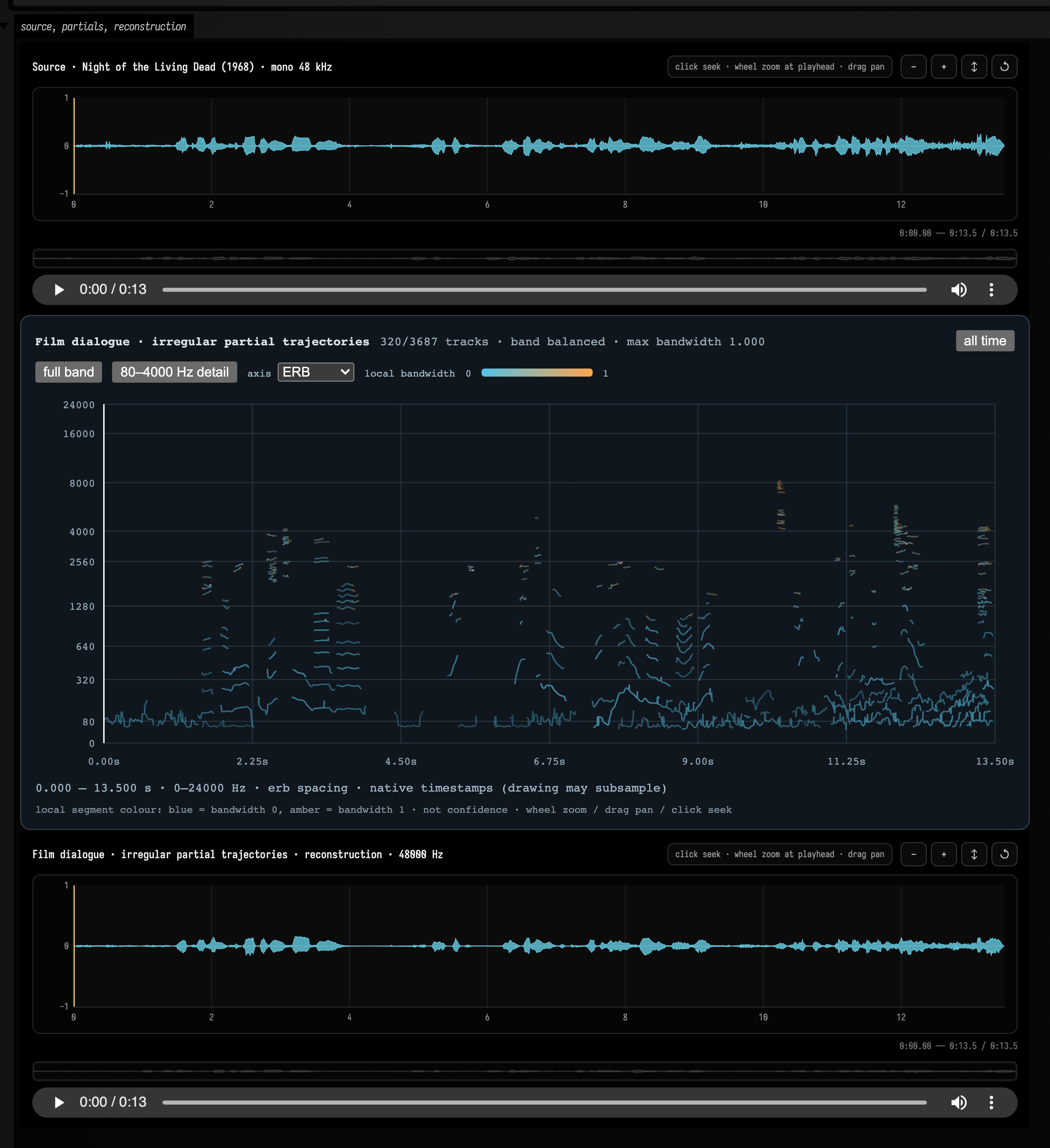
Source:
Loris reconstruction:
The map shares the tracks it draws across frequency bands, so loud low fundamentals do not crowd out everything above them. Each segment is coloured by its bandwidth at that moment, from blue (a pure tone) to amber (noise). When two tracks cross, one continuous line may still have swapped between voices. Listen to the consonants, the hiss and the attacks in both recordings to hear what the reconstruction kept.
Drawing is bounded by maxPartials and pointsPerPartial, shown in the caption. These limits
only select native observations for display; the model and resynthesis retain every breakpoint.
minimumHz, maximumHz and axis change the view, not the analyzer's frequency resolution.
selection = LorisTrackSelection.STRONGEST draws the loudest and longest tracks instead of the
default BAND_BALANCED.
Make a spectral whirlpool in one chunk
Keep the recording recognizable until six seconds, whirl its partial frequencies through ±18 semitones for three seconds, shutter their amplitudes at 12 Hz, and drive the center toward noisy bandwidth. A squared-sine envelope brings all three gestures in and out together, and nothing outside that window changes.
This box analyzes the WAV, edits the partials, waits for the resynthesis, and plots the edited model with a player for its sound. Each breakpoint keeps its stored phase, so expect some smearing of attacks. The frequency cap in the code keeps every partial below half the sample rate.
import kotlinx.coroutines.*
import kotlinx.coroutines.future.await

val client = cached { LorisClient() }
val chunkStart = 6.0
val chunkDuration = 3.0
go {
    try {
        val analyzed =
            client
                .analyzeWavAsync(
                    "%docs/assets/subharmonic_sound/notld-barbara-source.wav".path,
                    options = LorisOptions(
                        resolutionHz = 35.0,
                        windowWidthHz = 80.0,
                        frequencyDriftHz = 50.0,
                        amplitudeFloorDb = -55.0,
                    ),
                    onProgress = { if (isActive) display("status", it) },
                )
                .await()
        val model = analyzed.model
        val changed = model.copy(
            partials =
                model.partials.map { partial ->
                    partial.copy(
                        points =
                            partial.points.map { point ->
                                val u = (point.timeSeconds - chunkStart) / chunkDuration
                                if (u <= 0.0 || u >= 1.0) point
                                else {
                                    val envelope = sin(PI * u).pow(2)
                                    val octaves = 1.5 * envelope * sin(2 * PI * 4 * u)
                                    val shutter = .25 + .75 * (.5 + .5 * sin(2 * PI * 12 * chunkDuration * u))
                                    point.copy(
                                        frequencyHz = (point.frequencyHz * 2.0.pow(octaves)).coerceAtMost(
                                            model.sampleRate * .49,
                                        ),
                                        amplitude = point.amplitude * (1 - envelope + envelope * shutter),
                                        bandwidth = point.bandwidth * (1 - envelope) + .85 * envelope,
                                    )
                                }
                            },
                    )
                },
        )
        display("status", "Resynthesizing the whirlpool…")
        val edited = client.synthesizeAsync(changed).await()
        display(
            "edited tracks and sound",
            edited.visualizationHtml(
                LorisViewOptions(height = 400, syncGroup = "my-whirlpool"),
            ),
        )
    } catch (cancelled: CancellationException) {
        throw cancelled
    } catch (failure: Throwable) {
        markdown("error", "Loris failed: ${(failure.message ?: failure.toString()).md}")
    }
}
Here is the gesture on the film excerpt. Compare seconds 6–9 with the reconstruction above: the amber, noisy middle and the twisting tracks are what you hear.
:::static
display("edited tracks and sound", LorisDocs.whirlpoolHtml())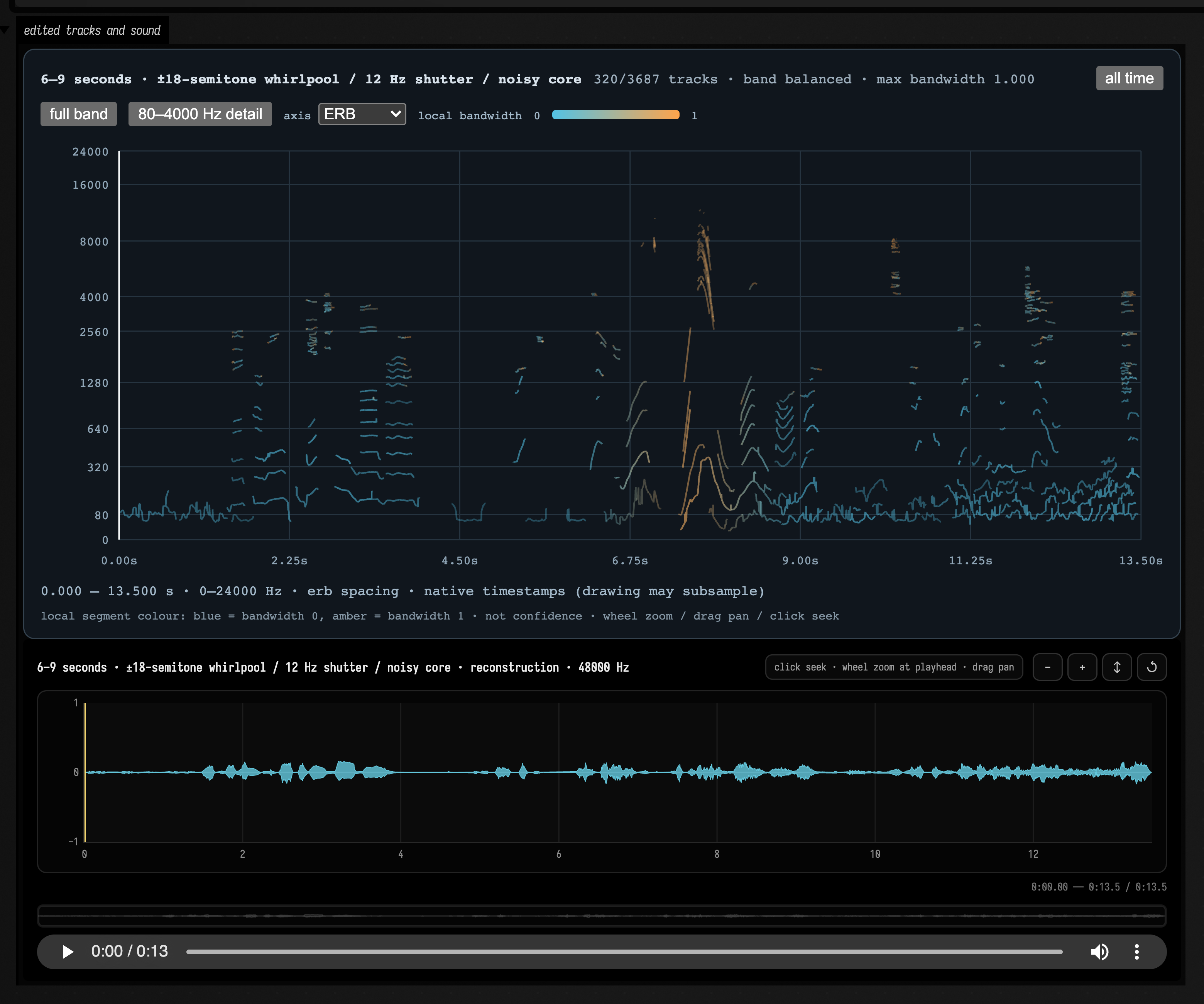
The same example gesture is available in a box as
model.spectralWhirlpool(6.0, 3.0). Its manifest records the
parent analysis, chunk range, sweep depth, shutter rate, bandwidth target and synthesis request.
Change the sound
This box analyzes the source, lowers every partial's frequency to three quarters, removes the noise bandwidth, then renders and displays the changed model. The breakpoints keep their stored phases, so attacks change character more than a dedicated pitch shifter would make them.
import kotlinx.coroutines.*
import kotlinx.coroutines.future.await

val client = cached { LorisClient() }
go {
    try {
        val analyzed =
            client
                .analyzeWavAsync(
                    "%docs/assets/subharmonic_sound/notld-barbara-source.wav".path,
                    options = LorisOptions(
                        resolutionHz = 35.0,
                        windowWidthHz = 80.0,
                        frequencyDriftHz = 50.0,
                        amplitudeFloorDb = -55.0,
                    ),
                    onProgress = { if (isActive) display("status", it) },
                )
                .await()
        display("status", "Resynthesizing changed envelopes…")
        val edited =
            client
                .synthesizeAsync(
                    analyzed.model.transformed(
                        frequencyScale = 0.75,
                        bandwidthScale = 0.0,
                        gain = 0.8,
                    ),
                )
                .await()
        display(
            "changed sound",
            edited.visualizationHtml(
                LorisViewOptions(
                    axis = LorisFrequencyAxis.ERB,
                    syncGroup = "changed-partials",
                ),
            ),
        )
    } catch (cancelled: CancellationException) {
        throw cancelled
    } catch (failure: Throwable) {
        markdown("error", "Loris failed: ${(failure.message ?: failure.toString()).md}")
    }
}
Here is that edit. Every segment is blue, because the edit set every bandwidth to zero:
:::static
display("changed partials and sound", LorisDocs.transformedHtml())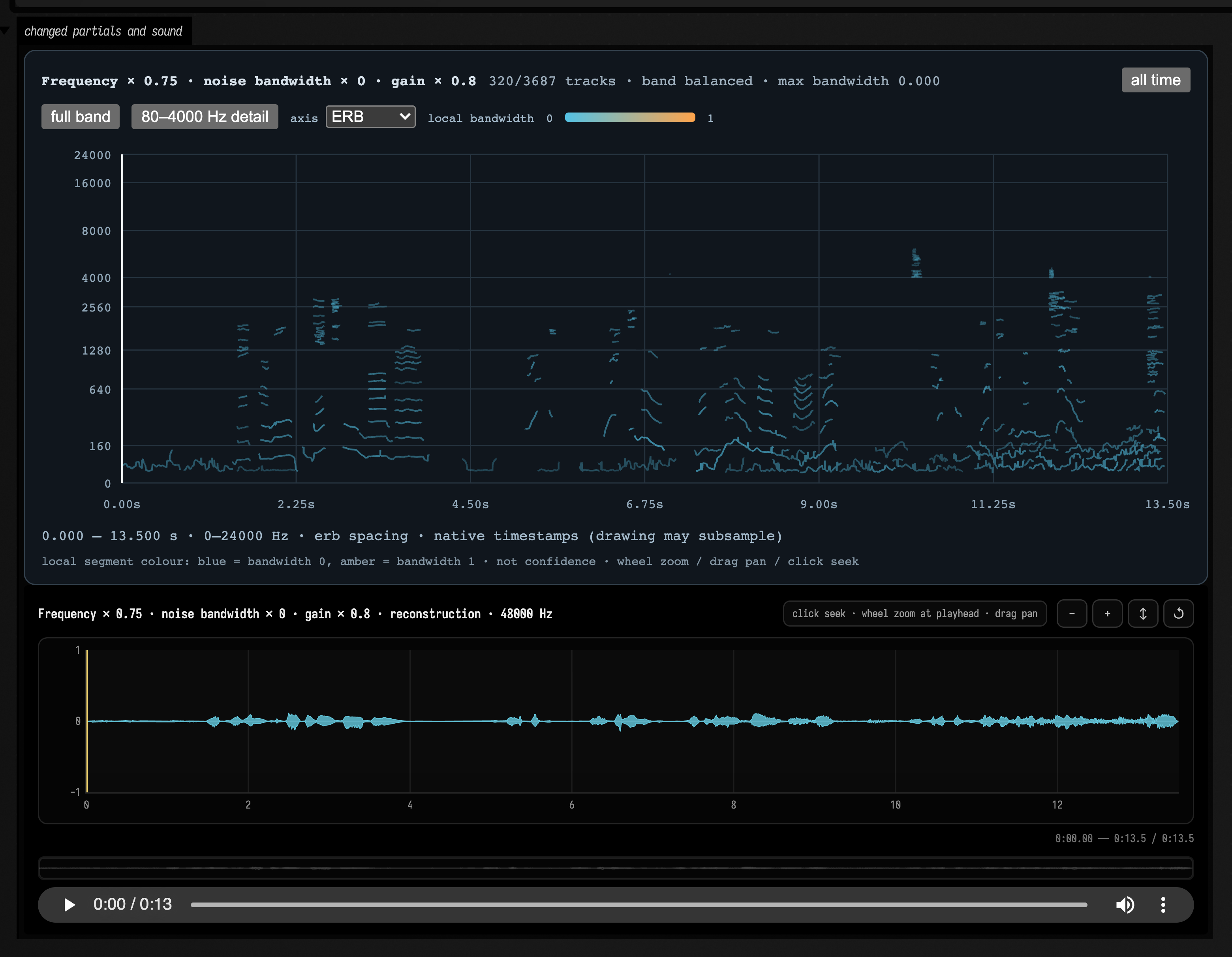
Other edits are ordinary data operations. Keep only tracks in a frequency band, delete short partials, or replace a selected partial's breakpoint list. The IDs remain stable through resynthesis. For example, after analyzing a source, this keeps only tracks whose mean frequency is below 900 Hz:
import kotlinx.coroutines.*
import kotlinx.coroutines.future.await

val bassModel = analyzed.model.copy(
    partials =
        analyzed.model.partials.filter { partial ->
            partial.points.map { it.frequencyHz }.average() < 900.0
        },
)
go {
    try {
        val it = client.synthesizeAsync(bassModel).await()
        display("low partials", it.visualizationHtml())
    } catch (cancelled: CancellationException) {
        throw cancelled
    } catch (failure: Throwable) {
        markdown("error", "Loris failed: ${(failure.message ?: failure.toString()).md}")
    }
}
transformed(timeScale = 2.0) stretches envelope times and doubles the frame extent;
gain changes linear amplitudes. Edits that exceed Nyquist or create invalid timestamps are
rejected. Field never clips a reconstruction: if a peak goes above 1, the player refuses it, so
apply a gain and keep the unmodified model for later.
Time versus frequency resolution
These settings are independent:
| Control | Unit | What it changes |
|---|---|---|
resolutionHz |
Hz | Separation between detected spectral peaks |
windowWidthHz |
Hz | Analysis window's main-lobe width; wider means a shorter window |
hopSeconds |
seconds | How often the analyzer examines the recording |
frequencyDriftHz |
Hz | Frequency movement allowed when building tracks |
amplitudeFloorDb |
dB | Detection floor |
minimumFrequencyHz |
Hz | Lower detection boundary |
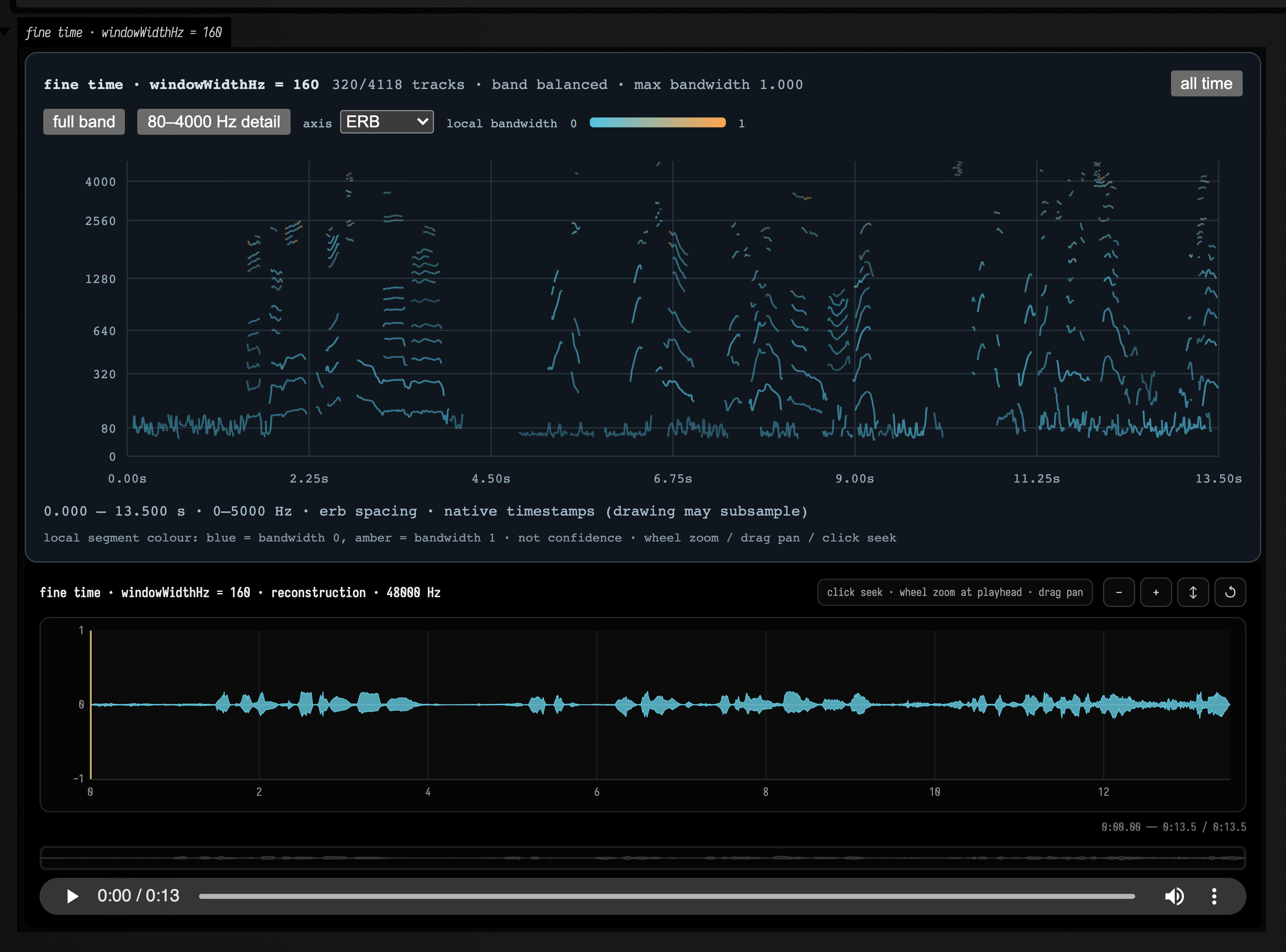
A small hop cannot recover events blurred by a long window. Try a fine-time pass with
windowWidthHz = 160.0, and a fine-frequency pass with windowWidthHz = 40.0; retain them as
separate readings of the same source. When judging attacks, look at a waveform or spectrogram as
well.
This box reads the dialogue with a short window, for fine time, and shows the reading with its resynthesis:
import kotlinx.coroutines.*
import kotlinx.coroutines.future.await

val client = cached { LorisClient() }
val windowWidthHz = 160.0
go {
    try {
        val analyzed =
            client
                .analyzeWavAsync(
                    "%docs/assets/subharmonic_sound/notld-barbara-source.wav".path,
                    options = LorisOptions(
                        resolutionHz = windowWidthHz / 2,
                        windowWidthHz = windowWidthHz,
                        hopSeconds = 0.005,
                        frequencyDriftHz = 50.0,
                        amplitudeFloorDb = -55.0,
                    ),
                )
                .await()
        display(
            "fine time · windowWidthHz = 160",
            analyzed.visualizationHtml(
                LorisViewOptions(height = 300, maximumHz = 5000.0, label = "fine time · windowWidthHz = 160"),
            ),
        )
    } catch (cancelled: CancellationException) {
        throw cancelled
    } catch (failure: Throwable) {
        markdown("error", "Loris failed: ${(failure.message ?: failure.toString()).md}")
    }
}
The same box with windowWidthHz = 40.0, for fine frequency:
import kotlinx.coroutines.*
import kotlinx.coroutines.future.await

val client = cached { LorisClient() }
val windowWidthHz = 40.0
go {
    try {
        val analyzed =
            client
                .analyzeWavAsync(
                    "%docs/assets/subharmonic_sound/notld-barbara-source.wav".path,
                    options = LorisOptions(
                        resolutionHz = windowWidthHz / 2,
                        windowWidthHz = windowWidthHz,
                        hopSeconds = 0.005,
                        frequencyDriftHz = 50.0,
                        amplitudeFloorDb = -55.0,
                    ),
                )
                .await()
        display(
            "fine frequency · windowWidthHz = 40",
            analyzed.visualizationHtml(
                LorisViewOptions(height = 300, maximumHz = 5000.0, label = "fine frequency · windowWidthHz = 40"),
            ),
        )
    } catch (cancelled: CancellationException) {
        throw cancelled
    } catch (failure: Throwable) {
        markdown("error", "Loris failed: ${(failure.message ?: failure.toString()).md}")
    }
}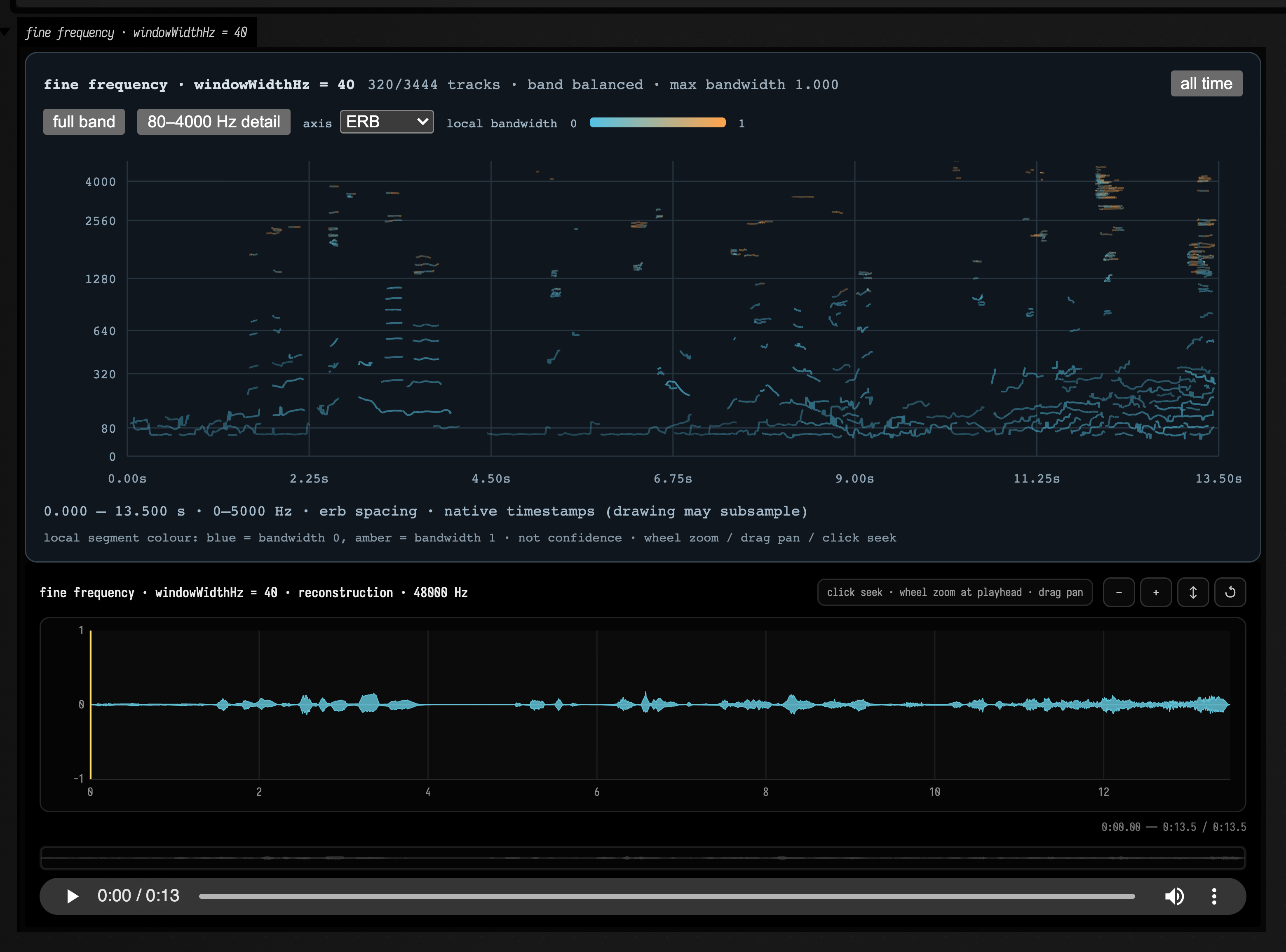
The short window keeps the onsets of syllables as sharp starts and stops but leaves the low harmonics ragged. The long window separates the low harmonics into long lines and smears the onsets.
Label, align and morph two sounds
Loris's best-known trick is the morph: one sound turns into another with frequency, amplitude and noise bandwidth moving on their own schedules. Before that can happen, both sounds need the same numbering of their partials, and their important moments need to line up. Three calls do this, and all three run Loris's own algorithms in the worker:
client.distill(model, reference)labels each partial with the harmonic it sits nearest to, then joins the partials that share a label, so you are left with one partial per harmonic plus the unlabeled rest (label 0).LorisReference.Estimated(minimumHz, maximumHz)lets Loris estimate the fundamental itself;LorisReference.constant(220.0)orLorisReference.Track(envelope)gives it one you know. Passdistill = falseto label without joining.client.dilate(model, from, to)warps time so each time infromlands on the matching time into.client.morph(a, b, frequency, amplitude, bandwidth)morphs partials with the same label. Each argument is aLorisEnvelopefrom time in seconds to a weight, where 0 isaand 1 isb. Pass one envelope and all three follow it.
This box takes two two-second phrases from the film, labels each against its own estimated fundamental, moves the loudest moment of the second onto the loudest moment of the first, and morphs from the first to the second between 0.4 and 1.6 seconds:
import kotlinx.coroutines.*
import kotlinx.coroutines.future.await

val client = cached { LorisClient() }
go {
    try {
        val analyzed =
            client
                .analyzeWavAsync(
                    "%docs/assets/subharmonic_sound/notld-barbara-source.wav".path,
                    options = LorisOptions(
                        resolutionHz = 35.0,
                        windowWidthHz = 80.0,
                        frequencyDriftHz = 50.0,
                        amplitudeFloorDb = -55.0,
                    ),
                    onProgress = { if (isActive) display("status", it) },
                )
                .await()
        val film = analyzed.model
        val a = client.distillAsync(film.crop(1.6, 3.6), LorisReference.Estimated(150.0, 450.0)).await().model
        val b = client.distillAsync(film.crop(11.5, 13.5), LorisReference.Estimated(60.0, 200.0)).await().model
        display("labels", "A ${a.labelCounts()}  B ${b.labelCounts()}")
        val end = a.durationSeconds
        val aligned =
            runInterruptible(Dispatchers.IO) {
                    client.dilate(
                        b,
                        [0.0, b.loudestTimeSeconds(), end],
                        [0.0, a.loudestTimeSeconds(), end],
                        durationSeconds = end,
                    )
                }
                .model
        val morphed =
            client.morphAsync(a.dropUnlabeled(), aligned.dropUnlabeled(), LorisEnvelope.ramp(0.4, 1.6)).await()
        display("morph", morphed.visualizationHtml(LorisViewOptions(maximumHz = 5000.0, syncGroup = "my-morph")))
    } catch (cancelled: CancellationException) {
        throw cancelled
    } catch (failure: Throwable) {
        markdown("error", "Loris failed: ${(failure.message ?: failure.toString()).md}")
    }
}
The three plots below are that pipeline on the film. The long straight segments are where the distiller joined pieces of one harmonic across a pause. Label 0 partials are left out of the morph here; keep them and Loris crossfades them instead.
Phrase A, film seconds 1.6–3.6, distilled:
:::static
display("phrase A", LorisDocs.morphPanelHtml(0))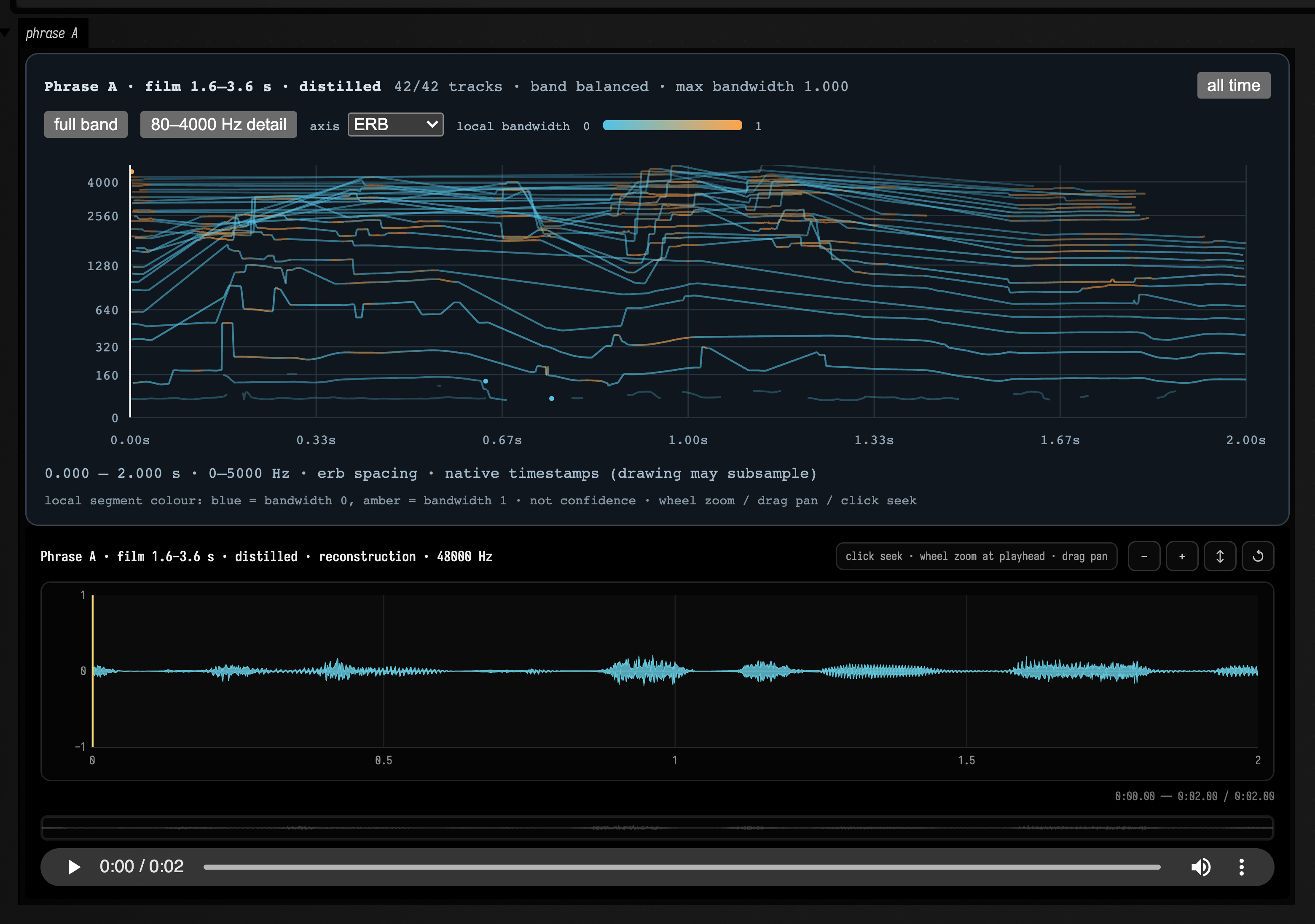
Phrase B, film seconds 11.5–13.5, distilled and dilated so its loudest moment meets A's:
:::static
display("phrase B", LorisDocs.morphPanelHtml(1))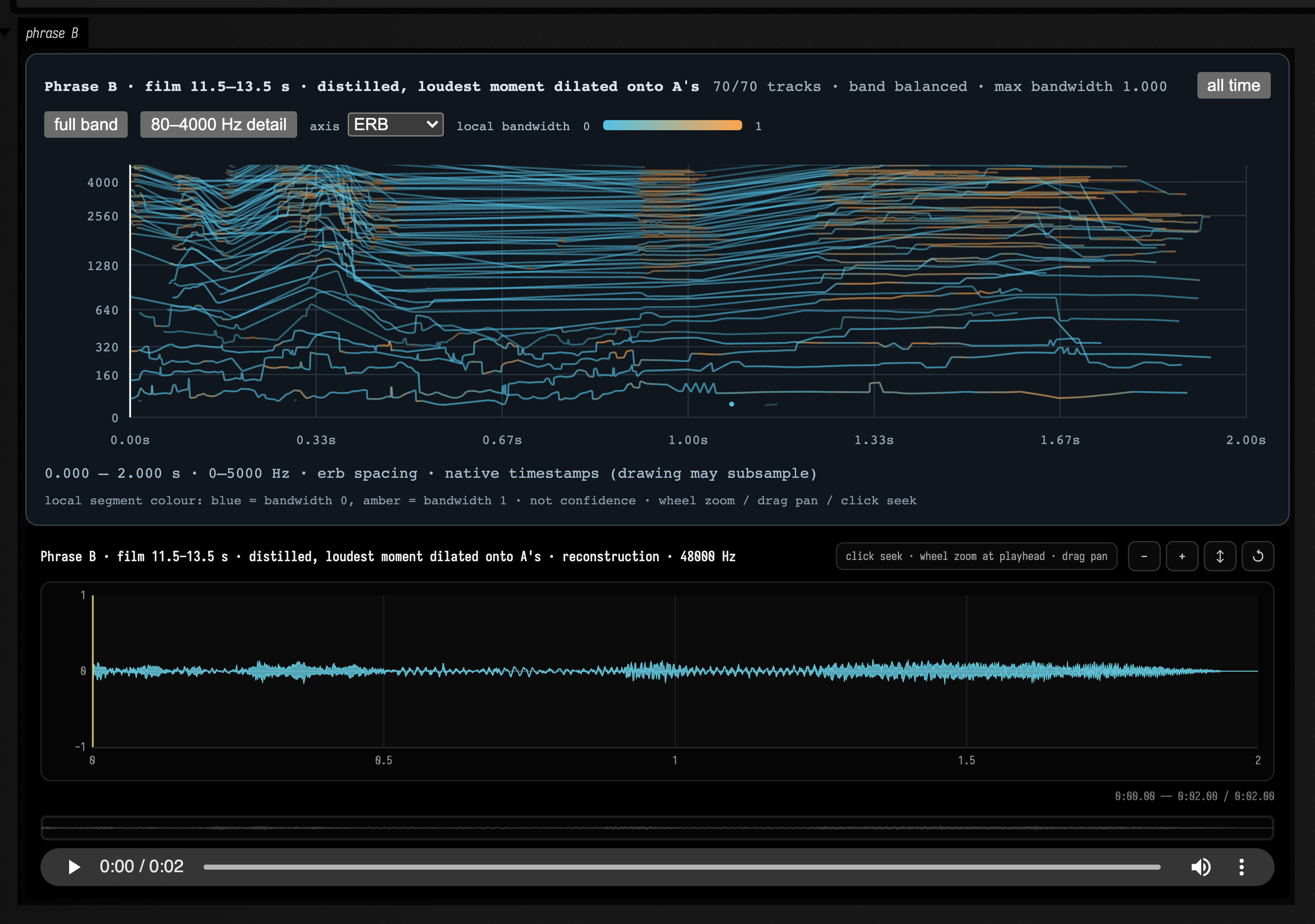
The morph, from A to B between 0.4 and 1.6 seconds:
:::static
display("morph", LorisDocs.morphPanelHtml(2))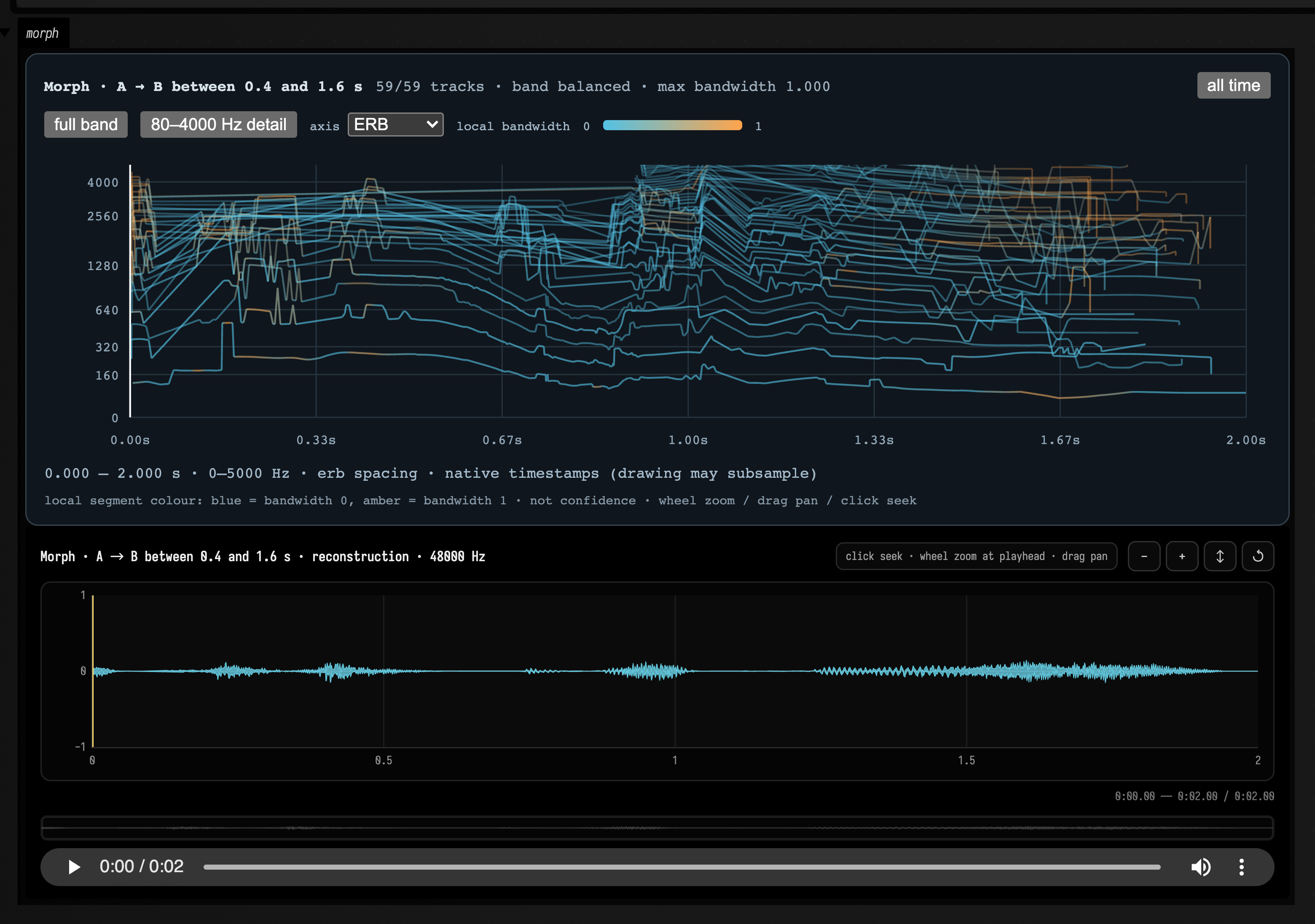
The morph manifest records both ranges, the label counts, the dilation markers, the envelope and the gain applied before writing the file.
To keep the sources' frequencies while their amplitudes cross, give the morph separate envelopes:
client.morph(a, b, frequency = LorisEnvelope.constant(0.0), amplitude = LorisEnvelope.ramp(0.0, 2.0)).
An envelope can have as many breakpoints as you like,
LorisEnvelope(listOf(0.0 to 0.0, 0.8 to 1.0, 1.2 to 0.2, 2.0 to 1.0)), and holds its first and
last values outside them. client.sift(model) is Loris's Sieve: where same-label partials
overlap, it keeps the longest and unlabels the rest.
Edits that stay in Kotlin
These change the breakpoints directly and return a new LorisModel; resynthesize it with
client.synthesize(...):
| Call | What it does |
|---|---|
model.shiftPitch(cents) |
Transposes; also takes a LorisEnvelope of cents for a glide |
model.stretched(factor) |
Scales every time and the timeline |
model.tilt(dbPerOctave, pivotHz) |
Brightens (positive) or darkens (negative) around pivotHz |
model.keepLabels(1..8), model.dropUnlabeled() |
Keeps partials by label, after distill |
model.minimumDuration(seconds), model.minimumPeak(db) |
Drops short or quiet partials |
model.crop(start, end) |
Keeps a time range and moves it to zero |
model.labelCounts() |
How many partials carry each label |
Breakpoints that a transposition or tilt pushes above 0.49 × the sample rate are removed.
A document to explore
The loris_partial_explorer starting point has a box for each step on this page: playing the source, analysis with its status, picking
partials, removing noise, the spectral whirlpool, resynthesis, a fine-time against
fine-frequency comparison, and the label, align and morph pipeline. Each box runs its own analysis, so you can start from any of them.
Setup and caching
Loris is optional, and Field does not build it unless you ask. Build the worker with:
./gradlew buildLorisNative
./gradlew jvmTest --tests 'afield.audio.analysis.loris.LorisTest'
The build needs CMake 3.24+ and a C++17 compiler. It downloads a checksummed, pinned Loris source
archive once and uses the bundled FFT; no FFTW, Python binding, neural model or GPU is needed.
It has been built and run on Linux and macOS (Apple silicon); the Windows build is untested. AFIELD_LORIS_EXECUTABLE
or the JVM property afield.loris.executable selects another built worker.
Each request runs the worker with a timeout and reports its progress in the box that asked.
Results are cached in build/field-loris/cache/ and survive closing the document; the cache is
keyed on the samples, the sample rate, the settings or edited breakpoints, and the worker build,
so any change runs the analysis again. Provenance is available on every result, and the
published example manifest records the source hash, controls and
transformation used for the sounds above. Audio remains at its native source rate; place it on
a 48 kHz project through an explicitly recorded conversion when needed.