How completions are ranked
What makes one completion appear above another? If you're writing a class and want its useful members to show up early, or you're changing Field's completion code, this page explains how the ordering works and how a class can influence it.
The server gathers candidates, and the browser ranks them. The server sends up to 1200 candidates;
its ordering is a last-resort tie-break (see the authority order). The
JavaScript function rankItems in src/commonMain/resources/fieldSuggest.js computes the order
you see.
So if you are reading Kotlin looking for the code that decides what comes first, you will not find it. What Kotlin decides is what each row carries: its category, where it was declared, and its receiver type's own prior. The browser turns those into an order.
The split buys two things. The popup can re-rank on every keystroke without another round trip, and which completions a person has accepted before can weigh on the order without leaving their machine.
One caret, end to end
Take a concrete caret. You have an FLine in hand, you type a ., and you press nothing else —
there is no prefix, no letters to match against. Six steps, in order.
The server answers with everything
For f. on an FLine that is on the order of 250 rows: the class's own members, extension functions
written for FLine, and the extensions that apply to literally every value in Kotlin (also,
apply, let, takeIf). Nothing is dropped. In rankItems the filter step is
!query || Number.isFinite(entry.fuzzy), and with an empty query the left half short-circuits, so at
a bare dot no row is filtered out at all.
Each row says where it was declared
Every candidate carries a declaredIn: a class's fully-qualified name for a member
(afield.geometry.path.FLine), or a package for a top-level extension. This is the field that decides the
row's category, which is the field that decides which section it renders under.
It has to be declaredIn rather than the member's bare name, because bare names collide: in
Field's source tree scale, close and copy are each declared in many categorised files. The
categoriser, KotlinSourceIndex.getCompletionCategoryForSymbol, asks in three steps:
| step | question asked | answer if it hits |
|---|---|---|
| 1 | is Owner.member in the index? |
that declaration's category — including no category, which does not fall through |
| 2 | does declaredIn's package contain a match? |
the vote, scoped to one package instead of the whole tree |
| 3 | declaredIn names something outside this tree |
decline — a namesake here says nothing about java.lang.Math |
The third row has a consequence worth spelling out. A receiver you did not write and cannot
annotate (java.lang.Math, kotlin.collections.List) gets a uniform "no category" for every one
of its members rather than a scatter of borrowed ones. Uniform means they all tie, and when
everything ties the popup falls back to the order the server sent, which for a foreign type is
alphabetical. So a bare dot on a foreign receiver is alphabetical, which is about as much as Field
knows about java.lang.Math.
The receiver's type states its own prior
This is the one input a class author controls. A class can name the members that answer "what do you actually do
with one of these", in the order a person reaches for them, with @CommonMembers. FLine uses
it:
@CommonMembers("moveTo", "lineTo", "cubicTo", "close", "here", "rot", "scale", "copy")
class FLine : HasProperties {
On the completion path, CommonMemberPrior.rankOf(receiverQualifiedName, candidateName) turns that
into a 1-based position, or 0 for "this type said nothing". Resolution:
- by the receiver's qualified name, loaded with
Class.forName; - then breadth-first up superclasses and interfaces, self first — because a receiver is very often typed as an interface, and because a subclass should be able to re-order its parent's list;
- nearest declaration wins, and the first writer of a name keeps its position;
- hits and misses are both cached. This runs per keystroke, and the overwhelmingly common answer is "this type has no annotation".
The qualified name comes from the candidate itself when the Analysis API served the completion. When the
K1 fallback did, no candidate carries one, and the server resolves the caret's receiver itself instead:
the live value's own class, else the declared type, else the constructor called to make it. Otherwise
the prior would be absent for the first ctrl-space after launch (see
the K1 fallback).
The position rides across the wire as Metadata.commonMemberRank.
The browser scores every row
rankItems adds up, per row: how well the text fuzzy-matches what you typed, the category weight,
recency (have you accepted this completion before, and how recently), a nudge for AI suggestions,
a penalty for equals/hashCode/toString in member position, a penalty for declarations that are
too far from the receiver (a name declared on Any is true of everything and therefore says
nothing about the thing in your hand), a server-supplied context boost, the receiver's prior, and
finally a hair of the server's original index so that ties break in the order the server chose.
It keeps the top 80
MAX_VISIBLE_ITEMS is 80. A completion can be in the server's response and still never reach the
screen: one at index 159 of 249 is in the payload and is nowhere in the popup.
Last, it regroups into sections
The rendering step is one line:
orderItemsForGroupedDisplay(rankItems(...).slice(0, MAX_VISIBLE_ITEMS))Read it right to left. Ranking picks the 80 rows. Then orderItemsForGroupedDisplay walks that
ranked list and buckets each row under its category's section title, stably, in first-appearance
order, then returns the buckets concatenated.
So ranking decides three things: which rows survive the cut, the order of the sections (a section appears where its best-ranked member ranked), and the order within a section. It does not decide anything across a section boundary. A row cannot be lifted past a row in an earlier section, no matter what it scored.
Where a row lands
Where a row lands on screen is (which section, then rank within that section). If a completion is much further down than its score should put it, check which section header it ended up under before suspecting the ranking.
Put five of FLine's eight common members into someone else's category and their prior still
works: it lifts each of them to the top of a section nobody is looking at, seventy-odd rows down.
With the same payload and the same ranker, one classification change moves moveTo from off-screen
to first.
Seeing it
The first figure is a ctrl-space on a box containing val f = FLine() and a bare f., with
the popup captured while it is open. It is served by the same Analysis API backend an ordinary
./field.sh session uses.
Provenance
docs_capture_audit --repeat 2 reproduces the popup byte-for-byte, and grades the prior table's
jitter at maxΔ9 on 0.0056 % of pixels. Both figures are otherwise deterministic, so if either
changes materially, something real changed.
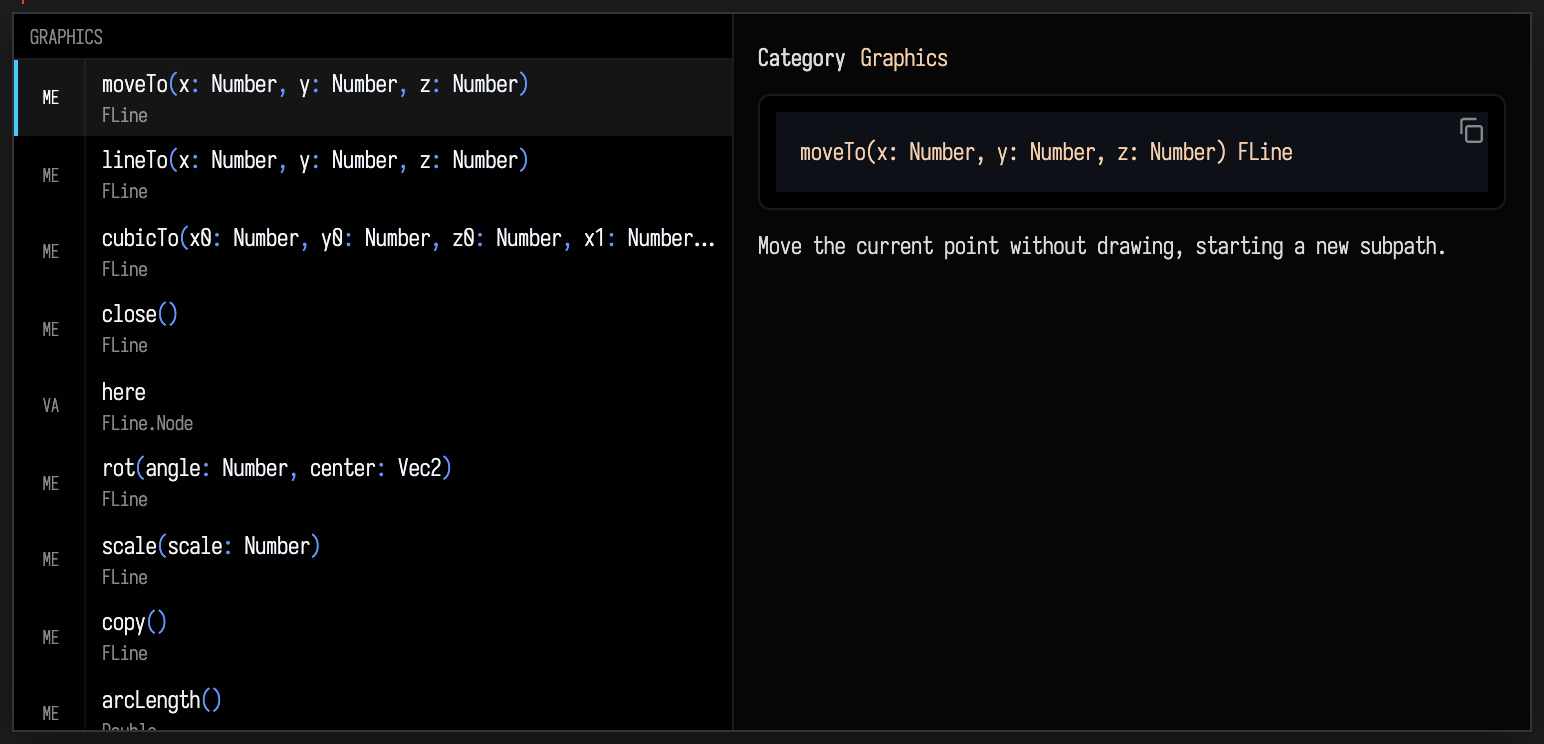
All eight of FLine's @CommonMembers are there, in the order the annotation lists them
(moveTo, lineTo, cubicTo, close, here, rot, scale, copy), and the first member the
class says nothing about, arcLength(), comes ninth. There is one GRAPHICS header: every FLine
member is categorised from where it is declared, so they all land in one section, and inside one
section the prior decides the order.
The K1 fallback
K1 serves every completion until the sidecar's Analysis API session exists, including the first
ctrl-space after launch. CommonMemberPrior keys on the receiver's qualified name and only the
sidecar's reply carries one; a K1 result names no receiver at all, so rankOf(null, "moveTo") would
be 0. The server resolves the caret's own receiver when the backend names none, so the prior applies
on both paths. Two consecutive completions on one caret, from an ordinary session's log:
completion backend=K1 … (AA→K1: empty: session building (warming up; using K1 meanwhile))
completion backend=AA … 1616ms (44 candidates)
On a K1-served f. the server logs completion prior-receiver resolved='afield.geometry.path.FLine',
and the popup renders moveTo, lineTo, cubicTo, close, here, scale, copy — the declared
order, out of the fallback backend.
Asking Field for the prior in numbers
Behind the popup, one f. is a couple of hundred candidates, and eight of them carry a prior. The
next box asks Field what that prior is, by calling afield.runtime.completion.CommonMemberPrior, the object the
completion server calls once per candidate on every keystroke.
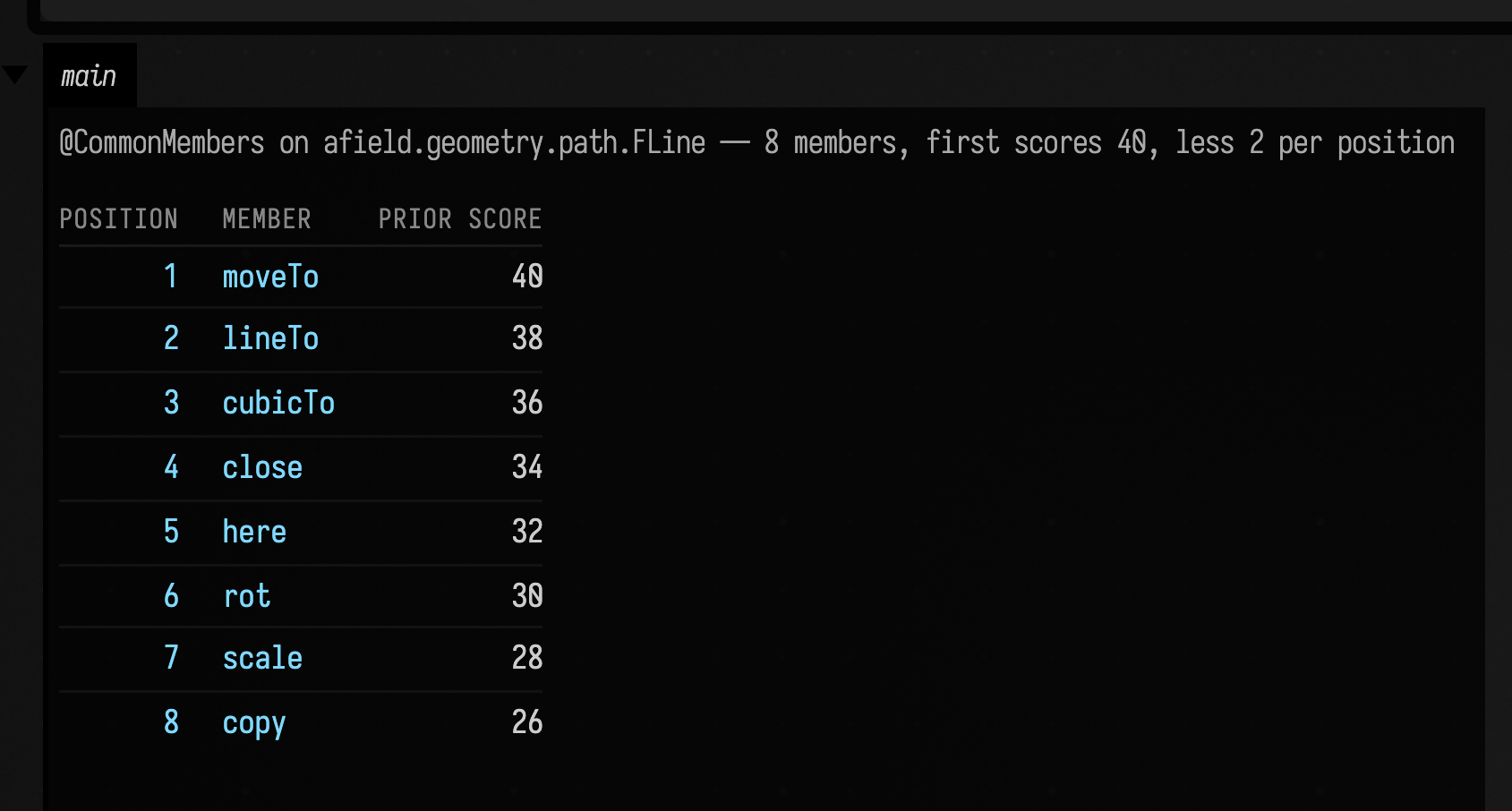
The two calls that table is built from are the whole public surface, and you can point them at your own class:
val ranks =
    afield.runtime.completion.CommonMemberPrior.ranksFor("afield.geometry.path.FLine") // name -> 1-based position
val score = afield.runtime.completion.CommonMemberPrior.scoreOf(ranks["moveTo"] ?: 0) // position -> points
The same box ships as a replayable transcript (popup_prior_inspect on the
agent transcripts page), so you can open it, change the one string, and ask
about a type of your own.
The authority order
Four things can decide an order, and they rank against each other in a fixed precedence:
recency > the author's prior > the category bucket > alphabetical.
| Priority | decided by | beats | because |
|---|---|---|---|
| 1 | recency — what you have actually accepted | everything below | what a person demonstrably does beats anybody's guess about what they will do |
| 2 | the author's prior — @CommonMembers |
bucket, alphabetical | the person who wrote the class knows its first page |
| 3 | the category bucket | alphabetical | a coarse grouping is better than none |
| 4 | the server's order — alphabetical for a foreign type | — | the last resort |
The prior's band is chosen to sit exactly in that gap: above the highest category weight, so a
called-out member clears a page of uncategorised rows, and below what recency can reach, so what
you use still wins over what the author guessed. The numbers are COMMON_MEMBER_BASE = 40 decaying
2 per position, against a category ceiling of 28 and a recency ceiling near 62.
The ordering is the contract and the four literals are its current tuning. The magnitude lives on
both sides of the wire (CommonMemberPrior.BASE/STEP in Kotlin and
COMMON_MEMBER_BASE/COMMON_MEMBER_STEP in JavaScript), and the build asserts the two agree, since
a server that ranks members the client scores differently would be worse than no prior.
The prior also covers a gap recency cannot: recency is localStorage. It is empty for a new user,
empty in a fresh browser profile, and empty in every test, because the harness clears it. So the term
with the most authority is unavailable when a person meets Field for the first time, and unavailable
to any test that wants to assert what the popup should do. A list written in the source is the same
answer in all four cases.
Writing @CommonMembers on your own class
If you write a class in a Field box, or anywhere on Field's classpath, you can give the popup its first page yourself.
import afield.runtime.completion.CommonMembers

@CommonMembers("advance", "reset", "value")
class Ramp {
    fun advance(dt: Double) { … }
    fun advance() { … }
    fun reset() { … }
    val value: Double get() = …
}
A few things to know about it:
Names, not callable references. "moveTo" rather than FLine::moveTo, so that one
entry covers every overload of a name (FLine.moveTo has four), and a property reads exactly the
same as a function. Only the bare name is matched, so a display string like moveTo(v: Vec3) still
resolves.
A typo is a build failure. A name that does not resolve to a member of the annotated class fails the build. The alternative failure is that the name simply stops ranking, with nothing said about it, which is undetectable by inspection.
Order is the claim. Position 1 scores most; each later position sheds a little. Write them in the
order a person reaches for them, not alphabetically. FLine's order follows its own KDoc — build the
path, then move it around.
Keep it short. It is the first page of the manual rather than an index. Past roughly ten entries the order stops being a real claim about what people reach for, and since scoring decays by position a long tail earns almost nothing anyway.
Inheritance is one-directional. A subclass inherits its parent's list, and may re-declare a name
to move it, but CommonMemberPrior.declaredNames, which the guard test checks against the class's
actual members, reads only the class's own annotation. A class is checked against the list it
writes.
Asking the popup to show its reasoning
A rank on its own says the answer moved without saying what moved above it, which is not enough to tell a ranking bug from a ranking decision. The presentation probe dumps the rows a person would actually see, with the two inputs that placed them:
FIELD_RANK_DUMP=14 FIELD_RANK_DUMP_CASE='FLine bare dot' \
  ./gradlew jvmTest --tests "afield.runtime.completion.FieldSuggestPresentationTest"
FIELD_RANK_DUMP=<n> prints the first n visible rows; FIELD_RANK_DUMP_CASE narrows it to one
recorded case (omit it for all of them). Each line gives the visible rank, the label, and the row's
category and commonMemberRank, which is to say the section it will land in and the prior that
placed it inside that section. Those are the two fields that explain essentially every "why is that
so far down" question.
On the FLine case above, that command reports 249 candidates sent and 80 rendered, with the first
eight of them FLine's eight @CommonMembers in declared order:
  case                    sent  visible      rank       was     ms
  FLine bare dot           249       80         1         1   16.1
    -- FLine bare dot: first 14 of 80 visible
       1  moveTo      category="Graphics" commonMemberRank=1
       2  lineTo      category="Graphics" commonMemberRank=2
       3  cubicTo     category="Graphics" commonMemberRank=3
       4  close       category="Graphics" commonMemberRank=4
       5  here        category="Graphics" commonMemberRank=5
       6  rot         category="Graphics" commonMemberRank=6
       7  scale       category="Graphics" commonMemberRank=7
       8  copy        category="Graphics" commonMemberRank=8
       9  breakNext   category="Graphics" commonMemberRank=0
      10  breakNext   category="Graphics" commonMemberRank=0
Ranks 1–8 carry a non-zero commonMemberRank and are in the annotation's order; rank 9 onwards is
commonMemberRank=0 and falls back to the alphabet within the same section. Every row reads
category="Graphics", which is why the prior shows at all (see
Last, it regroups into sections).
The cases it replays are recorded /complete payloads, ranked by fieldSuggest.js itself.
Parameter lists are elided above; ranks, names and categories are verbatim, which is why breakNext
occupies two rows. A function and a property of the same name are two separate completions, and the
popup shows both.
When a row is not where you expect
In rough order of how often each turns out to be the answer:
- It is in another section. Check the header above it. Ranking cannot cross a section boundary.
- The section it landed in was inferred rather than read. On a freshly launched Field the first
request or two are served by K1 while the sidecar builds its session. The prior applies on that
path too, but a K1 result carries no
declaredIn, so its category is guessed from the row's name and type, and a row in the wrong section cannot be lifted out of it. Ask again a second later. Your Field's own log names the backend and the reason on every request:completion backend=AA … (N candidates)orbackend=K1 … (AA→K1: <why>). - Its receiver is a foreign type. A type you did not write has no
@CommonMembersand gets no borrowed category, so a bare dot on it is alphabetical. Type a letter or two; with a prefix, fuzzy matching dominates everything else on this page. - You are past row 80. The popup renders at most 80 rows of however many the server sent.
- Recency is outvoting the prior. That is the intended order. It is also per-browser-profile, which is why a colleague's popup and yours can legitimately disagree.
Where this lives
| what | where |
|---|---|
| the annotation | CommonMembers in src/jvmMain/kotlin/afield/runtime/completion/util_completion.kt |
| resolving it for a receiver | src/jvmMain/kotlin/afield/runtime/completion/CommonMemberPrior.kt |
| naming the receiver when the backend did not | receiverQualifiedNameAtCompletion in KotlinCompletionSupport.kt |
| putting it on the wire | Metadata.commonMemberRank in src/commonMain/kotlin/afield/app/protocol/rpc.kt |
| categorising a candidate | getCompletionCategoryForSymbol in KotlinSourceIndex.kt |
| scoring, sorting, sectioning, rendering | src/commonMain/resources/fieldSuggest.js |
| the guard on listed names | CommonMembersAnnotationTest |
| the guard on rank and presentation | FieldSuggestPresentationTest + src/jvmTest/resources/fieldSuggest/probe.mjs |
| the guard on the prior surviving a K1 result | CompletionPriorReceiverTest |
| the guard on which backend a figure captured | tools/test_docs_runner_completion_backend.py |
| the internals, at length | dev_docs/completion_aa_sidecar.md |