Field on Apple Vision Pro
Work in progress
This is an early snapshot of Field's native visionOS front end. Some pieces are solid and verified; others are half-built and named as such. Expect it to move.
Field's front end and Vulkan renderer talk through a server, so a browser is only one way to use Field. On visionOS, the editor and canvas can float in the room alongside native 3D views and streams from the renderer.
- Docks — the existing Field web UI (editor, canvas, welcome) rendered in
WKWebViews the system composites and drives. HTML stays HTML; we never texture it. - Islands — native RealityKit geometry for the things that want to be genuinely 3D.
- Streams — the GPU renderer's output carried to the headset as native video.
- Poses — one channel running the other way: where the wearer is looking, back up to the Mac, so the renderer can draw the frame the headset is about to show rather than a surface hanging in the room.
All four are scoped projections of the same server-authoritative document, so nothing here forks Field: the visionOS app is a third client alongside the browser, speaking the protocols Field already has.
The web docks also behave as one workspace rather than isolated browser windows: selection follows between a canvas and its floating editor, and canvas-owned panels are routed to the right surface. For example, choosing Show Document History from the editor opens the full-width History panel over the paired canvas instead of covering Monaco.
Trying it
The visionOS app is a standalone Xcode project (visionOS 26 SDK) that points at a running Field server. In short:
- Start a Field server and build/run the visionOS app against it.
- In Field, run a box with
threeLines(myLines, editable = true). - In the headset, open the FLine 3D viewer — it discovers the live view and renders it. Toggle Edit to grab the handles.
- With a head attached,
println(visionPoseLatencyReport())from any box prints the whole chain. With no head attached it prints the same table empty, which is a useful thing to see first.
Native 3D FLine viewer
The first native island: a RealityKit viewer for FLines (Field's line/geometry primitive), the
native equivalent of the in-browser three.js viewer. It subscribes to every live FLine view on the
Field server (the same views you get from threeLines(...) in a box) and renders them fully in 3D.
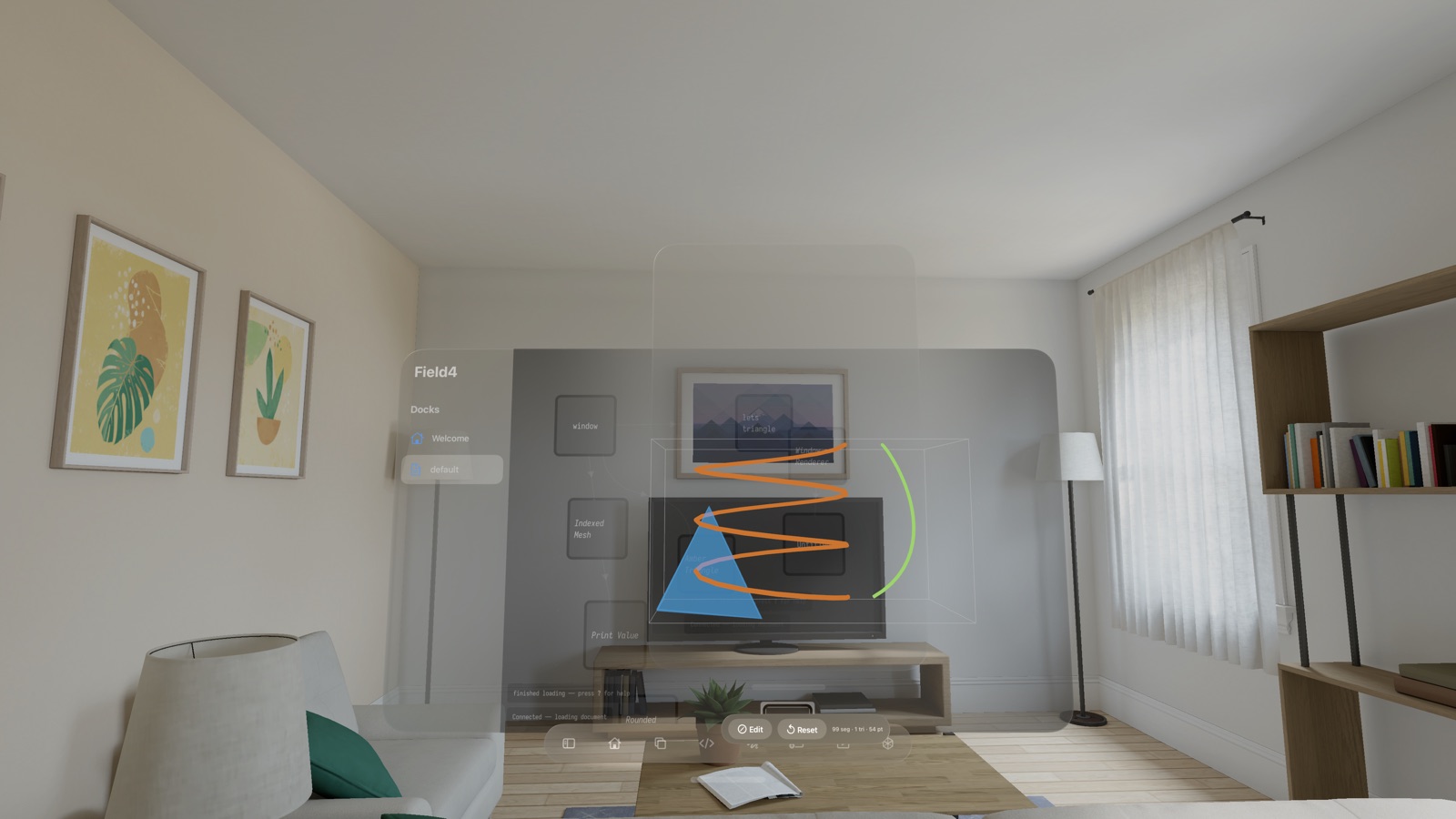 A live
threeLines(...) view in the native viewer: strokes as swept 3D tubes, a translucent filled
triangle, a cubic curve, inside a light wireframe bounding cage.
What it does today:
- Real 3D geometry. Strokes become swept tubes with genuine thickness (the browser viewer draws flat 1px lines), fills become triangle meshes, and nodes become spheres. Colour and transparency come straight from the FLine.
- Manipulation. Drag to orbit, pinch to scale, one tap to reset the framing. The model auto-frames itself into its window when it arrives or changes.
- A bounding cage. A light wireframe cuboid tracks the model as you rotate and scale it, then crossfades to sit upright and window-aligned when you let go — a stable spatial reference frame to read the model against, however far you have tumbled it.
- Interactivity. Tapping an interactive FLine fires its server-side
onClickcallback with the nearest vertex, exactly as the browser viewer does.
Editing
When a view is opened editable (threeLines(..., editable = true)), the viewer becomes a spatial
editor:
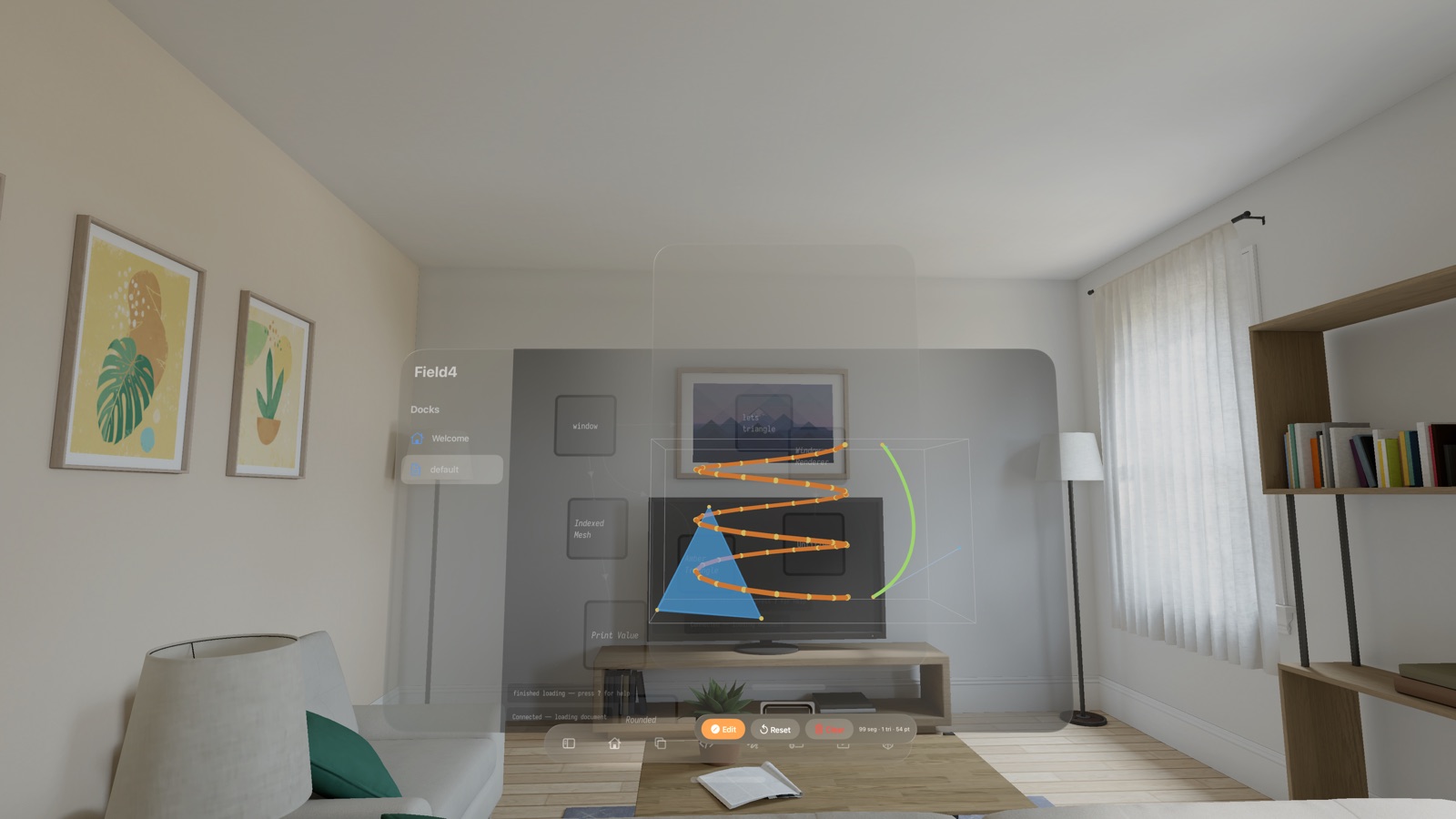 Edit mode. Amber spheres are node anchors; cyan spheres are cubic Bézier control points (with
faint control-polygon lines back to their anchors). Drag any of them to reshape the curve.
- Drag an anchor to move a node; drag a control point to bend a Bézier tangent.
- Edits apply optimistically in the headset and are sent back to the server, so the authoritative FLine stays in sync.
It lives in a movable, resizable volumetric window: grab its bar to reposition it, drag its corners to resize.
Live Metal — programmable native graphics
The second native surface reverses the FLine viewer's bargain. Instead of Field sending geometry to be displayed, the headset runs a program of yours. A box opens a mixed-immersion Compositor Services scene with its own Metal render thread, and you live-code against it.
A program has three explicit parts, in three places:
| Part | Where you write it |
|---|---|
| shader | the box's msl property — Metal Shading Language, both entry points |
| geometry | geometry { … } in the box's Kotlin, which runs in the headset |
| uniforms | the uniforms= list on the box's // {{ visionmetal }} marker |
// {{ visionmetal uniforms=phase,amount,tint }}
onStart {
    geometry {
        color(1.0, 0.35, 0.15)
        cube(0.18, cx = 0.45, cz = -1.2, tintFaces = true)
    }
    uniform("amount", 0.025)
    onFrame { frame -> uniform("phase", frame.time * 3.0) }
}
The Kotlin compiles to JavaScript and runs in a small JavaScriptCore context on the render thread:
not in a web view, and not in the animation path over the network. geometry { … } builds an indexed
triangle mesh in the headset and hands the whole thing to Metal in one call, so nothing per-vertex
crosses the wire at frame rate. Alongside a raw vertex/triangle/quad builder there are cube,
plane, sphere, and tube, which sweeps a polygon along a polyline. The FLine viewer gives a
stroke real thickness the same way. Building geometry in the headset
covers the builder in full, with runnable starting points.
Each part reloads on its own. Editing the shader and pressing Reload MSL recompiles the pipeline
on the headset while your Kotlin, your geometry, and the frame clock all keep running. A failed
compile leaves the last working shader on screen and reports the Metal error back into Field at your
own line number. The shader reads its uniforms by name (u_phase), because the head generates the
#defines from the declared list.
Field's Kotlin side sees MSL as a real language: msl is a box property with its own syntax
highlighting and completion (the ABI structs, the u_NAME uniforms that box declares, and snippets
for both entry points), and it saves beside the box as a .metal file.
The simplest case — one shader, one built-in cube, uniforms on the compositor clock — runs on a physical Vision Pro, and a Kotlin edit reaches a changed image with no perceptible lag. The rest of the three-part structure is exercised in the visionOS simulator rather than on a device, which the status table below says row by row.
Streaming the rendered scene as video
For everything that isn't lines (the full Vulkan-rendered scene), Field streams the render target to the headset as native video. On macOS the Vulkan RTT is backed directly by an IOSurface that VideoToolbox can wrap; on Linux the sender imports an exported Vulkan allocation through CUDA. The encoded HEVC/H.264 access units travel over a small UDP protocol. The visionOS client reassembles and decodes them, converts the decoded NV12 buffer into a RealityKit texture, and presents it on a screen you can place in the room.
This spine is verified end-to-end: Field renders → encodes → streams → the visionOS app reassembles, decodes, and displays it, with correct colour, and it survives the sender restarting. The stream can be shown either on a world-locked "cinema" screen or in an ordinary movable/resizable window.
One half-frame per eye
The capture and encode path produces side-by-side stereo frames, and a Camera Index Switch ShaderGraph material samples the left half of the frame for the left eye and the right half for the right.
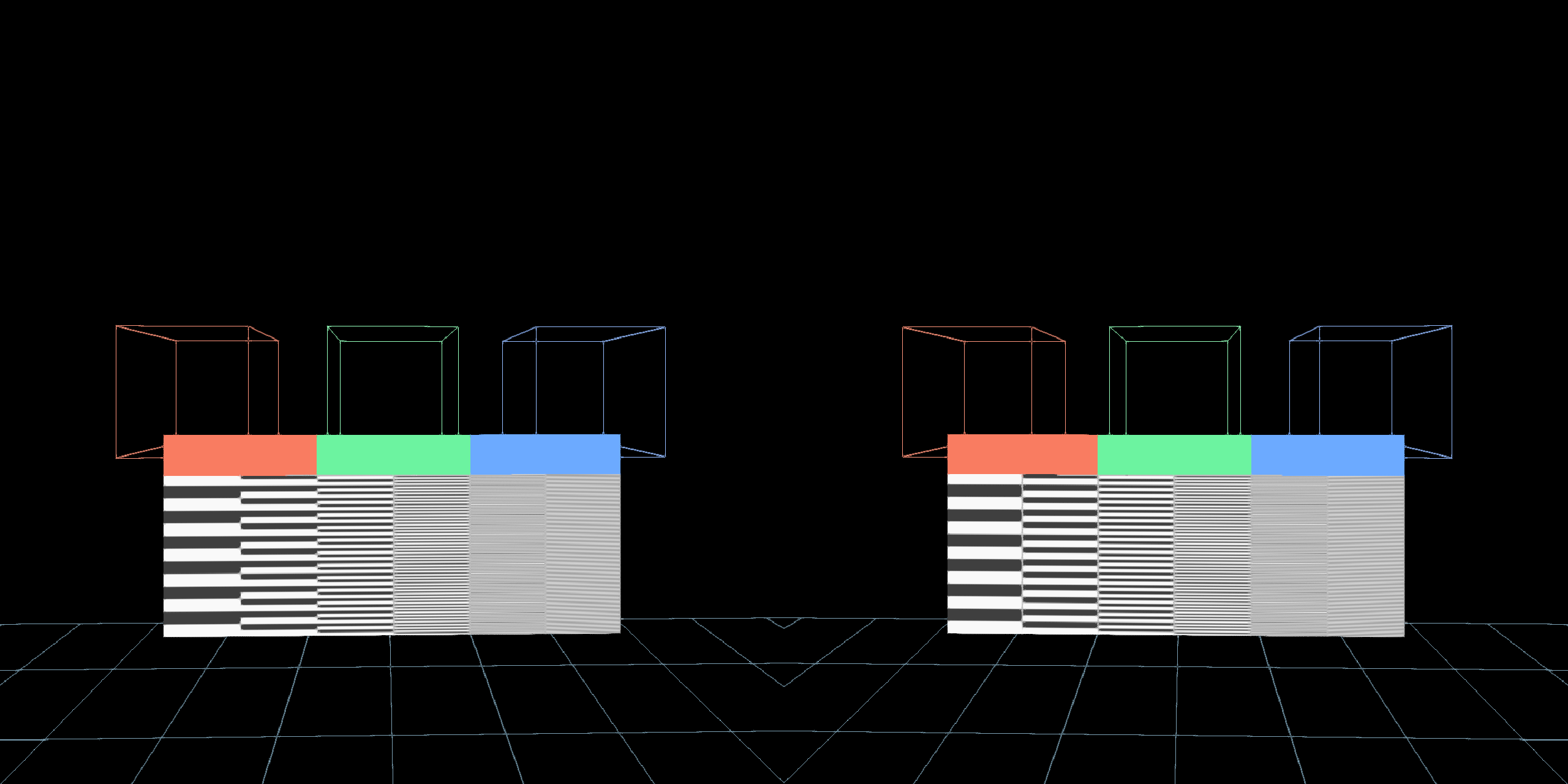
This is what such a frame looks like: the left eye's view in the left half, the right eye's in the right. It is packed by the same SideBySideStereoTarget the sender streams from, and captured from the desktop preview on the stereo RTT composite page.
Confirming that needs a real Vision Pro, because the simulator renders a single mono view: true per-eye separation, the thing that makes stereo stereo, is invisible there. It is confirmed on hardware.
Getting it smooth is a separate problem from getting it correct. The first thing to rule out is Wi-Fi contention from screen-sharing the Mac into the headset. Contention delays datagrams rather than losing them: every in-app counter stays clean while the image does not. Check what else is on the link before you distrust the code.
Three things inside the pipeline decide whether frames land evenly. The frame pacer carries the remainder forward on a late tick; discarding it yields 29.56fps against a 30fps target, which is fatal on a 90Hz display, where 30.00fps is exactly three refreshes and any deficit accumulates into a held frame. The presentation timestamp is derived from the sequence number rather than read off the wall clock at emit time. And the receiver holds a buffer and runs a depth-servoed presentation clock over it, because presenting each frame the moment it arrives is the wrong trade at 90Hz.
Head tracking — the pose comes back up
Everything above runs one way: the RTT stream carries pixels down, __visionmetal__ carries a
program down. On its own a stream can only ever be a surface placed in the room (correct,
stereoscopic, world-locked), because a renderer that does not know the head pose has nothing else
to draw.
__visionpose__ (VisionPose.kt:82) is the one channel in Field that
runs device to host. It is JSON on the same /ws bus the browser uses: a visionpose/hello, then a
visionpose/frame per compositor frame, then a visionpose/bye. A frame carries the head transform,
and each eye's transform and projection, as 16-float column-major arrays, plus the head's predicted
display time in its own clock.
It is sent from the one point in the Compositor Services renderer that already holds both the
drawable and the device anchor (PoseUplink.swift:164),
so the pose that travels is the pose that drawable was rendered from rather than a pose sampled
nearby. The sender is latest-wins and never queues: a pose is only useful while it is the newest
one, and a queue here would turn network jitter into accumulating pose delay.
The hazard here is ordering. Field's /ws reader dispatches each raw message in its own
coroutine, so poses decode concurrently and finish out of order: 9–10% of them, reproduced
across three runs against the simulator (123/1382, 181/1962, 230/2400). Publication is therefore
monotonic under a lock (VisionPose.kt:418). Without
that guard latest walks backwards several times a second, which a wearer experiences as the world
swimming, not as lag.
Rendering from the head's own pose
StereoPoseSource is the third pose source on SideBySideStereoTarget, beside an attached OpenXR
headset and the desktop mock, and it wins over both when set. What makes it a separate interface
rather than one more branch is a single property: a remote pose arrives asynchronously, so it has to
be latched (StereoPoseSource.kt:36) once per frame, before both eye
passes.
Read it per eye instead and the head moves between the left and right pass. The failure does not present as latency; it presents as the two eyes disagreeing, which is close to impossible to recognise from inside a headset. You feel unwell without being able to say why.
Three more decisions in this path:
- The projection is rebuilt, not forwarded. The head's matrix carries its own compositor's
near/far and depth range; Field's pipelines want
Options.zNear/zFarover a 0..1 range. So only the convention-free part crosses over: the frustum tangents (VisionPose.kt:545), from which Field builds its own matrix. The view matrix is forwarded untouched, because the wire already carries world-to-eye. - Losing tracking freezes the view rather than snapping it to the origin. A frozen image reads as "tracking dropped"; a snap to the origin reads as a broken scene.
- The target records which pose it drew from (
StereoPoseSource.kt:39,StereoPoseSource.kt:45), which is what the next section needs.
Tracked accessories (a PSVR2 Sense controller) ride the same message as the pose, so input and
the image it acts on describe one instant, and they report into the same ControllerState the OpenXR
path already fills. Field's interaction code cannot tell which backend it is running on.
Not verified, and not claimed: no controller has ever been read. AccessoryTrackingProvider
reports isSupported as false on the simulator, so the button and axis mapping is a best guess that
degrades to "not pressed". That is a device-only item and it is open.
Carrying the pose back down: media wire v2
For the head to reproject a frame it has received, it must know which pose that frame was drawn
from. The media header therefore carries a 16-byte pose tail: poseFrameId and
poseDisplayTimeNanos (WIRE_FORMAT.md:57), gated by a POSE_VALID flag
rather than a sentinel, because compositor frame index 0 is perfectly legitimate.
FieldRTTStreamer.tagPosesFrom (FieldRTTStreamer.kt:106) wires a stereo
target's latched pose into the stream, on the tick that rendered the surface rather than in the
deferred submit block where a newer pose could silently substitute itself.
ptsMicros looks like the obvious home for such a timestamp and is not one: it is stamped on the
ideal cadence grid (seq * interval) precisely so the receiver has something regular to schedule
against. A real clock reading there would bake render-tick quantisation into the stream, and a
receiver pacing off it would faithfully reproduce that irregularity. poseDisplayTimeNanos is in
the head's clock, not the sender's, because the head is the only consumer; it hands the value
straight back to queryDeviceAnchor(atTimestamp:).
Versions 1 and 2 are both permanent. The macOS sender emits v2 because its head is a Vision Pro reporting its pose back up; the Linux/NVENC sender emits v1 because its host tracks locally through OpenXR and has nothing to put in the tail. A receiver parses both, keyed on the version byte.
Nothing on the head consumes the pose tail yet. Frames carry it and the receiver parses it, but reprojection needs the present path moved off RealityKit onto Compositor Services. That is the same change the next section is waiting for, and it has not been made.
Where the latency goes
Before optimising any of this there is one call to make
(VisionPose.kt:666):
println(visionPoseLatencyReport())The point is attribution rather than a single number, because the plausible explanations for "it feels laggy" are spread across two machines and at least two of the stages are meant to be there. Folding them into one total invites someone to "fix" them.
The headline figure needs no clock agreement at all: a pose's predictedDisplayTime is in the
head's clock, the media wire carries it back down as poseDisplayTimeNanos, and the device
subtracts two of its own timestamps. The ping/pong clock offset
(VisionPoseLatency.kt:147) exists only to split the remainder into our side
and theirs, and it keeps the minimum-RTT sample, because averaging round trips on a contended
link estimates the contention, not the offset.
Read the spans, not the total. Two of them are costs Field chooses to pay:
- the receiver's jitter buffer holds frames, so that network jitter becomes smoothness
instead of dropped frames — it reports as
head: jitter buffer hold (deliberate)(RTTStream.swift:77; setFIELD4_RTT_BUFFER=0for the unbuffered comparison); submit to encodedincludes the render fence (VisionPoseLatency.kt:60), which puts scene complexity there rather than somewhere misleading.
And the limit. The last moment observable on the device is the decoded frame reaching the
display texture; actual presentation is up to one refresh later, and RealityKit exposes no hook for
it. So the motion-to-photon figure is a lower bound, and says so in its own name
(PoseLatency.swift:32 is spelled
head: POSE to texture (motion-to-photon lower bound)). That closes when the present path moves to
Compositor Services, the same change reprojection needs.
Here is the report with no headset attached:
heads attached = 0
latest pose = null
vision pose/stream latency
  clock offset UNKNOWN — no pong yet; host/device spans cannot be compared
  --- this machine ---
  pose uplink transit                    (no samples)
  pose age when latched                  (no samples)
  latch to frame submit                  (no samples)
  submit to encoded (incl. render fence) (no samples)
  --- the head ---
  (no report from the head yet)
  note: the head's last observable moment is the texture upload, so any motion-to-photon figure above is short by up to one compositor frame.
The four spans this machine can time on its own clock are named in that table whether or not they hold samples. "No pong yet" therefore stays distinguishable from "the offset is zero", and the lower-bound caveat is printed by the code rather than remembered by a reader.
No span on this page has ever been measured against real hardware. The visionpose.latency
smoke drives a synthetic head with a known clock offset and known one-way delays, so what it checks
is the arithmetic: that a device-reported span survives the wire intact, that a negative span is
dropped rather than counted as zero, and that the offset estimator recovers an offset it was never
told — a wrong offset does not fail, it produces a plausible latency. The head defines
five spans of its own and that smoke exercises two of them; on the
visionOS simulator the device's spans stay empty regardless, because there is no video stream there
to time. Its populated readout, and which of those figures are written in rather than measured, are
in dev_docs/VISION_LATENCY_MEASUREMENTS.md.
Hand tracking — on OpenXR, and read by the pointer layer
XR_EXT_hand_tracking on the OpenXR path gives 26 per-joint poses per hand and a
geometric pinchStrength interpolated from thumb-tip to index-tip distance, 50 mm to 10 mm
(OpenXRHmdTarget.kt:349). Confirmed against WiVRn on a Quest 3.
It is not part of the visionOS story at all: on visionOS hands remain a separate concept and are
not implemented, and StereoPoseSource carries controllers, not hands.
The pointer layer reads it. pinchPointer (pointing_pointer.kt:226) turns a
HandTrackingState into a ray plus a select value, and OpenXRHmdTarget.handPointer
(pointing_pointer.kt:294) binds it to
handState(hand) directly, so a pinched hand drives the same picking layer as a mouse or a
controller. Two cautions. The ray's default convention (wrist through pinch point) has no
in-tree precedent; pass eye for gaze-through-pinch instead, which is the better convention
wherever a head pose is available. And because every test constructs the HandTrackingState the
function expects, the binding to a real device is untested: the arithmetic and the
tracking-loss branches are pinned, not that a Quest or an Index fills those fields the way the code
assumes.
Eye tracking on OpenXR
OpenXRHmdTarget enables two optional eye extensions independently when the runtime advertises
them and the current system reports support:
eyeGazeState()usesXR_EXT_eye_gaze_interactionfor combined gaze. It returns null when unavailable or not yet initialized. Otherwise checkposeValidbefore readingpositionandorientation, andisTrackedwhen nominal tracking quality is needed.direction(out)copies the forward ray direction into aVec3and returns false when the pose is invalid.htcEyeState()usesXR_HTC_eye_trackerfor separateleftandrightobservations. Each eye hasgazeValid,position,orientation,pupilDiameterValid,pupilDiameter,pupilPositionValid,pupilPosition,geometricValid,eyeOpenness,eyeWide, andeyeSqueeze. Check the corresponding validity flag for each observation; a failed pupil query does not discard a valid gaze or eye geometry query.
Gaze poses use the same OpenXR LOCAL reference space as the controllers: metres, +Y up, with -Z
as the pose's forward direction. HTC pupil diameter is in millimetres; pupil position uses
normalized sensor coordinates, +X right and +Y up. EXT sampleTime and HTC gazeTime,
pupilTime, and geometricTime are OpenXR timestamps in nanoseconds, not wall-clock times.
The EXT timestamp may differ from the requested predicted display time, and zero means no
sample time is available.
These are live state objects updated on the renderer's queue thread. Read them in render callbacks, copy values you need to retain, and always check validity: numeric values retain their last valid observation. Skipped frames, lost focus, and cleanup invalidate observations. Neither extension is required for VR, and neither API synthesizes data from the other.
Hardware verification is pending. The native-memory tests cover pose conventions, HTC's inline arrays and field ordering, independent validity, and stale-state clearing. A synthetic runtime also exercises the actual native calls, input structures, timestamps, unsupported-system handling, partial-initialization cleanup, and independent query failures. These tests do not establish that a particular headset/runtime supplies these streams. These bindings are separate from the visionOS pose uplink and do not add eye data to that protocol.
For a headset check, start a normal OpenXR scene and look for EXT eye gaze interaction enabled
and/or HTC eye tracker enabled in the OpenXR log. Inspect the state in the scene's render
callback: confirm valid gaze follows eye movement with the head stationary, check HTC's pupil
and geometry validity independently, then check that observations invalidate when the session
loses focus and recover when focus returns. Run the automated binding checks with
./gradlew jvmTest --tests 'afield.graphics.vulkan.targets.OpenXREye*Test'.
The combined-gaze contract follows the Khronos extension specification. HTC's native structures follow its published bindings.
Status
The third column says how each state is known: on a device, in the simulator, or by a test.
| Capability | State | How that is known |
|---|---|---|
| Native 3D FLine viewer — render, orbit/scale, auto-frame, bounding cage | Working | On device |
| FLine interactivity (tap → server callback) | Working | On device |
| FLine editing — node + Bézier control-point drag | Working | On device |
| Web UI as spatial docks (editor / canvas / welcome) | Working | On device |
| Shared dock selection + editor-to-canvas History panel routing | Working | Browser regression tests |
| Live Metal — live shader + uniforms on the compositor clock | Working | On device |
Live Metal — headset-built geometry, per-part reload, msl as a property |
Built and smoke-tested | Simulator script asserts on the head's own status messages; device check pending |
| RTT video streaming (mono), world-locked + windowed | Working | Verified end-to-end on device |
| RTT stereo (per-eye present) | Working | Confirmed on device — the simulator renders one mono view and cannot judge it |
| Frame pacing + receiver presentation clock | Fixed | On device; the residual hiccup was Wi-Fi contention, not the pipeline |
Pose uplink __visionpose__ (device → host) |
Working | visionpose.uplink pins the wire decode and composition; vision_pose_simulator_smoke.sh takes it end to end in the simulator |
| Head-tracked stereo rendering from an uplinked pose | Built, arithmetic verified | visionpose.stereo-source checks the rebuilt frustum geometrically. Real head motion and true per-eye separation are device-only and unverified |
Media wire v2 pose tail (poseFrameId, poseDisplayTimeNanos) |
Working | tools/rtt_wire_check.py drives the real helper and reads real datagrams |
| Reprojection on the head from the pose tail | Not built | Needs the present path moved off RealityKit onto Compositor Services |
Latency attribution — visionPoseLatencyReport() |
Built, arithmetic verified | visionpose.latency recovers a known offset from a synthetic head. No span has ever been measured against real hardware |
| Tracked accessories (PSVR2 Sense) over the pose channel | Written, never read | AccessoryTrackingProvider.isSupported is false on the simulator; the button/axis mapping is a guess that degrades to "not pressed" |
Hand tracking (26 joints, pinchStrength) |
OpenXR only; read by the pointer layer | WiVRn + Quest 3. pinchPointer consumes handState, tested against constructed hand states only and never a device. Nothing on visionOS |
Three of those rows lean on smoke tests that run without a headset, and they are named in the reference below so you can run them yourself.
The screenshots on this page are from the visionOS simulator, which can't drive spatial gestures and throttles the immersive scene. Spatial-input feel and video smoothness are best judged on real hardware. They remain the active on-device verification items, alongside real head motion, true per-eye separation, controller input, and every latency span on this page.
Reference — where this lives
The pose path runs across two machines, so the table lists the Swift files on the headset beside the Kotlin on the Mac.
Agents: how this table is kept current
The table is cross-checked against source on every docsGates run, so a rename breaks the build.
How the list is derived, and the two things that sit outside every census it draws on, are in
dev_docs/vision_frontend.md.
| What | Where | Anchor |
|---|---|---|
| The device→host channel name | VisionPose.kt:82 |
const val VISION_POSE_CHANNEL |
| The newest-pose holder, and its counters | VisionPose.kt:273 |
object VisionPoseStream |
| Monotonic publication under a lock | VisionPose.kt:418 |
private fun publish(frame: VisionPoseFrame) |
| Frustum tangents out of the compositor's projection | VisionPose.kt:545 |
internal fun tangentsFromProjection |
| The one call to make on device | VisionPose.kt:666 |
fun visionPoseLatencyReport( |
| Clock-offset conversion, head → host | VisionPoseLatency.kt:147 |
fun headToHostNanos |
| The span that includes the render fence | VisionPoseLatency.kt:60 |
const val SUBMIT_TO_ENCODED |
| Latch-once-per-frame contract | StereoPoseSource.kt:36 |
fun latch(): Boolean |
| Which pose a frame was drawn from | StereoPoseSource.kt:39 |
val latchedFrameId: Long |
| The head's own display time for that pose | StereoPoseSource.kt:45 |
val latchedDisplayTime: Double |
| The implementation over the pose stream | VisionPoseStereoSource.kt:33 |
class VisionPoseStereoSource |
| Poses latched twice because none arrived | VisionPoseStereoSource.kt:45 |
var staleLatchCount |
| The target this plugs into | SideBySideStereoTarget.kt:41 |
class SideBySideStereoTarget |
| Where a remote pose overrides OpenXR and the mock | SideBySideStereoTarget.kt:96 |
var poseSource |
| What the target recorded it drew from | SideBySideStereoTarget.kt:105 |
var renderedPoseFrameId |
| …and that pose's display time | SideBySideStereoTarget.kt:109 |
var renderedPoseDisplayTime |
| OpenXR/browser multiview target, without a remote pose source | MultiviewStereoTarget.kt |
class MultiviewStereoTarget |
| The desktop mock a remote pose replaces | SideBySideStereoTarget.kt:883 |
class StereoCamera |
| …and the eye separation it invents | SideBySideStereoTarget.kt:884 |
var ipd |
| Tagging a stream's frames with the latched pose | FieldRTTStreamer.kt:106 |
fun tagPosesFrom |
| The pair a frame carries, or neither | FieldRTTStreamer.kt:341 |
class StreamPose |
| Hand tracking on the OpenXR path | OpenXRHmdTarget.kt:349 |
fun handState(hand: Hand) |
| …the per-hand state it returns | OpenXRHmdTarget.kt:218 |
class HandTrackingState |
| …and the 26 joints it is keyed by | OpenXRHmdTarget.kt:208 |
class HandJoint |
| Spatial audio driven off the stereo target | SimpleSpatialAudio.kt:638 |
fun setListenerFromSideBySide |
| The pose tail in the media header | WIRE_FORMAT.md:57 |
poseDisplayTimeNanos u64 |
| Where the pose is captured on the head | PoseUplink.swift:164 |
func record(drawable: LayerRenderer.Drawable |
| The lower-bound span, named as one | PoseLatency.swift:32 |
static let poseToTexture |
| The buffer the receiver holds frames in | RTTStream.swift:77 |
static let bufferFrames |
| The one clock all three Swift files share | CompositorClock.swift:16 |
var timeInterval: TimeInterval |
| The uplink sender on the head | PoseUplink.swift:18 |
class PoseUplink |
| Where ARKit and GameController are joined | ControllerTracker.swift:21 |
class ControllerTracker |
| The header parser, both versions | RTTWireFormat.swift:14 |
enum RTTWire |
| The parser's only execution coverage | RTTWireSelfCheck.swift:21 |
enum RTTWireSelfCheck |
Runnable without a headset, through the canonical runner
(python3 tools/run_field_tests.py --id <id>):
visionpose.uplink— the wire decode, the world-to-eye composition and the tangent extraction against hand-computed values. This is the half a headset cannot check for you: a transposed matrix or a swapped eye reads as "the world is wrong somehow" and looks perfectly correct in a screenshot.visionpose.stereo-source— the rebuilt frustum, checked geometrically: a point on each frustum edge must land on the matching clip boundary and the near plane at NDC z 0. Comparing matrix entries against a literal would pass just as happily with the depth range inverted, which renders a plausible image with the wrong things in front.visionpose.latency— recovers a known clock offset from a synthetic head, and pins that a congested sample cannot displace a clean one. A wrong offset yields a plausible latency rather than a failure, so nothing downstream would notice it.
Those three are the pose tests. Four more carry the same visionos tag and cover the Live Metal half:
visionmetal.kotlinjs-externals (the Kotlin→JS geometry externals), visionmetal.msl-language (the
MSL editor language, driven under Node), vision.geometry-preview (the CPU preview gallery), and
remotejs.kotlinjs-head-profiles. Run them the same way.
Two things none of them reach: tools/rtt_wire_check.py covers the real datagram bytes but not the
head, and tools/vision_pose_simulator_smoke.sh reaches a real compositor pose in the visionOS
simulator but the simulator reports one view where hardware reports two.
The architecture note behind this page, with the decisions and the full verification map, is
dev_docs/vision_frontend.md. See also Building geometry in the
headset, Kotlin in the head, RemoteJS and
WebXR for the browser-based sibling, ImGui as a VR
panel for the same side-by-side stereo path on the desktop, and
Field 4 Graphics for FieldRTTStreamer, the producer half of the
streaming spine.