Particles, welded, and traced
Drape a simulated sheet over a sphere, replace its connections with rods, and weld those rods into one solid. You can then count the holes in the lattice and render it with the path tracer. The simulation supplies the shape; Field's Boolean kernel joins the overlapping pieces.
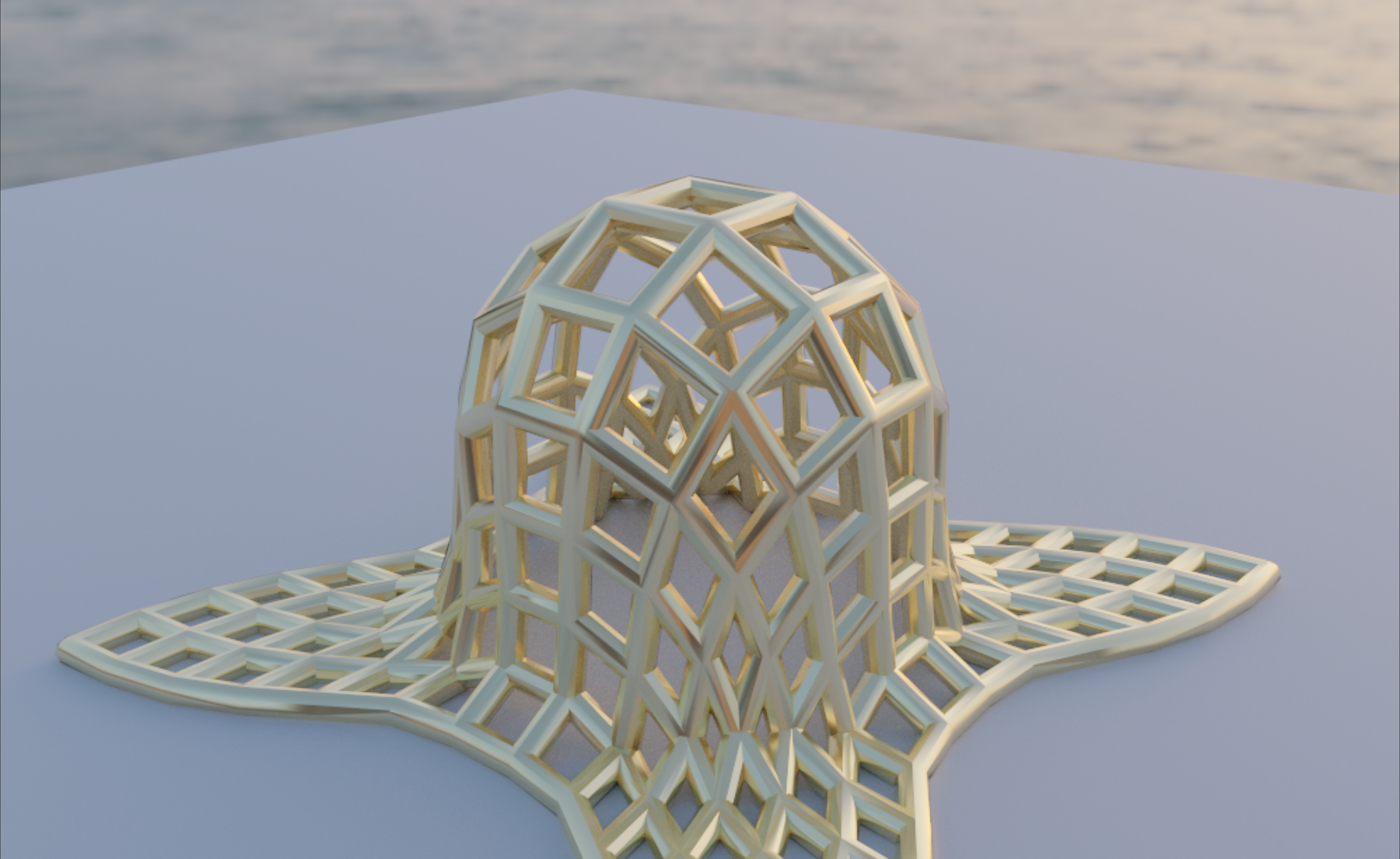
The sphere supporting the sheet is a SphereCollider: it shapes the drape by projecting positions
after the solver runs, but contributes no geometry to the render.
The document that makes this figure is a starting point: physics_manifold_path_trace.
From the cloth to the tracer
afield.simulation.physics runs the simulation, afield.geometry.solid.manifold welds the rods,
and afield.graphics.scene.fabricated traces them. We read positions from the cloth with
cloth.position(col, row) and pass the welded solid to the scene as a TriMesh.
val sim = SimdVerlet(SimdVerlet.State3.empty())
val cloth = sim.addCloth(
    width = side,
    height = side,
    spacing = spacing,
    stiffness = 60f,
    curvatureStrength = 20f,
    position = { c, r -> vec((c - (side - 1) * 0.5f) * spacing, 0f, (r - (side - 1) * 0.5f) * spacing) },
    pinned = { _, _ -> false },
)
val world = sim.addColliders(
    SphereCollider(0f, -0.78f, 0f, radius = 0.52f).also {
        it.friction = 0.8f
        it.margin = 0.01f
    },
    PlaneCollider(0f, 1f, 0f, offset = -1.28f).also { it.friction = 0.9f },
)
repeat(settleFrames) { cloth.step(dt = 1f / 60f, damping = 0.99f, gravity = -9.8f, iterations = 16) }
A capsule is the hull of two balls
To make a rod between two points, put a ball at each end and take their convex hull. The result is
a capsule, and Solid.hullOf computes it without any orientation arithmetic:
val rods = struts.map { (a, b) ->
    Solid.hullOf(
        Solid.sphere(rod, segments = 10).translated(a.first, a.second, a.third),
        Solid.sphere(rod, segments = 10).translated(b.first, b.second, b.third),
    )
}
val welded = Solid.union(rods).checked("cloth net")
Solid.union(list) takes the whole list. Folding - or + over it would nest n − 1 Booleans and
give Manifold no chance to plan; the batch call lets it build the tree itself. The box prints how
long the union took.
segments = 10 on each ball is a budget decision. A hull of two ten-segment spheres is a few dozen
triangles, and several hundred of those unioned is a mesh in the tens of thousands, which the tracer
builds a BVH over without noticing. Twenty segments would be four times that for a rod whose radius
is a thirtieth of the frame.
Genus against the sheet's quad count
For an n × n sheet the distance constraints run along the grid, so there are 2n(n − 1) of them, and the grid graph has (n − 1)² independent cycles. Every cycle is a hole through the welded solid. So the genus of the union has to equal the sheet's quad count, and the box compares the two for you:
println(
    "genus $netGenus against $quads quads in the sheet; " +
        if (netGenus == quads) "they agree, so no two rods have been welded by contact"
        else "they differ by ${quads - netGenus}, so that many cycles have been closed by folds touching",
)
The two can legitimately differ. A drape tight enough for one fold to touch
another welds two rods that were not neighbours, closes a cycle, and drops the genus. Raise
settleFrames or shrink the collider until the sheet crumples and the message changes.
Field's own isWatertight() and genus() read the returned mesh's indices, and Manifold's genus
reads its own half-edge structure. The two share no code, so if they disagree, suspect the conversion
between Field's mesh and Manifold's.
Degenerate triangles at the bridge
The hull of two balls has a fan of triangles where the two hemispheres meet, and a union of several
hundred of them leaves some of those with no area at all. PathTraceScene.triangle rejects a
zero-area triangle outright, which would lose the whole scene. importTriMesh skips them and reports
how many:
val added = scene.importTriMesh(shaded, metal)
println("${added.triangleCount} triangles appended, ${added.degenerateCount} dropped")
Watch that second number when you change an earlier stage. If it goes up, that stage has started producing slivers.
Where each piece is documented
- Particles, Cloth & Constraints for the solver: the force-based constraint pass, why
stiffness × iterationsis the number that matters, colliders as position projections, tearing and wind. - Solids & Booleans (Manifold) for the Boolean layer,
hullOf, batching and the status model. - Progressive Path Tracing for the tracer.
- A polytope, cut open, and traced is the same last two hops with a Conway operator chain at the front instead of a simulation.