Function domains
Every Fn in the Functions small language carries one interval: its domain, the stretch of the number line the function is meant to be looked at over. A hannWindow() is shaped across 0.0..1.0 and is silent outside it. A ramp rises across the interval you give it. An oscillator goes on forever.
Domains matter because arithmetic intersects them. Add two functions and the sum is only defined where both operands are defined, so an operand carrying the wrong domain narrows every expression it enters.
What a domain is
A Domain is a closed interval min..max, with a few well-known values:
Domain.DEFAULT // 0.0..1.0 — the everyday unit interval (also Domain.UNIT)
Domain.ALL // (-inf, +inf) — genuinely unbounded
Domain.EMPTY // nothing; length 0, contains no point
Domain.point(x) // a single point, min == max
Unless a constructor says otherwise, a fresh Fn starts at Domain.DEFAULT. You set the construction interval with domain = ..., relabel or place an existing function with over (...), and declare "this really is unbounded" with / all.
You rarely read a domain out by hand. It decides where a curve is drawn, where a sampler walks, and what is left of a sum.
Domains intersect under arithmetic
When you combine two functions, the result is defined on the intersection of their domains:
val a = ramp(0.0, 1.0, domain = 0.0..2.0) // defined on 0..2
val b = hannWindow(1.0..3.0) // defined on 1..3
val c = a + b // defined on 1..2  (the overlap)
Numbers are the exception. A literal like 0.6, or any argument passed as a Number, becomes a constant Fn whose domain is Domain.ALL. Intersecting with ALL changes nothing, so scaling and offsetting never accidentally narrow a function:
val d = hannWindow(1.0..3.0) * 0.6 + 0.2 // still defined on 1..3So a bare literal never narrows anything, while an explicit finite domain, or a genuinely finite-domain operand like a window, still constrains the result.
Why oscillators are unbounded
An oscillator is defined on all of ℝ. sin() has a value at x = -100 and at x = 1000; nothing about it is confined to 0.0..1.0. So sin, cos, saw, triangle, square, pulseTrain, impulseTrain and pulseBurst all default domain to Domain.ALL.
Give one a finite domain instead and it clamps every expression it enters:
// Old behavior — the trap.
val rising = identity(0.0..3.0) * 0.6 // a slow rise across 0..3
val tone = sin(2.0) // used to carry domain 0..1
val stack = tone + rising // 0..1  ∩  0..3  ==  0..1  (!)

// Plot `stack` over 0..3 and it just stops a third of the way across.
The rising term is defined across 0.0..3.0 and the oscillator cuts two-thirds of it off.
With the default Domain.ALL, the oscillator contributes nothing to the intersection, so the expression takes its extent from the finite terms:
// New behavior.
val rising = identity(0.0..3.0) * 0.6
val tone = sin(2.0) // Domain.ALL
val stack = tone + rising // ALL ∩ 0..3  ==  0..3  ✔

// Plot `stack` over 0..3 and the oscillation rides the ramp the whole way.
The picture below runs both versions on one box, plotted over the same 0.0..3.0 window. The only difference between them is the oscillator's domain:
:::static
with(Functions) {
    // A gentle rise defined across the whole 0..3 window.
    val rising = identity(0.0..3.0) * 0.6

    // BEFORE: an oscillator pinned to the old 0..1 default. The sum's domain
    // is 0..1 ∩ 0..3 == 0..1, so plotting over 0..3 stops at x = 1.
    val before = sin(frequency = 2.0, domain = 0.0..1.0) + rising

    // AFTER: today's default — sin() is Domain.ALL. The sum's domain is
    // ALL ∩ 0..3 == 0..3, so the oscillation rides the ramp the whole way.
    val after = sin(frequency = 2.0) + rising

    before.plot(
        "before",
        domain(0.0..3.0),
        title = "BEFORE — sin(domain = 0..1) + rising  → clamped to 0..1",
        yDomain = domain((-1.2)..2.6),
        heightPx = 170,
    )
    after.plot(
        "after",
        domain(0.0..3.0),
        title = "AFTER — sin() is Domain.ALL + rising  → full 0..3",
        yDomain = domain((-1.2)..2.6),
        heightPx = 170,
    )
}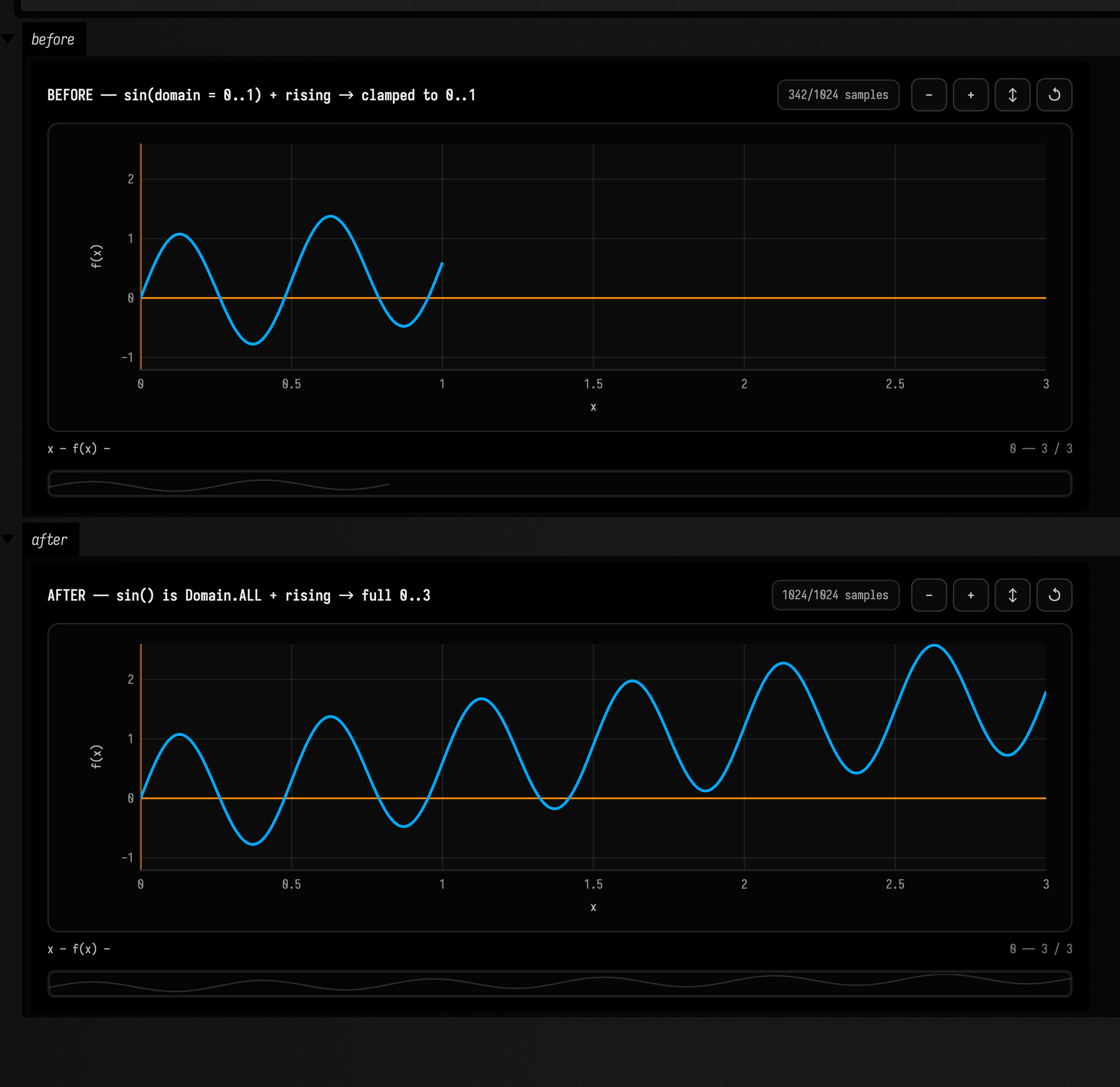
The top curve gives out at x = 1; the bottom one carries across the whole window.
If you want a bounded oscillator, a burst that lives on a finite interval, say so with domain = ... or over (...), and intersection does the rest.
Safe to enumerate: finiteSweep() and plotSafe()
You cannot walk an infinite interval at a fixed sample count, so wherever an implicit domain becomes actual samples it goes through Domain.finiteSweep():
- a finite domain (including a single point) passes through unchanged;
- an empty domain passes through unchanged;
- an unbounded domain previews over
plotSafe()'s finite fallback window.
So a bounded function samples over exactly the interval you would expect, while an ALL-domain oscillator handed no explicit window previews over a sensible finite range instead of hanging. Every sampler that falls back on the function's own domain does this (toDoubleArray, toVec2List, toFLine, the sample* family, the streams, and repeat/mirrorRepeat/tile), and so do the shapers that map a domain onto 0..1 (tween, spliceWindow, the window family). Windowing an unbounded oscillator therefore gives a finite shape.
Give a plot or sampler an explicit window when you have one, and rely on the fallback only for a quick look:
with(Functions) {
    sin(3.0)
        .plot(
            "tone",
            domain(0.0..2.0),
            title = "sin(3.0) with domain(0.0..2.0): exactly 0..2",
            heightPx = 150,
        ) // explicit window
    sin(3.0)
        .plot(
            "fallback",
            title = "sin(3.0) with no window: the plotSafe() fallback",
            heightPx = 150,
        ) // previews the fallback
}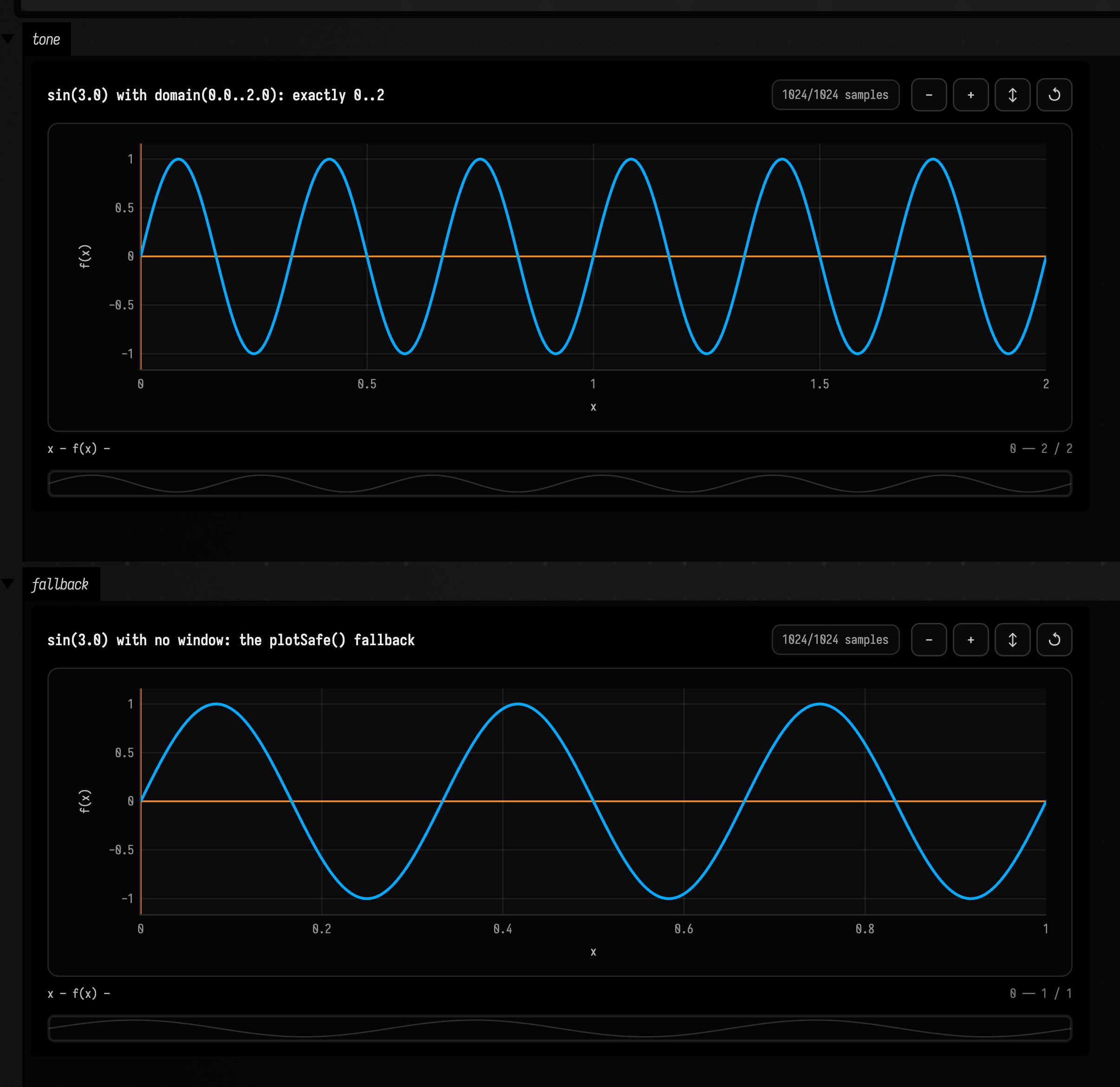
The explicit window samples 0..2; with no window the same oscillator previews over 0..1.
Serialization keeps the declared domain
Graph serialization and rebuild keep the original domain, unbounded or not, so it is part of a function's fingerprint and survives a round-trip unchanged by whatever window last previewed it.
The exception: gaussian stays local
Not every generator is periodic. gaussian is a localized bump: it has meaningful value near its center and falls away to nothing on either side. Its useful shape is local, so it keeps Domain.DEFAULT:
val bump = gaussian() // Domain.DEFAULT — a local feature, not a signal
val wave = sin() // Domain.ALL — genuinely everywhere
Plotted over the same explicit window, the product stops where the bump does:
with(Functions) {
    val bump = gaussian() // Domain.DEFAULT
    val wave = sin(3.0) // Domain.ALL
    val window = domain((-1.0)..2.0)

    bump.plot("bump", window, title = "gaussian(): stops at the edge of its own domain", heightPx = 130)
    wave.plot("wave", window, title = "sin(3.0): Domain.ALL, fills the window", heightPx = 130)
    (bump * wave).plot(
        "product",
        window,
        title = "gaussian() * sin(3.0): the intersection, clipped to the bump",
        heightPx = 130,
    )
}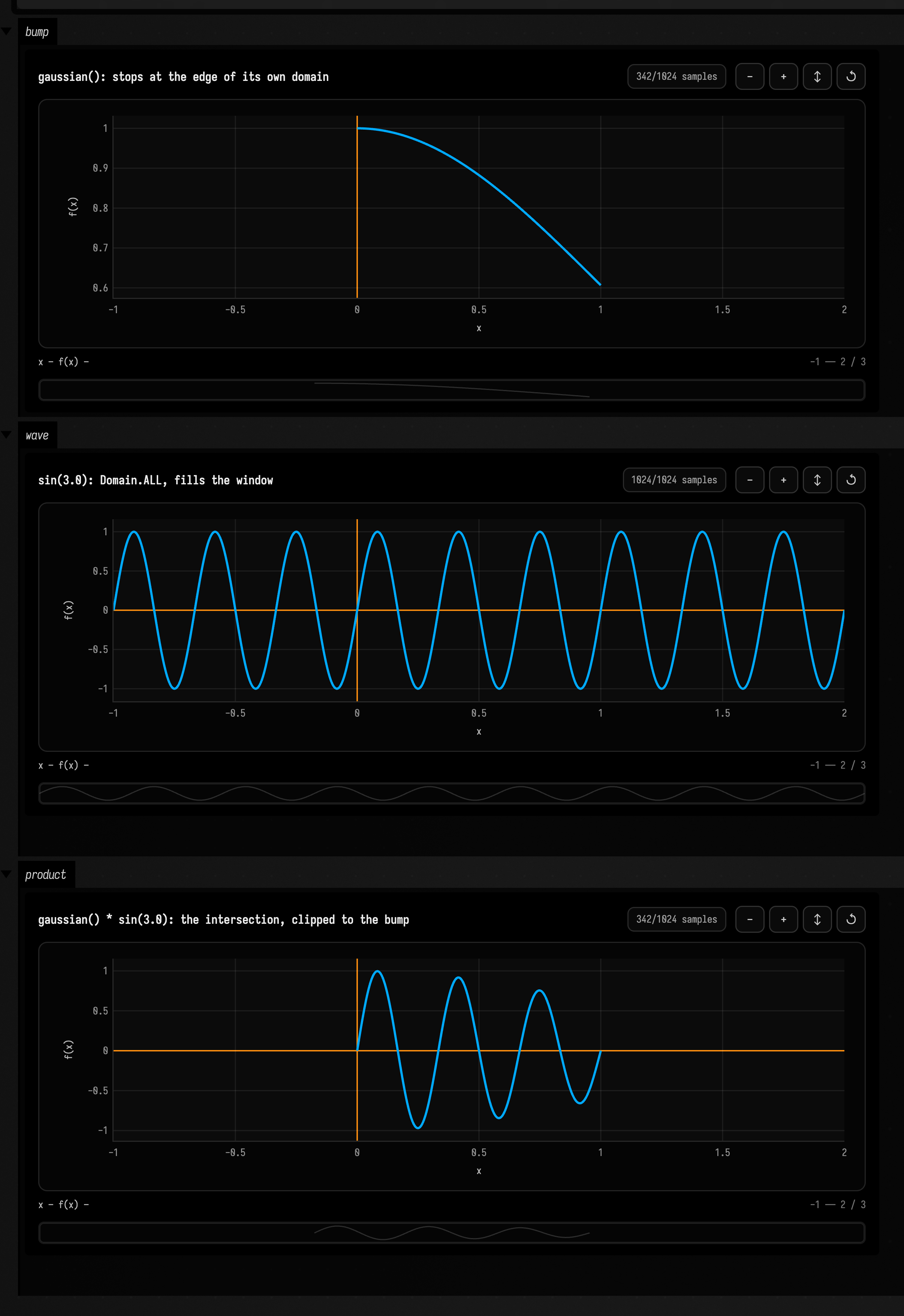
The question a constructor has to answer is whether its function is defined everywhere or only somewhere. A signal that oscillates forever answers everywhere and takes Domain.ALL. A shape that lives in a region, a window or a bump or a ramp, answers somewhere and carries a finite domain, which constrains any expression it enters.
The short rules
- A
Fn'sdomainis where it is meant to be looked at; arithmetic intersects operand domains. - Oscillators (
sin/cos/saw/triangle/square,pulseTrain/impulseTrain/pulseBurst) default toDomain.ALL, so they do not clamp the expressions they enter. - Numeric params carry
Domain.ALL, so literals never narrow a domain; explicit finite domains and finite-domain operands still do. - Unbounded domains are safe to enumerate:
finiteSweep()previews them over a finite window, while finite/point/empty domains pass through untouched. gaussiankeepsDomain.DEFAULT: it is local, not periodic.
See also the Functions examples page, whose Domains and timeline composition section covers domain = ... versus over, stretch, and the timeline helpers in more depth.
The public declarations used on this page are listed, with their KDoc, in the codebase reference: Functions.kt. Start from what's already in the box.