Landing on main
Field is developed by several people and many agents at once, each working in a separate
worktree on a topic branch. None of them merge into main themselves. Instead they hand the
branch to tools/land.py, which keeps one queue per clone and has a single process, the
lander, put branches onto main one at a time.
:::static
uv run python tools/land.py enqueue
That queues the current branch at its current commit and returns immediately. You can go back to
work; the lander will merge it, regenerate the generated artifacts, run the full guard once, and
fast-forward main, or bounce it back with a reason. Because only the lander writes to main,
branches never race each other to land, and nobody has to wait for their own landing.
Watching it
:::static
uv run python tools/land.py status --watch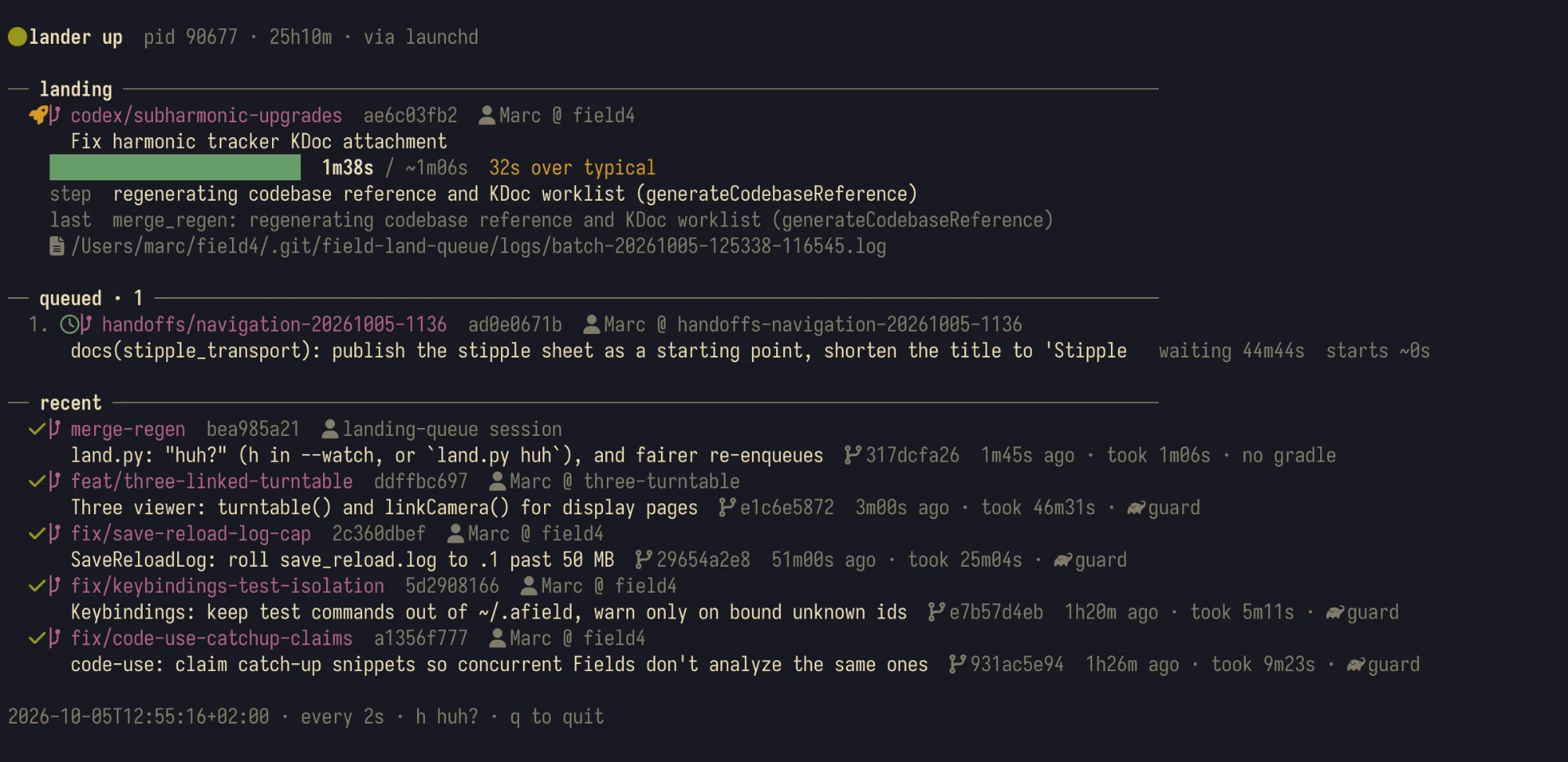
The top line says whether the lander is running (here under launchd, up for 25 hours). Below
it are three sections:
- landing: the item in progress, with its branch, commit, who queued it, and its commit
subject. The bar compares elapsed time with how long landings typically take, so a branch that
goes past that is easy to spot ("32s over typical").
stepis what the lander is doing now andlastis the newest line in its log, whose path is printed below. - queued: what is waiting, oldest first, with an estimate of when each starts.
- recent: what has landed (✓) or bounced, with the
Land ...commit onmain, how long it took, and which guard ran: the full Gradleguard, orno gradlewhen nothing the guard cares about changed.
Press h to ask what is going on, which sends the queue's state and logs to the agent and
prints the answer (land.py huh does the same from the command line, and huh --context shows
what it would send without asking). Press q to quit.
The commands
| command | what it does |
|---|---|
enqueue [branch] [--note "..."] [--push] |
queue a branch at its current commit; --push pushes main to origin once it lands |
status [id] [--watch] |
the queue, or one item (exit 0 landed, 1 bounced, 3 pending) |
wait <id> |
block until the item lands (exit 0) or bounces (exit 1) |
mine [branch] |
every attempt to land this branch, newest first |
sync [--push] |
fetch origin/main and land it through the queue |
huh [--context] |
ask the agent what the queue is doing |
run [--once] |
the lander itself; one per clone |
An agent that needs the outcome runs wait as a background command rather than polling
status. Someone returning to a branch after a while runs mine to see what happened to it.
What the lander does
For each round the lander:
- resets its own worktree to
main(it never touches yours); - skips any item whose commit is already on
main; - runs
tools/merge_regen.pyon the commit, which merges it, regenerates the committed generated artifacts on the merged tree (see Building & Testing), runs the guard once, and commitsLand <branch> (<who>); - fast-forwards
mainto that commit, starting over ifmainmoved in the meantime; - on a red guard, gives the fixer one chance; otherwise bounces the item with the
reason and log path and leaves
mainalone.
It takes up to eight of the oldest items per round, merges each as its own commit, and runs one regeneration and one guard for all of them. If the round fails, it splits the batch in half and retries from the oldest until the branch responsible bounces on its own. A branch that conflicts only with another branch in the same batch waits for a later round instead of bouncing.
The commit is fixed when you enqueue. Later commits on the branch are not landed until you enqueue again, and re-enqueueing keeps the branch's place in the queue.
The fixer
Many bounces are small slips: a count nobody updated, a citation pointing at a function that moved, a KDoc above the wrong declaration. When a round goes red, the lander hands the failure to the agent before it bounces anything, so a slip like that can be fixed without sending the branch back and halving the batch to find it.
The fixer works in the lander's own worktree, on the exact tree that failed, with the build still warm. It decides whether the failure is a mechanical slip that one branch plainly made. If it is, it makes the smallest edit that fixes it and re-runs just the check that failed. If the failure is about behaviour, timing, or design, it declines and says why, and that diagnosis goes into the bounce.
An edit is only accepted if it stays small (at most 6 files and 60 lines), deletes nothing, does
not switch a test off, and leaves alone what decides whether a change is acceptable: the registers
of accepted test failures, the guard scripts, the git hooks, the Gradle build, and the lander
itself. The lander, not the fixer, commits it, as a commit by Field lander fixer on top of the
culprit's own commit, on a new branch fixup/<branch>. The culprit's branch is never moved, since
it is usually checked out in someone's worktree. If the edit does not apply to that branch on its
own, it was not that branch's slip alone, and the round falls back to bisecting.
Then the whole round goes again with the full guard, which is what decides whether it lands. Each
item gets one attempt. The Land ... commit on main records the fixup, and mine tells the
branch's owner about it, with the command to take it: git merge fixup/<branch>.
Every attempt, fixed, declined or rejected, is a line in fixer.jsonl in the queue directory, and
the most recent ones go back into the fixer's prompt. FIELD_LAND_FIXER=off in the lander's
environment turns the fixer off, and FIELD_LAND_FIXER_MIN changes its time limit.
Which agent
The fixer, huh and bouncy run Claude Code (claude -p) unless you choose Codex CLI
(codex exec). The docs revision pass and its terminals on /docs-pass.html use the same
choice. Set it for one shell with an environment variable:
:::static
export FIELD_AGENT=codex
or for the whole machine, which also reaches a lander started by launchd that never sees your
shell's environment:
:::static
echo codex > ~/.afield/agent
The environment variable wins over the file, and with neither set the agent is claude. Any other
name is ignored. The file is read each time an agent starts, so changing it needs no restart.
To fix a bounce yourself, fix the branch, commit, and enqueue again. To bring main into your
branch while you work, use tools/merge_regen.py main, which regenerates generated files
instead of making you hand-merge them.
Where the queue lives
The queue is plain JSON files in the clone's common git directory
(.git/field-land-queue/), so every worktree of the clone sees the same queue, and the batch
logs live next to it under logs/. The full reference is uv run python tools/land.py --help.