Lengths in Millimetres and Inches
Use Length when a dimension needs to carry its unit. 12.7.mm, 0.5.inch, 4.ft and 3.m
are all lengths: you can add and compare them, then read the result in the unit you need. Draw a
part in inches and send its dimensions to a machine that wants millimetres without scattering
* 25.4 or / 12 through your code.
Start a box with this import to use lengths:
:::static
import afield.math.units.length.*
Writing a length
Put the unit after the number: .mm, .cm, .m, .inch, .ft or .yd. It is .inch rather
than .in because in is a Kotlin keyword. A length prints in millimetres, and .mm, .cm,
.m, .inches, .feet and .yards read it back as a plain Double.
This sets up the stock and parts for a laser-cut run, mixing inches and millimetres:
:::static
import afield.math.units.length.*

val stock = 2.ft
val part = 3.5.inch
val kerf = 0.15.mm

println(part)

println(part.inches)

println(stock.formatFeetInches())

println(stock.mm)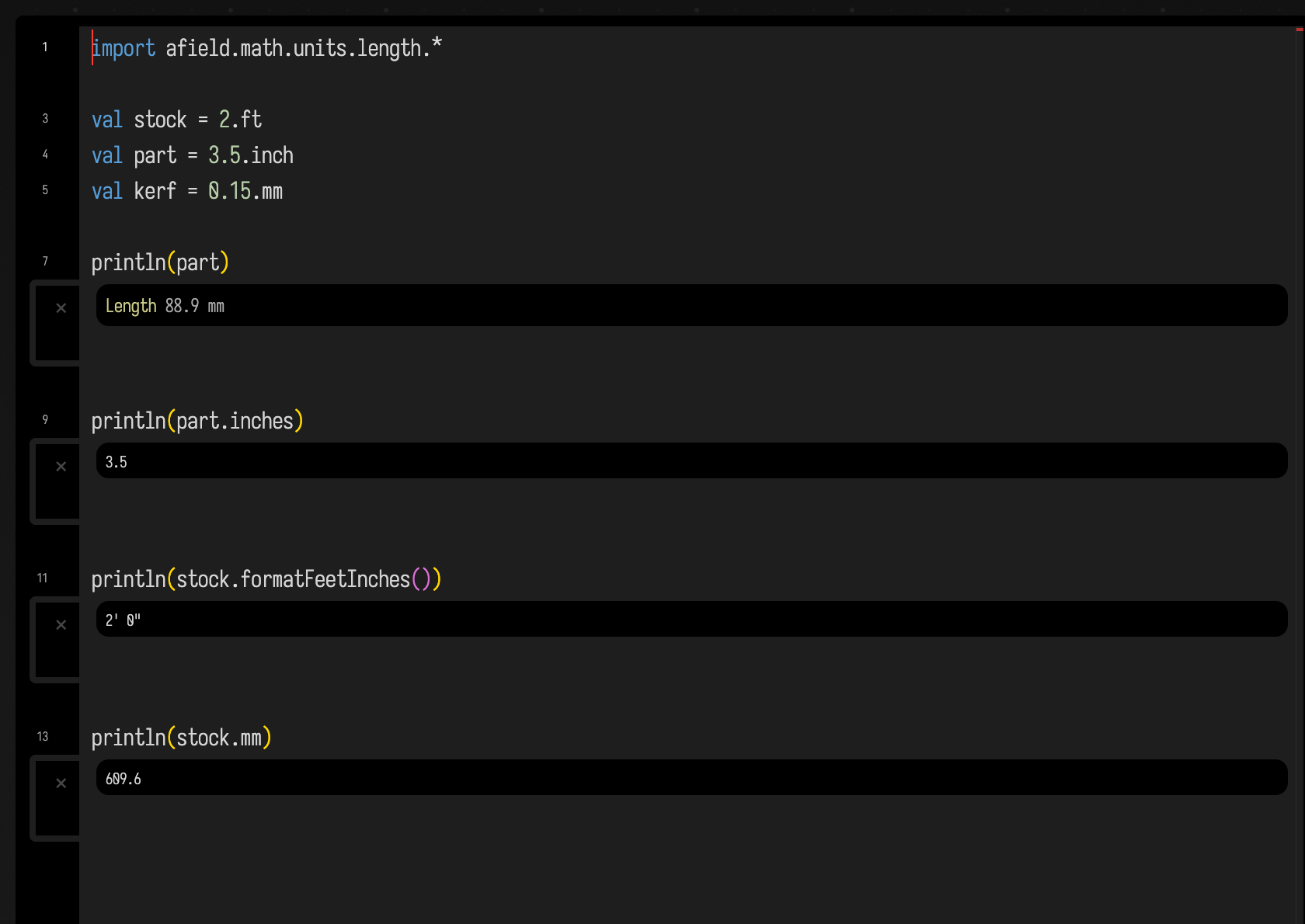
Every conversion is exact where the decimal you wrote allows it. An inch is exactly 25.4 mm, so
12.inch == 1.ft, 0.5.inch == 12.7.mm and 1.234.m == 1234.mm are all true, and 3.inch.inches
is 3.0, not the 2.9999999999999996 that multiplying and dividing by 25.4 gives.
Arithmetic
Lengths add and subtract, scale by a number (part * 3, 3 * part, part / 2), and compare with
< and >. Dividing one length by another gives a plain number: how many of the second fit in
the first. abs, min, max and sum() work as they do for numbers.
This works out how many parts fit across the stock, leaving a kerf's width between each:
:::static
import afield.math.units.length.*

val stock = 2.ft
val part = 3.5.inch
val kerf = 0.15.mm

val across = ((stock + kerf) / (part + kerf)).toInt()
val leftover = stock - (part + kerf) * across + kerf
println("$across parts, ${leftover.formatInches()} left over")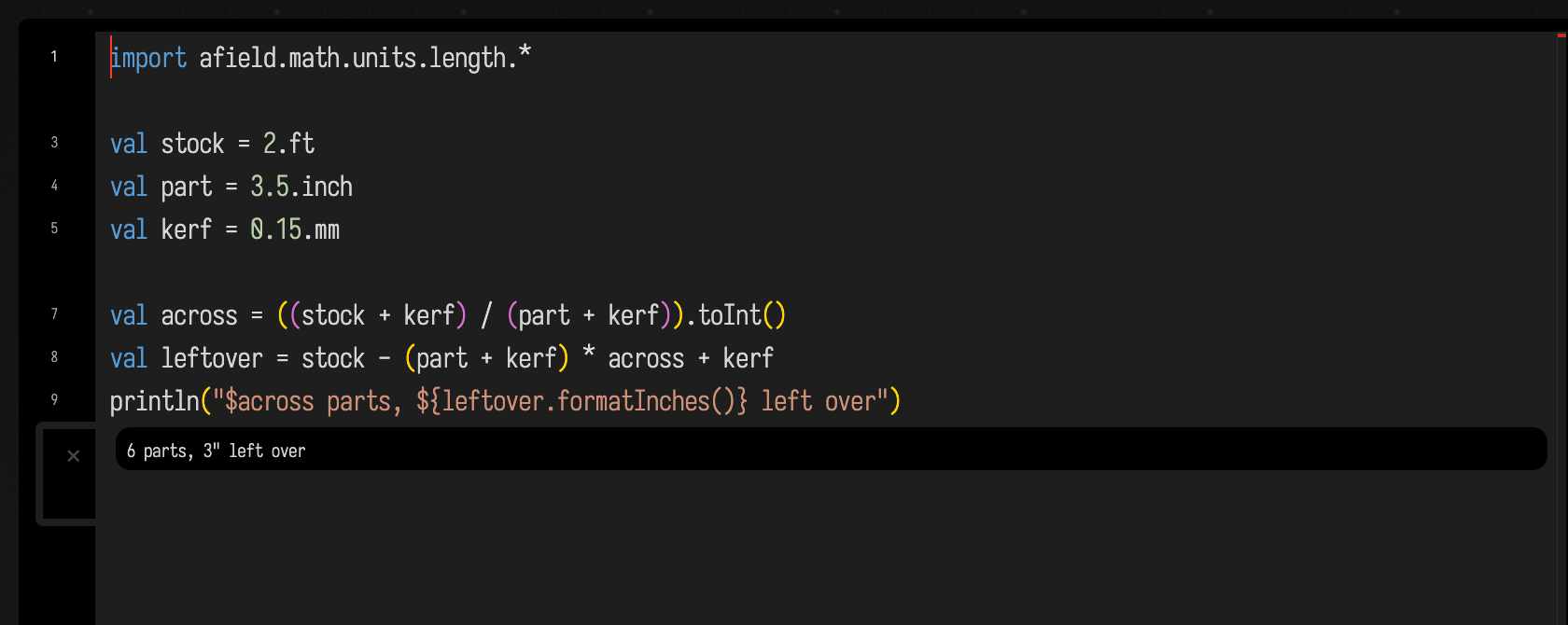
Compare results with near, not ==
Arithmetic on lengths is Double arithmetic, so it rounds in the last digit the way doubles
do: 0.1.mm + 0.2.mm == 0.3.mm is false. a.near(b) is true when the two are within a
millionth of a millimetre, and a.near(b, 0.01.mm) takes the tolerance you want.
Drawing with lengths
An FLine takes plain numbers, so read a length out in the unit your drawing uses as you pass it
in. This plate is specified in inches and drawn in millimetres: a 3 1/2" by 2" rectangle with four
1/4" holes, each 3/8" in from the corners.
:::static
import afield.math.units.length.*

val w = 3.5.inch
val h = 2.inch
val inset = 0.375.inch
val hole = 0.25.inch

val plate = FLine().rect(0, 0, w.mm, h.mm)
val holes = listOf(inset, w - inset).flatMap { x ->
    listOf(inset, h - inset).map { y -> FLine().circle(x.mm, y.mm, (hole / 2).mm) }
}
println("${w.mm} x ${h.mm} mm")
lines(listOf(plate) + holes, w = 360.0, h = 220.0, fitToSize = true)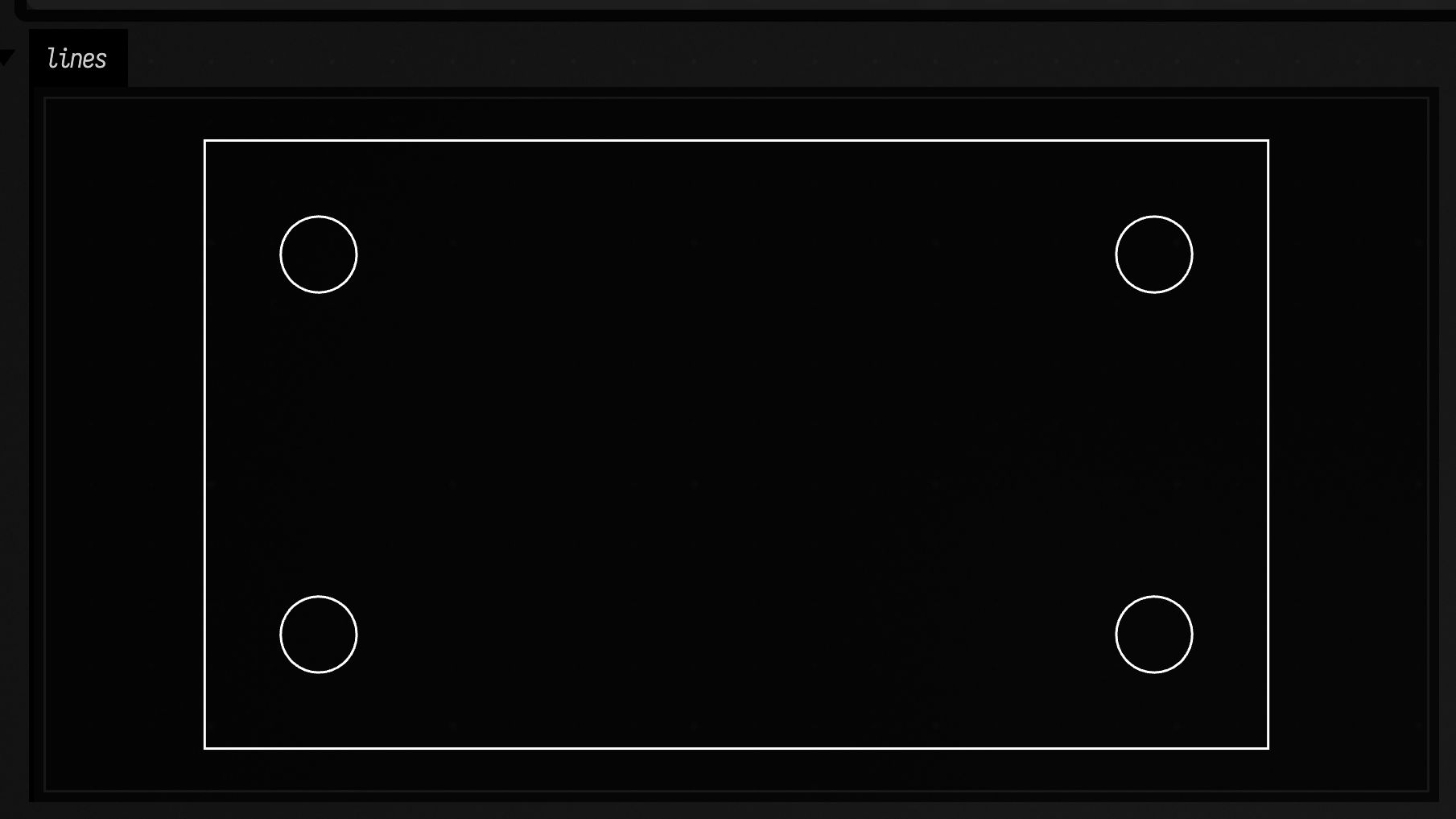
Printing a length
format writes a length as a decimal in any unit. It keeps three decimal places and drops
trailing zeros unless you say otherwise, and groups digits in threes with a space.
formatFeetInches writes feet and inches with a fraction, rounded to the nearest 16th unless you
pass another denominator, and formatInches does the same in inches alone:
:::static
import afield.math.units.length.*

val w = 1250.mm
println(w)

println(w.format(LengthUnit.M))

println(w.format(LengthUnit.M, decimals = 1))

println(w.format(LengthUnit.IN, decimals = 2))

println(w.formatFeetInches())

println(w.formatFeetInches(denominator = 8))

println(w.formatInches())

println(11.99.inch.formatFeetInches())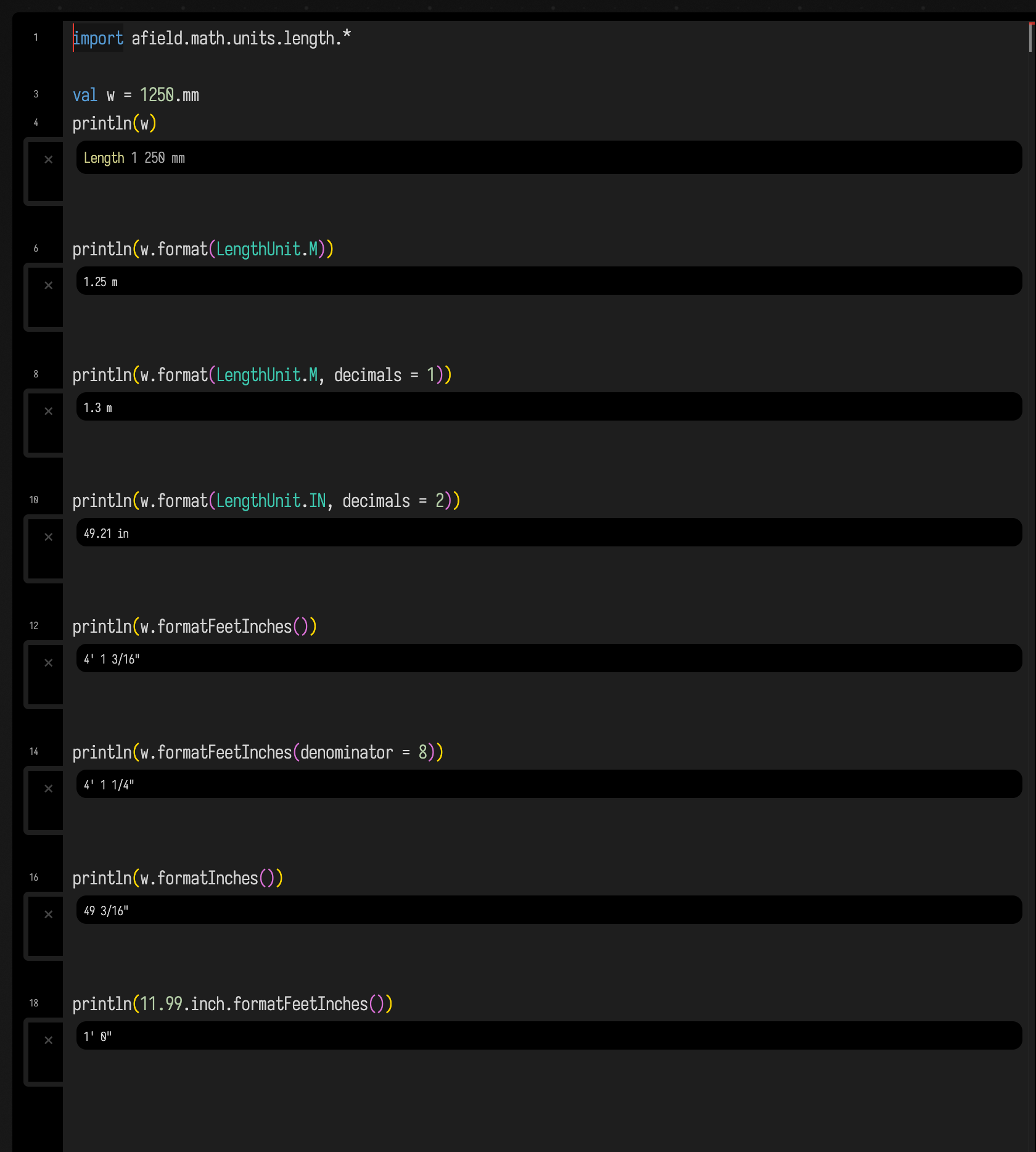
The rounding carries, so 11.99 inches is 1' 0" rather than 0' 12". Fractions are reduced
(8/16 prints as 1/2), and a negative length has one minus sign in front: -4' 6 1/2".
format(decimals = 1, trimZeros = false) keeps a fixed number of places (1 250.0 mm), and
groupSeparator = "" turns the grouping off.
Reading a length from text
Length.parse reads the lengths in a cut list, whether you type them into a text property or
load them from a file. It understands everything the printing functions write, as well as
1250mm, 1,250 mm, 125 cm, 6 inches, 6-1/2", 4'-6", 4ft 6in and typographic primes such as 4′ 6″:
:::static
import afield.math.units.length.*

val cutList = ["4' 6 1/2\"", "1250 mm", "1.25m", "6 in", "3/8\""]
for (cut in cutList) println(Length.parse(cut).formatInches())

println(Length.parseOrNull("12 furlongs") ?: "not a length")
try {
    Length.parse("4' 6 1/2x")
} catch (e: IllegalArgumentException) {
    println("${e.message}")
}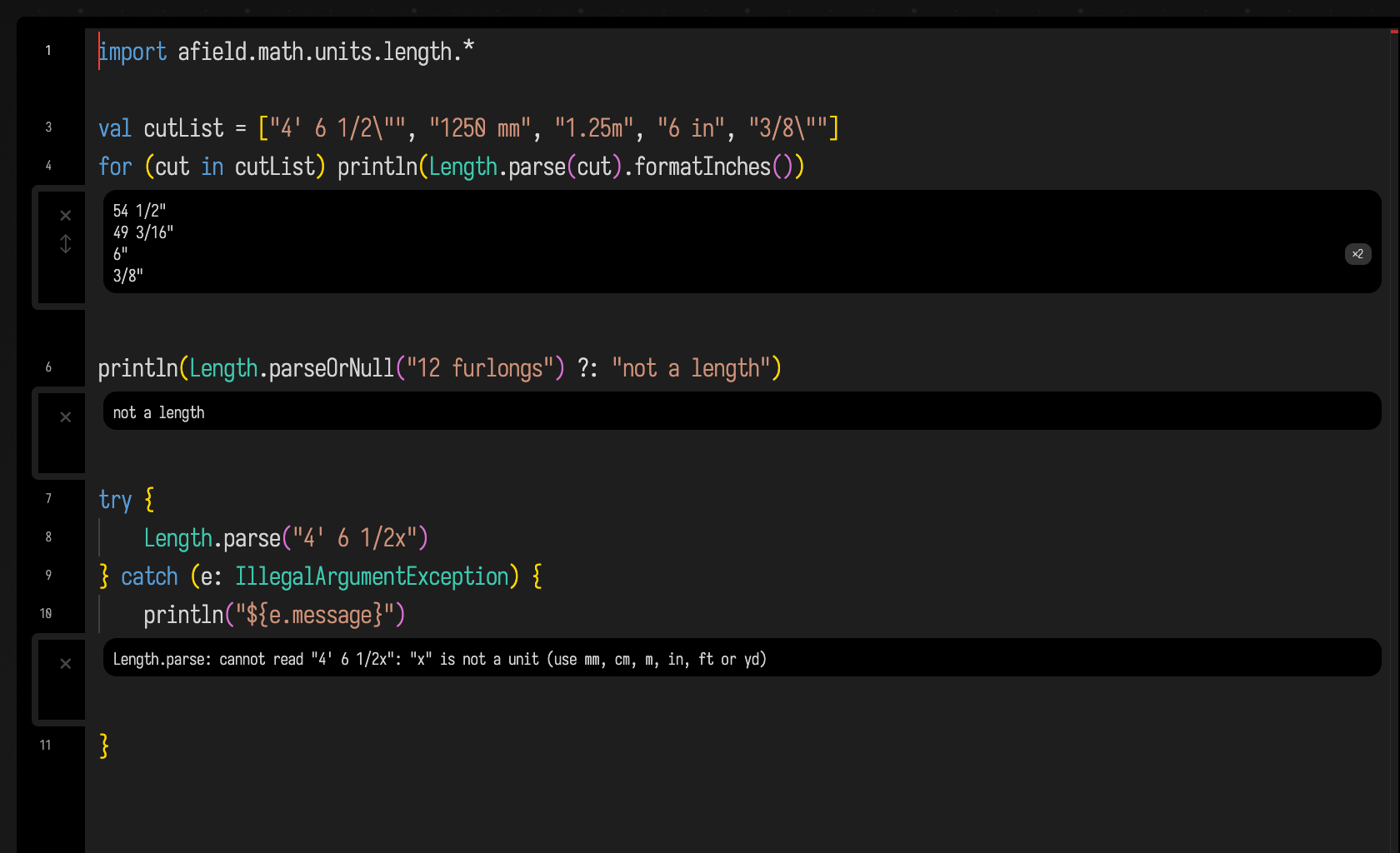
A number with no unit is an error, because it could be anything; Length.parse("12", LengthUnit.MM)
reads bare numbers in the unit you give. parseOrNull returns null instead of throwing.
See also
- The generated reference lists every function on
Length. - Spreadsheets have their own
units, written
3 | mminside a cell's formula, which also cover mass, time and the other physical quantities.