Pressure membranes
Give Field a closed triangular mesh and you can relax it as a pressurized membrane, with elastic
reinforcement, tethers and supports. The afield.simulation.physics.pressure library handles the
mesh mechanics; you supply the shape and connections, and make any sewing patterns you need.
Supply positions in metres and, for each triangle, its unstretched material coordinates in metres. Material coordinates determine strain independently of the initial spatial embedding. A curved initial surface is not automatically a stress-free or cuttable reference surface.
A complete small example
This example inflates a coarse octahedron to 1000 Pa and prints why the solver stopped and the remaining force residual. The octahedron is only there to exercise the solver; it is not a fabrication pattern.
import afield.simulation.physics.pressure.*

val points = [
    P3(1.0, 0.0, 0.0),
    P3(-1.0, 0.0, 0.0),
    P3(0.0, 1.0, 0.0),
    P3(0.0, -1.0, 0.0),
    P3(0.0, 0.0, 1.0),
    P3(0.0, 0.0, -1.0),
]
// Explicit illustrative material; not a product specification.
val film = Film(young = 1e6, poisson = .3, thickness = .1, density = 100.0)
val triangles =
    [0, 1].flatMap { a ->
        [2, 3].flatMap { b ->
            [4, 5].map { c ->
                // Choose outward winding using the face normal and its position from the origin.
                val ids =
                    if ((points[b] - points[a]).cross(points[c] - points[a]).dot(points[a]) > 0) [a, b, c]
                    else [a, c, b]
                val e = points[ids[1]] - points[ids[0]]
                val q = points[ids[2]] - points[ids[0]]
                // Project the rest triangle into its local, unstretched 2D material frame.
                PanelTriangle(
                    ids[0],
                    ids[1],
                    ids[2],
                    "skin",
                    doubleArrayOf(
                        0.0,
                        0.0,
                        e.norm(),
                        0.0,
                        q.dot(e.unit()),
                        q.cross(e.unit()).norm(),
                    ),
                    film,
                )
            }
        }
    }
val envelope = Envelope(points.flatMap { it.array().toList() }.toDoubleArray(), triangles)
val solution = InflationSolver.solve(envelope, LoadCase(pressure = 1000.0))
println("${solution.reason}; residual ${solution.residualN} N")
A finer mesh rounds out
Six vertices cannot show much shape: the octahedron above inflates into a slightly larger
octahedron. Cut each face into 36 flat triangles and give it a thinner film, and the same solver
pushes the flat facets out toward a sphere. The left drawing is the mesh as built, the right one
solution.positions, both seen from the same side:
import afield.simulation.physics.pressure.*

// An octahedron with each face cut into n x n flat triangles, so the pressure has facets to round out.
val n = 6
val corners = [P3(1.0, 0.0, 0.0), P3(-1.0, 0.0, 0.0), P3(0.0, 1.0, 0.0), P3(0.0, -1.0, 0.0), P3(0.0, 0.0, 1.0), P3(0.0, 0.0, -1.0)]
val points = mutableListOf<P3>()
val index = mutableMapOf<String, Int>()
fun node(p: P3): Int {
    val key = [p.x, p.y, p.z].map { Math.round(it * 1e6) }.toString()
    return index.getOrPut(key) { points.add(p); points.size - 1 }
}
val film = Film(young = 1e6, poisson = .3, thickness = 1e-3, density = 100.0)
val triangles = mutableListOf<PanelTriangle>()
fun face(a: P3, b: P3, c: P3) {
    // Outward winding, as in the small example.
    val (p, q, r) = if ((b - a).cross(c - a).dot(a) > 0) Triple(a, b, c) else Triple(a, c, b)
    fun at(i: Int, j: Int) = node(p + (q - p) * (i.toDouble() / n) + (r - p) * (j.toDouble() / n))
    fun tri(i0: Int, i1: Int, i2: Int) {
        val e = points[i1] - points[i0]
        val f = points[i2] - points[i0]
        triangles.add(PanelTriangle(i0, i1, i2, "skin",
            doubleArrayOf(0.0, 0.0, e.norm(), 0.0, f.dot(e.unit()), f.cross(e.unit()).norm()), film))
    }
    for (i in 0 until n) for (j in 0 until n - i) {
        tri(at(i, j), at(i + 1, j), at(i, j + 1))
        if (i + j < n - 1) tri(at(i + 1, j), at(i + 1, j + 1), at(i, j + 1))
    }
}
for (a in [0, 1]) for (b in [2, 3]) for (c in [4, 5]) face(corners[a], corners[b], corners[c])

val envelope = Envelope(points.flatMap { it.array().toList() }.toDoubleArray(), triangles)
val solution = InflationSolver.solve(envelope, LoadCase(pressure = 200.0))
markdown("${points.size} nodes, ${triangles.size} triangles: ${solution.reason}; residual ${solution.residualN} N")

:::fold draw the mesh before and after, side on
fun wire(xyz: DoubleArray, dx: Double) =
    triangles.map { t ->
        FLine().apply {
            [t.a, t.b, t.c, t.a].forEachIndexed { k, i ->
                val x = dx + (xyz[3 * i] - xyz[3 * i + 2] * 0.35) * 120.0
                val y = (xyz[3 * i + 2] * 0.2 - xyz[3 * i + 1]) * 120.0
                if (k == 0) moveTo(x, y) else lineTo(x, y)
            }
        }
    }

:::endfold
lines(wire(envelope.initial, 0.0) + wire(solution.positions, 340.0), w = 680.0, h = 300.0, fitToSize = true)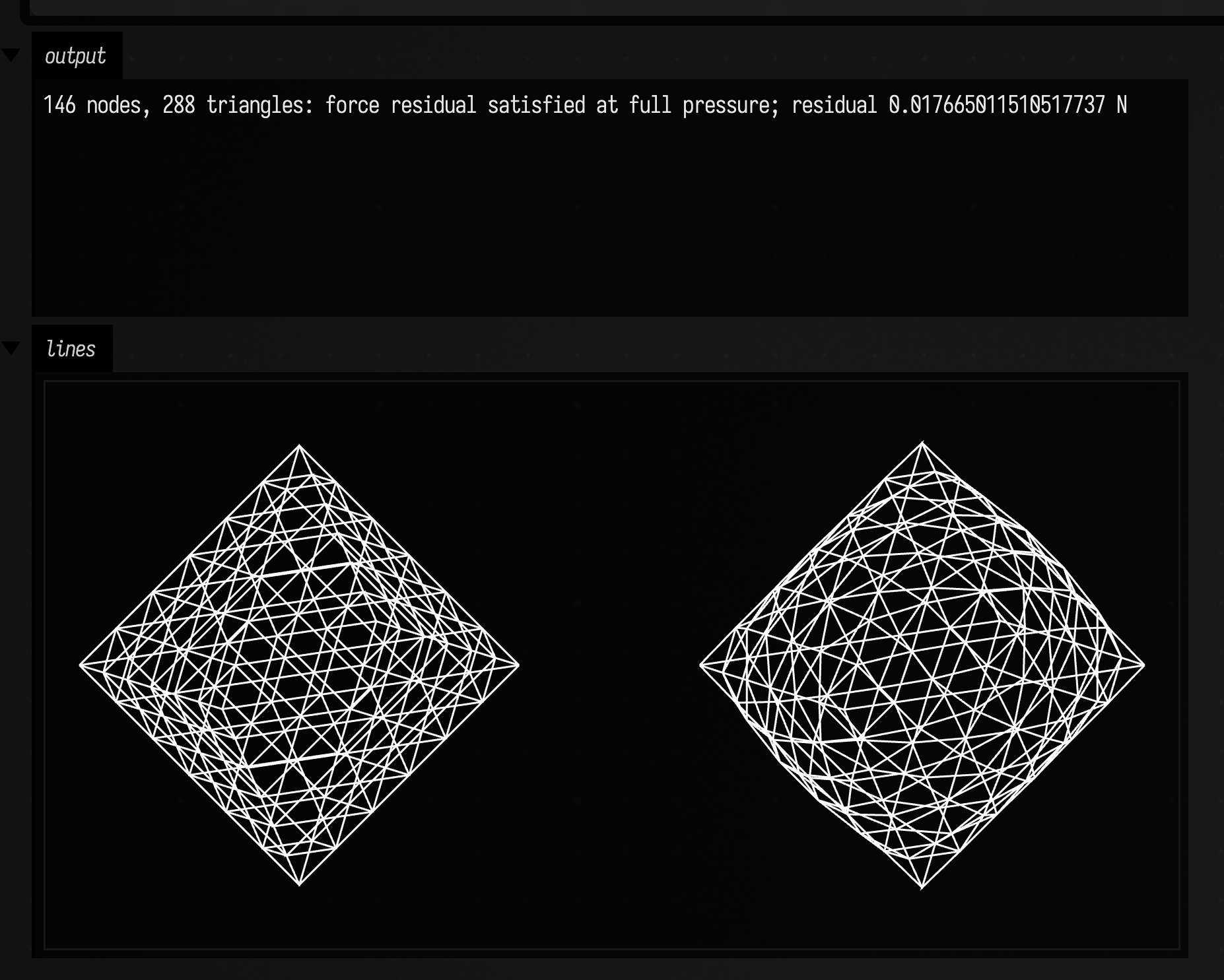
Loads, results, and stopping
Filmtakes Young's modulus in Pa, thickness in metres, density in kg/m³, and Poisson's ratio. There is no implicit Mylar material.TapeandTetheruse axial rigidity EA in N and unstretched length in metres. They carry tension only. ASurfacePointattaches them through fixed material barycentric weights. Tapes relax with the membrane; their starting paths are not constraints.Anchorfixes a node, or supplies a spring stiffness in N/m.LoadCasealso supports gravity in m/s² and a ground penalty in N/m. Tether targets and anchor locations are in the same coordinates as the mesh.- Pressure is gauge pressure in Pa. The default is zero.
REGULATEDholds the requested pressure;SEALED_ISOTHERMALholds pV using the initial volume. Solution.positionscontains the relaxed mesh. Film major/minor resultants are N per current metre; tape tension and support reactions are N. They are not material strength margins. Filmstrainis the largest principal stretch minus one.- Pressure continuation records accepted and rejected endpoints in
history. Checkconvergedand the actual history fraction before interpreting full-load results.initialPositionsstarts from a supplied full-load state. Cancellation and progress callbacks allow a host application to own execution and UI.
The solver uses analytic forces, L-BFGS, and optional Newton refinement. FastMechanics
is a packed equivalent evaluator; Mechanics supplies the reference implementation
and detailed surface values. Keep model arrays unchanged during a solve.
What the model establishes
The membrane uses a plane-stress St Venant–Kirchhoff elastic law with relaxed compressive principal directions: taut, uniaxially wrinkled, or slack. Large rotations are supported, but this is not a calibrated large-strain material model. There is no bending stiffness, wrinkle wavelength, plasticity, rupture, or self-contact response.
Force convergence establishes a stationary state. MinimumSearch can probe curvature
and restart along a sampled unstable direction; it does not certify a global minimum.
ShapeAudits.inspect reports triangle intersections and sharp folds as diagnostics,
not as collision prevention. Refine meshes and compare physical quantities before
trusting a visually smooth result.
What the tests cover
Independent tests cover analytic force derivatives, packed/reference agreement across material branches, sealed gas, translation invariance, mesh validation, cancellation, and convergence toward the spherical Laplace pressure law under mesh refinement.