Eigendrum: hear the shape of a drum
Draw a closed shape and hear it as a drum. Field finds the ways the shape can vibrate, the pitches
they ring at and the places that stay still; strike the drum and those modes sound together. The
idea comes from eigendrum.com, which does this in the browser. Here we'll
build it in Field, with afield.audio.modal, and play with the result.
The quickest way in is the starting point. Open Starting points on the welcome screen and search for eigendrum. Its fifth box makes a drum from whatever you last drew on the drawing layer. Browse the starting point ↗
A drum head clamped at its rim vibrates in modes: shapes u that satisfy −∇²u = λu inside the shape and u = 0 on the rim. Each mode rings at a frequency proportional to √λ, so the list of λ is the drum's spectrum. Three calls do the work:
drumMesh(polygon, h)triangulates the region inside a polygon (alternating x, y coordinates) with triangles abouthacross;drumMeshFitted(fline)does the same for an FLine of any size, andpolarDrumMesh(h) { t -> r(t) }for a polar curve.mesh.modes(16)returns the sixteen lowest modes:lambda,ratios(),frequencies(f0), and a shape for each.modes.strike(x, y)says how strongly a mallet at (x, y) excites every mode, andmodes.render(amplitudes)turns that into a sound, one decaying sine per mode.
Further down, Raman's harmonic drum adds weight to the head like a tabla, bringing its overtones close to a harmonic series. Then we'll try designing a drum for the pitches we want, by changing the load or the outline. Those examples have a starting point of their own: harmonic drum. Browse it ↗
Sixteen modes of a square
A unit square is the drum whose answer we know: λ = π²(m² + n²), so 19.74, then 49.35 twice, then 78.96. The table lists the sixteen lowest, each with a player that sounds that mode alone; below it are the first eight, orange where the head moves up and blue where it moves down.
import afield.audio.modal.*

// A unit-square drum. Its lowest sixteen modes, each a row you can play on its own;
// the analytic spectrum is π²(m² + n²), so λ₁ ≈ 19.74.
val square = drumMesh(doubleArrayOf(0.0, 0.0, 1.0, 0.0, 1.0, 1.0, 0.0, 1.0), 0.04)
val modes = square.modes(16)
display("modes", modes.modeTable(fundamental = 110.0))
lines(
    (0 until 8).flatMap { k ->
        modes.modeMesh(k).map { it.copy().apply { transform { v -> v.add((k % 4) * 1.1f, (k / 4) * 1.1f, 0f) } } }
    },
    w = 520.0,
    h = 270.0,
    fitToSize = true,
)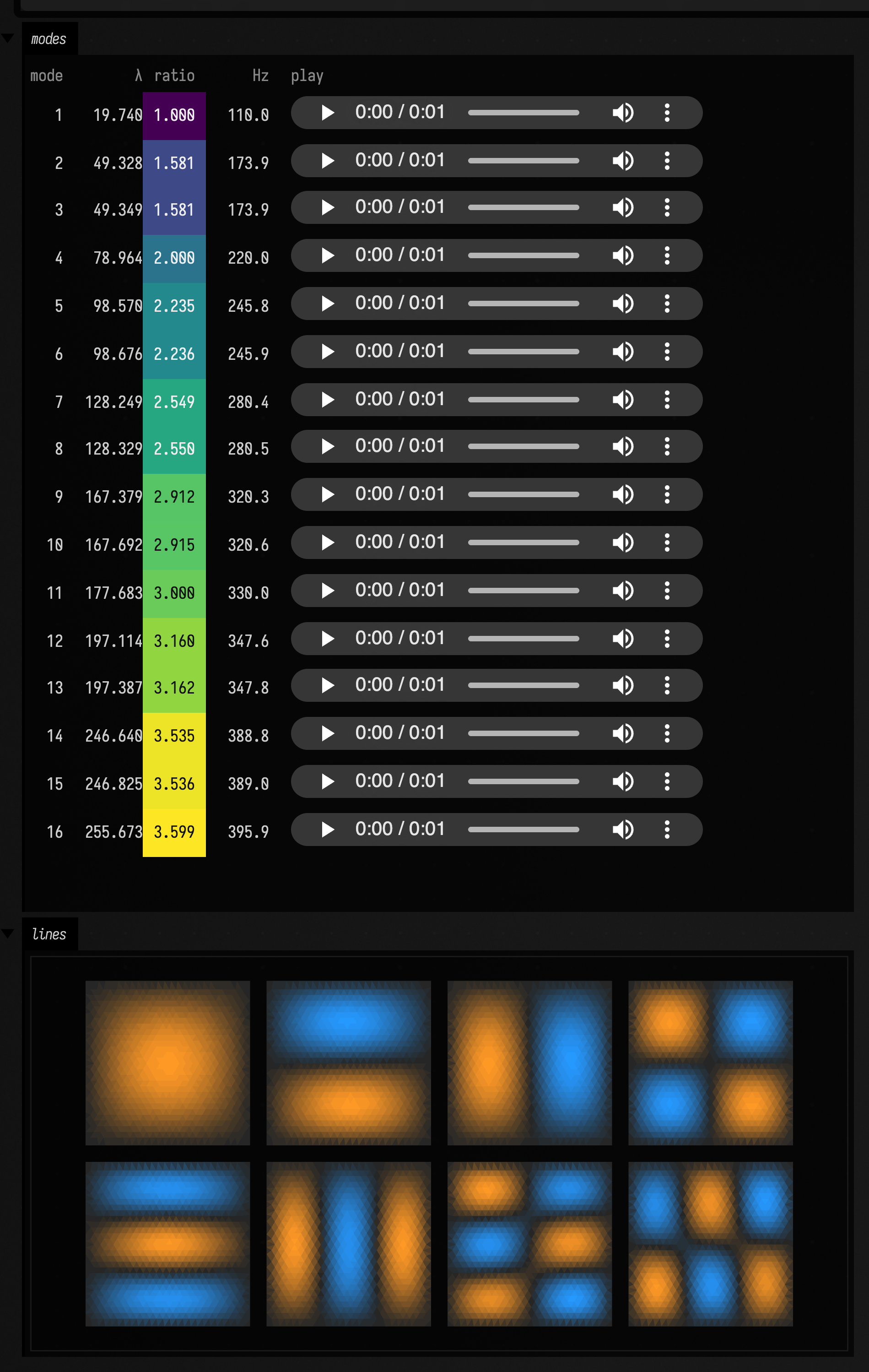
Modes come in pairs where the square's symmetry allows (2 and 3, 5 and 6): two shapes at one pitch. Within such a pair the solver may return any mixture of the two, so a pair's pictures can look rotated against the textbook ones.
A drum from a polar equation
A closed curve can define a drum. Here r(θ) = 1 + 0.3 cos 5θ, a five-lobed flower: on the left the mesh, on the right the sixth mode, coloured by displacement, with its nodal line (where the head stays still) in white.
import afield.audio.modal.*

// r(θ) = 1 + 0.3 cos 5θ: a five-lobed drum. Left, the triangle mesh;
// right, its sixth mode coloured by displacement, nodal lines in white.
val mesh = polarDrumMesh(0.06) { t -> 1 + 0.3 * cos(5 * t) }
val modes = mesh.modes(8)
val wire = mesh.wireframe().apply {
    color = vec(0.8, 0.8, 0.8, 0.6)
    thickness = 0.5
}
val shape = modes.modeMesh(5).map { it.copy().apply { transform { v -> v.add(3f, 0f, 0f) } } }
val nodes = modes.nodalLines(5).copy().apply {
    transform { v -> v.add(3f, 0f, 0f) }
    color = vec(1.0, 1.0, 1.0, 1.0)
    thickness = 1.5
}
lines(listOf(wire) + shape + listOf(nodes), w = 520.0, h = 260.0, fitToSize = true)
println("${mesh.nodeCount} nodes, ${mesh.triangleCount} triangles, ratios ${modes.ratios().map { it.f3 }}")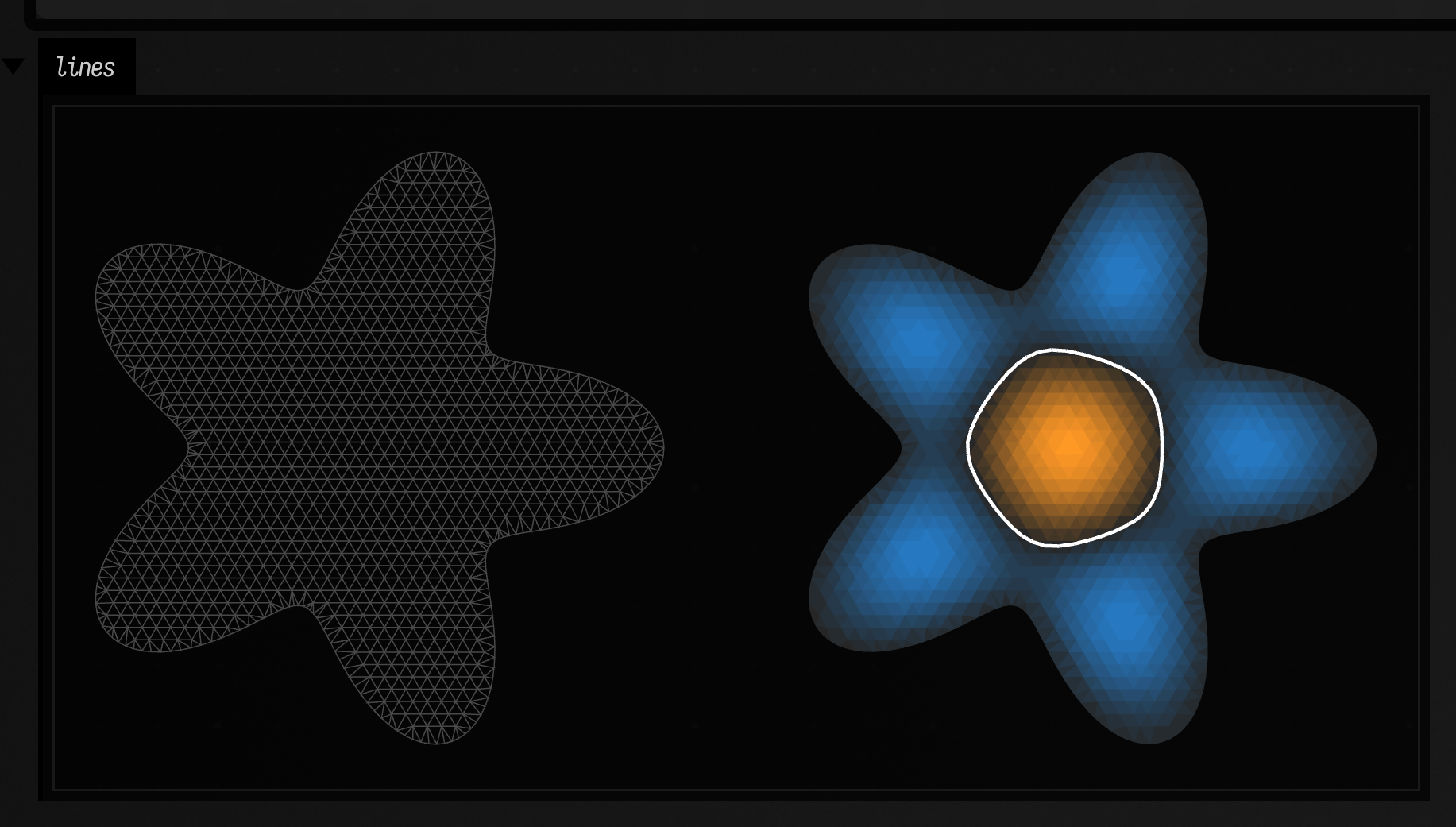
Two shapes, one spectrum
In 1966 Mark Kac asked whether you can hear the shape of a drum, that is, whether the spectrum fixes the shape. In 1992 Gordon, Webb and Wolpert answered no with this pair: two different polygons, each made of seven half-squares, with exactly the same eigenvalues. The table compares the first ten computed for each; they agree to better than 0.05%, which is the size of the discretisation error itself.
import afield.audio.engine.WavFloatArrayWriter
import afield.audio.modal.*

// Gordon, Webb and Wolpert's isospectral pair: you cannot hear the shape of a drum.
val a = drumMesh(KacPair.drumA, 0.06).modes(10)
val b = drumMesh(KacPair.drumB, 0.06).modes(10)
// λ A and λ B share one colour range, so matching rows come out the same colour.
val spectra = table(
    "mode" to (1..10).toList(),
    "λ A" to a.lambda.take(10),
    "λ B" to b.lambda.take(10),
    "diff %" to (0 until 10).map { 100 * abs(a.lambda[it] - b.lambda[it]) / a.lambda[it] },
).format("λ A") { (it as Double).f3 }
    .format("λ B") { (it as Double).f3 }
    .format("diff %") { (it as Double).f3 }
    .heat("λ A", "λ B", by = HeatScope.TABLE)
    .heat("diff %", colormap = "magma")
display("spectra", spectra)
val outlineA = polygonFLine(KacPair.drumA).apply {
    color = vec(1.0, 0.85, 0.3, 1.0)
    thickness = 2.0
}
val outlineB = polygonFLine(KacPair.drumB).apply {
    transform { v -> v.add(4f, 0f, 0f) }
    color = vec(1.0, 0.85, 0.3, 1.0)
    thickness = 2.0
}
val shapeA = a.modeMesh(2)
val shapeB = b.modeMesh(2).map { it.copy().apply { transform { v -> v.add(4f, 0f, 0f) } } }
lines(shapeA + shapeB + listOf(outlineA, outlineB), w = 520.0, h = 220.0, fitToSize = true)
val strikeA = a.render(a.strike(1.5, 1.5, 0.05), fundamental = 140.0, seconds = 2.0)
val strikeB = b.render(b.strike(1.5, 1.5, 0.05), fundamental = 140.0, seconds = 2.0)
display("drum A", WavFloatArrayWriter.encodeMono16(strikeA, 44100))
display("drum B", WavFloatArrayWriter.encodeMono16(strikeB, 44100))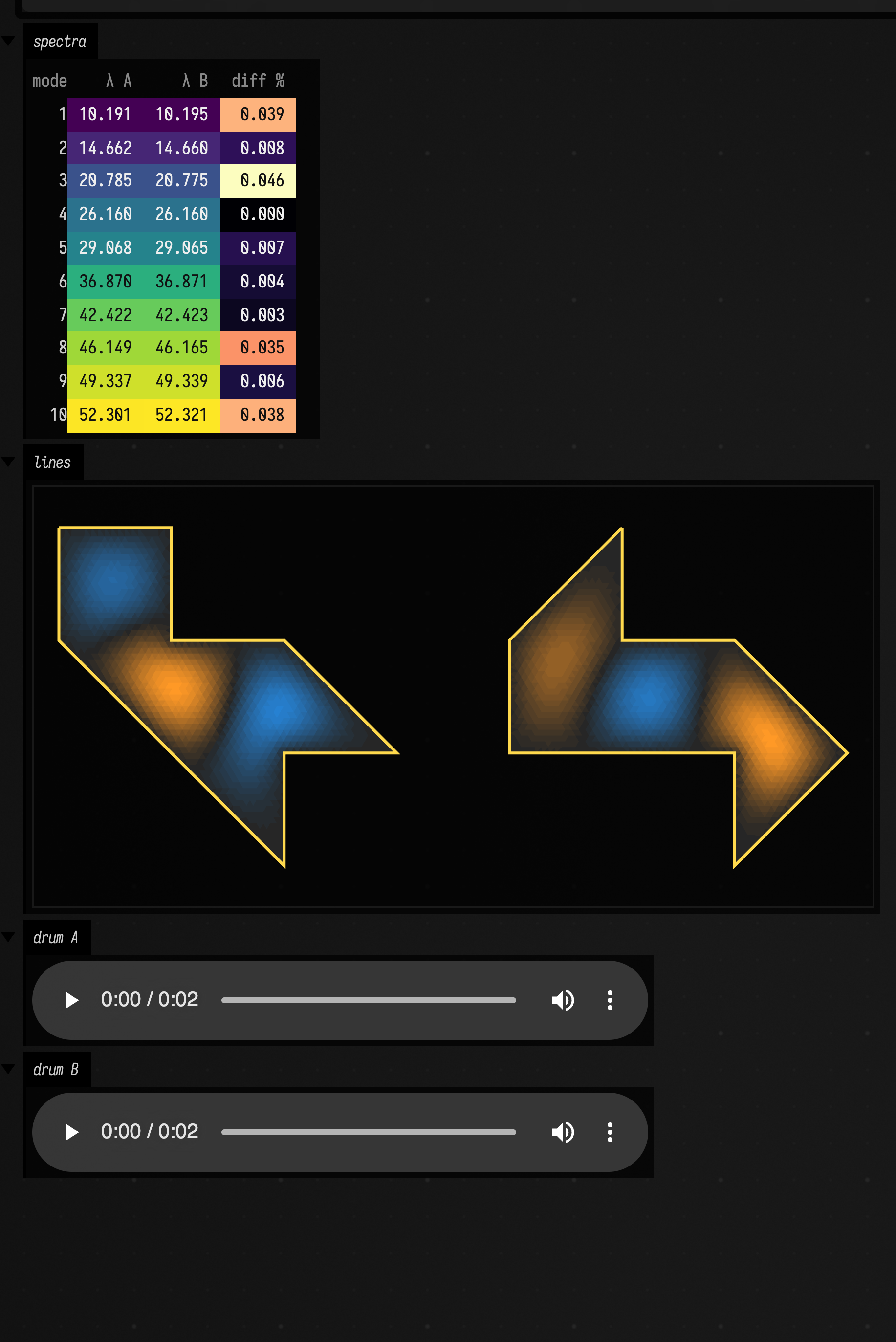
The same notes do not make the same sound. Struck at the same point the two drums ring at the same pitches, but in different proportions, because a point means different things on different shapes:
Where you strike
A mallet excites each mode in proportion to how much that mode moves under it. Strike on a nodal line and that mode stays silent. The centre of a square lies on a nodal line of every mode with an even m or n, so a centre strike leaves out more than half the spectrum (the bars, one per mode) and sounds hollower than a strike off-centre:
import afield.audio.engine.WavFloatArrayWriter
import afield.audio.modal.*

// A square drum struck on the centre, which lies on a nodal line of every mode with m or n even,
// and off-centre. The bars are how strongly each of the 16 modes rings.
val modes = drumMesh(doubleArrayOf(0.0, 0.0, 1.0, 0.0, 1.0, 1.0, 0.0, 1.0), 0.05).modes(16)
val spots = [0.5 to 0.5, 0.31 to 0.22]
val out = ArrayList<FLine>()
spots.forEachIndexed { s, (px, py) ->
    val dx = s * 2.4f
    out += modes.modeMesh(1).map { it.copy().apply { transform { v -> v.add(dx, 0f, 0f) } } }
    out +=
        modes.nodalLines(1).copy().apply {
            transform { v -> v.add(dx, 0f, 0f) }
            color = vec(1.0, 1.0, 1.0, 1.0)
            thickness = 1.5
        }
    out +=
        fline { circle(px + dx, py, 0.04) }
            .apply {
                color = vec(1.0, 0.85, 0.3, 1.0)
                filled = true
            }
    val amps = modes.strike(px, py)
    val peak = amps.maxOf { abs(it) }
    amps.forEachIndexed { k, a ->
        out +=
            fline {
                moveTo(dx + k * 0.06, -0.15)
                lineTo(dx + k * 0.06, -0.15 - 0.6 * abs(a) / peak)
            }
                .apply {
                    color = vec(1.0, 0.85, 0.3, 1.0)
                    thickness = 3.0
                }
    }
    display("strike ${s + 1}", WavFloatArrayWriter.encodeMono16(modes.render(amps, fundamental = 120.0), 44100))
}
lines(out, w = 520.0, h = 300.0, fitToSize = true)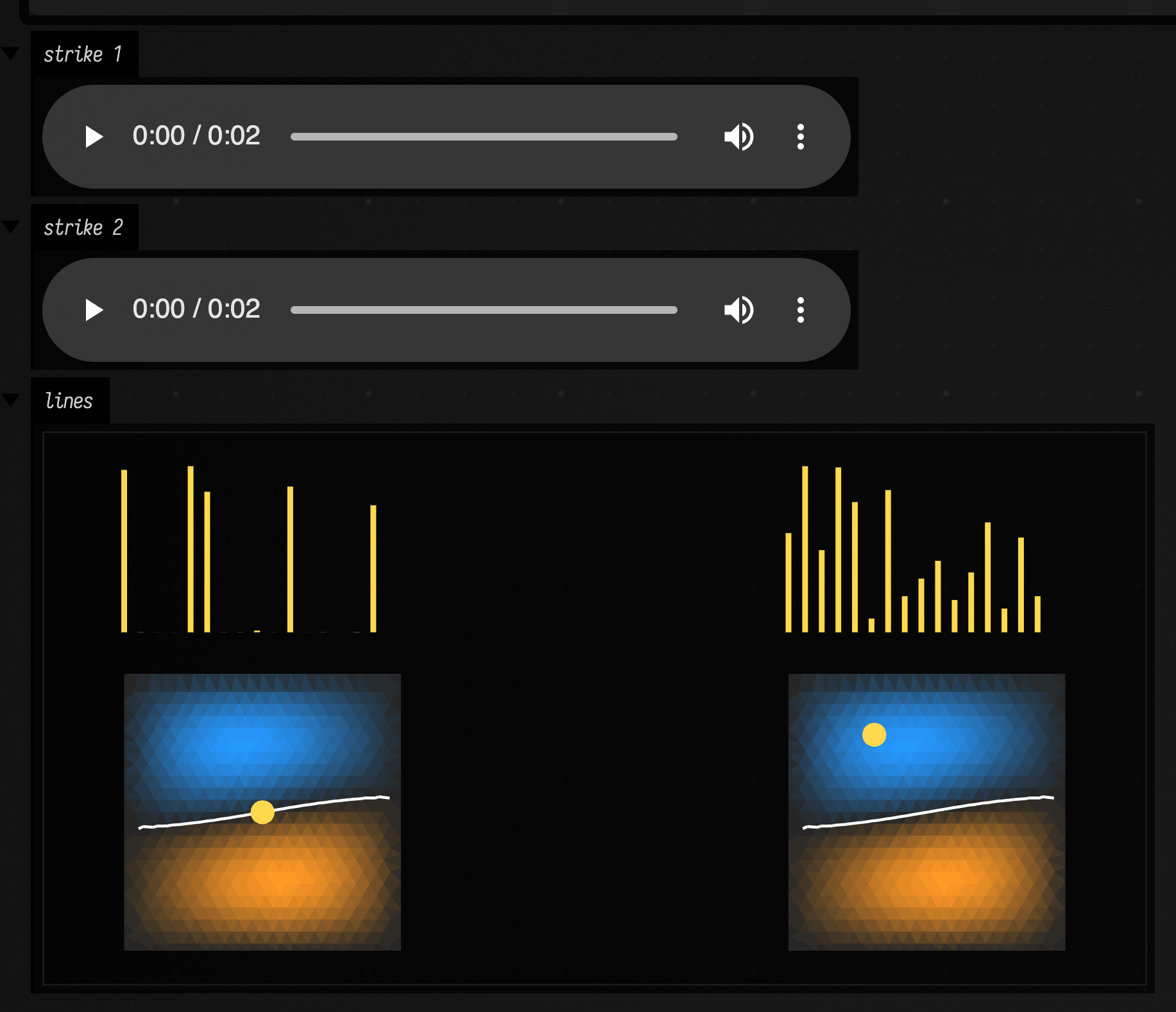
Your own drum
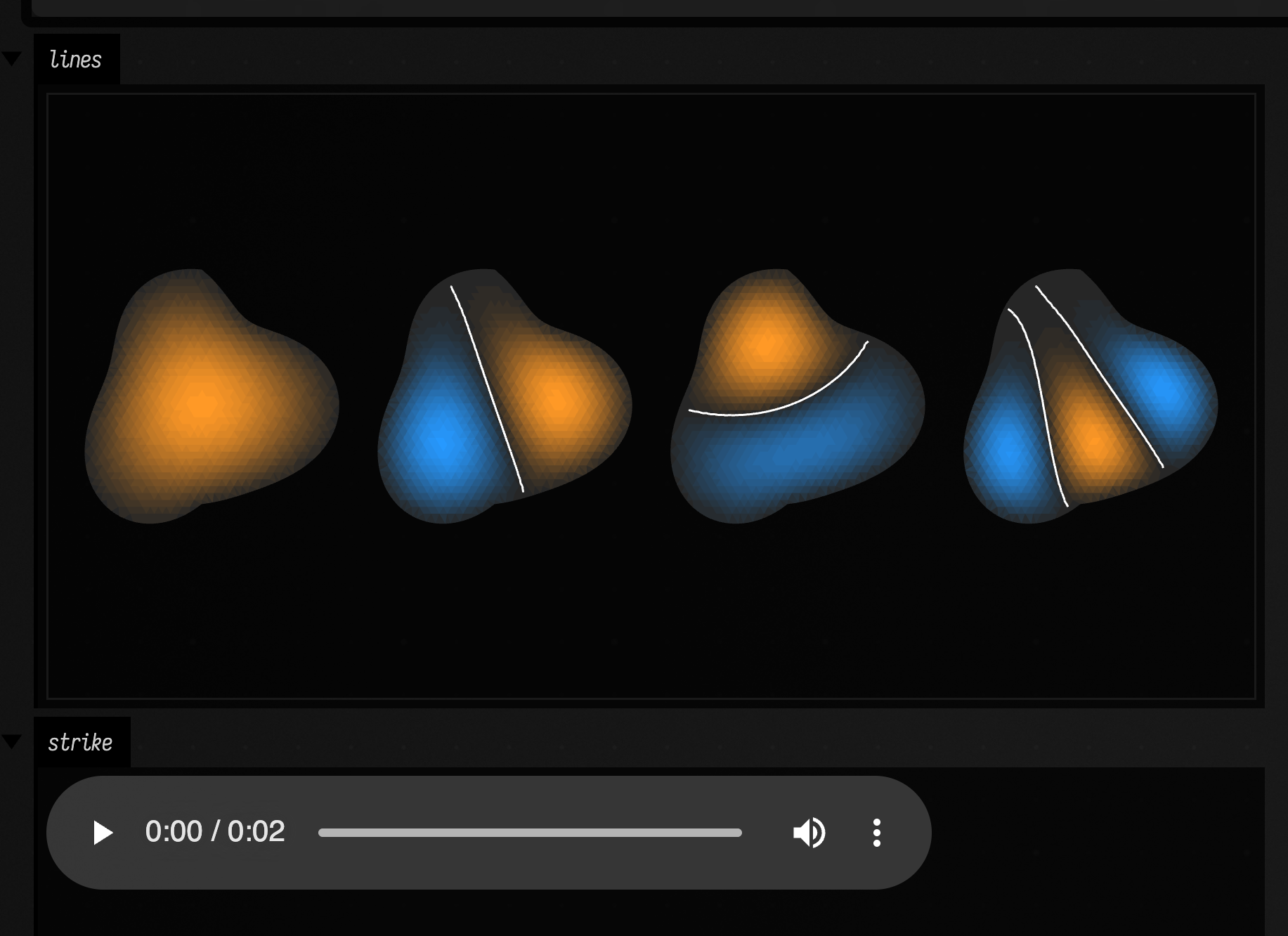
Press ⌥+D, draw a closed shape with the freedraw tool, and run the fifth box of the starting
point: notation.strokes.lastOrNull()?.toFLine() is your stroke, and drumMeshFitted scales it to
fit before meshing. With nothing drawn it uses a polar curve. Here are its first four modes and
their nodal lines:
import afield.audio.engine.WavFloatArrayWriter
import afield.audio.modal.*

// Draw a closed shape on the drawing layer (Alt+D, freedraw), then run this box.
// With nothing drawn yet it uses a heart-ish polar curve.
val stroke = notation.strokes.lastOrNull()?.toFLine()
val outline = stroke ?: polygonFLine(polarPolygon(200) { t -> 1 + 0.35 * sin(t) * abs(cos(t)) + 0.15 * cos(3 * t) })
val mesh = drumMeshFitted(outline, 32)
val modes = mesh.modes(12)
val pictures =
    (0 until 4).flatMap { k ->
        modes.modeMesh(k).map { it.copy().apply { transform { v -> v.add(k * 1.15f, 0f, 0f) } } } +
            modes.nodalLines(k).copy().apply {
                transform { v -> v.add(k * 1.15f, 0f, 0f) }
                color = vec(1.0, 1.0, 1.0, 1.0)
            }
    }
lines(pictures, w = 520.0, h = 150.0, fitToSize = true)
val c = mesh.x.indices.filter { !mesh.boundary[it] }.minBy { abs(mesh.x[it] - 0.4) + abs(mesh.y[it] - 0.35) }
display(
    "strike",
    WavFloatArrayWriter.encodeMono16(modes.render(modes.strike(mesh.x[c], mesh.y[c]), fundamental = 130.0), 44100),
)
println(
    if (stroke == null) "no stroke yet: using the polar curve" else "drum from your stroke: ${mesh.nodeCount} nodes",
)
A live drum
render makes a finished sound. For a drum you play, ModalDrum(modes) is a voice in Field's
audio engine: return it from a box and launch the box (it is a Signal, like SineOsc). Each
mode is a decaying oscillator running on the audio thread. drum.strike(x, y) can be called from
any box or callback; it computes the mallet's projection where it is called and hands it to the
audio thread, which adds it at the start of the next block. every = 1.5 makes the drum strike
itself on a sample-accurate clock.
import afield.audio.modal.*

// The flower drum as a live voice in the audio engine: it strikes itself every 1.5 s.
// Call drum.strike(x, y) from any box or callback to hit it somewhere else.
val modes = polarDrumMesh(0.06) { t -> 1 + 0.3 * cos(5 * t) }.modes(16)
val drum = ModalDrum(modes, fundamental = 110.0, every = 1.5, autoX = 0.35, autoY = 0.1)
drum
A drum that changes shape
retune(newModes) swaps the drum's shape while it rings: the oscillators keep their energy and
change pitch. With morph = shapes, the voice glides through a list of shapes and back, every
morphPeriod seconds, interpolating each mode's frequency on the audio thread. Here nine drums run
from a circle to the five-lobed flower. The table shows the overtones closing in on the
fundamental as the lobes deepen, so the strikes sound lower and more clustered at the flower end.
import afield.audio.modal.*

// Nine drums from a circle to a five-lobed flower. The voice glides through them and back
// every 4 s, striking itself as it goes, so every mode's pitch bends with the outline.
val shapes = (0..8).map { i -> polarDrumMesh(0.07) { t -> 1 + 0.05 * i * cos(5 * t) }.modes(12) }
val outlines = shapes.flatMapIndexed { i, m ->
    m.modeMesh(0).map { it.copy().apply { transform { v -> v.add(i * 2.8f, 0f, 0f) } } }
}
lines(outlines, w = 620.0, h = 100.0, fitToSize = true)
// One row per shape; each mode's column is heated on its own, so you can watch every
// overtone fall as the lobes deepen. Mode 1 is the reference and stays plain.
val modeNames = ["f₁", "f₂", "f₃", "f₄", "f₅", "f₆"]
val ratios = table(
    "a" to shapes.indices.map { 0.05 * it },
    *modeNames.mapIndexed { k, name -> name to shapes.map { it.ratios()[k] } }.toTypedArray(),
).apply { title = "f / f₁ of modes 1–6" }
    .format("a") { (it as Double).f2 }
modeNames.forEach { name -> ratios.format(name) { (it as Double).f3 } }
ratios.heat(*modeNames.drop(1).toTypedArray())
display("ratios", ratios)
ModalDrum(shapes[0], fundamental = 110.0, every = 0.6, autoX = 0.3, autoY = 0.1, morph = shapes, morphPeriod = 4.0)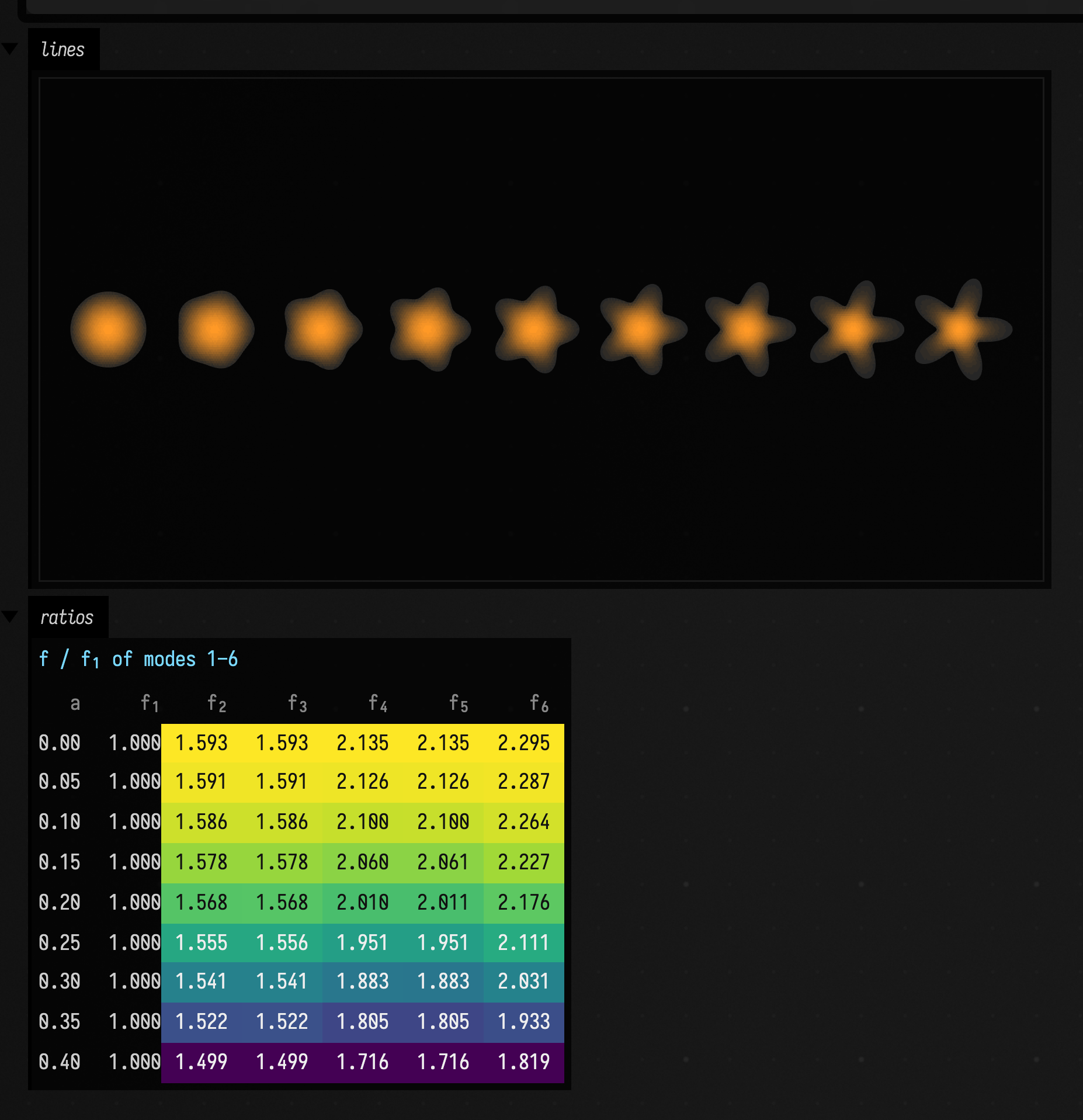
The interpolation follows modes by their rank, so where two modes cross in pitch partway through the morph, they swap roles rather than crossing.
Raman's harmonic drum
A plain circular drum has no clear pitch: its overtones ring at 1.59, 2.14 and 2.30 times the fundamental, not at 2, 3 and 4. The tabla and the mridangam fix this by loading the middle of the head with a heavy black paste, the syahi. C. V. Raman worked out how in 1919 (reported in Nature in 1920 and in full in 1935): the load pulls the nine lowest modes into five tones a harmonic series apart, and the third, fourth and fifth tones are each two or three different modes tuned to one pitch.
| tone | modes (nodal diameters, nodal circles counting the rim) |
|---|---|
| 1 | (0,1) |
| 2 | (1,1) |
| 3 | (2,1) and (0,2) |
| 4 | (3,1) and (1,2) |
| 5 | (4,1), (2,2) and (0,3) |
A load is a density on the drum head. mesh.withDensity { x, y -> ... } gives every triangle the
density there (the bare skin is 1), and syahi(radius, massRatio) is a disc of paste centred on the
origin. Ramakrishna and Sondhi modelled the tabla in 1954 as exactly this: a disc of radius 0.4 at
3.125² ≈ 9.77 times the skin's density. Below, that drum's nine mode families, one column per tone.
The table puts each family's frequency, with (1,1) set to 2, beside the bare drum's, the exact value
for this model and the frequencies measured on a real drum. ramanHarmonicity() measures how far the
fifteen lowest eigenvalues are from 1 : 2 2 : 3 3 3 : 4 4 4 4 : 5 5 5 5 5, in cents (hundredths of a
semitone) after the best overall tuning.
import afield.audio.modal.*

// A unit drum loaded like Ramakrishna & Sondhi's tabla: density ×9.77 inside radius 0.4.
// Its nine lowest mode families, drawn in Raman's five columns, one per harmonic.
val bare = polarDrumMesh(0.05) { 1.0 }
val bareModes = bare.modes(15)
val modes = bare.withDensity(syahi(0.4, 3.125 * 3.125)).modes(15)
val labels = modes.circularLabels()
val pictures = ArrayList<FLine>()
val perTone = IntArray(6)
Raman.families.forEach { (n, m, tone) ->
    val k = labels.indexOfFirst { it.diameters == n && it.circles == m }
    val dx = (tone - 1) * 2.3f
    val dy = perTone[tone]++ * 2.3f
    pictures += modes.modeMesh(k).map { it.copy().apply { transform { v -> v.add(dx, dy, 0f) } } }
    pictures +=
        modes.nodalLines(k).copy().apply {
            transform { v -> v.add(dx, dy, 0f) }
            color = vec(1.0, 1.0, 1.0, 1.0)
            thickness = 1.5
        }
    pictures +=
        fline { circle(dx.toDouble(), dy.toDouble(), 0.4) }
            .apply {
                color = vec(0.1, 0.1, 0.1, 1.0)
                thickness = 1.0
            }
}
val families = table(
    "mode" to Raman.families.map { (n, m, _) -> "($n,$m)" },
    "tone" to Raman.families.map { it.third },
    "bare" to bareModes.ramanFamilies().toList(),
    "loaded" to modes.ramanFamilies().toList(),
    "exact" to Raman.compositeExact.toList(),
    "measured" to Raman.measured.toList(),
)
listOf("bare", "loaded", "exact", "measured").forEach { c -> families.format(c) { (it as Double).f3 } }
display("families", families)
lines(pictures, w = 520.0, h = 330.0, fitToSize = true)
println("bare drum: ${bareModes.ramanHarmonicity()}")
println("loaded drum: ${modes.ramanHarmonicity()}")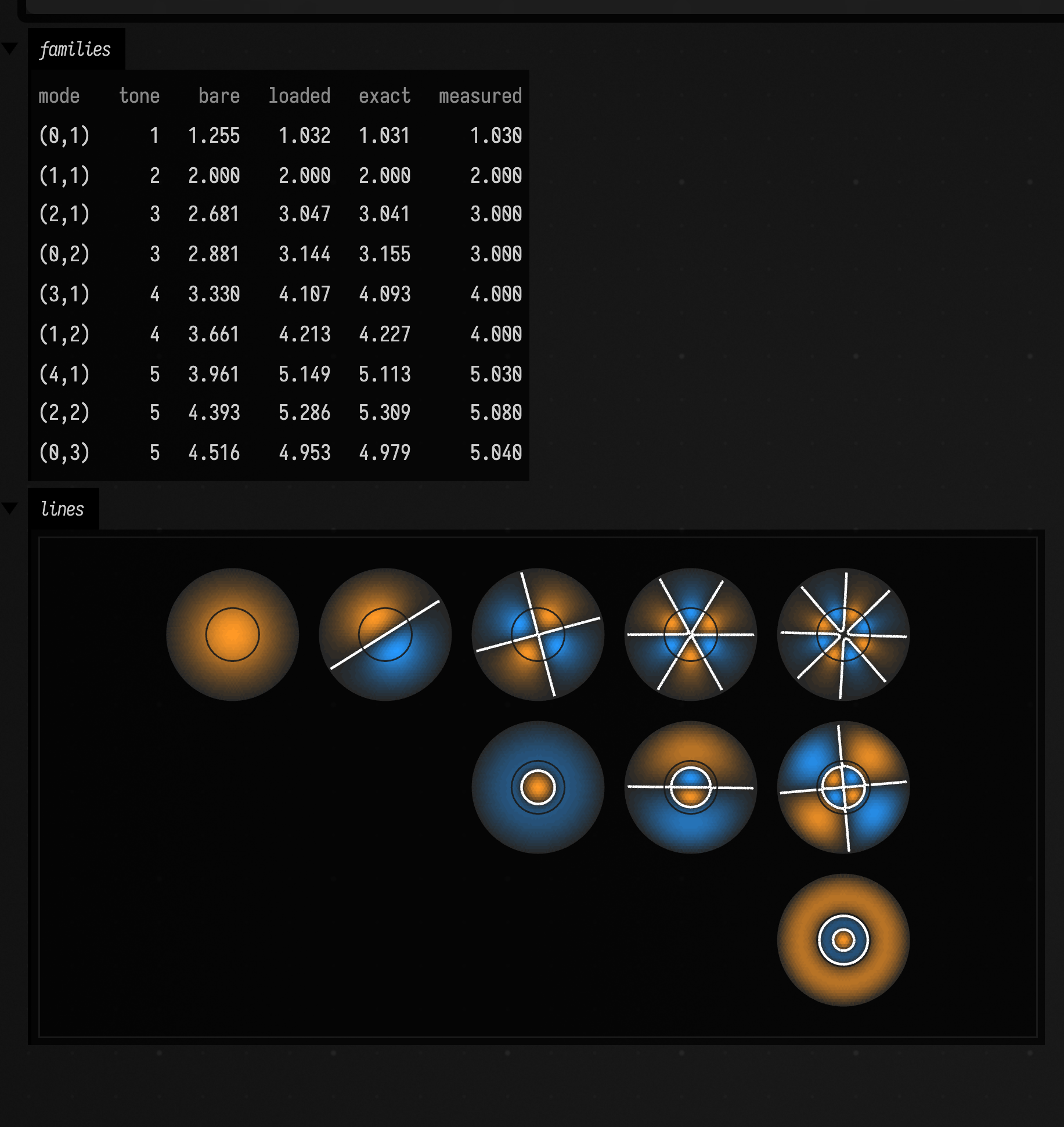
The loaded drum is about 36 cents from a harmonic series; the bare one is 190 cents away. Most of what
is left is the fundamental, a few percent sharp, which the measured drum shares. The finite-element
values agree with the exact ones to within 1%, which HarmonicDrumTest checks, along with the
claim that the fifteen lowest modes fall into Raman's five groups exactly as the table above lists
them.
Listen to the difference. The bare drum, struck halfway between the centre and the rim:
and the same drum with the syahi:
Two modes at one pitch
Because (2,1) and (0,2) ring at the same pitch, any mix of them is also a way the drum can vibrate. Raman damped the head with his fingers to pick a mix and scattered sand on it to see the nodal lines: a circle, then ellipses, then two parallel lines across the drum, so the head divides into three like a string sounding its third harmonic, then hyperbolas, and at the far end two diameters. The same mixes of the loaded drum's two modes, from all (0,2) on the left to all (2,1) on the right:
import afield.audio.modal.*

// Mixes of the loaded drum's (0,2) and (2,1) modes, which share one pitch: the nodal lines
// Raman saw in sand, from a circle to two parallel lines to two diameters.
val modes = polarDrumMesh(0.04) { 1.0 }.withDensity(syahi(0.4, 3.125 * 3.125)).modes(10)
val labels = modes.circularLabels()
val ring = labels.indexOf(CircularLabel(0, 2))
val cross = labels.indexOf(CircularLabel(2, 1))
val mixes = [0.0, 0.6, 1.0, 1.25, 2.5, 1000.0]
val out = ArrayList<FLine>()
mixes.forEachIndexed { i, w ->
    val dx = i * 2.3f
    out +=
        fline { circle(dx.toDouble(), 0.0, 1.0) }
            .apply {
                color = vec(0.5, 0.5, 0.5, 1.0)
                thickness = 1.0
            }
    out +=
        modes.mesh.zeroLines(modes.superpose(ring, cross, w)).apply {
            transform { v -> v.add(dx, 0f, 0f) }
            color = vec(1.0, 1.0, 1.0, 1.0)
            thickness = 2.0
        }
}
lines(out, w = 520.0, h = 110.0, fitToSize = true)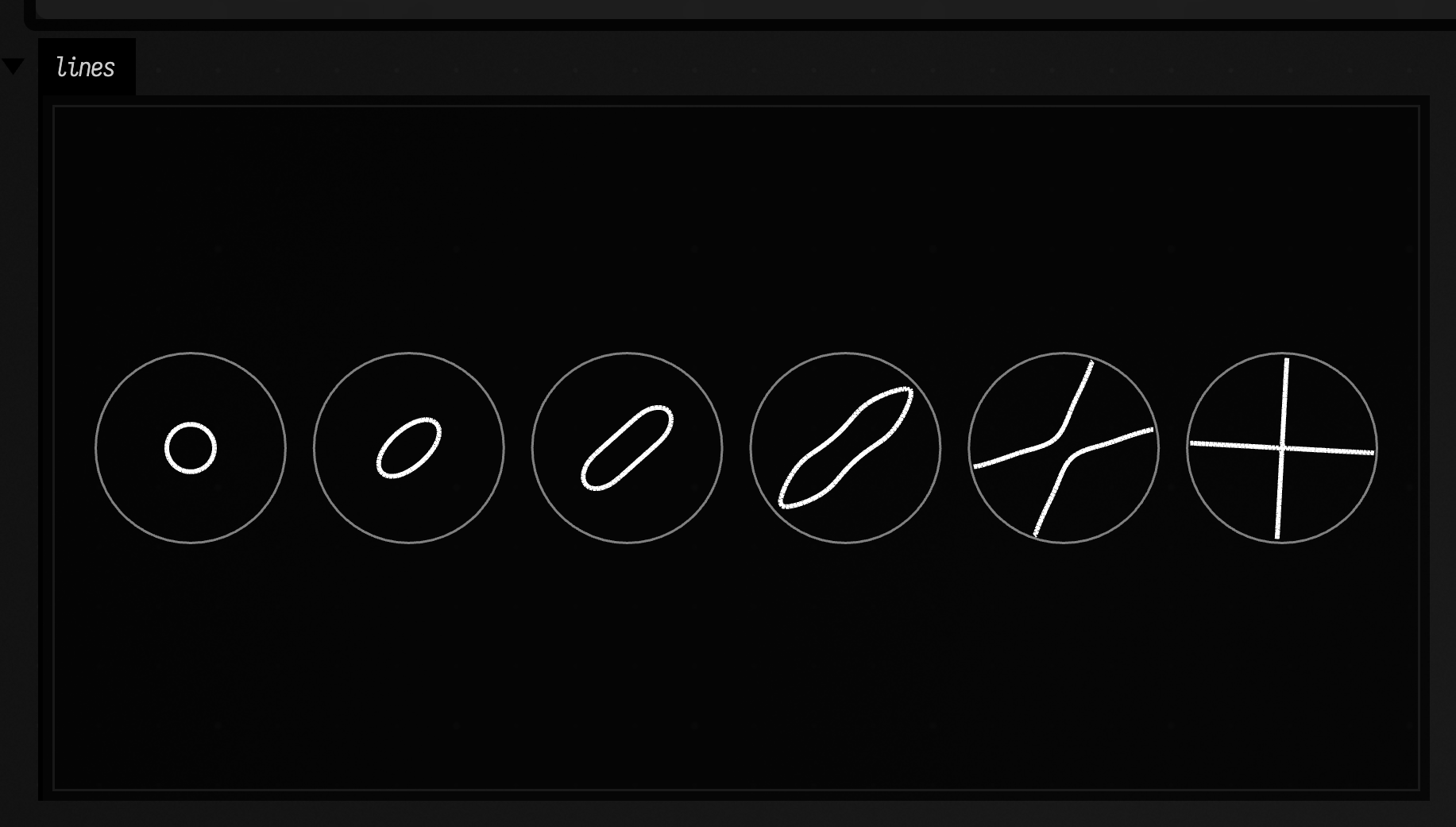
The whole range of loadings
How heavy, and how wide? harmonicityMap(radii, massRatios) solves a loaded drum for every pair
and scores each one. Radius runs across from 0.15 to 0.7 of the rim and density ratio up from 1 (no
paste) to 30, spaced evenly in log; bright cells are close to a harmonic series. The white ring is
Ramakrishna and Sondhi's tabla.
import afield.audio.modal.*

// Loading radius across (0.15–0.7 of the rim), density ratio up (1–30, log spaced); each
// cell is one loaded drum's rms distance from 1:2:3:4:5, bright where it is close.
val map = harmonicityMap(linSpace(0.15, 0.7, 12), logSpace(1.0, 30.0, 12), h = 0.07)
val tabla = [Raman.compositeRadius to Raman.compositeMassRatio]
lines(map.cells(w = 12.0, h = 12.0, marks = tabla), w = 400.0, h = 400.0, fitToSize = true)
val (i, j) = map.best
println("most harmonic cell: radius ${map.radii[j].f2}, density × ${map.massRatios[i].f2}, ${map.cents[i][j].f1} cents")
println("bare skin: ${map.cents[0][0].f1} cents")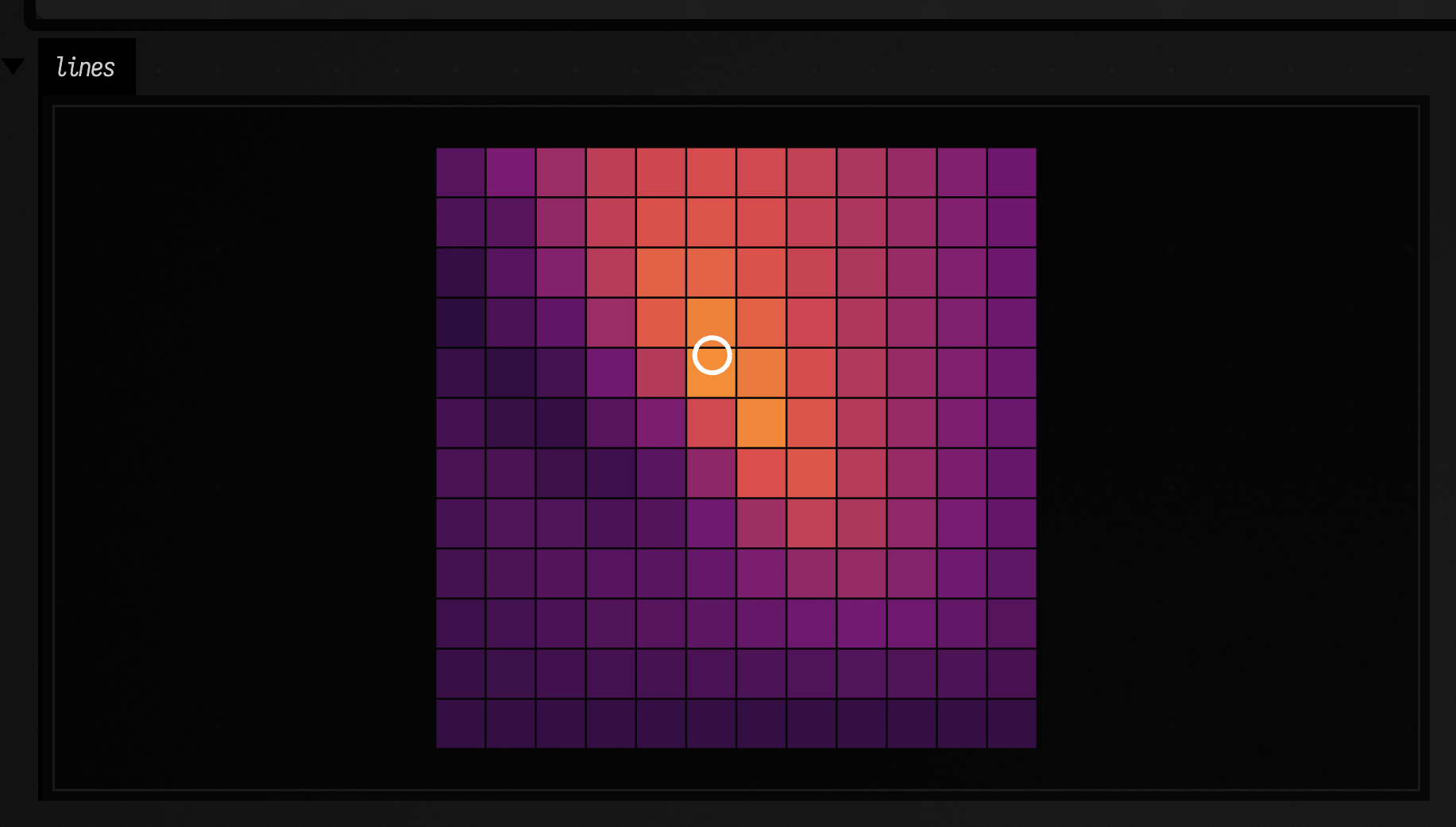
The most harmonic cell is radius 0.4 at about ten times the skin's density, Ramakrishna and Sondhi's own choice. Around it runs a valley: a smaller patch has to be heavier, a wider one lighter. Makers' drums sit along it; Sathej and Adhikari give densities of 6 to 16 times the skin over 45–55% of the radius. Above about twenty times the skin the scores hardly change: the paste then does nearly all the moving, and the bare skin acts only as a spring.
Designing a drum
The map lets you try a load and hear what it does. Now let's choose the pitches first and ask Field
to find a drum that plays them. The leastSquares solver can adjust the paste or the outline.
Shape alone cannot reach the octave
For a uniform drum of any shape, the second mode is at most 1.593 times the first. Ashbaugh and Benguria proved this in 1992, and the circle is the shape that reaches it. So no outline can put the first overtone an octave up, and every uniform drum stays far from Raman's series. Forty random outlines show it. Across is each drum's f₂/f₁, with the white line at 1.593; up is its distance from 1:2:3:4:5. The uniform drums are blue, and Ramakrishna and Sondhi's loaded drum is the yellow dot.
import afield.audio.modal.*

// Forty random uniform drums: f₂/f₁ across (1.0–2.1), distance from 1:2:3:4:5 up (0–400 cents).
// The white line is f₂/f₁ = 1.593, the most any uniform drum can reach; yellow is the syahi.
val disk = polarDrumMesh(0.08) { 1.0 }
val rnd = java.util.Random(3)
val shapes = (0 until 40).map {
    PolarShape.circle(5).apply {
        for (k in 2..5) {
            cosine[k] = 0.5 * (rnd.nextDouble() - 0.5) / k
            sine[k] = 0.5 * (rnd.nextDouble() - 0.5) / k
        }
    }
}
val scores =
    shapes
        .parallelStream()
        .map { s ->
            val m = disk.polarMorphed(s).modes(15)
            m.ratios()[1] to m.ramanHarmonicity().rms
        }
        .toList()
val syahi = loadedDisk(Raman.compositeRadius, Raman.compositeMassRatio, h = 0.07).modes(15)
fun dot(f: Double, cents: Double) = fline { circle((f - 1.0) * 400, 400 - cents, 6.0) }.apply { filled = true }
val out = ArrayList<FLine>()
out +=
    fline {
        moveTo(0.0, 0.0)
        lineTo(440.0, 0.0)
        lineTo(440.0, 400.0)
        lineTo(0.0, 400.0)
        lineTo(0.0, 0.0)
    }
        .apply { color = vec(0.4, 0.4, 0.4, 1.0) }
out +=
    fline {
        moveTo(0.593 * 400, 0.0)
        lineTo(0.593 * 400, 400.0)
    }
        .apply {
            color = vec(1.0, 1.0, 1.0, 1.0)
            thickness = 1.5
        }
scores.forEach { (f, c) -> out += dot(f, c).apply { color = vec(0.35, 0.6, 1.0, 1.0) } }
out += dot(syahi.ratios()[1], syahi.ramanHarmonicity().rms).apply { color = vec(1.0, 0.85, 0.3, 1.0) }
lines(out, w = 440.0, h = 400.0, fitToSize = true)
println(
    "highest f₂/f₁ of 40 shapes: ${scores.maxOf { it.first }.f3}; closest to 1:2:3:4:5: ${scores.minOf { it.second }.f1} cents",
)
println("loaded disk: f₂/f₁ ${syahi.ratios()[1].f3}, ${syahi.ramanHarmonicity().rms.f1} cents")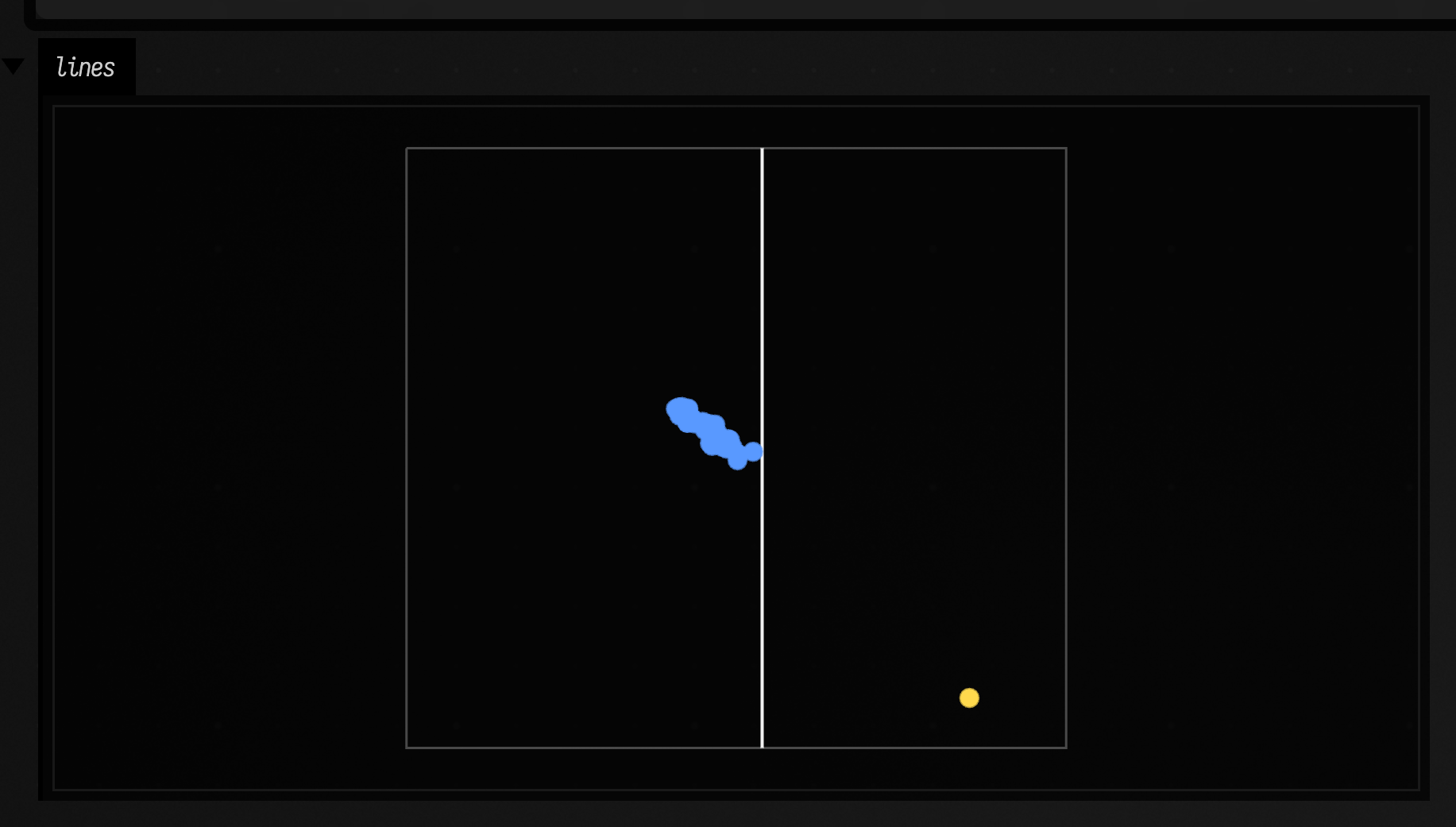
Fitting the paste
designSyahi(layers) keeps the circle and fits the paste instead. The paste is a stack of discs,
each with its own radius and added density, like the layers a maker presses on one at a time. Raman
noted that the paste "is stepped down by three, five or seven stages towards the margin". The fit
starts from Ramakrishna and Sondhi's single disc and keeps the centre at no more than 16 times the
skin, the top of the range makers use. Each step needs only one solve, because the gradient is
exact: making a patch 1% heavier lowers each mode's λ by that mode's share of energy on the patch,
times 1%.
import afield.audio.modal.*

// Fit a syahi of one, two and three stacked layers to 1:2:3:4:5, each starting from
// Ramakrishna & Sondhi's disc. Below, each design's density from the centre (left) to the rim.
val designs = (1..3).toList().parallelStream().map { designSyahi(it, h = 0.08) }.toList()
display(
    "designs",
    table(
        "layers" to designs.map { it.layers },
        "radii" to designs.map { d -> d.radii.sorted().joinToString(" ") { it.f2 } },
        "centre density" to designs.map { it.peak.f1 },
        "start (cents)" to designs.map { it.startFit.rms.f1 },
        "fitted (cents)" to designs.map { it.fit.rms.f1 },
        "worst (cents)" to designs.map { it.fit.worst.f1 },
    ),
)
val colours = [vec(0.35, 0.6, 1.0, 1.0), vec(1.0, 0.85, 0.3, 1.0), vec(1.0, 0.45, 0.3, 1.0)]
val profiles = designs.mapIndexed { i, d -> d.profile(w = 3.0, h = 1.0, top = 16.0).apply { color = colours[i] } }
val composite = fline {
    moveTo(0.0, 1 - 9.77 / 16)
    lineTo(1.2, 1 - 9.77 / 16)
    lineTo(1.2, 1 - 1.0 / 16)
    lineTo(3.0, 1 - 1.0 / 16)
}
    .apply { color = vec(0.6, 0.6, 0.6, 1.0) }
lines(profiles + composite, w = 520.0, h = 180.0, fitToSize = true)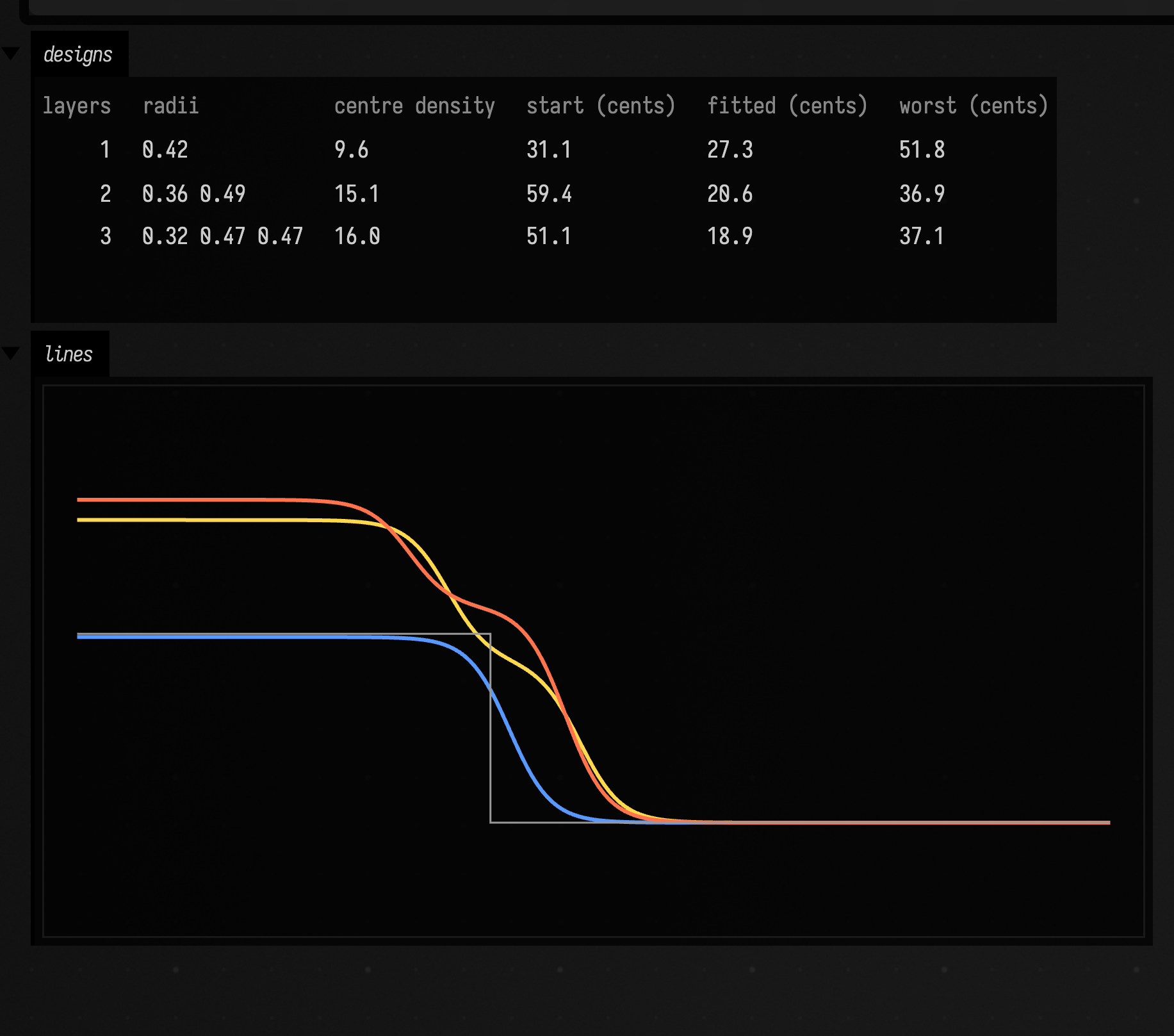
The grey line is the single disc the fits start from; blue, yellow and red are one, two and three layers. Two layers take the drum from about 27 cents to about 21, and a third adds little. The fits keep Raman's grouping, (0,2) with (2,1), (1,2) with (3,1), and so on, without being told it: the target is just the fifteen numbers. The two-layer drum:
A drum that plays a chord
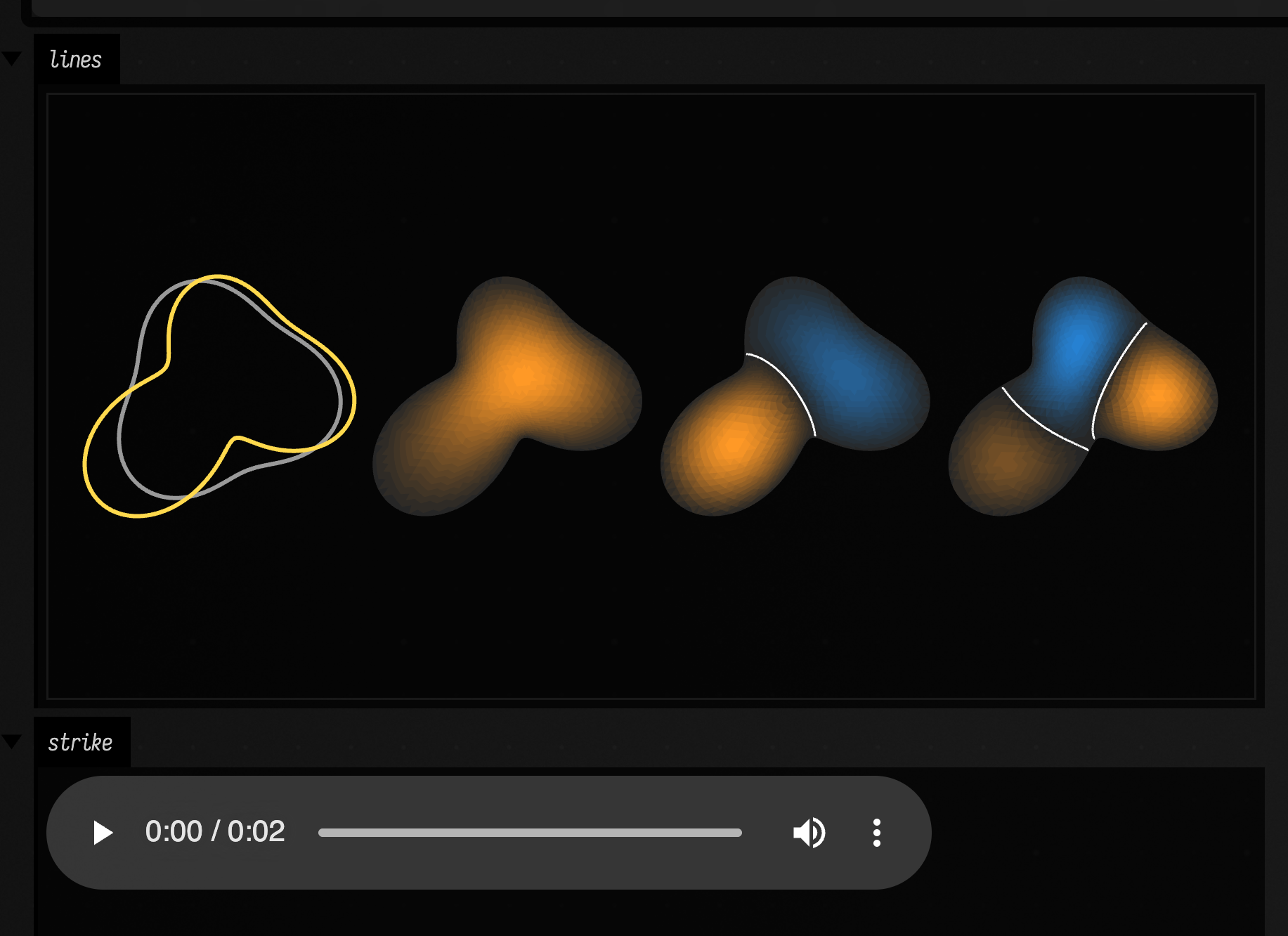
Without paste, an outline can still be fitted to any target it can reach. designShape(target)
bends r(θ) as a short Fourier series (PolarShape) until the lowest modes sound the target. Here
the target is a major triad, 4:5:6. The starting guess is your last drawn stroke, as in
Your own drum, fitted with three harmonics by PolarShape.fromLine; with nothing
drawn it is the heart from that section. Grey is the start, yellow the fitted drum, followed by its
three lowest modes.
import afield.audio.engine.WavFloatArrayWriter
import afield.audio.modal.*

// Bend your last drawn stroke (or the heart) into a uniform drum whose three lowest
// modes sound a major triad, 4:5:6.
val stroke = notation.strokes.lastOrNull()?.toFLine()
val start = if (stroke != null) PolarShape.fromLine(stroke, 3) else PolarShape.fromPolygon(EigendrumDocs.heart, 3)
val design = designShape([4.0, 5.0, 6.0], start = start, h = 0.08)
val modes = polarDrumMesh(0.05) { 1.0 }.polarMorphed(design.shape).modes(12)
val out = ArrayList<FLine>()
out +=
    design.start.outline().apply {
        color = vec(0.6, 0.6, 0.6, 1.0)
        thickness = 2.0
    }
out +=
    design.shape.outline().apply {
        color = vec(1.0, 0.85, 0.3, 1.0)
        thickness = 2.0
    }
for (k in 0 until 3) {
    val dx = (k + 1) * 2.8f
    out += modes.modeMesh(k).map { it.copy().apply { transform { v -> v.add(dx, 0f, 0f) } } }
    out +=
        modes.nodalLines(k).copy().apply {
            transform { v -> v.add(dx, 0f, 0f) }
            color = vec(1.0, 1.0, 1.0, 1.0)
        }
}
lines(out, w = 520.0, h = 140.0, fitToSize = true)
println("start ${design.startFit}, fitted ${design.fit}; ratios ${modes.ratios().take(3).map { (4 * it).f3 }}")
display(
    "strike",
    WavFloatArrayWriter.encodeMono16(modes.render(modes.strike(0.3, 0.25, 0.04), fundamental = 220.0), 44100),
)
Morphing between them
The live voice glides between any drums with the same number of modes. This one runs from the bare drum through Ramakrishna and Sondhi's syahi to the fitted one-layer syahi and back, every four seconds, striking itself between the paste and the rim. The table lists the overtones it passes through.
import afield.audio.modal.*

// From the bare drum to Raman's harmonic drum and back, every 4 s, as a live voice.
val bare = polarDrumMesh(0.07) { 1.0 }.modes(15)
val composite = loadedDisk(Raman.compositeRadius, Raman.compositeMassRatio, h = 0.07).modes(15)
val fitted = designSyahi(1, h = 0.08).modes
val drums = [bare, composite, fitted]
val names = ["f₂", "f₄", "f₆", "f₇", "f₉", "f₁₁", "f₁₅"]
val picks = [1, 3, 5, 6, 8, 10, 14]
val spectra = table(
    "drum" to ["bare", "composite", "one layer"],
    *names.mapIndexed { c, name -> name to drums.map { it.ratios()[picks[c]] } }.toTypedArray(),
)
names.forEach { n -> spectra.format(n) { (it as Double).f3 } }
display("spectra", spectra)
ModalDrum(bare, fundamental = 220.0, every = 0.7, autoX = 0.62, autoY = 0.15, morph = drums, morphPeriod = 4.0)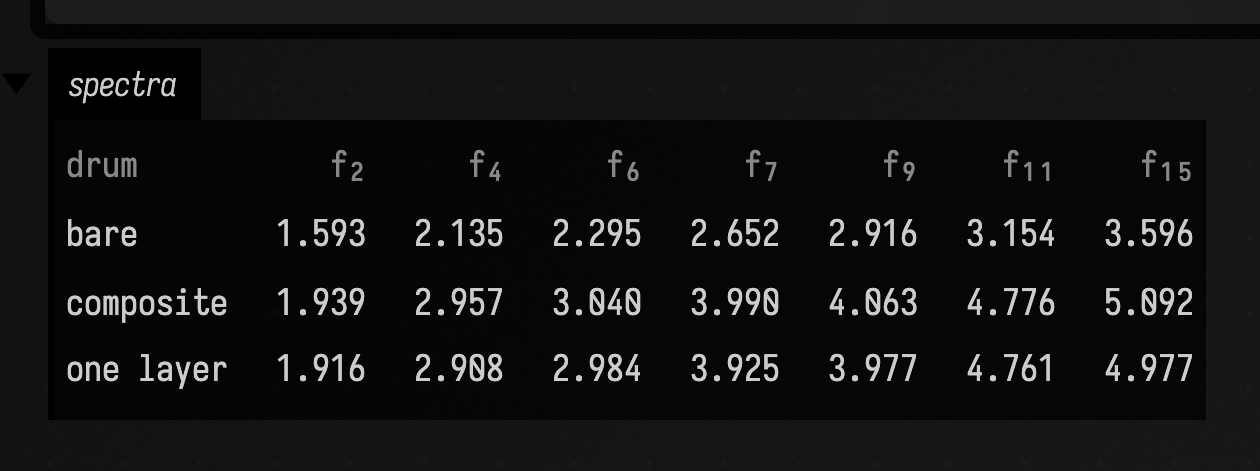
The loaded drum follows C. V. Raman, "The Indian musical drums", Proc. Indian Acad. Sci. A 1, 179–188 (1935), and C. V. Raman and S. Kumar, "Musical drums with harmonic overtones", Nature 104, 500 (1920); the composite membrane is B. S. Ramakrishna and M. M. Sondhi, J. Acoust. Soc. Am. 26, 523 (1954). The measured and exact frequencies in the table are from G. Sathej and R. Adhikari, "The eigenspectra of Indian musical drums", J. Acoust. Soc. Am. 125, 831 (2009), arXiv:0809.1320, Table I. The bound on f₂/f₁ is M. S. Ashbaugh and R. D. Benguria, "A sharp bound for the ratio of the first two eigenvalues of Dirichlet Laplacians and extensions", Annals of Mathematics 135, 601–628 (1992).
How it is computed
drumMesh puts points along the rim every h, fills the inside with a triangular lattice of
spacing h, and joins them with a Delaunay triangulation. On those triangles, linear finite
elements turn the equation into a matrix problem Kφ = λMφ: K (stiffness) measures how much a shape
bends, M (mass) how much it moves. modes(n) finds the n smallest λ by subspace iteration, solving
with a banded Cholesky factor of K. The mass matrix is an average of the consistent and lumped
forms, which cancels most of the error of linear elements: on a unit square and a unit disk with
h = 0.04 and 0.05 the lowest eigenvalues land within 0.13% of π²(m² + n²) and of the Bessel
zeros (j₀,₁² ≈ 5.783), which EigendrumTest checks. A thousand-node drum solves in well under a
second.
render gives mode i the frequency f₀√(λᵢ/λ₁) and decay rate α + β(fᵢ/f₀)², so the high modes die
first, as on a real membrane. Change alpha and beta for a drier or more ringing head.
The same synthesis runs on any network of masses and springs.
Striking the tiling builds one from a Penrose tiling's
vertices and edges, where a tenth of the modes share a single pitch, and plays it through
ModalDrum.
For a membrane under steady load rather than vibrating, see Pressure membranes. For playing sound in boxes and the pattern-to-audio path, see Sound.
The method and the Gordon–Webb–Wolpert coordinates follow Toby Driscoll, "Eigenmodes of isospectral drums", SIAM Review 39 (1997), and Cleve Moler's blog post; the idea of a drum you draw is eigendrum.com's.