Ray Reconstruction
Ray Reconstruction turns raw samples from RTXDI into a temporally reconstructed image. In this lighting experiment you can compare it with Field's spatial filter, and with that filter followed by DLAA.
Open the experiment
Open the ray_reconstruction starting point. The scene has a moving area light, a moving camera, and four interchangeable paths, all at 1920 × 1080:
- 0: Raw shows RTXDI's unfiltered light samples.
- 1: Spatial uses Field's surface-guided spatial filter.
- 2: Spatial + DLAA adds native-resolution neural antialiasing to that filter.
- 3: RR gives the raw light samples and surface guides directly to Ray Reconstruction.
Stop the camera and light independently. Cut / reset history jumps the animation and discards old samples. The raw image stays available throughout. The paths are separate: RR does not run after the spatial filter, and no DLAA pass runs after RR.
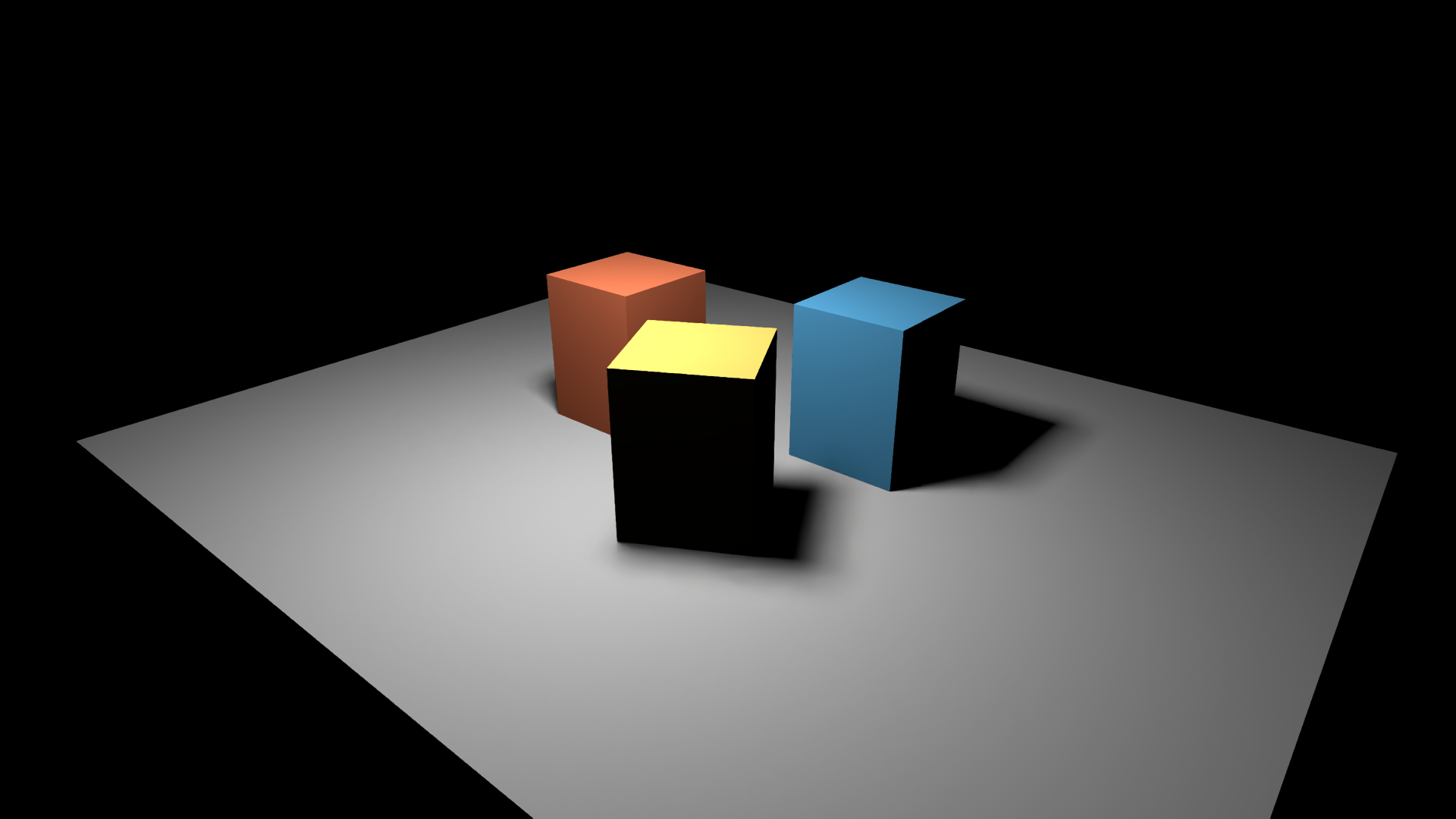
Top left: raw. Top right: spatial. Bottom left: spatial + DLAA. Bottom right: RR. The four panels follow the same animation, with a camera cut halfway through and an instance edit later. Use fullscreen to inspect disocclusion and shadow boundaries.
Use it in a renderer
The adapter records into Field's command buffer and consumes Field-owned images. DlssReconstruction(..., rayReconstruction=true) selects RR. evaluate then requires a RayReconstructionGuides value in addition to color, depth, motion, and frame state.
val rr = DlssReconstruction(
    renderer,
    size,
    size,
    ReconstructionMode.DLAA,
    rayReconstruction = true,
)

// Outside the render pass, after producing these sampled images:
rr.evaluate(
    command,
    ReconstructionInputs(rawLight, depth, motion),
    frame,
    RayReconstructionGuides(
        diffuseAlbedo,
        specularAlbedo,
        normalRoughness,
        camera.modelView(),
        projection.evaluateUniform(),
    ),
)
The guides have to describe the light you are handing over. This experiment's RTXDI bridge is Lambertian, so its specular albedo is zero and its roughness is one. Those values are specific to this bridge; a scene with glossy materials has to supply real ones. This example does not cover glossy or path-traced RR.
Normals are world-space unit vectors, packed with linear roughness in alpha. Diffuse and specular albedo are linear RGB. Depth uses Vulkan's standard 0–1 projection, with background at one. Motion points from the current pixel to its previous position, in input pixels, without jitter. Camera matrices are unjittered. Fabricate applies raster jitter separately, so its motion vectors keep that meaning. Specular hit distance is optional and is not fabricated for this diffuse scene.
Cost and limits
On this RTX 4090, native 1080p RR costs 6.22 ms median and 6.23 ms p95, against 1.34 ms for the DLAA pass that follows spatial filtering on path 2. The SDK reports about 94 MB of shared allocations on top of Field's lighting and guide images. The timings hold for this resolution and sample budget and exclude presentation; measure your own scene rather than scaling them.
RR is not the closest still image here. Against a 4,096-candidate static reference, RGB MSE is 0.000150 for raw lighting, 0.000047 for RR, and 0.0000091 for the spatial filter, so in this simple diffuse scene the cheap filter wins on a frozen frame. Movement, disocclusion, and your intended look are why you would still compare the paths. The measurement file records the per-pass timings, SDK memory and errors behind these figures.
RR can make noisy illumination substantially smoother, but history can also soften intentional discontinuities. Reset after a cut or semantic edit, and inspect motion as well as still frames. The bridge carries opaque mono direct lighting only. Alpha coverage, transmission, glossy reflections and latent pigment channels are not supported.
Use the same optional NGX installation as DLAA/SR. RR availability is queried separately, including its required extensions before device creation. Ordinary rendering remains available when the SDK or feature is absent.
From modules to reconstruction shows the five-guide conversion and command ordering in the rr_plumbing starting point, ready to adapt to your own render targets.
For multi-bounce lighting from Field’s existing path tracer, see Path-traced reconstruction.