A polytope, cut open, and traced
Let's build a polyhedron, cut it open, and render it. We'll also keep track of where its faces came from, so the finished image can colour the shape by its own history.
Three parts of Field do the work: afield.geometry.polytope builds the shape with Conway
operators, afield.geometry.solid.manifold cuts the closed solid, and
afield.graphics.scene.fabricated renders it with a GPU path tracer.
The shape is bD: bevel of the dodecahedron, better known as the truncated icosidodecahedron. It has
62 faces, few enough to count and enough that a mistake shows.
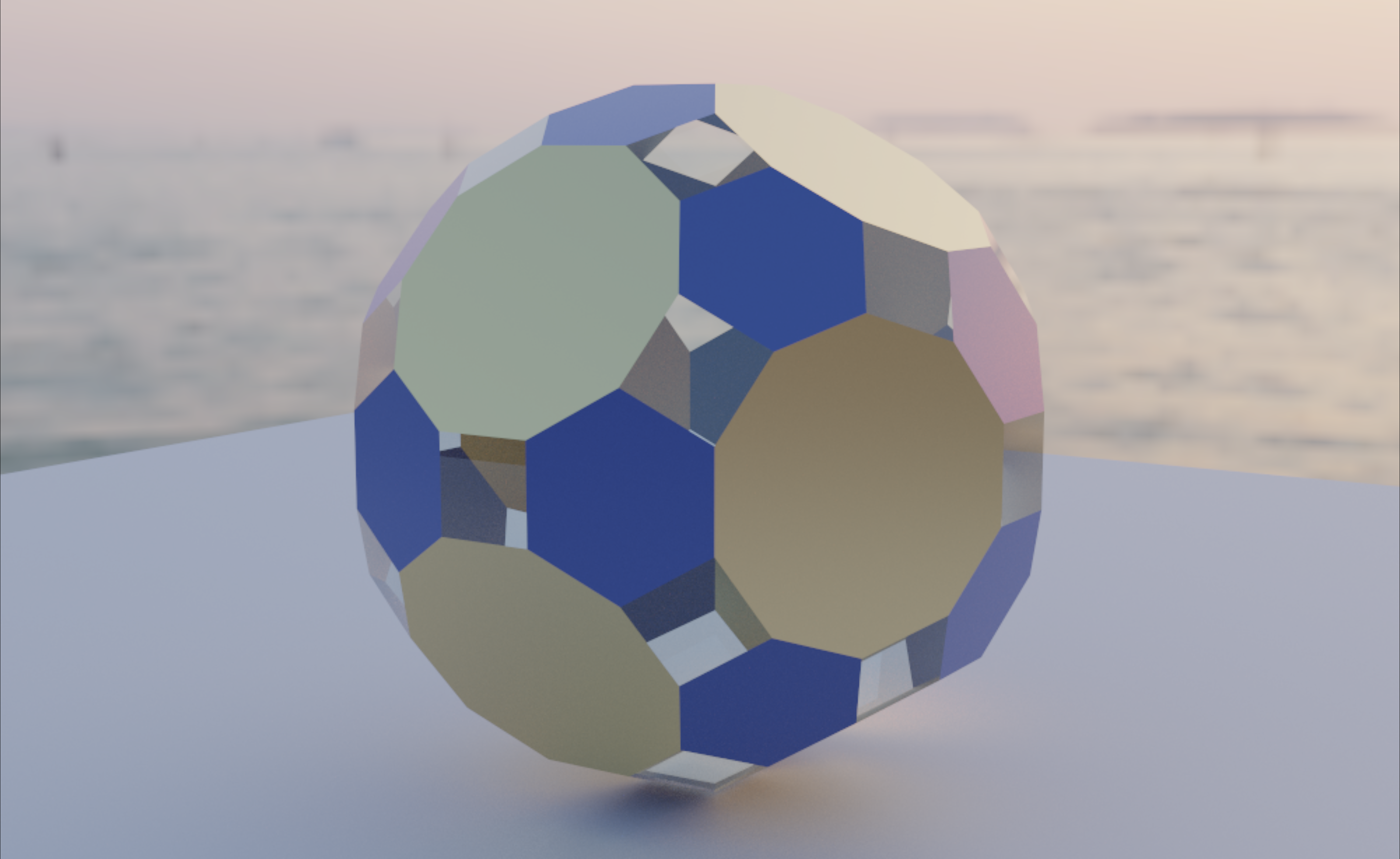
The colours come from the shape's history. Each face of bD descends from exactly one element of the
dodecahedron it was built from, and the rank of that one element picks the material: a face over a
pentagon is gold, a face over an edge is glass, a face over a vertex is blue. So the twelve decagons,
the thirty squares and the twenty hexagons in that picture are the dodecahedron's twelve faces,
thirty edges and twenty vertices, and the picture is a drawing of the seed's own incidence counts.
Environment: Venice Sunset by Greg Zaal / Poly Haven (CC0), shared with the Fabricate demo assets.
What crosses each hop
| hop | the call | what crosses | what stops here |
|---|---|---|---|
| topology to triangles | triangulate |
positions, indices, and a map from each triangle back to its polygon | nothing; this is the only hop that carries provenance forwards |
| triangles to a solid | toSolid |
positions and indices | the triangle-to-polygon map. The binding hands Manifold three floats per vertex and nothing else |
| a solid back to triangles | toTriMesh |
positions, indices, optionally split normals | any correspondence with the triangles that went in. A Boolean retriangulates |
| triangles to a scene | importTriMesh |
positions, normals, a material per triangle | zero-area triangles, which are counted and skipped |
Provenance crosses the first hop and stops at the second, so a per-face material has to be assigned
before any Boolean. triangulate returns a TriangulatedGeometry, and sourceFace(t) on it names
the polygon triangle t was cut from, so the material selector is a lineage lookup with nothing in
between:
val chain = canonicalConway("bD")
val geometry = chain.polyhedron.triangulate(normals = NormalPolicy.Flat)

val scene = PathTraceScene()
val gold = scene.material(PathTraceMaterial.metal(1.0f, 0.73f, 0.31f, 0.32f))
val glass = scene.material(PathTraceMaterial.thinGlass(1.52f, Vector3f(0.9f, 0.97f, 0.94f)))
val plastic = scene.material(PathTraceMaterial.plastic(0.05f, 0.09f, 0.34f, 0.3f))

scene.importTriMesh(
    geometry.mesh,
    { t ->
        // Bevel sends every output face back to exactly one element of the seed, so `single()` is
        // safe here and throws the moment that stops being true.
        when (chain.sourceElements(geometry.sourceFace(t)).single().rank) {
            2 -> gold
            1 -> glass
            else -> plastic
        }
    },
)
Thin glass rather than solid glass, for the thirty squares
Solid glass measures its attenuation between surface crossings, so it assumes a closed,
outward-wound, non-overlapping mesh. A single face of a closed polyhedron is a patch, not a
volume, and thinGlass is the material for a patch.
Roughness 0.32 on the gold is a choice about the environment rather than about the metal. A decagon is flat and large, and a flat mirror that size returns one direction of a hazy sky, which reads as pale. Spreading the specular lobe averages the map and the gold tint comes back.
The numbers each hop owes the next
Run this to read the counts off your own build. It needs no renderer: everything up to the trace is CPU work.
:::static
import afield.geometry.solid.manifold.*

val thickness = 0.09 // wall thickness, in the polytope's own units; the shape spans about 2

val chain = canonicalConway("bD")
val geometry = chain.polyhedron.triangulate(normals = NormalPolicy.Flat)

/*
The triangulator cuts each polygon on its own, so a corner shared by three faces comes out as
three vertices. Weld before handing it over: being a manifold is a property of the indices, and
unwelded vertices describe the same surface while sharing an edge nowhere.
*/
val plain = geometry.mesh.weld(1e-6)

:::fold measure every hop, then lay the numbers out
val topology = chain.polyhedron.topology
val byRank = topology.elements(2).groupBy { chain.sourceElements(it.id).single().rank }
val censusRows =
    byRank.keys.sortedDescending().joinToString("\n") { rank ->
        val group = byRank.getValue(rank)
        val sides = group.map { topology.faceCycle(it.id).size }.distinct().sorted()
        val seed = ["a vertex", "an edge", "a pentagon"].getOrElse(rank) { "?" }
        "| rank $rank, $seed | ${group.size} | ${sides.joinToString(", ")} |"
    }

Solid.scope {
    val solid = plain.toSolid()

    /*
    Erode by a ball, then subtract. What is left is the set of points within `thickness` of the
    surface, so the wall is that thick everywhere. Scaling the solid down instead gives a wall
    thicker at the vertices than at the face centres, which looks similar and is a different shape.
    */
    val ball = Solid.sphere(thickness, segments = 24)
    val wall = solid - solid.minkowskiDifference(ball)
    val cut = wall.trimByPlane(0.0, -1.0, 0.0, 0.0).checked("cut shell")

    val volumeGap = kotlin.math.abs(plain.signedVolume() - solid.volume)
    val ratio = wall.volume / (solid.surfaceArea * thickness)

    // Content at column zero, because `$censusRows` is several lines that begin there: an indented
    // block plus trimIndent would leave the rest indented far enough to read as code.
    markdown(
        "chain",
        """
#### `canonicalConway("bD")`, and where each face came from

| the seed element a face descends from | faces | sides each |
|---|---|---|
$censusRows

The dodecahedron has 12 faces, 30 edges and 20 vertices. The polytope arrives as
${geometry.triangleCount} triangles over ${geometry.mesh.vertexCount} vertices as the triangulator
left them, and ${plain.vertexCount} after welding.

#### The same surface, measured by two implementations that share no code

| | Manifold | Field's own mesh code |
|---|---|---|
| closed | `${solid.status}` | `${plain.isWatertight()}` |
| genus | ${solid.genus} | ${plain.genus()} |
| volume | ${solid.volume.f4} | ${plain.signedVolume().f4} |
| surface area | ${solid.surfaceArea.f4} | |

They are ${"%.2e".format(volumeGap)} apart on the volume.

#### Eroded by a ball of radius $thickness, then cut open

| | |
|---|---|
| wall volume | ${wall.volume.f4} |
| area × thickness | ${(solid.surfaceArea * thickness).f4}, so the ratio is ${ratio.f3} |
| wall genus | ${wall.genus} |
| wall triangles | ${wall.triangleCount} |
| cut open | genus ${cut.genus}, volume ${cut.volume.f4} |
""",
        width = 860,
    )
    Unit
}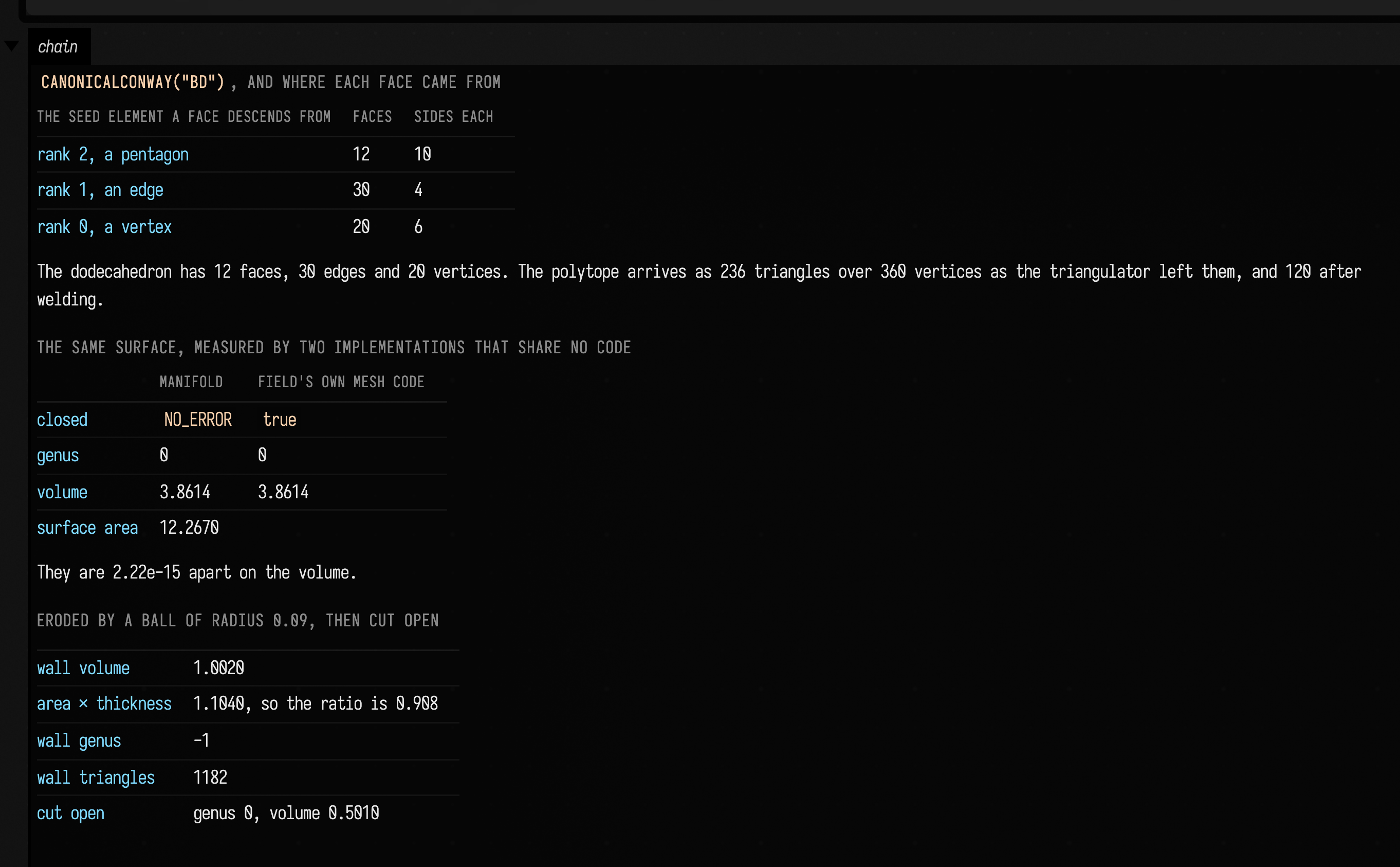
Four of those numbers are cross-checks rather than reports.
- 120 welded vertices. The truncated icosidodecahedron has 120 vertices, so the weld recovering exactly that number says the triangulator's duplicated corners were duplicates and not a shape.
- Two volumes that agree. Manifold integrates the solid in double precision; Field sums signed
tetrahedra over float triangles in
signedVolume. They share no code, so a disagreement here points at the bridge rather than at either of them. - Genus 0 twice. Field's
genus()reads indices and Manifold'sgenusreads its own half-edge structure. - Area times thickness. A wall of constant thickness over a convex body has volume
A·tless a curvature term, so the ratio has to land a little under one. Reading exactly one would mean the erosion had not happened; reading far under it would mean the thickness was not constant.
The shell's genus is −1. Manifold reports genus from the Euler characteristic of the whole boundary;
a closed shell has two boundary components, two spheres give χ = 4, and g = (2 − χ) / 2 is then
−1. decompose() is how to get at components separately.
Through the Booleans, and back out to the tracer
The second render erodes bD into a shell of constant thickness, cuts it in half with a plane, and
traces the lower half as a bowl.
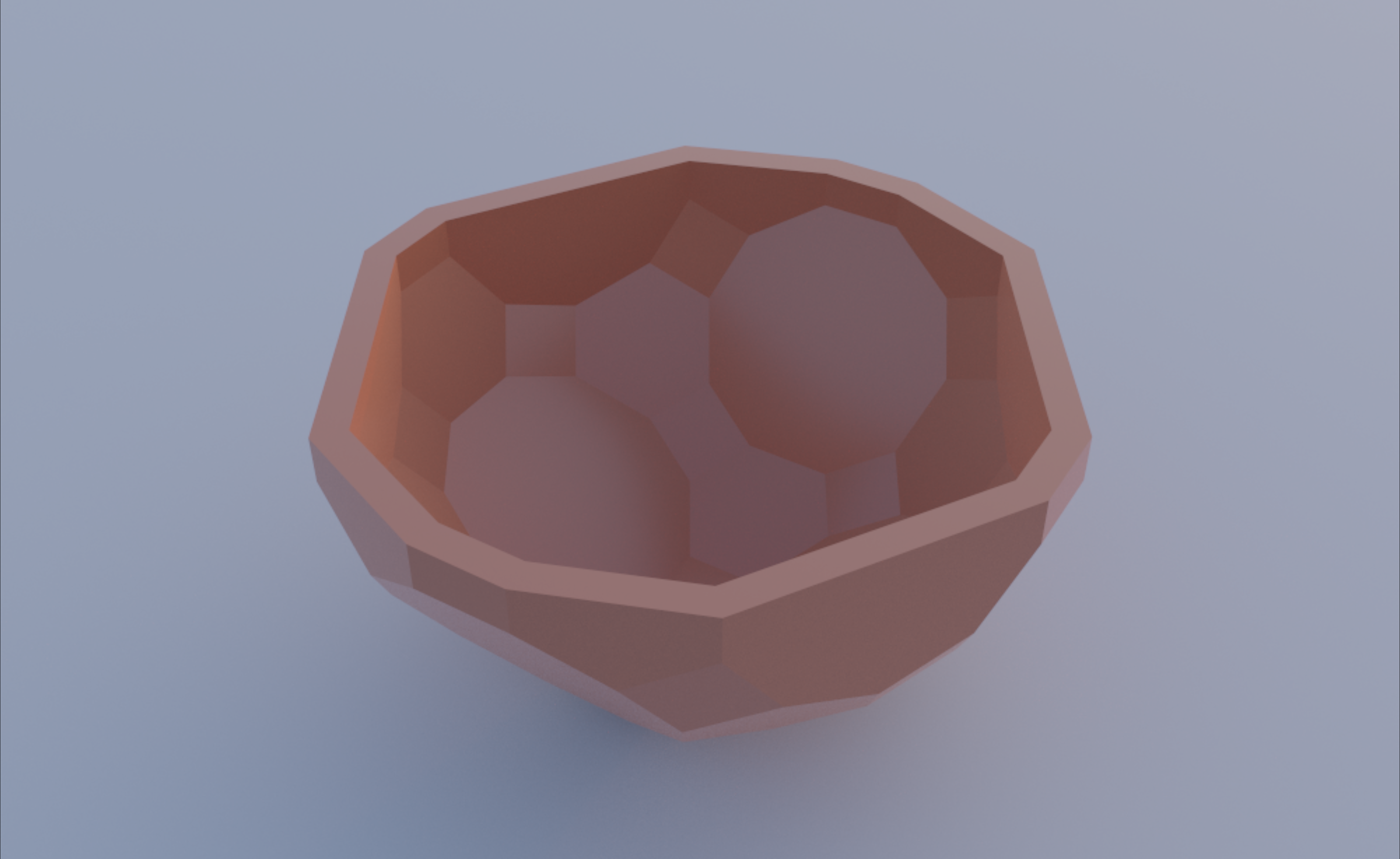
The rim is the same thickness the whole way round: erosion keeps the thickness constant. The interior facets are rounded where the exterior ones are sharp, because eroding by a ball cannot reproduce a concave corner tighter than the ball.
Two details of the last hop are worth copying:
// A 20-degree crease rather than the default 60. This surface is all facets, and at 60 the shallow
// ones average together and the polytope stops reading as one.
val shaded = cut.toTriMesh(normals = true, minSharpAngle = 20.0)

val added = scene.importTriMesh(shaded, body)
println("${added.triangleCount} triangles appended, ${added.degenerateCount} dropped")
Manifold's output of a Boolean followed by a plane trim contains a few triangles of zero area; the
scene skips them, and degenerateCount says how many.
Where each piece is documented
- Polytopes & the Conway Algebra for the topology, the operator algebra and the lineage queries, and Polytopes for the declarations.
- Solids & Booleans (Manifold) for the Boolean layer, the status model and what it refuses.
- Progressive Path Tracing for the tracer: materials, camera, environment maps, convergence and the two traversal backends.
- Particles, welded, and traced is the same last two hops with a cloth simulation at the front instead of a polytope.