A polytope, canonicalised, and sliced into layers
Start with a polytope in Conway notation and you can turn it into a stack of slices, like the layers a 3D printer would print. Along the way we'll make the shape canonical (every edge touching one common sphere; see below) and check what the slices tell us about the resulting solid.
afield.geometry.polytope builds and canonicalises the shape; afield.geometry.solid.manifold
handles the closed solid. Solid.slice cuts it with a plane and returns the 2D contours.
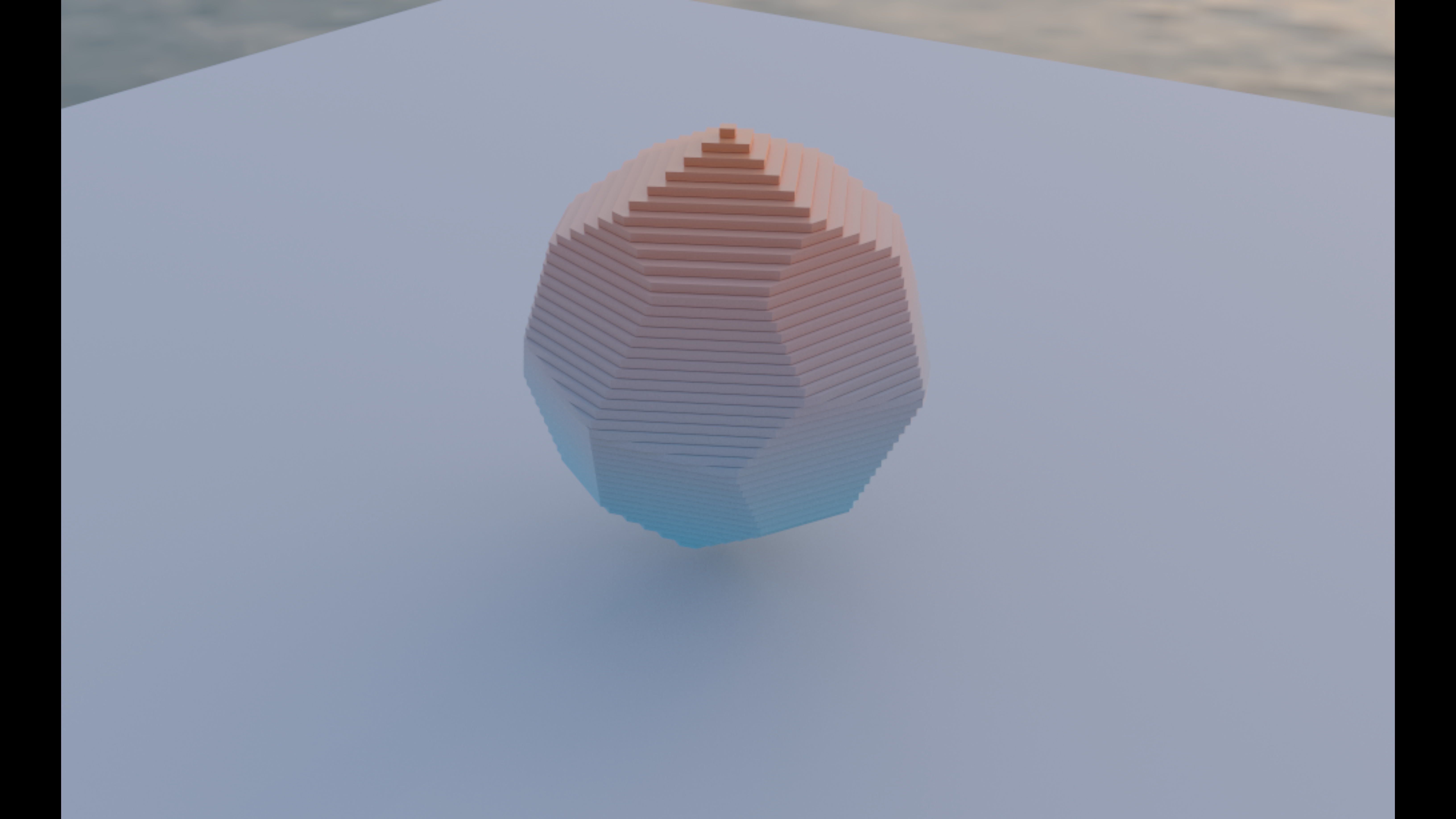
Forty-eight extruded slices of canonical gC, scaled to volume one. Colour follows height; the small gaps make the individual layers visible.
Canonicalising a polytope can change its layers a great deal while leaving the number of contours on each layer alone. The layer stack also checks the polytope itself: its areas have to add up to the solid's volume, and when they do not, the surface passes through itself.
A polytope, cut open, and traced starts from the same polytopes and ends in a path-traced picture instead.
Cutting exactly on a face, a vertex, or the top
A slicer meets this case on every part with a flat top. This box asks what slice returns when the
cutting plane is exactly a face plane, exactly a vertex, or exactly the top of the bounding box.
:::static
import afield.geometry.solid.manifold.Solid

// Geometry with closed-form answers only, so nothing below rests on a tolerance.
val rows = mutableListOf<List<Any?>>()
fun cut(what: String, solid: Solid, z: Double) {
    solid.slice(z).use { s ->
        // Nine decimals, because two of these cuts are one part in a billion apart and a
        // table that printed both as 1.000000 would read as a contradiction.
        rows += [what, z.f9, if (s.isEmpty) "—" else s.area.f4, s.contourCount]
    }
}

Solid.scope {
    val cube = Solid.cube(2.0, 2.0, 2.0, center = true) // faces at z = ±1
    cut("2×2×2 cube, through the middle", cube, 0.0)
    cut("… exactly on the bottom face plane", cube, -1.0)
    cut("… exactly on the top face plane", cube, 1.0)
    cut("… one part in a billion below the top", cube, 1.0 - 1e-9)
    cut("… one part in a billion above it", cube, 1.0 + 1e-9)

    val onBed = Solid.cube(2.0, 2.0, 2.0) // the same cube, sitting on z = 0
    cut("the same cube on the bed, at z = 0", onBed, 0.0)
    cut("… at z equal to its own height", onBed, 2.0)

    // A 4×4×1 slab with a 2×2×1 block on top of it. z = 1 is the slab's top face *and* the
    // block's bottom face, so it is the case that separates the two possible rules.
    val step = (Solid.cube(4.0, 4.0, 1.0) + Solid.cube(2.0, 2.0, 1.0).translated(1.0, 1.0, 1.0)).checked("step")
    cut("a 4×4 slab with a 2×2 block on it, just below the step", step, 0.999999)
    cut("… exactly on the step", step, 1.0)

    val cone = Solid.cone(2.0, 1.0, segments = 256, center = true)
    cut("a cone, exactly through its apex vertex", cone, cone.bounds.max.z.toDouble())
    val tet = Solid.tetrahedron()
    cut("a tetrahedron, exactly on its topmost edge", tet, tet.bounds.max.z.toDouble())
    cut("… and on its lowest edge", tet, tet.bounds.min.z.toDouble())

    /*
    The prediction. Two unit cubes touching along one edge at z = 0.5: the lower one ends
    there, the upper one begins there. If only material above the plane answers, exactly one
    square comes back, and it is the upper cube's — centred at x = 1 rather than x = 0.
    */
    val pair = Solid.compose(
        [
            Solid.cube(1.0, 1.0, 1.0, center = true),
            Solid.cube(1.0, 1.0, 1.0, center = true).translated(1.0, 0.0, 1.0),
        ],
    )
    pair.slice(0.5).use { s ->
        val centre = (s.bounds.first.x + s.bounds.second.x) / 2.0
        rows +=
            listOf(
                "two unit cubes meeting along one edge, cut on it",
                "0.500000000",
                s.area.f4 + " centred at x = %.4f".format(centre),
                s.contourCount,
            )
    }
    Unit
}

markdown("cuts", Table(["the cut", "z", "area", "contours"]).rows(rows).h, width = 1040)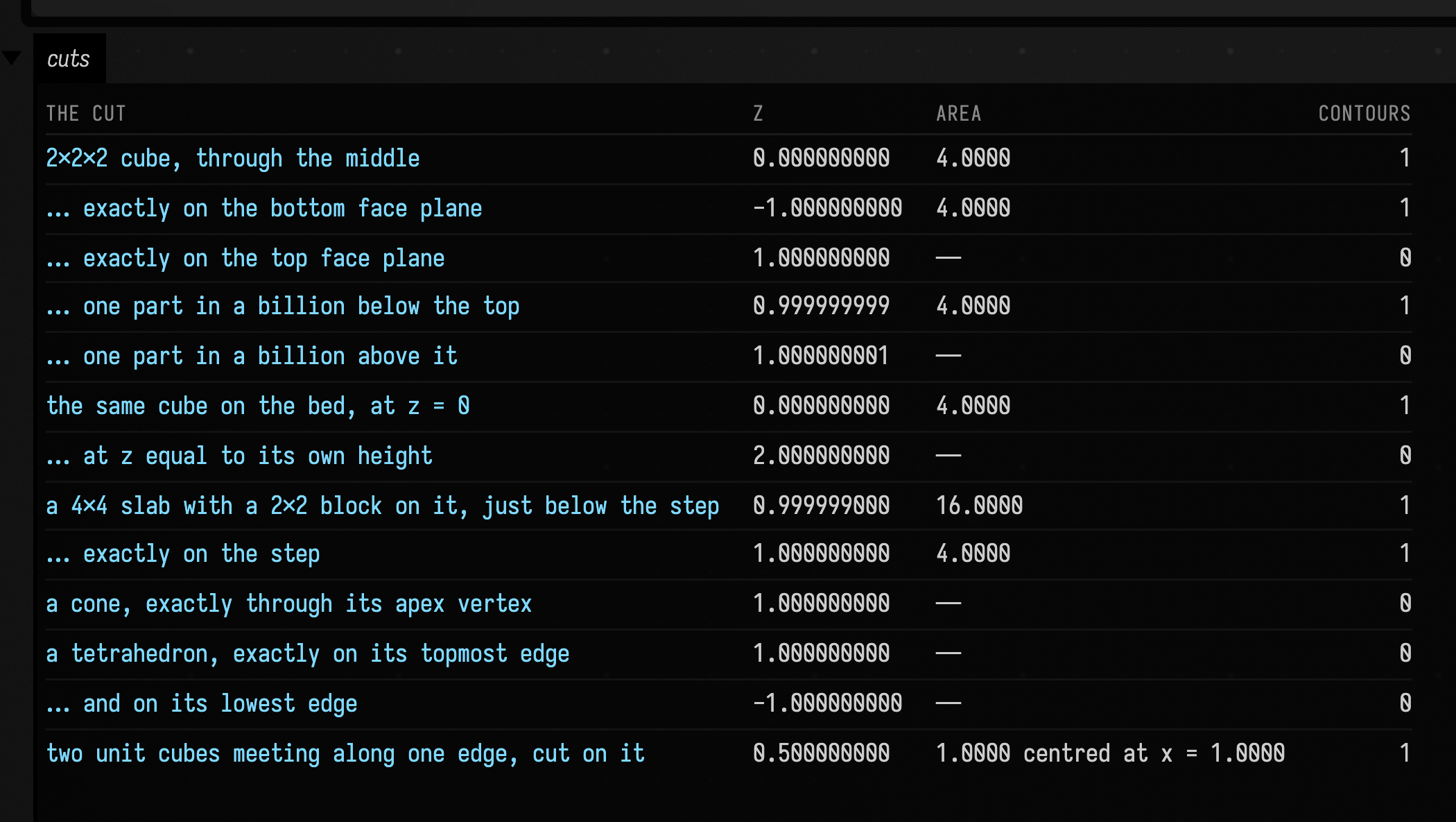
The cuts all follow one rule:
slice(z)returns the cross-section of the material at and abovez. A face lying in the cutting plane counts when the solid is above it and does not count when the solid is below it.
So a cube spanning \( [-1, 1] \) returns its whole bottom face at \( z = -1 \) and nothing at z = +1. Cut
a hair below the top and the top face is back. On the step, a cut just below z = 1 returns the
wide slab, and a cut at exactly z = 1 returns only the narrow block above it. Two cubes stacked
corner to corner return only the upper one's square at the plane where they touch.
Zero-area contacts return nothing: a cone cut through its apex, and a tetrahedron cut on either of its two horizontal edges. A point and a segment have no area, so there is no region to hand back.
What this means for a layer ladder
Put the cuts at layer midpoints, not at layer boundaries. Boundaries land on face planes on exactly the parts most likely to have them — anything designed flat — and a boundary ladder on a part whose height is an exact multiple of the layer height loses its top layer outright. Every stack below is \( z = z_{\min} + h\,(i + \tfrac{1}{2})/n \).
Canonicalisation, scale and orientation
canonicalize() seeks the representative with every edge tangent to one common sphere, the centroid
of those tangency points at the origin, and every face planar
(Polytopes & the Conway Algebra has the guarantees). Getting there involves
a fixed scale: the mean tangency radius is driven to one. So the canonical form comes out at a
different size from the raw form, and comparing their slices as they are would mostly compare sizes.
The box therefore scales each form to enclosed volume exactly 1 and moves it so z = 0 is its lowest
point: the same amount of material, sitting on the print bed.
Orientation matters too. Vertex indexing survives canonicalisation, so the box measures how far each vertex's direction from the centroid turns. If the largest turn is small, one set of cutting planes cuts both forms comparably.
:::static
import afield.geometry.solid.manifold.Solid
import afield.geometry.solid.manifold.toSolid
import afield.media.image.util.PngEncoder

val LAYERS = 48
val PANEL = 600

:::fold the chain, the bed gauge, the layer stack, and a plan-view rasteriser
/*
Conway notation to a Manifold solid. The triangulator cuts each polygon on its own, so a
corner shared by three faces arrives as three vertices; weld before handing it over,
because being a manifold is a property of the indices.
*/
fun solidOf(p: PolyhedralObject): Solid = p.triangulate(normals = NormalPolicy.Flat).mesh.weld(1e-6).toSolid()

// Enclosed volume exactly 1, lowest point at z = 0, centred in x and y. Without this,
// every area below would be a statement about the canonicaliser's scale gauge.
fun onTheBed(s: Solid): Solid {
    val k = s.scaled(1.0 / Math.cbrt(s.volume))
    val b = k.bounds
    return k.translated(-b.center.x.toDouble(), -b.center.y.toDouble(), -b.min.z.toDouble())
}

fun centroidOf(v: List<Vec3>): Triple<Double, Double, Double> = Triple(
    v.sumOf { it.x.toDouble() } / v.size,
    v.sumOf { it.y.toDouble() } / v.size,
    v.sumOf { it.z.toDouble() } / v.size,
)

/*
The largest and mean angle any vertex's direction from the centroid turns through.
Canonicalisation keeps the vertex indexing, so this is a true per-vertex comparison
rather than a shape descriptor that might agree by accident.
*/
fun directionTurn(a: PolyhedralObject, b: PolyhedralObject): Pair<Double, Double> {
    val p = a.realization!!.vertexCoordinates
    val q = b.realization!!.vertexCoordinates
    val cp = centroidOf(p)
    val cq = centroidOf(q)
    var worst = 0.0
    var total = 0.0
    for (i in p.indices) {
        val ux = p[i].x - cp.first
        val uy = p[i].y - cp.second
        val uz = p[i].z - cp.third
        val vx = q[i].x - cq.first
        val vy = q[i].y - cq.second
        val vz = q[i].z - cq.third
        val nu = sqrt(ux * ux + uy * uy + uz * uz)
        val nv = sqrt(vx * vx + vy * vy + vz * vz)
        if (nu < 1e-9 || nv < 1e-9) continue
        val d = Math.toDegrees(acos(((ux * vx + uy * vy + uz * vz) / (nu * nv)).coerceIn(-1.0, 1.0)))
        if (d > worst) worst = d
        total += d
    }
    return worst to total / p.size
}

// A plan view of a whole layer stack, drawn with no AWT: the stack seen from overhead,
// each contour coloured by how far up it sits.
fun mark(px: IntArray, w: Int, x: Int, y: Int, c: Int) {
    if (x >= 0 && x < w && y >= 0 && y < PANEL) px[y * w + x] = c
}

fun segment(px: IntArray, w: Int, x0: Double, y0: Double, x1: Double, y1: Double, c: Int) {
    val steps = maxOf(abs(x1 - x0), abs(y1 - y0)).toInt() + 1
    for (s in 0..steps) {
        val t = s.toDouble() / steps
        mark(px, w, (x0 + (x1 - x0) * t).toInt(), (y0 + (y1 - y0) * t).toInt(), c)
    }
}

fun heightColour(t: Double): Int {
    // Cyan at the bed, orange at the top: the signal palette's two leads.
    val r = (0x7a + (0xff - 0x7a) * t).toInt()
    val g = (0xd9 + (0x9e - 0xd9) * t).toInt()
    val b = (0xff + (0x4a - 0xff) * t).toInt()
    return (0xFF shl 24) or (r shl 16) or (g shl 8) or b
}

fun plan(stacks: List<List<List<List<Vec2>>>>): ByteArray {
    val w = PANEL * stacks.size
    val px = IntArray(w * PANEL) { 0xFF0D1017.toInt() }
    // One scale for every panel, or the comparison would be about the framing.
    var reach = 1e-9
    for (stack in stacks) for (layer in stack) for (ring in layer) for (p in ring) {
        reach = maxOf(reach, abs(p.x).toDouble(), abs(p.y).toDouble())
    }
    val k = (PANEL / 2.0 - 16.0) / reach
    stacks.forEachIndexed { panel, stack ->
        val ox = panel * PANEL + PANEL / 2.0
        stack.forEachIndexed { i, layer ->
            val colour = heightColour(i.toDouble() / maxOf(1, stack.size - 1))
            for (ring in layer) {
                for (j in ring.indices) {
                    val a = ring[j]
                    val b = ring[(j + 1) % ring.size]
                    segment(
                        px,
                        w,
                        ox + a.x * k,
                        PANEL / 2.0 - a.y * k,
                        ox + b.x * k,
                        PANEL / 2.0 - b.y * k,
                        colour,
                    )
                }
            }
        }
    }
    return PngEncoder.encode(px, w, PANEL)
}

:::

val rows = mutableListOf<List<Any?>>()
val profiles = mutableListOf<Pair<String, List<Number>>>()
val panels = mutableListOf<List<List<List<Vec2>>>>()

for (expression in ["gC", "gD"]) {
    val raw = conway(expression).polyhedron
    val canonical = raw.canonicalize().polyhedron
    val turn = directionTurn(raw, canonical)

    Solid.scope {
        for (label in ["raw", "canonical"]) {
            val solid = onTheBed(solidOf(if (label == "raw") raw else canonical))
            val height = solid.bounds.max.z.toDouble()
            // Copy area and contours while the native section is open; it closes after each callback.
            val sampled = solid.sampleSlices(LAYERS) { _, section -> section.area to section.toPolygons() }
            val a = sampled.map { it.first }
            val layers = sampled.map { it.second }
            profiles.add("$expression $label" to a)
            if (expression == "gC") panels.add(layers)
            rows.add(
                [
                    "$expression, $label",
                    height.f6,
                    solid.surfaceArea.f6,
                    "%.6f".format(a.sumOf { it } * height / LAYERS),
                    layers.sumOf { it.size },
                    a.min().f6,
                    a.max().f6,
                    if (label == "raw") "" else "%.2f° / %.2f°".format(turn.first, turn.second),
                ],
            )
        }
        Unit
    }
}

display("plan", plan(panels))
markdown(
    "forms",
    Table(
            [
                "form",
                "height",
                "surface",
                "Σ area·h/n",
                "contours over $LAYERS layers",
                "smallest layer",
                "largest layer",
                "vertex turn, worst / mean",
            ],
        )
        .rows(rows)
        .h,
    width = 1180,
)
showSignals(
    profiles[0],
    profiles[1],
    profiles[2],
    profiles[3],
    x = (0 until LAYERS).map { (it + 0.5) / LAYERS },
    channel = "profile",
    xTitle = "height, as a fraction of the object's own",
    yTitle = "layer area (each form has volume 1)",
)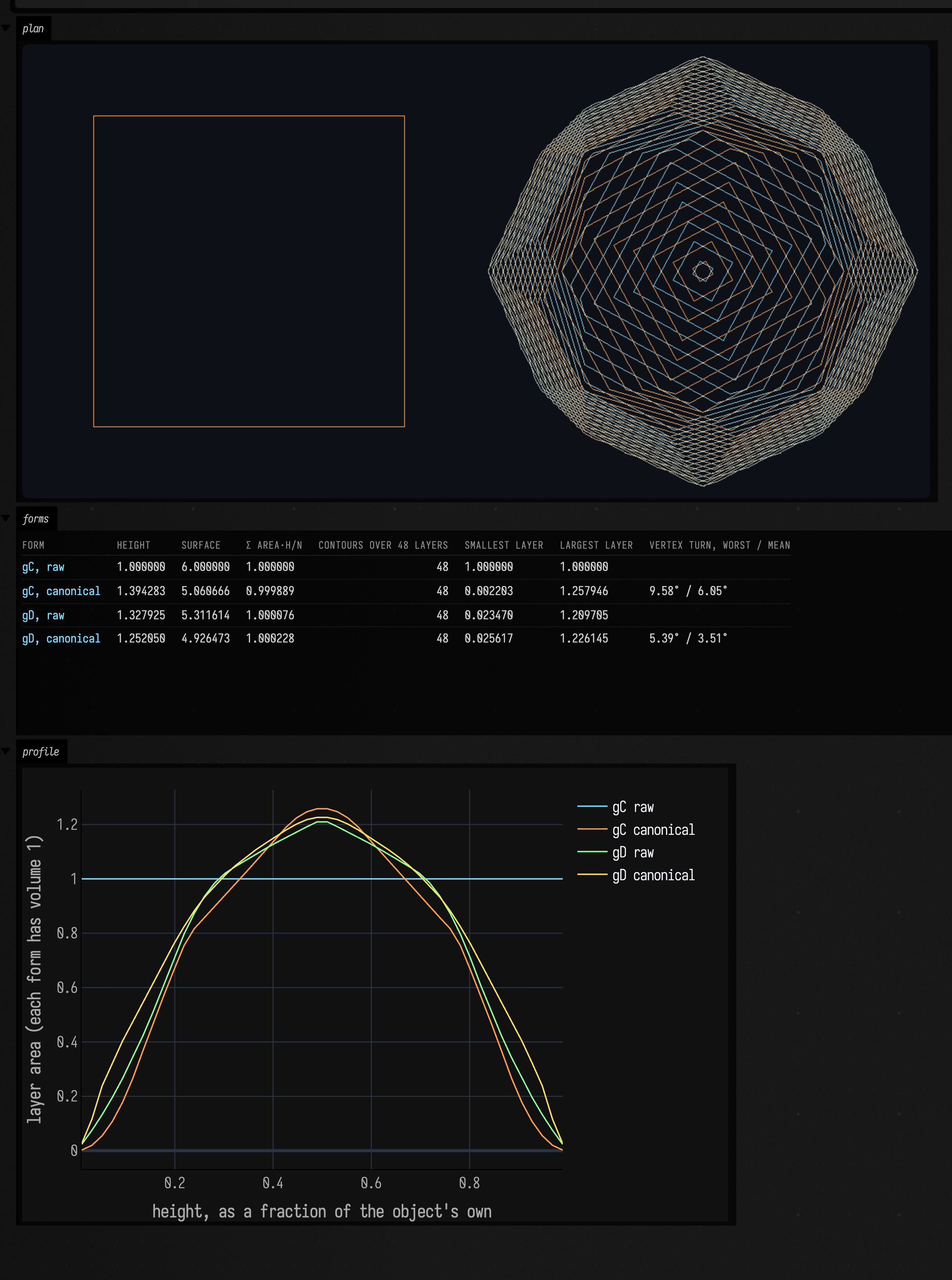
In the left panel every layer of raw gC is the same square. Gyro applied to the cube adds new
vertices, but before canonicalisation every one of them lies on the cube's own surface, so the solid
that comes out is still a unit cube. The new faces are there in the topology and not yet in the
shape.
Canonicalised, the same topology becomes the pentagonal icositetrahedron: taller, with less surface
at the same volume, and with layers that start almost at zero area on the bed and swell in the
middle. gD changes less, but its layers still differ noticeably.
The table shows two more things:
- The number of contours does not change. Both forms of each polytope have one island per layer and no holes. Canonicalisation moves every contour and splits none, so the questions a slicer cares most about (how many islands, does this layer need support) get the same answers.
- Canonicalisation rounds the form. At equal volume the canonical forms have less surface than
the raw ones, and the canonical
gDcomes within a few percent of a sphere, which no solid can beat.
The vertex turns are small for both polytopes, so the two stacks are cut along nearly the same axis and the differences in the plot come from the shape, not from a rotation.
kkC, and the solver that reaches it
As the layers get thinner, a midpoint Riemann sum over their areas should approach the volume of
the solid. The two calculations share no code: the area integral works on regions in 2D, while
Manifold's volume works on the surface in 3D. Comparing them can reveal a problem with the solid.
Every form above sums correctly. kkC (kis, which raises a pyramid on every face, applied twice to the cube) is a polytope that
canonicalize() cannot make canonical, and
Polytopes & the Conway Algebra uses it as its counter-example. The Ceres
solver, relaxWithCeres, does meet every canonical condition, though, as the bottom row shows,
not as a solid. This box tries both and slices each result.
:::static
import afield.geometry.solid.manifold.FillRule
import afield.geometry.solid.manifold.Solid
import afield.geometry.solid.manifold.toSolid

// relaxWithCeres needs the native wrapper: ./gradlew buildCeresRedistributable
val seed = conway("kkC").polyhedron
val iterated = seed.canonicalize().polyhedron
val solved =
    seed
        .relaxWithCeres(
            RelaxationPlan.canonicalConditions(),
            CeresRelaxationOptions(maxIterations = 500),
        )
        .realization
        .polyhedron

:::fold the same chain, plus a convergence sweep and a fill-rule comparison
// Keep invalid winding here so the table can report its signed volume and status.
fun solidOf(p: PolyhedralObject): Solid =
    p.triangulate(normals = NormalPolicy.Flat).mesh.weld(1e-6).toSolid(check = false)

fun onTheBed(s: Solid): Solid {
    val k = s.scaled(1.0 / Math.cbrt(s.volume))
    val b = k.bounds
    return k.translated(-b.center.x.toDouble(), -b.center.y.toDouble(), -b.min.z.toDouble())
}

// Σ area·h/n over n layers, at the layer midpoints.
fun riemann(s: Solid, n: Int): Double {
    val h = s.bounds.max.z.toDouble() - s.bounds.min.z.toDouble()
    return s.sampleSlices(n) { _, section -> section.area }.sum() * h / n
}

// POSITIVE unions overlapping same-wound contours; EVEN_ODD punches their overlap out. Equal
// areas on every layer means the contours do not overlap, and a gap is twice the overlap.
fun overlap(s: Solid, n: Int = 192): Pair<Int, Double> {
    val h = s.bounds.max.z.toDouble() - s.bounds.min.z.toDouble()
    val positive = s.sampleSlices(n, FillRule.POSITIVE) { _, section -> section.area }
    val evenOdd = s.sampleSlices(n, FillRule.EVEN_ODD) { _, section -> section.area }
    var disagreeing = 0
    var gap = 0.0
    for ((p, e) in positive.zip(evenOdd)) {
        if (abs(p - e) > 1e-9 * maxOf(1.0, p)) disagreeing++
        gap += p - e
    }
    return disagreeing to gap * h / n / 2.0
}

val SWEEP = [12, 24, 48, 96, 192, 384, 768]
:::

val rows = mutableListOf<List<Any?>>()
val sweeps = mutableListOf<Pair<String, List<Number>>>()

Solid.scope {
    for ((label, p) in ["kkC as built" to seed, "canonicalize()" to iterated, "relaxWithCeres()" to solved]) {
        val d = p.canonicalDiagnostics()
        val verdict = when {
            d.isEmbedded -> "a solid"
            d.signedVolume <= 0.0 -> "inside out"
            else -> "${d.selfIntersectingFacePairs} face pairs cross"
        }
        val bare = solidOf(p)
        // Scaling an inside-out body onto the bed would mirror it into looking like one.
        if (d.signedVolume <= 0.0) {
            rows +=
                listOf(
                    label,
                    "%.3e".format(d.tangencyRadiusSpread),
                    verdict,
                    "${bare.status}",
                    bare.genus,
                    bare.volume.f4,
                    "—",
                    "—",
                    "—",
                )
            continue
        }
        val solid = onTheBed(bare)
        val sweep = SWEEP.map { riemann(solid, it) }
        val (disagreeing, over) = overlap(solid)
        sweeps += label to sweep
        rows +=
            listOf(
                label,
                "%.3e".format(d.tangencyRadiusSpread),
                verdict,
                "${bare.status}",
                bare.genus,
                bare.volume.f4,
                sweep.last().f5,
                "$disagreeing / 192, %.6f".format(over),
                (1.0 - 2.0 * over).f5,
            )
    }
    Unit
}

markdown(
    "kkc",
    Table(
            [
                "embedding",
                "tangency spread",
                "canonicalDiagnostics()",
                "Manifold status",
                "genus",
                "signed volume",
                "Σ area·h/n at 768 layers",
                "layers where POSITIVE ≠ EVEN_ODD, overlap",
                "1 − 2·overlap",
            ],
        )
        .rows(rows)
        .h,
    width = 1180,
)
showSignals(
    *sweeps.map { (k, v) -> k to v }.toTypedArray(),
    x = SWEEP,
    channel = "sweep",
    xTitle = "layers in the stack",
    yTitle = "Σ area·h/n (the volume is 1)",
)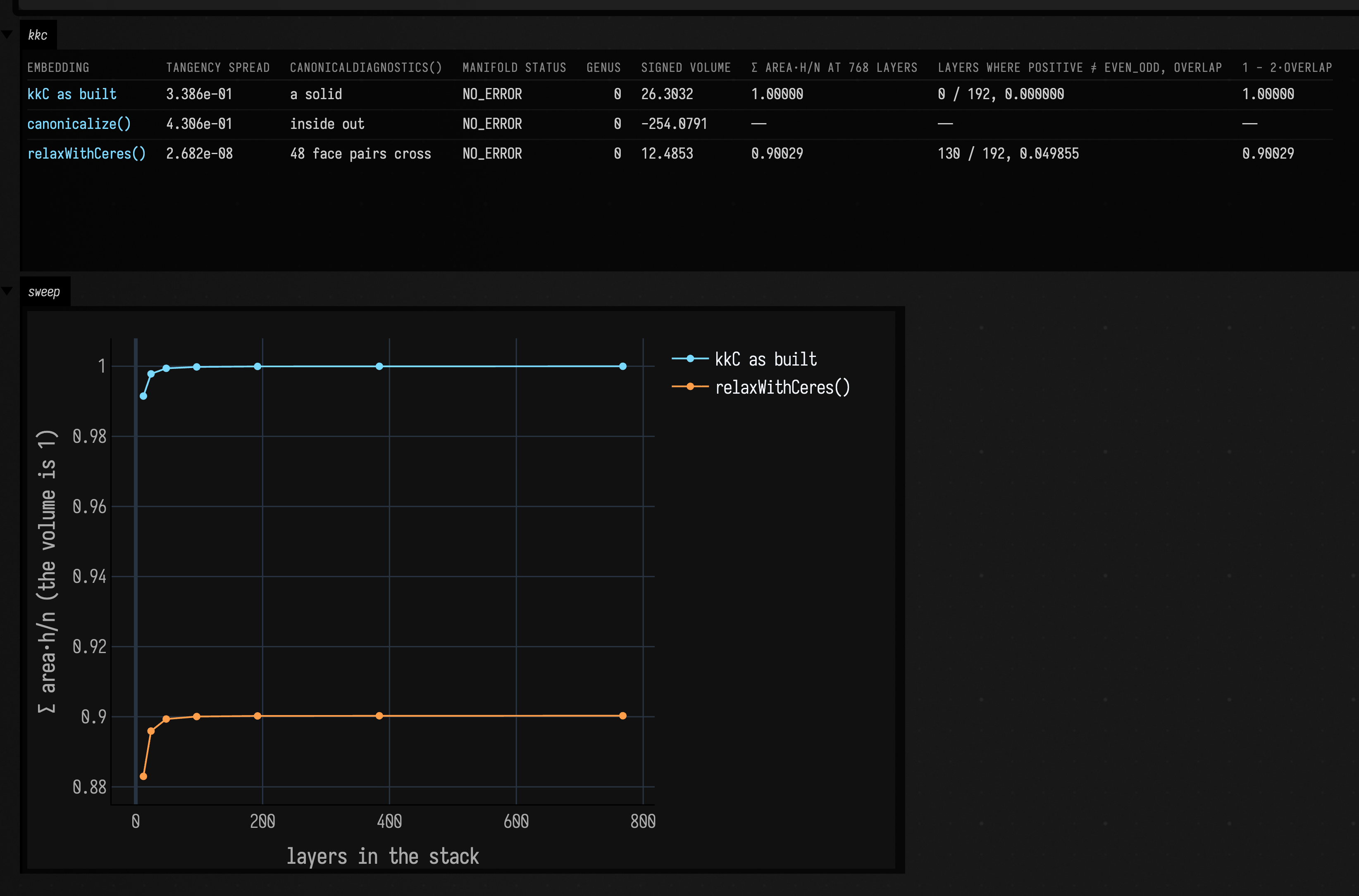
In the middle row, canonicalize() turns kkC inside out: its signed volume goes negative.
Manifold still reports NO_ERROR and genus 0, because a surface that passes through itself can
still be a valid manifold as far as status is concerned. canonicalDiagnostics() reports the
negative signedVolume, so isEmbedded is false and the box does not slice it.
In the bottom row, relaxWithCeres(RelaxationPlan.canonicalConditions()) converges in a few
milliseconds to a positive volume with every canonical condition met, and canonicalDiagnostics()
still says it is not a solid: selfIntersectingFacePairs counts the faces that pass through each
other. The layer stack agrees:
- The Riemann sum levels off below 1 and stays there as the layers get thinner. A sum that is short
only because the layers are coarse keeps climbing, as
kkCas built does in the same plot. FillRule.POSITIVEandFillRule.EVEN_ODDdisagree on most of the layers. On every other form on this page they agree on every layer.- The overlap the fill rules imply accounts exactly for the missing volume.
volume integrates over the boundary and counts the overlapping region twice; the slicer resolves
each layer into a region and counts it once. The riemann and overlap lines in the box are the
same test done with slices, and they work on any solid, not only a polytope.
A Boolean will not find the crossings for you
Intersecting the solid with a box that already contains it returns the same volume it went in with. Manifold's Booleans assume their input does not intersect itself and do not resolve crossings. Compare fill rules instead.
What crosses each hop
| hop | the call | what crosses | what stops here |
|---|---|---|---|
| notation to topology | conway |
the ranked incidence structure, a realization from the operator's own policy, and the lineage | nothing; this hop only adds |
| realization to realization | canonicalize / relaxWithCeres |
the same vertex indexing, so a per-vertex before/after comparison is meaningful | the scale and the centring, both replaced by the canonical scale, which is why every form here is rescaled to volume 1 before anything is compared |
| topology to triangles | triangulate |
positions, indices, and a map from each triangle back to its polygon | shared corners: each polygon is cut on its own, so weld comes next or the surface has no edges |
| triangles to a solid | toSolid |
positions and indices | every attribute, and any guarantee about self-intersection — status checks that the indices describe a manifold, not that the surface avoids itself |
| a solid to a contour | slice |
a Section: contours wound so holes are negative, with an area, a count and decompose() |
the third dimension, and any material strictly below the cutting plane, including a coplanar face the solid sits on top of |
Where each piece is documented
- Polytopes & the Conway Algebra for the operator algebra, the three
realization verbs and the
kkCcounter-example in its own terms, and Polytopes for the declarations. - Solids & Booleans (Manifold) for
Solid,Section, the fill rules and the status model. - A polytope, cut open, and traced is the sibling chain: the same first two hops, then Booleans and a path tracer instead of a slicer.
PolytopeLayerContours.ktruns everything on this page as a single program.