A photograph, closed and mounted
A photograph holds a view of a room, but no explicit depth. Here we'll use one to make a printable
object. The Depth Anything V2 Small model, run through afield.ai.inference.onnx, predicts how far
away everything in the image is. Field's imaging functions
normalise and smooth that prediction, its mesh functions turn it into triangles, and
afield.geometry.solid.manifold closes and combines the result as a solid. The
photo_to_solid_chain starting point has the whole
route as a document you can open.
The photograph is a Vision Pro passthrough frame of a living room, the same one the
ONNX page uses. No depth camera is involved. The model's weights download on the first run
and are cached under ~/.afield/onnx/models after that.
The frame has Field's own interface drawn over the room: a panel, some buttons, a blue triangle and an orange curve. The model cannot tell those from surfaces, and the large dark rectangle in the middle of the depth map is where the semi-transparent panel is. The steps below work on any depth map, but a clean photograph would give a different plaque.
// Built and launched from dev_docs/agents/transcripts/photo_to_solid_chain.yaml.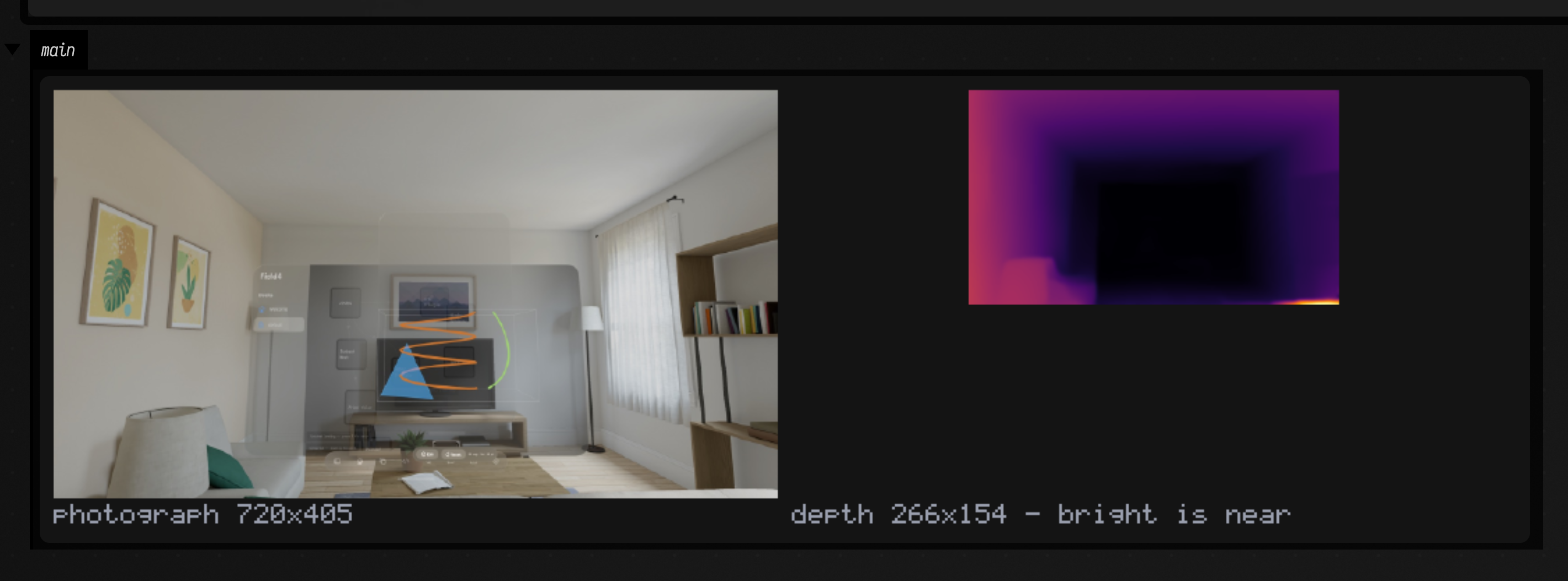
Read the right-hand panel as a height map and the room is concave. The side walls and the near floor are close to the camera, the far wall is not, so the brightest values ring the edges of the frame and the darkest sit in the middle. So the solid this page builds is a basin: the room turned inside out.
Closing a heightfield into a solid
Img.toHeightfieldMesh turns a raster into a surface, but that surface is a sheet with no
underside, and TriMesh.toSolid refuses an open sheet. A sheet is fine for drawing; an exact
Boolean, a volume or a printed object needs a closed solid. TriMesh.repairToSolid does not give
the shape you want either: it fits a lid across the sheet's rim, which encloses only the sliver
between the lid and the surface.
Img.toReliefMesh (and reliefMesh, for a plain grid of heights) drops the rim straight down to a
flat base and floors it, the way a lithophane, a relief map or a stamp is made:
// before: two calls that do not compose
val open = depth.toHeightfieldMesh(scale = 0.35) // χ = 1, one boundary loop
open.toSolid() // refused: not a closed manifold

// after
val plaque = depth.toReliefMesh(scale = 0.35, baseThickness = 0.12) // χ = 2, no boundary loops
plaque.toSolid() // legal
You can predict the size of the mesh before you build it. With \( P = 2n_x + 2n_z \) rim vertices, a
relief has \( (n_x+1)(n_z+1) + P + 1 \) vertices (the grid, the rim at the base, and one centre vertex the
floor fans out from) and \( 2n_x n_z + 3P \) triangles. Its Euler characteristic is 2 at every
resolution, as a closed surface with no holes should be.
The rim winds clockwise in (x, z)
The rim runs clockwise in (x, z), because \( \hat{x} \times \hat{z} = -\hat{y} \): a clockwise loop in those two
coordinates is the one whose right-hand normal points +y. That matches the way the grid quads
wind, so each wall crosses its shared rim edge in the opposite direction, as a consistently
oriented closed mesh requires. Wound the other way, the mesh still renders, with a negative
volume.
What crosses each hop
| hop | the call | what crosses | what stops here |
|---|---|---|---|
| photograph to depth | DepthAnything.infer |
one single-channel map, in the model's own arbitrary units | the photograph's colours, and any absolute scale. The output is inverse relative depth and needs a normalisation window |
| depth to a surface | Img.toReliefMesh |
positions, on one grid vertex per sampled pixel | every pixel between samples. step and the resample before it are where the resolution decision lives |
| a surface to a solid | TriMesh.toSolid |
positions and indices | normals, uvs, colours. The binding hands Manifold three floats per vertex and nothing else |
| a solid through a Boolean | Solid.plus |
a closed surface | any correspondence with the triangles that went in. A Boolean retriangulates |
| a solid to triangles | Solid.toTriMesh |
positions, indices, optionally split normals | watertightness, if you ask for normals — see below |
The plaque
// Built and launched from dev_docs/agents/transcripts/docs_capture/photo_plaque.yaml.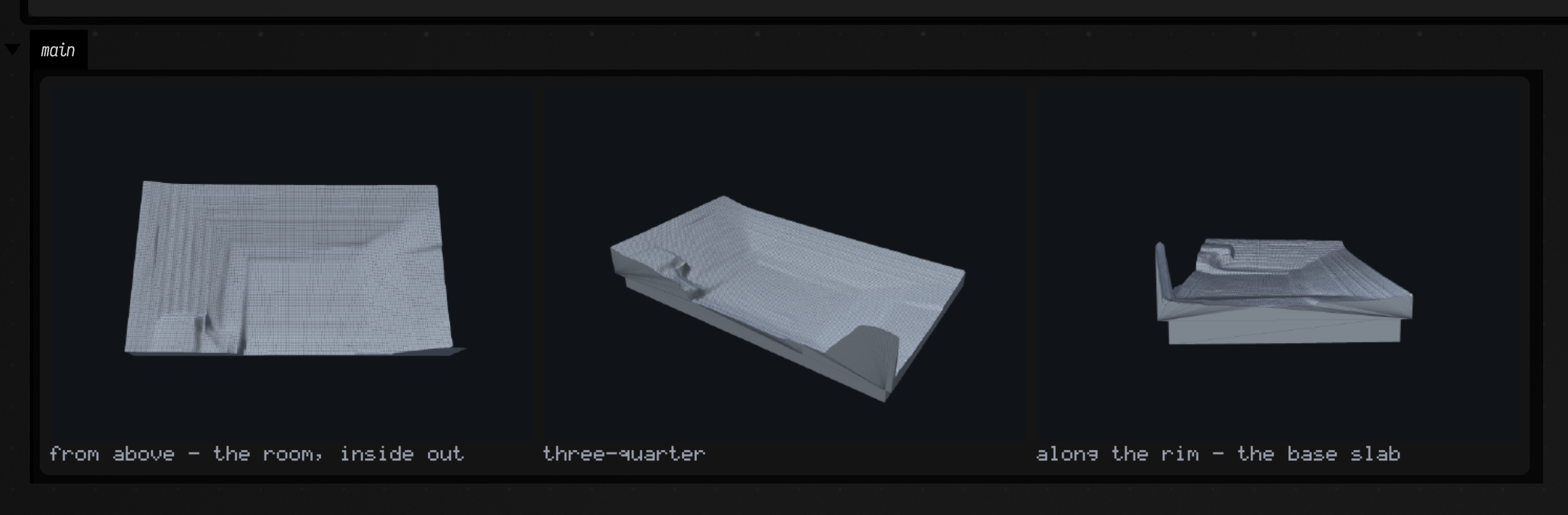
The caption reads watertight=true manifold=true chi=2 and boundary loops=0, where the
heightfield it came from has one boundary loop. Field's signedVolume and Manifold's own volume
agree on the plaque. If you change scale or baseThickness and the plaque stops looking right,
compare those two first.
Mounted in a frame
A picture frame is a slab with a rectangular window, so it is a torus and its genus is 1. Union it
with the plaque and the plaque's base blocks the window, so the assembly's genus is 0. The box
mounts the plaque and reports both.
// Built and launched from dev_docs/agents/transcripts/photo_to_solid_chain.yaml.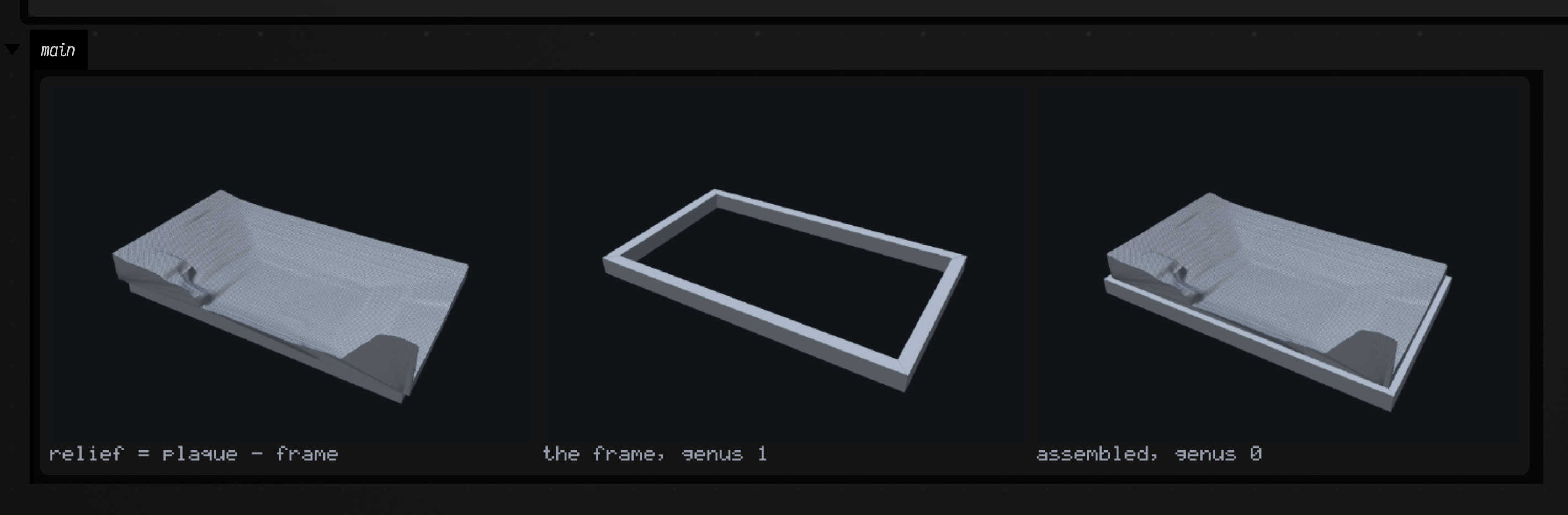
The identity in that readout is inclusion–exclusion, which holds for any two solids at all:
vol(A ∪ B) + vol(A ∩ B) = vol(A) + vol(B)It is a quick check on any Boolean. A union that dropped a component, a difference that kept a coincident face, or an intersection that misclassified a shell changes one side and not the other. The companion \( \mathrm{vol}(A - B) = \mathrm{vol}(A) - \mathrm{vol}(A \cap B) \) is checked in the same box.
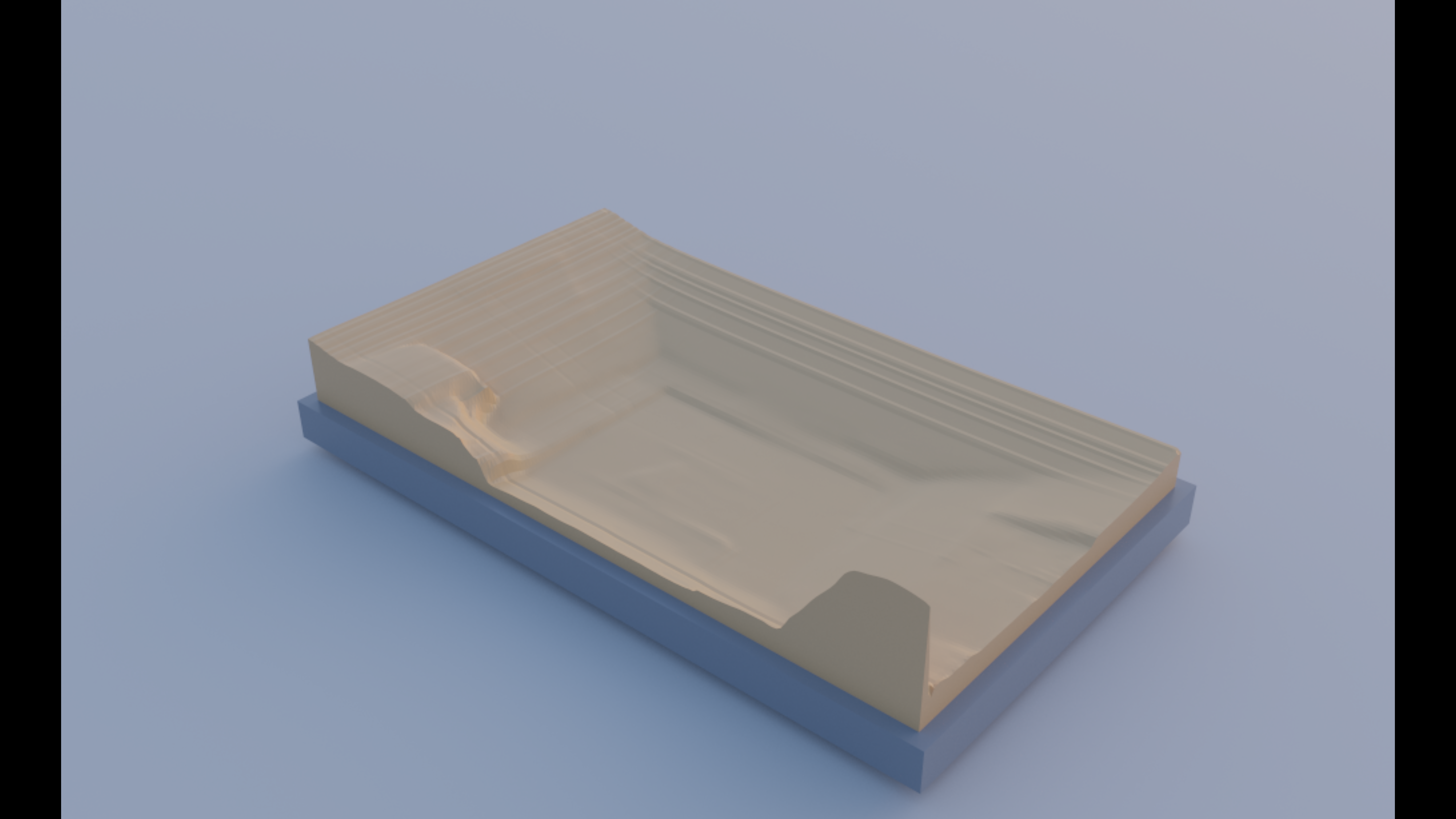
The renders come from TriMesh.renderPng, a CPU rasteriser with a depth-tested wireframe. It does
not use AWT, so it is safe to call from a box on macOS. For a lit picture instead of a wireframe,
the same mounted relief and its frame can go through the GPU path tracer:
Asking for normals breaks the round trip
A renderer wants toTriMesh(normals = true), but a mesh made that way cannot go back through
toSolid. Manifold refuses it, and MeshDiagnosis says why:
this TriMesh is not a valid manifold: NOT_MANIFOLD.
mesh: 18389 vertices, 35578 triangles, chi=7, 11 component(s)
2 blocking defect(s) — Manifold will refuse this mesh.
1. [BLOCKING] UNWELDED_VERTICES x598
     598 of 18389 vertices are duplicates within 1.0E-6; until they are merged every seam reads as a hole
     fix: TriMesh.weld(1.0E-6)
2. [BLOCKING] OPEN_BOUNDARY x1186
     1186 boundary edges in 15 traced loop(s), edge counts [457, 195, 180, 178, 103, 30, 10, 6] …
normals = true splits a vertex wherever two faces disagree about the surface direction, and being a
manifold is a property of the indices: two vertices at one position that share an edge nowhere
read as a line of holes. The Manifold page gives the rule: ask for toTriMesh()
when you are measuring and toTriMesh(normals = true) when you are drawing. Pass the unsplit mesh
along and let each renderer add normals itself, as renderPng does.
Two constructions of the same solid
Marching an image as a field gives the same surface Img.toHeightfieldMesh builds directly, to
about one marching cell. One walks a grid in Kotlin; the other is Manifold's own marcher, calling
back into Kotlin for each sample. Either gets a plaque out of a depth map, and Img.asHeightSdf is
the entry point to the second. This box builds both and compares them.
// Built and launched from dev_docs/agents/transcripts/photo_to_solid_chain.yaml.
Why Manifold reports a negative genus
Genus is computed from the Euler characteristic of the whole surface, \( g = (2 - \chi)/2 \), and χ adds
across disjoint components, so k separate pieces report \( 1 - k \). A negative genus is a
component count in disguise, not an error: composing k translated plaques for k = 1..4 gives
genus 0, −1, −2, −3 while decompose() gives 1, 2, 3, 4 parts.
The limits of this route
This interior becomes a basin because the near surfaces surround the distant wall. To make a lithophane of a face, start with a photograph where the subject is the near surface; the same steps can then turn its depth map into a relief.
Where the code is
reliefMeshandImg.toReliefMeshare inmesh_generate.kt.- The whole route as one program is
PhotoToSolidChain.kt. - The photo_to_solid_chain starting point is the same route as a document.