A RectSL scene on a light rig
An LED matrix is a screen with very few pixels. Let's play a RectSL animation on one, then read the signal back to see what the lights received.
RectSLImager draws the scene into an Img, and Patch.mapImage uses it to colour 128 RGB pixels
and four RGBWA washes (wide lights with red, green, blue, white and amber channels). DmxOutput
sends those colours as DMX, the standard lighting-control protocol, carried over the network by
sACN; here it goes to this machine, where DmxInput
receives them. Fixture.decode turns the received bytes back into colours so we can compare them
with what was sent.
The box below draws one frame, lights the rig from it, sends it over sACN, and draws what came back.
:::static
import afield.io.dmx.*
import afield.lang.rectsl.*

// The scene, drawn on the CPU: 256 x 128 pixels of a 16 x 8 wall, at one second in.
val scene = RectSLImager(SceneOnARig.SCENE)
val frame = scene.frame(1.0, 256, 128)
showImg(frame, channel = "scene")

// A 16 x 8 grid of RGB pixels in universe 1 and four RGBWA washes in universe 2, coloured from
// the frame shrunk to one pixel per fixture.
val rig = SceneOnARig.Rig()
rig.show(frame)

:::fold send it as sACN to this machine, receive it, and draw both
// Nested scopes close the sender even if receiver construction fails.
val port = 35692
DmxOutput(DmxProtocol.SACN, host = "127.0.0.1", port = port, autoStart = false, discovery = false).use { out ->
    DmxInput(DmxProtocol.SACN, port = port, bindAddress = "127.0.0.1").use { node ->
        rig.patch.render(out)
        out.flush()
        val deadline = System.nanoTime() + 2_000_000_000L
        while ((node.version(1) == 0L || node.version(2) == 0L) && System.nanoTime() < deadline) Thread.sleep(5)
        check(node.version(1) > 0L && node.version(2) > 0L) {
            "Incomplete sACN frame on port $port after 2 seconds: universe 1=${node.version(1)}, universe 2=${node.version(2)}. Check sender address/port."
        }
        showPatch(rig.patch, channel = "sent", w = 540.0, h = 330.0)
        showReceived(rig.patch, node, channel = "received", w = 540.0, h = 330.0)
    }
}
:::endfold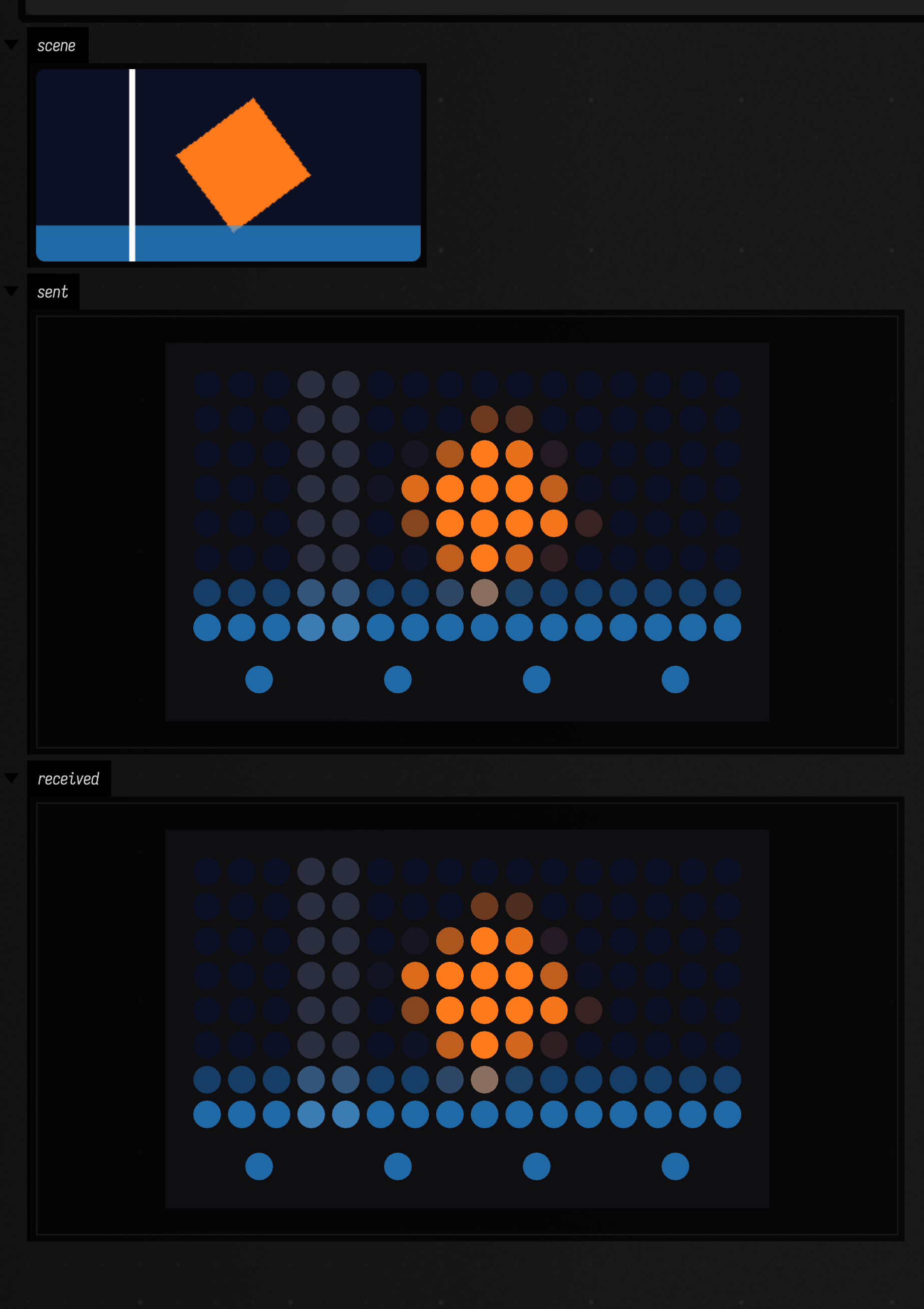
The first panel is the scene: an orange square that crosses the wall and turns, a line a quarter of a unit wide sweeping from left to right, and a blue band along the bottom that fades in and out. In RectSL it reads:
#rectsl
->wall 16 8 abstract
->background 0x0c1024
->duration 4
->fps 30

"sun" rect
  4 4 ->wh
  0xff7a1a solid ->fill
  '( 0=-5  2=5  4=-5 ) ->x
  '( 0=0  4=3.14159 ) ->rot
;

"band" rect
  16 1.5 ->wh
  0 -3.25 ->xy
  0x2a9df4 solid ->fill
  '( 0=0.15  2=1  4=0.15 ) ->alpha
;

"sweep" rect
  0.25 8 ->wh
  0xffffff solid ->fill
  '( 0=-8  4=8 ) linear ->x
;
The second panel is the rig in its sent colours. The third is the same rig lit only by what the receiver decoded from the two universes that came back (a DMX universe is one packet of 512 channel bytes; the rig needs two). The wall is 16 units by 8, which gives one fixture per unit, and the frame is drawn at 16 pixels per unit, so each fixture stands for a 16 × 16 block of pixels.
From a scene to an image
RectSLImager(source) compiles the scene once, including any {{ … }} Kotlin escapes, and
frame(t, width, height) draws it with the CPU reference rasterizer that the RectSL study tools
use. That rasterizer draws the background, blends the rectangles the way the GPU blends them into
an 8-bit target, and runs StackSL materials through the StackSL interpreter. No window or graphics
context is involved, so the lights keep running on a machine whose display is asleep.
import afield.io.dmx.*
import afield.lang.rectsl.*

val scene = RectSLImager(SceneOnARig.SCENE)
val img = scene.frame(1.5, 256, 128) // colours as typed: 0x808080 is 0.502
val light = scene.frame(1.5, 256, 128, linear = true) // the light that stands for: 0.216
showImgGrid("as typed" to img, "linear = true" to light, columns = 2, cellSide = 400)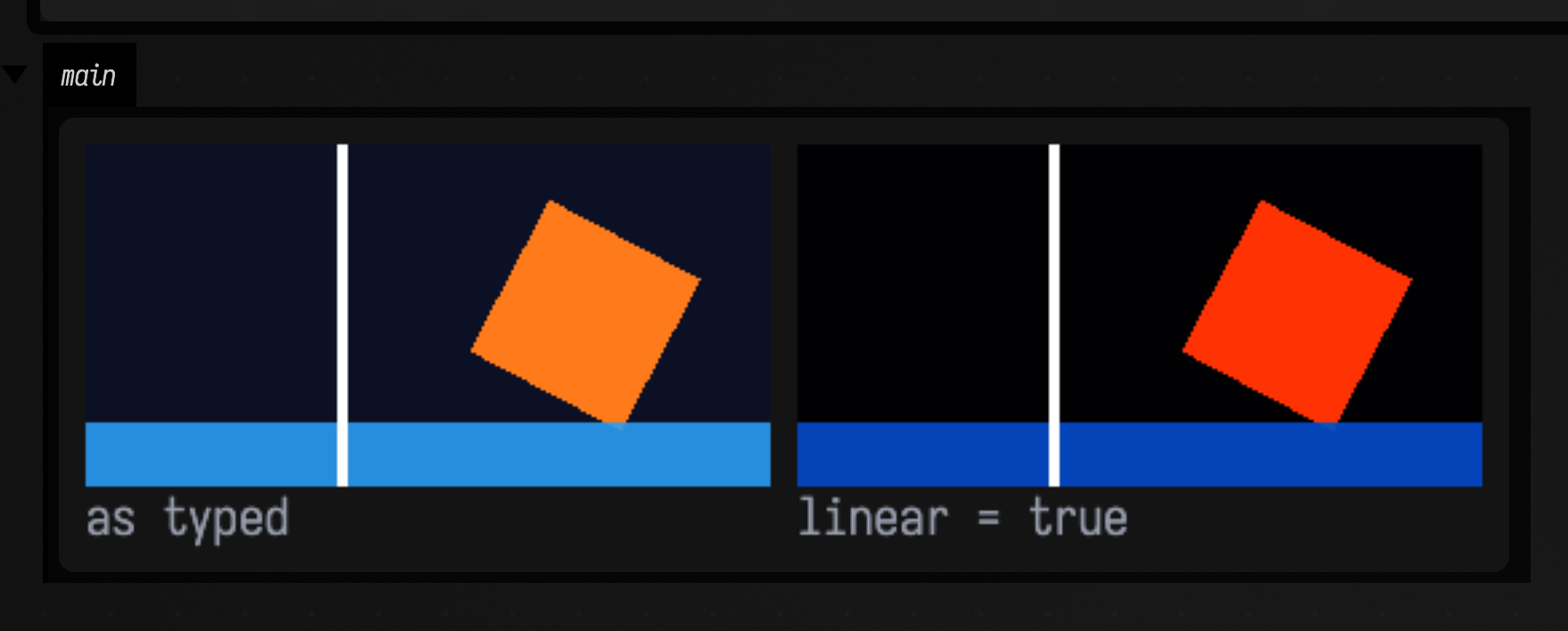
The linear frame is darker everywhere except at full white and the saturated channels: the navy background goes nearly black.
There are two choices of value. A frame holds colours as typed by default, which is what the
RectSL pictures show and what an 8-bit target stores. linear = true gives the light those values
stand for. The difference matters in two places. Averaging pixels is only right on light, and an
LED's PWM output is linear in light. So a rig driven with linear frames at gamma 1 and a rig driven
with as-typed frames through FixtureProfile.withGamma(2.2) come out at roughly the same
brightness, but only the first gives a thin line the correct total energy when it is averaged into
a fixture, as the section on thin lines shows.
What the wire does
Both panels above come from one frame. The readout below covers nine frames of the scene, sent and received the same way on a port of their own. It compares every slot byte and every fixture's colour, then runs the scene on the sender's own 44 Hz clock for three seconds and times it.
:::static
import afield.io.dmx.*

val trip = SceneOnARig.roundTrip(port = 35693)
val timing = SceneOnARig.timing(port = 35694, seconds = 3.0)
val floor = SceneOnARig.decodeErrors()

:::fold the readout
fun f(v: Double, d: Int = 2) = "%.${d}f".format(v)
markdown(
    "roundtrip",
    """
#### ${trip.frames} frames, ${trip.fixtures} fixtures, two universes, sACN to 127.0.0.1 and back

| | |
|---|---|
| slot bytes compared | ${trip.slotsCompared} |
| slot bytes that changed on the way | **${trip.levelErrors}** |
| worst RGB pixel, asked for vs decoded | ${f(trip.worstGridLevels, 3)} of 255 levels |
| worst RGBWA wash, asked for vs decoded | ${f(trip.worstWashLevels, 3)} of 255 levels |
| packets sent / received | ${trip.packetsSent} / ${trip.packetsReceived} |
| median send-to-merged latency | ${f(trip.medianLatencyMicros / 1000.0, 2)} ms |

#### ${f(timing.seconds, 0)} s animated on the sender's clock

| | median | 95th percentile |
|---|---|---|
| one look: draw 256 × 128, shrink, map (ms) | ${f(timing.frameMedian)} | ${f(timing.frameP95)} |
| gap between universe-1 frames at the receiver (ms) | ${f(timing.arrivalMedian)} | ${f(timing.arrivalP95)} |

${timing.ticks} looks computed; ${timing.arrivalMillis.size + 1} frames of universe 1 received, ${f(timing.receivedHz, 1)} per second.

#### What each profile's slots cost, with no network: 2000 random colours each

| profile | ${floor.keys.joinToString(" | ") { it.name }} |
|---|${floor.keys.joinToString("") { "---|" }}
| worst error, levels | ${floor.values.joinToString(" | ") { f(it, 3) }} |
""",
    width = 1000,
)
:::endfold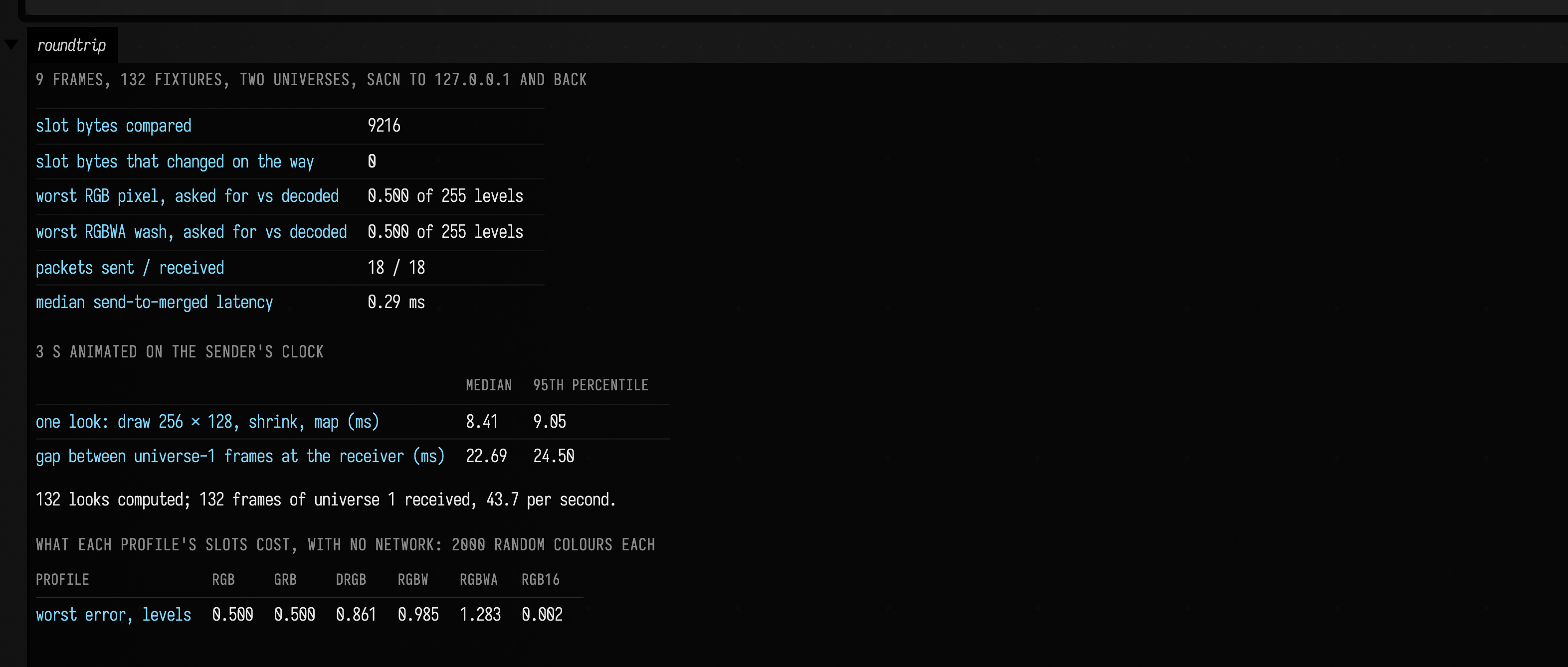
In this run, no slot byte changes on its way over loopback. The remaining error comes from
quantisation. An RGB pixel's colour is rounded to 8 bits once, so it comes back within half a level. A wash is
further off because writeInto splits its colour into red, green, blue, white and amber, and
rounds each of those separately. decode adds white back into all three primaries and amber into
red and green, so up to three rounded values combine in the red channel. The washes in this scene
happen to come back as close as the pixels do, because the band and the background they sample
leave little for white and amber to carry. The last table gives the general case: random colours
through each profile's slots and straight back, with no network involved, which is the floor any
round trip sits on.
The timing table is the sender's budget. At 44 Hz there are 22.7 ms between ticks. The look is computed inside the tick, on the sender thread, before the universes are copied out, so a scene that takes longer than that to draw would slow the lights down rather than tear them.
A thin line on sixteen columns
mapImage stretches the rig's bounding box over the image and samples it bilinearly at each
fixture's position. If the image is exactly one pixel per fixture, that lands every fixture on its
own pixel, and the result is correct. With a 256-pixel frame and 16 fixtures across, the same call
takes one point sample every seventeen pixels, and whatever falls between the sample points never
reaches the rig.
The line in the scene is four pixels wide, a quarter of a fixture. Below it crosses the wall alone
on black, drawn in linear light, and the rig is coloured from it by the two routes: point samples of
the full frame, and the frame shrunk to 16 × 8 by area averaging (Img.resize) first.
:::static
import afield.io.dmx.*
import afield.lang.rectsl.*

val (point, area) = SceneOnARig.aliasing()

:::fold plot both routes, and show the rig at an instant the point samples miss
val times = (0 until point.total.size).map { 0.5 + 3.0 * it / (point.total.size - 1.0) }
showSignals(
    "point samples of the 256 × 128 frame" to point.total.toList(),
    "area average to 16 × 8 first" to area.total.toList(),
    x = times,
    channel = "light on the rig",
    // No third trace for the truth: it is 2.0, exactly under the area-averaged route.
    title = "Light on the grid; the line is worth ${SceneOnARig.LINE_TRUTH}",
    xTitle = "seconds",
    yTitle = "fully lit fixtures",
)

// The first instant at which the point-sampled rig is dark.
val k = point.peak.indexOfFirst { it < 0.01 }.coerceAtLeast(0)
val frame = RectSLImager(SceneOnARig.LINE).frame(times[k], 256, 128, linear = true)
val rig = SceneOnARig.Rig()
rig.show(frame, area = false)
showPatch(rig.patch, channel = "point samples at t = ${times[k].f3} s", w = 540.0, h = 300.0)
rig.show(frame, area = true)
showPatch(rig.patch, channel = "area average at t = ${times[k].f3} s", w = 540.0, h = 300.0)

markdown(
    "counts",
    """
| route | frames with the rig dark | light on the rig, min – max | mean over the sweep | (max − min) / mean |
|---|---|---|---|---|
| point samples | ${point.darkFrames} of ${point.total.size} | ${point.min.f2} – ${point.max.f2} | ${point.mean.f3} | ${point.flicker.f2} |
| area average | ${area.darkFrames} of ${area.total.size} | ${area.min.f3} – ${area.max.f3} | ${area.mean.f3} | ${area.flicker.f4} |
""",
    width = 1000,
)
:::endfold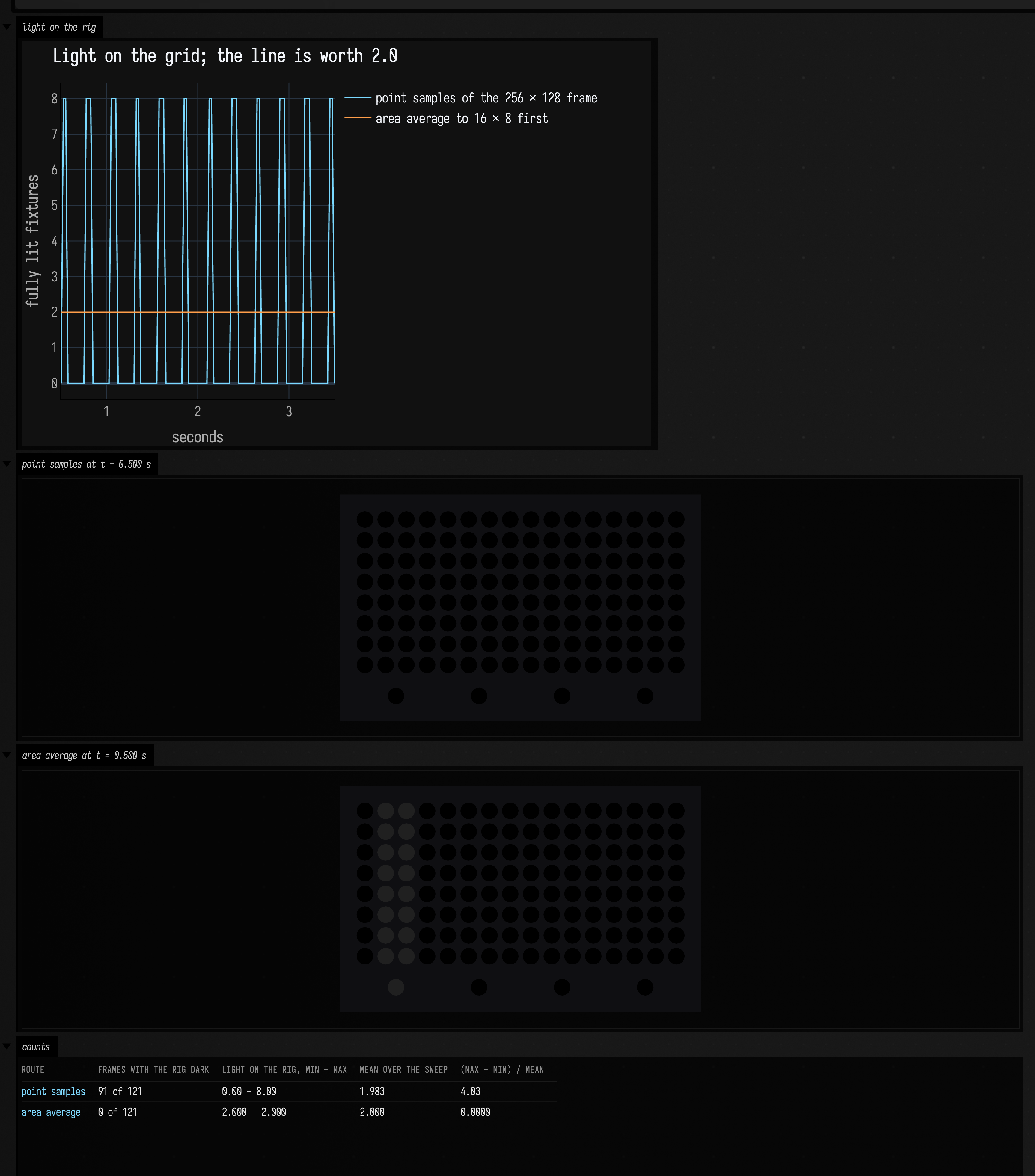
Both rigs in the figure are coloured from linear light and drawn as it is, so the area-averaged column is dim: each of those fixtures carries an eighth of a white one, the line's quarter split between two columns.
Point sampling makes the rig strobe. The line lights a column of eight fixtures at full brightness while it is over their sample points and disappears in between, so the rig flashes once per column. It also overshoots: at a peak, eight fixtures are fully lit by a line that covers a quarter of one column. Averaged over the whole sweep the strobe delivers about the right amount of light, but at the wrong times. Area averaging puts the right amount of the line's light onto the rig wherever the line is, and as the line crosses from one column to the next, the light moves between them without flickering.
That is why SceneOnARig.Rig.show shrinks the frame first:
patch.mapImage(frame.resize(16, 8)) // one pixel per fixture, each the mean of its cellThis works exactly because resize averages whole 16 × 16 blocks, and the image size then matches
the grid, so mapImage puts each fixture on its own pixel. A rig that is not a grid (a strip on a
curve, scattered pars) has no such image size, and the fix there is a smaller or blurred frame, so
that each sample point averages what its fixture ought to show.
Average light, not typed colour
The flat line above averages linear frames. Averaging as-typed values instead gives a dimmer
line, because the sRGB encoding is concave: a quarter of a white pixel is 0.25 in light and
0.54 as typed, and the mean of typed values sits below the typed value of the mean light.
Shrink with linear = true, and send linear values to fixtures at gamma 1.
Running it live
Open chain_scene_to_light from the welcome screen's
starting points. No lights are needed: the
universes go to this machine on port 35690 and come back. Launch 1. Scene on the rig: it draws
the scene from this page, shrinks it to one pixel per fixture, and sends it on the 44 Hz clock,
showing the look it sends. Launch 2. Receiver: it listens on the same port and draws the rig from
what arrives. Run 3. Measure to repeat this page's numbers on your machine. Edit the scene in the
first box and launch it again to see the change reach the second; area = false in that box brings
back the flickering line.
To drive real lights, give sacnOut a node's address (sacnOut("10.0.0.20")), or no host at all
for multicast.
Where each piece is documented
- RectSL Examples and the RectSL Cheatsheet for the
language; Talking a Scene into Existence for the study tools whose CPU
rasterizer
RectSLImageruses. - Driving Lights: Art-Net and sACN for
Patch, the profiles,mapImage, the outputs and inputs, andshowUniverse. - A RectSL Animation as a Solid is the neighbouring chain: the same language read as a volume over (x, y, t) instead of a sequence of frames.