Change a rule without breaking what already works
A rule might place loot in a level, divide a wall into panels or choose a solver's fallback. When you improve it for one case, how do you know it still handles the others? A qualified source keeps the rule alongside cases it has already handled and their recorded outcomes. Before a new rule is applied, Field replays those cases; a person can review and approve any outcomes that should change.
It has three parts:
- the rule, in a box property, with a checked history;
- the fixtures: real cases the rule has handled, each with its input and its recorded outcome;
- a replay: a build stage that runs a proposed rule on every fixture, and on a control, an input no correct rule can pass, which must fail.
Changes go through six agent tools: <name>.inspect, .candidate, .test, .apply,
.retainFixture and .proposeRebaseline.
A rule and its fixtures
This rule picks a loot tier for each room of a level from how many doors the room is from the spawn. It is written in Kotlin, and has two halves. The first half is the rule itself. The second half places the loot and checks the result: every tier is one the game has, there is no epic loot fewer than three doors from the spawn, and every level has at least one epic room. A line in the source marks where the second half begins, and a change may not touch anything below it.
The box keeps the rule in a property, with three levels it has already placed as fixtures. The control is a level with no room deep enough for epic loot: no rule can place it without breaking a check, so its replay has to fail. The replay function evaluates a candidate's source once and returns the placement function it defines.
val rule =
    """
// Loot for a room, from how many doors it is from the spawn.
fun loot(doors: Int) = when {
    doors >= 4 -> "epic"
    doors >= 2 -> "rare"
    else -> "common"
}

// Checks: everything below this line stays as it is.
fun place(level: String): Map<String, String> {
    val rooms = level.split(", ").associate { it.substringBefore(' ') to it.substringAfter(' ').toInt() }
    val placed = rooms.mapValues { (_, doors) -> loot(doors) }.toSortedMap()
    for ((room, tier) in placed) {
        check(tier in setOf("common", "rare", "epic")) { room + " got " + tier + ", which is not a loot tier" }
        check(tier != "epic" || rooms.getValue(room) >= 3) { room + " has epic loot " + rooms.getValue(room) + " doors from the spawn" }
    }
    check("epic" in placed.values) { "no room has epic loot" }
    return placed
}
::place
"""
        .trimStart()

val loot = qualifiedSource(
    "loot",
    rule,
    label = "Loot rule",
    frozen = [FrozenRegion.after("// Checks: everything below this line stays as it is.")],
    control = QualifiedControl("shallow", "hall 1, store 2", "no room has epic loot"),
    fixtures = mapOf(
        "keep" to
            QualifiedFixture(
                "gate 1, yard 2, keep 4",
                mapOf("gate" to "common", "keep" to "epic", "yard" to "rare"),
            ),
        "crypt" to
            QualifiedFixture(
                "stairs 1, ossuary 3, tomb 5",
                mapOf("ossuary" to "rare", "stairs" to "common", "tomb" to "epic"),
            ),
        "mill" to
            QualifiedFixture(
                "door 1, loft 2, well 4",
                mapOf("door" to "common", "loft" to "rare", "well" to "epic"),
            ),
    ),
    replayVersion = "loot-replay-1",
) { replay ->
    QualifiedSource.evaluateKotlin(replay.source) as (String) -> Map<String, String>
}
The rule lives in the box's lootRule property and the fixtures in lootFixtures. Builds that use
the rule read loot.source(), which is the version last applied. Change replayVersion whenever
the replay function changes, as you would a build stage's recipeVersion.
Ask for a change
Ask the agent in the box's chat for a change, for example "the rooms deepest in a level should feel
special". It reads the rule with loot.inspect, which returns the rule's revision and the hash of
its live text. It then calls loot.candidate with edits to the live text, quoting both. The
candidate is saved, and nothing is published yet. It records what it was made against: the rule's
revision and hash, its own source, the fixtures, the replay's dependencies and the checks below the
marker. Its id is a hash of all of these. Next, loot.test queues the replay and returns the
build's job id, and the agent waits for that build with AwaitStudyBuildsRequest.
The box below makes the same two calls an agent would, with an edit that adds a legendary tier for rooms five or more doors in:
:::static
:::fold the loot rule and its fixtures, as above
val rule =
    """
// Loot for a room, from how many doors it is from the spawn.
fun loot(doors: Int) = when {
    doors >= 4 -> "epic"
    doors >= 2 -> "rare"
    else -> "common"
}

// Checks: everything below this line stays as it is.
fun place(level: String): Map<String, String> {
    val rooms = level.split(", ").associate { it.substringBefore(' ') to it.substringAfter(' ').toInt() }
    val placed = rooms.mapValues { (_, doors) -> loot(doors) }.toSortedMap()
    for ((room, tier) in placed) {
        check(tier in setOf("common", "rare", "epic")) { room + " got " + tier + ", which is not a loot tier" }
        check(tier != "epic" || rooms.getValue(room) >= 3) { room + " has epic loot " + rooms.getValue(room) + " doors from the spawn" }
    }
    check("epic" in placed.values) { "no room has epic loot" }
    return placed
}
::place
"""
        .trimStart()

val loot = qualifiedSource(
    "loot",
    rule,
    label = "Loot rule",
    frozen = [FrozenRegion.after("// Checks: everything below this line stays as it is.")],
    control = QualifiedControl("shallow", "hall 1, store 2", "no room has epic loot"),
    fixtures = mapOf(
        "keep" to
            QualifiedFixture(
                "gate 1, yard 2, keep 4",
                mapOf("gate" to "common", "keep" to "epic", "yard" to "rare"),
            ),
        "crypt" to
            QualifiedFixture(
                "stairs 1, ossuary 3, tomb 5",
                mapOf("ossuary" to "rare", "stairs" to "common", "tomb" to "epic"),
            ),
        "mill" to
            QualifiedFixture(
                "door 1, loft 2, well 4",
                mapOf("door" to "common", "loft" to "rare", "well" to "epic"),
            ),
    ),
    replayVersion = "loot-replay-1",
) { replay ->
        QualifiedSource.evaluateKotlin(replay.source) as (String) -> Map<String, String>
    }
:::endfold
val legendary = QualifiedEdit("doors >= 4 -> \"epic\"", "doors >= 5 -> \"legendary\"\n    doors >= 4 -> \"epic\"")
val first = loot.candidate(
    loot.rule.currentId(),
    SourceStudy.hash(loot.rule.liveSource()),
    "A legendary tier for the deepest rooms",
    [legendary],
)
loot.test(first.id)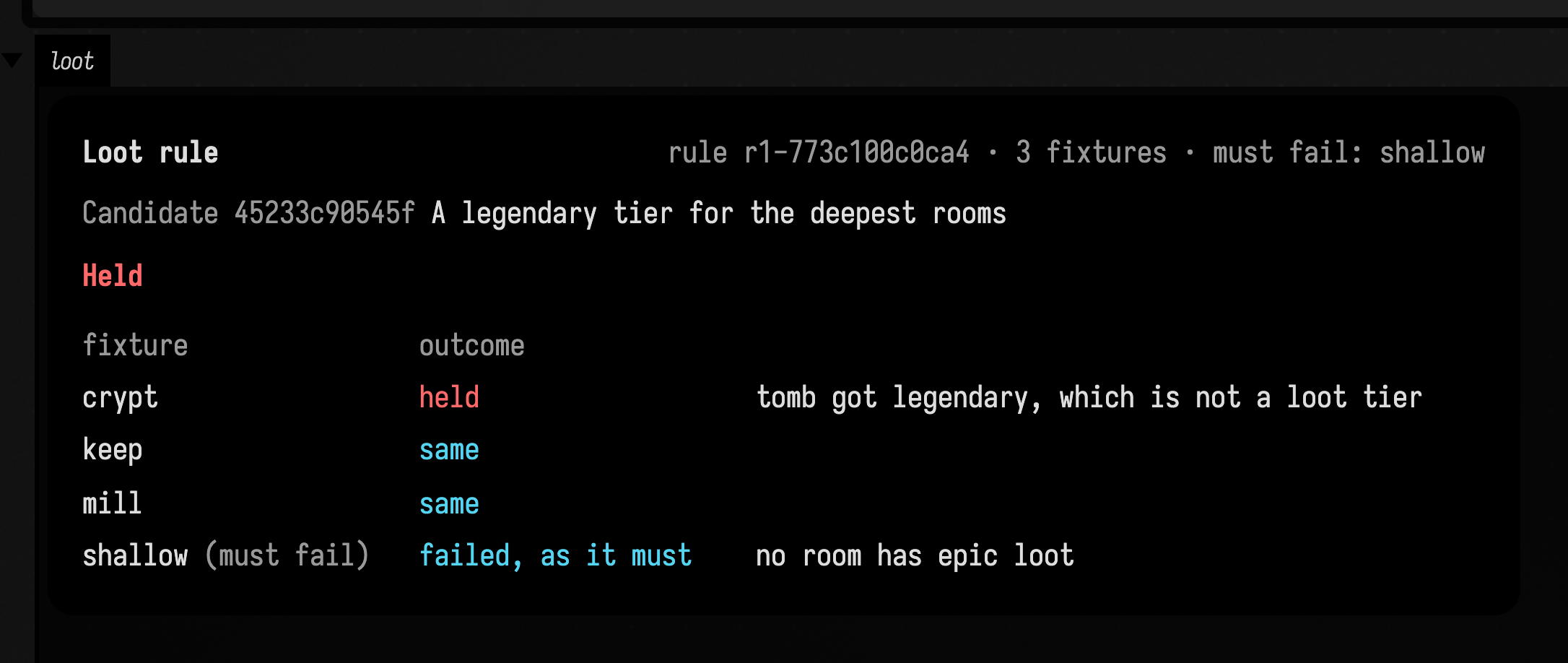
The replay card in the box's loot output marks each fixture same, changed or held.
Held means the rule or its checks refused the case. Here the crypt is held because its tomb is five
doors in and the game has no legendary tier. The control fails as intended; if it passes, the
candidate cannot be admitted.
loot.apply refuses this candidate and names the held fixture and its reason, so the agent can
revise the change. The live rule is unchanged.
A candidate is admitted only when its latest replay is current, every fixture kept its recorded
outcome, and the control failed as it must. The fixtures, the replay's dependencies and the checks
must also be the ones the candidate was made with. If any of them changes, the agent makes a new
candidate. loot.apply then publishes the candidate as the rule's next revision, quoting the
revision and hash it was made against, so an edit made in the meantime is never overwritten.
When outcomes change
The agent's second try makes rooms three doors in epic. Nothing breaks a check now, but the crypt's
ossuary, three doors from the spawn, used to get rare loot and now gets epic. Whether that is right
is a decision about the game, so the replay fails with the crypt marked changed. The agent
calls loot.proposeRebaseline with the replay's job id:
import kotlinx.coroutines.*

:::static
:::fold the loot rule and its fixtures, as above
val rule =
    """
// Loot for a room, from how many doors it is from the spawn.
fun loot(doors: Int) = when {
    doors >= 4 -> "epic"
    doors >= 2 -> "rare"
    else -> "common"
}

// Checks: everything below this line stays as it is.
fun place(level: String): Map<String, String> {
    val rooms = level.split(", ").associate { it.substringBefore(' ') to it.substringAfter(' ').toInt() }
    val placed = rooms.mapValues { (_, doors) -> loot(doors) }.toSortedMap()
    for ((room, tier) in placed) {
        check(tier in setOf("common", "rare", "epic")) { room + " got " + tier + ", which is not a loot tier" }
        check(tier != "epic" || rooms.getValue(room) >= 3) { room + " has epic loot " + rooms.getValue(room) + " doors from the spawn" }
    }
    check("epic" in placed.values) { "no room has epic loot" }
    return placed
}
::place
"""
        .trimStart()

val loot = qualifiedSource(
    "loot",
    rule,
    label = "Loot rule",
    frozen = [FrozenRegion.after("// Checks: everything below this line stays as it is.")],
    control = QualifiedControl("shallow", "hall 1, store 2", "no room has epic loot"),
    fixtures = mapOf(
        "keep" to
            QualifiedFixture(
                "gate 1, yard 2, keep 4",
                mapOf("gate" to "common", "keep" to "epic", "yard" to "rare"),
            ),
        "crypt" to
            QualifiedFixture(
                "stairs 1, ossuary 3, tomb 5",
                mapOf("ossuary" to "rare", "stairs" to "common", "tomb" to "epic"),
            ),
        "mill" to
            QualifiedFixture(
                "door 1, loft 2, well 4",
                mapOf("door" to "common", "loft" to "rare", "well" to "epic"),
            ),
    ),
    replayVersion = "loot-replay-1",
) { replay ->
        QualifiedSource.evaluateKotlin(replay.source) as (String) -> Map<String, String>
    }
:::endfold
val second = loot.candidate(
    loot.rule.currentId(),
    SourceStudy.hash(loot.rule.liveSource()),
    "Epic loot from three doors in",
    [QualifiedEdit("doors >= 4", "doors >= 3")],
)
val job = loot.test(second.id)
go {
    runInterruptible(Dispatchers.IO) { loot.replays.await(job.id) }
    ensureActive()
    loot.proposeRebaseline(job.id)
}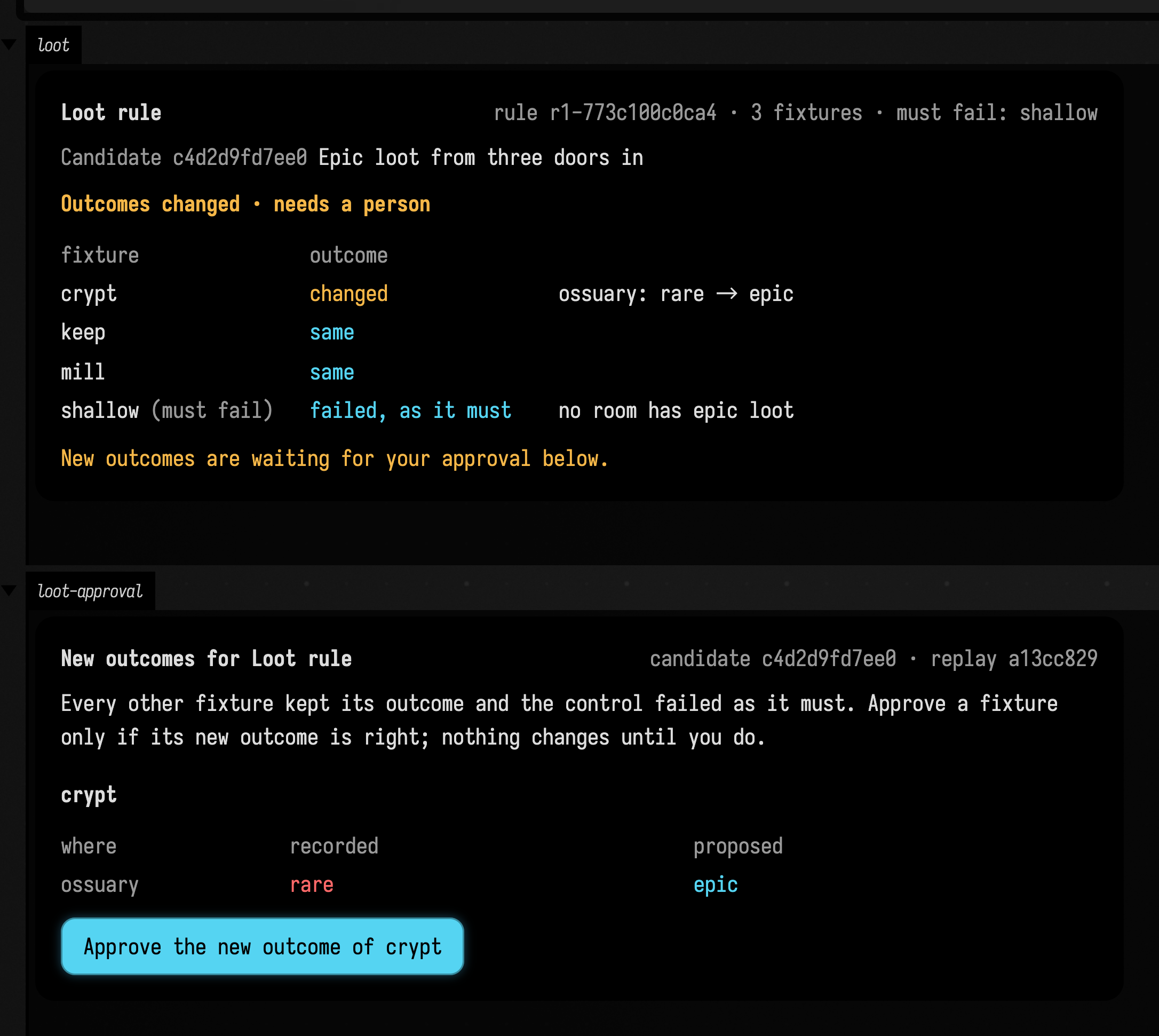
The proposal opens in the box's loot-approval output. For each fixture whose outcome changed it
lists every value that differs, as recorded and as proposed, with one Approve button per
fixture. Nothing changes until you press one.
Approve a new outcome
Only a person changes a fixture's recorded outcome. No tool approves, and an approval attempted from inside any agent tool call is refused. Pressing Approve makes the fixture's outcome the proposed one, in a new revision of the fixtures, and records who approved it, when, and the proposal, candidate and replay it came from. The earlier outcome stays in the fixtures' history.
The candidate was made with the old outcome, so it is now out of date. The agent makes a copy of it against the new fixtures, replays that, and applies it. In box code those three steps are:
go {
    val third = loot.candidate(
        loot.rule.currentId(),
        SourceStudy.hash(loot.rule.liveSource()),
        second.description,
        fromCandidate = second.id,
    )
    val replay = loot.test(third.id)
    runInterruptible(Dispatchers.IO) { loot.replays.await(replay.id) }
    ensureActive()
    loot.apply(third.id, third.baseRevision, third.baseSourceHash)
}
The agent makes the same three calls as tools: loot.candidate with fromCandidateId, then
loot.test and loot.apply. This is the box after the press:
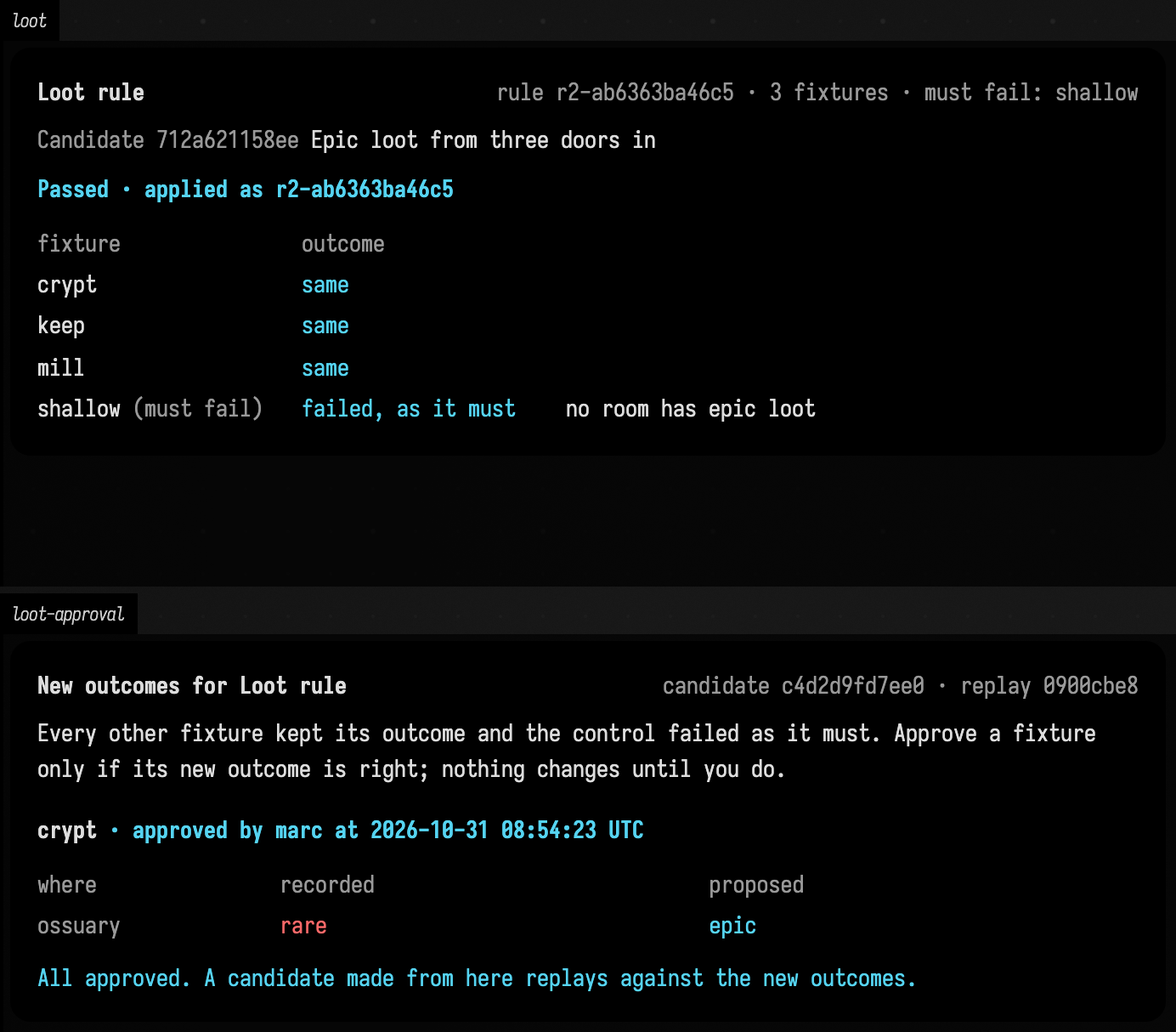
Every fixture now keeps its outcome, the crypt's because a person recorded the new one. The rule's new revision records the candidate and the replay that admitted it.
Keep the checks out of reach
A candidate may not change what judges it. frozen says how the checks are kept apart, in one of
three ways, and a candidate that breaks the rule is refused before it is saved.
FrozenRegion.after(marker): everything after the marker line stays byte for byte. The marker must occur exactly once. This is the simplest: the rule and its checks are one source. The two halves run in one program, though, so the first half could still shadow a name the second half uses. A frozen copy, below, keeps them apart.FrozenRegion.files("placement.kt", "fallback.kt"): the rule is a set of named files, kept as a JSON object of file name to text, and a candidate may edit or add only the files named here. Its edits name the file they change.FrozenRegion.baseline { mapOf("audit.kt" to "checks/audit.kt".file.readText()) }: the checks are a separate copy, frozen when the box first runs and handed to the replay asreplay.checks. The replay judges each outcome with that copy, and the candidate never sees it.
A frozen copy goes stale when the checks it was copied from improve. The function you pass says
what the checks should be now. When the copy differs from it, the card says which files differ, and
loot.inspect returns the same notice as checksNotice. The copy changes only when a person
presses Accept the current checks on the card. A migration in box code can also call
loot.upgradeChecks(by, reason). Either way the new checks become a new revision of the copy, and
every candidate made before then is out of date.
The same button appears when the frozen part of the rule itself was edited outside loot.apply,
for example by hand in the editor. Until a person accepts that edit, no candidate can be made.
Keep a real case as a fixture
Fixtures should be cases the rule has really handled. When the rule feeds a build in the same
document, pass a retain function that reads a finished attempt of that build and returns its
input and outcome:
retain = { attempt ->
    QualifiedFixture(attempt.file("level.txt").readText(), attempt.record.facts["placed"])
}
The agent then calls loot.retainFixture with the build runner's name, the attempt's job id, a name
for the fixture, and the fixtures' revision and hash from loot.inspect. The new fixture records
which attempt it came from and a hash of its input. Retaining the same case twice changes nothing,
and a fixture's name cannot be reused for a different case. An attempt that failed can be kept too,
with the failure as its outcome. The candidate that fixes it then shows that fixture as changed,
and a person approves the new outcome.
What the agent sees
| tool | what it does |
|---|---|
loot.inspect |
the rule's revision and live hash, the frozen checks, the fixtures, the latest replay, and anything waiting for a person |
loot.candidate |
saves a candidate from exact edits, a whole source, or a copy of an earlier candidate; runs nothing |
loot.test |
queues the replay of a candidate on every fixture and the control, and returns the job to wait for |
loot.apply |
publishes an admitted candidate as the rule's next revision, or says why it is not admitted |
loot.retainFixture |
keeps a finished build attempt as a new fixture |
loot.proposeRebaseline |
shows changed outcomes to the person with an Approve button each |
The replay is an ordinary build runner named after the source, so InspectStudyBuildsRequest and
AwaitStudyBuildsRequest work on it too. Rules, fixtures, candidates, proposals and replays are
kept in the document's studies directory, and re-running the box picks them up again.
Who pressed Approve in the last capture
The docs runner did, in a real browser on the real page: the capture's script waits for the Approve button and clicks it, which sends the same button press a person's click does. The box then makes the agent's three calls itself. The approval records the account Field runs under.
See also: Studies, whose build runners the replay is made with, and Let AI4 Wait for Long Builds.