Learn from a shader on the GPU
The learned shader workflow can train directly from a Field render target, with no exported pixel dataset. Your moduleHere() shader renders its normal image; a GPU pass samples that image, Slang differentiates a small network, and cooperative-vector operations accumulate its weight gradients. You can watch the approximation improve while editing the source.

Open the experiment
Build the optional shaders with ./gradlew buildLearnedShaders, then open Starting points → gpu_shader_learning. Your GPU and driver must support cooperative-vector training as well as inference. The shader build uses Field's pinned Slang compiler (2026.19); a Slang compiler you set explicitly still takes priority.
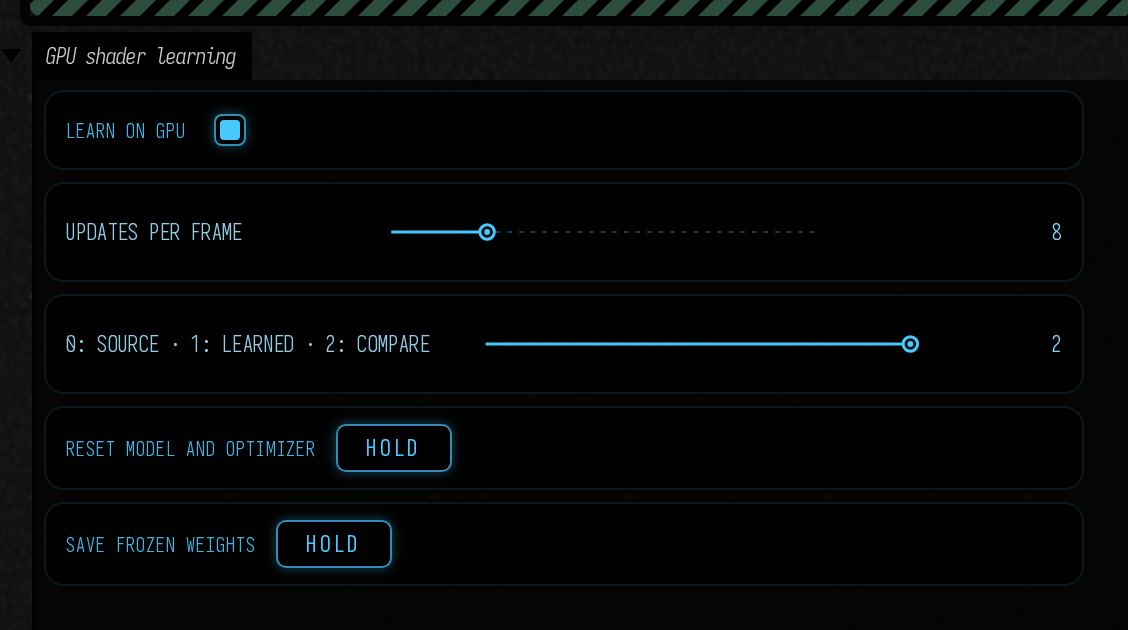
The three panels are source, learned output and absolute RGB error × 8. The purple stripe sits in the middle of each source/learned panel: its two hard edges are there to give the network something difficult to fit. Training visits thirteen normalized time values. Turning off Learn on GPU animates through intermediate values, so you can see how the fit interpolates. Select 1: Learned with learning disabled to stop executing the teacher entirely. The learned texture remains available as lab.model.output.
Edit the fragment property to change what is learned. In this starting point a shader that compiles resets the fit; one that fails to compile leaves the previous shader running. Reset model and optimizer restores the seeded initial weights and clears Adam's history. Changing a uniform, texture or camera does not reset anything; press reset yourself if the fit should start again.
Start with the shader you want to learn
The shader being learned is called the teacher. Here is its complete fragment property from the starting point; this is the code to edit. p.state.xy holds the render target's width and height; p.state.z is the normalized training parameter, −1…1. The shader turns pixel coordinates into the same normalized x/y domain used by the learner.
:::fold Fragment interface
#version 460
layout(push_constant) uniform P {
    vec4 state;
} p;
layout(location = 0) out vec4 color;
:::endfold

void main() {
    vec2 xy = gl_FragCoord.xy / p.state.xy * 2 - 1;
    float t = p.state.z;

    vec3 rgb = .5 + .22 * cos(
    vec3(xy.x * 2 + t, xy.y * 2 - t * .7, xy.x + xy.y + t * .5)
    + vec3(0, 2, 4));
    for (int k = 1; k <= 96; k++) {
        float a = float(k) * .61803399;
        rgb += .028 / float(k) * sin(
        vec3(xy.x * cos(a) + xy.y * sin(a)) * 3
        + t + vec3(0, 2, 4) + a);
    }
    // Two hard edges: a deliberately discontinuous target for the small network.
    float stripe = step(-.12, xy.x) * (1 - step(.12, xy.x));
    color = vec4(mix(rgb, vec3(.95, .04, .8), stripe), 1);
}
Change the colour offsets vec3(0, 2, 4), replace the rgb expression, or increase the spatial frequencies to make the fit harder. Use Update Shader, then watch the learned panel catch up and the error panel settle. Keep the interface declarations and opaque output while replacing the function's body. The learner sees the resulting RTT pixels; there is no second copy of your formula to edit in Slang or Python. Changing the teacher starts a new fit; extending an already frozen result instead happens in its host shader.
From moduleHere() to a learned texture
The teacher is an ordinary module attached to one linear RGBA16F or RGBA32F RenderToTexture. Keep RGB unclamped and alpha one. Invalid/nonfinite or nonopaque samples are rejected; the network learns RGB, not coverage, latent pigment channels or arbitrary attachments.
val source = RenderToTexture(renderer) {
    width = 1920
    height = 1080
    useDepth = false
    format = VK_FORMAT_R32G32B32A32_SFLOAT
}
val teacher = moduleHere { +source }
source += "teacher" to teacher

// Add your existing meshes and bind their uniforms as usual.

val lab =
    GpuShaderLearningView(renderer, source) { normalizedTime ->
            mesh.push["state"] = vec(source.width, source.height, normalizedTime, 0)
        }
        .install()
lab.parameter = .25f
lab.iterationsPerFrame = 8
The view borrows the source target, records source → sample/train → inference → comparison, and owns its learner and comparison images. It does not attach the source as a second render pass. Close the view before retiring the source. The lower-level GpuShaderTraining.train(command, image, parameter, iterations) and evaluate(command, index, parameter) methods let your own Target schedule the same work.
This is still a learned (screen x, screen y, one parameter) → RGB function. The parameter is explicitly normalized to −1…1. Hold everything else fixed unless you extend the network's input contract. A fit of a rendered image does not learn its geometry, feedback state or material response to unseen cameras. Sharp discontinuities and tiny features may need more capacity or may be better left as ordinary shader code.
Keep and reuse the result
Save frozen weights writes a new directory under build/shader-learning/. Between frames, Field converts the driver-specific training matrices into the portable row-major layout the offline learner also uses, reads back the small model once, and writes weights.f16 and a checksummed weights.json. Training and evaluation themselves have no CPU image or weight readback.
lab.model.save(
    File("build/my-fit-001"),
    ShaderTraining.sourceDigest(source),
    "Fixed camera and texture; normalized time is the only changing input",
)

val frozen = LearnedShader(
    renderer,
    1920,
    1080,
    weightsFile = File("build/my-fit-001/weights.f16"),
    manifestFile = File("build/my-fit-001/weights.json"),
)
The saved model works through cooperative-vector inference or cooperative=false ordinary shader arithmetic. You can continue extending its host shader: sampling coordinates, compositing, texture lookups and effects around the learned function remain yours. The saved manifest records training steps, seed, domain and source identity; saving alone makes no quality claim.
What training actually does
The network has the same fixed architecture as the offline learner: sixteen positional features, two 32-unit ReLU layers, and three linear RGB outputs. Slang's reverse-mode derivative computes the chain rule. The layer derivative uses real Vulkan cooperative-vector outer-product and reduction operations. Matrices use the queried training-optimal layout; FP32 master weights and Adam moments update FP16 published weights. Gradients accumulate in FP16 with fixed loss scaling. It is meant for fitting one small function you can inspect, and it is not a general model-training framework.
The complete learning shader
This is the complete src/jvmMain/resources/afield/four/neural/train.slang, formatted for reading. model() is the learned function. The three compute entry points train against sampled teacher pixels, update the weights, and evaluate the current fit across the output image. Buffer declarations, feature encoding, layer derivatives and optimizer details are folded; Copy includes the entire file.
:::fold Buffers and dispatch parameters
// Field's GPU-resident 16 -> 32 -> 32 -> RGB experiment.
// Uses Slang 2026.18 native CoopVec autodiff and Vulkan training intrinsics directly.
// This fixed network deliberately does not import RTXNS's older CoopVec autodiff extension.
[[vk::binding(0, 0)]] ByteAddressBuffer weights;
[[vk::binding(1, 0)]] RWByteAddressBuffer gradients;
[[vk::binding(2, 0)]] RWStructuredBuffer<float4> optimizer;
[[vk::binding(3, 0)]] StructuredBuffer<float4> samples;
[[vk::binding(4, 0)]] RWStructuredBuffer<float4> pixels;
[[vk::binding(5, 0)]] RWByteAddressBuffer mutableWeights;
struct Params {
    uint count; uint step; uint w0; uint b0; uint w1; uint b1; uint w2; uint b2;
    float rate; uint width; uint height; float time; uint words; uint view;
};
[[vk::push_constant]] Params p;
:::endfold

:::fold Encode x, y and the parameter into sixteen features
CoopVec<half, 16> features(float3 v) {
    float x = v.x, y = v.y, t = v.z;
    const float pi = 3.14159265359;
    float f[16] = {
        x, y, t, 1, sin(x*pi), cos(x*pi), sin(y*pi), cos(y*pi), sin(t*pi), cos(t*pi),
        sin((x+y)*pi), cos((x-y)*pi), sin(2*x*pi), sin(2*y*pi), cos(2*x*pi), cos(2*y*pi)
    };
    CoopVec<half, 16> result;
    for (int i = 0; i < 16; i++) result[i] = half(f[i]);
    return result;
}
:::endfold

:::fold Cooperative-vector layer and its backward derivative
[BackwardDerivative(backwardLayer<I, O>)]
CoopVec<half, O> layer<let I:int, let O:int>(CoopVec<half, I> x, uint matrix, uint bias) {
    return coopVecMatMulAdd<half, O>(
        x, CoopVecComponentType::Float16, weights, matrix, CoopVecComponentType::Float16,
        weights, bias, CoopVecComponentType::Float16, CoopVecMatrixLayout::TrainingOptimal, false, 0);
}
void backwardLayer<let I:int, let O:int>(
    inout DifferentialPair<CoopVec<half, I>> x, uint matrix, uint bias, CoopVec<half, O> gradient
) {
    coopVecOuterProductAccumulate(gradient, x.p, gradients, matrix, 0,
        CoopVecMatrixLayout::TrainingOptimal, CoopVecComponentType::Float16);
    coopVecReduceSumAccumulate(gradient, gradients, bias);
    x = diffPair(x.p, coopVecMatMul<half, I>(gradient, CoopVecComponentType::Float16,
        weights, matrix, CoopVecComponentType::Float16, CoopVecMatrixLayout::TrainingOptimal, true, 0));
}
:::endfold

[Differentiable]
CoopVec<half, 3> model(CoopVec<half, 16> x) {
    var h1 = max(layer<16, 32>(x, p.w0, p.b0), CoopVec<half, 32>(half(0)));
    var h2 = max(layer<32, 32>(h1, p.w1, p.b1), CoopVec<half, 32>(half(0)));
    return layer<32, 3>(h2, p.w2, p.b2);
}

[shader("compute")][numthreads(64, 1, 1)]
void train(uint3 id:SV_DispatchThreadID) {
    if (id.x >= p.count || samples[id.x*2+1].w == 0) return;
    var input = features(samples[id.x*2].xyz);
    var prediction = model(input);
    float3 target = samples[id.x*2+1].rgb;
    CoopVec<half, 3> loss;
    for (int c = 0; c < 3; c++)
        loss[c] = half((float(prediction[c]) - target[c]) * (2.0 * 128.0 / (3.0 * p.count)));
    var differentiableInput = diffPair(input);
    bwd_diff(model)(differentiableInput, loss);
}

:::fold Adam optimizer, FP32 master weights and packed FP16 publication
// Each invocation owns a packed pair, avoiding racing 16-bit updates. FP32 master weights/moments
// retain sub-half-ulp updates; FP16 gradients are loss-scaled by 128 and cleared before each step.
[shader("compute")][numthreads(64, 1, 1)]
void optimize(uint3 id:SV_DispatchThreadID) {
    uint word = id.x;
    if (word >= p.words) return;
    uint old = weights.Load(word*4), grad = gradients.Load(word*4), packed = 0;
    for (uint lane = 0; lane < 2; lane++) {
        uint index = word*2 + lane;
        float4 state = optimizer[index];
        float master = p.step == 1 ? f16tof32((old >> (lane*16)) & 65535) : state.x;
        float g = f16tof32((grad >> (lane*16)) & 65535) / 128.0;
        if (!isfinite(g)) g = 0;
        g = clamp(g, -10.0, 10.0);
        float m = .9*state.y + .1*g, v = .999*state.z + .001*g*g;
        master -= p.rate * (m / (1 - pow(.9, float(p.step))))
                        / (sqrt(v / (1 - pow(.999, float(p.step)))) + 1e-8);
        optimizer[index] = float4(master, m, v, 0);
        packed |= (f32tof16(master) & 65535) << (lane*16);
    }
    mutableWeights.Store(word*4, packed);
}
:::endfold

[shader("compute")][numthreads(8, 8, 1)]
void evaluate(uint3 id:SV_DispatchThreadID) {
    if (id.x >= p.width || id.y >= p.height) return;
    var result = model(features(float3(
        (float2(id.xy) + .5) / float2(p.width, p.height) * 2 - 1, p.time)));
    pixels[id.y*p.width + id.x] = float4(result[0], result[1], result[2], 1);
}
Each training sample occupies two float4s: normalized x/y/parameter in the first, target RGB and a validity flag in the second. train() seeds differentiation with the RGB mean-squared-error gradient, scaled by 128 for FP16 accumulation. Field clears the gradient buffer before training, dispatches optimize() with the necessary barriers, then runs evaluate() to produce the learned image. A GLSL resolve pass exposes that RGB buffer as lab.model.output; the renderer continues to own scheduling and image lifetime.
Edit the teacher's fragment property to change the function being fitted. To experiment with the learning algorithm itself, edit this train.slang file, run ./gradlew buildLearnedShaders, then stop and relaunch the Starting Point. Changes to layer sizes, feature count or weight layout also require matching changes in the Kotlin allocation/export code and frozen-model inference shader; those contracts are fixed in this experiment.
Measured fit and cost
Eight minibatches of 256 samples are a good default. Every eighth hashed pixel is withheld from sampling, and the measurement also evaluates an entire image at time 0.173, absent from the thirteen training slices. After 4,001 updates on the striped teacher, its RGB MSE fell from 0.350 to about 0.00186. See the measurement record for the measured training batch time and allocations.
The purple stripe is part of the learned function. Its sharp source edges become finite transitions in the approximation; the error panel makes them conspicuous. Within 0.02 normalized x units of either edge, RGB MSE was 0.0233, versus 0.000974 away from those bands. The bands cover 3.96% of the image, and maximum individual channel error was 0.409. A small whole-image average does not mean the discontinuity was reproduced exactly.
Eight 256-sample updates measured 0.188 ms median / 0.200 ms p95 in the recorded striped run, with automatic GPU clocks. Learner allocations were 65.46 MiB at 1080p, mostly the output buffer and image; this excludes the teacher and comparison target.
These measurements include sample gathering, gradient clearing, differentiation, optimizer dispatches and their synchronization. They exclude the teacher render and full-resolution evaluation, which remain separate work. Float16 accumulation is not bitwise deterministic; the seed fixes initialization and sampled coordinates, not atomic summation order.
This training path needs no NVIDIA SDK or Python worker beyond Field's optional Slang setup; the shader uses Slang's built-in differentiation rather than RTXNS. On a GPU without training support, use offline capture and training instead.