Paint settings, swept
The moving-hairs brush has many settings, and most of them interact. The figures on this page each paint one gesture over and over, changing one setting from left to right and keeping everything else as it is in the black Elegy: a soft house painter's brush 10 cm wide, laying a thin film of fat (oily) black paint. Most settings are taken well past their usual range, where they stop behaving and start doing something else. Where a setting also belongs to an ordinary brush, a second row paints the same path with one, at the same pressures. Click a figure to see it full size.
The gesture has four parts, top to bottom: a long straight stroke; a loop that crosses itself, so the brush paints over its own wet paint; a scrub back and forth; and a last straight in four pieces, each faster and lighter than the one before (100, 200, 350 and 600 mm/s) and lifting off the canvas at the end. The code that paints it is folded inside every example below; open it to see or change it. Each figure takes 10 to 20 seconds to paint.
The settings live in four places, and the folded code passes each one where it belongs: the brush's
build (BrushConfig: stiffness, ragged, splay, lay, run, pickup, push, hair,
bristles), its load of paint (load(...): amount, thinner, hiding, stiff, oil,
drying), the moving brush's liquid (brush.set(...): cohesion, clumping, splayFan,
splayScatter) and the gesture itself (tilt, faster, facets). Lengths such as width, run
and facets are in canvas units; this canvas is 50 cm wide and 1000 units across, so a unit is
half a millimetre and the 10 cm brush is width 200. A flat is a brush with a flat, square end,
here a hog-bristle flat (BrushKind.HogFlat).
The paint
How much paint the brush carries (amount, 1 is a full load) matters more than anything else
about the paint. A light load is a grey drawing of hair tracks; a full one is solid black; and a
brush loaded far past full stands its paint up in a thick crust where it first touches. The
ordinary brush goes the same way, but its black is a smooth silhouette with a tapered tail.
:::static
:::fold the gesture, and a column of it painted with settings `s`
// what every column starts from: the black of the Elegy above
data class Settings(
    val stiffness: Double = 0.5,
    val ragged: Double = 0.5,
    val splay: Double = 0.0,
    val lay: Double = 0.8,
    val run: Double = 1100.0,
    val pickup: Double? = null,
    val push: Double? = null,
    val hairs: Int = 48,
    val bristles: Int? = null,
    val stiff: Double = 0.5,
    val thinner: Double = 0.0,
    val oil: Double = 1.5,
    val amount: Double = 0.5,
    val hiding: Double = 0.65,
    val tilt: Double = 30.0,
    val faster: Double = 1.0,
    val facets: Double? = null,
    val moving: Boolean = true,
    val width: Double = 200.0,
    val hair: Double? = null,
    val cohesion: Double? = null,
    val clumping: Double? = null,
    val splayFan: Double? = null,
    val splayScatter: Double? = null,
    val drying: Double = 1.0,
    val absorbent: Double = 0.0,
    val lamp: Boolean = false,
    val wipeAfter: Double? = null,
    val dry: Boolean = false,
)

// A canvas 50 cm wide and 1.25 m tall; the default brush is 10 cm wide.
fun canvas() = PaintCanvas(300, aspect = 0.4, groundColor = rgb(0.93, 0.9, 0.83), sizeMm = 500.0, seed = 7)
val straight = FLine().moveTo(500, 120).lineTo(510, 900)
val loop = FLine().moveTo(510, 900).apply {
    for (i in 1..480) {
        val a = PI / 2 + 2 * PI * 1.15 * i / 480
        lineTo(510 + 190 * cos(a), 1090 - 190 * sin(a))
    }
}
val scrub = FLine().moveTo(560, 1330).apply {
    for (i in 0 until 5) {
        lineTo(if (i % 2 == 0) 380.0 else 640.0, 1375.0 + 45 * i)
    }
}
val last =
    [1600.0, 1800.0, 2000.0, 2200.0, 2400.0].zipWithNext().mapIndexed { k, (y0, y1) ->
        FLine().moveTo(500.0 + 4 * k, y0).lineTo(504.0 + 4 * k, y1)
    }

// a long straight, a loop that crosses itself, a scrub back and forth, and a last straight in four
// pieces, each faster and lighter: 100, 200, 350, then 600 mm/s, lifting off the canvas at the end
fun gesture(c: PaintCanvas, s: Settings): TimedGesture {
    fun part(line: FLine, speed: Double, vararg pressure: Double) =
        c.gesture(line, speed = speed, pressure = pressure.toList(), tilt = s.tilt, facets = s.facets)
    var g =
        part(straight, 250.0, 0.8, 1.0, 1.0).then(part(loop, 250.0, 1.0, 0.9)).pause(0.1).then(part(scrub, 300.0, 1.1))
    val press = [1.0, 0.8, 0.6, 0.3, -0.2]
    for ((k, speed) in [100.0, 200.0, 350.0, 600.0].withIndex()) g =
        g.then(part(last[k], speed, press[k], press[k + 1]))
    return g.faster(s.faster)
}

fun column(label: String, s: Settings): Pair<String, Img> {
    val c = canvas()
    try {
        if (s.absorbent > 0.0) c.prime(rgb(0.93, 0.9, 0.83), texture = 0.0, absorbent = s.absorbent)
        val config = BrushConfig(
            bristles = s.bristles,
            hair = s.hair,
            stiffness = s.stiffness,
            ragged = s.ragged,
            splay = s.splay,
            lay = s.lay,
            run = s.run,
            pickup = s.pickup,
            push = s.push,
        )
        val black = rgb(0.05, 0.045, 0.04)
        if (s.moving) {
            val brush =
                c.dynamicBrush(BrushKind.HogFlat, s.width, hairs = s.hairs, segments = 6, config = config)
                    .load(
                        black,
                        hiding = s.hiding,
                        stiff = s.stiff,
                        drying = s.drying,
                        thinner = s.thinner,
                        oil = s.oil,
                        amount = s.amount,
                    )
            brush.set(
                cohesion = s.cohesion,
                clumping = s.clumping,
                splayFan = s.splayFan,
                splayScatter = s.splayScatter,
            )
            c.stroke(gesture(c, s), brush)
        } else {
            // an ordinary brush along the same path, with the same pressures; it has no timing or tilt
            val brush =
                c.brush(BrushKind.HogFlat, s.width, config = config)
                    .load(
                        black,
                        hiding = s.hiding,
                        stiff = s.stiff,
                        drying = s.drying,
                        thinner = s.thinner,
                        oil = s.oil,
                        amount = s.amount,
                    )
            c.stroke(straight, brush, pressure = 0.8..1.0)
            c.stroke(loop, brush, pressure = 1.0..0.9)
            c.stroke(scrub, brush, pressure = 1.1..1.1)
            c.stroke(FLine().moveTo(500, 1600).lineTo(516, 2400), brush, pressure = 1.0..0.0)
        }
        // a rag wiped across the bar, the loop and the last stroke after some minutes (infinite: dry first)
        s.wipeAfter?.let { minutes ->
            if (minutes.isInfinite()) c.dry() else c.wait(minutes)
            val rag = c.rag(150.0)
            for (y in [500.0, 1090.0, 2000.0]) c.wipe(FLine().moveTo(250, y).lineTo(760, y + 10), rag, [0.8])
        }
        if (s.dry) c.dry()
        val png = if (s.lamp) c.png(relief = 0.3, light = PaintLight.Gallery) else c.png(relief = 0.3)
        return label to imgFromBytes(png)
    } finally {
        c.close()
    }
}

// the same columns twice: a row with moving hairs above a row with an ordinary brush
fun rows(cells: (moving: Boolean) -> List<Pair<String, Img>>): Img {
    val rows =
        ["moving hairs" to true, "ordinary brush" to false].map { (name, moving) ->
            val strokes = cells(moving)
            name to montage(strokes, columns = strokes.size, cellSide = 750, textScale = 3)
        }
    return montage(rows, columns = 1, cellSide = 4000, textScale = 3)
}
:::endfold
val sheet = rows { moving ->
    [0.05, 0.15, 0.5, 1.0, 4.0, 16.0, 128.0].map { column("amount $it", Settings(amount = it, moving = moving)) }
}
showImg(sheet)
sheet.savePng("/tmp/field-docs-paint-sweep-amount.png")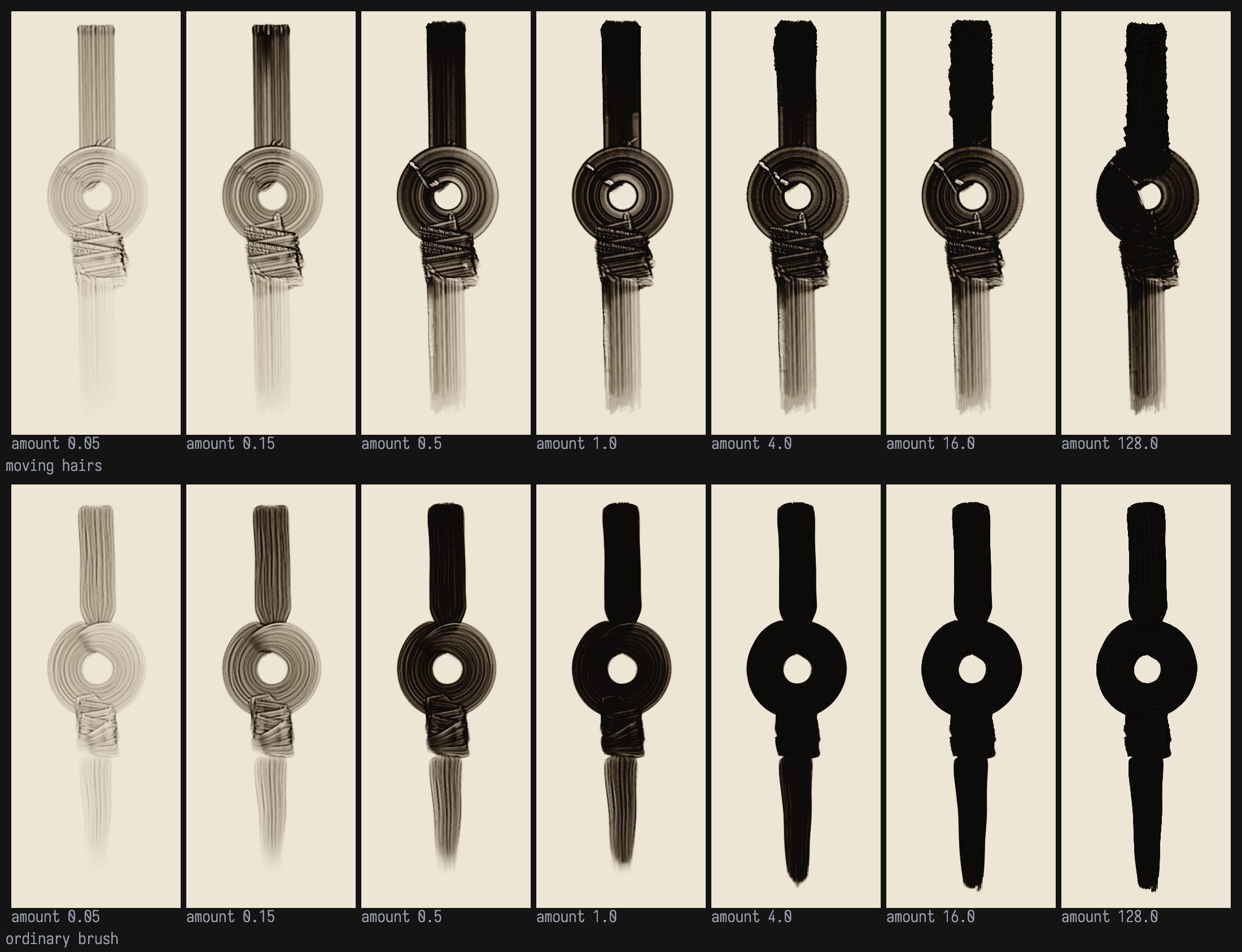
lay (in BrushConfig) is how thick a film a full brush lays. Thin, the bristle tracks show
through the black; thick, they disappear, and far past the usual the paint spreads into one solid
silhouette, lumpy where the bar starts. The ordinary brush is solid black from 2.
:::static
:::fold the gesture, and a column of it painted with settings `s`
// what every column starts from: the black of the Elegy above
data class Settings(
    val stiffness: Double = 0.5,
    val ragged: Double = 0.5,
    val splay: Double = 0.0,
    val lay: Double = 0.8,
    val run: Double = 1100.0,
    val pickup: Double? = null,
    val push: Double? = null,
    val hairs: Int = 48,
    val bristles: Int? = null,
    val stiff: Double = 0.5,
    val thinner: Double = 0.0,
    val oil: Double = 1.5,
    val amount: Double = 0.5,
    val hiding: Double = 0.65,
    val tilt: Double = 30.0,
    val faster: Double = 1.0,
    val facets: Double? = null,
    val moving: Boolean = true,
    val width: Double = 200.0,
    val hair: Double? = null,
    val cohesion: Double? = null,
    val clumping: Double? = null,
    val splayFan: Double? = null,
    val splayScatter: Double? = null,
    val drying: Double = 1.0,
    val absorbent: Double = 0.0,
    val lamp: Boolean = false,
    val wipeAfter: Double? = null,
    val dry: Boolean = false,
)

// A canvas 50 cm wide and 1.25 m tall; the default brush is 10 cm wide.
fun canvas() = PaintCanvas(300, aspect = 0.4, groundColor = rgb(0.93, 0.9, 0.83), sizeMm = 500.0, seed = 7)
val straight = FLine().moveTo(500, 120).lineTo(510, 900)
val loop = FLine().moveTo(510, 900).apply {
    for (i in 1..480) {
        val a = PI / 2 + 2 * PI * 1.15 * i / 480
        lineTo(510 + 190 * cos(a), 1090 - 190 * sin(a))
    }
}
val scrub = FLine().moveTo(560, 1330).apply {
    for (i in 0 until 5) {
        lineTo(if (i % 2 == 0) 380.0 else 640.0, 1375.0 + 45 * i)
    }
}
val last =
    [1600.0, 1800.0, 2000.0, 2200.0, 2400.0].zipWithNext().mapIndexed { k, (y0, y1) ->
        FLine().moveTo(500.0 + 4 * k, y0).lineTo(504.0 + 4 * k, y1)
    }

// a long straight, a loop that crosses itself, a scrub back and forth, and a last straight in four
// pieces, each faster and lighter: 100, 200, 350, then 600 mm/s, lifting off the canvas at the end
fun gesture(c: PaintCanvas, s: Settings): TimedGesture {
    fun part(line: FLine, speed: Double, vararg pressure: Double) =
        c.gesture(line, speed = speed, pressure = pressure.toList(), tilt = s.tilt, facets = s.facets)
    var g =
        part(straight, 250.0, 0.8, 1.0, 1.0).then(part(loop, 250.0, 1.0, 0.9)).pause(0.1).then(part(scrub, 300.0, 1.1))
    val press = [1.0, 0.8, 0.6, 0.3, -0.2]
    for ((k, speed) in [100.0, 200.0, 350.0, 600.0].withIndex()) g =
        g.then(part(last[k], speed, press[k], press[k + 1]))
    return g.faster(s.faster)
}

fun column(label: String, s: Settings): Pair<String, Img> {
    val c = canvas()
    try {
        if (s.absorbent > 0.0) c.prime(rgb(0.93, 0.9, 0.83), texture = 0.0, absorbent = s.absorbent)
        val config = BrushConfig(
            bristles = s.bristles,
            hair = s.hair,
            stiffness = s.stiffness,
            ragged = s.ragged,
            splay = s.splay,
            lay = s.lay,
            run = s.run,
            pickup = s.pickup,
            push = s.push,
        )
        val black = rgb(0.05, 0.045, 0.04)
        if (s.moving) {
            val brush =
                c.dynamicBrush(BrushKind.HogFlat, s.width, hairs = s.hairs, segments = 6, config = config)
                    .load(
                        black,
                        hiding = s.hiding,
                        stiff = s.stiff,
                        drying = s.drying,
                        thinner = s.thinner,
                        oil = s.oil,
                        amount = s.amount,
                    )
            brush.set(
                cohesion = s.cohesion,
                clumping = s.clumping,
                splayFan = s.splayFan,
                splayScatter = s.splayScatter,
            )
            c.stroke(gesture(c, s), brush)
        } else {
            // an ordinary brush along the same path, with the same pressures; it has no timing or tilt
            val brush =
                c.brush(BrushKind.HogFlat, s.width, config = config)
                    .load(
                        black,
                        hiding = s.hiding,
                        stiff = s.stiff,
                        drying = s.drying,
                        thinner = s.thinner,
                        oil = s.oil,
                        amount = s.amount,
                    )
            c.stroke(straight, brush, pressure = 0.8..1.0)
            c.stroke(loop, brush, pressure = 1.0..0.9)
            c.stroke(scrub, brush, pressure = 1.1..1.1)
            c.stroke(FLine().moveTo(500, 1600).lineTo(516, 2400), brush, pressure = 1.0..0.0)
        }
        // a rag wiped across the bar, the loop and the last stroke after some minutes (infinite: dry first)
        s.wipeAfter?.let { minutes ->
            if (minutes.isInfinite()) c.dry() else c.wait(minutes)
            val rag = c.rag(150.0)
            for (y in [500.0, 1090.0, 2000.0]) c.wipe(FLine().moveTo(250, y).lineTo(760, y + 10), rag, [0.8])
        }
        if (s.dry) c.dry()
        val png = if (s.lamp) c.png(relief = 0.3, light = PaintLight.Gallery) else c.png(relief = 0.3)
        return label to imgFromBytes(png)
    } finally {
        c.close()
    }
}

// the same columns twice: a row with moving hairs above a row with an ordinary brush
fun rows(cells: (moving: Boolean) -> List<Pair<String, Img>>): Img {
    val rows =
        ["moving hairs" to true, "ordinary brush" to false].map { (name, moving) ->
            val strokes = cells(moving)
            name to montage(strokes, columns = strokes.size, cellSide = 750, textScale = 3)
        }
    return montage(rows, columns = 1, cellSide = 4000, textScale = 3)
}
:::endfold
val sheet = rows { moving ->
    [0.5, 1.0, 2.0, 8.0, 32.0, 256.0].map { column("lay $it", Settings(lay = it, moving = moving)) }
}
showImg(sheet)
sheet.savePng("/tmp/field-docs-paint-sweep-lay.png")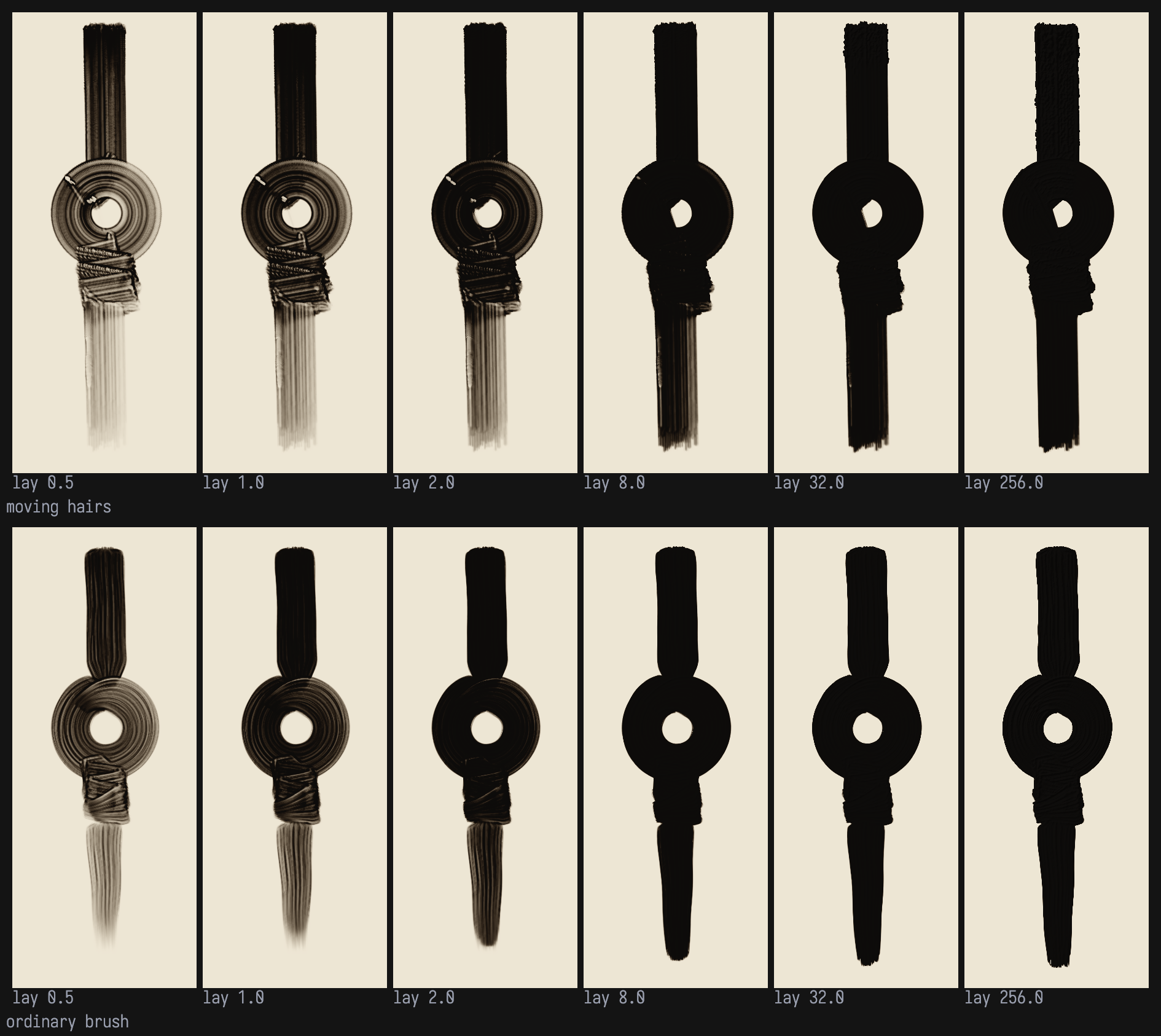
run is how far a load lasts, in canvas units. Short, the brush is dry before it reaches the
loop; very long, it never runs out and the gesture is one solid shape. Both brushes run out alike.
:::static
:::fold the gesture, and a column of it painted with settings `s`
// what every column starts from: the black of the Elegy above
data class Settings(
    val stiffness: Double = 0.5,
    val ragged: Double = 0.5,
    val splay: Double = 0.0,
    val lay: Double = 0.8,
    val run: Double = 1100.0,
    val pickup: Double? = null,
    val push: Double? = null,
    val hairs: Int = 48,
    val bristles: Int? = null,
    val stiff: Double = 0.5,
    val thinner: Double = 0.0,
    val oil: Double = 1.5,
    val amount: Double = 0.5,
    val hiding: Double = 0.65,
    val tilt: Double = 30.0,
    val faster: Double = 1.0,
    val facets: Double? = null,
    val moving: Boolean = true,
    val width: Double = 200.0,
    val hair: Double? = null,
    val cohesion: Double? = null,
    val clumping: Double? = null,
    val splayFan: Double? = null,
    val splayScatter: Double? = null,
    val drying: Double = 1.0,
    val absorbent: Double = 0.0,
    val lamp: Boolean = false,
    val wipeAfter: Double? = null,
    val dry: Boolean = false,
)

// A canvas 50 cm wide and 1.25 m tall; the default brush is 10 cm wide.
fun canvas() = PaintCanvas(300, aspect = 0.4, groundColor = rgb(0.93, 0.9, 0.83), sizeMm = 500.0, seed = 7)
val straight = FLine().moveTo(500, 120).lineTo(510, 900)
val loop = FLine().moveTo(510, 900).apply {
    for (i in 1..480) {
        val a = PI / 2 + 2 * PI * 1.15 * i / 480
        lineTo(510 + 190 * cos(a), 1090 - 190 * sin(a))
    }
}
val scrub = FLine().moveTo(560, 1330).apply {
    for (i in 0 until 5) {
        lineTo(if (i % 2 == 0) 380.0 else 640.0, 1375.0 + 45 * i)
    }
}
val last =
    [1600.0, 1800.0, 2000.0, 2200.0, 2400.0].zipWithNext().mapIndexed { k, (y0, y1) ->
        FLine().moveTo(500.0 + 4 * k, y0).lineTo(504.0 + 4 * k, y1)
    }

// a long straight, a loop that crosses itself, a scrub back and forth, and a last straight in four
// pieces, each faster and lighter: 100, 200, 350, then 600 mm/s, lifting off the canvas at the end
fun gesture(c: PaintCanvas, s: Settings): TimedGesture {
    fun part(line: FLine, speed: Double, vararg pressure: Double) =
        c.gesture(line, speed = speed, pressure = pressure.toList(), tilt = s.tilt, facets = s.facets)
    var g =
        part(straight, 250.0, 0.8, 1.0, 1.0).then(part(loop, 250.0, 1.0, 0.9)).pause(0.1).then(part(scrub, 300.0, 1.1))
    val press = [1.0, 0.8, 0.6, 0.3, -0.2]
    for ((k, speed) in [100.0, 200.0, 350.0, 600.0].withIndex()) g =
        g.then(part(last[k], speed, press[k], press[k + 1]))
    return g.faster(s.faster)
}

fun column(label: String, s: Settings): Pair<String, Img> {
    val c = canvas()
    try {
        if (s.absorbent > 0.0) c.prime(rgb(0.93, 0.9, 0.83), texture = 0.0, absorbent = s.absorbent)
        val config = BrushConfig(
            bristles = s.bristles,
            hair = s.hair,
            stiffness = s.stiffness,
            ragged = s.ragged,
            splay = s.splay,
            lay = s.lay,
            run = s.run,
            pickup = s.pickup,
            push = s.push,
        )
        val black = rgb(0.05, 0.045, 0.04)
        if (s.moving) {
            val brush =
                c.dynamicBrush(BrushKind.HogFlat, s.width, hairs = s.hairs, segments = 6, config = config)
                    .load(
                        black,
                        hiding = s.hiding,
                        stiff = s.stiff,
                        drying = s.drying,
                        thinner = s.thinner,
                        oil = s.oil,
                        amount = s.amount,
                    )
            brush.set(
                cohesion = s.cohesion,
                clumping = s.clumping,
                splayFan = s.splayFan,
                splayScatter = s.splayScatter,
            )
            c.stroke(gesture(c, s), brush)
        } else {
            // an ordinary brush along the same path, with the same pressures; it has no timing or tilt
            val brush =
                c.brush(BrushKind.HogFlat, s.width, config = config)
                    .load(
                        black,
                        hiding = s.hiding,
                        stiff = s.stiff,
                        drying = s.drying,
                        thinner = s.thinner,
                        oil = s.oil,
                        amount = s.amount,
                    )
            c.stroke(straight, brush, pressure = 0.8..1.0)
            c.stroke(loop, brush, pressure = 1.0..0.9)
            c.stroke(scrub, brush, pressure = 1.1..1.1)
            c.stroke(FLine().moveTo(500, 1600).lineTo(516, 2400), brush, pressure = 1.0..0.0)
        }
        // a rag wiped across the bar, the loop and the last stroke after some minutes (infinite: dry first)
        s.wipeAfter?.let { minutes ->
            if (minutes.isInfinite()) c.dry() else c.wait(minutes)
            val rag = c.rag(150.0)
            for (y in [500.0, 1090.0, 2000.0]) c.wipe(FLine().moveTo(250, y).lineTo(760, y + 10), rag, [0.8])
        }
        if (s.dry) c.dry()
        val png = if (s.lamp) c.png(relief = 0.3, light = PaintLight.Gallery) else c.png(relief = 0.3)
        return label to imgFromBytes(png)
    } finally {
        c.close()
    }
}

// the same columns twice: a row with moving hairs above a row with an ordinary brush
fun rows(cells: (moving: Boolean) -> List<Pair<String, Img>>): Img {
    val rows =
        ["moving hairs" to true, "ordinary brush" to false].map { (name, moving) ->
            val strokes = cells(moving)
            name to montage(strokes, columns = strokes.size, cellSide = 750, textScale = 3)
        }
    return montage(rows, columns = 1, cellSide = 4000, textScale = 3)
}
:::endfold
val sheet = rows { moving ->
    [50.0, 300.0, 1100.0, 4000.0, 30000.0, 1000000.0].map {
        column("run ${it.toInt()}", Settings(run = it, moving = moving))
    }
}
showImg(sheet)
sheet.savePng("/tmp/field-docs-paint-sweep-run.png")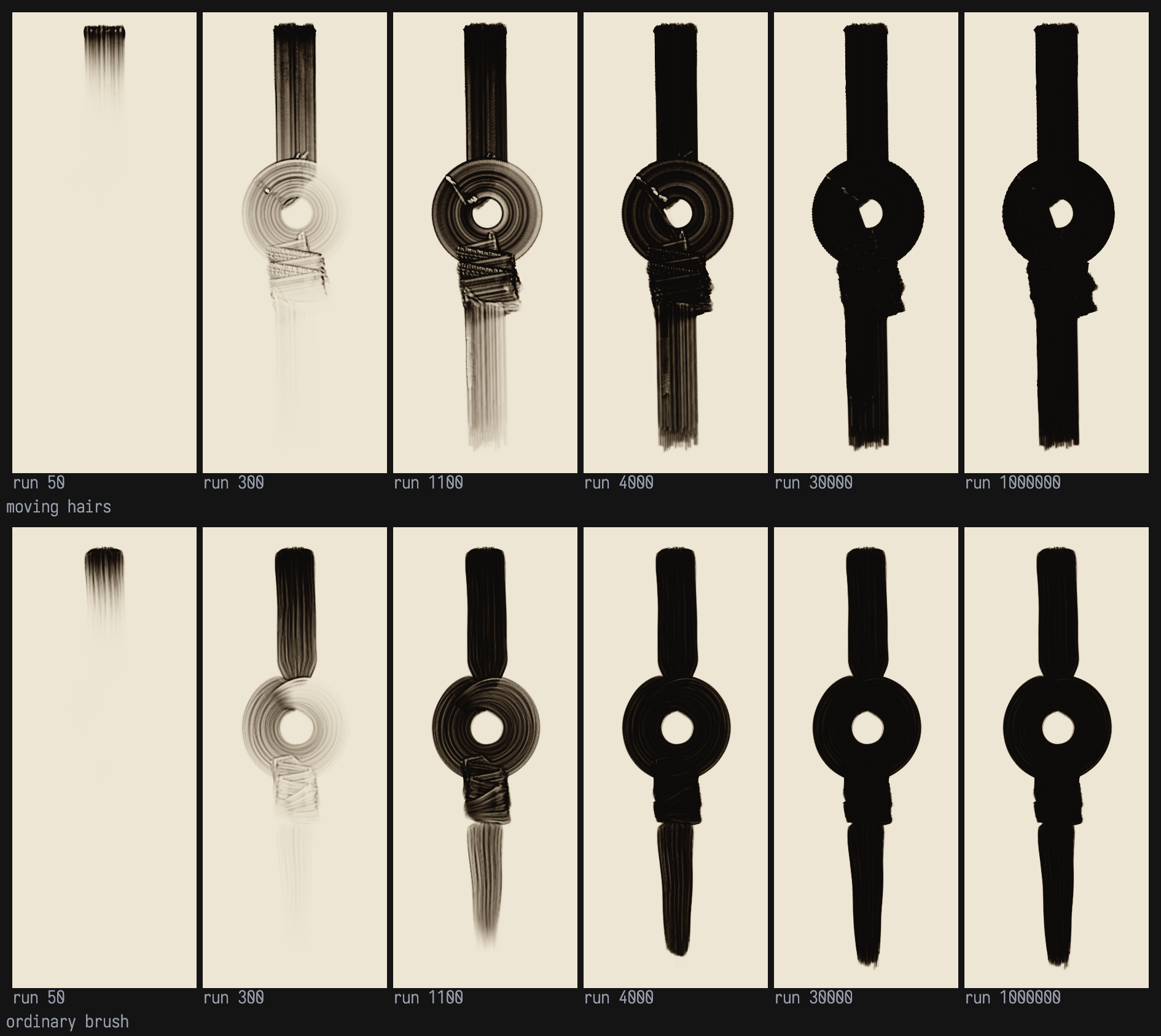
A little painting medium (thinner, a share of the paint's volume) changes the black all at once.
Up to about 0.01 the film still covers; from 0.02 it breaks into streaks with dark outlines, and
then into a pale veil over the ground; and at 0.9 the paint is nearly all medium and almost nothing
stays. The ordinary brush holds its black a little longer, to about 0.05.
:::static
:::fold the gesture, and a column of it painted with settings `s`
// what every column starts from: the black of the Elegy above
data class Settings(
    val stiffness: Double = 0.5,
    val ragged: Double = 0.5,
    val splay: Double = 0.0,
    val lay: Double = 0.8,
    val run: Double = 1100.0,
    val pickup: Double? = null,
    val push: Double? = null,
    val hairs: Int = 48,
    val bristles: Int? = null,
    val stiff: Double = 0.5,
    val thinner: Double = 0.0,
    val oil: Double = 1.5,
    val amount: Double = 0.5,
    val hiding: Double = 0.65,
    val tilt: Double = 30.0,
    val faster: Double = 1.0,
    val facets: Double? = null,
    val moving: Boolean = true,
    val width: Double = 200.0,
    val hair: Double? = null,
    val cohesion: Double? = null,
    val clumping: Double? = null,
    val splayFan: Double? = null,
    val splayScatter: Double? = null,
    val drying: Double = 1.0,
    val absorbent: Double = 0.0,
    val lamp: Boolean = false,
    val wipeAfter: Double? = null,
    val dry: Boolean = false,
)

// A canvas 50 cm wide and 1.25 m tall; the default brush is 10 cm wide.
fun canvas() = PaintCanvas(300, aspect = 0.4, groundColor = rgb(0.93, 0.9, 0.83), sizeMm = 500.0, seed = 7)
val straight = FLine().moveTo(500, 120).lineTo(510, 900)
val loop = FLine().moveTo(510, 900).apply {
    for (i in 1..480) {
        val a = PI / 2 + 2 * PI * 1.15 * i / 480
        lineTo(510 + 190 * cos(a), 1090 - 190 * sin(a))
    }
}
val scrub = FLine().moveTo(560, 1330).apply {
    for (i in 0 until 5) {
        lineTo(if (i % 2 == 0) 380.0 else 640.0, 1375.0 + 45 * i)
    }
}
val last =
    [1600.0, 1800.0, 2000.0, 2200.0, 2400.0].zipWithNext().mapIndexed { k, (y0, y1) ->
        FLine().moveTo(500.0 + 4 * k, y0).lineTo(504.0 + 4 * k, y1)
    }

// a long straight, a loop that crosses itself, a scrub back and forth, and a last straight in four
// pieces, each faster and lighter: 100, 200, 350, then 600 mm/s, lifting off the canvas at the end
fun gesture(c: PaintCanvas, s: Settings): TimedGesture {
    fun part(line: FLine, speed: Double, vararg pressure: Double) =
        c.gesture(line, speed = speed, pressure = pressure.toList(), tilt = s.tilt, facets = s.facets)
    var g =
        part(straight, 250.0, 0.8, 1.0, 1.0).then(part(loop, 250.0, 1.0, 0.9)).pause(0.1).then(part(scrub, 300.0, 1.1))
    val press = [1.0, 0.8, 0.6, 0.3, -0.2]
    for ((k, speed) in [100.0, 200.0, 350.0, 600.0].withIndex()) g =
        g.then(part(last[k], speed, press[k], press[k + 1]))
    return g.faster(s.faster)
}

fun column(label: String, s: Settings): Pair<String, Img> {
    val c = canvas()
    try {
        if (s.absorbent > 0.0) c.prime(rgb(0.93, 0.9, 0.83), texture = 0.0, absorbent = s.absorbent)
        val config = BrushConfig(
            bristles = s.bristles,
            hair = s.hair,
            stiffness = s.stiffness,
            ragged = s.ragged,
            splay = s.splay,
            lay = s.lay,
            run = s.run,
            pickup = s.pickup,
            push = s.push,
        )
        val black = rgb(0.05, 0.045, 0.04)
        if (s.moving) {
            val brush =
                c.dynamicBrush(BrushKind.HogFlat, s.width, hairs = s.hairs, segments = 6, config = config)
                    .load(
                        black,
                        hiding = s.hiding,
                        stiff = s.stiff,
                        drying = s.drying,
                        thinner = s.thinner,
                        oil = s.oil,
                        amount = s.amount,
                    )
            brush.set(
                cohesion = s.cohesion,
                clumping = s.clumping,
                splayFan = s.splayFan,
                splayScatter = s.splayScatter,
            )
            c.stroke(gesture(c, s), brush)
        } else {
            // an ordinary brush along the same path, with the same pressures; it has no timing or tilt
            val brush =
                c.brush(BrushKind.HogFlat, s.width, config = config)
                    .load(
                        black,
                        hiding = s.hiding,
                        stiff = s.stiff,
                        drying = s.drying,
                        thinner = s.thinner,
                        oil = s.oil,
                        amount = s.amount,
                    )
            c.stroke(straight, brush, pressure = 0.8..1.0)
            c.stroke(loop, brush, pressure = 1.0..0.9)
            c.stroke(scrub, brush, pressure = 1.1..1.1)
            c.stroke(FLine().moveTo(500, 1600).lineTo(516, 2400), brush, pressure = 1.0..0.0)
        }
        // a rag wiped across the bar, the loop and the last stroke after some minutes (infinite: dry first)
        s.wipeAfter?.let { minutes ->
            if (minutes.isInfinite()) c.dry() else c.wait(minutes)
            val rag = c.rag(150.0)
            for (y in [500.0, 1090.0, 2000.0]) c.wipe(FLine().moveTo(250, y).lineTo(760, y + 10), rag, [0.8])
        }
        if (s.dry) c.dry()
        val png = if (s.lamp) c.png(relief = 0.3, light = PaintLight.Gallery) else c.png(relief = 0.3)
        return label to imgFromBytes(png)
    } finally {
        c.close()
    }
}

// the same columns twice: a row with moving hairs above a row with an ordinary brush
fun rows(cells: (moving: Boolean) -> List<Pair<String, Img>>): Img {
    val rows =
        ["moving hairs" to true, "ordinary brush" to false].map { (name, moving) ->
            val strokes = cells(moving)
            name to montage(strokes, columns = strokes.size, cellSide = 750, textScale = 3)
        }
    return montage(rows, columns = 1, cellSide = 4000, textScale = 3)
}
:::endfold
val sheet = rows { moving ->
    [0.0, 0.01, 0.02, 0.05, 0.2, 0.5, 0.9].map { column("thinner $it", Settings(thinner = it, moving = moving)) }
}
showImg(sheet)
sheet.savePng("/tmp/field-docs-paint-sweep-thinner.png")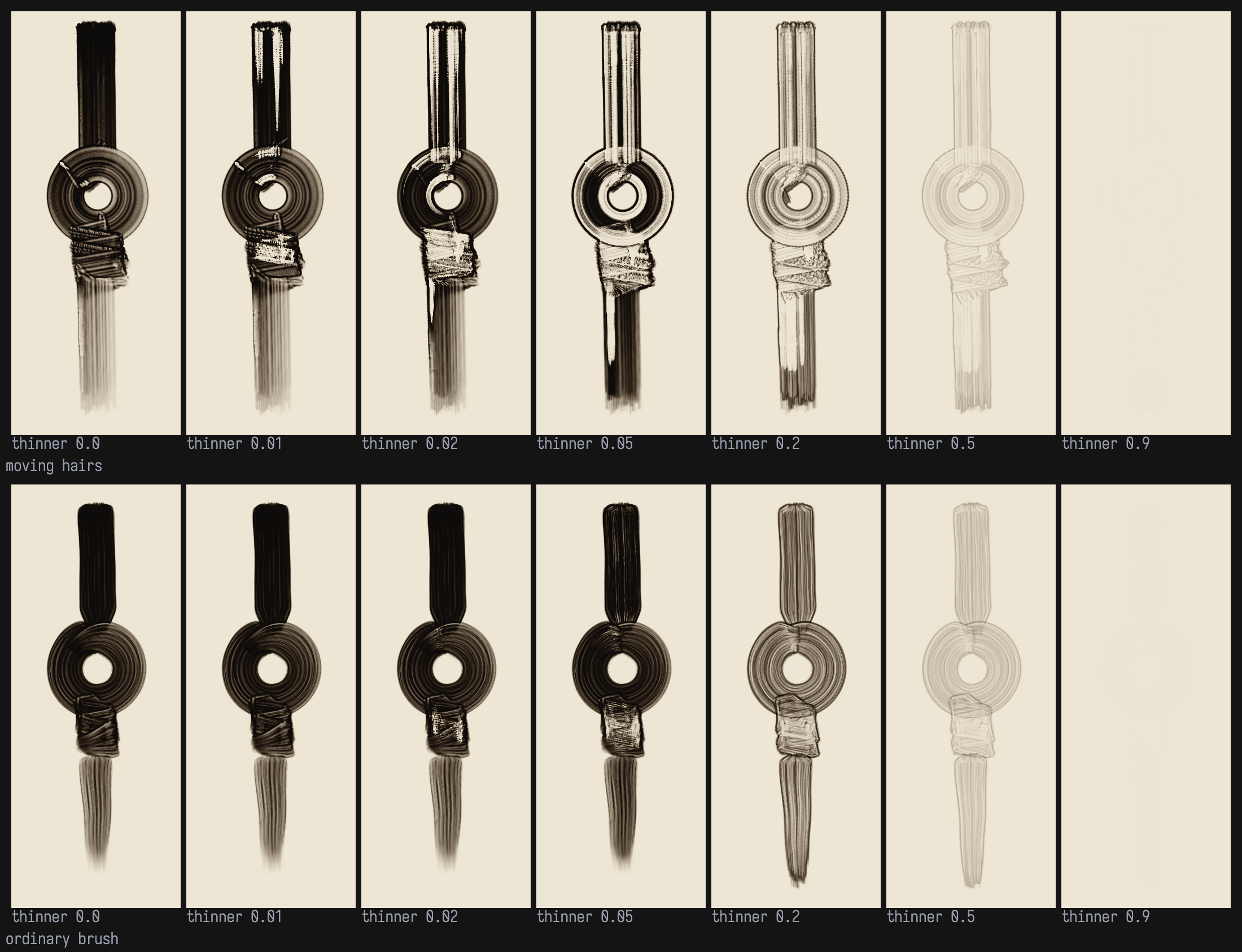
hiding is how much one coat covers. Black absorbs so strongly that it covers from about 0.1 up,
but at very small values it fades to a ghost. The ordinary brush follows it step for step.
:::static
:::fold the gesture, and a column of it painted with settings `s`
// what every column starts from: the black of the Elegy above
data class Settings(
    val stiffness: Double = 0.5,
    val ragged: Double = 0.5,
    val splay: Double = 0.0,
    val lay: Double = 0.8,
    val run: Double = 1100.0,
    val pickup: Double? = null,
    val push: Double? = null,
    val hairs: Int = 48,
    val bristles: Int? = null,
    val stiff: Double = 0.5,
    val thinner: Double = 0.0,
    val oil: Double = 1.5,
    val amount: Double = 0.5,
    val hiding: Double = 0.65,
    val tilt: Double = 30.0,
    val faster: Double = 1.0,
    val facets: Double? = null,
    val moving: Boolean = true,
    val width: Double = 200.0,
    val hair: Double? = null,
    val cohesion: Double? = null,
    val clumping: Double? = null,
    val splayFan: Double? = null,
    val splayScatter: Double? = null,
    val drying: Double = 1.0,
    val absorbent: Double = 0.0,
    val lamp: Boolean = false,
    val wipeAfter: Double? = null,
    val dry: Boolean = false,
)

// A canvas 50 cm wide and 1.25 m tall; the default brush is 10 cm wide.
fun canvas() = PaintCanvas(300, aspect = 0.4, groundColor = rgb(0.93, 0.9, 0.83), sizeMm = 500.0, seed = 7)
val straight = FLine().moveTo(500, 120).lineTo(510, 900)
val loop = FLine().moveTo(510, 900).apply {
    for (i in 1..480) {
        val a = PI / 2 + 2 * PI * 1.15 * i / 480
        lineTo(510 + 190 * cos(a), 1090 - 190 * sin(a))
    }
}
val scrub = FLine().moveTo(560, 1330).apply {
    for (i in 0 until 5) {
        lineTo(if (i % 2 == 0) 380.0 else 640.0, 1375.0 + 45 * i)
    }
}
val last =
    [1600.0, 1800.0, 2000.0, 2200.0, 2400.0].zipWithNext().mapIndexed { k, (y0, y1) ->
        FLine().moveTo(500.0 + 4 * k, y0).lineTo(504.0 + 4 * k, y1)
    }

// a long straight, a loop that crosses itself, a scrub back and forth, and a last straight in four
// pieces, each faster and lighter: 100, 200, 350, then 600 mm/s, lifting off the canvas at the end
fun gesture(c: PaintCanvas, s: Settings): TimedGesture {
    fun part(line: FLine, speed: Double, vararg pressure: Double) =
        c.gesture(line, speed = speed, pressure = pressure.toList(), tilt = s.tilt, facets = s.facets)
    var g =
        part(straight, 250.0, 0.8, 1.0, 1.0).then(part(loop, 250.0, 1.0, 0.9)).pause(0.1).then(part(scrub, 300.0, 1.1))
    val press = [1.0, 0.8, 0.6, 0.3, -0.2]
    for ((k, speed) in [100.0, 200.0, 350.0, 600.0].withIndex()) g =
        g.then(part(last[k], speed, press[k], press[k + 1]))
    return g.faster(s.faster)
}

fun column(label: String, s: Settings): Pair<String, Img> {
    val c = canvas()
    try {
        if (s.absorbent > 0.0) c.prime(rgb(0.93, 0.9, 0.83), texture = 0.0, absorbent = s.absorbent)
        val config = BrushConfig(
            bristles = s.bristles,
            hair = s.hair,
            stiffness = s.stiffness,
            ragged = s.ragged,
            splay = s.splay,
            lay = s.lay,
            run = s.run,
            pickup = s.pickup,
            push = s.push,
        )
        val black = rgb(0.05, 0.045, 0.04)
        if (s.moving) {
            val brush =
                c.dynamicBrush(BrushKind.HogFlat, s.width, hairs = s.hairs, segments = 6, config = config)
                    .load(
                        black,
                        hiding = s.hiding,
                        stiff = s.stiff,
                        drying = s.drying,
                        thinner = s.thinner,
                        oil = s.oil,
                        amount = s.amount,
                    )
            brush.set(
                cohesion = s.cohesion,
                clumping = s.clumping,
                splayFan = s.splayFan,
                splayScatter = s.splayScatter,
            )
            c.stroke(gesture(c, s), brush)
        } else {
            // an ordinary brush along the same path, with the same pressures; it has no timing or tilt
            val brush =
                c.brush(BrushKind.HogFlat, s.width, config = config)
                    .load(
                        black,
                        hiding = s.hiding,
                        stiff = s.stiff,
                        drying = s.drying,
                        thinner = s.thinner,
                        oil = s.oil,
                        amount = s.amount,
                    )
            c.stroke(straight, brush, pressure = 0.8..1.0)
            c.stroke(loop, brush, pressure = 1.0..0.9)
            c.stroke(scrub, brush, pressure = 1.1..1.1)
            c.stroke(FLine().moveTo(500, 1600).lineTo(516, 2400), brush, pressure = 1.0..0.0)
        }
        // a rag wiped across the bar, the loop and the last stroke after some minutes (infinite: dry first)
        s.wipeAfter?.let { minutes ->
            if (minutes.isInfinite()) c.dry() else c.wait(minutes)
            val rag = c.rag(150.0)
            for (y in [500.0, 1090.0, 2000.0]) c.wipe(FLine().moveTo(250, y).lineTo(760, y + 10), rag, [0.8])
        }
        if (s.dry) c.dry()
        val png = if (s.lamp) c.png(relief = 0.3, light = PaintLight.Gallery) else c.png(relief = 0.3)
        return label to imgFromBytes(png)
    } finally {
        c.close()
    }
}

// the same columns twice: a row with moving hairs above a row with an ordinary brush
fun rows(cells: (moving: Boolean) -> List<Pair<String, Img>>): Img {
    val rows =
        ["moving hairs" to true, "ordinary brush" to false].map { (name, moving) ->
            val strokes = cells(moving)
            name to montage(strokes, columns = strokes.size, cellSide = 750, textScale = 3)
        }
    return montage(rows, columns = 1, cellSide = 4000, textScale = 3)
}
:::endfold
val sheet = rows { moving ->
    [0.0001, 0.001, 0.01, 0.1, 0.65, 1.0].map { column("hiding $it", Settings(hiding = it, moving = moving)) }
}
showImg(sheet)
sheet.savePng("/tmp/field-docs-paint-sweep-hiding.png")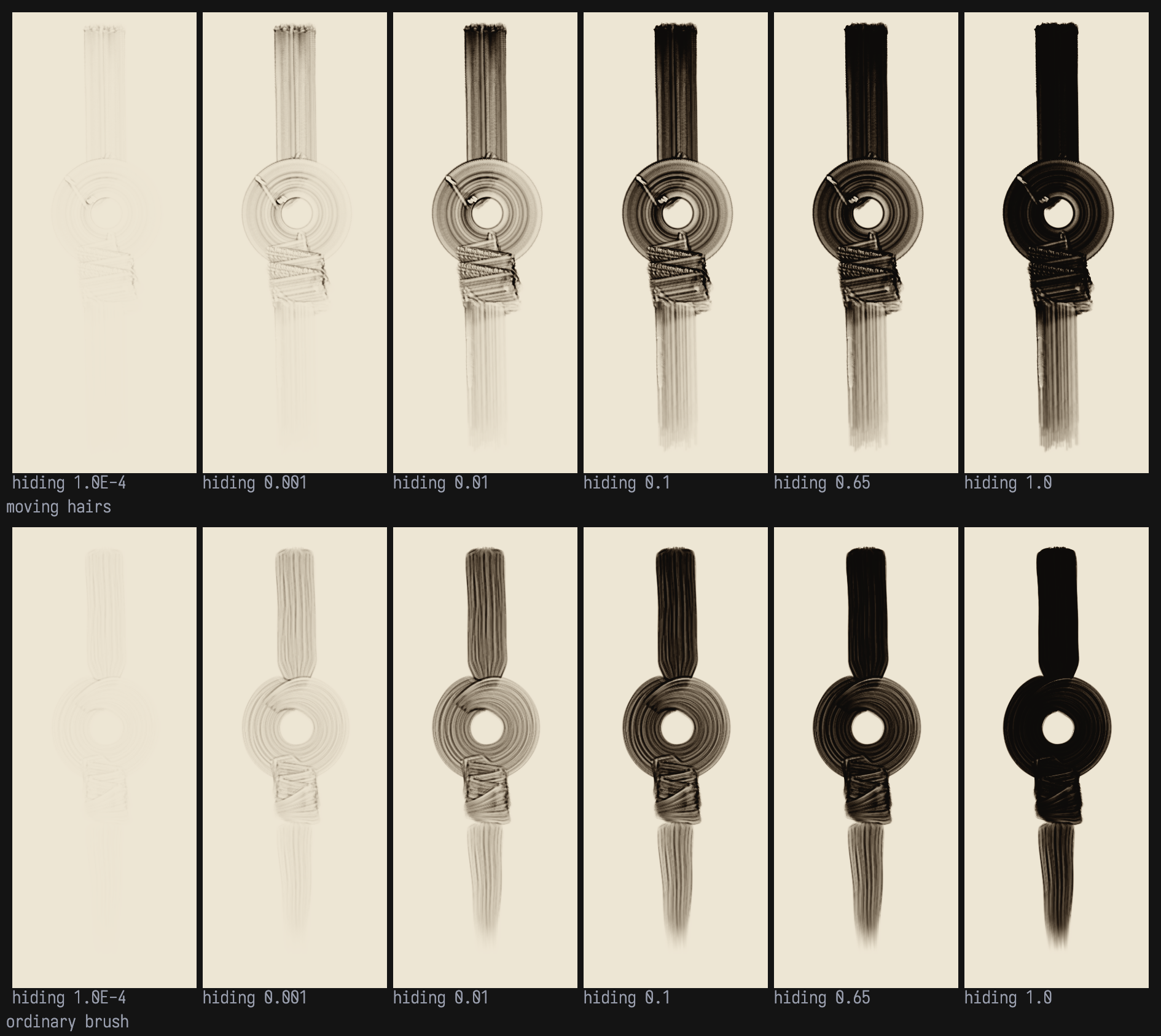
stiff is the paint's own stiffness (1 is tube paint). Up to tube paint it hardly changes a film
this thin. Past it the paint is a stiffer paste than any tube: it gathers the hairs into fewer,
wider clumps that leave bare furrows between their ridges, and comes off the hairs more reluctantly,
so the black goes paler and more broken the stiffer it is. The ordinary brush pales at 2 as well,
but past that it changes little.
:::static
:::fold the gesture, and a column of it painted with settings `s`
// what every column starts from: the black of the Elegy above
data class Settings(
    val stiffness: Double = 0.5,
    val ragged: Double = 0.5,
    val splay: Double = 0.0,
    val lay: Double = 0.8,
    val run: Double = 1100.0,
    val pickup: Double? = null,
    val push: Double? = null,
    val hairs: Int = 48,
    val bristles: Int? = null,
    val stiff: Double = 0.5,
    val thinner: Double = 0.0,
    val oil: Double = 1.5,
    val amount: Double = 0.5,
    val hiding: Double = 0.65,
    val tilt: Double = 30.0,
    val faster: Double = 1.0,
    val facets: Double? = null,
    val moving: Boolean = true,
    val width: Double = 200.0,
    val hair: Double? = null,
    val cohesion: Double? = null,
    val clumping: Double? = null,
    val splayFan: Double? = null,
    val splayScatter: Double? = null,
    val drying: Double = 1.0,
    val absorbent: Double = 0.0,
    val lamp: Boolean = false,
    val wipeAfter: Double? = null,
    val dry: Boolean = false,
)

// A canvas 50 cm wide and 1.25 m tall; the default brush is 10 cm wide.
fun canvas() = PaintCanvas(300, aspect = 0.4, groundColor = rgb(0.93, 0.9, 0.83), sizeMm = 500.0, seed = 7)
val straight = FLine().moveTo(500, 120).lineTo(510, 900)
val loop = FLine().moveTo(510, 900).apply {
    for (i in 1..480) {
        val a = PI / 2 + 2 * PI * 1.15 * i / 480
        lineTo(510 + 190 * cos(a), 1090 - 190 * sin(a))
    }
}
val scrub = FLine().moveTo(560, 1330).apply {
    for (i in 0 until 5) {
        lineTo(if (i % 2 == 0) 380.0 else 640.0, 1375.0 + 45 * i)
    }
}
val last =
    [1600.0, 1800.0, 2000.0, 2200.0, 2400.0].zipWithNext().mapIndexed { k, (y0, y1) ->
        FLine().moveTo(500.0 + 4 * k, y0).lineTo(504.0 + 4 * k, y1)
    }

// a long straight, a loop that crosses itself, a scrub back and forth, and a last straight in four
// pieces, each faster and lighter: 100, 200, 350, then 600 mm/s, lifting off the canvas at the end
fun gesture(c: PaintCanvas, s: Settings): TimedGesture {
    fun part(line: FLine, speed: Double, vararg pressure: Double) =
        c.gesture(line, speed = speed, pressure = pressure.toList(), tilt = s.tilt, facets = s.facets)
    var g =
        part(straight, 250.0, 0.8, 1.0, 1.0).then(part(loop, 250.0, 1.0, 0.9)).pause(0.1).then(part(scrub, 300.0, 1.1))
    val press = [1.0, 0.8, 0.6, 0.3, -0.2]
    for ((k, speed) in [100.0, 200.0, 350.0, 600.0].withIndex()) g =
        g.then(part(last[k], speed, press[k], press[k + 1]))
    return g.faster(s.faster)
}

fun column(label: String, s: Settings): Pair<String, Img> {
    val c = canvas()
    try {
        if (s.absorbent > 0.0) c.prime(rgb(0.93, 0.9, 0.83), texture = 0.0, absorbent = s.absorbent)
        val config = BrushConfig(
            bristles = s.bristles,
            hair = s.hair,
            stiffness = s.stiffness,
            ragged = s.ragged,
            splay = s.splay,
            lay = s.lay,
            run = s.run,
            pickup = s.pickup,
            push = s.push,
        )
        val black = rgb(0.05, 0.045, 0.04)
        if (s.moving) {
            val brush =
                c.dynamicBrush(BrushKind.HogFlat, s.width, hairs = s.hairs, segments = 6, config = config)
                    .load(
                        black,
                        hiding = s.hiding,
                        stiff = s.stiff,
                        drying = s.drying,
                        thinner = s.thinner,
                        oil = s.oil,
                        amount = s.amount,
                    )
            brush.set(
                cohesion = s.cohesion,
                clumping = s.clumping,
                splayFan = s.splayFan,
                splayScatter = s.splayScatter,
            )
            c.stroke(gesture(c, s), brush)
        } else {
            // an ordinary brush along the same path, with the same pressures; it has no timing or tilt
            val brush =
                c.brush(BrushKind.HogFlat, s.width, config = config)
                    .load(
                        black,
                        hiding = s.hiding,
                        stiff = s.stiff,
                        drying = s.drying,
                        thinner = s.thinner,
                        oil = s.oil,
                        amount = s.amount,
                    )
            c.stroke(straight, brush, pressure = 0.8..1.0)
            c.stroke(loop, brush, pressure = 1.0..0.9)
            c.stroke(scrub, brush, pressure = 1.1..1.1)
            c.stroke(FLine().moveTo(500, 1600).lineTo(516, 2400), brush, pressure = 1.0..0.0)
        }
        // a rag wiped across the bar, the loop and the last stroke after some minutes (infinite: dry first)
        s.wipeAfter?.let { minutes ->
            if (minutes.isInfinite()) c.dry() else c.wait(minutes)
            val rag = c.rag(150.0)
            for (y in [500.0, 1090.0, 2000.0]) c.wipe(FLine().moveTo(250, y).lineTo(760, y + 10), rag, [0.8])
        }
        if (s.dry) c.dry()
        val png = if (s.lamp) c.png(relief = 0.3, light = PaintLight.Gallery) else c.png(relief = 0.3)
        return label to imgFromBytes(png)
    } finally {
        c.close()
    }
}

// the same columns twice: a row with moving hairs above a row with an ordinary brush
fun rows(cells: (moving: Boolean) -> List<Pair<String, Img>>): Img {
    val rows =
        ["moving hairs" to true, "ordinary brush" to false].map { (name, moving) ->
            val strokes = cells(moving)
            name to montage(strokes, columns = strokes.size, cellSide = 750, textScale = 3)
        }
    return montage(rows, columns = 1, cellSide = 4000, textScale = 3)
}
:::endfold
val sheet = rows { moving ->
    [0.0, 0.5, 2.0, 5.0, 30.0, 300.0].map { column("stiff $it", Settings(stiff = it, moving = moving)) }
}
showImg(sheet)
sheet.savePng("/tmp/field-docs-paint-sweep-stiff.png")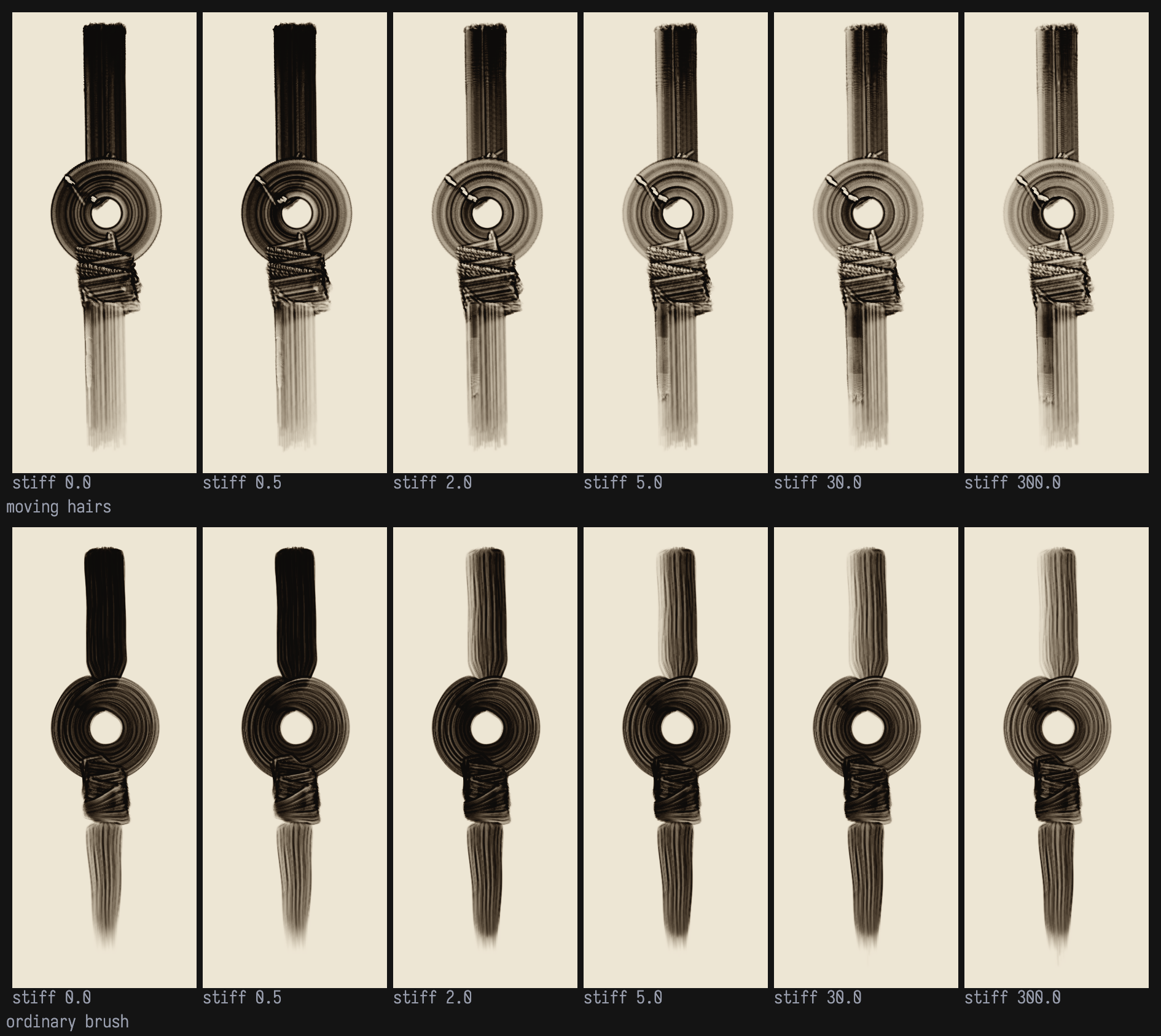
The brush
The stiffness of the hairs (BrushConfig.stiffness, 0 soft hair to 1 hog bristle) changes the
most. Below 0 the hairs are driven away from their own shape and hardly reach the canvas; at 0 they
flop and drag into a fur of hair marks; from about 0.4 the brush holds its shape; and far past 1
the hairs are rigid rods that splinter the loop and the scrub into hard straight marks. The ordinary
brush hardly notices: from 1 up its scrub spreads a little wider and its last stroke parts at the top.
:::static
:::fold the gesture, and a column of it painted with settings `s`
// what every column starts from: the black of the Elegy above
data class Settings(
    val stiffness: Double = 0.5,
    val ragged: Double = 0.5,
    val splay: Double = 0.0,
    val lay: Double = 0.8,
    val run: Double = 1100.0,
    val pickup: Double? = null,
    val push: Double? = null,
    val hairs: Int = 48,
    val bristles: Int? = null,
    val stiff: Double = 0.5,
    val thinner: Double = 0.0,
    val oil: Double = 1.5,
    val amount: Double = 0.5,
    val hiding: Double = 0.65,
    val tilt: Double = 30.0,
    val faster: Double = 1.0,
    val facets: Double? = null,
    val moving: Boolean = true,
    val width: Double = 200.0,
    val hair: Double? = null,
    val cohesion: Double? = null,
    val clumping: Double? = null,
    val splayFan: Double? = null,
    val splayScatter: Double? = null,
    val drying: Double = 1.0,
    val absorbent: Double = 0.0,
    val lamp: Boolean = false,
    val wipeAfter: Double? = null,
    val dry: Boolean = false,
)

// A canvas 50 cm wide and 1.25 m tall; the default brush is 10 cm wide.
fun canvas() = PaintCanvas(300, aspect = 0.4, groundColor = rgb(0.93, 0.9, 0.83), sizeMm = 500.0, seed = 7)
val straight = FLine().moveTo(500, 120).lineTo(510, 900)
val loop = FLine().moveTo(510, 900).apply {
    for (i in 1..480) {
        val a = PI / 2 + 2 * PI * 1.15 * i / 480
        lineTo(510 + 190 * cos(a), 1090 - 190 * sin(a))
    }
}
val scrub = FLine().moveTo(560, 1330).apply {
    for (i in 0 until 5) {
        lineTo(if (i % 2 == 0) 380.0 else 640.0, 1375.0 + 45 * i)
    }
}
val last =
    [1600.0, 1800.0, 2000.0, 2200.0, 2400.0].zipWithNext().mapIndexed { k, (y0, y1) ->
        FLine().moveTo(500.0 + 4 * k, y0).lineTo(504.0 + 4 * k, y1)
    }

// a long straight, a loop that crosses itself, a scrub back and forth, and a last straight in four
// pieces, each faster and lighter: 100, 200, 350, then 600 mm/s, lifting off the canvas at the end
fun gesture(c: PaintCanvas, s: Settings): TimedGesture {
    fun part(line: FLine, speed: Double, vararg pressure: Double) =
        c.gesture(line, speed = speed, pressure = pressure.toList(), tilt = s.tilt, facets = s.facets)
    var g =
        part(straight, 250.0, 0.8, 1.0, 1.0).then(part(loop, 250.0, 1.0, 0.9)).pause(0.1).then(part(scrub, 300.0, 1.1))
    val press = [1.0, 0.8, 0.6, 0.3, -0.2]
    for ((k, speed) in [100.0, 200.0, 350.0, 600.0].withIndex()) g =
        g.then(part(last[k], speed, press[k], press[k + 1]))
    return g.faster(s.faster)
}

fun column(label: String, s: Settings): Pair<String, Img> {
    val c = canvas()
    try {
        if (s.absorbent > 0.0) c.prime(rgb(0.93, 0.9, 0.83), texture = 0.0, absorbent = s.absorbent)
        val config = BrushConfig(
            bristles = s.bristles,
            hair = s.hair,
            stiffness = s.stiffness,
            ragged = s.ragged,
            splay = s.splay,
            lay = s.lay,
            run = s.run,
            pickup = s.pickup,
            push = s.push,
        )
        val black = rgb(0.05, 0.045, 0.04)
        if (s.moving) {
            val brush =
                c.dynamicBrush(BrushKind.HogFlat, s.width, hairs = s.hairs, segments = 6, config = config)
                    .load(
                        black,
                        hiding = s.hiding,
                        stiff = s.stiff,
                        drying = s.drying,
                        thinner = s.thinner,
                        oil = s.oil,
                        amount = s.amount,
                    )
            brush.set(
                cohesion = s.cohesion,
                clumping = s.clumping,
                splayFan = s.splayFan,
                splayScatter = s.splayScatter,
            )
            c.stroke(gesture(c, s), brush)
        } else {
            // an ordinary brush along the same path, with the same pressures; it has no timing or tilt
            val brush =
                c.brush(BrushKind.HogFlat, s.width, config = config)
                    .load(
                        black,
                        hiding = s.hiding,
                        stiff = s.stiff,
                        drying = s.drying,
                        thinner = s.thinner,
                        oil = s.oil,
                        amount = s.amount,
                    )
            c.stroke(straight, brush, pressure = 0.8..1.0)
            c.stroke(loop, brush, pressure = 1.0..0.9)
            c.stroke(scrub, brush, pressure = 1.1..1.1)
            c.stroke(FLine().moveTo(500, 1600).lineTo(516, 2400), brush, pressure = 1.0..0.0)
        }
        // a rag wiped across the bar, the loop and the last stroke after some minutes (infinite: dry first)
        s.wipeAfter?.let { minutes ->
            if (minutes.isInfinite()) c.dry() else c.wait(minutes)
            val rag = c.rag(150.0)
            for (y in [500.0, 1090.0, 2000.0]) c.wipe(FLine().moveTo(250, y).lineTo(760, y + 10), rag, [0.8])
        }
        if (s.dry) c.dry()
        val png = if (s.lamp) c.png(relief = 0.3, light = PaintLight.Gallery) else c.png(relief = 0.3)
        return label to imgFromBytes(png)
    } finally {
        c.close()
    }
}

// the same columns twice: a row with moving hairs above a row with an ordinary brush
fun rows(cells: (moving: Boolean) -> List<Pair<String, Img>>): Img {
    val rows =
        ["moving hairs" to true, "ordinary brush" to false].map { (name, moving) ->
            val strokes = cells(moving)
            name to montage(strokes, columns = strokes.size, cellSide = 750, textScale = 3)
        }
    return montage(rows, columns = 1, cellSide = 4000, textScale = 3)
}
:::endfold
val sheet = rows { moving ->
    [-1.0, -0.25, 0.0, 0.4, 1.0, 2.0, 1000.0].map { column("stiffness $it", Settings(stiffness = it, moving = moving)) }
}
showImg(sheet)
sheet.savePng("/tmp/field-docs-paint-sweep-stiffness.png")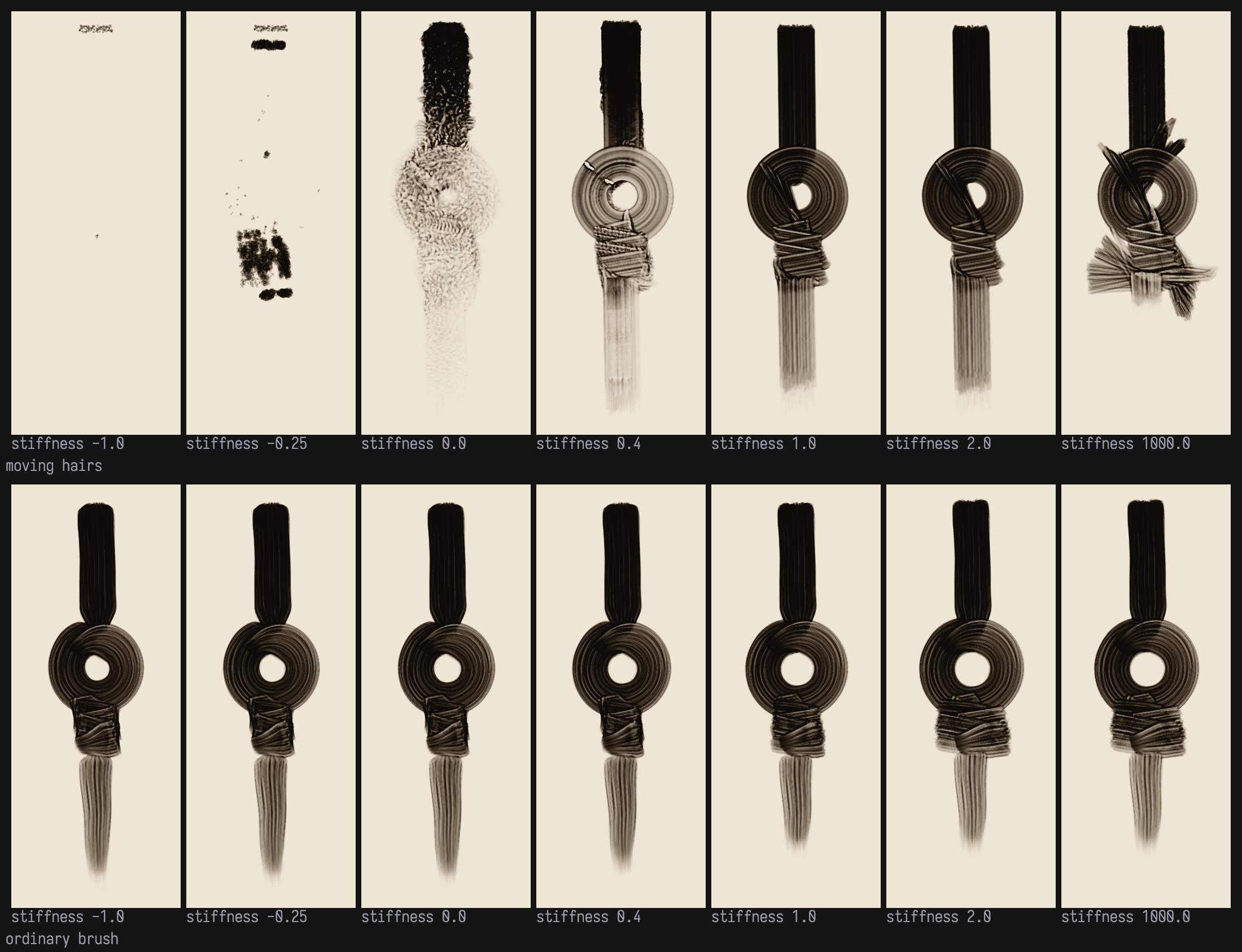
hairs is how many guide hairs are simulated: the hairs whose bending the brush works out, which
the rest of its bristles follow. Even two give a whole stroke on this flat. With few,
the loop drags a dark wedge across the ring where it crosses itself; from about 48 the ring is evenly
striped, and more hairs change little.
:::static
:::fold the gesture, and a column of it painted with settings `s`
// what every column starts from: the black of the Elegy above
data class Settings(
    val stiffness: Double = 0.5,
    val ragged: Double = 0.5,
    val splay: Double = 0.0,
    val lay: Double = 0.8,
    val run: Double = 1100.0,
    val pickup: Double? = null,
    val push: Double? = null,
    val hairs: Int = 48,
    val bristles: Int? = null,
    val stiff: Double = 0.5,
    val thinner: Double = 0.0,
    val oil: Double = 1.5,
    val amount: Double = 0.5,
    val hiding: Double = 0.65,
    val tilt: Double = 30.0,
    val faster: Double = 1.0,
    val facets: Double? = null,
    val moving: Boolean = true,
    val width: Double = 200.0,
    val hair: Double? = null,
    val cohesion: Double? = null,
    val clumping: Double? = null,
    val splayFan: Double? = null,
    val splayScatter: Double? = null,
    val drying: Double = 1.0,
    val absorbent: Double = 0.0,
    val lamp: Boolean = false,
    val wipeAfter: Double? = null,
    val dry: Boolean = false,
)

// A canvas 50 cm wide and 1.25 m tall; the default brush is 10 cm wide.
fun canvas() = PaintCanvas(300, aspect = 0.4, groundColor = rgb(0.93, 0.9, 0.83), sizeMm = 500.0, seed = 7)
val straight = FLine().moveTo(500, 120).lineTo(510, 900)
val loop = FLine().moveTo(510, 900).apply {
    for (i in 1..480) {
        val a = PI / 2 + 2 * PI * 1.15 * i / 480
        lineTo(510 + 190 * cos(a), 1090 - 190 * sin(a))
    }
}
val scrub = FLine().moveTo(560, 1330).apply {
    for (i in 0 until 5) {
        lineTo(if (i % 2 == 0) 380.0 else 640.0, 1375.0 + 45 * i)
    }
}
val last =
    [1600.0, 1800.0, 2000.0, 2200.0, 2400.0].zipWithNext().mapIndexed { k, (y0, y1) ->
        FLine().moveTo(500.0 + 4 * k, y0).lineTo(504.0 + 4 * k, y1)
    }

// a long straight, a loop that crosses itself, a scrub back and forth, and a last straight in four
// pieces, each faster and lighter: 100, 200, 350, then 600 mm/s, lifting off the canvas at the end
fun gesture(c: PaintCanvas, s: Settings): TimedGesture {
    fun part(line: FLine, speed: Double, vararg pressure: Double) =
        c.gesture(line, speed = speed, pressure = pressure.toList(), tilt = s.tilt, facets = s.facets)
    var g =
        part(straight, 250.0, 0.8, 1.0, 1.0).then(part(loop, 250.0, 1.0, 0.9)).pause(0.1).then(part(scrub, 300.0, 1.1))
    val press = [1.0, 0.8, 0.6, 0.3, -0.2]
    for ((k, speed) in [100.0, 200.0, 350.0, 600.0].withIndex()) g =
        g.then(part(last[k], speed, press[k], press[k + 1]))
    return g.faster(s.faster)
}

fun column(label: String, s: Settings): Pair<String, Img> {
    val c = canvas()
    try {
        if (s.absorbent > 0.0) c.prime(rgb(0.93, 0.9, 0.83), texture = 0.0, absorbent = s.absorbent)
        val config = BrushConfig(
            bristles = s.bristles,
            hair = s.hair,
            stiffness = s.stiffness,
            ragged = s.ragged,
            splay = s.splay,
            lay = s.lay,
            run = s.run,
            pickup = s.pickup,
            push = s.push,
        )
        val black = rgb(0.05, 0.045, 0.04)
        if (s.moving) {
            val brush =
                c.dynamicBrush(BrushKind.HogFlat, s.width, hairs = s.hairs, segments = 6, config = config)
                    .load(
                        black,
                        hiding = s.hiding,
                        stiff = s.stiff,
                        drying = s.drying,
                        thinner = s.thinner,
                        oil = s.oil,
                        amount = s.amount,
                    )
            brush.set(
                cohesion = s.cohesion,
                clumping = s.clumping,
                splayFan = s.splayFan,
                splayScatter = s.splayScatter,
            )
            c.stroke(gesture(c, s), brush)
        } else {
            // an ordinary brush along the same path, with the same pressures; it has no timing or tilt
            val brush =
                c.brush(BrushKind.HogFlat, s.width, config = config)
                    .load(
                        black,
                        hiding = s.hiding,
                        stiff = s.stiff,
                        drying = s.drying,
                        thinner = s.thinner,
                        oil = s.oil,
                        amount = s.amount,
                    )
            c.stroke(straight, brush, pressure = 0.8..1.0)
            c.stroke(loop, brush, pressure = 1.0..0.9)
            c.stroke(scrub, brush, pressure = 1.1..1.1)
            c.stroke(FLine().moveTo(500, 1600).lineTo(516, 2400), brush, pressure = 1.0..0.0)
        }
        // a rag wiped across the bar, the loop and the last stroke after some minutes (infinite: dry first)
        s.wipeAfter?.let { minutes ->
            if (minutes.isInfinite()) c.dry() else c.wait(minutes)
            val rag = c.rag(150.0)
            for (y in [500.0, 1090.0, 2000.0]) c.wipe(FLine().moveTo(250, y).lineTo(760, y + 10), rag, [0.8])
        }
        if (s.dry) c.dry()
        val png = if (s.lamp) c.png(relief = 0.3, light = PaintLight.Gallery) else c.png(relief = 0.3)
        return label to imgFromBytes(png)
    } finally {
        c.close()
    }
}

// the same columns twice: a row with moving hairs above a row with an ordinary brush
fun rows(cells: (moving: Boolean) -> List<Pair<String, Img>>): Img {
    val rows =
        ["moving hairs" to true, "ordinary brush" to false].map { (name, moving) ->
            val strokes = cells(moving)
            name to montage(strokes, columns = strokes.size, cellSide = 750, textScale = 3)
        }
    return montage(rows, columns = 1, cellSide = 4000, textScale = 3)
}
:::endfold
val strokes = [2, 4, 8, 48, 256, 1024].map { column("hairs $it", Settings(hairs = it)) }
val sheet = montage(strokes, columns = strokes.size, cellSide = 750, textScale = 3)
showImg(sheet)
sheet.savePng("/tmp/field-docs-paint-sweep-hairs.png")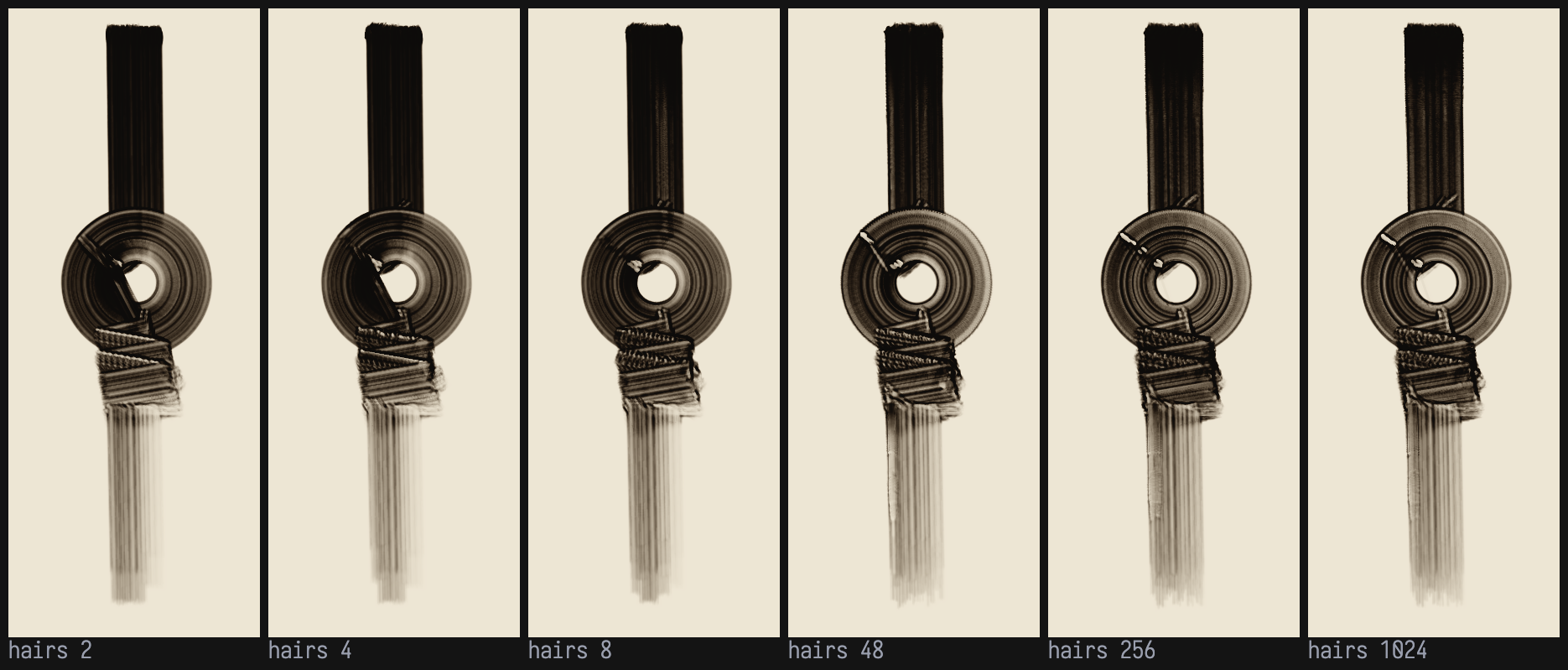
hairs means nothing to an ordinary brush. Its count is bristles (in BrushConfig), the hairs
that touch the canvas: 140 for this flat. One bristle draws a single beaded line, a few paint
separate tracks, and from about 40 the stroke is whole; far past the default it closes up into a
smooth dark shape with hardly a hair mark.
:::static
:::fold the gesture, and a column of it painted with settings `s`
// what every column starts from: the black of the Elegy above
data class Settings(
    val stiffness: Double = 0.5,
    val ragged: Double = 0.5,
    val splay: Double = 0.0,
    val lay: Double = 0.8,
    val run: Double = 1100.0,
    val pickup: Double? = null,
    val push: Double? = null,
    val hairs: Int = 48,
    val bristles: Int? = null,
    val stiff: Double = 0.5,
    val thinner: Double = 0.0,
    val oil: Double = 1.5,
    val amount: Double = 0.5,
    val hiding: Double = 0.65,
    val tilt: Double = 30.0,
    val faster: Double = 1.0,
    val facets: Double? = null,
    val moving: Boolean = true,
    val width: Double = 200.0,
    val hair: Double? = null,
    val cohesion: Double? = null,
    val clumping: Double? = null,
    val splayFan: Double? = null,
    val splayScatter: Double? = null,
    val drying: Double = 1.0,
    val absorbent: Double = 0.0,
    val lamp: Boolean = false,
    val wipeAfter: Double? = null,
    val dry: Boolean = false,
)

// A canvas 50 cm wide and 1.25 m tall; the default brush is 10 cm wide.
fun canvas() = PaintCanvas(300, aspect = 0.4, groundColor = rgb(0.93, 0.9, 0.83), sizeMm = 500.0, seed = 7)
val straight = FLine().moveTo(500, 120).lineTo(510, 900)
val loop = FLine().moveTo(510, 900).apply {
    for (i in 1..480) {
        val a = PI / 2 + 2 * PI * 1.15 * i / 480
        lineTo(510 + 190 * cos(a), 1090 - 190 * sin(a))
    }
}
val scrub = FLine().moveTo(560, 1330).apply {
    for (i in 0 until 5) {
        lineTo(if (i % 2 == 0) 380.0 else 640.0, 1375.0 + 45 * i)
    }
}
val last =
    [1600.0, 1800.0, 2000.0, 2200.0, 2400.0].zipWithNext().mapIndexed { k, (y0, y1) ->
        FLine().moveTo(500.0 + 4 * k, y0).lineTo(504.0 + 4 * k, y1)
    }

// a long straight, a loop that crosses itself, a scrub back and forth, and a last straight in four
// pieces, each faster and lighter: 100, 200, 350, then 600 mm/s, lifting off the canvas at the end
fun gesture(c: PaintCanvas, s: Settings): TimedGesture {
    fun part(line: FLine, speed: Double, vararg pressure: Double) =
        c.gesture(line, speed = speed, pressure = pressure.toList(), tilt = s.tilt, facets = s.facets)
    var g =
        part(straight, 250.0, 0.8, 1.0, 1.0).then(part(loop, 250.0, 1.0, 0.9)).pause(0.1).then(part(scrub, 300.0, 1.1))
    val press = [1.0, 0.8, 0.6, 0.3, -0.2]
    for ((k, speed) in [100.0, 200.0, 350.0, 600.0].withIndex()) g =
        g.then(part(last[k], speed, press[k], press[k + 1]))
    return g.faster(s.faster)
}

fun column(label: String, s: Settings): Pair<String, Img> {
    val c = canvas()
    try {
        if (s.absorbent > 0.0) c.prime(rgb(0.93, 0.9, 0.83), texture = 0.0, absorbent = s.absorbent)
        val config = BrushConfig(
            bristles = s.bristles,
            hair = s.hair,
            stiffness = s.stiffness,
            ragged = s.ragged,
            splay = s.splay,
            lay = s.lay,
            run = s.run,
            pickup = s.pickup,
            push = s.push,
        )
        val black = rgb(0.05, 0.045, 0.04)
        if (s.moving) {
            val brush =
                c.dynamicBrush(BrushKind.HogFlat, s.width, hairs = s.hairs, segments = 6, config = config)
                    .load(
                        black,
                        hiding = s.hiding,
                        stiff = s.stiff,
                        drying = s.drying,
                        thinner = s.thinner,
                        oil = s.oil,
                        amount = s.amount,
                    )
            brush.set(
                cohesion = s.cohesion,
                clumping = s.clumping,
                splayFan = s.splayFan,
                splayScatter = s.splayScatter,
            )
            c.stroke(gesture(c, s), brush)
        } else {
            // an ordinary brush along the same path, with the same pressures; it has no timing or tilt
            val brush =
                c.brush(BrushKind.HogFlat, s.width, config = config)
                    .load(
                        black,
                        hiding = s.hiding,
                        stiff = s.stiff,
                        drying = s.drying,
                        thinner = s.thinner,
                        oil = s.oil,
                        amount = s.amount,
                    )
            c.stroke(straight, brush, pressure = 0.8..1.0)
            c.stroke(loop, brush, pressure = 1.0..0.9)
            c.stroke(scrub, brush, pressure = 1.1..1.1)
            c.stroke(FLine().moveTo(500, 1600).lineTo(516, 2400), brush, pressure = 1.0..0.0)
        }
        // a rag wiped across the bar, the loop and the last stroke after some minutes (infinite: dry first)
        s.wipeAfter?.let { minutes ->
            if (minutes.isInfinite()) c.dry() else c.wait(minutes)
            val rag = c.rag(150.0)
            for (y in [500.0, 1090.0, 2000.0]) c.wipe(FLine().moveTo(250, y).lineTo(760, y + 10), rag, [0.8])
        }
        if (s.dry) c.dry()
        val png = if (s.lamp) c.png(relief = 0.3, light = PaintLight.Gallery) else c.png(relief = 0.3)
        return label to imgFromBytes(png)
    } finally {
        c.close()
    }
}

// the same columns twice: a row with moving hairs above a row with an ordinary brush
fun rows(cells: (moving: Boolean) -> List<Pair<String, Img>>): Img {
    val rows =
        ["moving hairs" to true, "ordinary brush" to false].map { (name, moving) ->
            val strokes = cells(moving)
            name to montage(strokes, columns = strokes.size, cellSide = 750, textScale = 3)
        }
    return montage(rows, columns = 1, cellSide = 4000, textScale = 3)
}
:::endfold
val strokes =
    [1, 3, 10, 40, 140, 1000, 10000, 100000].map { column("bristles $it", Settings(bristles = it, moving = false)) }
val sheet = montage(strokes, columns = strokes.size, cellSide = 750, textScale = 3)
showImg(sheet)
sheet.savePng("/tmp/field-docs-paint-sweep-bristles.png")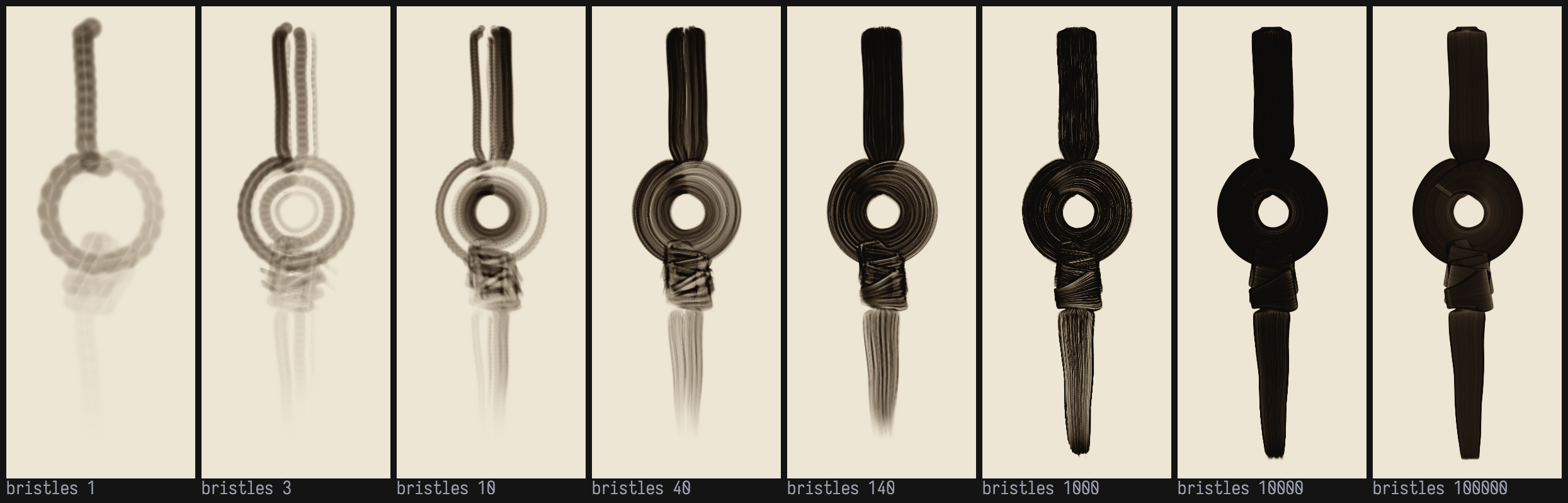
hair (in BrushConfig) is how thick each hair is, which decides how much neighbouring hairs
overlap. With thinner hairs the tracks close up, until the stroke is a solid black silhouette with a
sharp, fringed edge. The ordinary brush closes up sooner, solid by 0.5, and finer still its last
stroke ends in splinters.
:::static
:::fold the gesture, and a column of it painted with settings `s`
// what every column starts from: the black of the Elegy above
data class Settings(
    val stiffness: Double = 0.5,
    val ragged: Double = 0.5,
    val splay: Double = 0.0,
    val lay: Double = 0.8,
    val run: Double = 1100.0,
    val pickup: Double? = null,
    val push: Double? = null,
    val hairs: Int = 48,
    val bristles: Int? = null,
    val stiff: Double = 0.5,
    val thinner: Double = 0.0,
    val oil: Double = 1.5,
    val amount: Double = 0.5,
    val hiding: Double = 0.65,
    val tilt: Double = 30.0,
    val faster: Double = 1.0,
    val facets: Double? = null,
    val moving: Boolean = true,
    val width: Double = 200.0,
    val hair: Double? = null,
    val cohesion: Double? = null,
    val clumping: Double? = null,
    val splayFan: Double? = null,
    val splayScatter: Double? = null,
    val drying: Double = 1.0,
    val absorbent: Double = 0.0,
    val lamp: Boolean = false,
    val wipeAfter: Double? = null,
    val dry: Boolean = false,
)

// A canvas 50 cm wide and 1.25 m tall; the default brush is 10 cm wide.
fun canvas() = PaintCanvas(300, aspect = 0.4, groundColor = rgb(0.93, 0.9, 0.83), sizeMm = 500.0, seed = 7)
val straight = FLine().moveTo(500, 120).lineTo(510, 900)
val loop = FLine().moveTo(510, 900).apply {
    for (i in 1..480) {
        val a = PI / 2 + 2 * PI * 1.15 * i / 480
        lineTo(510 + 190 * cos(a), 1090 - 190 * sin(a))
    }
}
val scrub = FLine().moveTo(560, 1330).apply {
    for (i in 0 until 5) {
        lineTo(if (i % 2 == 0) 380.0 else 640.0, 1375.0 + 45 * i)
    }
}
val last =
    [1600.0, 1800.0, 2000.0, 2200.0, 2400.0].zipWithNext().mapIndexed { k, (y0, y1) ->
        FLine().moveTo(500.0 + 4 * k, y0).lineTo(504.0 + 4 * k, y1)
    }

// a long straight, a loop that crosses itself, a scrub back and forth, and a last straight in four
// pieces, each faster and lighter: 100, 200, 350, then 600 mm/s, lifting off the canvas at the end
fun gesture(c: PaintCanvas, s: Settings): TimedGesture {
    fun part(line: FLine, speed: Double, vararg pressure: Double) =
        c.gesture(line, speed = speed, pressure = pressure.toList(), tilt = s.tilt, facets = s.facets)
    var g =
        part(straight, 250.0, 0.8, 1.0, 1.0).then(part(loop, 250.0, 1.0, 0.9)).pause(0.1).then(part(scrub, 300.0, 1.1))
    val press = [1.0, 0.8, 0.6, 0.3, -0.2]
    for ((k, speed) in [100.0, 200.0, 350.0, 600.0].withIndex()) g =
        g.then(part(last[k], speed, press[k], press[k + 1]))
    return g.faster(s.faster)
}

fun column(label: String, s: Settings): Pair<String, Img> {
    val c = canvas()
    try {
        if (s.absorbent > 0.0) c.prime(rgb(0.93, 0.9, 0.83), texture = 0.0, absorbent = s.absorbent)
        val config = BrushConfig(
            bristles = s.bristles,
            hair = s.hair,
            stiffness = s.stiffness,
            ragged = s.ragged,
            splay = s.splay,
            lay = s.lay,
            run = s.run,
            pickup = s.pickup,
            push = s.push,
        )
        val black = rgb(0.05, 0.045, 0.04)
        if (s.moving) {
            val brush =
                c.dynamicBrush(BrushKind.HogFlat, s.width, hairs = s.hairs, segments = 6, config = config)
                    .load(
                        black,
                        hiding = s.hiding,
                        stiff = s.stiff,
                        drying = s.drying,
                        thinner = s.thinner,
                        oil = s.oil,
                        amount = s.amount,
                    )
            brush.set(
                cohesion = s.cohesion,
                clumping = s.clumping,
                splayFan = s.splayFan,
                splayScatter = s.splayScatter,
            )
            c.stroke(gesture(c, s), brush)
        } else {
            // an ordinary brush along the same path, with the same pressures; it has no timing or tilt
            val brush =
                c.brush(BrushKind.HogFlat, s.width, config = config)
                    .load(
                        black,
                        hiding = s.hiding,
                        stiff = s.stiff,
                        drying = s.drying,
                        thinner = s.thinner,
                        oil = s.oil,
                        amount = s.amount,
                    )
            c.stroke(straight, brush, pressure = 0.8..1.0)
            c.stroke(loop, brush, pressure = 1.0..0.9)
            c.stroke(scrub, brush, pressure = 1.1..1.1)
            c.stroke(FLine().moveTo(500, 1600).lineTo(516, 2400), brush, pressure = 1.0..0.0)
        }
        // a rag wiped across the bar, the loop and the last stroke after some minutes (infinite: dry first)
        s.wipeAfter?.let { minutes ->
            if (minutes.isInfinite()) c.dry() else c.wait(minutes)
            val rag = c.rag(150.0)
            for (y in [500.0, 1090.0, 2000.0]) c.wipe(FLine().moveTo(250, y).lineTo(760, y + 10), rag, [0.8])
        }
        if (s.dry) c.dry()
        val png = if (s.lamp) c.png(relief = 0.3, light = PaintLight.Gallery) else c.png(relief = 0.3)
        return label to imgFromBytes(png)
    } finally {
        c.close()
    }
}

// the same columns twice: a row with moving hairs above a row with an ordinary brush
fun rows(cells: (moving: Boolean) -> List<Pair<String, Img>>): Img {
    val rows =
        ["moving hairs" to true, "ordinary brush" to false].map { (name, moving) ->
            val strokes = cells(moving)
            name to montage(strokes, columns = strokes.size, cellSide = 750, textScale = 3)
        }
    return montage(rows, columns = 1, cellSide = 4000, textScale = 3)
}
:::endfold
val sheet = rows { moving ->
    [1.0, 0.5, 0.2, 0.05, 0.01, 0.002].map { column("hair $it", Settings(hair = it, moving = moving)) }
}
showImg(sheet)
sheet.savePng("/tmp/field-docs-paint-sweep-hair.png")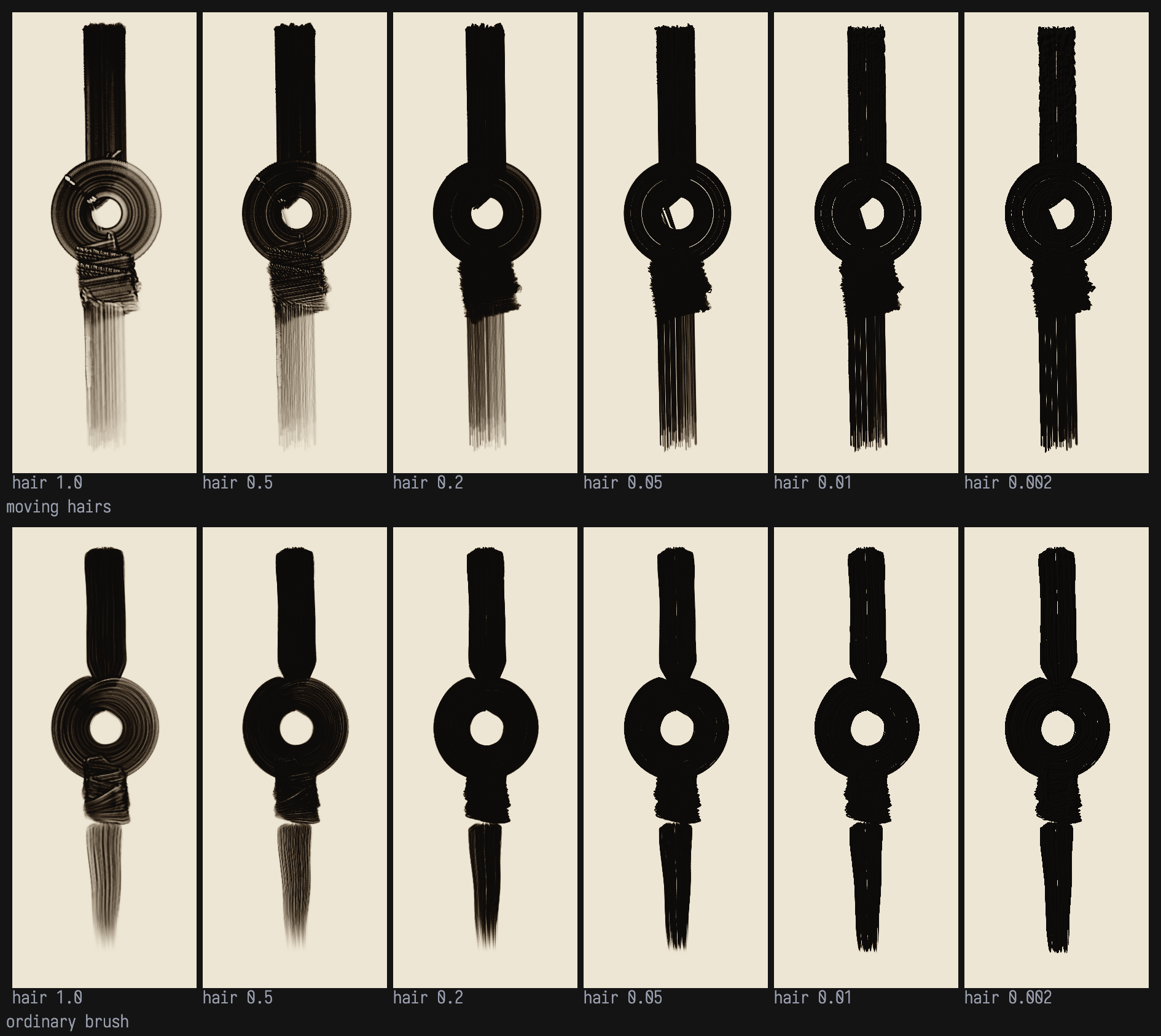
width is the brush's width in canvas units, here from 10 cm down to 1 mm: the same gesture from a
house painter's brush down to a fine liner. At the narrowest the ordinary brush still draws the last
stroke to its end, tapering to a point.
:::static
:::fold the gesture, and a column of it painted with settings `s`
// what every column starts from: the black of the Elegy above
data class Settings(
    val stiffness: Double = 0.5,
    val ragged: Double = 0.5,
    val splay: Double = 0.0,
    val lay: Double = 0.8,
    val run: Double = 1100.0,
    val pickup: Double? = null,
    val push: Double? = null,
    val hairs: Int = 48,
    val bristles: Int? = null,
    val stiff: Double = 0.5,
    val thinner: Double = 0.0,
    val oil: Double = 1.5,
    val amount: Double = 0.5,
    val hiding: Double = 0.65,
    val tilt: Double = 30.0,
    val faster: Double = 1.0,
    val facets: Double? = null,
    val moving: Boolean = true,
    val width: Double = 200.0,
    val hair: Double? = null,
    val cohesion: Double? = null,
    val clumping: Double? = null,
    val splayFan: Double? = null,
    val splayScatter: Double? = null,
    val drying: Double = 1.0,
    val absorbent: Double = 0.0,
    val lamp: Boolean = false,
    val wipeAfter: Double? = null,
    val dry: Boolean = false,
)

// A canvas 50 cm wide and 1.25 m tall; the default brush is 10 cm wide.
fun canvas() = PaintCanvas(300, aspect = 0.4, groundColor = rgb(0.93, 0.9, 0.83), sizeMm = 500.0, seed = 7)
val straight = FLine().moveTo(500, 120).lineTo(510, 900)
val loop = FLine().moveTo(510, 900).apply {
    for (i in 1..480) {
        val a = PI / 2 + 2 * PI * 1.15 * i / 480
        lineTo(510 + 190 * cos(a), 1090 - 190 * sin(a))
    }
}
val scrub = FLine().moveTo(560, 1330).apply {
    for (i in 0 until 5) {
        lineTo(if (i % 2 == 0) 380.0 else 640.0, 1375.0 + 45 * i)
    }
}
val last =
    [1600.0, 1800.0, 2000.0, 2200.0, 2400.0].zipWithNext().mapIndexed { k, (y0, y1) ->
        FLine().moveTo(500.0 + 4 * k, y0).lineTo(504.0 + 4 * k, y1)
    }

// a long straight, a loop that crosses itself, a scrub back and forth, and a last straight in four
// pieces, each faster and lighter: 100, 200, 350, then 600 mm/s, lifting off the canvas at the end
fun gesture(c: PaintCanvas, s: Settings): TimedGesture {
    fun part(line: FLine, speed: Double, vararg pressure: Double) =
        c.gesture(line, speed = speed, pressure = pressure.toList(), tilt = s.tilt, facets = s.facets)
    var g =
        part(straight, 250.0, 0.8, 1.0, 1.0).then(part(loop, 250.0, 1.0, 0.9)).pause(0.1).then(part(scrub, 300.0, 1.1))
    val press = [1.0, 0.8, 0.6, 0.3, -0.2]
    for ((k, speed) in [100.0, 200.0, 350.0, 600.0].withIndex()) g =
        g.then(part(last[k], speed, press[k], press[k + 1]))
    return g.faster(s.faster)
}

fun column(label: String, s: Settings): Pair<String, Img> {
    val c = canvas()
    try {
        if (s.absorbent > 0.0) c.prime(rgb(0.93, 0.9, 0.83), texture = 0.0, absorbent = s.absorbent)
        val config = BrushConfig(
            bristles = s.bristles,
            hair = s.hair,
            stiffness = s.stiffness,
            ragged = s.ragged,
            splay = s.splay,
            lay = s.lay,
            run = s.run,
            pickup = s.pickup,
            push = s.push,
        )
        val black = rgb(0.05, 0.045, 0.04)
        if (s.moving) {
            val brush =
                c.dynamicBrush(BrushKind.HogFlat, s.width, hairs = s.hairs, segments = 6, config = config)
                    .load(
                        black,
                        hiding = s.hiding,
                        stiff = s.stiff,
                        drying = s.drying,
                        thinner = s.thinner,
                        oil = s.oil,
                        amount = s.amount,
                    )
            brush.set(
                cohesion = s.cohesion,
                clumping = s.clumping,
                splayFan = s.splayFan,
                splayScatter = s.splayScatter,
            )
            c.stroke(gesture(c, s), brush)
        } else {
            // an ordinary brush along the same path, with the same pressures; it has no timing or tilt
            val brush =
                c.brush(BrushKind.HogFlat, s.width, config = config)
                    .load(
                        black,
                        hiding = s.hiding,
                        stiff = s.stiff,
                        drying = s.drying,
                        thinner = s.thinner,
                        oil = s.oil,
                        amount = s.amount,
                    )
            c.stroke(straight, brush, pressure = 0.8..1.0)
            c.stroke(loop, brush, pressure = 1.0..0.9)
            c.stroke(scrub, brush, pressure = 1.1..1.1)
            c.stroke(FLine().moveTo(500, 1600).lineTo(516, 2400), brush, pressure = 1.0..0.0)
        }
        // a rag wiped across the bar, the loop and the last stroke after some minutes (infinite: dry first)
        s.wipeAfter?.let { minutes ->
            if (minutes.isInfinite()) c.dry() else c.wait(minutes)
            val rag = c.rag(150.0)
            for (y in [500.0, 1090.0, 2000.0]) c.wipe(FLine().moveTo(250, y).lineTo(760, y + 10), rag, [0.8])
        }
        if (s.dry) c.dry()
        val png = if (s.lamp) c.png(relief = 0.3, light = PaintLight.Gallery) else c.png(relief = 0.3)
        return label to imgFromBytes(png)
    } finally {
        c.close()
    }
}

// the same columns twice: a row with moving hairs above a row with an ordinary brush
fun rows(cells: (moving: Boolean) -> List<Pair<String, Img>>): Img {
    val rows =
        ["moving hairs" to true, "ordinary brush" to false].map { (name, moving) ->
            val strokes = cells(moving)
            name to montage(strokes, columns = strokes.size, cellSide = 750, textScale = 3)
        }
    return montage(rows, columns = 1, cellSide = 4000, textScale = 3)
}
:::endfold
val sheet = rows { moving ->
    [200.0, 100.0, 50.0, 20.0, 8.0, 2.0].map { column("width ${it.toInt()}", Settings(width = it, moving = moving)) }
}
showImg(sheet)
sheet.savePng("/tmp/field-docs-paint-sweep-width.png")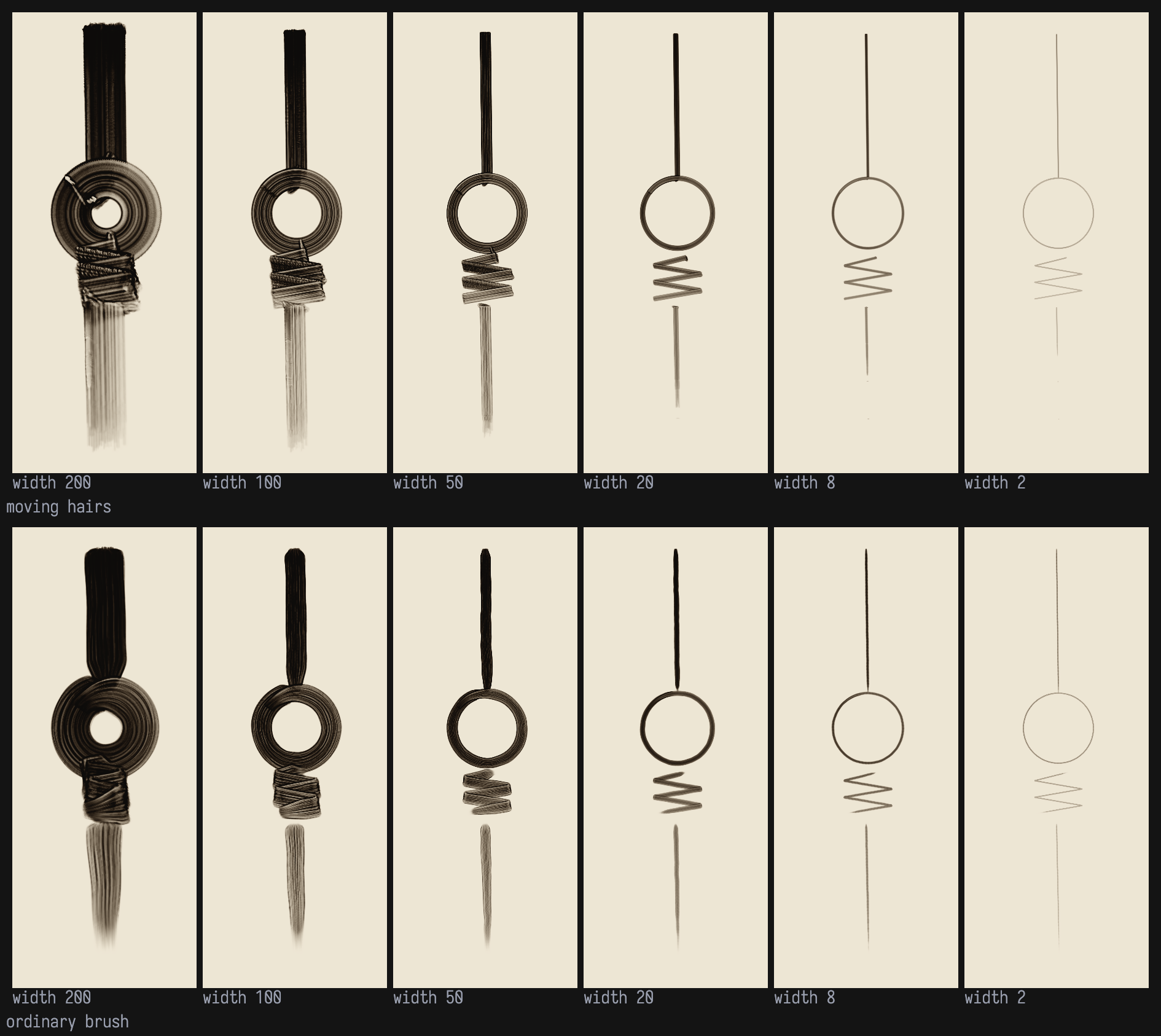
pickup is how much of the wet paint under it a hair takes up. With none, the brush only gives
paint and runs dry; with more, it takes up the black it has just laid and the whole stroke goes
paler, until the brush mostly lifts what it lays. With moving hairs the paling is patchy, as some
hairs keep their black; the ordinary brush pales evenly.
:::static
:::fold the gesture, and a column of it painted with settings `s`
// what every column starts from: the black of the Elegy above
data class Settings(
    val stiffness: Double = 0.5,
    val ragged: Double = 0.5,
    val splay: Double = 0.0,
    val lay: Double = 0.8,
    val run: Double = 1100.0,
    val pickup: Double? = null,
    val push: Double? = null,
    val hairs: Int = 48,
    val bristles: Int? = null,
    val stiff: Double = 0.5,
    val thinner: Double = 0.0,
    val oil: Double = 1.5,
    val amount: Double = 0.5,
    val hiding: Double = 0.65,
    val tilt: Double = 30.0,
    val faster: Double = 1.0,
    val facets: Double? = null,
    val moving: Boolean = true,
    val width: Double = 200.0,
    val hair: Double? = null,
    val cohesion: Double? = null,
    val clumping: Double? = null,
    val splayFan: Double? = null,
    val splayScatter: Double? = null,
    val drying: Double = 1.0,
    val absorbent: Double = 0.0,
    val lamp: Boolean = false,
    val wipeAfter: Double? = null,
    val dry: Boolean = false,
)

// A canvas 50 cm wide and 1.25 m tall; the default brush is 10 cm wide.
fun canvas() = PaintCanvas(300, aspect = 0.4, groundColor = rgb(0.93, 0.9, 0.83), sizeMm = 500.0, seed = 7)
val straight = FLine().moveTo(500, 120).lineTo(510, 900)
val loop = FLine().moveTo(510, 900).apply {
    for (i in 1..480) {
        val a = PI / 2 + 2 * PI * 1.15 * i / 480
        lineTo(510 + 190 * cos(a), 1090 - 190 * sin(a))
    }
}
val scrub = FLine().moveTo(560, 1330).apply {
    for (i in 0 until 5) {
        lineTo(if (i % 2 == 0) 380.0 else 640.0, 1375.0 + 45 * i)
    }
}
val last =
    [1600.0, 1800.0, 2000.0, 2200.0, 2400.0].zipWithNext().mapIndexed { k, (y0, y1) ->
        FLine().moveTo(500.0 + 4 * k, y0).lineTo(504.0 + 4 * k, y1)
    }

// a long straight, a loop that crosses itself, a scrub back and forth, and a last straight in four
// pieces, each faster and lighter: 100, 200, 350, then 600 mm/s, lifting off the canvas at the end
fun gesture(c: PaintCanvas, s: Settings): TimedGesture {
    fun part(line: FLine, speed: Double, vararg pressure: Double) =
        c.gesture(line, speed = speed, pressure = pressure.toList(), tilt = s.tilt, facets = s.facets)
    var g =
        part(straight, 250.0, 0.8, 1.0, 1.0).then(part(loop, 250.0, 1.0, 0.9)).pause(0.1).then(part(scrub, 300.0, 1.1))
    val press = [1.0, 0.8, 0.6, 0.3, -0.2]
    for ((k, speed) in [100.0, 200.0, 350.0, 600.0].withIndex()) g =
        g.then(part(last[k], speed, press[k], press[k + 1]))
    return g.faster(s.faster)
}

fun column(label: String, s: Settings): Pair<String, Img> {
    val c = canvas()
    try {
        if (s.absorbent > 0.0) c.prime(rgb(0.93, 0.9, 0.83), texture = 0.0, absorbent = s.absorbent)
        val config = BrushConfig(
            bristles = s.bristles,
            hair = s.hair,
            stiffness = s.stiffness,
            ragged = s.ragged,
            splay = s.splay,
            lay = s.lay,
            run = s.run,
            pickup = s.pickup,
            push = s.push,
        )
        val black = rgb(0.05, 0.045, 0.04)
        if (s.moving) {
            val brush =
                c.dynamicBrush(BrushKind.HogFlat, s.width, hairs = s.hairs, segments = 6, config = config)
                    .load(
                        black,
                        hiding = s.hiding,
                        stiff = s.stiff,
                        drying = s.drying,
                        thinner = s.thinner,
                        oil = s.oil,
                        amount = s.amount,
                    )
            brush.set(
                cohesion = s.cohesion,
                clumping = s.clumping,
                splayFan = s.splayFan,
                splayScatter = s.splayScatter,
            )
            c.stroke(gesture(c, s), brush)
        } else {
            // an ordinary brush along the same path, with the same pressures; it has no timing or tilt
            val brush =
                c.brush(BrushKind.HogFlat, s.width, config = config)
                    .load(
                        black,
                        hiding = s.hiding,
                        stiff = s.stiff,
                        drying = s.drying,
                        thinner = s.thinner,
                        oil = s.oil,
                        amount = s.amount,
                    )
            c.stroke(straight, brush, pressure = 0.8..1.0)
            c.stroke(loop, brush, pressure = 1.0..0.9)
            c.stroke(scrub, brush, pressure = 1.1..1.1)
            c.stroke(FLine().moveTo(500, 1600).lineTo(516, 2400), brush, pressure = 1.0..0.0)
        }
        // a rag wiped across the bar, the loop and the last stroke after some minutes (infinite: dry first)
        s.wipeAfter?.let { minutes ->
            if (minutes.isInfinite()) c.dry() else c.wait(minutes)
            val rag = c.rag(150.0)
            for (y in [500.0, 1090.0, 2000.0]) c.wipe(FLine().moveTo(250, y).lineTo(760, y + 10), rag, [0.8])
        }
        if (s.dry) c.dry()
        val png = if (s.lamp) c.png(relief = 0.3, light = PaintLight.Gallery) else c.png(relief = 0.3)
        return label to imgFromBytes(png)
    } finally {
        c.close()
    }
}

// the same columns twice: a row with moving hairs above a row with an ordinary brush
fun rows(cells: (moving: Boolean) -> List<Pair<String, Img>>): Img {
    val rows =
        ["moving hairs" to true, "ordinary brush" to false].map { (name, moving) ->
            val strokes = cells(moving)
            name to montage(strokes, columns = strokes.size, cellSide = 750, textScale = 3)
        }
    return montage(rows, columns = 1, cellSide = 4000, textScale = 3)
}
:::endfold
val sheet = rows { moving ->
    [0.0, 0.5, 1.0, 2.0, 4.0, 10.0].map { column("pickup $it", Settings(pickup = it, moving = moving)) }
}
showImg(sheet)
sheet.savePng("/tmp/field-docs-paint-sweep-pickup.png")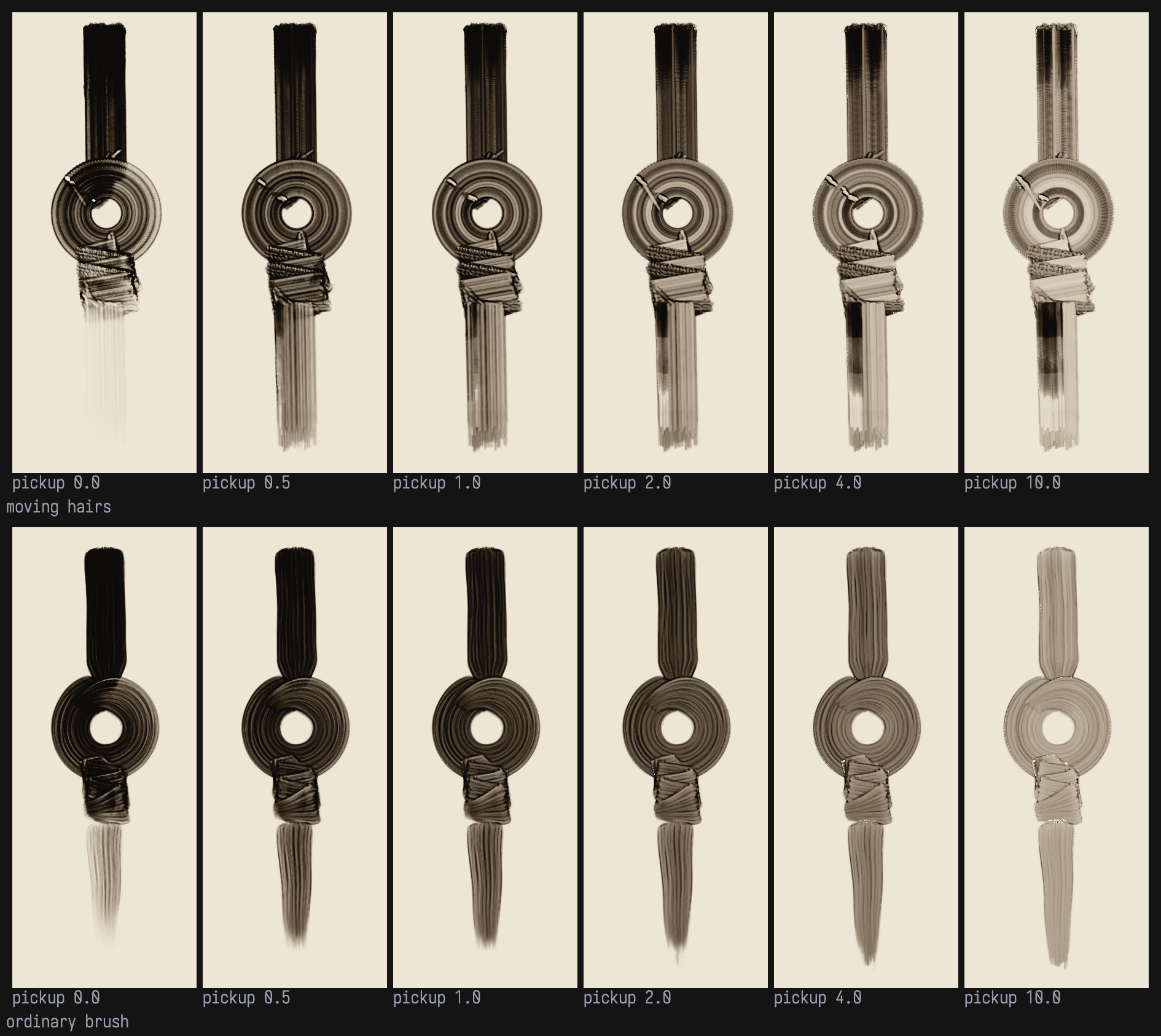
push is how much of the wet paint a moving hair ploughs aside. With none the stroke is soft;
with more, every pass is outlined in dark ridges; and with a lot, all the paint is pushed to the
edges and the stroke becomes a pale shape drawn in black outlines. The ordinary brush gets there
sooner, by 2.
:::static
:::fold the gesture, and a column of it painted with settings `s`
// what every column starts from: the black of the Elegy above
data class Settings(
    val stiffness: Double = 0.5,
    val ragged: Double = 0.5,
    val splay: Double = 0.0,
    val lay: Double = 0.8,
    val run: Double = 1100.0,
    val pickup: Double? = null,
    val push: Double? = null,
    val hairs: Int = 48,
    val bristles: Int? = null,
    val stiff: Double = 0.5,
    val thinner: Double = 0.0,
    val oil: Double = 1.5,
    val amount: Double = 0.5,
    val hiding: Double = 0.65,
    val tilt: Double = 30.0,
    val faster: Double = 1.0,
    val facets: Double? = null,
    val moving: Boolean = true,
    val width: Double = 200.0,
    val hair: Double? = null,
    val cohesion: Double? = null,
    val clumping: Double? = null,
    val splayFan: Double? = null,
    val splayScatter: Double? = null,
    val drying: Double = 1.0,
    val absorbent: Double = 0.0,
    val lamp: Boolean = false,
    val wipeAfter: Double? = null,
    val dry: Boolean = false,
)

// A canvas 50 cm wide and 1.25 m tall; the default brush is 10 cm wide.
fun canvas() = PaintCanvas(300, aspect = 0.4, groundColor = rgb(0.93, 0.9, 0.83), sizeMm = 500.0, seed = 7)
val straight = FLine().moveTo(500, 120).lineTo(510, 900)
val loop = FLine().moveTo(510, 900).apply {
    for (i in 1..480) {
        val a = PI / 2 + 2 * PI * 1.15 * i / 480
        lineTo(510 + 190 * cos(a), 1090 - 190 * sin(a))
    }
}
val scrub = FLine().moveTo(560, 1330).apply {
    for (i in 0 until 5) {
        lineTo(if (i % 2 == 0) 380.0 else 640.0, 1375.0 + 45 * i)
    }
}
val last =
    [1600.0, 1800.0, 2000.0, 2200.0, 2400.0].zipWithNext().mapIndexed { k, (y0, y1) ->
        FLine().moveTo(500.0 + 4 * k, y0).lineTo(504.0 + 4 * k, y1)
    }

// a long straight, a loop that crosses itself, a scrub back and forth, and a last straight in four
// pieces, each faster and lighter: 100, 200, 350, then 600 mm/s, lifting off the canvas at the end
fun gesture(c: PaintCanvas, s: Settings): TimedGesture {
    fun part(line: FLine, speed: Double, vararg pressure: Double) =
        c.gesture(line, speed = speed, pressure = pressure.toList(), tilt = s.tilt, facets = s.facets)
    var g =
        part(straight, 250.0, 0.8, 1.0, 1.0).then(part(loop, 250.0, 1.0, 0.9)).pause(0.1).then(part(scrub, 300.0, 1.1))
    val press = [1.0, 0.8, 0.6, 0.3, -0.2]
    for ((k, speed) in [100.0, 200.0, 350.0, 600.0].withIndex()) g =
        g.then(part(last[k], speed, press[k], press[k + 1]))
    return g.faster(s.faster)
}

fun column(label: String, s: Settings): Pair<String, Img> {
    val c = canvas()
    try {
        if (s.absorbent > 0.0) c.prime(rgb(0.93, 0.9, 0.83), texture = 0.0, absorbent = s.absorbent)
        val config = BrushConfig(
            bristles = s.bristles,
            hair = s.hair,
            stiffness = s.stiffness,
            ragged = s.ragged,
            splay = s.splay,
            lay = s.lay,
            run = s.run,
            pickup = s.pickup,
            push = s.push,
        )
        val black = rgb(0.05, 0.045, 0.04)
        if (s.moving) {
            val brush =
                c.dynamicBrush(BrushKind.HogFlat, s.width, hairs = s.hairs, segments = 6, config = config)
                    .load(
                        black,
                        hiding = s.hiding,
                        stiff = s.stiff,
                        drying = s.drying,
                        thinner = s.thinner,
                        oil = s.oil,
                        amount = s.amount,
                    )
            brush.set(
                cohesion = s.cohesion,
                clumping = s.clumping,
                splayFan = s.splayFan,
                splayScatter = s.splayScatter,
            )
            c.stroke(gesture(c, s), brush)
        } else {
            // an ordinary brush along the same path, with the same pressures; it has no timing or tilt
            val brush =
                c.brush(BrushKind.HogFlat, s.width, config = config)
                    .load(
                        black,
                        hiding = s.hiding,
                        stiff = s.stiff,
                        drying = s.drying,
                        thinner = s.thinner,
                        oil = s.oil,
                        amount = s.amount,
                    )
            c.stroke(straight, brush, pressure = 0.8..1.0)
            c.stroke(loop, brush, pressure = 1.0..0.9)
            c.stroke(scrub, brush, pressure = 1.1..1.1)
            c.stroke(FLine().moveTo(500, 1600).lineTo(516, 2400), brush, pressure = 1.0..0.0)
        }
        // a rag wiped across the bar, the loop and the last stroke after some minutes (infinite: dry first)
        s.wipeAfter?.let { minutes ->
            if (minutes.isInfinite()) c.dry() else c.wait(minutes)
            val rag = c.rag(150.0)
            for (y in [500.0, 1090.0, 2000.0]) c.wipe(FLine().moveTo(250, y).lineTo(760, y + 10), rag, [0.8])
        }
        if (s.dry) c.dry()
        val png = if (s.lamp) c.png(relief = 0.3, light = PaintLight.Gallery) else c.png(relief = 0.3)
        return label to imgFromBytes(png)
    } finally {
        c.close()
    }
}

// the same columns twice: a row with moving hairs above a row with an ordinary brush
fun rows(cells: (moving: Boolean) -> List<Pair<String, Img>>): Img {
    val rows =
        ["moving hairs" to true, "ordinary brush" to false].map { (name, moving) ->
            val strokes = cells(moving)
            name to montage(strokes, columns = strokes.size, cellSide = 750, textScale = 3)
        }
    return montage(rows, columns = 1, cellSide = 4000, textScale = 3)
}
:::endfold
val sheet = rows { moving ->
    [0.0, 0.5, 1.0, 2.0, 10.0, 100.0].map { column("push $it", Settings(push = it, moving = moving)) }
}
showImg(sheet)
sheet.savePng("/tmp/field-docs-paint-sweep-push.png")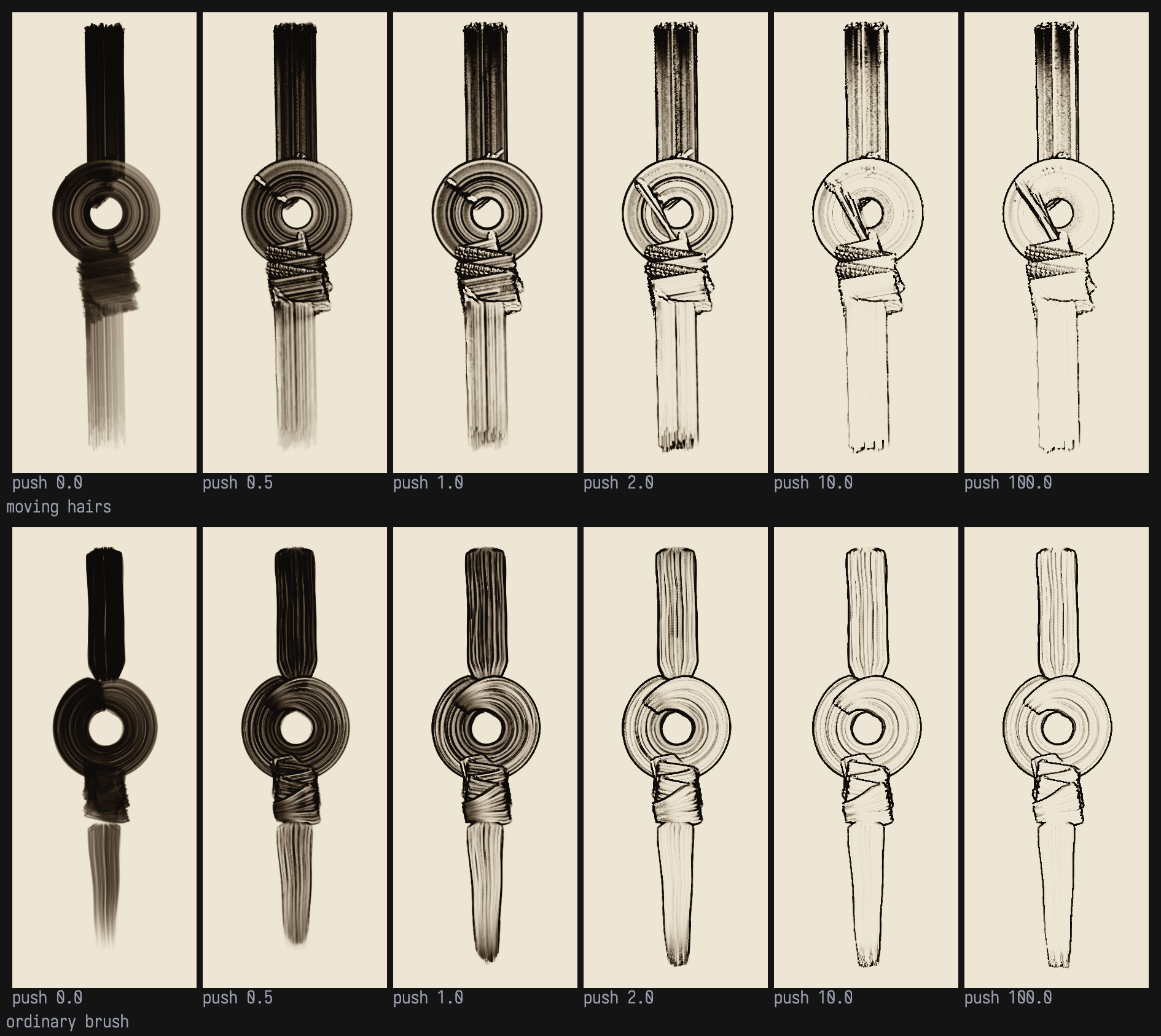
ragged makes the hairs uneven in length. A little roughens the edges; a lot gives some hairs many
times the length of the rest, and at 512 the longest hairs reach across the canvas and draw great
circles around the gesture. The ordinary brush comes apart much sooner: at 8 its hairs wander in
curls around the path, and at 64 they loop away across the canvas.
:::static
:::fold the gesture, and a column of it painted with settings `s`
// what every column starts from: the black of the Elegy above
data class Settings(
    val stiffness: Double = 0.5,
    val ragged: Double = 0.5,
    val splay: Double = 0.0,
    val lay: Double = 0.8,
    val run: Double = 1100.0,
    val pickup: Double? = null,
    val push: Double? = null,
    val hairs: Int = 48,
    val bristles: Int? = null,
    val stiff: Double = 0.5,
    val thinner: Double = 0.0,
    val oil: Double = 1.5,
    val amount: Double = 0.5,
    val hiding: Double = 0.65,
    val tilt: Double = 30.0,
    val faster: Double = 1.0,
    val facets: Double? = null,
    val moving: Boolean = true,
    val width: Double = 200.0,
    val hair: Double? = null,
    val cohesion: Double? = null,
    val clumping: Double? = null,
    val splayFan: Double? = null,
    val splayScatter: Double? = null,
    val drying: Double = 1.0,
    val absorbent: Double = 0.0,
    val lamp: Boolean = false,
    val wipeAfter: Double? = null,
    val dry: Boolean = false,
)

// A canvas 50 cm wide and 1.25 m tall; the default brush is 10 cm wide.
fun canvas() = PaintCanvas(300, aspect = 0.4, groundColor = rgb(0.93, 0.9, 0.83), sizeMm = 500.0, seed = 7)
val straight = FLine().moveTo(500, 120).lineTo(510, 900)
val loop = FLine().moveTo(510, 900).apply {
    for (i in 1..480) {
        val a = PI / 2 + 2 * PI * 1.15 * i / 480
        lineTo(510 + 190 * cos(a), 1090 - 190 * sin(a))
    }
}
val scrub = FLine().moveTo(560, 1330).apply {
    for (i in 0 until 5) {
        lineTo(if (i % 2 == 0) 380.0 else 640.0, 1375.0 + 45 * i)
    }
}
val last =
    [1600.0, 1800.0, 2000.0, 2200.0, 2400.0].zipWithNext().mapIndexed { k, (y0, y1) ->
        FLine().moveTo(500.0 + 4 * k, y0).lineTo(504.0 + 4 * k, y1)
    }

// a long straight, a loop that crosses itself, a scrub back and forth, and a last straight in four
// pieces, each faster and lighter: 100, 200, 350, then 600 mm/s, lifting off the canvas at the end
fun gesture(c: PaintCanvas, s: Settings): TimedGesture {
    fun part(line: FLine, speed: Double, vararg pressure: Double) =
        c.gesture(line, speed = speed, pressure = pressure.toList(), tilt = s.tilt, facets = s.facets)
    var g =
        part(straight, 250.0, 0.8, 1.0, 1.0).then(part(loop, 250.0, 1.0, 0.9)).pause(0.1).then(part(scrub, 300.0, 1.1))
    val press = [1.0, 0.8, 0.6, 0.3, -0.2]
    for ((k, speed) in [100.0, 200.0, 350.0, 600.0].withIndex()) g =
        g.then(part(last[k], speed, press[k], press[k + 1]))
    return g.faster(s.faster)
}

fun column(label: String, s: Settings): Pair<String, Img> {
    val c = canvas()
    try {
        if (s.absorbent > 0.0) c.prime(rgb(0.93, 0.9, 0.83), texture = 0.0, absorbent = s.absorbent)
        val config = BrushConfig(
            bristles = s.bristles,
            hair = s.hair,
            stiffness = s.stiffness,
            ragged = s.ragged,
            splay = s.splay,
            lay = s.lay,
            run = s.run,
            pickup = s.pickup,
            push = s.push,
        )
        val black = rgb(0.05, 0.045, 0.04)
        if (s.moving) {
            val brush =
                c.dynamicBrush(BrushKind.HogFlat, s.width, hairs = s.hairs, segments = 6, config = config)
                    .load(
                        black,
                        hiding = s.hiding,
                        stiff = s.stiff,
                        drying = s.drying,
                        thinner = s.thinner,
                        oil = s.oil,
                        amount = s.amount,
                    )
            brush.set(
                cohesion = s.cohesion,
                clumping = s.clumping,
                splayFan = s.splayFan,
                splayScatter = s.splayScatter,
            )
            c.stroke(gesture(c, s), brush)
        } else {
            // an ordinary brush along the same path, with the same pressures; it has no timing or tilt
            val brush =
                c.brush(BrushKind.HogFlat, s.width, config = config)
                    .load(
                        black,
                        hiding = s.hiding,
                        stiff = s.stiff,
                        drying = s.drying,
                        thinner = s.thinner,
                        oil = s.oil,
                        amount = s.amount,
                    )
            c.stroke(straight, brush, pressure = 0.8..1.0)
            c.stroke(loop, brush, pressure = 1.0..0.9)
            c.stroke(scrub, brush, pressure = 1.1..1.1)
            c.stroke(FLine().moveTo(500, 1600).lineTo(516, 2400), brush, pressure = 1.0..0.0)
        }
        // a rag wiped across the bar, the loop and the last stroke after some minutes (infinite: dry first)
        s.wipeAfter?.let { minutes ->
            if (minutes.isInfinite()) c.dry() else c.wait(minutes)
            val rag = c.rag(150.0)
            for (y in [500.0, 1090.0, 2000.0]) c.wipe(FLine().moveTo(250, y).lineTo(760, y + 10), rag, [0.8])
        }
        if (s.dry) c.dry()
        val png = if (s.lamp) c.png(relief = 0.3, light = PaintLight.Gallery) else c.png(relief = 0.3)
        return label to imgFromBytes(png)
    } finally {
        c.close()
    }
}

// the same columns twice: a row with moving hairs above a row with an ordinary brush
fun rows(cells: (moving: Boolean) -> List<Pair<String, Img>>): Img {
    val rows =
        ["moving hairs" to true, "ordinary brush" to false].map { (name, moving) ->
            val strokes = cells(moving)
            name to montage(strokes, columns = strokes.size, cellSide = 750, textScale = 3)
        }
    return montage(rows, columns = 1, cellSide = 4000, textScale = 3)
}
:::endfold
val sheet = rows { moving ->
    [0.0, 1.0, 8.0, 64.0, 512.0, 4096.0].map { column("ragged $it", Settings(ragged = it, moving = moving)) }
}
showImg(sheet)
sheet.savePng("/tmp/field-docs-paint-sweep-ragged.png")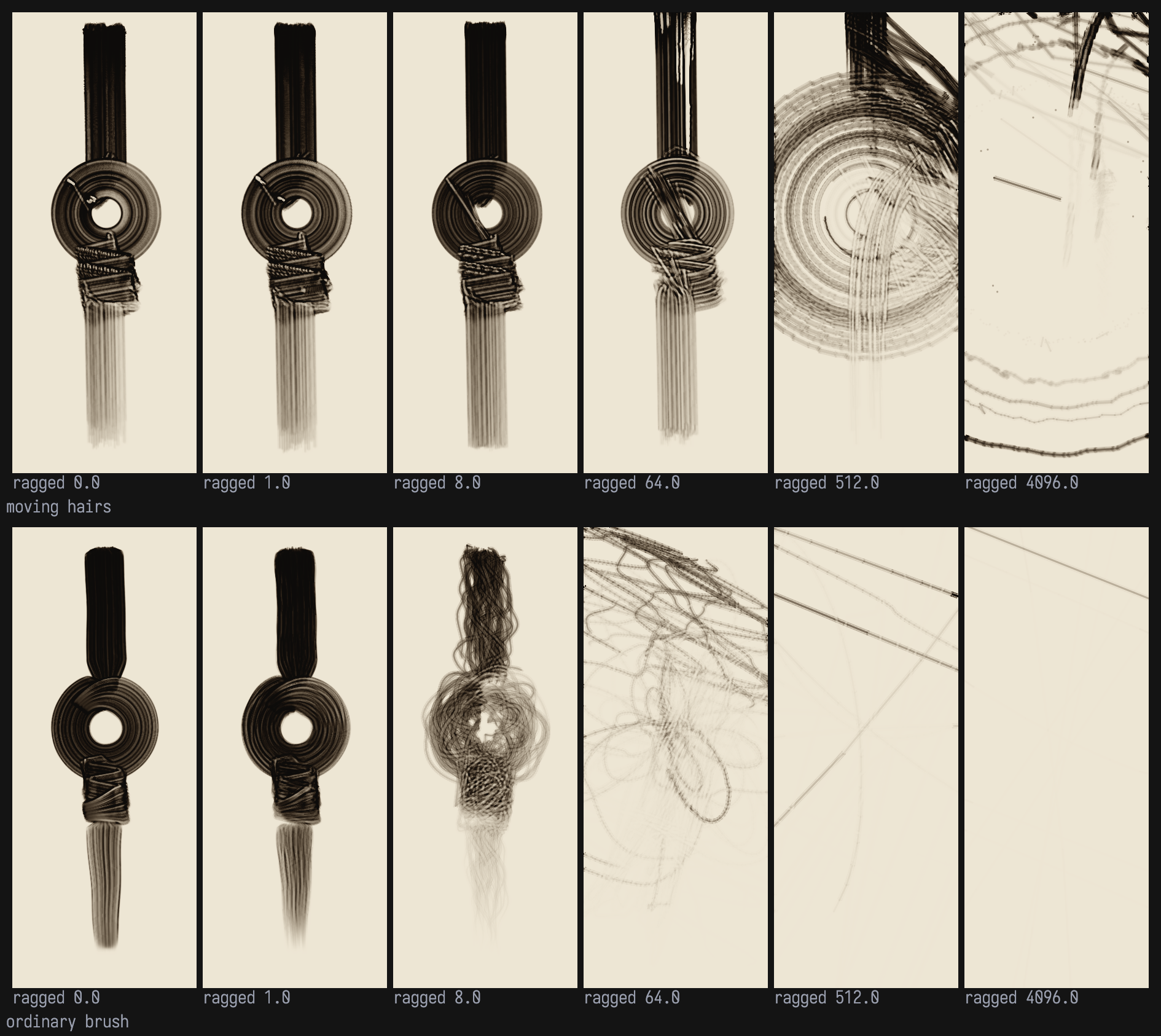
splay is how far a hair pressed into the canvas is pushed out from the brush's middle. With a lot,
a flat pressed hard parts in two, and the loop becomes two rings. An ordinary flat does not part:
splay widens its mark, until at 4 the gesture is a broad fan of hair marks and at 10 they cover the
canvas.
:::static
:::fold the gesture, and a column of it painted with settings `s`
// what every column starts from: the black of the Elegy above
data class Settings(
    val stiffness: Double = 0.5,
    val ragged: Double = 0.5,
    val splay: Double = 0.0,
    val lay: Double = 0.8,
    val run: Double = 1100.0,
    val pickup: Double? = null,
    val push: Double? = null,
    val hairs: Int = 48,
    val bristles: Int? = null,
    val stiff: Double = 0.5,
    val thinner: Double = 0.0,
    val oil: Double = 1.5,
    val amount: Double = 0.5,
    val hiding: Double = 0.65,
    val tilt: Double = 30.0,
    val faster: Double = 1.0,
    val facets: Double? = null,
    val moving: Boolean = true,
    val width: Double = 200.0,
    val hair: Double? = null,
    val cohesion: Double? = null,
    val clumping: Double? = null,
    val splayFan: Double? = null,
    val splayScatter: Double? = null,
    val drying: Double = 1.0,
    val absorbent: Double = 0.0,
    val lamp: Boolean = false,
    val wipeAfter: Double? = null,
    val dry: Boolean = false,
)

// A canvas 50 cm wide and 1.25 m tall; the default brush is 10 cm wide.
fun canvas() = PaintCanvas(300, aspect = 0.4, groundColor = rgb(0.93, 0.9, 0.83), sizeMm = 500.0, seed = 7)
val straight = FLine().moveTo(500, 120).lineTo(510, 900)
val loop = FLine().moveTo(510, 900).apply {
    for (i in 1..480) {
        val a = PI / 2 + 2 * PI * 1.15 * i / 480
        lineTo(510 + 190 * cos(a), 1090 - 190 * sin(a))
    }
}
val scrub = FLine().moveTo(560, 1330).apply {
    for (i in 0 until 5) {
        lineTo(if (i % 2 == 0) 380.0 else 640.0, 1375.0 + 45 * i)
    }
}
val last =
    [1600.0, 1800.0, 2000.0, 2200.0, 2400.0].zipWithNext().mapIndexed { k, (y0, y1) ->
        FLine().moveTo(500.0 + 4 * k, y0).lineTo(504.0 + 4 * k, y1)
    }

// a long straight, a loop that crosses itself, a scrub back and forth, and a last straight in four
// pieces, each faster and lighter: 100, 200, 350, then 600 mm/s, lifting off the canvas at the end
fun gesture(c: PaintCanvas, s: Settings): TimedGesture {
    fun part(line: FLine, speed: Double, vararg pressure: Double) =
        c.gesture(line, speed = speed, pressure = pressure.toList(), tilt = s.tilt, facets = s.facets)
    var g =
        part(straight, 250.0, 0.8, 1.0, 1.0).then(part(loop, 250.0, 1.0, 0.9)).pause(0.1).then(part(scrub, 300.0, 1.1))
    val press = [1.0, 0.8, 0.6, 0.3, -0.2]
    for ((k, speed) in [100.0, 200.0, 350.0, 600.0].withIndex()) g =
        g.then(part(last[k], speed, press[k], press[k + 1]))
    return g.faster(s.faster)
}

fun column(label: String, s: Settings): Pair<String, Img> {
    val c = canvas()
    try {
        if (s.absorbent > 0.0) c.prime(rgb(0.93, 0.9, 0.83), texture = 0.0, absorbent = s.absorbent)
        val config = BrushConfig(
            bristles = s.bristles,
            hair = s.hair,
            stiffness = s.stiffness,
            ragged = s.ragged,
            splay = s.splay,
            lay = s.lay,
            run = s.run,
            pickup = s.pickup,
            push = s.push,
        )
        val black = rgb(0.05, 0.045, 0.04)
        if (s.moving) {
            val brush =
                c.dynamicBrush(BrushKind.HogFlat, s.width, hairs = s.hairs, segments = 6, config = config)
                    .load(
                        black,
                        hiding = s.hiding,
                        stiff = s.stiff,
                        drying = s.drying,
                        thinner = s.thinner,
                        oil = s.oil,
                        amount = s.amount,
                    )
            brush.set(
                cohesion = s.cohesion,
                clumping = s.clumping,
                splayFan = s.splayFan,
                splayScatter = s.splayScatter,
            )
            c.stroke(gesture(c, s), brush)
        } else {
            // an ordinary brush along the same path, with the same pressures; it has no timing or tilt
            val brush =
                c.brush(BrushKind.HogFlat, s.width, config = config)
                    .load(
                        black,
                        hiding = s.hiding,
                        stiff = s.stiff,
                        drying = s.drying,
                        thinner = s.thinner,
                        oil = s.oil,
                        amount = s.amount,
                    )
            c.stroke(straight, brush, pressure = 0.8..1.0)
            c.stroke(loop, brush, pressure = 1.0..0.9)
            c.stroke(scrub, brush, pressure = 1.1..1.1)
            c.stroke(FLine().moveTo(500, 1600).lineTo(516, 2400), brush, pressure = 1.0..0.0)
        }
        // a rag wiped across the bar, the loop and the last stroke after some minutes (infinite: dry first)
        s.wipeAfter?.let { minutes ->
            if (minutes.isInfinite()) c.dry() else c.wait(minutes)
            val rag = c.rag(150.0)
            for (y in [500.0, 1090.0, 2000.0]) c.wipe(FLine().moveTo(250, y).lineTo(760, y + 10), rag, [0.8])
        }
        if (s.dry) c.dry()
        val png = if (s.lamp) c.png(relief = 0.3, light = PaintLight.Gallery) else c.png(relief = 0.3)
        return label to imgFromBytes(png)
    } finally {
        c.close()
    }
}

// the same columns twice: a row with moving hairs above a row with an ordinary brush
fun rows(cells: (moving: Boolean) -> List<Pair<String, Img>>): Img {
    val rows =
        ["moving hairs" to true, "ordinary brush" to false].map { (name, moving) ->
            val strokes = cells(moving)
            name to montage(strokes, columns = strokes.size, cellSide = 750, textScale = 3)
        }
    return montage(rows, columns = 1, cellSide = 4000, textScale = 3)
}
:::endfold
val sheet = rows { moving ->
    [0.0, 0.3, 0.6, 1.0, 2.0, 4.0, 10.0].map { column("splay $it", Settings(splay = it, moving = moving)) }
}
showImg(sheet)
sheet.savePng("/tmp/field-docs-paint-sweep-splay.png")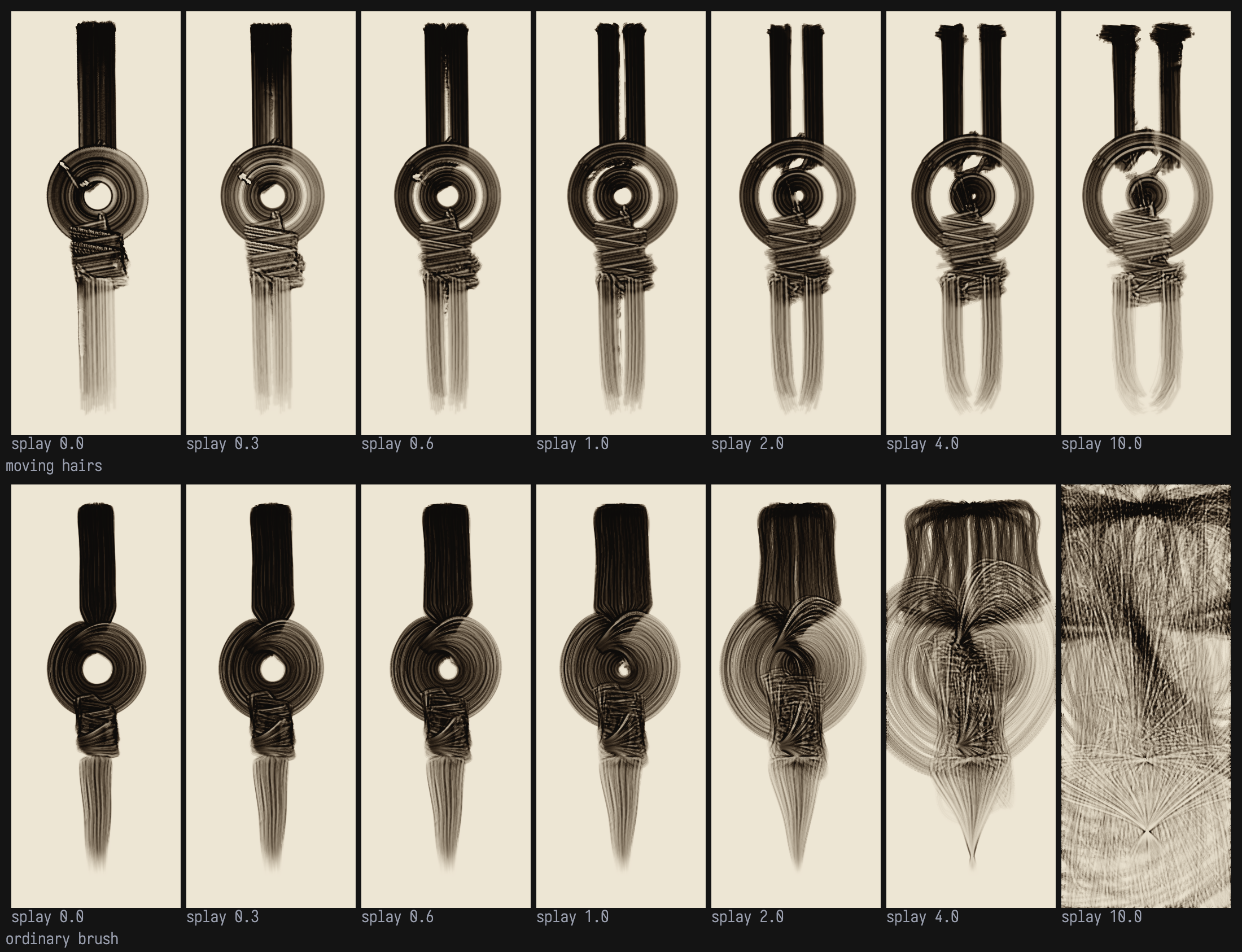
The moving hairs' clumping comes in two models, and clumping (set on the brush:
brush.set(clumping = ...)) blends between them. At 0, as a brush is made, the liquid draws the tips
of hairs that are neighbours at the root together. At 1 it joins any two wet hairs that come near
each other with a bridge of paint, which pulls them together and snaps when they are pulled a few
spacings apart, so the brush gathers into clumps that splay can tear apart, and the bristles they
carry gather with them. Between, the two pull together; past 1 the bridges pull harder, and below 0
the neighbour model pulls harder while the bridges push. The sweep runs from -1 to 2 at cohesion
4 (how strongly the liquid pulls, the next sweep),
unsplayed and at splay 2.
:::static
:::fold the gesture, and a column of it painted with settings `s`
// what every column starts from: the black of the Elegy above
data class Settings(
    val stiffness: Double = 0.5,
    val ragged: Double = 0.5,
    val splay: Double = 0.0,
    val lay: Double = 0.8,
    val run: Double = 1100.0,
    val pickup: Double? = null,
    val push: Double? = null,
    val hairs: Int = 48,
    val bristles: Int? = null,
    val stiff: Double = 0.5,
    val thinner: Double = 0.0,
    val oil: Double = 1.5,
    val amount: Double = 0.5,
    val hiding: Double = 0.65,
    val tilt: Double = 30.0,
    val faster: Double = 1.0,
    val facets: Double? = null,
    val moving: Boolean = true,
    val width: Double = 200.0,
    val hair: Double? = null,
    val cohesion: Double? = null,
    val clumping: Double? = null,
    val splayFan: Double? = null,
    val splayScatter: Double? = null,
    val drying: Double = 1.0,
    val absorbent: Double = 0.0,
    val lamp: Boolean = false,
    val wipeAfter: Double? = null,
    val dry: Boolean = false,
)

// A canvas 50 cm wide and 1.25 m tall; the default brush is 10 cm wide.
fun canvas() = PaintCanvas(300, aspect = 0.4, groundColor = rgb(0.93, 0.9, 0.83), sizeMm = 500.0, seed = 7)
val straight = FLine().moveTo(500, 120).lineTo(510, 900)
val loop = FLine().moveTo(510, 900).apply {
    for (i in 1..480) {
        val a = PI / 2 + 2 * PI * 1.15 * i / 480
        lineTo(510 + 190 * cos(a), 1090 - 190 * sin(a))
    }
}
val scrub = FLine().moveTo(560, 1330).apply {
    for (i in 0 until 5) {
        lineTo(if (i % 2 == 0) 380.0 else 640.0, 1375.0 + 45 * i)
    }
}
val last =
    [1600.0, 1800.0, 2000.0, 2200.0, 2400.0].zipWithNext().mapIndexed { k, (y0, y1) ->
        FLine().moveTo(500.0 + 4 * k, y0).lineTo(504.0 + 4 * k, y1)
    }

// a long straight, a loop that crosses itself, a scrub back and forth, and a last straight in four
// pieces, each faster and lighter: 100, 200, 350, then 600 mm/s, lifting off the canvas at the end
fun gesture(c: PaintCanvas, s: Settings): TimedGesture {
    fun part(line: FLine, speed: Double, vararg pressure: Double) =
        c.gesture(line, speed = speed, pressure = pressure.toList(), tilt = s.tilt, facets = s.facets)
    var g =
        part(straight, 250.0, 0.8, 1.0, 1.0).then(part(loop, 250.0, 1.0, 0.9)).pause(0.1).then(part(scrub, 300.0, 1.1))
    val press = [1.0, 0.8, 0.6, 0.3, -0.2]
    for ((k, speed) in [100.0, 200.0, 350.0, 600.0].withIndex()) g =
        g.then(part(last[k], speed, press[k], press[k + 1]))
    return g.faster(s.faster)
}

fun column(label: String, s: Settings): Pair<String, Img> {
    val c = canvas()
    try {
        if (s.absorbent > 0.0) c.prime(rgb(0.93, 0.9, 0.83), texture = 0.0, absorbent = s.absorbent)
        val config = BrushConfig(
            bristles = s.bristles,
            hair = s.hair,
            stiffness = s.stiffness,
            ragged = s.ragged,
            splay = s.splay,
            lay = s.lay,
            run = s.run,
            pickup = s.pickup,
            push = s.push,
        )
        val black = rgb(0.05, 0.045, 0.04)
        if (s.moving) {
            val brush =
                c.dynamicBrush(BrushKind.HogFlat, s.width, hairs = s.hairs, segments = 6, config = config)
                    .load(
                        black,
                        hiding = s.hiding,
                        stiff = s.stiff,
                        drying = s.drying,
                        thinner = s.thinner,
                        oil = s.oil,
                        amount = s.amount,
                    )
            brush.set(
                cohesion = s.cohesion,
                clumping = s.clumping,
                splayFan = s.splayFan,
                splayScatter = s.splayScatter,
            )
            c.stroke(gesture(c, s), brush)
        } else {
            // an ordinary brush along the same path, with the same pressures; it has no timing or tilt
            val brush =
                c.brush(BrushKind.HogFlat, s.width, config = config)
                    .load(
                        black,
                        hiding = s.hiding,
                        stiff = s.stiff,
                        drying = s.drying,
                        thinner = s.thinner,
                        oil = s.oil,
                        amount = s.amount,
                    )
            c.stroke(straight, brush, pressure = 0.8..1.0)
            c.stroke(loop, brush, pressure = 1.0..0.9)
            c.stroke(scrub, brush, pressure = 1.1..1.1)
            c.stroke(FLine().moveTo(500, 1600).lineTo(516, 2400), brush, pressure = 1.0..0.0)
        }
        // a rag wiped across the bar, the loop and the last stroke after some minutes (infinite: dry first)
        s.wipeAfter?.let { minutes ->
            if (minutes.isInfinite()) c.dry() else c.wait(minutes)
            val rag = c.rag(150.0)
            for (y in [500.0, 1090.0, 2000.0]) c.wipe(FLine().moveTo(250, y).lineTo(760, y + 10), rag, [0.8])
        }
        if (s.dry) c.dry()
        val png = if (s.lamp) c.png(relief = 0.3, light = PaintLight.Gallery) else c.png(relief = 0.3)
        return label to imgFromBytes(png)
    } finally {
        c.close()
    }
}

// the same columns twice: a row with moving hairs above a row with an ordinary brush
fun rows(cells: (moving: Boolean) -> List<Pair<String, Img>>): Img {
    val rows =
        ["moving hairs" to true, "ordinary brush" to false].map { (name, moving) ->
            val strokes = cells(moving)
            name to montage(strokes, columns = strokes.size, cellSide = 750, textScale = 3)
        }
    return montage(rows, columns = 1, cellSide = 4000, textScale = 3)
}
:::endfold
// moving hairs only (an ordinary brush has neither model): unsplayed above, splayed below
val sheet = montage(
    [0.0, 2.0].map { sp ->
        val strokes = [-1.0, 0.0, 0.5, 1.0, 1.5, 2.0].map {
            column("clumping $it", Settings(cohesion = 4.0, clumping = it, splay = sp))
        }
        "cohesion 4, splay $sp" to montage(strokes, columns = strokes.size, cellSide = 750, textScale = 3)
    },
    columns = 1,
    cellSide = 4000,
    textScale = 3,
)
showImg(sheet)
sheet.savePng("/tmp/field-docs-paint-sweep-clumping.png")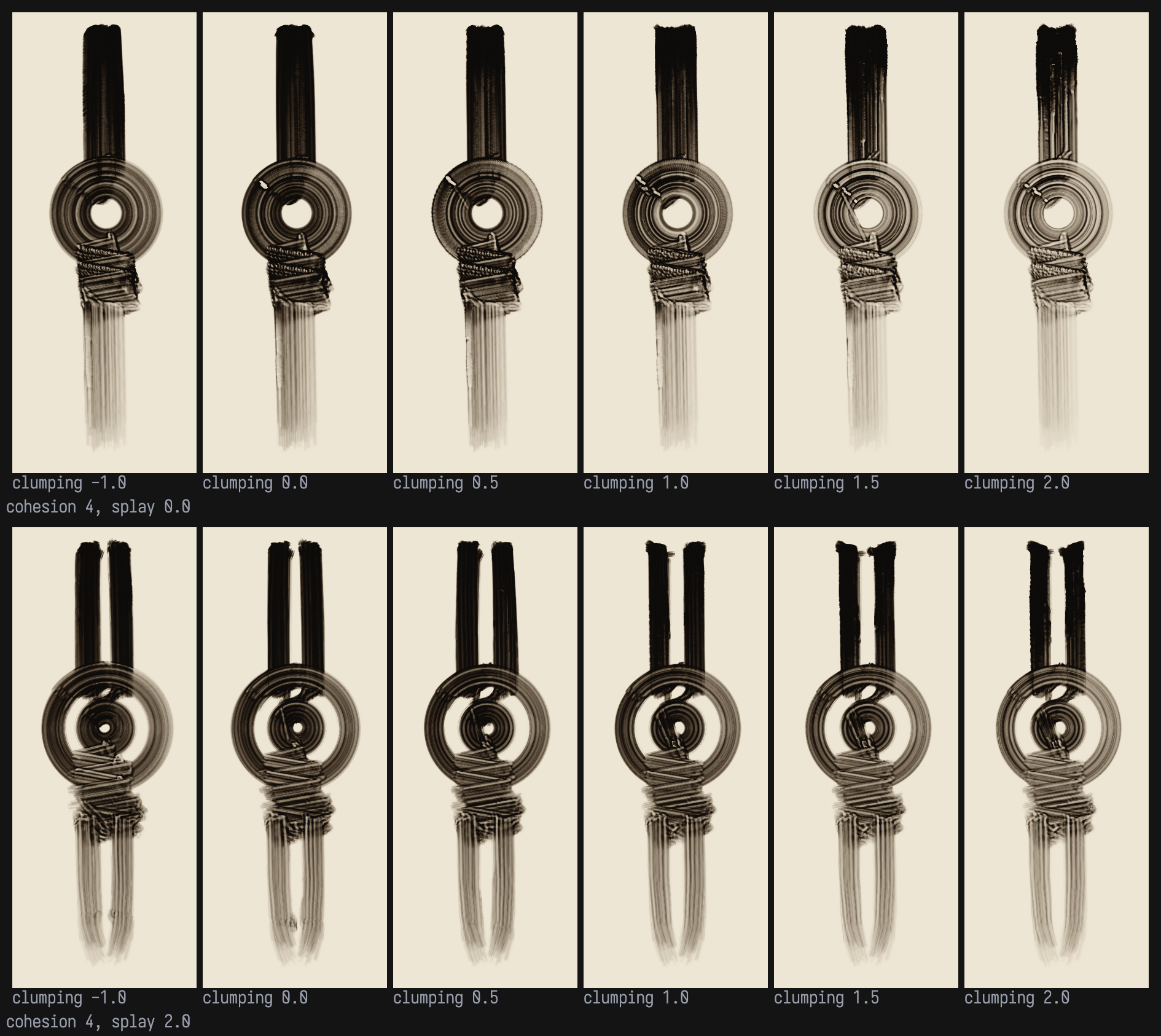
cohesion is how strongly the liquid pulls. With liquid bridges it also sets how far a bridge
reaches, so a stronger pull gathers the hairs into fewer, larger clumps, and past about 16 the
gathered brush lays its paint sooner; below 0 the hairs push each other apart. A hog flat's own is
0.35.
:::static
:::fold the gesture, and a column of it painted with settings `s`
// what every column starts from: the black of the Elegy above
data class Settings(
    val stiffness: Double = 0.5,
    val ragged: Double = 0.5,
    val splay: Double = 0.0,
    val lay: Double = 0.8,
    val run: Double = 1100.0,
    val pickup: Double? = null,
    val push: Double? = null,
    val hairs: Int = 48,
    val bristles: Int? = null,
    val stiff: Double = 0.5,
    val thinner: Double = 0.0,
    val oil: Double = 1.5,
    val amount: Double = 0.5,
    val hiding: Double = 0.65,
    val tilt: Double = 30.0,
    val faster: Double = 1.0,
    val facets: Double? = null,
    val moving: Boolean = true,
    val width: Double = 200.0,
    val hair: Double? = null,
    val cohesion: Double? = null,
    val clumping: Double? = null,
    val splayFan: Double? = null,
    val splayScatter: Double? = null,
    val drying: Double = 1.0,
    val absorbent: Double = 0.0,
    val lamp: Boolean = false,
    val wipeAfter: Double? = null,
    val dry: Boolean = false,
)

// A canvas 50 cm wide and 1.25 m tall; the default brush is 10 cm wide.
fun canvas() = PaintCanvas(300, aspect = 0.4, groundColor = rgb(0.93, 0.9, 0.83), sizeMm = 500.0, seed = 7)
val straight = FLine().moveTo(500, 120).lineTo(510, 900)
val loop = FLine().moveTo(510, 900).apply {
    for (i in 1..480) {
        val a = PI / 2 + 2 * PI * 1.15 * i / 480
        lineTo(510 + 190 * cos(a), 1090 - 190 * sin(a))
    }
}
val scrub = FLine().moveTo(560, 1330).apply {
    for (i in 0 until 5) {
        lineTo(if (i % 2 == 0) 380.0 else 640.0, 1375.0 + 45 * i)
    }
}
val last =
    [1600.0, 1800.0, 2000.0, 2200.0, 2400.0].zipWithNext().mapIndexed { k, (y0, y1) ->
        FLine().moveTo(500.0 + 4 * k, y0).lineTo(504.0 + 4 * k, y1)
    }

// a long straight, a loop that crosses itself, a scrub back and forth, and a last straight in four
// pieces, each faster and lighter: 100, 200, 350, then 600 mm/s, lifting off the canvas at the end
fun gesture(c: PaintCanvas, s: Settings): TimedGesture {
    fun part(line: FLine, speed: Double, vararg pressure: Double) =
        c.gesture(line, speed = speed, pressure = pressure.toList(), tilt = s.tilt, facets = s.facets)
    var g =
        part(straight, 250.0, 0.8, 1.0, 1.0).then(part(loop, 250.0, 1.0, 0.9)).pause(0.1).then(part(scrub, 300.0, 1.1))
    val press = [1.0, 0.8, 0.6, 0.3, -0.2]
    for ((k, speed) in [100.0, 200.0, 350.0, 600.0].withIndex()) g =
        g.then(part(last[k], speed, press[k], press[k + 1]))
    return g.faster(s.faster)
}

fun column(label: String, s: Settings): Pair<String, Img> {
    val c = canvas()
    try {
        if (s.absorbent > 0.0) c.prime(rgb(0.93, 0.9, 0.83), texture = 0.0, absorbent = s.absorbent)
        val config = BrushConfig(
            bristles = s.bristles,
            hair = s.hair,
            stiffness = s.stiffness,
            ragged = s.ragged,
            splay = s.splay,
            lay = s.lay,
            run = s.run,
            pickup = s.pickup,
            push = s.push,
        )
        val black = rgb(0.05, 0.045, 0.04)
        if (s.moving) {
            val brush =
                c.dynamicBrush(BrushKind.HogFlat, s.width, hairs = s.hairs, segments = 6, config = config)
                    .load(
                        black,
                        hiding = s.hiding,
                        stiff = s.stiff,
                        drying = s.drying,
                        thinner = s.thinner,
                        oil = s.oil,
                        amount = s.amount,
                    )
            brush.set(
                cohesion = s.cohesion,
                clumping = s.clumping,
                splayFan = s.splayFan,
                splayScatter = s.splayScatter,
            )
            c.stroke(gesture(c, s), brush)
        } else {
            // an ordinary brush along the same path, with the same pressures; it has no timing or tilt
            val brush =
                c.brush(BrushKind.HogFlat, s.width, config = config)
                    .load(
                        black,
                        hiding = s.hiding,
                        stiff = s.stiff,
                        drying = s.drying,
                        thinner = s.thinner,
                        oil = s.oil,
                        amount = s.amount,
                    )
            c.stroke(straight, brush, pressure = 0.8..1.0)
            c.stroke(loop, brush, pressure = 1.0..0.9)
            c.stroke(scrub, brush, pressure = 1.1..1.1)
            c.stroke(FLine().moveTo(500, 1600).lineTo(516, 2400), brush, pressure = 1.0..0.0)
        }
        // a rag wiped across the bar, the loop and the last stroke after some minutes (infinite: dry first)
        s.wipeAfter?.let { minutes ->
            if (minutes.isInfinite()) c.dry() else c.wait(minutes)
            val rag = c.rag(150.0)
            for (y in [500.0, 1090.0, 2000.0]) c.wipe(FLine().moveTo(250, y).lineTo(760, y + 10), rag, [0.8])
        }
        if (s.dry) c.dry()
        val png = if (s.lamp) c.png(relief = 0.3, light = PaintLight.Gallery) else c.png(relief = 0.3)
        return label to imgFromBytes(png)
    } finally {
        c.close()
    }
}

// the same columns twice: a row with moving hairs above a row with an ordinary brush
fun rows(cells: (moving: Boolean) -> List<Pair<String, Img>>): Img {
    val rows =
        ["moving hairs" to true, "ordinary brush" to false].map { (name, moving) ->
            val strokes = cells(moving)
            name to montage(strokes, columns = strokes.size, cellSide = 750, textScale = 3)
        }
    return montage(rows, columns = 1, cellSide = 4000, textScale = 3)
}
:::endfold
// liquid bridges (clumping 1); unsplayed above, fanned open below (`splayFan`, next)
val sheet = montage(
    [0.0, 3.0].map { sp ->
        val strokes = [-8.0, 0.0, 0.35, 1.0, 4.0, 16.0, 32.0].map {
            column(
                "cohesion $it",
                Settings(cohesion = it, clumping = 1.0, splay = sp, splayFan = if (sp > 0) 1.0 else null),
            )
        }
        (if (sp > 0) "liquid bridges, splay $sp fanned" else "liquid bridges, no splay") to
            montage(strokes, columns = strokes.size, cellSide = 750, textScale = 3)
    },
    columns = 1,
    cellSide = 4000,
    textScale = 3,
)
showImg(sheet)
sheet.savePng("/tmp/field-docs-paint-sweep-cohesion.png")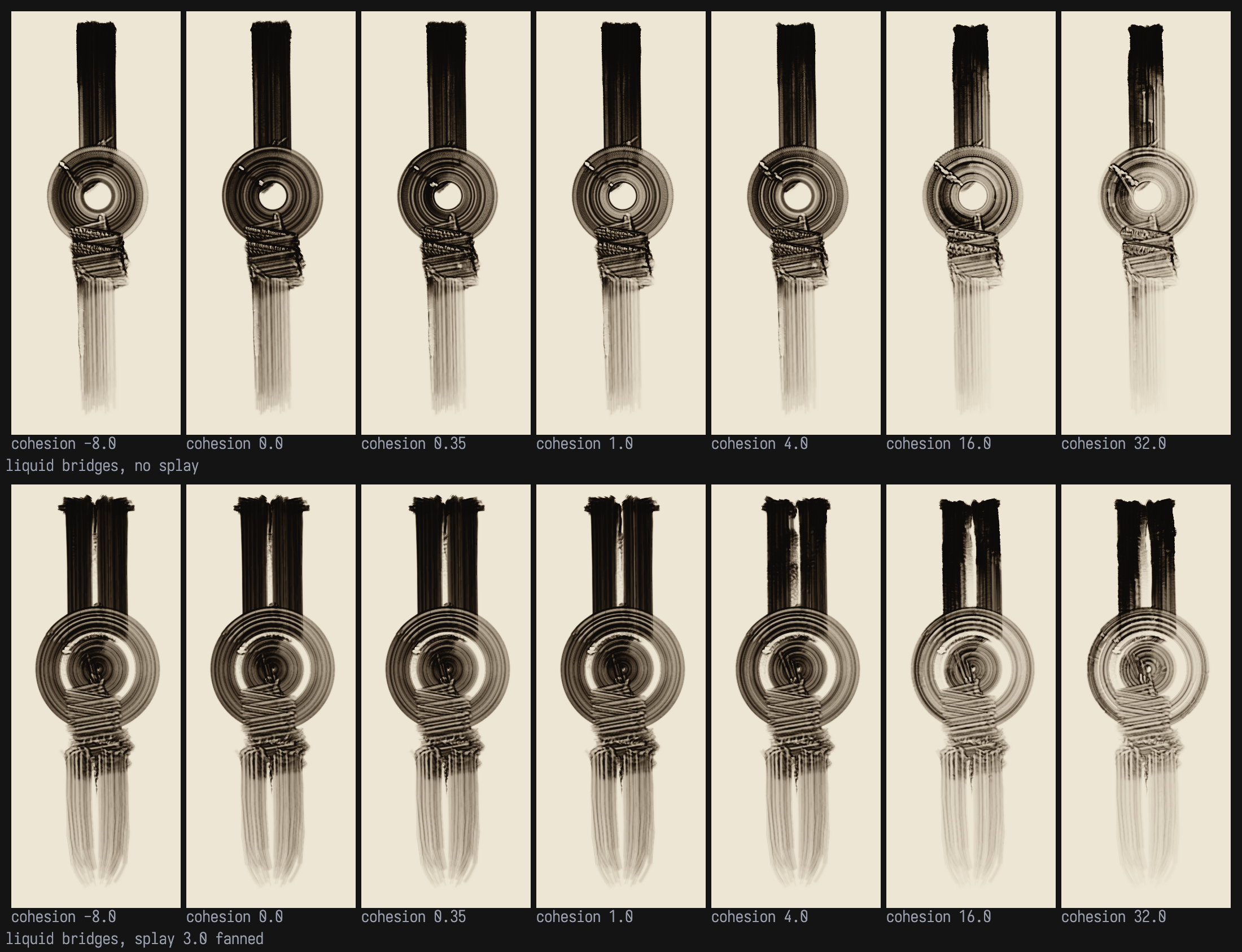
splay pushes every pressed hair straight out from the brush's middle, so a flat can only part in
two. splayFan 1 pushes each in proportion to how far out its root is, so the brush fans open and
neighbours part everywhere; splayScatter turns each push off the outward by its own slowly drifting
angle and amount, alike for hairs near each other, the way pressed hairs buckle in bundles. With
liquid bridges, the bundles hold together and each leaves its own trail, braiding and crossing.
:::static
:::fold the gesture, and a column of it painted with settings `s`
// what every column starts from: the black of the Elegy above
data class Settings(
    val stiffness: Double = 0.5,
    val ragged: Double = 0.5,
    val splay: Double = 0.0,
    val lay: Double = 0.8,
    val run: Double = 1100.0,
    val pickup: Double? = null,
    val push: Double? = null,
    val hairs: Int = 48,
    val bristles: Int? = null,
    val stiff: Double = 0.5,
    val thinner: Double = 0.0,
    val oil: Double = 1.5,
    val amount: Double = 0.5,
    val hiding: Double = 0.65,
    val tilt: Double = 30.0,
    val faster: Double = 1.0,
    val facets: Double? = null,
    val moving: Boolean = true,
    val width: Double = 200.0,
    val hair: Double? = null,
    val cohesion: Double? = null,
    val clumping: Double? = null,
    val splayFan: Double? = null,
    val splayScatter: Double? = null,
    val drying: Double = 1.0,
    val absorbent: Double = 0.0,
    val lamp: Boolean = false,
    val wipeAfter: Double? = null,
    val dry: Boolean = false,
)

// A canvas 50 cm wide and 1.25 m tall; the default brush is 10 cm wide.
fun canvas() = PaintCanvas(300, aspect = 0.4, groundColor = rgb(0.93, 0.9, 0.83), sizeMm = 500.0, seed = 7)
val straight = FLine().moveTo(500, 120).lineTo(510, 900)
val loop = FLine().moveTo(510, 900).apply {
    for (i in 1..480) {
        val a = PI / 2 + 2 * PI * 1.15 * i / 480
        lineTo(510 + 190 * cos(a), 1090 - 190 * sin(a))
    }
}
val scrub = FLine().moveTo(560, 1330).apply {
    for (i in 0 until 5) {
        lineTo(if (i % 2 == 0) 380.0 else 640.0, 1375.0 + 45 * i)
    }
}
val last =
    [1600.0, 1800.0, 2000.0, 2200.0, 2400.0].zipWithNext().mapIndexed { k, (y0, y1) ->
        FLine().moveTo(500.0 + 4 * k, y0).lineTo(504.0 + 4 * k, y1)
    }

// a long straight, a loop that crosses itself, a scrub back and forth, and a last straight in four
// pieces, each faster and lighter: 100, 200, 350, then 600 mm/s, lifting off the canvas at the end
fun gesture(c: PaintCanvas, s: Settings): TimedGesture {
    fun part(line: FLine, speed: Double, vararg pressure: Double) =
        c.gesture(line, speed = speed, pressure = pressure.toList(), tilt = s.tilt, facets = s.facets)
    var g =
        part(straight, 250.0, 0.8, 1.0, 1.0).then(part(loop, 250.0, 1.0, 0.9)).pause(0.1).then(part(scrub, 300.0, 1.1))
    val press = [1.0, 0.8, 0.6, 0.3, -0.2]
    for ((k, speed) in [100.0, 200.0, 350.0, 600.0].withIndex()) g =
        g.then(part(last[k], speed, press[k], press[k + 1]))
    return g.faster(s.faster)
}

fun column(label: String, s: Settings): Pair<String, Img> {
    val c = canvas()
    try {
        if (s.absorbent > 0.0) c.prime(rgb(0.93, 0.9, 0.83), texture = 0.0, absorbent = s.absorbent)
        val config = BrushConfig(
            bristles = s.bristles,
            hair = s.hair,
            stiffness = s.stiffness,
            ragged = s.ragged,
            splay = s.splay,
            lay = s.lay,
            run = s.run,
            pickup = s.pickup,
            push = s.push,
        )
        val black = rgb(0.05, 0.045, 0.04)
        if (s.moving) {
            val brush =
                c.dynamicBrush(BrushKind.HogFlat, s.width, hairs = s.hairs, segments = 6, config = config)
                    .load(
                        black,
                        hiding = s.hiding,
                        stiff = s.stiff,
                        drying = s.drying,
                        thinner = s.thinner,
                        oil = s.oil,
                        amount = s.amount,
                    )
            brush.set(
                cohesion = s.cohesion,
                clumping = s.clumping,
                splayFan = s.splayFan,
                splayScatter = s.splayScatter,
            )
            c.stroke(gesture(c, s), brush)
        } else {
            // an ordinary brush along the same path, with the same pressures; it has no timing or tilt
            val brush =
                c.brush(BrushKind.HogFlat, s.width, config = config)
                    .load(
                        black,
                        hiding = s.hiding,
                        stiff = s.stiff,
                        drying = s.drying,
                        thinner = s.thinner,
                        oil = s.oil,
                        amount = s.amount,
                    )
            c.stroke(straight, brush, pressure = 0.8..1.0)
            c.stroke(loop, brush, pressure = 1.0..0.9)
            c.stroke(scrub, brush, pressure = 1.1..1.1)
            c.stroke(FLine().moveTo(500, 1600).lineTo(516, 2400), brush, pressure = 1.0..0.0)
        }
        // a rag wiped across the bar, the loop and the last stroke after some minutes (infinite: dry first)
        s.wipeAfter?.let { minutes ->
            if (minutes.isInfinite()) c.dry() else c.wait(minutes)
            val rag = c.rag(150.0)
            for (y in [500.0, 1090.0, 2000.0]) c.wipe(FLine().moveTo(250, y).lineTo(760, y + 10), rag, [0.8])
        }
        if (s.dry) c.dry()
        val png = if (s.lamp) c.png(relief = 0.3, light = PaintLight.Gallery) else c.png(relief = 0.3)
        return label to imgFromBytes(png)
    } finally {
        c.close()
    }
}

// the same columns twice: a row with moving hairs above a row with an ordinary brush
fun rows(cells: (moving: Boolean) -> List<Pair<String, Img>>): Img {
    val rows =
        ["moving hairs" to true, "ordinary brush" to false].map { (name, moving) ->
            val strokes = cells(moving)
            name to montage(strokes, columns = strokes.size, cellSide = 750, textScale = 3)
        }
    return montage(rows, columns = 1, cellSide = 4000, textScale = 3)
}
:::endfold
// a flat half the usual width, 64 hairs, splay 3 fanned open, liquid bridges
val sheet = run {
    val strokes = [0.0, 0.15, 0.3, 0.6, 1.0, 2.0].map {
        column(
            "scatter $it",
            Settings(
                width = 100.0,
                hairs = 64,
                splay = 3.0,
                splayFan = 1.0,
                cohesion = 1.0,
                clumping = 1.0,
                splayScatter = it,
            ),
        )
    }
    montage(strokes, columns = strokes.size, cellSide = 750, textScale = 3)
}
showImg(sheet)
sheet.savePng("/tmp/field-docs-paint-sweep-scatter.png")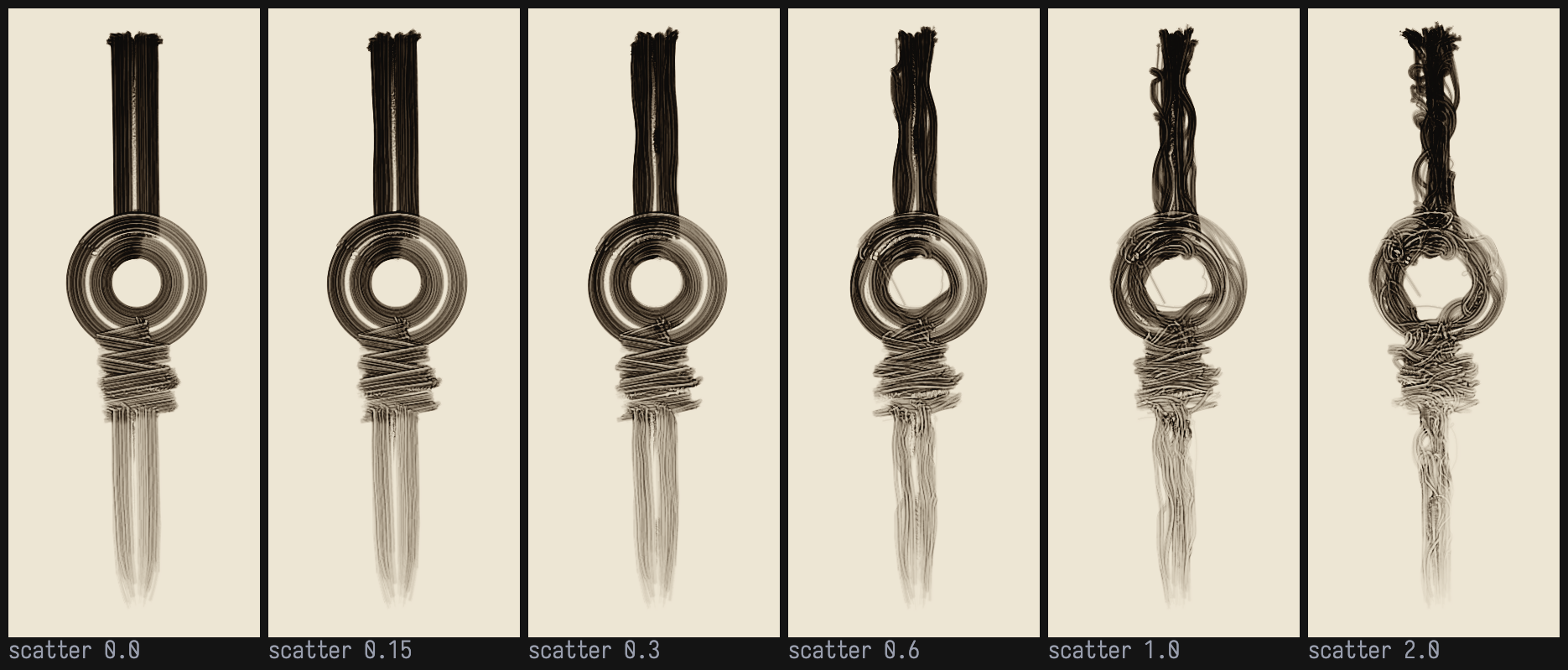
Drying
Oil paint dries over days, and the oil in it decides how it looks dry. Below, the strokes are
painted with more and less oil (oil, 1 is tube paint), dried, and lit from above so the gloss
shows: lean paint dries dull, oily paint dark and glossy.
:::static
:::fold the gesture, and a column of it painted with settings `s`
// what every column starts from: the black of the Elegy above
data class Settings(
    val stiffness: Double = 0.5,
    val ragged: Double = 0.5,
    val splay: Double = 0.0,
    val lay: Double = 0.8,
    val run: Double = 1100.0,
    val pickup: Double? = null,
    val push: Double? = null,
    val hairs: Int = 48,
    val bristles: Int? = null,
    val stiff: Double = 0.5,
    val thinner: Double = 0.0,
    val oil: Double = 1.5,
    val amount: Double = 0.5,
    val hiding: Double = 0.65,
    val tilt: Double = 30.0,
    val faster: Double = 1.0,
    val facets: Double? = null,
    val moving: Boolean = true,
    val width: Double = 200.0,
    val hair: Double? = null,
    val cohesion: Double? = null,
    val clumping: Double? = null,
    val splayFan: Double? = null,
    val splayScatter: Double? = null,
    val drying: Double = 1.0,
    val absorbent: Double = 0.0,
    val lamp: Boolean = false,
    val wipeAfter: Double? = null,
    val dry: Boolean = false,
)

// A canvas 50 cm wide and 1.25 m tall; the default brush is 10 cm wide.
fun canvas() = PaintCanvas(300, aspect = 0.4, groundColor = rgb(0.93, 0.9, 0.83), sizeMm = 500.0, seed = 7)
val straight = FLine().moveTo(500, 120).lineTo(510, 900)
val loop = FLine().moveTo(510, 900).apply {
    for (i in 1..480) {
        val a = PI / 2 + 2 * PI * 1.15 * i / 480
        lineTo(510 + 190 * cos(a), 1090 - 190 * sin(a))
    }
}
val scrub = FLine().moveTo(560, 1330).apply {
    for (i in 0 until 5) {
        lineTo(if (i % 2 == 0) 380.0 else 640.0, 1375.0 + 45 * i)
    }
}
val last =
    [1600.0, 1800.0, 2000.0, 2200.0, 2400.0].zipWithNext().mapIndexed { k, (y0, y1) ->
        FLine().moveTo(500.0 + 4 * k, y0).lineTo(504.0 + 4 * k, y1)
    }

// a long straight, a loop that crosses itself, a scrub back and forth, and a last straight in four
// pieces, each faster and lighter: 100, 200, 350, then 600 mm/s, lifting off the canvas at the end
fun gesture(c: PaintCanvas, s: Settings): TimedGesture {
    fun part(line: FLine, speed: Double, vararg pressure: Double) =
        c.gesture(line, speed = speed, pressure = pressure.toList(), tilt = s.tilt, facets = s.facets)
    var g =
        part(straight, 250.0, 0.8, 1.0, 1.0).then(part(loop, 250.0, 1.0, 0.9)).pause(0.1).then(part(scrub, 300.0, 1.1))
    val press = [1.0, 0.8, 0.6, 0.3, -0.2]
    for ((k, speed) in [100.0, 200.0, 350.0, 600.0].withIndex()) g =
        g.then(part(last[k], speed, press[k], press[k + 1]))
    return g.faster(s.faster)
}

fun column(label: String, s: Settings): Pair<String, Img> {
    val c = canvas()
    try {
        if (s.absorbent > 0.0) c.prime(rgb(0.93, 0.9, 0.83), texture = 0.0, absorbent = s.absorbent)
        val config = BrushConfig(
            bristles = s.bristles,
            hair = s.hair,
            stiffness = s.stiffness,
            ragged = s.ragged,
            splay = s.splay,
            lay = s.lay,
            run = s.run,
            pickup = s.pickup,
            push = s.push,
        )
        val black = rgb(0.05, 0.045, 0.04)
        if (s.moving) {
            val brush =
                c.dynamicBrush(BrushKind.HogFlat, s.width, hairs = s.hairs, segments = 6, config = config)
                    .load(
                        black,
                        hiding = s.hiding,
                        stiff = s.stiff,
                        drying = s.drying,
                        thinner = s.thinner,
                        oil = s.oil,
                        amount = s.amount,
                    )
            brush.set(
                cohesion = s.cohesion,
                clumping = s.clumping,
                splayFan = s.splayFan,
                splayScatter = s.splayScatter,
            )
            c.stroke(gesture(c, s), brush)
        } else {
            // an ordinary brush along the same path, with the same pressures; it has no timing or tilt
            val brush =
                c.brush(BrushKind.HogFlat, s.width, config = config)
                    .load(
                        black,
                        hiding = s.hiding,
                        stiff = s.stiff,
                        drying = s.drying,
                        thinner = s.thinner,
                        oil = s.oil,
                        amount = s.amount,
                    )
            c.stroke(straight, brush, pressure = 0.8..1.0)
            c.stroke(loop, brush, pressure = 1.0..0.9)
            c.stroke(scrub, brush, pressure = 1.1..1.1)
            c.stroke(FLine().moveTo(500, 1600).lineTo(516, 2400), brush, pressure = 1.0..0.0)
        }
        // a rag wiped across the bar, the loop and the last stroke after some minutes (infinite: dry first)
        s.wipeAfter?.let { minutes ->
            if (minutes.isInfinite()) c.dry() else c.wait(minutes)
            val rag = c.rag(150.0)
            for (y in [500.0, 1090.0, 2000.0]) c.wipe(FLine().moveTo(250, y).lineTo(760, y + 10), rag, [0.8])
        }
        if (s.dry) c.dry()
        val png = if (s.lamp) c.png(relief = 0.3, light = PaintLight.Gallery) else c.png(relief = 0.3)
        return label to imgFromBytes(png)
    } finally {
        c.close()
    }
}

// the same columns twice: a row with moving hairs above a row with an ordinary brush
fun rows(cells: (moving: Boolean) -> List<Pair<String, Img>>): Img {
    val rows =
        ["moving hairs" to true, "ordinary brush" to false].map { (name, moving) ->
            val strokes = cells(moving)
            name to montage(strokes, columns = strokes.size, cellSide = 750, textScale = 3)
        }
    return montage(rows, columns = 1, cellSide = 4000, textScale = 3)
}
:::endfold
val strokes = [0.0, 0.15, 0.4, 0.8, 1.3, 4.0].map { column("oil $it", Settings(oil = it, lamp = true, dry = true)) }
val sheet = montage(strokes, columns = strokes.size, cellSide = 750, textScale = 3)
showImg(sheet)
sheet.savePng("/tmp/field-docs-paint-sweep-gloss.png")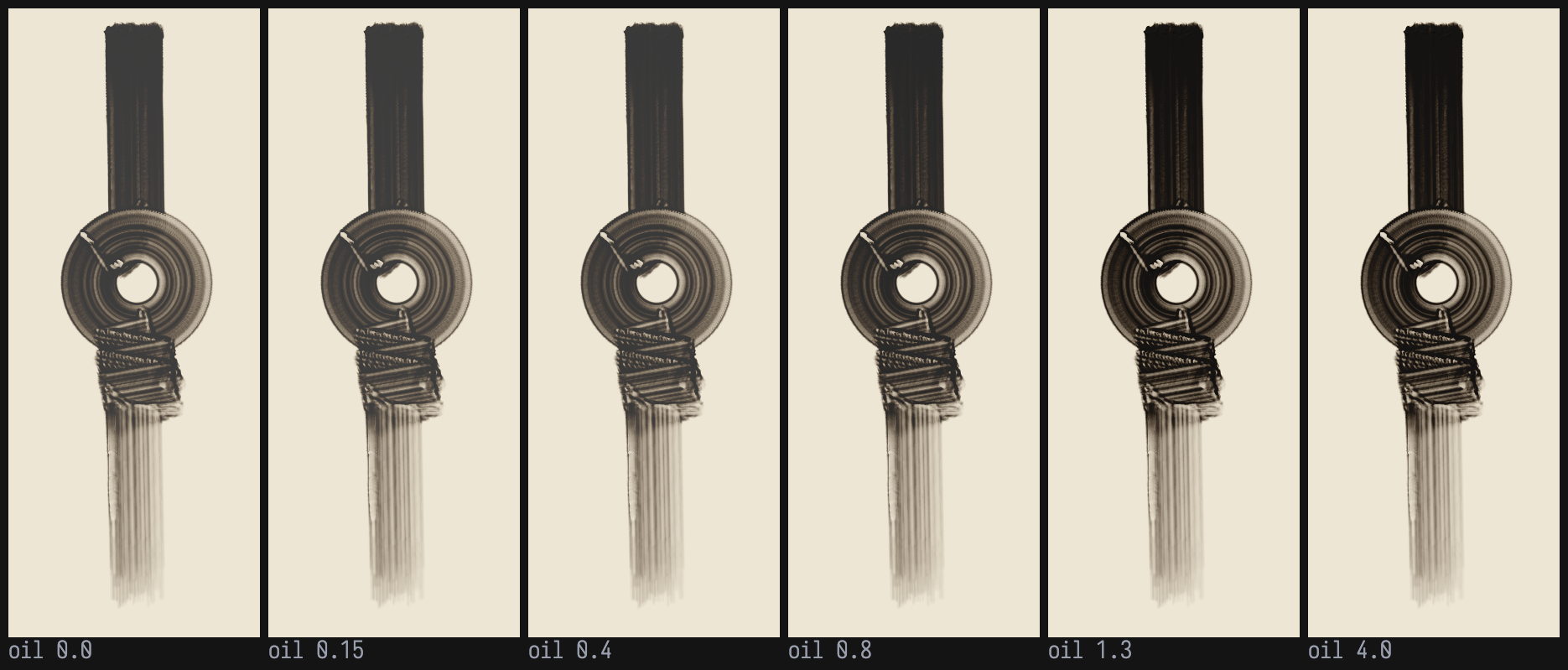
On an absorbent ground (prime(..., absorbent = 1.0)) the ground draws oil out of the paint laid
on it. Very oily paint is drawn in so fast that the stroke runs out sooner.
:::static
:::fold the gesture, and a column of it painted with settings `s`
// what every column starts from: the black of the Elegy above
data class Settings(
    val stiffness: Double = 0.5,
    val ragged: Double = 0.5,
    val splay: Double = 0.0,
    val lay: Double = 0.8,
    val run: Double = 1100.0,
    val pickup: Double? = null,
    val push: Double? = null,
    val hairs: Int = 48,
    val bristles: Int? = null,
    val stiff: Double = 0.5,
    val thinner: Double = 0.0,
    val oil: Double = 1.5,
    val amount: Double = 0.5,
    val hiding: Double = 0.65,
    val tilt: Double = 30.0,
    val faster: Double = 1.0,
    val facets: Double? = null,
    val moving: Boolean = true,
    val width: Double = 200.0,
    val hair: Double? = null,
    val cohesion: Double? = null,
    val clumping: Double? = null,
    val splayFan: Double? = null,
    val splayScatter: Double? = null,
    val drying: Double = 1.0,
    val absorbent: Double = 0.0,
    val lamp: Boolean = false,
    val wipeAfter: Double? = null,
    val dry: Boolean = false,
)

// A canvas 50 cm wide and 1.25 m tall; the default brush is 10 cm wide.
fun canvas() = PaintCanvas(300, aspect = 0.4, groundColor = rgb(0.93, 0.9, 0.83), sizeMm = 500.0, seed = 7)
val straight = FLine().moveTo(500, 120).lineTo(510, 900)
val loop = FLine().moveTo(510, 900).apply {
    for (i in 1..480) {
        val a = PI / 2 + 2 * PI * 1.15 * i / 480
        lineTo(510 + 190 * cos(a), 1090 - 190 * sin(a))
    }
}
val scrub = FLine().moveTo(560, 1330).apply {
    for (i in 0 until 5) {
        lineTo(if (i % 2 == 0) 380.0 else 640.0, 1375.0 + 45 * i)
    }
}
val last =
    [1600.0, 1800.0, 2000.0, 2200.0, 2400.0].zipWithNext().mapIndexed { k, (y0, y1) ->
        FLine().moveTo(500.0 + 4 * k, y0).lineTo(504.0 + 4 * k, y1)
    }

// a long straight, a loop that crosses itself, a scrub back and forth, and a last straight in four
// pieces, each faster and lighter: 100, 200, 350, then 600 mm/s, lifting off the canvas at the end
fun gesture(c: PaintCanvas, s: Settings): TimedGesture {
    fun part(line: FLine, speed: Double, vararg pressure: Double) =
        c.gesture(line, speed = speed, pressure = pressure.toList(), tilt = s.tilt, facets = s.facets)
    var g =
        part(straight, 250.0, 0.8, 1.0, 1.0).then(part(loop, 250.0, 1.0, 0.9)).pause(0.1).then(part(scrub, 300.0, 1.1))
    val press = [1.0, 0.8, 0.6, 0.3, -0.2]
    for ((k, speed) in [100.0, 200.0, 350.0, 600.0].withIndex()) g =
        g.then(part(last[k], speed, press[k], press[k + 1]))
    return g.faster(s.faster)
}

fun column(label: String, s: Settings): Pair<String, Img> {
    val c = canvas()
    try {
        if (s.absorbent > 0.0) c.prime(rgb(0.93, 0.9, 0.83), texture = 0.0, absorbent = s.absorbent)
        val config = BrushConfig(
            bristles = s.bristles,
            hair = s.hair,
            stiffness = s.stiffness,
            ragged = s.ragged,
            splay = s.splay,
            lay = s.lay,
            run = s.run,
            pickup = s.pickup,
            push = s.push,
        )
        val black = rgb(0.05, 0.045, 0.04)
        if (s.moving) {
            val brush =
                c.dynamicBrush(BrushKind.HogFlat, s.width, hairs = s.hairs, segments = 6, config = config)
                    .load(
                        black,
                        hiding = s.hiding,
                        stiff = s.stiff,
                        drying = s.drying,
                        thinner = s.thinner,
                        oil = s.oil,
                        amount = s.amount,
                    )
            brush.set(
                cohesion = s.cohesion,
                clumping = s.clumping,
                splayFan = s.splayFan,
                splayScatter = s.splayScatter,
            )
            c.stroke(gesture(c, s), brush)
        } else {
            // an ordinary brush along the same path, with the same pressures; it has no timing or tilt
            val brush =
                c.brush(BrushKind.HogFlat, s.width, config = config)
                    .load(
                        black,
                        hiding = s.hiding,
                        stiff = s.stiff,
                        drying = s.drying,
                        thinner = s.thinner,
                        oil = s.oil,
                        amount = s.amount,
                    )
            c.stroke(straight, brush, pressure = 0.8..1.0)
            c.stroke(loop, brush, pressure = 1.0..0.9)
            c.stroke(scrub, brush, pressure = 1.1..1.1)
            c.stroke(FLine().moveTo(500, 1600).lineTo(516, 2400), brush, pressure = 1.0..0.0)
        }
        // a rag wiped across the bar, the loop and the last stroke after some minutes (infinite: dry first)
        s.wipeAfter?.let { minutes ->
            if (minutes.isInfinite()) c.dry() else c.wait(minutes)
            val rag = c.rag(150.0)
            for (y in [500.0, 1090.0, 2000.0]) c.wipe(FLine().moveTo(250, y).lineTo(760, y + 10), rag, [0.8])
        }
        if (s.dry) c.dry()
        val png = if (s.lamp) c.png(relief = 0.3, light = PaintLight.Gallery) else c.png(relief = 0.3)
        return label to imgFromBytes(png)
    } finally {
        c.close()
    }
}

// the same columns twice: a row with moving hairs above a row with an ordinary brush
fun rows(cells: (moving: Boolean) -> List<Pair<String, Img>>): Img {
    val rows =
        ["moving hairs" to true, "ordinary brush" to false].map { (name, moving) ->
            val strokes = cells(moving)
            name to montage(strokes, columns = strokes.size, cellSide = 750, textScale = 3)
        }
    return montage(rows, columns = 1, cellSide = 4000, textScale = 3)
}
:::endfold
val strokes = [0.0, 0.15, 0.4, 0.8, 1.3, 4.0].map {
    column("oil $it", Settings(oil = it, absorbent = 1.0, lamp = true, dry = true))
}
val sheet = montage(strokes, columns = strokes.size, cellSide = 750, textScale = 3)
showImg(sheet)
sheet.savePng("/tmp/field-docs-paint-sweep-absorbent.png")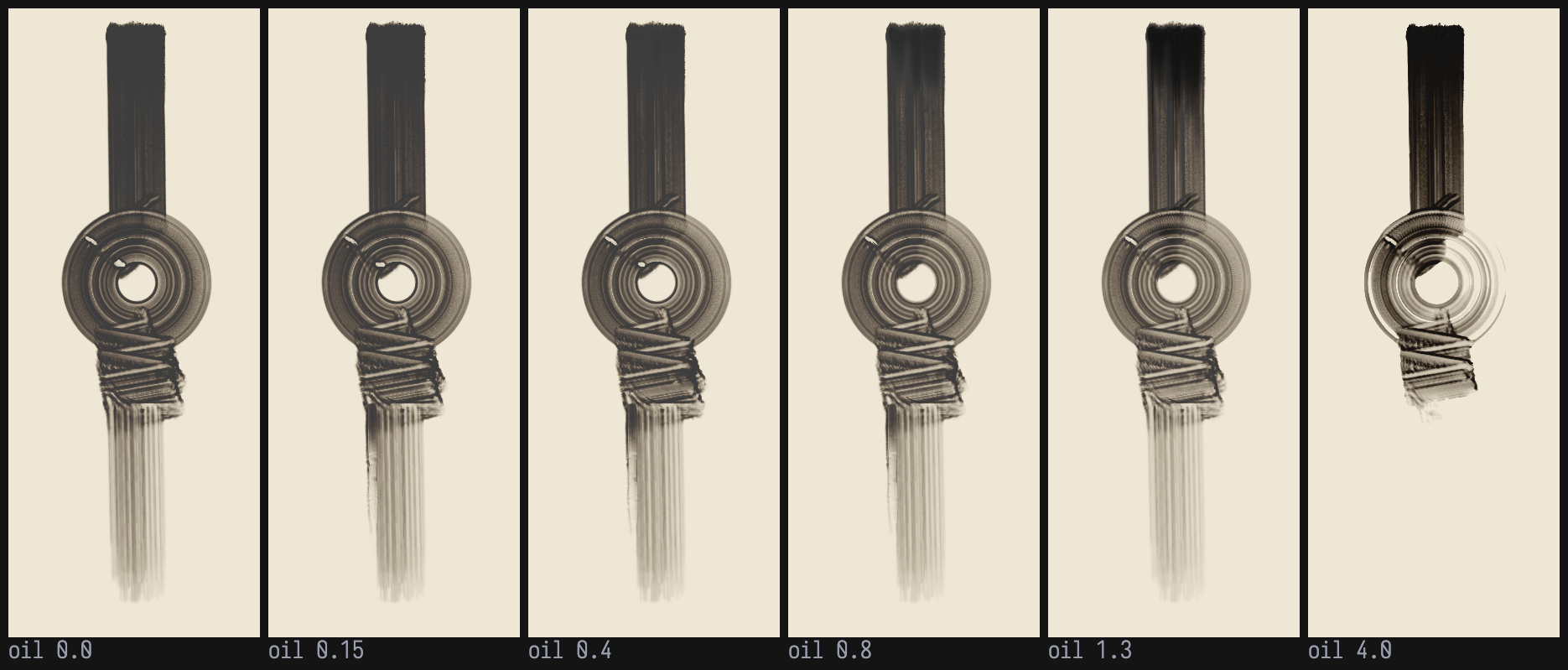
A rag wiped across the paint shows how far it has set. Wiped within hours, black oil paint lifts almost to the ground; after a day only partly; after two days hardly at all; and from four days it has set and does not move.
:::static
:::fold the gesture, and a column of it painted with settings `s`
// what every column starts from: the black of the Elegy above
data class Settings(
    val stiffness: Double = 0.5,
    val ragged: Double = 0.5,
    val splay: Double = 0.0,
    val lay: Double = 0.8,
    val run: Double = 1100.0,
    val pickup: Double? = null,
    val push: Double? = null,
    val hairs: Int = 48,
    val bristles: Int? = null,
    val stiff: Double = 0.5,
    val thinner: Double = 0.0,
    val oil: Double = 1.5,
    val amount: Double = 0.5,
    val hiding: Double = 0.65,
    val tilt: Double = 30.0,
    val faster: Double = 1.0,
    val facets: Double? = null,
    val moving: Boolean = true,
    val width: Double = 200.0,
    val hair: Double? = null,
    val cohesion: Double? = null,
    val clumping: Double? = null,
    val splayFan: Double? = null,
    val splayScatter: Double? = null,
    val drying: Double = 1.0,
    val absorbent: Double = 0.0,
    val lamp: Boolean = false,
    val wipeAfter: Double? = null,
    val dry: Boolean = false,
)

// A canvas 50 cm wide and 1.25 m tall; the default brush is 10 cm wide.
fun canvas() = PaintCanvas(300, aspect = 0.4, groundColor = rgb(0.93, 0.9, 0.83), sizeMm = 500.0, seed = 7)
val straight = FLine().moveTo(500, 120).lineTo(510, 900)
val loop = FLine().moveTo(510, 900).apply {
    for (i in 1..480) {
        val a = PI / 2 + 2 * PI * 1.15 * i / 480
        lineTo(510 + 190 * cos(a), 1090 - 190 * sin(a))
    }
}
val scrub = FLine().moveTo(560, 1330).apply {
    for (i in 0 until 5) {
        lineTo(if (i % 2 == 0) 380.0 else 640.0, 1375.0 + 45 * i)
    }
}
val last =
    [1600.0, 1800.0, 2000.0, 2200.0, 2400.0].zipWithNext().mapIndexed { k, (y0, y1) ->
        FLine().moveTo(500.0 + 4 * k, y0).lineTo(504.0 + 4 * k, y1)
    }

// a long straight, a loop that crosses itself, a scrub back and forth, and a last straight in four
// pieces, each faster and lighter: 100, 200, 350, then 600 mm/s, lifting off the canvas at the end
fun gesture(c: PaintCanvas, s: Settings): TimedGesture {
    fun part(line: FLine, speed: Double, vararg pressure: Double) =
        c.gesture(line, speed = speed, pressure = pressure.toList(), tilt = s.tilt, facets = s.facets)
    var g =
        part(straight, 250.0, 0.8, 1.0, 1.0).then(part(loop, 250.0, 1.0, 0.9)).pause(0.1).then(part(scrub, 300.0, 1.1))
    val press = [1.0, 0.8, 0.6, 0.3, -0.2]
    for ((k, speed) in [100.0, 200.0, 350.0, 600.0].withIndex()) g =
        g.then(part(last[k], speed, press[k], press[k + 1]))
    return g.faster(s.faster)
}

fun column(label: String, s: Settings): Pair<String, Img> {
    val c = canvas()
    try {
        if (s.absorbent > 0.0) c.prime(rgb(0.93, 0.9, 0.83), texture = 0.0, absorbent = s.absorbent)
        val config = BrushConfig(
            bristles = s.bristles,
            hair = s.hair,
            stiffness = s.stiffness,
            ragged = s.ragged,
            splay = s.splay,
            lay = s.lay,
            run = s.run,
            pickup = s.pickup,
            push = s.push,
        )
        val black = rgb(0.05, 0.045, 0.04)
        if (s.moving) {
            val brush =
                c.dynamicBrush(BrushKind.HogFlat, s.width, hairs = s.hairs, segments = 6, config = config)
                    .load(
                        black,
                        hiding = s.hiding,
                        stiff = s.stiff,
                        drying = s.drying,
                        thinner = s.thinner,
                        oil = s.oil,
                        amount = s.amount,
                    )
            brush.set(
                cohesion = s.cohesion,
                clumping = s.clumping,
                splayFan = s.splayFan,
                splayScatter = s.splayScatter,
            )
            c.stroke(gesture(c, s), brush)
        } else {
            // an ordinary brush along the same path, with the same pressures; it has no timing or tilt
            val brush =
                c.brush(BrushKind.HogFlat, s.width, config = config)
                    .load(
                        black,
                        hiding = s.hiding,
                        stiff = s.stiff,
                        drying = s.drying,
                        thinner = s.thinner,
                        oil = s.oil,
                        amount = s.amount,
                    )
            c.stroke(straight, brush, pressure = 0.8..1.0)
            c.stroke(loop, brush, pressure = 1.0..0.9)
            c.stroke(scrub, brush, pressure = 1.1..1.1)
            c.stroke(FLine().moveTo(500, 1600).lineTo(516, 2400), brush, pressure = 1.0..0.0)
        }
        // a rag wiped across the bar, the loop and the last stroke after some minutes (infinite: dry first)
        s.wipeAfter?.let { minutes ->
            if (minutes.isInfinite()) c.dry() else c.wait(minutes)
            val rag = c.rag(150.0)
            for (y in [500.0, 1090.0, 2000.0]) c.wipe(FLine().moveTo(250, y).lineTo(760, y + 10), rag, [0.8])
        }
        if (s.dry) c.dry()
        val png = if (s.lamp) c.png(relief = 0.3, light = PaintLight.Gallery) else c.png(relief = 0.3)
        return label to imgFromBytes(png)
    } finally {
        c.close()
    }
}

// the same columns twice: a row with moving hairs above a row with an ordinary brush
fun rows(cells: (moving: Boolean) -> List<Pair<String, Img>>): Img {
    val rows =
        ["moving hairs" to true, "ordinary brush" to false].map { (name, moving) ->
            val strokes = cells(moving)
            name to montage(strokes, columns = strokes.size, cellSide = 750, textScale = 3)
        }
    return montage(rows, columns = 1, cellSide = 4000, textScale = 3)
}
:::endfold
fun hours(m: Double) =
    if (m < 60) "${m.toInt()} min" else if (m < 2880) "${(m / 60).toInt()} h" else "${(m / 1440).toInt()} d"
val strokes =
    [0.0, 480.0, 1440.0, 2880.0, 5760.0, 10080.0, 20160.0].map { column("wipe " + hours(it), Settings(wipeAfter = it)) }
val sheet = montage(strokes, columns = strokes.size, cellSide = 750, textScale = 3)
showImg(sheet)
sheet.savePng("/tmp/field-docs-paint-sweep-wipe.png")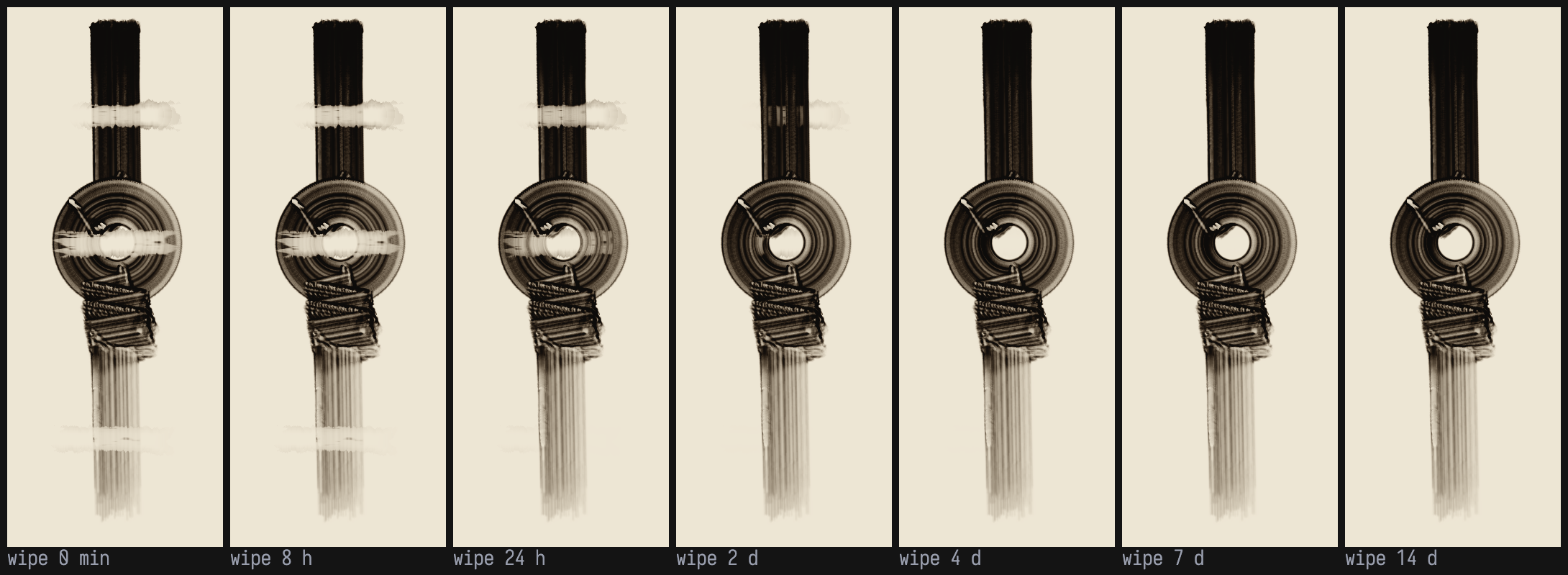
drying speeds or slows the paint's drying. Each stroke here is wiped 8 hours after it was
painted: at the usual rate the paint is still open; four times as fast and it has begun to set; from
sixteen times the wipes do not show.
:::static
:::fold the gesture, and a column of it painted with settings `s`
// what every column starts from: the black of the Elegy above
data class Settings(
    val stiffness: Double = 0.5,
    val ragged: Double = 0.5,
    val splay: Double = 0.0,
    val lay: Double = 0.8,
    val run: Double = 1100.0,
    val pickup: Double? = null,
    val push: Double? = null,
    val hairs: Int = 48,
    val bristles: Int? = null,
    val stiff: Double = 0.5,
    val thinner: Double = 0.0,
    val oil: Double = 1.5,
    val amount: Double = 0.5,
    val hiding: Double = 0.65,
    val tilt: Double = 30.0,
    val faster: Double = 1.0,
    val facets: Double? = null,
    val moving: Boolean = true,
    val width: Double = 200.0,
    val hair: Double? = null,
    val cohesion: Double? = null,
    val clumping: Double? = null,
    val splayFan: Double? = null,
    val splayScatter: Double? = null,
    val drying: Double = 1.0,
    val absorbent: Double = 0.0,
    val lamp: Boolean = false,
    val wipeAfter: Double? = null,
    val dry: Boolean = false,
)

// A canvas 50 cm wide and 1.25 m tall; the default brush is 10 cm wide.
fun canvas() = PaintCanvas(300, aspect = 0.4, groundColor = rgb(0.93, 0.9, 0.83), sizeMm = 500.0, seed = 7)
val straight = FLine().moveTo(500, 120).lineTo(510, 900)
val loop = FLine().moveTo(510, 900).apply {
    for (i in 1..480) {
        val a = PI / 2 + 2 * PI * 1.15 * i / 480
        lineTo(510 + 190 * cos(a), 1090 - 190 * sin(a))
    }
}
val scrub = FLine().moveTo(560, 1330).apply {
    for (i in 0 until 5) {
        lineTo(if (i % 2 == 0) 380.0 else 640.0, 1375.0 + 45 * i)
    }
}
val last =
    [1600.0, 1800.0, 2000.0, 2200.0, 2400.0].zipWithNext().mapIndexed { k, (y0, y1) ->
        FLine().moveTo(500.0 + 4 * k, y0).lineTo(504.0 + 4 * k, y1)
    }

// a long straight, a loop that crosses itself, a scrub back and forth, and a last straight in four
// pieces, each faster and lighter: 100, 200, 350, then 600 mm/s, lifting off the canvas at the end
fun gesture(c: PaintCanvas, s: Settings): TimedGesture {
    fun part(line: FLine, speed: Double, vararg pressure: Double) =
        c.gesture(line, speed = speed, pressure = pressure.toList(), tilt = s.tilt, facets = s.facets)
    var g =
        part(straight, 250.0, 0.8, 1.0, 1.0).then(part(loop, 250.0, 1.0, 0.9)).pause(0.1).then(part(scrub, 300.0, 1.1))
    val press = [1.0, 0.8, 0.6, 0.3, -0.2]
    for ((k, speed) in [100.0, 200.0, 350.0, 600.0].withIndex()) g =
        g.then(part(last[k], speed, press[k], press[k + 1]))
    return g.faster(s.faster)
}

fun column(label: String, s: Settings): Pair<String, Img> {
    val c = canvas()
    try {
        if (s.absorbent > 0.0) c.prime(rgb(0.93, 0.9, 0.83), texture = 0.0, absorbent = s.absorbent)
        val config = BrushConfig(
            bristles = s.bristles,
            hair = s.hair,
            stiffness = s.stiffness,
            ragged = s.ragged,
            splay = s.splay,
            lay = s.lay,
            run = s.run,
            pickup = s.pickup,
            push = s.push,
        )
        val black = rgb(0.05, 0.045, 0.04)
        if (s.moving) {
            val brush =
                c.dynamicBrush(BrushKind.HogFlat, s.width, hairs = s.hairs, segments = 6, config = config)
                    .load(
                        black,
                        hiding = s.hiding,
                        stiff = s.stiff,
                        drying = s.drying,
                        thinner = s.thinner,
                        oil = s.oil,
                        amount = s.amount,
                    )
            brush.set(
                cohesion = s.cohesion,
                clumping = s.clumping,
                splayFan = s.splayFan,
                splayScatter = s.splayScatter,
            )
            c.stroke(gesture(c, s), brush)
        } else {
            // an ordinary brush along the same path, with the same pressures; it has no timing or tilt
            val brush =
                c.brush(BrushKind.HogFlat, s.width, config = config)
                    .load(
                        black,
                        hiding = s.hiding,
                        stiff = s.stiff,
                        drying = s.drying,
                        thinner = s.thinner,
                        oil = s.oil,
                        amount = s.amount,
                    )
            c.stroke(straight, brush, pressure = 0.8..1.0)
            c.stroke(loop, brush, pressure = 1.0..0.9)
            c.stroke(scrub, brush, pressure = 1.1..1.1)
            c.stroke(FLine().moveTo(500, 1600).lineTo(516, 2400), brush, pressure = 1.0..0.0)
        }
        // a rag wiped across the bar, the loop and the last stroke after some minutes (infinite: dry first)
        s.wipeAfter?.let { minutes ->
            if (minutes.isInfinite()) c.dry() else c.wait(minutes)
            val rag = c.rag(150.0)
            for (y in [500.0, 1090.0, 2000.0]) c.wipe(FLine().moveTo(250, y).lineTo(760, y + 10), rag, [0.8])
        }
        if (s.dry) c.dry()
        val png = if (s.lamp) c.png(relief = 0.3, light = PaintLight.Gallery) else c.png(relief = 0.3)
        return label to imgFromBytes(png)
    } finally {
        c.close()
    }
}

// the same columns twice: a row with moving hairs above a row with an ordinary brush
fun rows(cells: (moving: Boolean) -> List<Pair<String, Img>>): Img {
    val rows =
        ["moving hairs" to true, "ordinary brush" to false].map { (name, moving) ->
            val strokes = cells(moving)
            name to montage(strokes, columns = strokes.size, cellSide = 750, textScale = 3)
        }
    return montage(rows, columns = 1, cellSide = 4000, textScale = 3)
}
:::endfold
val strokes = [0.25, 1.0, 4.0, 16.0, 64.0, 256.0].map { column("drying $it", Settings(drying = it, wipeAfter = 480.0)) }
val sheet = montage(strokes, columns = strokes.size, cellSide = 750, textScale = 3)
showImg(sheet)
sheet.savePng("/tmp/field-docs-paint-sweep-drying.png")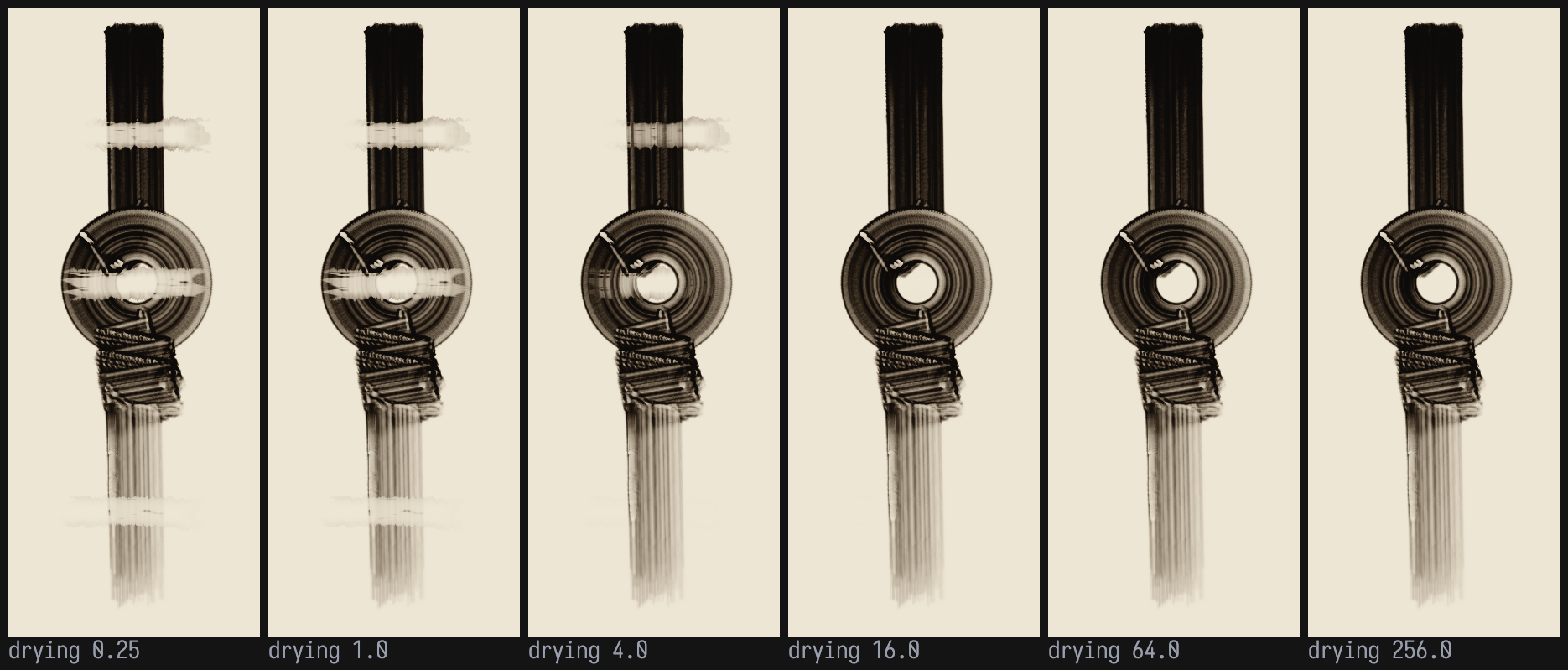
The hand
tilt is the handle's lean from upright in degrees, here past 90, where the handle leans back the
way it came.
:::static
:::fold the gesture, and a column of it painted with settings `s`
// what every column starts from: the black of the Elegy above
data class Settings(
    val stiffness: Double = 0.5,
    val ragged: Double = 0.5,
    val splay: Double = 0.0,
    val lay: Double = 0.8,
    val run: Double = 1100.0,
    val pickup: Double? = null,
    val push: Double? = null,
    val hairs: Int = 48,
    val bristles: Int? = null,
    val stiff: Double = 0.5,
    val thinner: Double = 0.0,
    val oil: Double = 1.5,
    val amount: Double = 0.5,
    val hiding: Double = 0.65,
    val tilt: Double = 30.0,
    val faster: Double = 1.0,
    val facets: Double? = null,
    val moving: Boolean = true,
    val width: Double = 200.0,
    val hair: Double? = null,
    val cohesion: Double? = null,
    val clumping: Double? = null,
    val splayFan: Double? = null,
    val splayScatter: Double? = null,
    val drying: Double = 1.0,
    val absorbent: Double = 0.0,
    val lamp: Boolean = false,
    val wipeAfter: Double? = null,
    val dry: Boolean = false,
)

// A canvas 50 cm wide and 1.25 m tall; the default brush is 10 cm wide.
fun canvas() = PaintCanvas(300, aspect = 0.4, groundColor = rgb(0.93, 0.9, 0.83), sizeMm = 500.0, seed = 7)
val straight = FLine().moveTo(500, 120).lineTo(510, 900)
val loop = FLine().moveTo(510, 900).apply {
    for (i in 1..480) {
        val a = PI / 2 + 2 * PI * 1.15 * i / 480
        lineTo(510 + 190 * cos(a), 1090 - 190 * sin(a))
    }
}
val scrub = FLine().moveTo(560, 1330).apply {
    for (i in 0 until 5) {
        lineTo(if (i % 2 == 0) 380.0 else 640.0, 1375.0 + 45 * i)
    }
}
val last =
    [1600.0, 1800.0, 2000.0, 2200.0, 2400.0].zipWithNext().mapIndexed { k, (y0, y1) ->
        FLine().moveTo(500.0 + 4 * k, y0).lineTo(504.0 + 4 * k, y1)
    }

// a long straight, a loop that crosses itself, a scrub back and forth, and a last straight in four
// pieces, each faster and lighter: 100, 200, 350, then 600 mm/s, lifting off the canvas at the end
fun gesture(c: PaintCanvas, s: Settings): TimedGesture {
    fun part(line: FLine, speed: Double, vararg pressure: Double) =
        c.gesture(line, speed = speed, pressure = pressure.toList(), tilt = s.tilt, facets = s.facets)
    var g =
        part(straight, 250.0, 0.8, 1.0, 1.0).then(part(loop, 250.0, 1.0, 0.9)).pause(0.1).then(part(scrub, 300.0, 1.1))
    val press = [1.0, 0.8, 0.6, 0.3, -0.2]
    for ((k, speed) in [100.0, 200.0, 350.0, 600.0].withIndex()) g =
        g.then(part(last[k], speed, press[k], press[k + 1]))
    return g.faster(s.faster)
}

fun column(label: String, s: Settings): Pair<String, Img> {
    val c = canvas()
    try {
        if (s.absorbent > 0.0) c.prime(rgb(0.93, 0.9, 0.83), texture = 0.0, absorbent = s.absorbent)
        val config = BrushConfig(
            bristles = s.bristles,
            hair = s.hair,
            stiffness = s.stiffness,
            ragged = s.ragged,
            splay = s.splay,
            lay = s.lay,
            run = s.run,
            pickup = s.pickup,
            push = s.push,
        )
        val black = rgb(0.05, 0.045, 0.04)
        if (s.moving) {
            val brush =
                c.dynamicBrush(BrushKind.HogFlat, s.width, hairs = s.hairs, segments = 6, config = config)
                    .load(
                        black,
                        hiding = s.hiding,
                        stiff = s.stiff,
                        drying = s.drying,
                        thinner = s.thinner,
                        oil = s.oil,
                        amount = s.amount,
                    )
            brush.set(
                cohesion = s.cohesion,
                clumping = s.clumping,
                splayFan = s.splayFan,
                splayScatter = s.splayScatter,
            )
            c.stroke(gesture(c, s), brush)
        } else {
            // an ordinary brush along the same path, with the same pressures; it has no timing or tilt
            val brush =
                c.brush(BrushKind.HogFlat, s.width, config = config)
                    .load(
                        black,
                        hiding = s.hiding,
                        stiff = s.stiff,
                        drying = s.drying,
                        thinner = s.thinner,
                        oil = s.oil,
                        amount = s.amount,
                    )
            c.stroke(straight, brush, pressure = 0.8..1.0)
            c.stroke(loop, brush, pressure = 1.0..0.9)
            c.stroke(scrub, brush, pressure = 1.1..1.1)
            c.stroke(FLine().moveTo(500, 1600).lineTo(516, 2400), brush, pressure = 1.0..0.0)
        }
        // a rag wiped across the bar, the loop and the last stroke after some minutes (infinite: dry first)
        s.wipeAfter?.let { minutes ->
            if (minutes.isInfinite()) c.dry() else c.wait(minutes)
            val rag = c.rag(150.0)
            for (y in [500.0, 1090.0, 2000.0]) c.wipe(FLine().moveTo(250, y).lineTo(760, y + 10), rag, [0.8])
        }
        if (s.dry) c.dry()
        val png = if (s.lamp) c.png(relief = 0.3, light = PaintLight.Gallery) else c.png(relief = 0.3)
        return label to imgFromBytes(png)
    } finally {
        c.close()
    }
}

// the same columns twice: a row with moving hairs above a row with an ordinary brush
fun rows(cells: (moving: Boolean) -> List<Pair<String, Img>>): Img {
    val rows =
        ["moving hairs" to true, "ordinary brush" to false].map { (name, moving) ->
            val strokes = cells(moving)
            name to montage(strokes, columns = strokes.size, cellSide = 750, textScale = 3)
        }
    return montage(rows, columns = 1, cellSide = 4000, textScale = 3)
}
:::endfold
val strokes = [0.0, 30.0, 60.0, 85.0, 120.0, 179.0].map { column("tilt $it", Settings(tilt = it)) }
val sheet = montage(strokes, columns = strokes.size, cellSide = 750, textScale = 3)
showImg(sheet)
sheet.savePng("/tmp/field-docs-paint-sweep-tilt.png")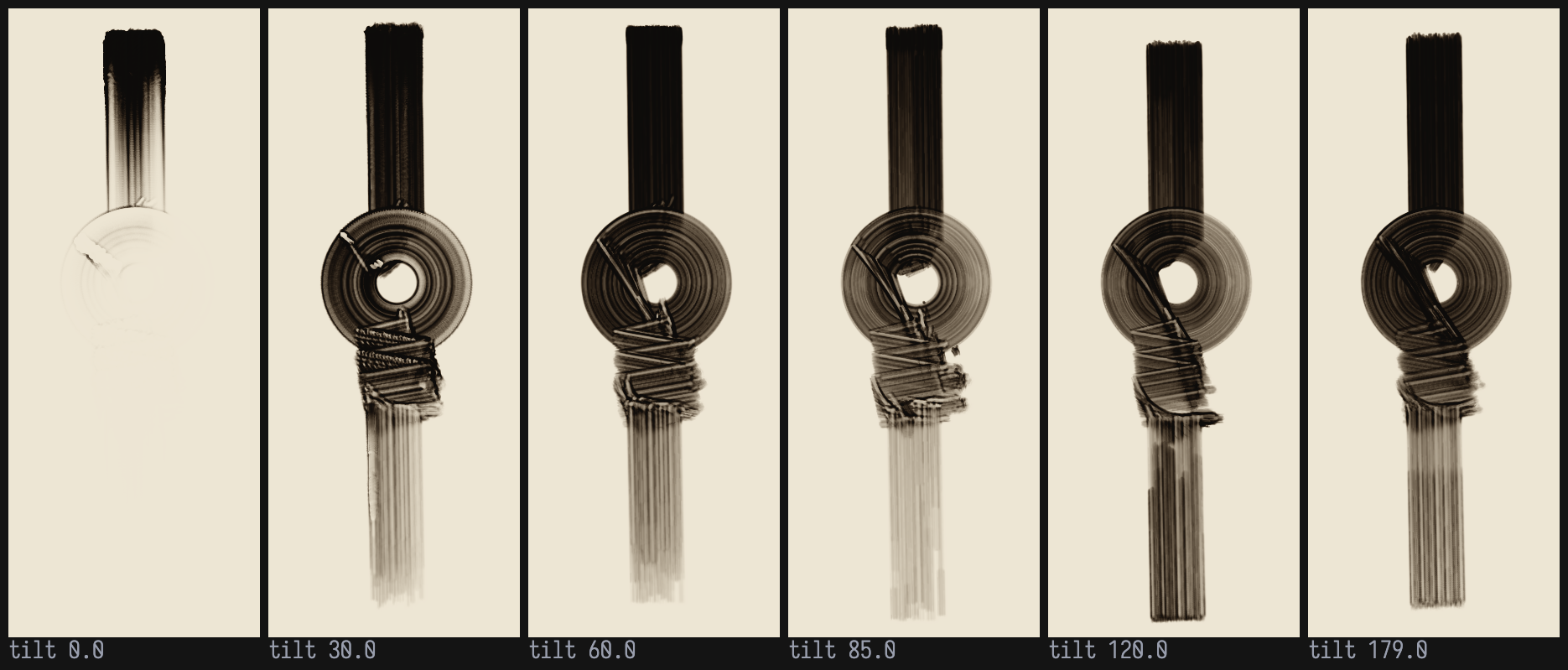
faster plays the whole gesture faster or slower, as a factor on its speed. At 16 times as fast the
hairs chatter on the last stroke; at 64 times the brush lands late and the loop is a blur.
:::static
:::fold the gesture, and a column of it painted with settings `s`
// what every column starts from: the black of the Elegy above
data class Settings(
    val stiffness: Double = 0.5,
    val ragged: Double = 0.5,
    val splay: Double = 0.0,
    val lay: Double = 0.8,
    val run: Double = 1100.0,
    val pickup: Double? = null,
    val push: Double? = null,
    val hairs: Int = 48,
    val bristles: Int? = null,
    val stiff: Double = 0.5,
    val thinner: Double = 0.0,
    val oil: Double = 1.5,
    val amount: Double = 0.5,
    val hiding: Double = 0.65,
    val tilt: Double = 30.0,
    val faster: Double = 1.0,
    val facets: Double? = null,
    val moving: Boolean = true,
    val width: Double = 200.0,
    val hair: Double? = null,
    val cohesion: Double? = null,
    val clumping: Double? = null,
    val splayFan: Double? = null,
    val splayScatter: Double? = null,
    val drying: Double = 1.0,
    val absorbent: Double = 0.0,
    val lamp: Boolean = false,
    val wipeAfter: Double? = null,
    val dry: Boolean = false,
)

// A canvas 50 cm wide and 1.25 m tall; the default brush is 10 cm wide.
fun canvas() = PaintCanvas(300, aspect = 0.4, groundColor = rgb(0.93, 0.9, 0.83), sizeMm = 500.0, seed = 7)
val straight = FLine().moveTo(500, 120).lineTo(510, 900)
val loop = FLine().moveTo(510, 900).apply {
    for (i in 1..480) {
        val a = PI / 2 + 2 * PI * 1.15 * i / 480
        lineTo(510 + 190 * cos(a), 1090 - 190 * sin(a))
    }
}
val scrub = FLine().moveTo(560, 1330).apply {
    for (i in 0 until 5) {
        lineTo(if (i % 2 == 0) 380.0 else 640.0, 1375.0 + 45 * i)
    }
}
val last =
    [1600.0, 1800.0, 2000.0, 2200.0, 2400.0].zipWithNext().mapIndexed { k, (y0, y1) ->
        FLine().moveTo(500.0 + 4 * k, y0).lineTo(504.0 + 4 * k, y1)
    }

// a long straight, a loop that crosses itself, a scrub back and forth, and a last straight in four
// pieces, each faster and lighter: 100, 200, 350, then 600 mm/s, lifting off the canvas at the end
fun gesture(c: PaintCanvas, s: Settings): TimedGesture {
    fun part(line: FLine, speed: Double, vararg pressure: Double) =
        c.gesture(line, speed = speed, pressure = pressure.toList(), tilt = s.tilt, facets = s.facets)
    var g =
        part(straight, 250.0, 0.8, 1.0, 1.0).then(part(loop, 250.0, 1.0, 0.9)).pause(0.1).then(part(scrub, 300.0, 1.1))
    val press = [1.0, 0.8, 0.6, 0.3, -0.2]
    for ((k, speed) in [100.0, 200.0, 350.0, 600.0].withIndex()) g =
        g.then(part(last[k], speed, press[k], press[k + 1]))
    return g.faster(s.faster)
}

fun column(label: String, s: Settings): Pair<String, Img> {
    val c = canvas()
    try {
        if (s.absorbent > 0.0) c.prime(rgb(0.93, 0.9, 0.83), texture = 0.0, absorbent = s.absorbent)
        val config = BrushConfig(
            bristles = s.bristles,
            hair = s.hair,
            stiffness = s.stiffness,
            ragged = s.ragged,
            splay = s.splay,
            lay = s.lay,
            run = s.run,
            pickup = s.pickup,
            push = s.push,
        )
        val black = rgb(0.05, 0.045, 0.04)
        if (s.moving) {
            val brush =
                c.dynamicBrush(BrushKind.HogFlat, s.width, hairs = s.hairs, segments = 6, config = config)
                    .load(
                        black,
                        hiding = s.hiding,
                        stiff = s.stiff,
                        drying = s.drying,
                        thinner = s.thinner,
                        oil = s.oil,
                        amount = s.amount,
                    )
            brush.set(
                cohesion = s.cohesion,
                clumping = s.clumping,
                splayFan = s.splayFan,
                splayScatter = s.splayScatter,
            )
            c.stroke(gesture(c, s), brush)
        } else {
            // an ordinary brush along the same path, with the same pressures; it has no timing or tilt
            val brush =
                c.brush(BrushKind.HogFlat, s.width, config = config)
                    .load(
                        black,
                        hiding = s.hiding,
                        stiff = s.stiff,
                        drying = s.drying,
                        thinner = s.thinner,
                        oil = s.oil,
                        amount = s.amount,
                    )
            c.stroke(straight, brush, pressure = 0.8..1.0)
            c.stroke(loop, brush, pressure = 1.0..0.9)
            c.stroke(scrub, brush, pressure = 1.1..1.1)
            c.stroke(FLine().moveTo(500, 1600).lineTo(516, 2400), brush, pressure = 1.0..0.0)
        }
        // a rag wiped across the bar, the loop and the last stroke after some minutes (infinite: dry first)
        s.wipeAfter?.let { minutes ->
            if (minutes.isInfinite()) c.dry() else c.wait(minutes)
            val rag = c.rag(150.0)
            for (y in [500.0, 1090.0, 2000.0]) c.wipe(FLine().moveTo(250, y).lineTo(760, y + 10), rag, [0.8])
        }
        if (s.dry) c.dry()
        val png = if (s.lamp) c.png(relief = 0.3, light = PaintLight.Gallery) else c.png(relief = 0.3)
        return label to imgFromBytes(png)
    } finally {
        c.close()
    }
}

// the same columns twice: a row with moving hairs above a row with an ordinary brush
fun rows(cells: (moving: Boolean) -> List<Pair<String, Img>>): Img {
    val rows =
        ["moving hairs" to true, "ordinary brush" to false].map { (name, moving) ->
            val strokes = cells(moving)
            name to montage(strokes, columns = strokes.size, cellSide = 750, textScale = 3)
        }
    return montage(rows, columns = 1, cellSide = 4000, textScale = 3)
}
:::endfold
val strokes = [0.0625, 0.25, 1.0, 4.0, 16.0, 64.0].map { column("speed × $it", Settings(faster = it)) }
val sheet = montage(strokes, columns = strokes.size, cellSide = 750, textScale = 3)
showImg(sheet)
sheet.savePng("/tmp/field-docs-paint-sweep-faster.png")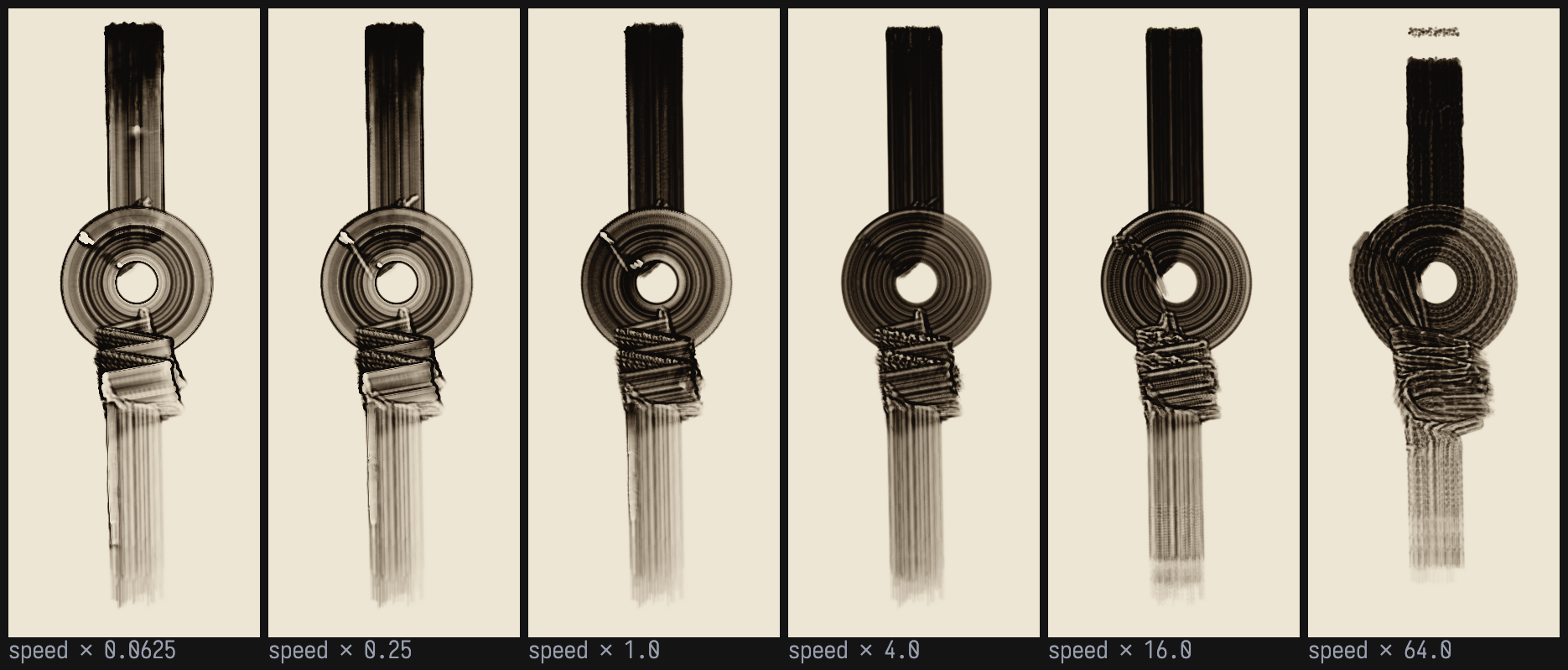
facets makes the hand move in straight chords of that length instead of following the curve. At
each corner the handle turns at once and the hairs whip round: with long chords the loop is a
polygon with beaded corners.
:::static
:::fold the gesture, and a column of it painted with settings `s`
// what every column starts from: the black of the Elegy above
data class Settings(
    val stiffness: Double = 0.5,
    val ragged: Double = 0.5,
    val splay: Double = 0.0,
    val lay: Double = 0.8,
    val run: Double = 1100.0,
    val pickup: Double? = null,
    val push: Double? = null,
    val hairs: Int = 48,
    val bristles: Int? = null,
    val stiff: Double = 0.5,
    val thinner: Double = 0.0,
    val oil: Double = 1.5,
    val amount: Double = 0.5,
    val hiding: Double = 0.65,
    val tilt: Double = 30.0,
    val faster: Double = 1.0,
    val facets: Double? = null,
    val moving: Boolean = true,
    val width: Double = 200.0,
    val hair: Double? = null,
    val cohesion: Double? = null,
    val clumping: Double? = null,
    val splayFan: Double? = null,
    val splayScatter: Double? = null,
    val drying: Double = 1.0,
    val absorbent: Double = 0.0,
    val lamp: Boolean = false,
    val wipeAfter: Double? = null,
    val dry: Boolean = false,
)

// A canvas 50 cm wide and 1.25 m tall; the default brush is 10 cm wide.
fun canvas() = PaintCanvas(300, aspect = 0.4, groundColor = rgb(0.93, 0.9, 0.83), sizeMm = 500.0, seed = 7)
val straight = FLine().moveTo(500, 120).lineTo(510, 900)
val loop = FLine().moveTo(510, 900).apply {
    for (i in 1..480) {
        val a = PI / 2 + 2 * PI * 1.15 * i / 480
        lineTo(510 + 190 * cos(a), 1090 - 190 * sin(a))
    }
}
val scrub = FLine().moveTo(560, 1330).apply {
    for (i in 0 until 5) {
        lineTo(if (i % 2 == 0) 380.0 else 640.0, 1375.0 + 45 * i)
    }
}
val last =
    [1600.0, 1800.0, 2000.0, 2200.0, 2400.0].zipWithNext().mapIndexed { k, (y0, y1) ->
        FLine().moveTo(500.0 + 4 * k, y0).lineTo(504.0 + 4 * k, y1)
    }

// a long straight, a loop that crosses itself, a scrub back and forth, and a last straight in four
// pieces, each faster and lighter: 100, 200, 350, then 600 mm/s, lifting off the canvas at the end
fun gesture(c: PaintCanvas, s: Settings): TimedGesture {
    fun part(line: FLine, speed: Double, vararg pressure: Double) =
        c.gesture(line, speed = speed, pressure = pressure.toList(), tilt = s.tilt, facets = s.facets)
    var g =
        part(straight, 250.0, 0.8, 1.0, 1.0).then(part(loop, 250.0, 1.0, 0.9)).pause(0.1).then(part(scrub, 300.0, 1.1))
    val press = [1.0, 0.8, 0.6, 0.3, -0.2]
    for ((k, speed) in [100.0, 200.0, 350.0, 600.0].withIndex()) g =
        g.then(part(last[k], speed, press[k], press[k + 1]))
    return g.faster(s.faster)
}

fun column(label: String, s: Settings): Pair<String, Img> {
    val c = canvas()
    try {
        if (s.absorbent > 0.0) c.prime(rgb(0.93, 0.9, 0.83), texture = 0.0, absorbent = s.absorbent)
        val config = BrushConfig(
            bristles = s.bristles,
            hair = s.hair,
            stiffness = s.stiffness,
            ragged = s.ragged,
            splay = s.splay,
            lay = s.lay,
            run = s.run,
            pickup = s.pickup,
            push = s.push,
        )
        val black = rgb(0.05, 0.045, 0.04)
        if (s.moving) {
            val brush =
                c.dynamicBrush(BrushKind.HogFlat, s.width, hairs = s.hairs, segments = 6, config = config)
                    .load(
                        black,
                        hiding = s.hiding,
                        stiff = s.stiff,
                        drying = s.drying,
                        thinner = s.thinner,
                        oil = s.oil,
                        amount = s.amount,
                    )
            brush.set(
                cohesion = s.cohesion,
                clumping = s.clumping,
                splayFan = s.splayFan,
                splayScatter = s.splayScatter,
            )
            c.stroke(gesture(c, s), brush)
        } else {
            // an ordinary brush along the same path, with the same pressures; it has no timing or tilt
            val brush =
                c.brush(BrushKind.HogFlat, s.width, config = config)
                    .load(
                        black,
                        hiding = s.hiding,
                        stiff = s.stiff,
                        drying = s.drying,
                        thinner = s.thinner,
                        oil = s.oil,
                        amount = s.amount,
                    )
            c.stroke(straight, brush, pressure = 0.8..1.0)
            c.stroke(loop, brush, pressure = 1.0..0.9)
            c.stroke(scrub, brush, pressure = 1.1..1.1)
            c.stroke(FLine().moveTo(500, 1600).lineTo(516, 2400), brush, pressure = 1.0..0.0)
        }
        // a rag wiped across the bar, the loop and the last stroke after some minutes (infinite: dry first)
        s.wipeAfter?.let { minutes ->
            if (minutes.isInfinite()) c.dry() else c.wait(minutes)
            val rag = c.rag(150.0)
            for (y in [500.0, 1090.0, 2000.0]) c.wipe(FLine().moveTo(250, y).lineTo(760, y + 10), rag, [0.8])
        }
        if (s.dry) c.dry()
        val png = if (s.lamp) c.png(relief = 0.3, light = PaintLight.Gallery) else c.png(relief = 0.3)
        return label to imgFromBytes(png)
    } finally {
        c.close()
    }
}

// the same columns twice: a row with moving hairs above a row with an ordinary brush
fun rows(cells: (moving: Boolean) -> List<Pair<String, Img>>): Img {
    val rows =
        ["moving hairs" to true, "ordinary brush" to false].map { (name, moving) ->
            val strokes = cells(moving)
            name to montage(strokes, columns = strokes.size, cellSide = 750, textScale = 3)
        }
    return montage(rows, columns = 1, cellSide = 4000, textScale = 3)
}
:::endfold
val strokes = [null, 200.0, 60.0, 20.0, 6.0, 2.0].map {
    column(if (it == null) "smooth" else "facets ${it.toInt()}", Settings(facets = it))
}
val sheet = montage(strokes, columns = strokes.size, cellSide = 750, textScale = 3)
showImg(sheet)
sheet.savePng("/tmp/field-docs-paint-sweep-facets.png")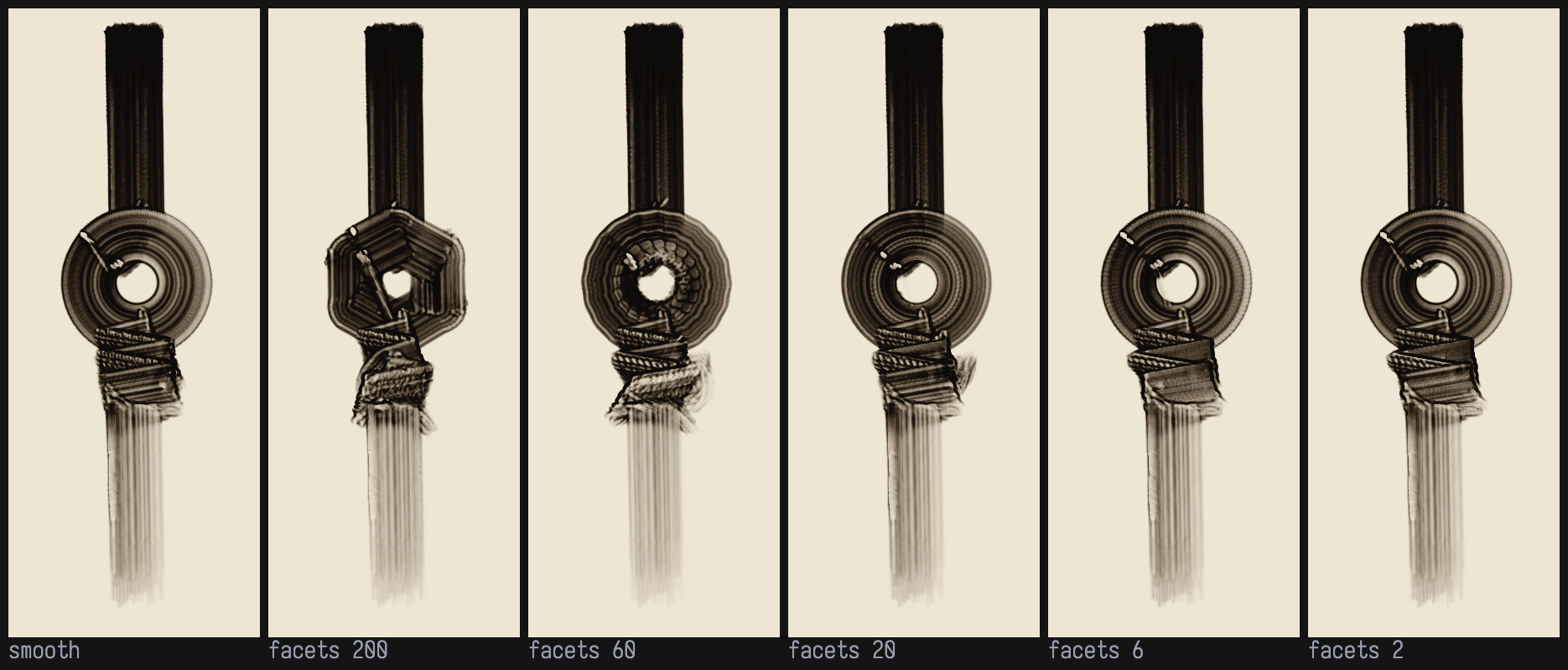
Last, the moving brush beside an ordinary one along the same path with the same pressures. The ordinary brush has no timing and no tilt: its loop is smooth, and its last stroke narrows to a point as the pressure falls, where the moving brush stays wide and breaks up.
:::static
:::fold the gesture, and a column of it painted with settings `s`
// what every column starts from: the black of the Elegy above
data class Settings(
    val stiffness: Double = 0.5,
    val ragged: Double = 0.5,
    val splay: Double = 0.0,
    val lay: Double = 0.8,
    val run: Double = 1100.0,
    val pickup: Double? = null,
    val push: Double? = null,
    val hairs: Int = 48,
    val bristles: Int? = null,
    val stiff: Double = 0.5,
    val thinner: Double = 0.0,
    val oil: Double = 1.5,
    val amount: Double = 0.5,
    val hiding: Double = 0.65,
    val tilt: Double = 30.0,
    val faster: Double = 1.0,
    val facets: Double? = null,
    val moving: Boolean = true,
    val width: Double = 200.0,
    val hair: Double? = null,
    val cohesion: Double? = null,
    val clumping: Double? = null,
    val splayFan: Double? = null,
    val splayScatter: Double? = null,
    val drying: Double = 1.0,
    val absorbent: Double = 0.0,
    val lamp: Boolean = false,
    val wipeAfter: Double? = null,
    val dry: Boolean = false,
)

// A canvas 50 cm wide and 1.25 m tall; the default brush is 10 cm wide.
fun canvas() = PaintCanvas(300, aspect = 0.4, groundColor = rgb(0.93, 0.9, 0.83), sizeMm = 500.0, seed = 7)
val straight = FLine().moveTo(500, 120).lineTo(510, 900)
val loop = FLine().moveTo(510, 900).apply {
    for (i in 1..480) {
        val a = PI / 2 + 2 * PI * 1.15 * i / 480
        lineTo(510 + 190 * cos(a), 1090 - 190 * sin(a))
    }
}
val scrub = FLine().moveTo(560, 1330).apply {
    for (i in 0 until 5) {
        lineTo(if (i % 2 == 0) 380.0 else 640.0, 1375.0 + 45 * i)
    }
}
val last =
    [1600.0, 1800.0, 2000.0, 2200.0, 2400.0].zipWithNext().mapIndexed { k, (y0, y1) ->
        FLine().moveTo(500.0 + 4 * k, y0).lineTo(504.0 + 4 * k, y1)
    }

// a long straight, a loop that crosses itself, a scrub back and forth, and a last straight in four
// pieces, each faster and lighter: 100, 200, 350, then 600 mm/s, lifting off the canvas at the end
fun gesture(c: PaintCanvas, s: Settings): TimedGesture {
    fun part(line: FLine, speed: Double, vararg pressure: Double) =
        c.gesture(line, speed = speed, pressure = pressure.toList(), tilt = s.tilt, facets = s.facets)
    var g =
        part(straight, 250.0, 0.8, 1.0, 1.0).then(part(loop, 250.0, 1.0, 0.9)).pause(0.1).then(part(scrub, 300.0, 1.1))
    val press = [1.0, 0.8, 0.6, 0.3, -0.2]
    for ((k, speed) in [100.0, 200.0, 350.0, 600.0].withIndex()) g =
        g.then(part(last[k], speed, press[k], press[k + 1]))
    return g.faster(s.faster)
}

fun column(label: String, s: Settings): Pair<String, Img> {
    val c = canvas()
    try {
        if (s.absorbent > 0.0) c.prime(rgb(0.93, 0.9, 0.83), texture = 0.0, absorbent = s.absorbent)
        val config = BrushConfig(
            bristles = s.bristles,
            hair = s.hair,
            stiffness = s.stiffness,
            ragged = s.ragged,
            splay = s.splay,
            lay = s.lay,
            run = s.run,
            pickup = s.pickup,
            push = s.push,
        )
        val black = rgb(0.05, 0.045, 0.04)
        if (s.moving) {
            val brush =
                c.dynamicBrush(BrushKind.HogFlat, s.width, hairs = s.hairs, segments = 6, config = config)
                    .load(
                        black,
                        hiding = s.hiding,
                        stiff = s.stiff,
                        drying = s.drying,
                        thinner = s.thinner,
                        oil = s.oil,
                        amount = s.amount,
                    )
            brush.set(
                cohesion = s.cohesion,
                clumping = s.clumping,
                splayFan = s.splayFan,
                splayScatter = s.splayScatter,
            )
            c.stroke(gesture(c, s), brush)
        } else {
            // an ordinary brush along the same path, with the same pressures; it has no timing or tilt
            val brush =
                c.brush(BrushKind.HogFlat, s.width, config = config)
                    .load(
                        black,
                        hiding = s.hiding,
                        stiff = s.stiff,
                        drying = s.drying,
                        thinner = s.thinner,
                        oil = s.oil,
                        amount = s.amount,
                    )
            c.stroke(straight, brush, pressure = 0.8..1.0)
            c.stroke(loop, brush, pressure = 1.0..0.9)
            c.stroke(scrub, brush, pressure = 1.1..1.1)
            c.stroke(FLine().moveTo(500, 1600).lineTo(516, 2400), brush, pressure = 1.0..0.0)
        }
        // a rag wiped across the bar, the loop and the last stroke after some minutes (infinite: dry first)
        s.wipeAfter?.let { minutes ->
            if (minutes.isInfinite()) c.dry() else c.wait(minutes)
            val rag = c.rag(150.0)
            for (y in [500.0, 1090.0, 2000.0]) c.wipe(FLine().moveTo(250, y).lineTo(760, y + 10), rag, [0.8])
        }
        if (s.dry) c.dry()
        val png = if (s.lamp) c.png(relief = 0.3, light = PaintLight.Gallery) else c.png(relief = 0.3)
        return label to imgFromBytes(png)
    } finally {
        c.close()
    }
}

// the same columns twice: a row with moving hairs above a row with an ordinary brush
fun rows(cells: (moving: Boolean) -> List<Pair<String, Img>>): Img {
    val rows =
        ["moving hairs" to true, "ordinary brush" to false].map { (name, moving) ->
            val strokes = cells(moving)
            name to montage(strokes, columns = strokes.size, cellSide = 750, textScale = 3)
        }
    return montage(rows, columns = 1, cellSide = 4000, textScale = 3)
}
:::endfold
val strokes = [column("moving hairs", Settings()), column("ordinary brush", Settings(moving = false))]
val sheet = montage(strokes, columns = strokes.size, cellSide = 750, textScale = 3)
showImg(sheet)
sheet.savePng("/tmp/field-docs-paint-sweep-moving.png")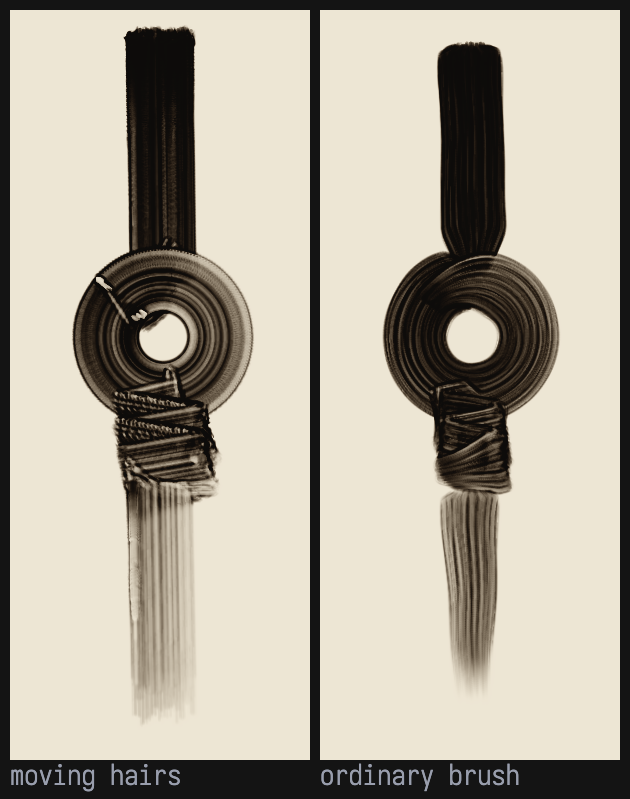
See also: Brushes with moving hairs, Paint and pencil from FLines.