Lights and Shadows
Everything we see is light that left a source, struck something, and reached an eye. This talk builds up how much light lands on a surface, and why one shadow is crisp while another is soft.
After “Lights and Shadows” by Bartosz Ciechanowski, ciechanow.ski/lights-and-shadows. Words and figures made in Field.
Follow the talk figure by figure on this page. Each figure is a box in the document: you'll see
its code and what it draws, with the slide that uses it in the margin. Open → shows the whole
document beside the page; Open in Field·4 imports an editable copy. To give the talk, run its
deck box in Field's desktop app. Live figures beside prose
shows how to build a deck like this one.
A lamp over a floor
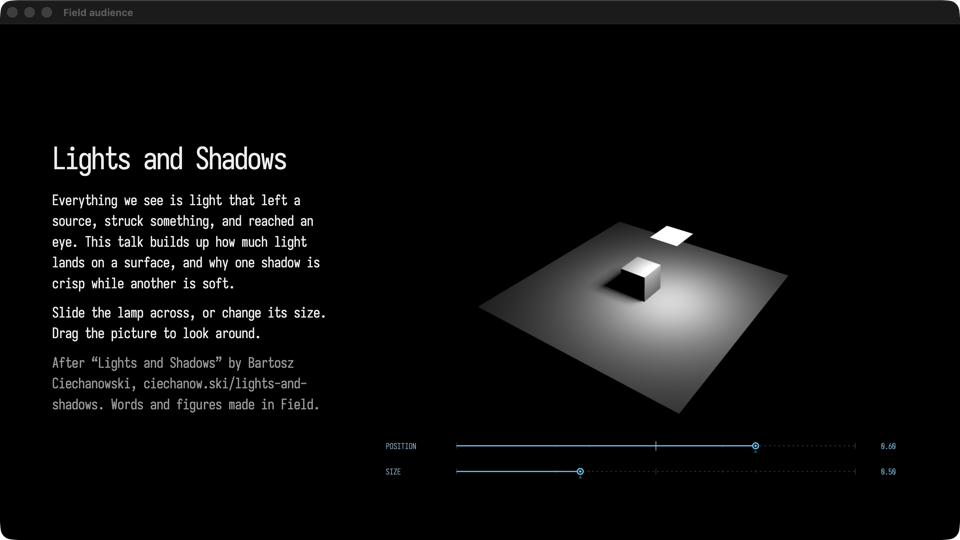
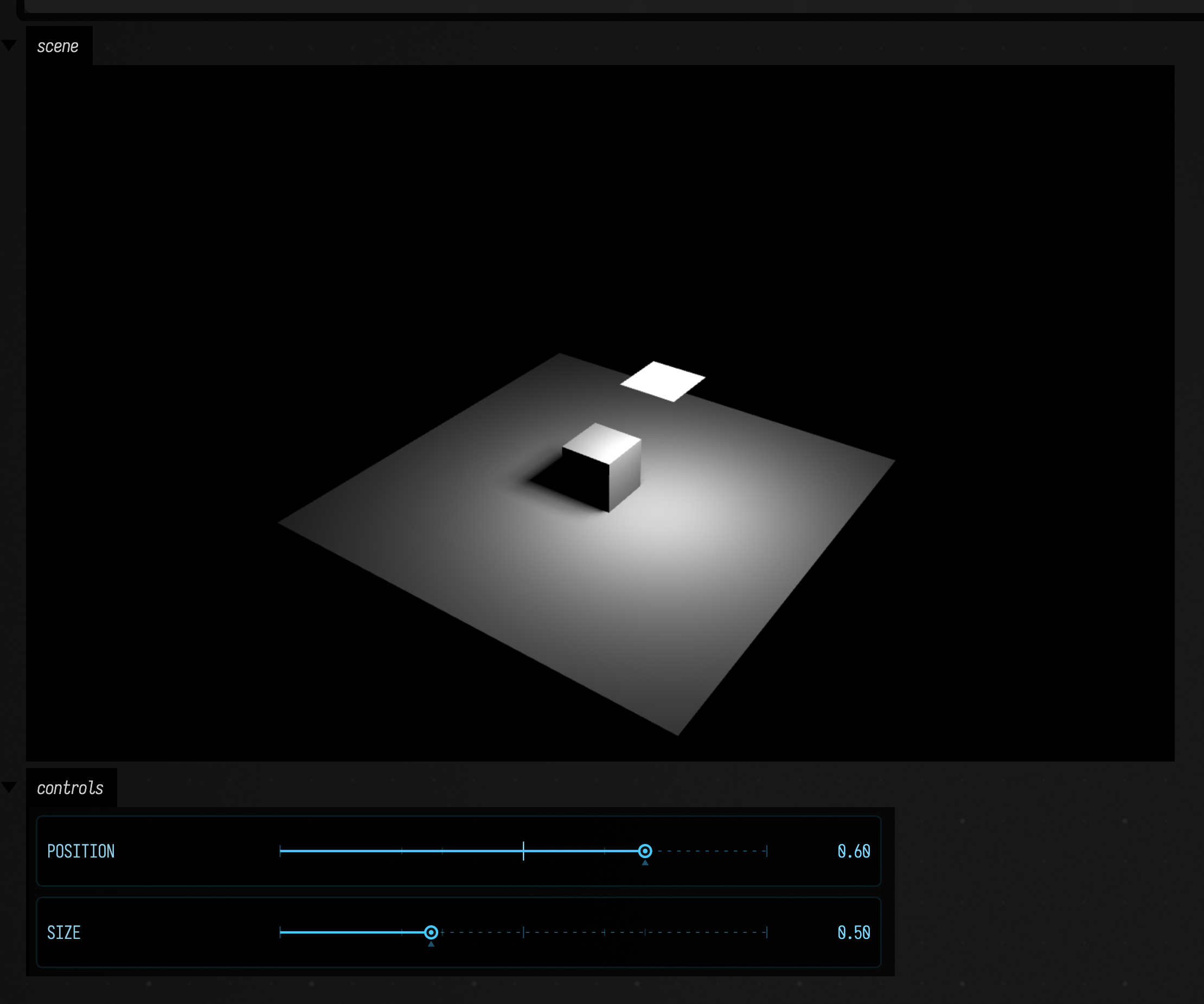
Slide the lamp across, or change its size. Drag the picture to look around.
:::fold imports
import afield.graphics.lighting.*
:::endfold

// A lamp over a floor with a block on it. The light at every vertex is computed here.
val floor = floorMesh(4.0, 4.0, divisions = 64)
val block = panelBoxMesh(0.5, 0.5, 0.5, divisions = 10).translated(0.0, 0.25, 0.0)
val scene = floor + block
var across = 0.6
var size = 0.5

fun draw() {
    val lamp = RectLight(vec(across, 1.3, 0.0), width = size, height = size, power = 30.0)
    three(channel = "scene", width = 640, height = 420) {
        // Only the block casts shadows.
        mesh(scene.lit([lamp], occluders = block, exposure = 0.5), unlit = true, wireframe = false)
        // Frame the view on the whole set, so it holds still as the lamp changes.
        fitTo(vec(-2.0, 0.0, -2.0), vec(2.0, 1.6, 2.0))
        mesh(lamp.mesh(), unlit = true, wireframe = false, cullBackFaces = false)
        camera(yaw = 35.0, pitch = 30.0, distance = 2.6)
        background("#000000")
        hud(false)
    }
}

draw()
controlGroup {
    slider("position", -1.2, 1.2, initialValue = across) {
        across = it
        draw()
    }
    slider("size", 0.05, 1.5, initialValue = size) {
        size = it
        draw()
    }
}
Power
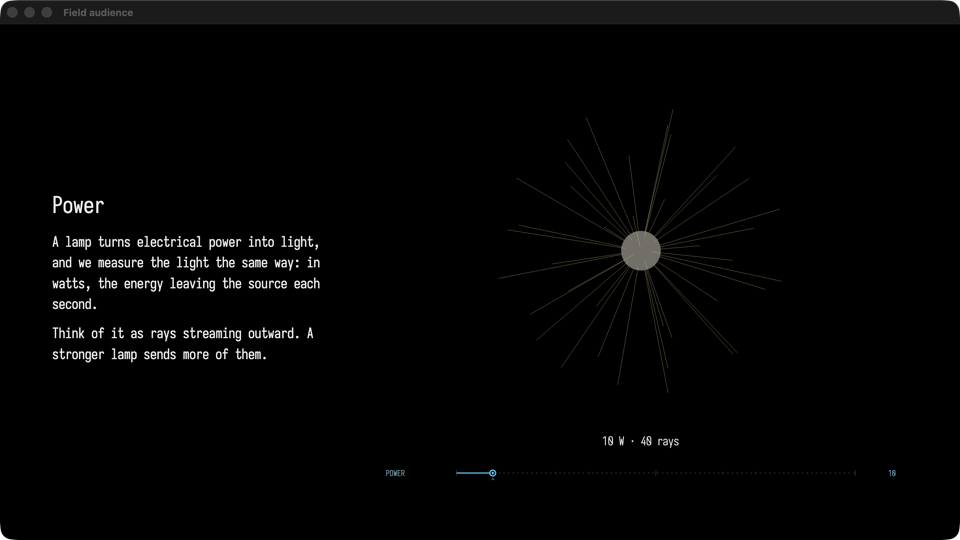
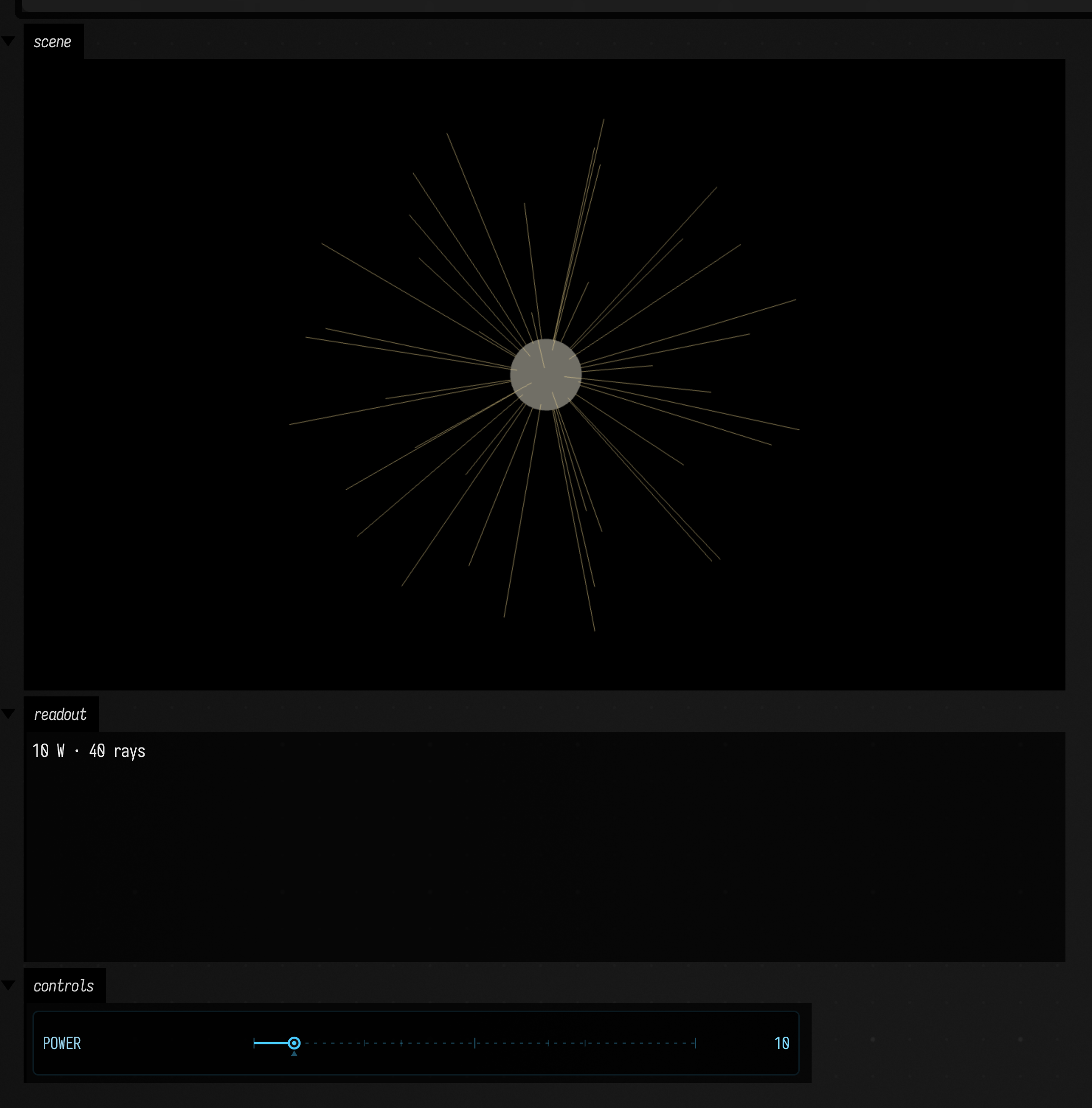
A lamp turns electrical power into light, and we measure the light the same way: in watts, the energy leaving the source each second.
Think of it as rays streaming outward. A stronger lamp sends more of them.
// A glowing ball and the light leaving it, drawn as rays: one ray for every quarter watt.
val golden = PI * (3 - sqrt(5.0))

fun draw(watts: Double) {
    val n = (watts * 4).roundToInt()
    val rays = n { i ->
        // Directions spread evenly over the sphere, each ray starting on the ball's surface.
        val y = 1 - 2 * (i + 0.5) / n
        val r = sqrt(1 - y * y)
        val d = vec(r * cos(golden * i), y, r * sin(golden * i))
        fline {
            moveTo(d.x * 0.2, d.y * 0.2, d.z * 0.2)
            lineTo(d.x * 1.4, d.y * 1.4, d.z * 1.4)
            color = vec(1.0, 0.9, 0.6, 0.5)
        }
    }
    // How bright the ball looks: its glow fills up and then stays white.
    val glow = min(1.0, watts / 60)
    three(channel = "scene", width = 640, height = 420) {
        lines(rays)
        // Frame the view on the rays' reach, not on the ball.
        fitTo(vec(-1.0, -1.0, -1.0), vec(1.0, 1.0, 1.0))
        mesh(icosphereMesh(3, 0.2).withColor(glow, glow * 0.95, glow * 0.8), unlit = true, wireframe = false)
        camera(yaw = 20.0, pitch = 15.0, distance = 2.2)
        background("#000000")
        hud(false)
        helpers(false)
    }
    markdown("readout", "${watts.roundToInt()} W · $n rays")
}

draw(10.0)
controlGroup {
    slider("power", 1.0, 100.0, step = 1.0, initialValue = 10.0) { draw(it) }
}
Brightness is not power
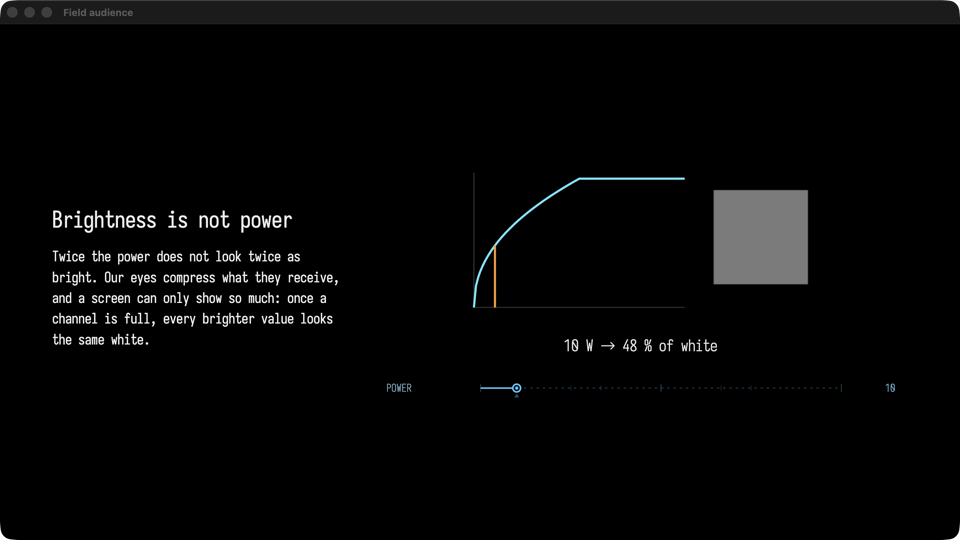
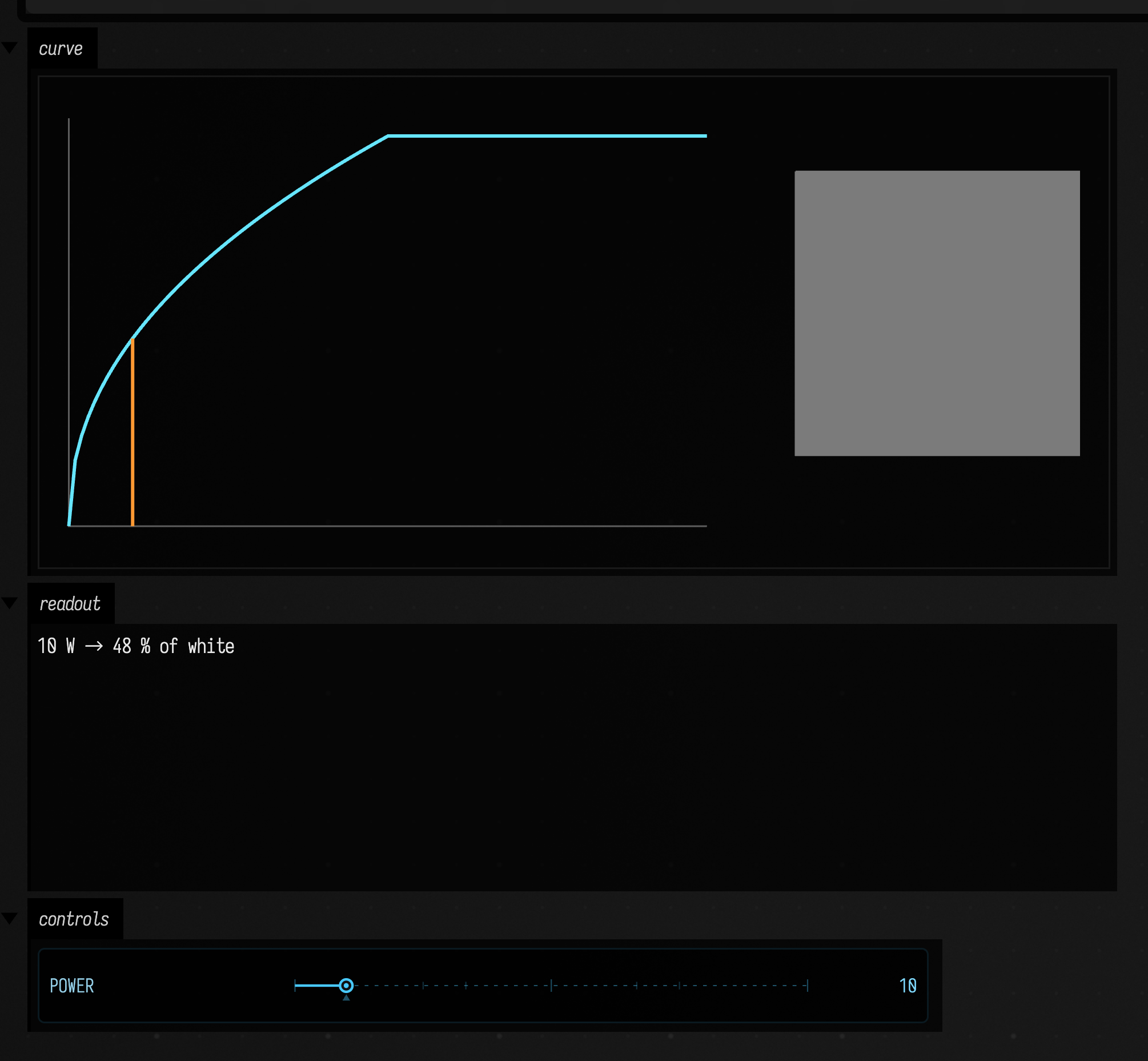
Twice the power does not look twice as bright. Our eyes compress what they receive, and a screen can only show so much: once a channel is full, every brighter value looks the same white.
// The light a patch gives off, against what a screen can show of it. The swatch is the patch;
// the curve is the brightness the screen sends, which runs out at its brightest white.
fun draw(watts: Double) {
    // A screen channel holds 0..1 of linear light, here reached at 50 W, and encodes it as sRGB.
    fun shown(w: Double) = min(1.0, w / 50).pow(1 / 2.2)
    val curve = fline {
        moveTo(40.0, 260.0)
        for (w in 1..100) lineTo(40.0 + w * 3.6, 260.0 - 220 * shown(w.toDouble()))
        thickness = 2.0
        color = vec(0.4, 0.9, 1.0, 1.0)
    }
    val axes = fline {
        moveTo(40.0, 30.0)
        lineTo(40.0, 260.0)
        lineTo(400.0, 260.0)
        color = vec(1.0, 1.0, 1.0, 0.35)
    }
    val here = fline {
        moveTo(40.0 + watts * 3.6, 260.0)
        lineTo(40.0 + watts * 3.6, 260.0 - 220 * shown(watts))
        thickness = 2.0
        color = vec(1.0, 0.6, 0.2, 1.0)
    }
    val v = shown(watts)
    val swatch = fline {
        moveTo(450.0, 60.0)
        lineTo(610.0, 60.0)
        lineTo(610.0, 220.0)
        lineTo(450.0, 220.0)
        lineTo(450.0, 60.0)
        filled = true
        color = vec(v, v, v, 1.0)
    }
    lines(axes, curve, here, swatch, channel = "curve", w = 640.0, h = 280.0)
    markdown("readout", "${watts.roundToInt()} W → ${(v * 100).roundToInt()} % of white")
}

draw(10.0)
controlGroup {
    slider("power", 0.0, 100.0, step = 1.0, initialValue = 10.0) { draw(it) }
}
Position
Light at a slant
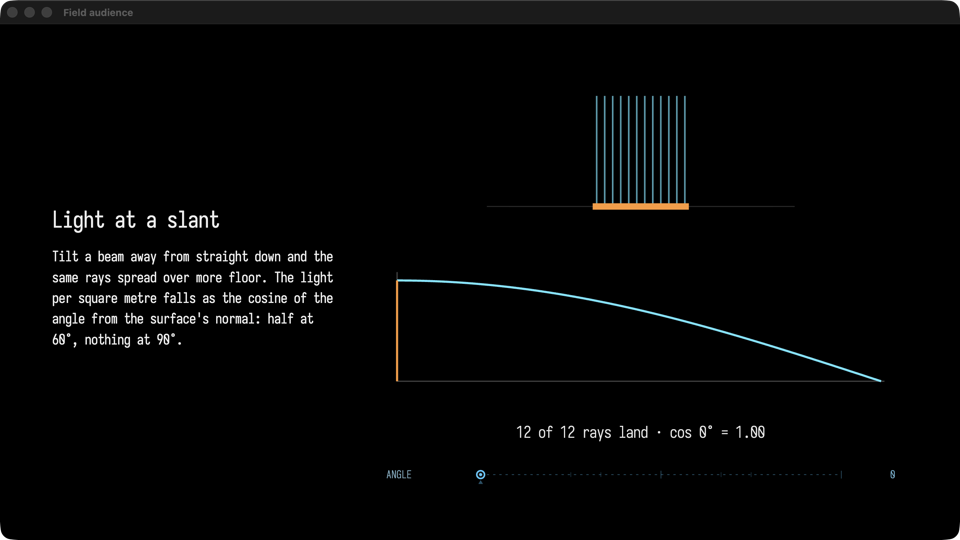
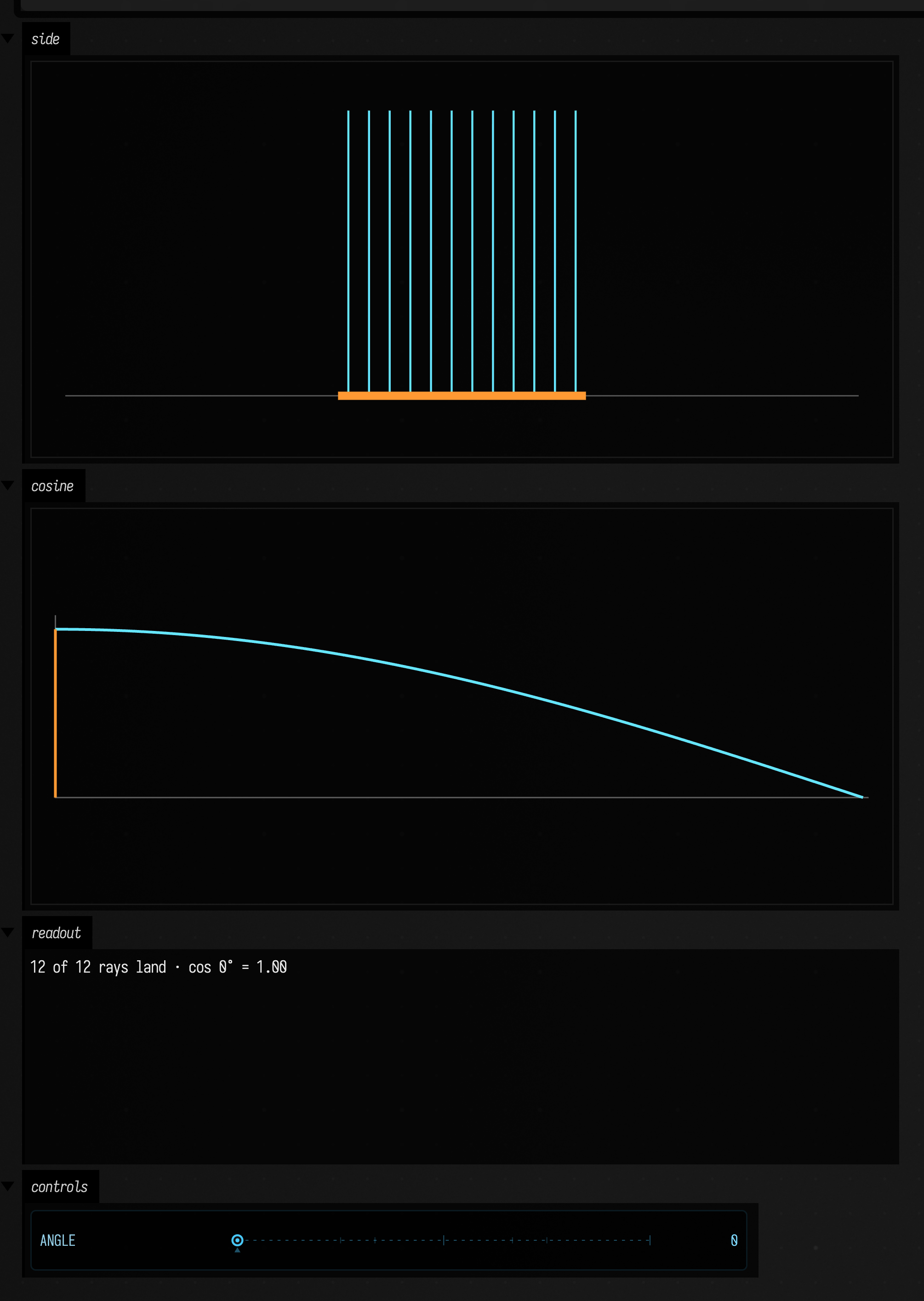
Tilt a beam away from straight down and the same rays spread over more floor. The light per square metre falls as the cosine of the angle from the surface's normal: half at 60°, nothing at 90°.
// Parallel rays falling on an orange patch of floor, seen from the side.
// Tilt them away from straight down and fewer of them land on the patch.
val rays = 12

fun draw(degrees: Double) {
    val a = degrees * PI / 180
    val across = sin(a)
    val down = cos(a)
    var landed = 0
    val drawn = mutableListOf<FLine>()
    for (i in 0 until rays) {
        // Rays sit evenly across a beam 200 pixels wide; this is where each one meets the floor.
        val x = 320 + ((i + 0.5) / rays - 0.5) * 200 / down
        val hit = abs(x - 320) <= 100
        if (hit) landed++
        // Each ray is drawn back from the floor to the top or side of the frame.
        val back = min(230 / down, if (across > 0) x / across else 1e9)
        drawn += fline {
            moveTo(x - across * back, 250 - down * back)
            lineTo(x, 250.0)
            thickness = 1.5
            color = if (hit) vec(0.4, 0.9, 1.0, 1.0) else vec(1.0, 1.0, 1.0, 0.35)
        }
    }
    drawn += fline {
        moveTo(0.0, 250.0)
        lineTo(640.0, 250.0)
        color = vec(1.0, 1.0, 1.0, 0.35)
    }
    drawn += fline {
        moveTo(220.0, 250.0)
        lineTo(420.0, 250.0)
        thickness = 6.0
        color = vec(1.0, 0.6, 0.2, 1.0)
    }
    lines(drawn, channel = "side", w = 640.0, h = 280.0, framing = LinesFraming.fixed(0.0, 0.0, 640.0, 280.0))

    // The cosine of the angle, with this angle marked.
    val curve = fline {
        moveTo(40.0, 20.0)
        for (d in 1..90) lineTo(40.0 + d * 6.4, 20.0 + 120 * (1 - cos(d * PI / 180)))
        thickness = 2.0
        color = vec(0.4, 0.9, 1.0, 1.0)
    }
    val axes = fline {
        moveTo(40.0, 10.0)
        lineTo(40.0, 140.0)
        lineTo(620.0, 140.0)
        color = vec(1.0, 1.0, 1.0, 0.35)
    }
    val here = fline {
        moveTo(40.0 + degrees * 6.4, 140.0)
        lineTo(40.0 + degrees * 6.4, 20.0 + 120 * (1 - down))
        thickness = 2.0
        color = vec(1.0, 0.6, 0.2, 1.0)
    }
    lines(axes, curve, here, channel = "cosine", w = 640.0, h = 150.0)
    markdown("readout", "$landed of $rays rays land · cos ${degrees.roundToInt()}° = ${down.f2}")
}

draw(0.0)
controlGroup {
    slider("angle", 0.0, 85.0, step = 1.0, initialValue = 0.0) { draw(it) }
}
Shape from the cosine
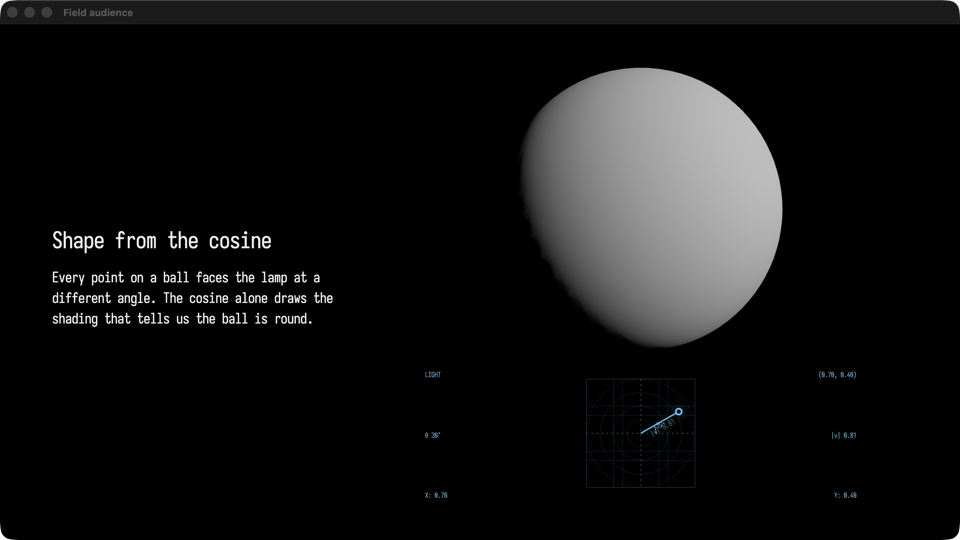
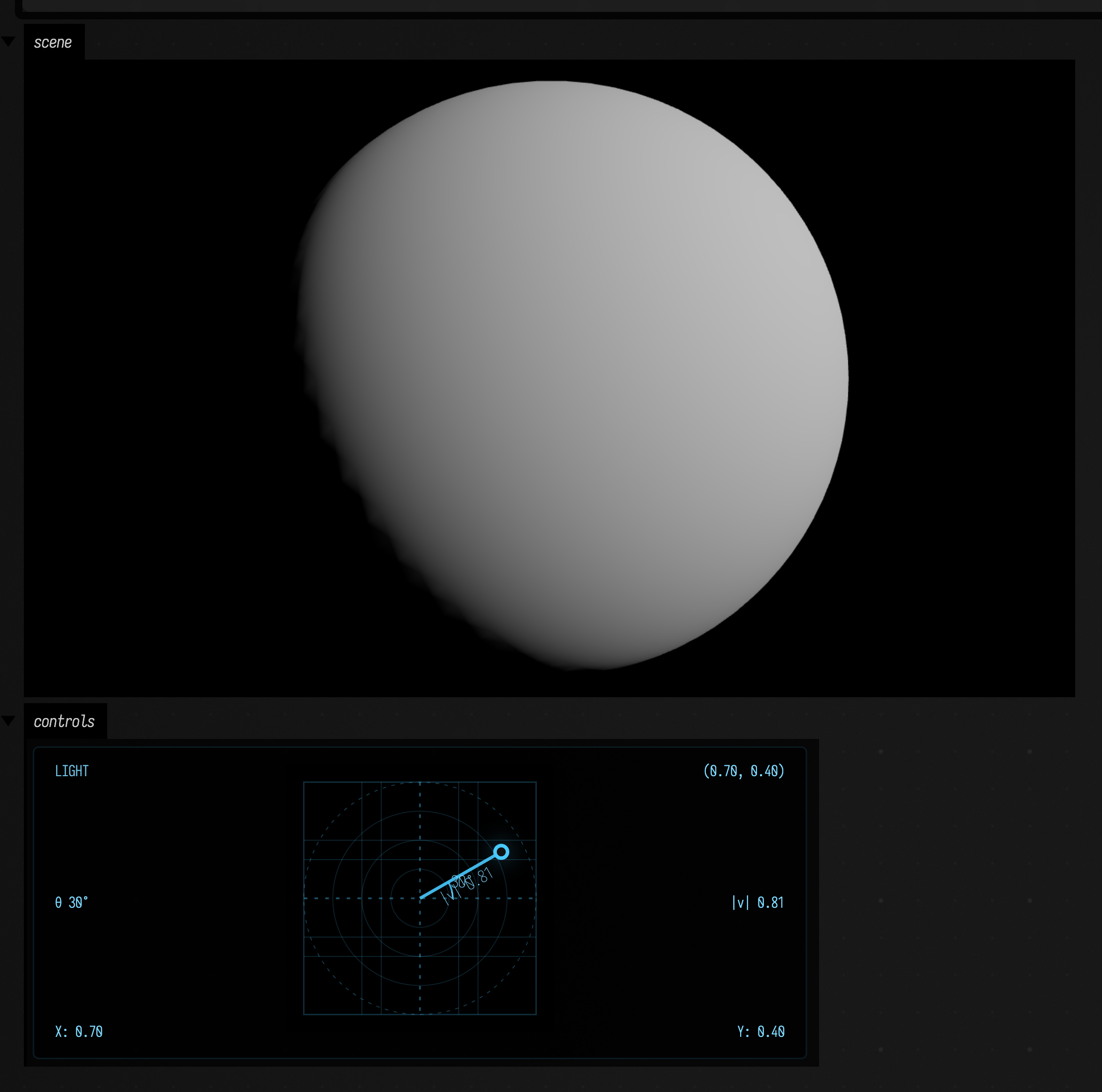
Every point on a ball faces the lamp at a different angle. The cosine alone draws the shading that tells us the ball is round.
:::fold imports
import afield.graphics.lighting.*
:::endfold

// A ball under one far-away light. Its shading is the cosine factor and nothing else.
val ball = icosphereMesh(4, 0.5)

fun draw(toward: Vec2) {
    // The control picks where the light is, seen from the camera; it sits 100 m away in that direction.
    val z = sqrt(max(0.0, 1.0 - toward.x * toward.x - toward.y * toward.y))
    val far = 100.0
    // Φ = 4π·100² W makes the irradiance one watt per square metre where the light hits head on.
    val sun = PointLight(vec(toward.x * far, toward.y * far, z * far), power = 4 * PI * far * far)
    three(channel = "scene", width = 640, height = 420) {
        mesh(ball.lit([sun], occluders = null, exposure = 2.0), unlit = true, wireframe = false)
        camera(yaw = 0.0, pitch = 0.0, distance = 2.4)
        background("#000000")
        hud(false)
    }
}

draw(vec(0.7, 0.4))
controlGroup {
    vec2Control("light", initialValue = vec(0.7, 0.4)) { draw(it) }
}
Farther away
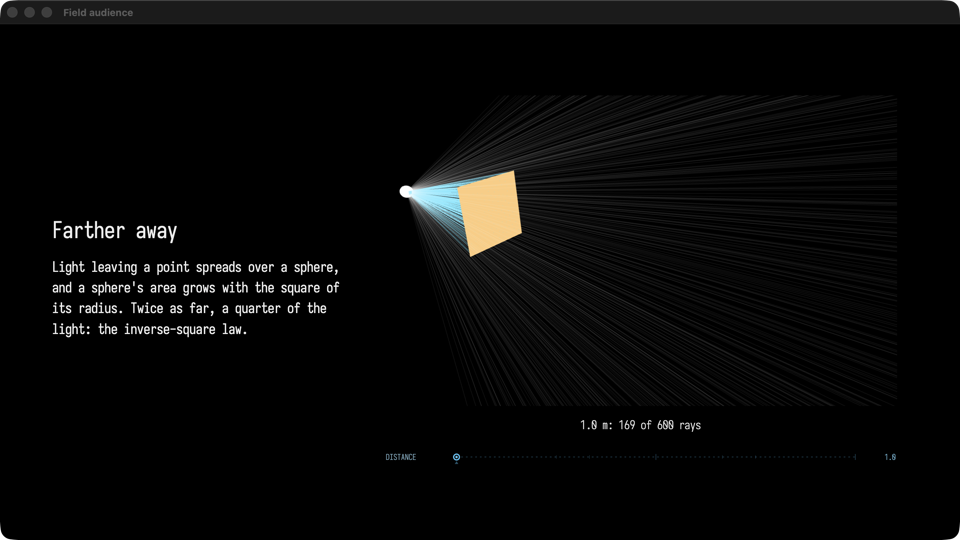
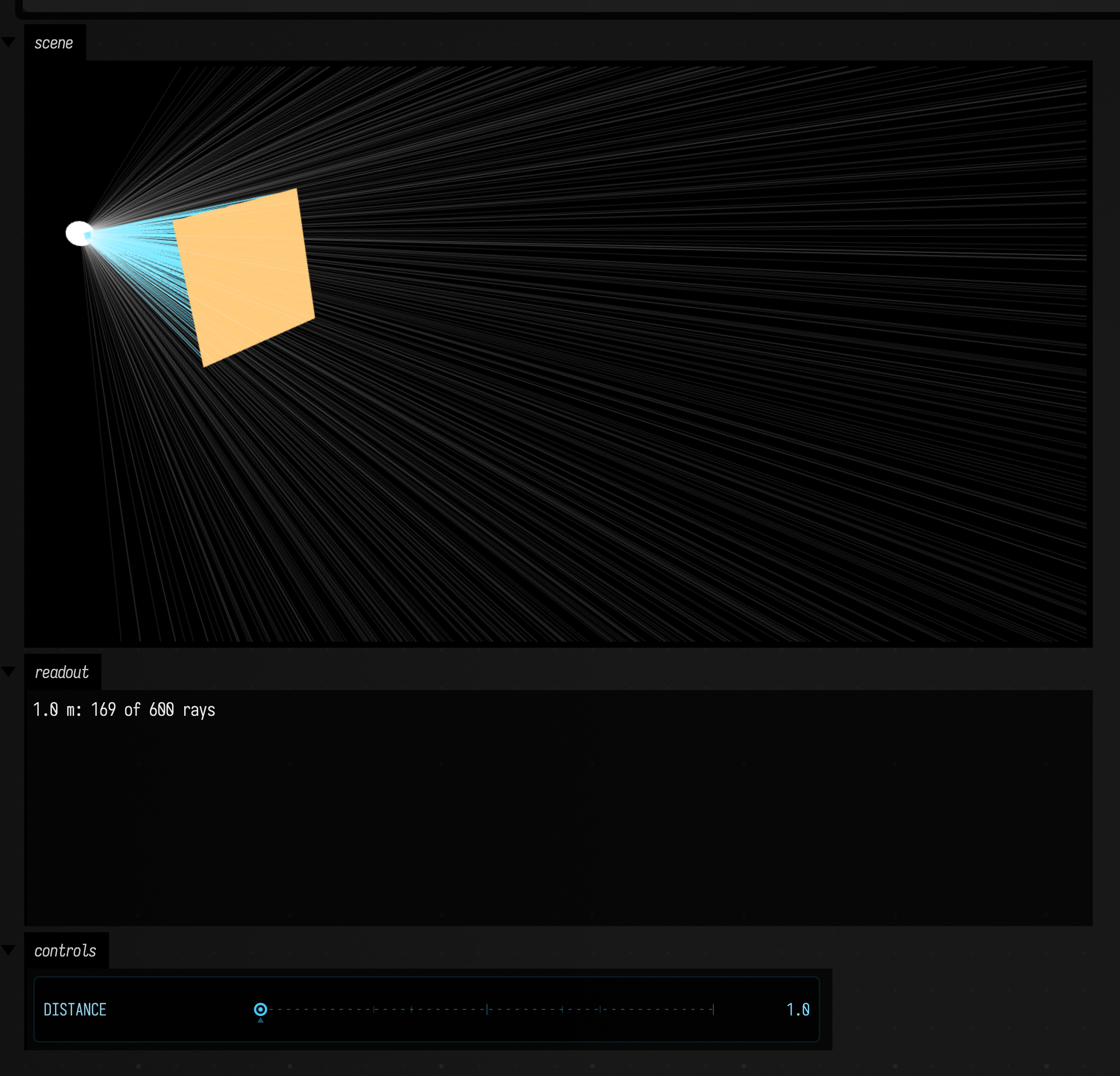
Light leaving a point spreads over a sphere, and a sphere's area grows with the square of its radius. Twice as far, a quarter of the light: the inverse-square law.
// A point light sends 600 rays into a cone. Move the square patch away and count how many reach it.
val count = 600
val golden = PI * (3 - sqrt(5.0))
// Directions spread evenly over a cone 30° around +x.
val directions = count { i ->
    val c = 1 - (1 - cos(PI / 6)) * (i + 0.5) / count
    val s = sqrt(1 - c * c)
    vec(c, s * cos(golden * i), s * sin(golden * i))
}

fun draw(distance: Double) {
    var reached = 0
    val rays = directions.map { d ->
        // Where the ray crosses the patch's plane, x = distance.
        val t = distance / d.x
        val hit = abs(t * d.y) <= 0.25 && abs(t * d.z) <= 0.25
        if (hit) reached++
        val end = if (hit) t else 4.5 / d.x
        fline {
            moveTo(0.0, 0.0, 0.0)
            lineTo(end * d.x, end * d.y, end * d.z)
            color = if (hit) vec(0.4, 0.9, 1.0, 1.0) else vec(1.0, 1.0, 1.0, 0.12)
        }
    }
    val patch =
        planeMesh(1, 1, 0.5, 0.5)
            .rotated(Quat().rotateY((-PI / 2).toFloat()))
            .translated(distance, 0.0, 0.0)
            .withColor(1.0, 0.6, 0.2)
    three(channel = "scene", width = 640, height = 380) {
        lines(rays)
        mesh(patch, unlit = true, wireframe = false, cullBackFaces = false)
        mesh(icosphereMesh(2, 0.05).withColor(1.0, 1.0, 1.0), unlit = true, wireframe = false)
        camera(yaw = 30.0, pitch = 25.0, distance = 2.2)
        background("#000000")
        hud(false)
        helpers(false)
    }
    markdown("readout", "${distance.f1} m: $reached of $count rays")
}

draw(1.0)
controlGroup {
    slider("distance", 1.0, 4.0, step = 0.1, initialValue = 1.0) { draw(it) }
}
Angles
How big things look
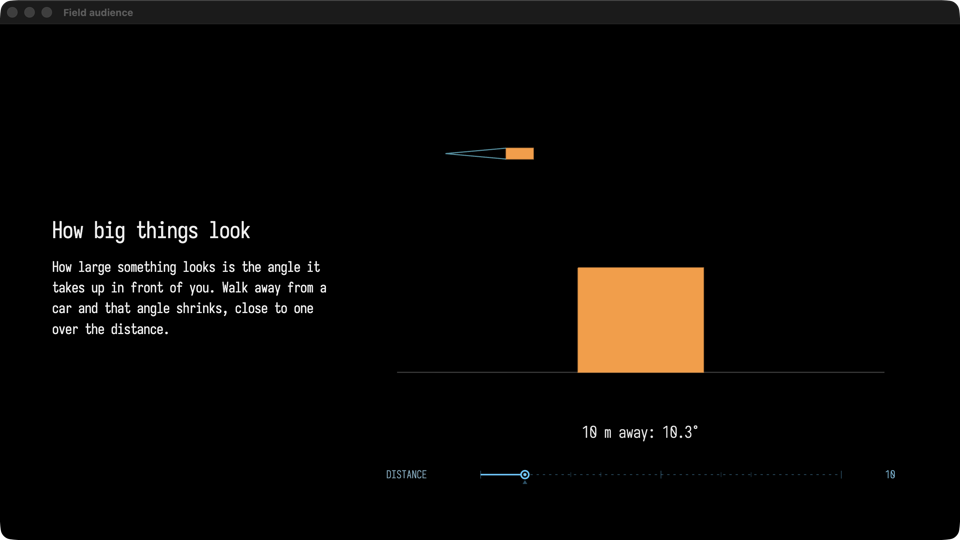
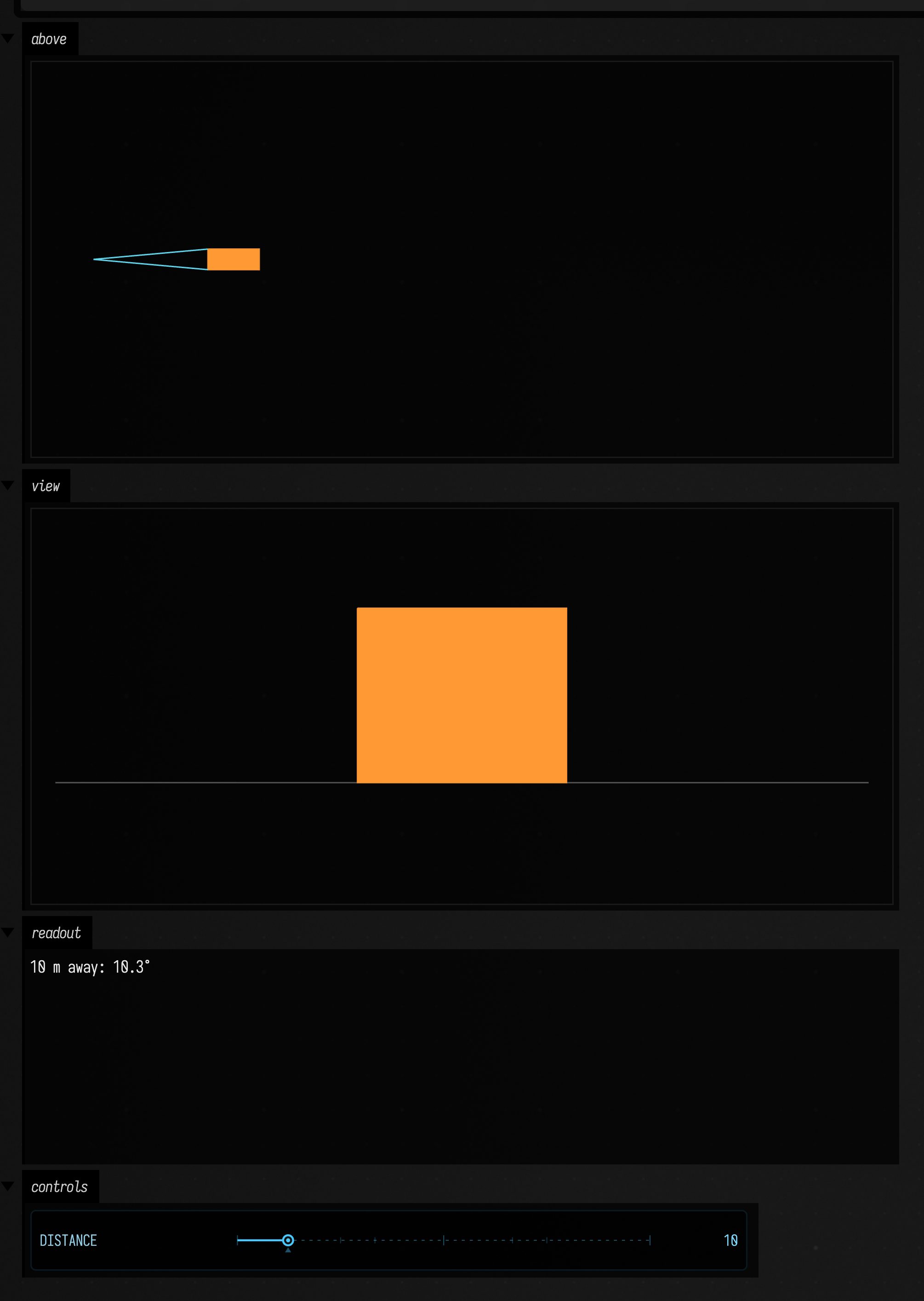
How large something looks is the angle it takes up in front of you. Walk away from a car and that angle shrinks, close to one over the distance.
// A car 1.8 m wide driving away from you, from above and through your eye. How wide it looks is
// the angle it spans, and that angle shrinks about as one over the distance.
fun draw(distance: Double) {
    val half = atan(0.9 / distance)
    val scale = 9.0
    val x = 30 + distance * scale
    val top = mutableListOf<FLine>()
    top += fline {
        moveTo(x, 100 - 0.9 * scale)
        lineTo(x + 4.5 * scale, 100 - 0.9 * scale)
        lineTo(x + 4.5 * scale, 100 + 0.9 * scale)
        lineTo(x, 100 + 0.9 * scale)
        lineTo(x, 100 - 0.9 * scale)
        filled = true
        color = vec(1.0, 0.6, 0.2, 1.0)
    }
    top += fline {
        moveTo(x, 100 - 0.9 * scale)
        lineTo(30.0, 100.0)
        lineTo(x, 100 + 0.9 * scale)
        color = vec(0.4, 0.9, 1.0, 1.0)
    }
    lines(top, channel = "above", w = 640.0, h = 200.0, framing = LinesFraming.fixed(0.0, 0.0, 640.0, 200.0))
    // The eye's view: 40° across 640 pixels. The car is 1.8 m wide and 1.5 m tall.
    val perDegree = 640.0 / 40
    val w = 2 * half * 180 / PI * perDegree
    val h = 2 * atan(0.75 / distance) * 180 / PI * perDegree
    val eye = fline {
        moveTo(320 - w / 2, 140 - h)
        lineTo(320 + w / 2, 140 - h)
        lineTo(320 + w / 2, 140.0)
        lineTo(320 - w / 2, 140.0)
        lineTo(320 - w / 2, 140 - h)
        filled = true
        color = vec(1.0, 0.6, 0.2, 1.0)
    }
    val ground = fline {
        moveTo(0.0, 140.0)
        lineTo(640.0, 140.0)
        color = vec(1.0, 1.0, 1.0, 0.35)
    }
    lines(ground, eye, channel = "view", w = 640.0, h = 160.0, framing = LinesFraming.fixed(0.0, 0.0, 640.0, 160.0))
    markdown("readout", "${distance.roundToInt()} m away: ${(2 * half * 180 / PI).f1}°")
}

draw(10.0)
controlGroup {
    slider("distance", 3.0, 60.0, step = 1.0, initialValue = 10.0) { draw(it) }
}
Angles as lengths
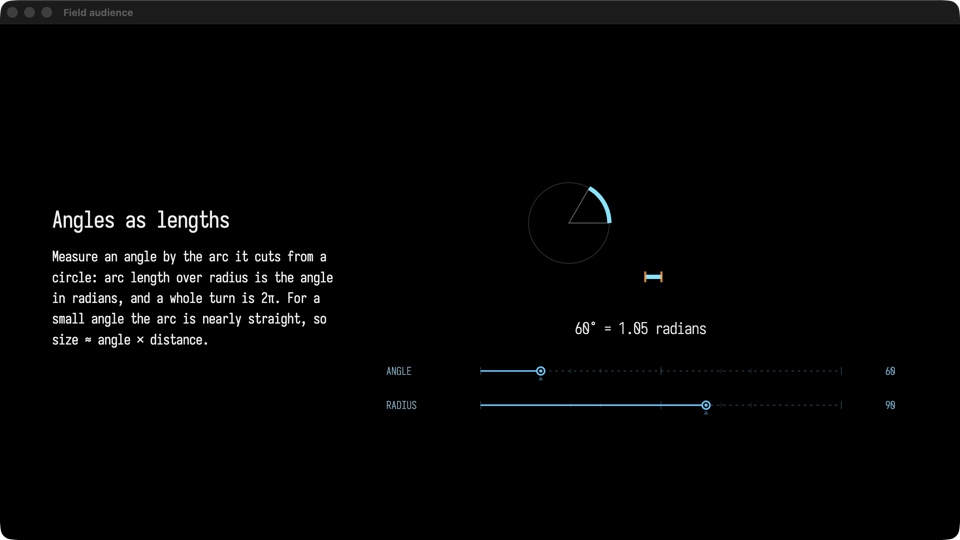
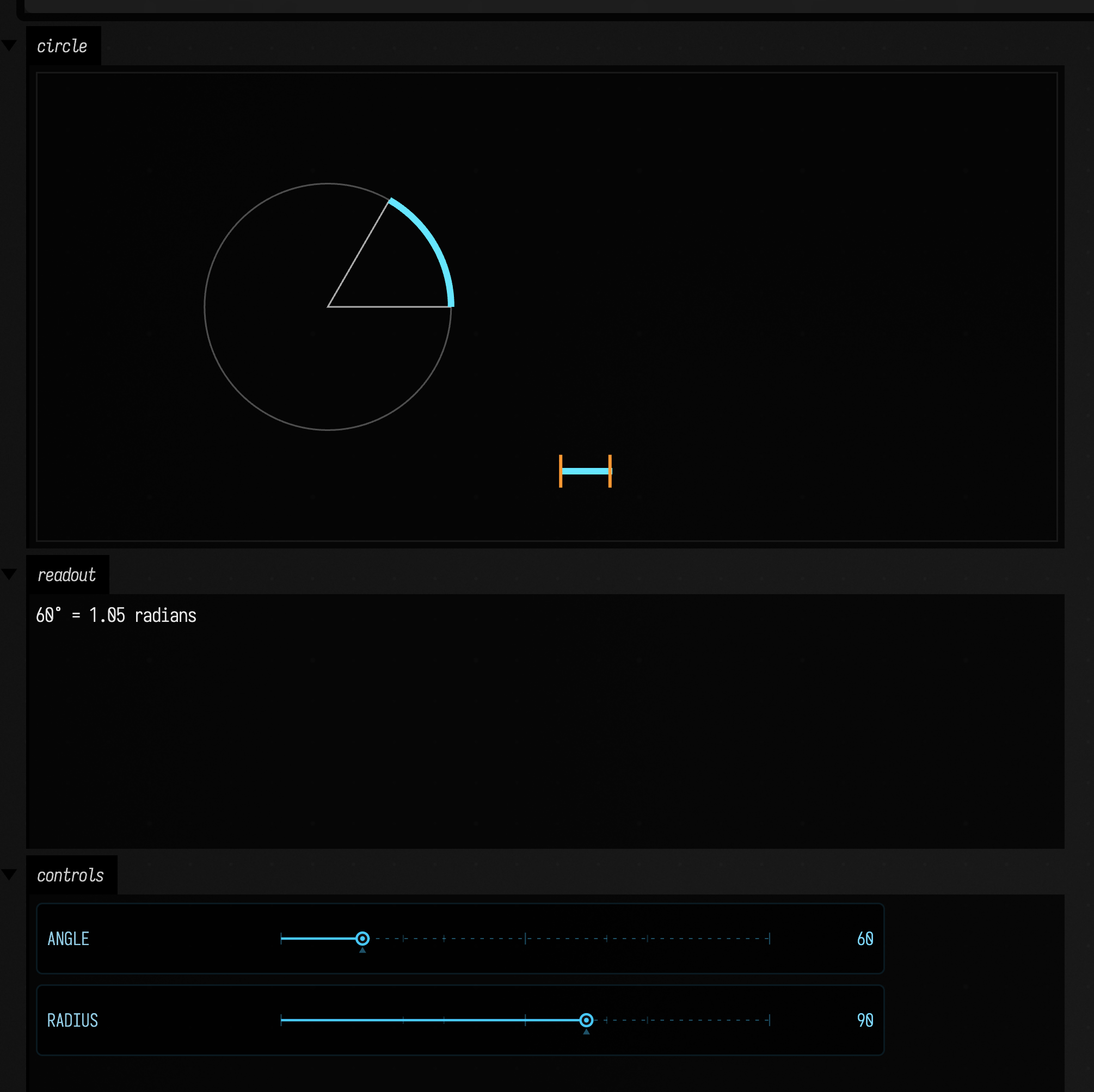
Measure an angle by the arc it cuts from a circle: arc length over radius is the angle in radians, and a whole turn is 2π. For a small angle the arc is nearly straight, so size ≈ angle × distance.
// An angle measured by the arc it cuts from a circle. Unrolled on the right, the arc is so many
// radii long: that count is the angle in radians.
var radius = 90.0
var degrees = 60.0

fun draw() {
    val a = degrees * PI / 180
    val cx = 160.0
    val cy = 150.0
    val drawn = mutableListOf<FLine>()
    drawn += fline {
        moveTo(cx + radius, cy)
        for (k in 1..120) lineTo(cx + radius * cos(2 * PI * k / 120), cy - radius * sin(2 * PI * k / 120))
        color = vec(1.0, 1.0, 1.0, 0.35)
    }
    drawn += fline {
        moveTo(cx + radius, cy)
        lineTo(cx, cy)
        lineTo(cx + radius * cos(a), cy - radius * sin(a))
        color = vec(1.0, 1.0, 1.0, 0.8)
    }
    drawn += fline {
        moveTo(cx + radius, cy)
        for (k in 1..90) lineTo(cx + radius * cos(a * k / 90), cy - radius * sin(a * k / 90))
        thickness = 4.0
        color = vec(0.4, 0.9, 1.0, 1.0)
    }
    // The arc laid straight, drawn at 0.4 of its length, with a tick at every radius.
    val x0 = 330.0
    drawn += fline {
        moveTo(x0, 270.0)
        lineTo(x0 + radius * a * 0.4, 270.0)
        thickness = 4.0
        color = vec(0.4, 0.9, 1.0, 1.0)
    }
    var k = 0
    while (k * radius <= radius * a + 1e-9) {
        drawn += fline {
            moveTo(x0 + k * radius * 0.4, 258.0)
            lineTo(x0 + k * radius * 0.4, 282.0)
            thickness = 2.0
            color = vec(1.0, 0.6, 0.2, 1.0)
        }
        k++
    }
    lines(drawn, channel = "circle", w = 640.0, h = 300.0, framing = LinesFraming.fixed(0.0, 0.0, 640.0, 300.0))
    markdown("readout", "${degrees.roundToInt()}° = ${a.f2} radians")
}

draw()
controlGroup {
    slider("angle", 0.0, 360.0, step = 1.0, initialValue = degrees) {
        degrees = it
        draw()
    }
    slider("radius", 40.0, 120.0, step = 1.0, initialValue = radius) {
        radius = it
        draw()
    }
}
Solid angles
Angles in three dimensions
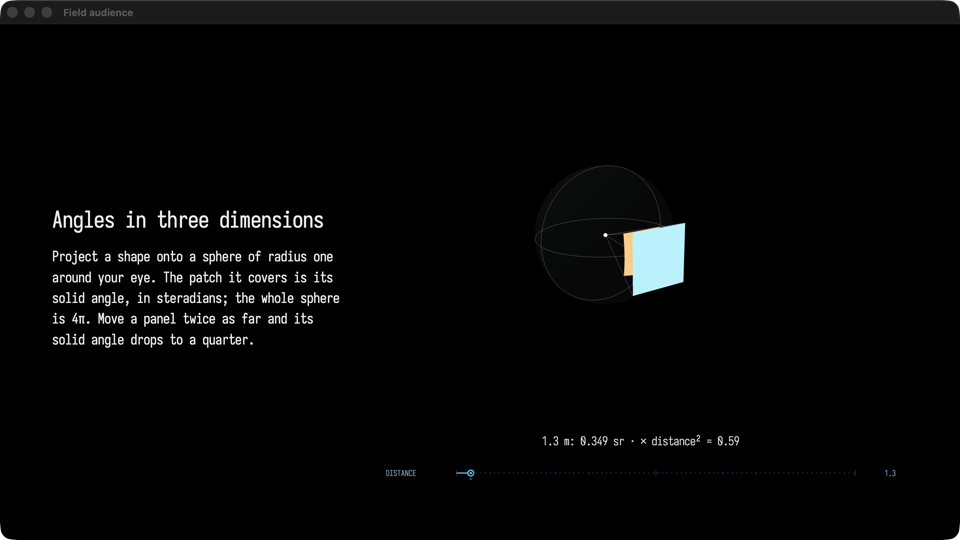
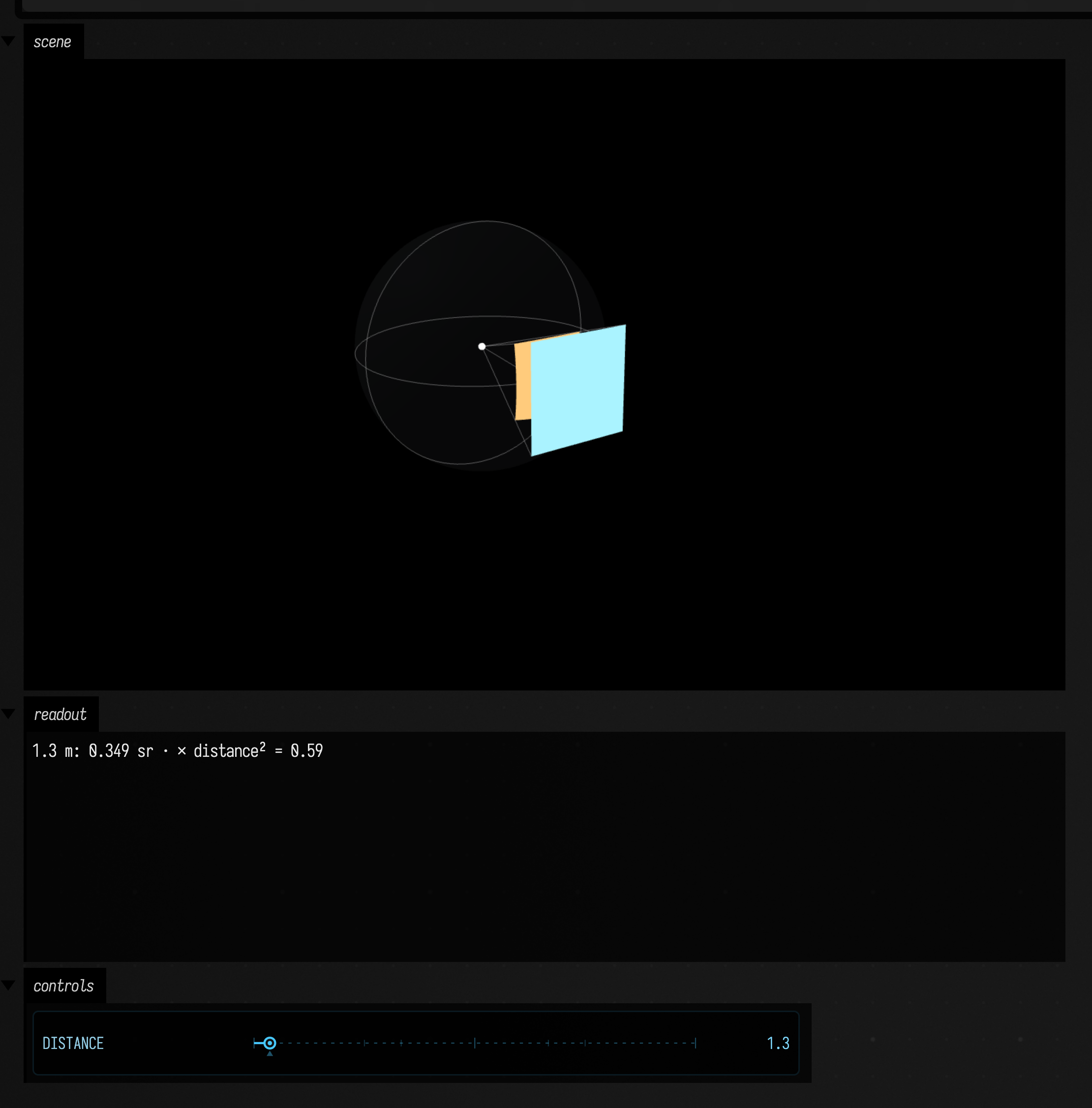
Project a shape onto a sphere of radius one around your eye. The patch it covers is its solid angle, in steradians; the whole sphere is 4π. Move a panel twice as far and its solid angle drops to a quarter.
// A square panel 0.8 m across and its shadow on a sphere of radius one around the eye. The area of
// that shadow is the panel's solid angle; move the panel away and it shrinks as the square.
val sphere = icosphereMesh(4, 1.0)
// Two great circles, so the sphere reads as a sphere without a wireframe in the way.
val circles = [
    fline {
        moveTo(1.0, 0.0, 0.0)
        for (k in 1..96) lineTo(cos(2 * PI * k / 96), 0.0, sin(2 * PI * k / 96))
        color = vec(1.0, 1.0, 1.0, 0.35)
    },
    fline {
        moveTo(1.0, 0.0, 0.0)
        for (k in 1..96) lineTo(cos(2 * PI * k / 96), sin(2 * PI * k / 96), 0.0)
        color = vec(1.0, 1.0, 1.0, 0.35)
    },
]

fun draw(distance: Double) {
    val panel = planeMesh(12, 12, 0.8, 0.8).translated(0.0, 0.0, -distance)
    // Every point of the panel pushed onto the unit sphere, along its line to the eye.
    val shadow = panel.transformed { p -> p.normalize().mul(1.004f) }
    var omega = 0.0
    for (t in 0 until shadow.triangleCount) omega += shadow.triangleArea(t)
    // From the eye through each corner of the patch to the panel's corner.
    val corners =
        listOf(-0.4 to -0.4, 0.4 to -0.4, 0.4 to 0.4, -0.4 to 0.4).map { (x, y) ->
            fline {
                moveTo(0.0, 0.0, 0.0)
                lineTo(x, y, -distance)
                color = vec(1.0, 1.0, 1.0, 0.35)
            }
        }
    three(channel = "scene", width = 640, height = 420) {
        mesh(sphere.withColor(0.4, 0.45, 0.5), opacity = 0.1, wireframe = false)
        lines(circles + corners)
        mesh(panel.withColor(0.4, 0.9, 1.0), unlit = true, wireframe = false, cullBackFaces = false)
        mesh(shadow.withColor(1.0, 0.6, 0.2), unlit = true, wireframe = false, cullBackFaces = false)
        mesh(icosphereMesh(1, 0.03).withColor(1.0, 1.0, 1.0), unlit = true, wireframe = false)
        fitTo(vec(-1.1, -1.1, -2.4), vec(1.1, 1.1, 0.6))
        camera(yaw = 145.0, pitch = 18.0)
        background("#000000")
        hud(false)
    }
    markdown("readout", "${distance.f1} m: ${omega.f3} sr · × distance² = ${(omega * distance * distance).f2}")
}

draw(1.3)
controlGroup {
    slider("distance", 1.2, 4.0, step = 0.1, initialValue = 1.3) { draw(it) }
}
Surface vision
What the floor sees
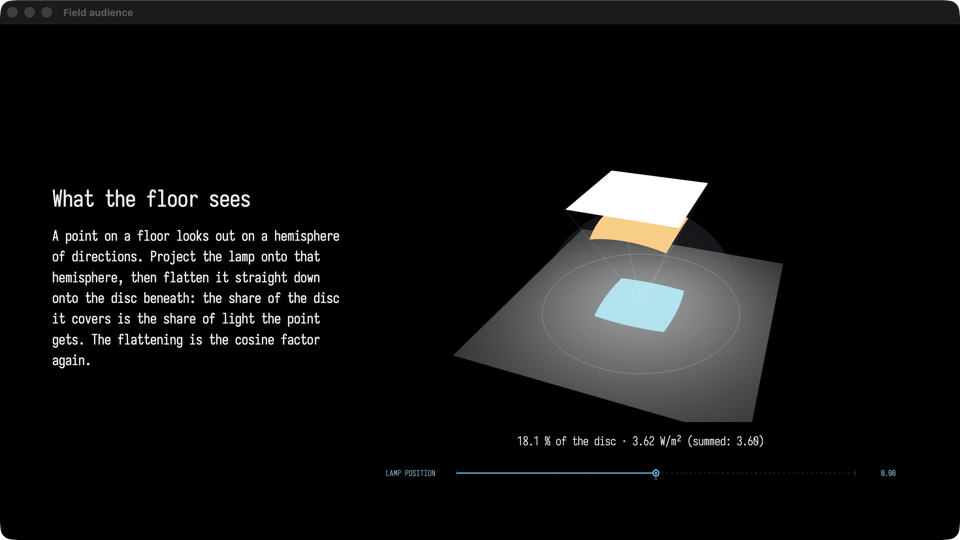
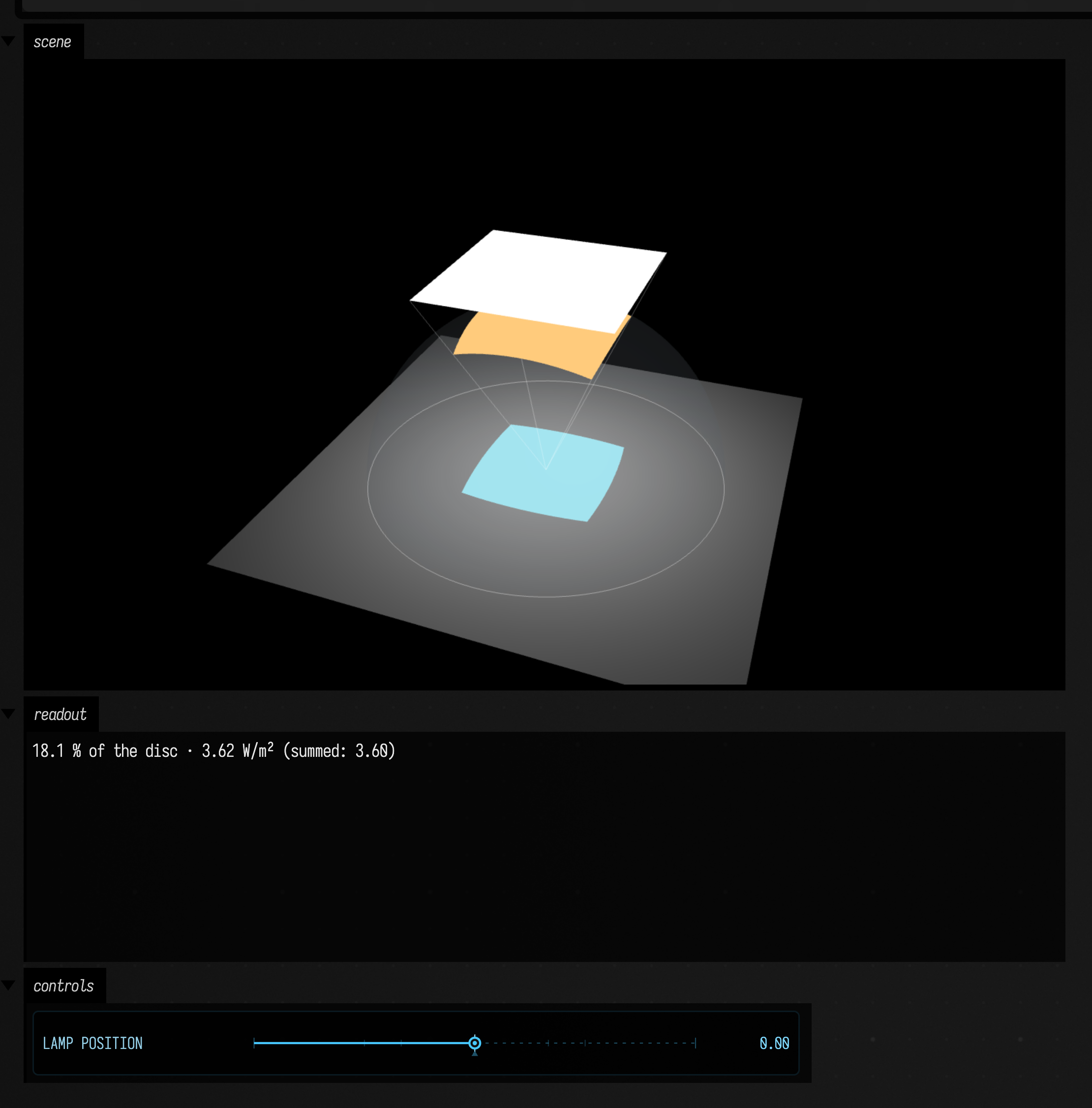
A point on a floor looks out on a hemisphere of directions. Project the lamp onto that hemisphere, then flatten it straight down onto the disc beneath: the share of the disc it covers is the share of light the point gets. The flattening is the cosine factor again.
:::fold imports
import afield.graphics.lighting.*
:::endfold

/*
What one point on the floor sees: a hemisphere of directions. The lamp, pushed onto that
hemisphere (orange) and then flattened straight down onto the disc beneath (cyan). The share of
the disc the flattened lamp covers is the share of the lamp's radiance that reaches the point.
*/
val dome =
    icosphereMesh(4, 1.0).let { ball ->
        ball.filterTriangles { t -> ball.triangle(t).let { (a, b, c) -> a.y + b.y + c.y > 0 } }
    }
val floor = floorMesh(2.6, 2.6, divisions = 48)
val rim = fline {
    moveTo(1.0, 0.0, 0.0)
    for (k in 1..96) lineTo(cos(2 * PI * k / 96), 0.0, sin(2 * PI * k / 96))
    color = vec(1.0, 1.0, 1.0, 0.4)
}
val side = 1.0

fun draw(across: Double) {
    val lamp = RectLight(vec(across, 1.2, 0.0), width = side, height = side, power = 20.0)
    val outline = planeMesh(12, 12, side, side).transformed { p -> vec(p.x + across, 1.2, p.y) }
    val onDome = outline.transformed { p -> p.normalize().mul(1.004f) }
    val flat = onDome.transformed { p -> vec(p.x, 0.004, p.z) }
    var covered = 0.0
    for (t in 0 until flat.triangleCount) covered += flat.triangleArea(t)
    // Irradiance two ways: summed over the lamp by afield.graphics.lighting, and the lamp's
    // radiance times the flattened area it covers.
    val radiance = lamp.power / (PI * side * side)
    val e = irradianceAt(vec(0.0, 0.0, 0.0), vec(0.0, 1.0, 0.0), lamp).x
    val sight =
        listOf(-0.5 to -0.5, 0.5 to -0.5, 0.5 to 0.5, -0.5 to 0.5).map { (x, z) ->
            fline {
                moveTo(0.0, 0.0, 0.0)
                lineTo(across + x, 1.2, z)
                color = vec(1.0, 1.0, 1.0, 0.3)
            }
        }
    three(channel = "scene", width = 640, height = 420) {
        mesh(floor.lit([lamp], occluders = null, exposure = 0.35), unlit = true, wireframe = false)
        mesh(dome.withColor(0.4, 0.45, 0.5), opacity = 0.12, wireframe = false, cullBackFaces = false)
        lines(sight + rim)
        mesh(lamp.mesh(), unlit = true, wireframe = false, cullBackFaces = false)
        mesh(onDome.withColor(1.0, 0.6, 0.2), unlit = true, wireframe = false, cullBackFaces = false)
        mesh(flat.withColor(0.4, 0.9, 1.0), unlit = true, wireframe = false, cullBackFaces = false)
        fitTo(vec(-1.1, 0.0, -1.1), vec(1.1, 1.25, 1.1))
        camera(yaw = 20.0, pitch = 30.0)
        background("#000000")
        hud(false)
    }
    markdown("readout", "${(100 * covered / PI).f1} % of the disc · ${(radiance * covered).f2} W/m² (summed: ${e.f2})")
}

draw(0.0)
controlGroup {
    slider("lamp position", -2.0, 2.0, step = 0.05, initialValue = 0.0) { draw(it) }
}
Radiance
Brightness that does not fade
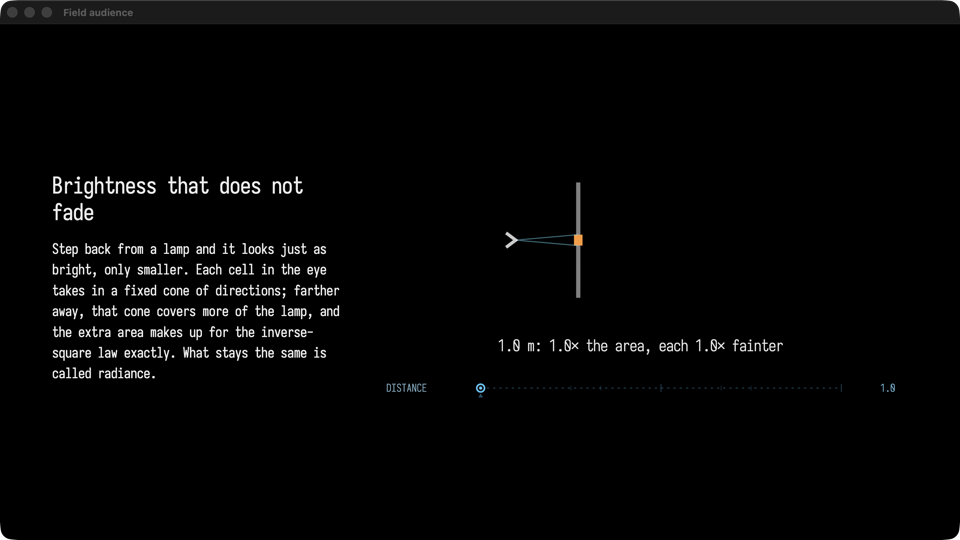
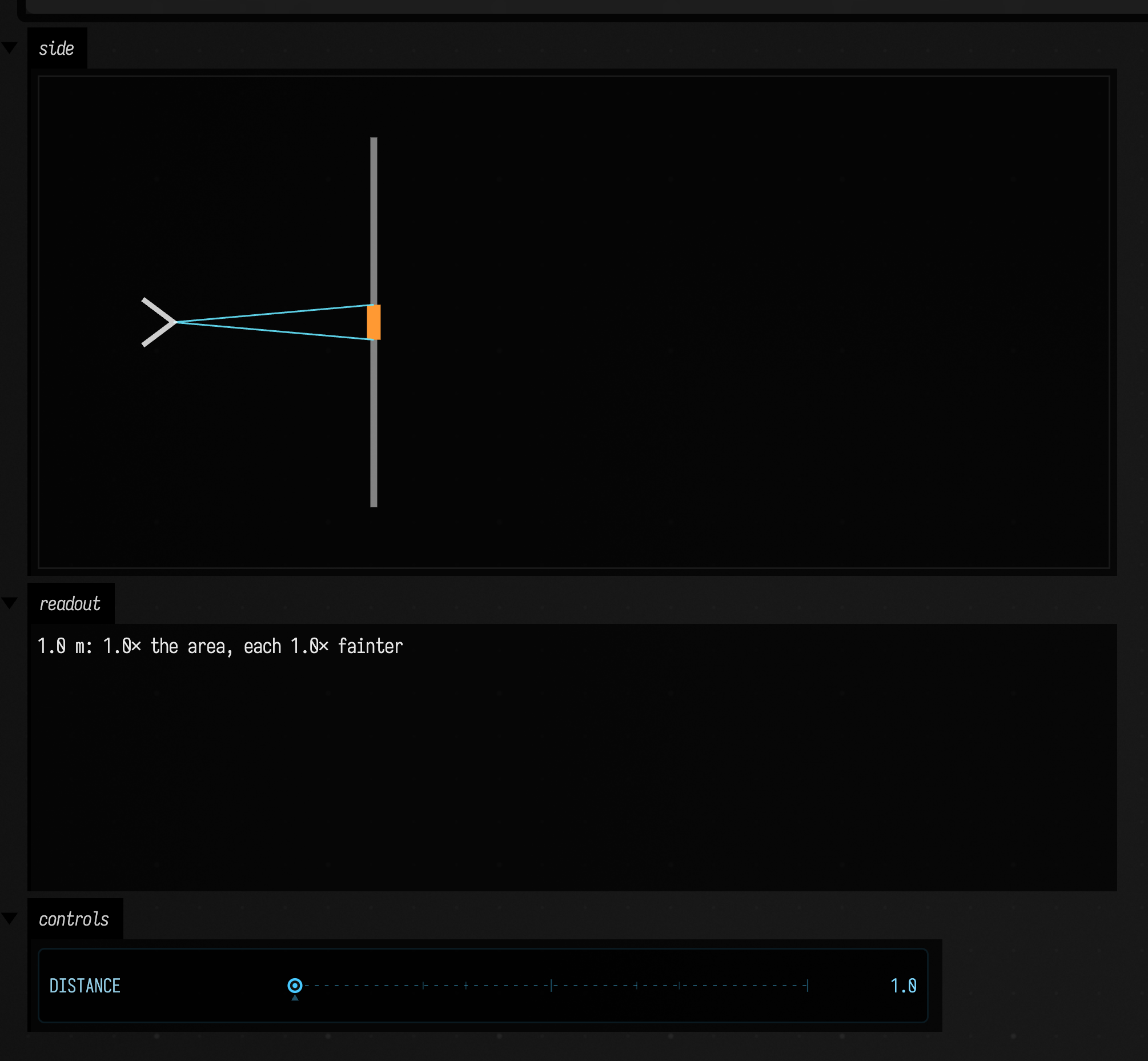
Step back from a lamp and it looks just as bright, only smaller. Each cell in the eye takes in a fixed cone of directions; farther away, that cone covers more of the lamp, and the extra area makes up for the inverse-square law exactly. What stays the same is called radiance.
// An eye looking at a wide lamp, from the side. One cell of the eye takes in a fixed cone of
// directions; move the lamp away and the cone covers more of it.
fun draw(distance: Double) {
    val half = 5 * PI / 180
    val x = 60 + distance * 130
    val reach = (x - 60) * tan(half)
    val drawn = mutableListOf<FLine>()
    drawn += fline {
        moveTo(x, 20.0)
        lineTo(x, 260.0)
        thickness = 4.0
        color = vec(1.0, 1.0, 1.0, 0.5)
    }
    drawn += fline {
        moveTo(x, 140 - reach)
        lineTo(x, 140 + reach)
        thickness = 8.0
        color = vec(1.0, 0.6, 0.2, 1.0)
    }
    drawn += fline {
        moveTo(x, 140 - reach)
        lineTo(60.0, 140.0)
        lineTo(x, 140 + reach)
        color = vec(0.4, 0.9, 1.0, 1.0)
    }
    drawn += fline {
        moveTo(40.0, 125.0)
        lineTo(60.0, 140.0)
        lineTo(40.0, 155.0)
        thickness = 3.0
        color = vec(1.0, 1.0, 1.0, 0.8)
    }
    lines(drawn, channel = "side", w = 640.0, h = 280.0, framing = LinesFraming.fixed(0.0, 0.0, 640.0, 280.0))
    val d2 = distance * distance
    markdown("readout", "${distance.f1} m: ${d2.f1}× the area, each ${d2.f1}× fainter")
}

draw(1.0)
controlGroup {
    slider("distance", 1.0, 4.0, step = 0.1, initialValue = 1.0) { draw(it) }
}
Equally bright from every side
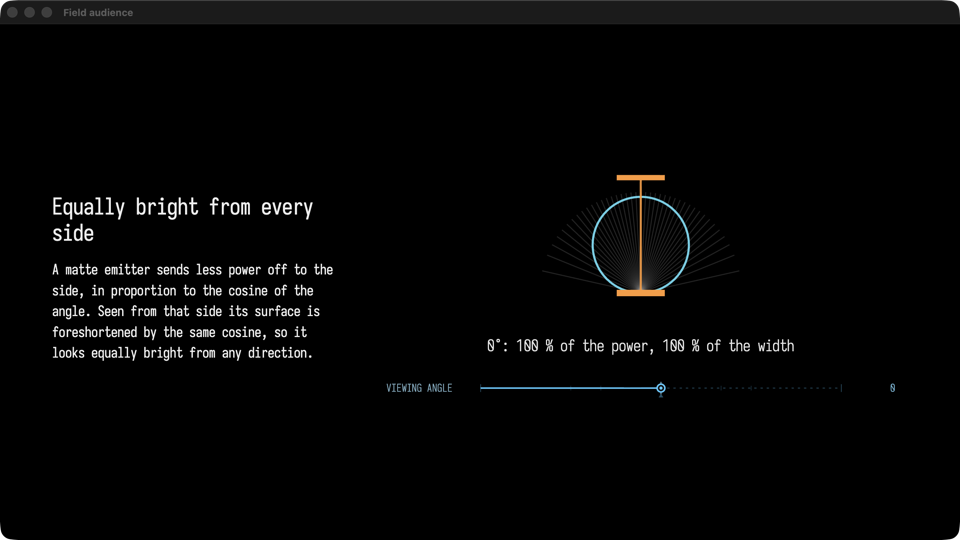
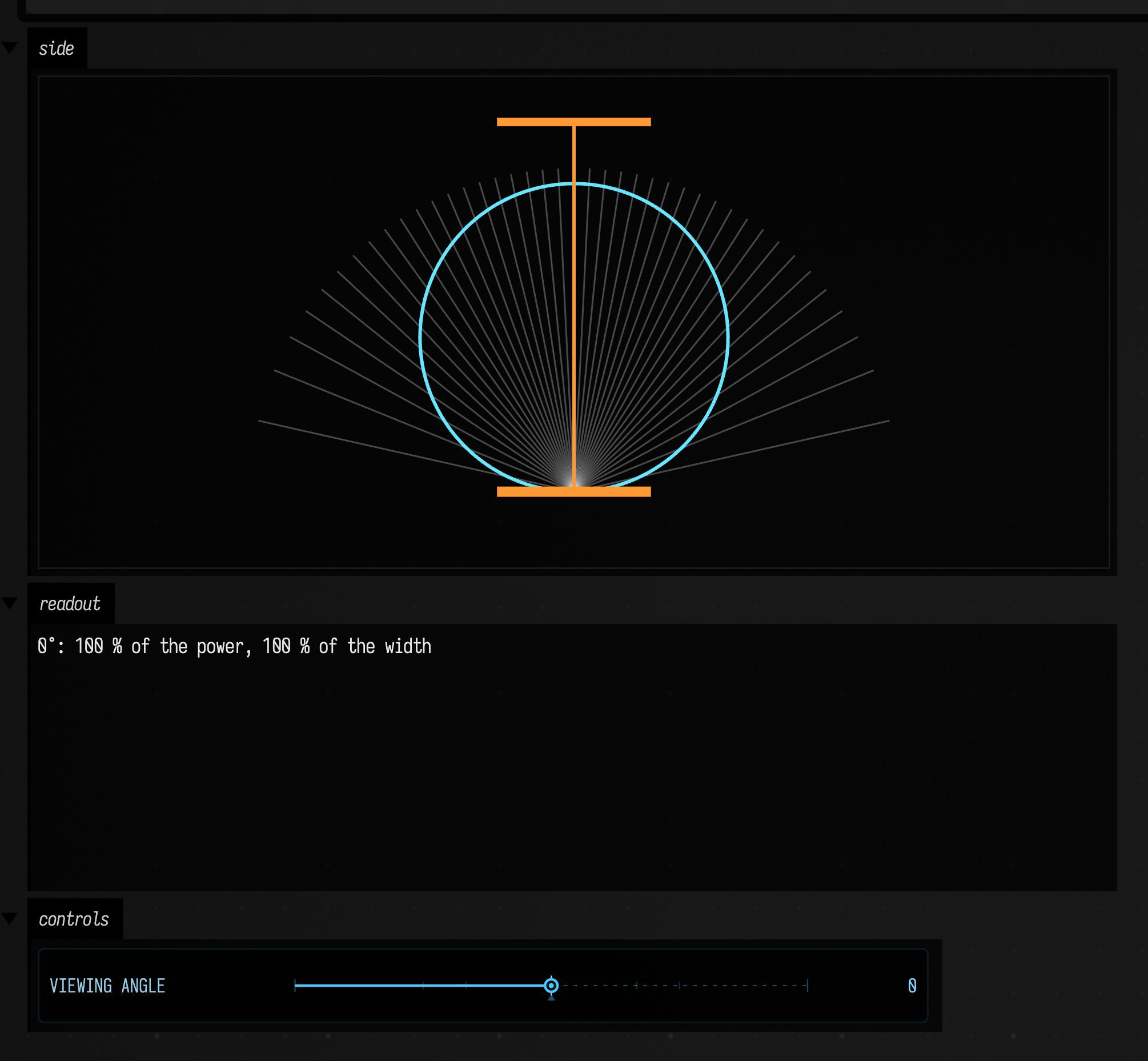
A matte emitter sends less power off to the side, in proportion to the cosine of the angle. Seen from that side its surface is foreshortened by the same cosine, so it looks equally bright from any direction.
// A small matte patch giving off light, seen from the side. It sends less light off to the side,
// as the cosine of the angle, and it also looks narrower from there by the same cosine.
val rays = 41

fun draw(degrees: Double) {
    val v = degrees * PI / 180
    val drawn = mutableListOf<FLine>()
    // Rays whose sines are evenly spaced: their density falls off as the cosine.
    for (i in 0 until rays) {
        val s = 2.0 * (i + 0.5) / rays - 1
        val c = sqrt(1 - s * s)
        drawn += fline {
            moveTo(320.0, 250.0)
            lineTo(320 + 210 * s, 250 - 210 * c)
            color = vec(1.0, 1.0, 1.0, 0.3)
        }
    }
    // The lobe: in each direction, the power sent that way. A circle resting on the patch.
    drawn += fline {
        moveTo(320.0, 250.0)
        for (k in 1..180) {
            val p = -PI / 2 + PI * k / 180
            lineTo(320 + 200 * cos(p) * sin(p), 250 - 200 * cos(p) * cos(p))
        }
        thickness = 2.0
        color = vec(0.4, 0.9, 1.0, 1.0)
    }
    drawn += fline {
        moveTo(270.0, 250.0)
        lineTo(370.0, 250.0)
        thickness = 6.0
        color = vec(1.0, 0.6, 0.2, 1.0)
    }
    // The viewing direction, and how wide the patch looks from there.
    drawn += fline {
        moveTo(320.0, 250.0)
        lineTo(320 + 240 * sin(v), 250 - 240 * cos(v))
        thickness = 2.0
        color = vec(1.0, 0.6, 0.2, 1.0)
    }
    val w = 50 * cos(v)
    drawn += fline {
        moveTo(320 + 240 * sin(v) - w * cos(v), 250 - 240 * cos(v) - w * sin(v))
        lineTo(320 + 240 * sin(v) + w * cos(v), 250 - 240 * cos(v) + w * sin(v))
        thickness = 5.0
        color = vec(1.0, 0.6, 0.2, 1.0)
    }
    lines(drawn, channel = "side", w = 640.0, h = 280.0, framing = LinesFraming.fixed(0.0, 0.0, 640.0, 280.0))
    val c = cos(v)
    markdown(
        "readout",
        "${degrees.roundToInt()}°: ${(c * 100).roundToInt()} % of the power, ${(c * 100).roundToInt()} % of the width",
    )
}

draw(0.0)
controlGroup {
    slider("viewing angle", -80.0, 80.0, step = 1.0, initialValue = 0.0) { draw(it) }
}
Reflections
Mirror to matte
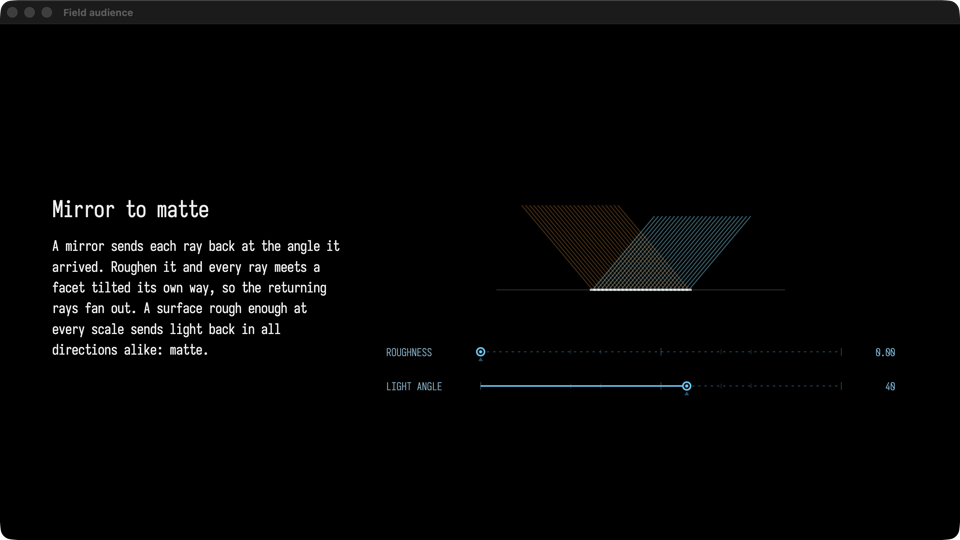
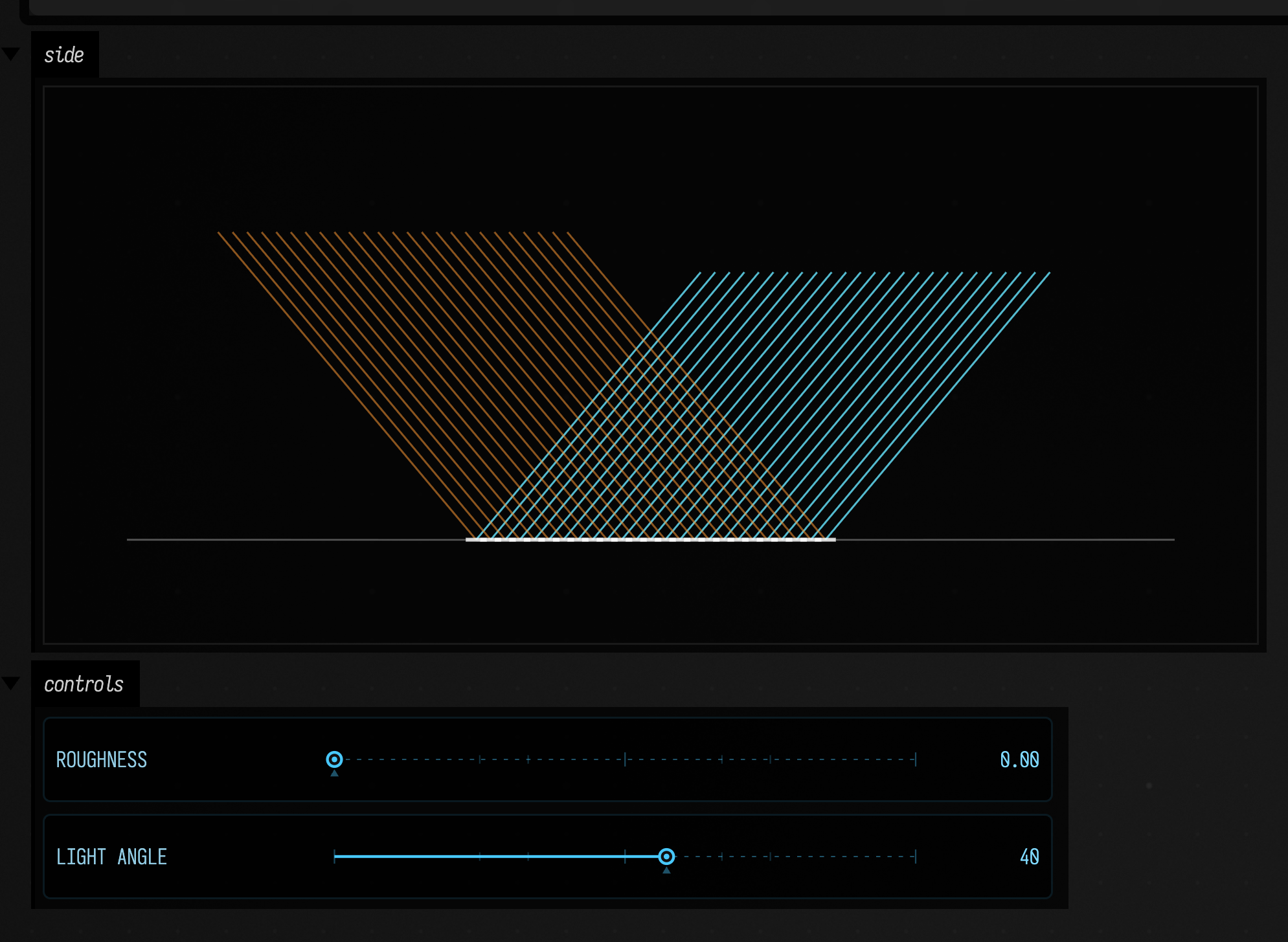
A mirror sends each ray back at the angle it arrived. Roughen it and every ray meets a facet tilted its own way, so the returning rays fan out. A surface rough enough at every scale sends light back in all directions alike: matte.
// Parallel rays striking a surface, seen from the side. Each ray meets a tiny facet of the
// surface and leaves as from a mirror; roughness tilts the facets, so the rays fan out.
val rays = 25
var roughness = 0.0
var angle = 40.0

fun draw() {
    val a = angle * PI / 180
    val drawn = mutableListOf<FLine>()
    drawn += fline {
        moveTo(20.0, 240.0)
        lineTo(620.0, 240.0)
        color = vec(1.0, 1.0, 1.0, 0.35)
    }
    for (i in 0 until rays) {
        val x = 220 + 200.0 * i / (rays - 1)
        // Each facet's tilt, spread evenly (golden-ratio steps) over ± roughness × 50°.
        val tilt = roughness * 50 * PI / 180 * (2 * ((i * 0.618034) % 1.0) - 1)
        // Travelling down and to the right; y grows downward in this drawing.
        val dx = sin(a)
        val dy = cos(a)
        // The facet's normal points up, tilted; the ray reflects about it.
        val nx = sin(tilt)
        val ny = -cos(tilt)
        val dot = dx * nx + dy * ny
        var rx = dx - 2 * dot * nx
        var ry = dy - 2 * dot * ny
        if (ry > 0) ry = -ry
        drawn += fline {
            moveTo(x - dx * 230, 240 - dy * 230)
            lineTo(x, 240.0)
            color = vec(1.0, 0.6, 0.2, 0.6)
        }
        drawn += fline {
            moveTo(x, 240.0)
            lineTo(x + rx * 200, 240 + ry * 200)
            color = vec(0.4, 0.9, 1.0, 0.9)
        }
        drawn += fline {
            moveTo(x - 6 * cos(tilt), 240 - 6 * sin(tilt))
            lineTo(x + 6 * cos(tilt), 240 + 6 * sin(tilt))
            thickness = 2.0
            color = vec(1.0, 1.0, 1.0, 0.8)
        }
    }
    lines(drawn, channel = "side", w = 640.0, h = 280.0, framing = LinesFraming.fixed(0.0, 0.0, 640.0, 280.0))
}

draw()
controlGroup {
    slider("roughness", 0.0, 1.0, step = 0.01, initialValue = roughness) {
        roughness = it
        draw()
    }
    slider("light angle", 0.0, 70.0, step = 1.0, initialValue = angle) {
        angle = it
        draw()
    }
}
Shadow
Soft and hard shadows
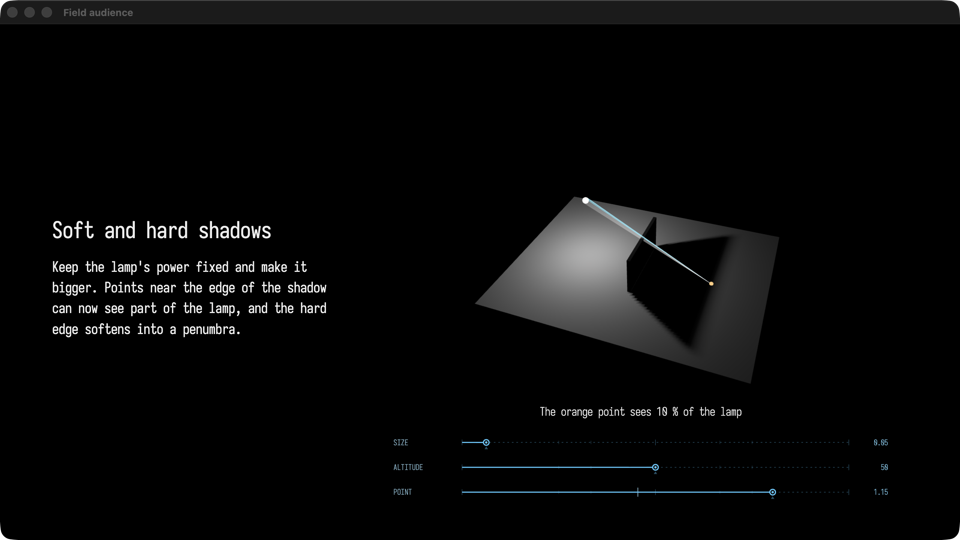
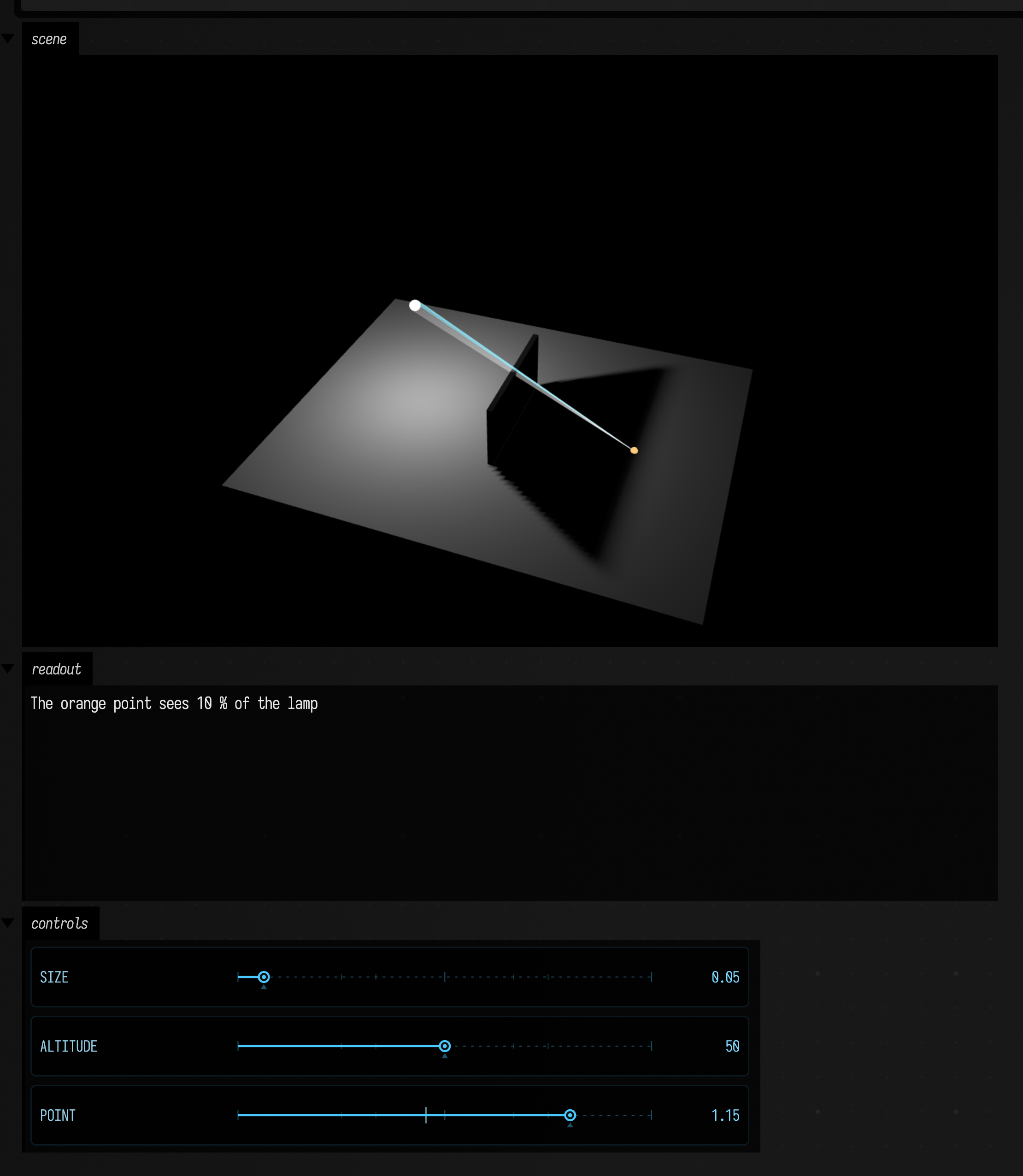
Keep the lamp's power fixed and make it bigger. Points near the edge of the shadow can now see part of the lamp, and the hard edge softens into a penumbra.
:::fold imports
import afield.graphics.lighting.*
:::endfold

/*
A black wall on a white floor, lit by a ball of light. The ball always gives out 40 W;
make it bigger and the edge of the shadow softens.
The wall's faces sit on the floor's grid lines, so no floor vertex is half under it.
*/
val floor = floorMesh(4.0, 3.2, divisions = 80).withColor(0.8, 0.8, 0.8)
val wall = panelBoxMesh(0.05, 0.6, 1.2, divisions = 4).translated(0.025, 0.3, 0.0).withColor(0.03, 0.03, 0.03)
val blocker = wall.bvh()
val scene = floor + wall
// The lit floor depends only on the lamp, so moving the point redraws the lines, not the light.
var litFor = ""
var litScene = scene
var size = 0.05
var altitude = 50.0
var probe = 1.15

fun draw() {
    val a = altitude * PI / 180
    val lamp = SphereLight(vec(-1.4 * cos(a), 1.4 * sin(a), 0.0), radius = size, power = 40.0, samples = 160)
    // From one point on the floor: a line to every bit of the lamp it faces, cyan where it is clear.
    val point = vec(probe, 0.0, 0.0)
    val sight = lamp.sightLines(point, vec(0.0, 1.0, 0.0), blocker)
    val rays = sight.map { s ->
        fline {
            moveTo(s.from.x.toDouble(), s.from.y.toDouble(), s.from.z.toDouble())
            lineTo(s.to.x.toDouble(), s.to.y.toDouble(), s.to.z.toDouble())
            color = if (s.clear) vec(0.4, 0.9, 1.0, 0.7) else vec(1.0, 1.0, 1.0, 0.08)
        }
    }
    if (litFor != "$size $altitude") {
        // Only the wall casts shadows; the floor need not be tested against its own triangles.
        litScene = scene.lit([lamp], occluders = wall, exposure = 0.6)
        litFor = "$size $altitude"
    }
    three(channel = "scene", width = 640, height = 420) {
        mesh(litScene, unlit = true, wireframe = false)
        mesh(lamp.mesh(), unlit = true, wireframe = false)
        mesh(icosphereMesh(2, 0.035).translated(point).withColor(1.0, 0.6, 0.2), unlit = true, wireframe = false)
        lines(rays)
        // Frame the view on the whole set, so it holds still as the lamp changes.
        fitTo(vec(-2.0, 0.0, -1.6), vec(2.0, 1.6, 1.6))
        camera(yaw = 20.0, pitch = 35.0)
        background("#000000")
        hud(false)
    }
    markdown(
        "readout",
        "The orange point sees ${(100.0 * sight.count { it.clear } / sight.size.coerceAtLeast(1)).roundToInt()} % of the lamp",
    )
}

draw()
controlGroup {
    slider("size", 0.02, 0.5, step = 0.01, initialValue = size) {
        size = it
        draw()
    }
    slider("altitude", 15.0, 85.0, step = 1.0, initialValue = altitude) {
        altitude = it
        draw()
    }
    slider("point", -1.5, 1.8, step = 0.01, initialValue = probe) {
        probe = it
        draw()
    }
}
Colour
Coloured light
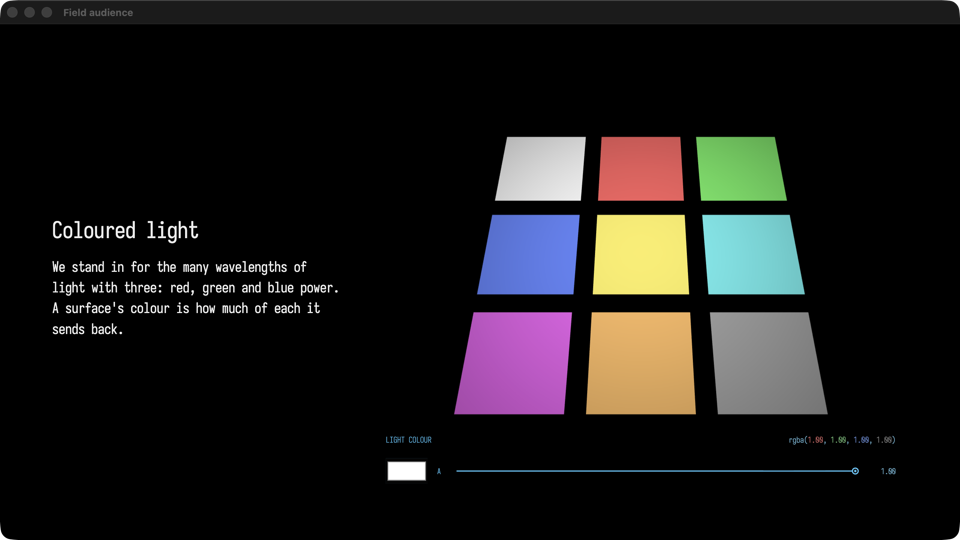
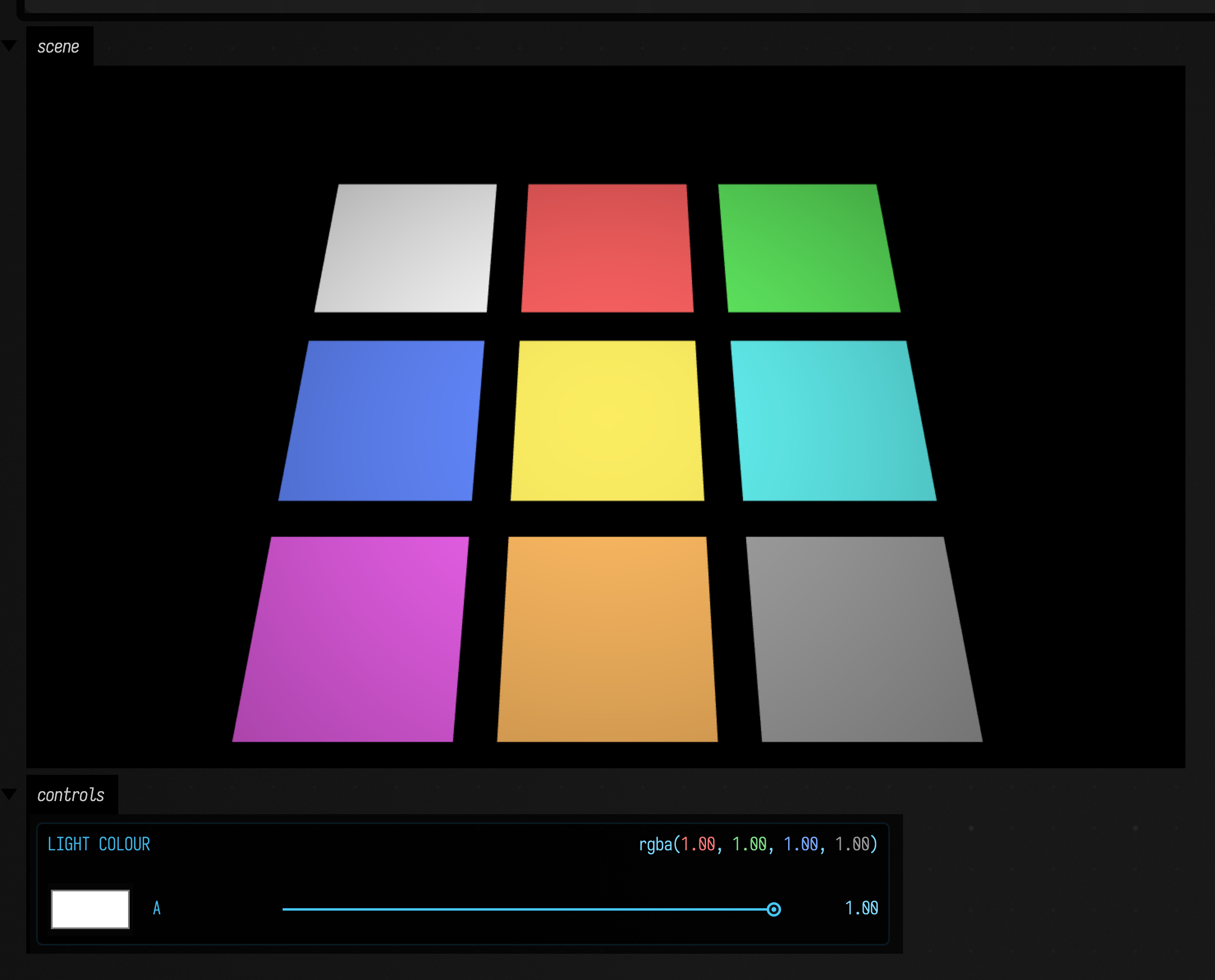
We stand in for the many wavelengths of light with three: red, green and blue power. A surface's colour is how much of each it sends back.
:::fold imports
import afield.graphics.lighting.*
:::endfold

// Nine tiles of different colours under one lamp whose colour you pick. A tile can only send
// back the colours the lamp gives it.
val colours = [
    vec(0.8, 0.8, 0.8),
    vec(0.8, 0.1, 0.1),
    vec(0.1, 0.7, 0.1),
    vec(0.1, 0.2, 0.8),
    vec(0.8, 0.7, 0.1),
    vec(0.1, 0.7, 0.7),
    vec(0.7, 0.1, 0.7),
    vec(0.8, 0.4, 0.1),
    vec(0.3, 0.3, 0.3),
]
val tiles =
    colours
        .withIndex()
        .map { (i, c) ->
            floorMesh(0.5, 0.5, divisions = 8)
                .translated((i % 3 - 1) * 0.6, 0.0, (i / 3 - 1) * 0.6)
                .withColor(c.x, c.y, c.z)
        }
        .reduce { a, b -> a + b }

fun draw(light: Vec4) {
    val lamp =
        RectLight(vec(0.0, 1.6, 0.0), width = 1.2, height = 1.2, power = 60.0, color = vec(light.x, light.y, light.z))
    three(channel = "scene", width = 640, height = 420) {
        mesh(tiles.lit([lamp], occluders = null, exposure = 0.6), unlit = true, wireframe = false)
        camera(yaw = 0.0, pitch = 60.0, distance = 2.0)
        background("#000000")
        hud(false)
    }
}

draw(vec(1.0, 1.0, 1.0, 1.0))
controlGroup {
    colorPicker("light colour", initialValue = vec(1.0, 1.0, 1.0, 1.0)) { draw(it) }
}
Lights add up
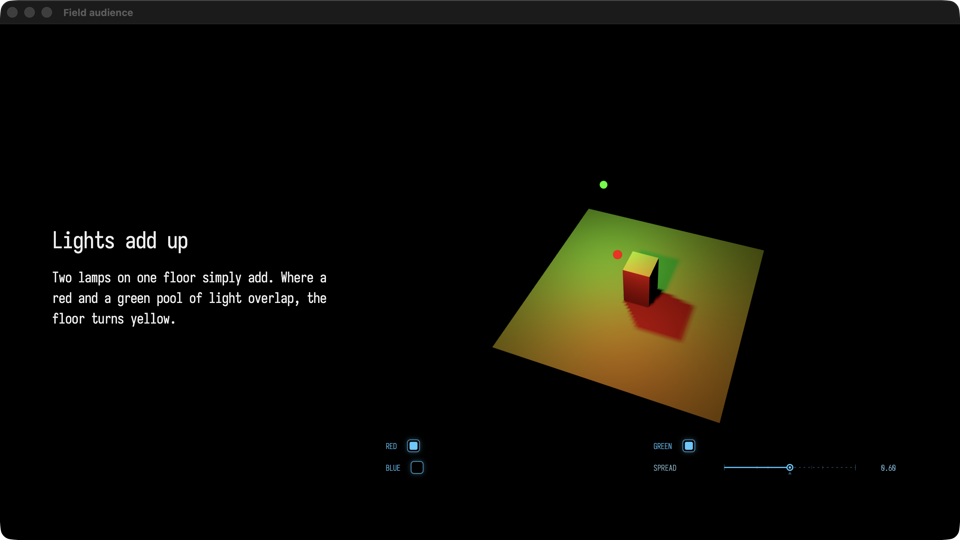
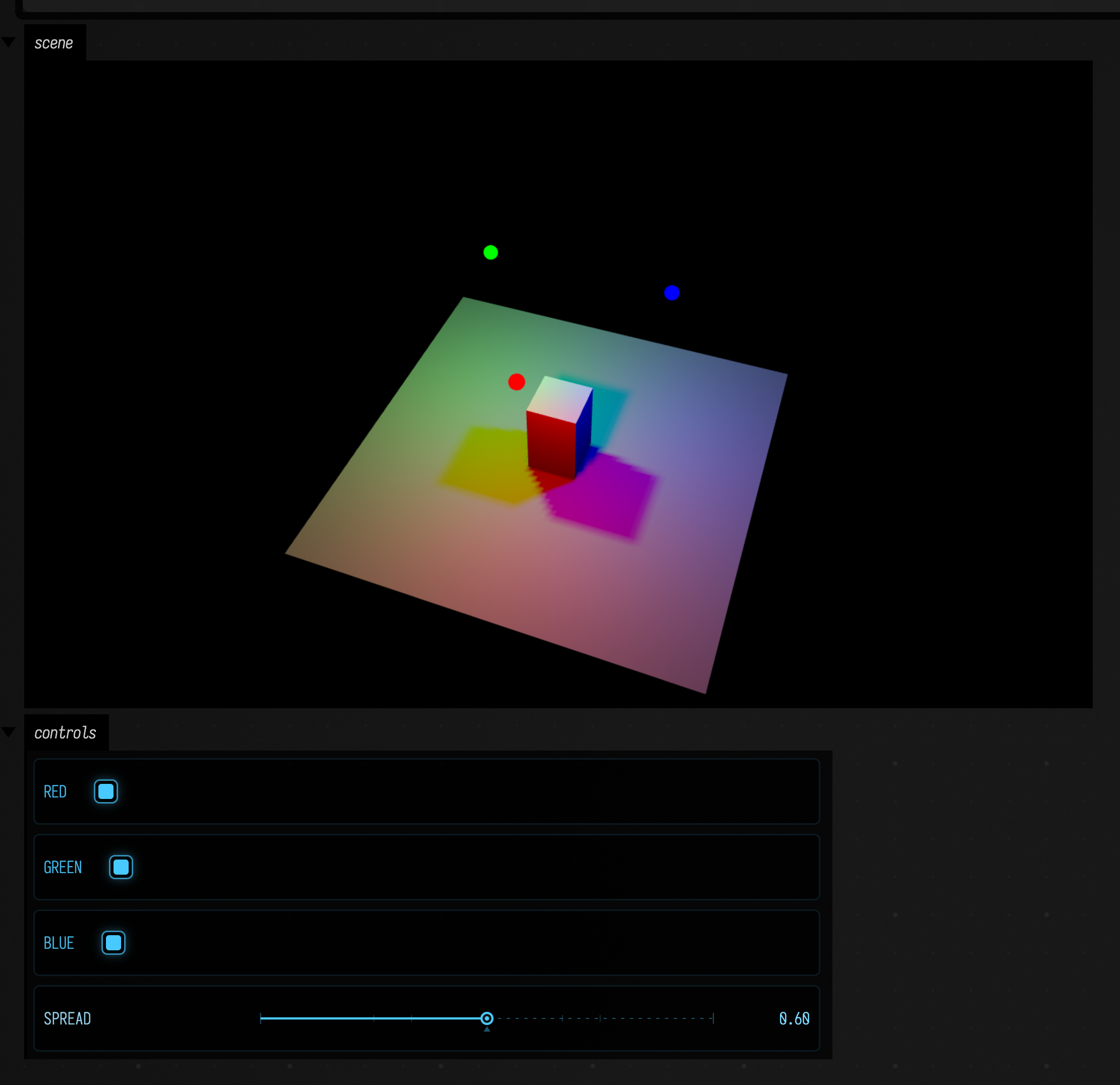
Two lamps on one floor simply add. Where a red and a green pool of light overlap, the floor turns yellow.
:::fold imports
import afield.graphics.lighting.*
:::endfold

// Red, green and blue lamps over a white floor with a white block. Where two pools overlap
// their light adds; the block's shadows take the colours of the lamps it hides.
val floor = floorMesh(2.4, 2.4, divisions = 72).withColor(0.8, 0.8, 0.8)
val block = panelBoxMesh(0.3, 0.5, 0.3, divisions = 6).translated(0.0, 0.25, 0.0).withColor(0.8, 0.8, 0.8)
val scene = floor + block
var red = true
var green = true
var blue = true
var spread = 0.6

fun draw() {
    val lamps = listOf(
        Triple(red, 90.0, vec(1.0, 0.0, 0.0)),
        Triple(green, 210.0, vec(0.0, 1.0, 0.0)),
        Triple(blue, 330.0, vec(0.0, 0.0, 1.0)),
    ).filter { it.first }
        .map { (_, degrees, colour) ->
            val a = degrees * PI / 180
            SphereLight(
                vec(spread * cos(a), 1.2, spread * sin(a)),
                radius = 0.04,
                power = 25.0,
                color = colour,
                samples = 128,
            )
        }
    three(channel = "scene", width = 640, height = 420) {
        mesh(scene.lit(lamps, occluders = block, exposure = 1.2), unlit = true, wireframe = false)
        lamps.forEach { mesh(it.mesh(), unlit = true, wireframe = false) }
        camera(yaw = 20.0, pitch = 45.0, distance = 2.0)
        background("#000000")
        hud(false)
    }
}

draw()
controlGroup {
    checkbox("red", initialValue = true) {
        red = it
        draw()
    }
    checkbox("green", initialValue = true) {
        green = it
        draw()
    }
    checkbox("blue", initialValue = true) {
        blue = it
        draw()
    }
    slider("spread", 0.0, 1.2, step = 0.01, initialValue = spread) {
        spread = it
        draw()
    }
}
Bounces
Light keeps going
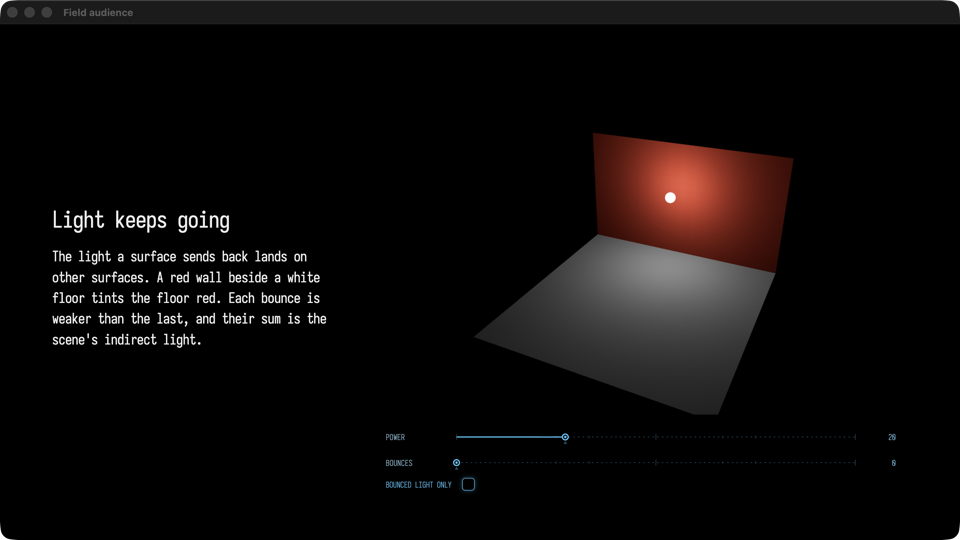
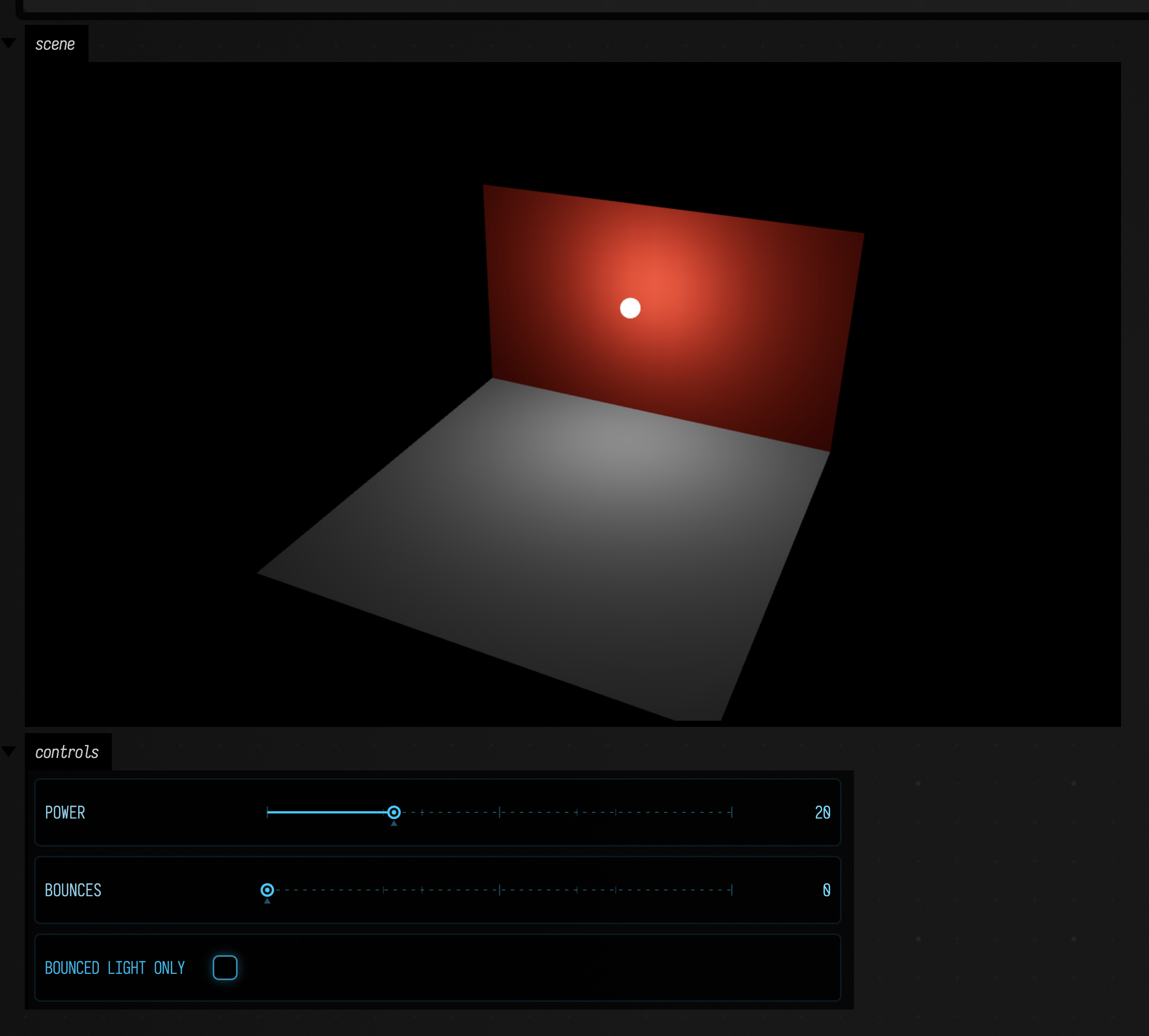
The light a surface sends back lands on other surfaces. A red wall beside a white floor tints the floor red. Each bounce is weaker than the last, and their sum is the scene's indirect light.
:::fold imports
import afield.graphics.lighting.*
:::endfold

/*
A white floor beside a red wall, lit by one small lamp close to the wall, so the wall is lit
far more brightly than the floor. The solve follows the light through three bounces once,
when the box runs; the sliders only choose what to show.
*/
val floor = floorMesh(2.4, 2.4, divisions = 24).withColor(0.8, 0.8, 0.8)
val wall = panelBoxMesh(2.4, 1.4, 0.05, divisions = 16).translated(0.0, 0.7, -1.225).withColor(0.9, 0.06, 0.03)
val lamp = SphereLight(vec(0.0, 0.9, -0.8), radius = 0.06, power = 1.0)
val solve = Radiosity(floor + wall, [lamp], bounces = 3)

var power = 20.0
var bounces = 0.0
var bounceOnly = false

fun draw() {
    val shown = solve.lit(
        upTo = bounces.toInt(),
        from = if (bounceOnly) 1 else 0,
        exposure = if (bounceOnly) 2.0 else 0.6,
        scale = power,
        toneMap = ToneMap.EXPONENTIAL,
    )
    three(channel = "scene", width = 640, height = 420) {
        mesh(shown, unlit = true, wireframe = false)
        mesh(lamp.mesh(), unlit = true, wireframe = false)
        camera(yaw = 25.0, pitch = 28.0, distance = 2.2)
        background("#000000")
        hud(false)
    }
}

draw()
controlGroup {
    slider("power", 5.0, 60.0, step = 1.0, initialValue = power) {
        power = it
        draw()
    }
    slider("bounces", 0.0, 3.0, step = 1.0, initialValue = bounces) {
        bounces = it
        draw()
    }
    checkbox("bounced light only") {
        bounceOnly = it
        draw()
    }
}
Sphere of light
A sky of light
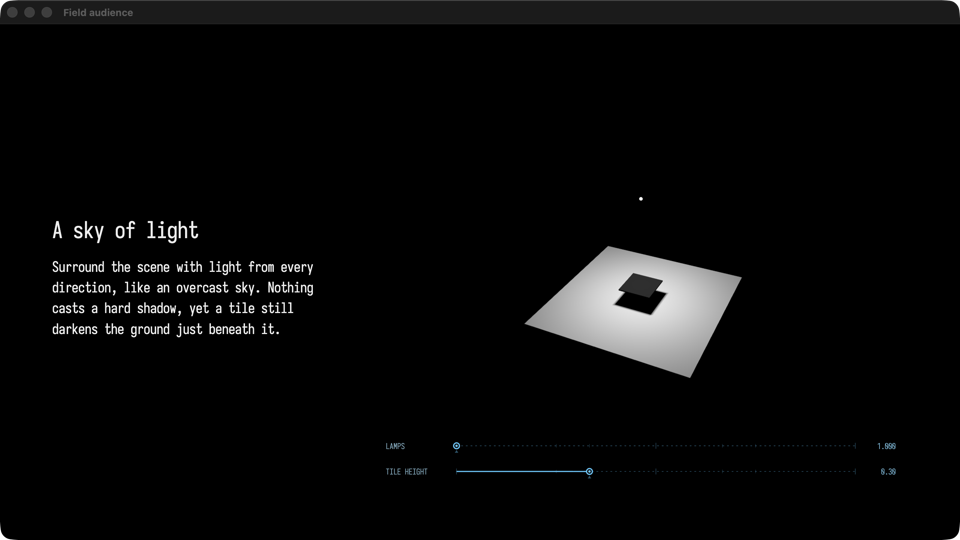
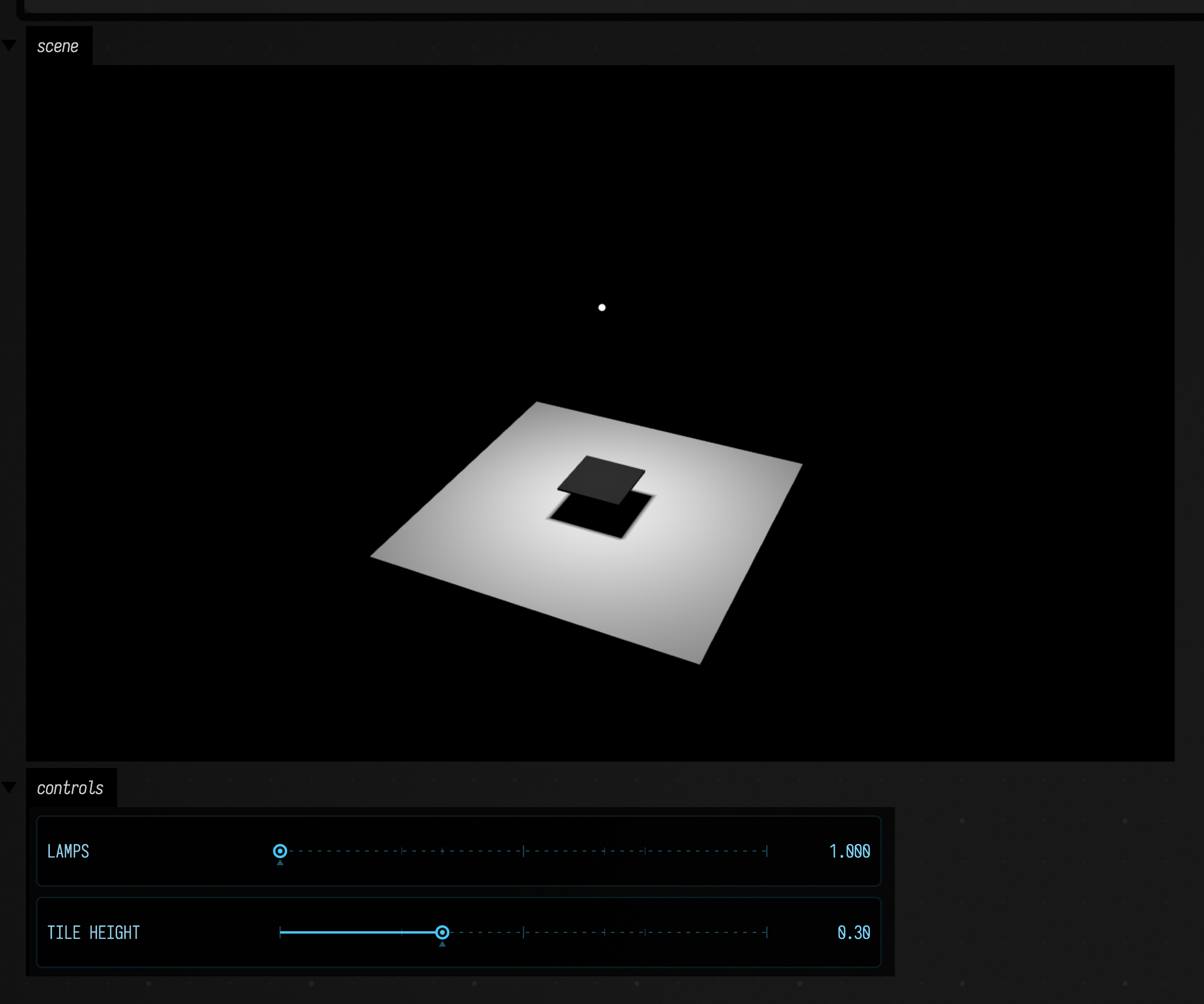
Surround the scene with light from every direction, like an overcast sky. Nothing casts a hard shadow, yet a tile still darkens the ground just beneath it.
:::fold imports
import afield.graphics.lighting.*
:::endfold

/*
A floor under a dome of small lamps, all of them together giving out 400 W, and a black tile
held above the floor. With one lamp the tile casts a hard shadow; with hundreds the light comes
from the whole sky and only the ground right under the tile stays dark.
*/
val floor = floorMesh(3.0, 3.0, divisions = 60).withColor(0.8, 0.8, 0.8)
val golden = PI * (3 - sqrt(5.0))
val dot = icosphereMesh(1, 0.03).withColor(1.0, 1.0, 1.0)
var count = 1.0
var height = 0.3

fun draw() {
    val n = count.toInt()
    // Lamps spread evenly over the upper half of a sphere of radius 2; the first sits overhead.
    val lamps = n { i ->
        val y = if (n == 1) 1.0 else 1 - (i + 0.5) / n
        val r = sqrt(1 - y * y)
        PointLight(vec(2 * r * cos(golden * i), 2 * y, 2 * r * sin(golden * i)), power = 400.0 / n)
    }
    val tile = panelBoxMesh(0.6, 0.02, 0.6, divisions = 4).translated(0.0, height, 0.0).withColor(0.02, 0.02, 0.02)
    val dots = lamps.map { dot.translated(it.position) }.reduce { a, b -> a + b }
    three(channel = "scene", width = 640, height = 420) {
        // Only the tile casts shadows.
        mesh((floor + tile).lit(lamps, occluders = tile, exposure = 0.4), unlit = true, wireframe = false)
        mesh(dots, unlit = true, wireframe = false)
        // Frame the view on the whole set, so it holds still as the lamp changes.
        fitTo(vec(-2.0, 0.0, -2.0), vec(2.0, 2.0, 2.0))
        camera(yaw = 25.0, pitch = 30.0, distance = 2.3)
        background("#000000")
        hud(false)
    }
}

draw()
controlGroup {
    slider("lamps", 1.0, 300.0, step = 1.0, initialValue = count, law = ControlLaw.LOGARITHMIC) {
        count = it
        draw()
    }
    slider("tile height", 0.05, 0.8, step = 0.01, initialValue = height) {
        height = it
        draw()
    }
}
Further reading
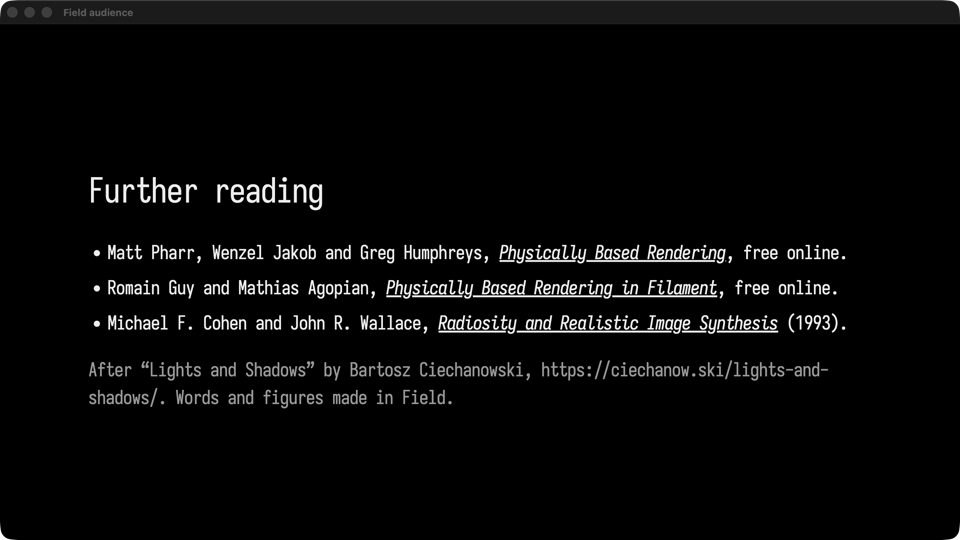
- Matt Pharr, Wenzel Jakob and Greg Humphreys, Physically Based Rendering, free online.
- Romain Guy and Mathias Agopian, Physically Based Rendering in Filament, free online.
- Michael F. Cohen and John R. Wallace, Radiosity and Realistic Image Synthesis (1993). The link is the Internet Archive's lending copy.
The talk follows Bartosz Ciechanowski's Lights and Shadows, read for its order of ideas; every word and figure here was made in Field.
See also: Sound, Cameras and Lenses, the other two talks in this series, and Presenting with Field.
API reference
Implementation and parameter details for the helpers used above: