Brushes with moving hairs
An ordinary PaintCanvas brush places its bristles by rule: they follow the
path, and the tips trail a little behind. canvas.dynamicBrush(...) makes a brush whose hairs are
simulated instead. Each hair is a chain of short segments that bends, drags on the surface, sticks
and slides, splays when it is pressed and springs back when it is lifted. Where the hairs touch,
they lay and pick up paint, oil or watercolour. A brush pressed hard and dragged sideways for long
enough keeps a set, as a real one does.
The hairs have mass and stiffness, so the way the hand moves affects the mark. A TimedGesture
gives the brush's position over time, how hard it presses, and how the handle is tilted and turned. The same path drawn slowly, fast, with a pause, tilted or rolled gives different
marks.
Here is a round brush drawn along the same curve at 20, 80 and 300 mm/s, and then right to left. The slow stroke lays the most paint and runs out first; the fast one lays thinner paint and carries it further.
:::static
val canvas = PaintCanvas(900, aspect = 1.5, groundColor = rgb(0.97, 0.96, 0.92), sizeMm = 200.0, seed = 2)
val umber = rgb(0.25, 0.15, 0.1)

for ((i, speed) in [20.0, 80.0, 300.0].withIndex()) {
    val brush = canvas.dynamicBrush(BrushKind.Round, 60.0, hairs = 32).load(umber, stiff = 0.5)
    val y = 90.0 + i * 120
    canvas.stroke(FLine().moveTo(80, y).cubicTo(350, y - 60, 600, y + 70, 920, y), brush, speed = speed, tilt = 35.0)
}
val brush = canvas.dynamicBrush(BrushKind.Round, 60.0, hairs = 32).load(umber, stiff = 0.5)
canvas.stroke(FLine().moveTo(920, 450).cubicTo(600, 520, 350, 390, 80, 450), brush, speed = 80.0, tilt = 35.0)

display("main", canvas.png(relief = 0.6))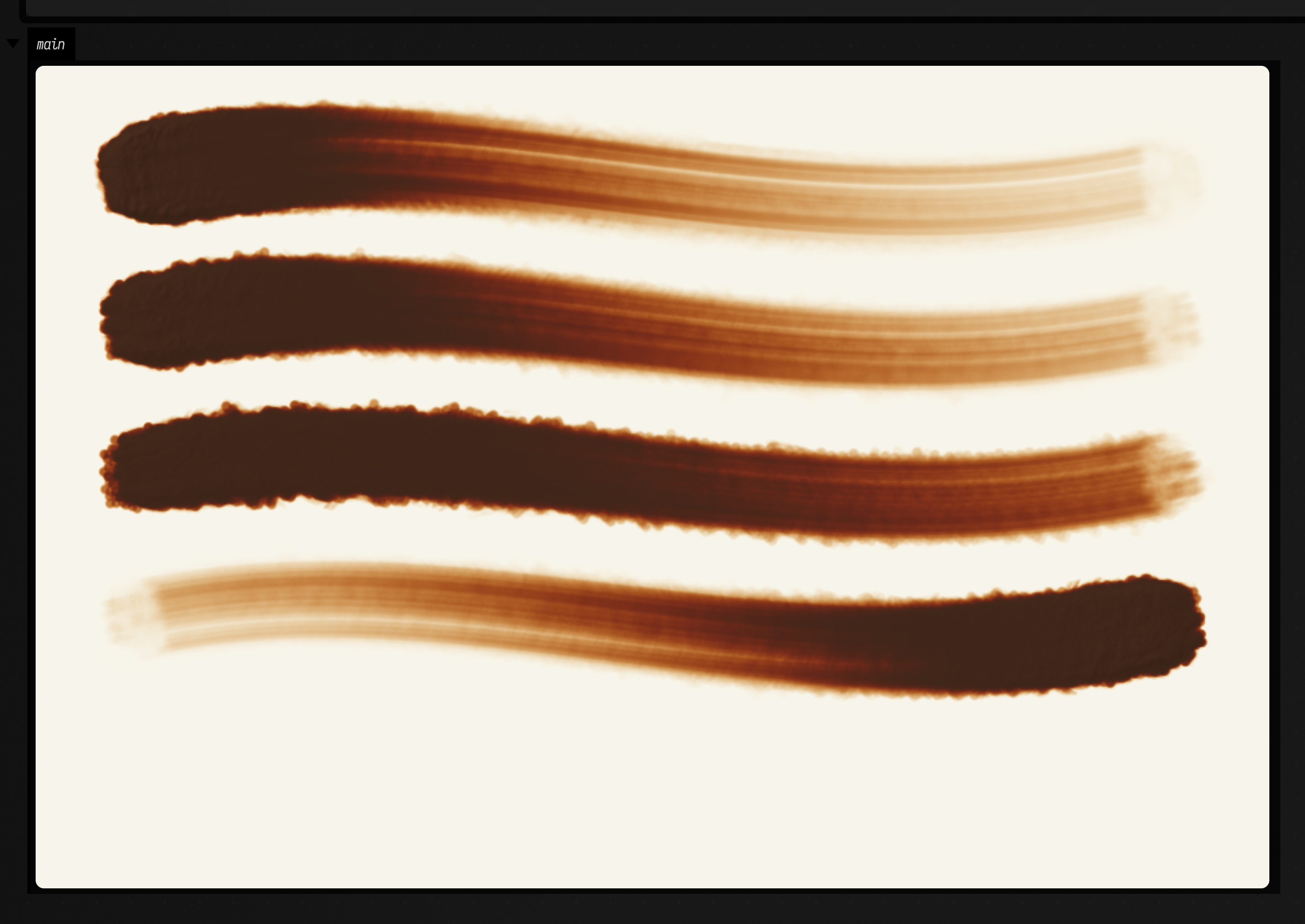
dynamicBrush(kind, width, hairs, segments, config) takes the same BrushKind and
BrushConfig as an ordinary brush, with the number of
hairs to simulate (32 by default) and the segments in each (5). It loads like one, load(color,
...) or load(tubes), and canvas.stroke(line, brush, pressure, speed, tilt) drags it along an
FLine. Every stroke is simulated in 1 ms steps, so a long slow stroke takes longer to paint than
with an ordinary brush.
Gestures
canvas.gesture(line, speed, pressure, tilt, lean, roll) turns an FLine into a TimedGesture:
speedis in mm/s along the path, so the time a stroke takes depends on the canvas'ssizeMm.pressureis one value, a start and an end, or a profile at evenly spaced points along each subpath. At 0 the tips just touch, at 1 the ferrule is pressed down by 60% of the hairs' length, and more presses harder still. Below 0 the brush is lifted clear of the surface, so a stroke that ends below 0 leaves the paper.tiltis the handle's lean from upright in degrees, and withlean(on by default) it leans toward where it is going, so the hairs trail behind the way a pulled brush's do.rollturns the handle about its own axis, which for a flat is the direction of its wide edge. By default a flat is held across its path.facetsmoves the hand in straight chords of that many canvas units instead of along the curve: at each corner the handle turns at once and the hairs whip round, beading a curve with a mark at every corner. A path drawn as a polyline does this at its own corners (the sweep shows how it looks).
A gesture is a list of TimedGesture.Sample(x, y, t, pressure, tilt, azimuth, roll), so you can
also build one yourself, from a pen's samples or a calculation. faster(k), pause(seconds),
then(other) and reversed() make new gestures from old ones.
Below, top left, a flick: pressed at the start and lifted off over a fast 400 mm/s stroke. Top right, the same over a slow one. Second, a stroke that stops for 0.6 s halfway and carries on: the brush held still on the canvas keeps laying paint, so the paint pools under it, and it lays thinner paint afterwards. Third, a flat rolled through half a turn along its stroke, a ribbon that narrows to the brush's edge and opens out again. Last, a filbert held upright and laid well over: upright, only its tips touch, and it runs out sooner.
:::static
fun line(x0: Double, y0: Double, x1: Double, y1: Double) = FLine().moveTo(x0, y0).lineTo(x1, y1)
val canvas = PaintCanvas(900, aspect = 1.5, groundColor = rgb(0.97, 0.96, 0.92), sizeMm = 200.0, seed = 3)
val umber = rgb(0.25, 0.15, 0.1)
fun round() = canvas.dynamicBrush(BrushKind.Round, 50.0).load(umber, stiff = 0.4)

// a flick, then a slow lift over the same distance
canvas.stroke(
    canvas.gesture(line(80.0, 100.0, 420.0, 70.0), speed = 400.0, pressure = [0.9, -0.6], tilt = 30.0),
    round(),
)
canvas.stroke(
    canvas.gesture(line(500.0, 100.0, 900.0, 70.0), speed = 30.0, pressure = [0.9, -0.6], tilt = 30.0),
    round(),
)

// a pause halfway
val first = canvas.gesture(line(80.0, 250.0, 450.0, 250.0), speed = 80.0, pressure = [0.6], tilt = 30.0)
val second = canvas.gesture(line(450.0, 250.0, 900.0, 250.0), speed = 80.0, pressure = [0.6], tilt = 30.0)
canvas.stroke(first.pause(0.6).then(second), round())

// a flat rolled through half a turn
val straight = canvas.gesture(line(80.0, 400.0, 900.0, 400.0), speed = 60.0, pressure = [0.6], tilt = 20.0)
val n = straight.samples.size - 1
val rolled = TimedGesture(straight.samples.mapIndexed { i, s -> s.copy(roll = 90.0 + 180.0 * i / n) })
canvas.stroke(rolled, canvas.dynamicBrush(BrushKind.HogFlat, 60.0).load(umber, stiff = 0.7))

// upright, then laid well over
canvas.stroke(
    canvas.gesture(line(80.0, 540.0, 450.0, 540.0), speed = 80.0, tilt = 0.0),
    canvas.dynamicBrush(BrushKind.Filbert, 50.0).load(umber),
)
canvas.stroke(
    canvas.gesture(line(500.0, 540.0, 900.0, 540.0), speed = 80.0, tilt = 65.0),
    canvas.dynamicBrush(BrushKind.Filbert, 50.0).load(umber),
)

display("main", canvas.png(relief = 0.6))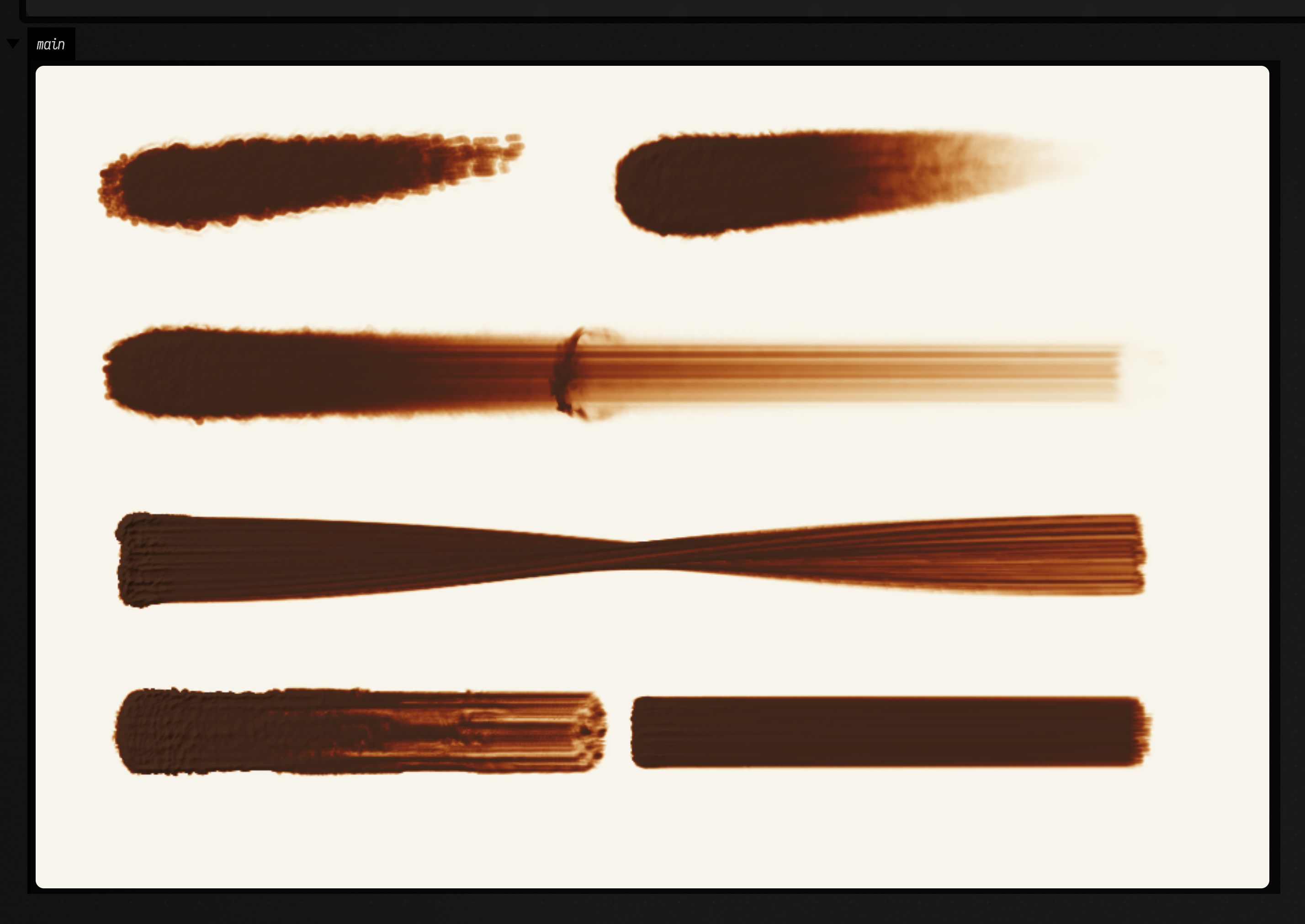
Seeing the hairs
canvas.hairs(brush) gives each hair's nodes as they are now: x and y in canvas coordinates and
the height above the canvas in mm. Below, a round brush pressed down and pulled to the right,
stopped partway, seen from the side: the handle's end of each hair is held in the ferrule at the
top, and the rest bends back and lies along the paper behind it. canvas.contactMap() is how many
seconds of hair touched each pixel during the last stroke, and contactMapPng() draws it.
:::static
val canvas = PaintCanvas(600, aspect = 2.0, groundColor = rgb(0.97, 0.96, 0.92), sizeMm = 100.0, seed = 3)
val brush = canvas.dynamicBrush(BrushKind.Round, 80.0, hairs = 24).load(rgb(0.25, 0.15, 0.1))
canvas.stroke(
    canvas.gesture(FLine().moveTo(200, 250).lineTo(500, 250), speed = 60.0, pressure = [0.8], tilt = 20.0),
    brush,
)

// x along the stroke against height: on a 100 mm canvas 10 units are a mm, so this is to scale
val side =
    canvas.hairs(brush).map { hair ->
        val l = FLine().moveTo(hair[0].first, -hair[0].third * 10)
        for ((x, _, z) in hair.drop(1)) l.lineTo(x, -z * 10)
        l.apply {
            thickness = 1.5
            color = vec(0.95, 0.8, 0.55, 1.0)
        }
    }
val paper = FLine().moveTo(300, 0).lineTo(560, 0).apply {
    thickness = 2.0
    color = vec(0.5, 0.6, 0.7, 1.0)
}
lines(side + paper, w = 520.0, h = 240.0, fitToSize = true)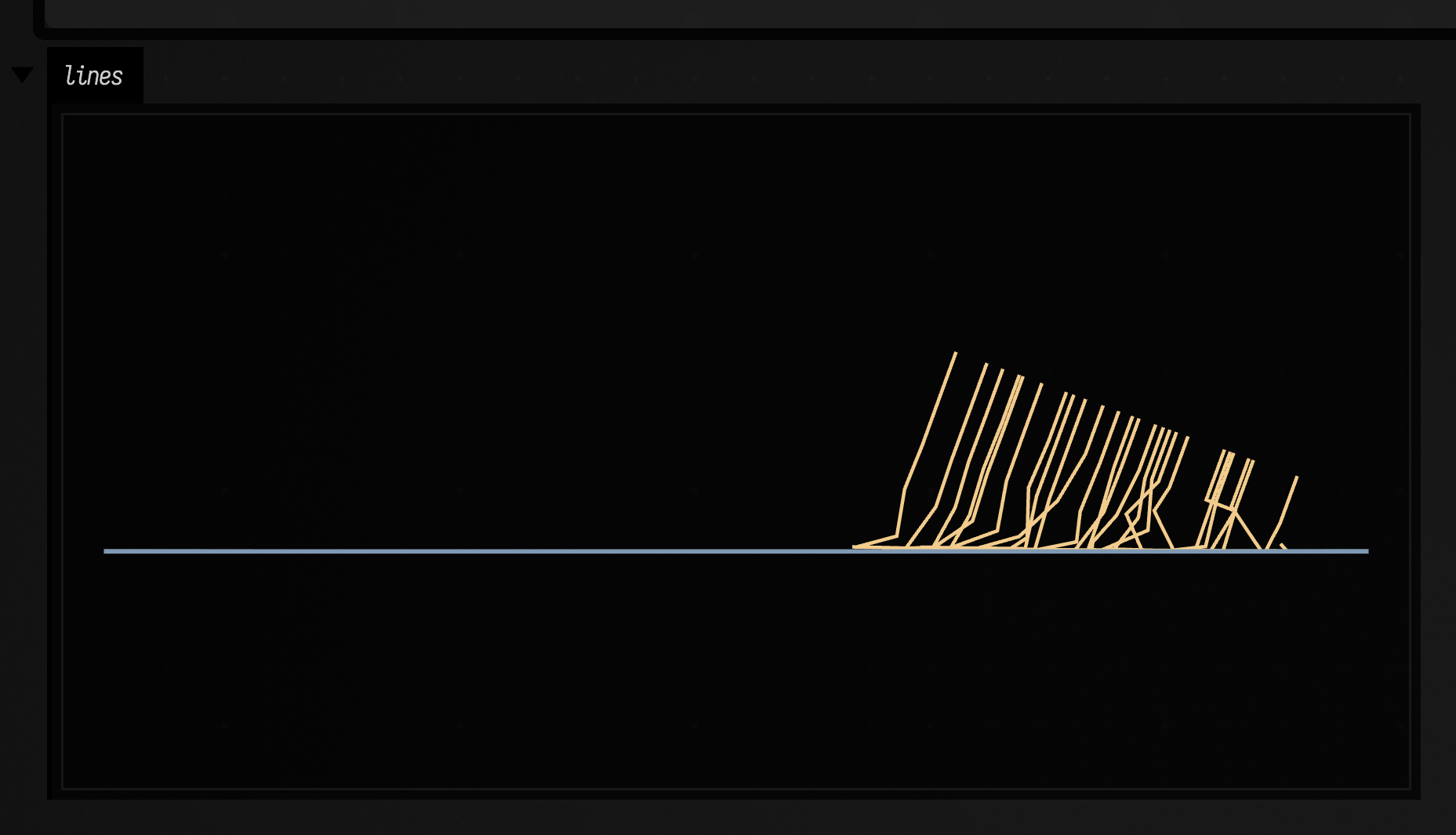
A brush that keeps a set
Hair and hog bristle are keratin, which bends back elastically up to a strain of about 2% and
yields beyond it. A thick, stiff hog bristle reaches that strain at a smaller bend than a fine
sable hair, so ordinary painting leaves a brush nearly straight, but a hog pressed hard and
scrubbed sideways comes away splayed, and stays that way for its next strokes.
brush.retainedBend is the bend the hairs keep at rest, in radians averaged over every joint, 0
for a straight brush; a set comes slowly, over seconds of hard scrubbing, and goes again more
slowly still. brush.set(...) changes how the hairs behave:
friction, static and kinetic, against the surface (0.35 and 0.25 by default);yieldDegrees, the bend past which a joint yields (from the fibre's thickness and the 2% strain by default);plasticity, how fast a yielded joint takes on its bend, per second, andrecovery, how fast a set straightens again;cohesion, how strongly the liquid in a wet brush draws its hairs together: 1 draws a full brush's tips to a point, more pulls harder and closer, and below 0 pushes nearby hairs apart;clumping, which way it does it: 0 (the default) draws the tips of neighbouring hairs together, 1 joins any wet hairs that come near each other by liquid bridges that snap when stretched, so the brush gathers into clumps; between, a blend; past 1 or below 0, more or the reverse;splay,splayFan(0 every pressed hair pushed out alike, 1 the outer ones furthest, so the brush fans open) andsplayScatter(each bundle of hairs buckling its own way).
stroke(gesture, brush, ...) can vary any of the last five along a stroke: give it a function of
the gesture's sample, such as { s -> 0.2 + 0.2 * PaintNoise.along(s) }.
The defaults are estimates for hair and hog bristle. Any value that makes physical sense is accepted: friction can't be negative.
Below, two hog flats loaded the same way and drawn along the same line at the same light pressure. The lower one was first scrubbed hard back and forth for a few seconds. Its bristles have taken a bend, so at that pressure most of them no longer reach the paper, and it paints a thin line where the fresh brush lays a full band.
:::static
fun line(x0: Double, y0: Double, x1: Double, y1: Double) = FLine().moveTo(x0, y0).lineTo(x1, y1)
val umber = rgb(0.25, 0.15, 0.1)

// a scrap canvas of the same size to abuse the brush on
val scrap = PaintCanvas(400, aspect = 1.5, sizeMm = 200.0, seed = 4)
val abused = scrap.dynamicBrush(BrushKind.HogFlat, 60.0, hairs = 40).load(umber, stiff = 0.6)
val scrub = scrap.gesture(
    FLine().moveTo(100, 300).lineTo(900, 300).lineTo(100, 310).lineTo(900, 320).lineTo(100, 330),
    speed = 120.0,
    pressure = [1.6],
    tilt = 10.0,
    roll = 0.0,
)
scrap.stroke(scrub, abused)

val canvas = PaintCanvas(900, aspect = 3.0, groundColor = rgb(0.97, 0.96, 0.92), sizeMm = 200.0, seed = 4)
val fresh = canvas.dynamicBrush(BrushKind.HogFlat, 60.0, hairs = 40)
for ((y, brush) in [100.0 to fresh, 230.0 to abused]) {
    brush.load(umber, stiff = 0.6, wipe = 1.0)
    canvas.stroke(canvas.gesture(line(100.0, y, 900.0, y), speed = 80.0, pressure = [0.5], tilt = 25.0), brush)
}
display("main", canvas.png(relief = 0.6))
markdown("retained bend: fresh %.3f rad, scrubbed %.3f rad".format(fresh.retainedBend, abused.retainedBend))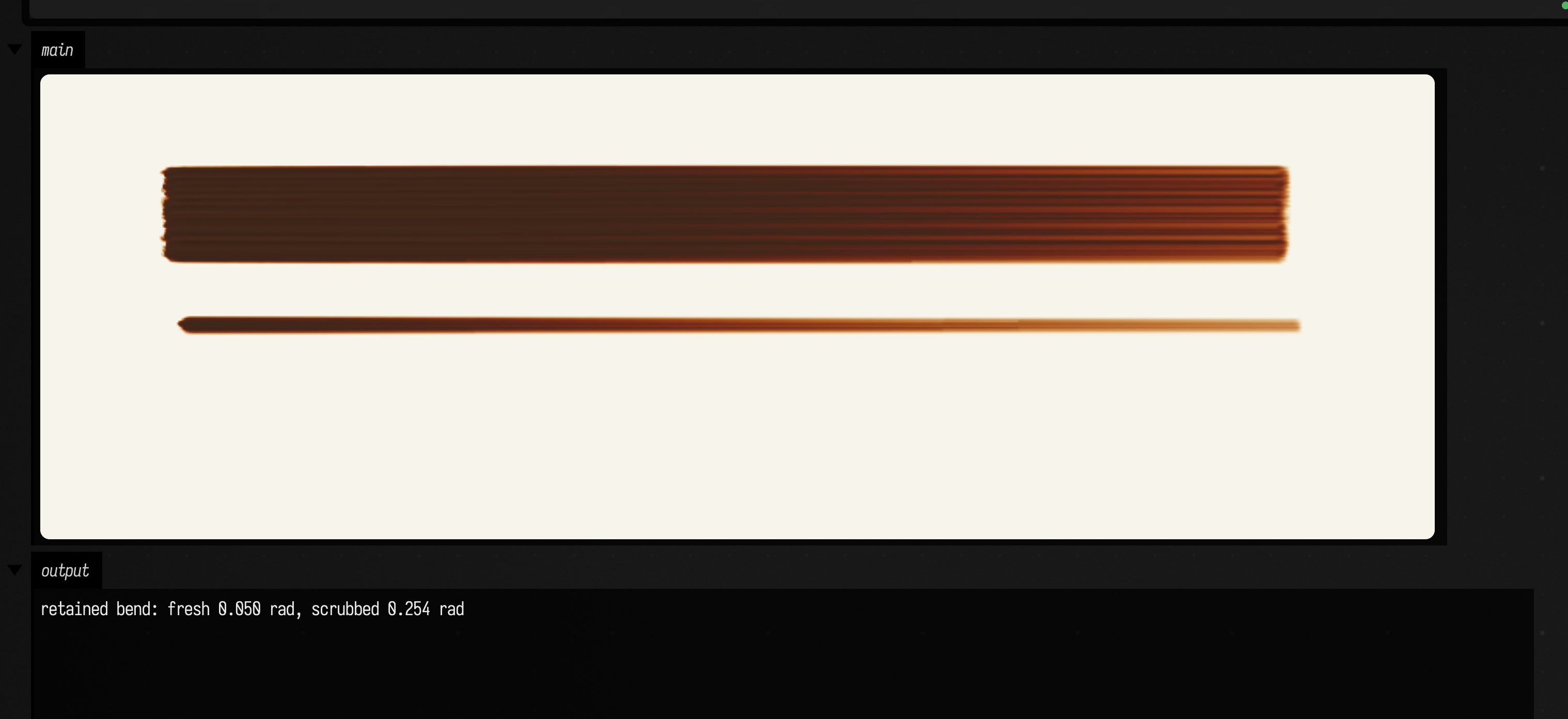
Watercolour
brush.loadWater(canvas, paint, fill) loads a moving brush with
watercolour instead, and from then on its hairs trade water and pigment with the
sheet wherever they touch it. How far the water on them reaches into the paper's tooth depends on
how hard the brush is pressed and how full it is, so a nearly dry brush, light and fast, catches
only the top of the tooth. Below, three strokes on rough paper with the brush full, a quarter full
and nearly dry:
:::static
val sheet = PaintCanvas.paper(700, aspect = 2.5, paper = Paper.Rough, sizeMm = 150.0, seed = 5)
for ((i, fill) in [1.0, 0.25, 0.08].withIndex()) {
    val brush =
        sheet
            .dynamicBrush(BrushKind.Round, 80.0, hairs = 32)
            .loadWater(sheet, Watercolors.burntSienna * 80.0 + Watercolors.ultramarine * 40.0, fill = fill)
    val y = 70.0 + i * 120
    sheet.stroke(FLine().moveTo(60, y).lineTo(940, y), brush, pressure = [0.3], speed = 200.0, tilt = 50.0)
}
sheet.dry()
display("main", sheet.png(relief = 0.5))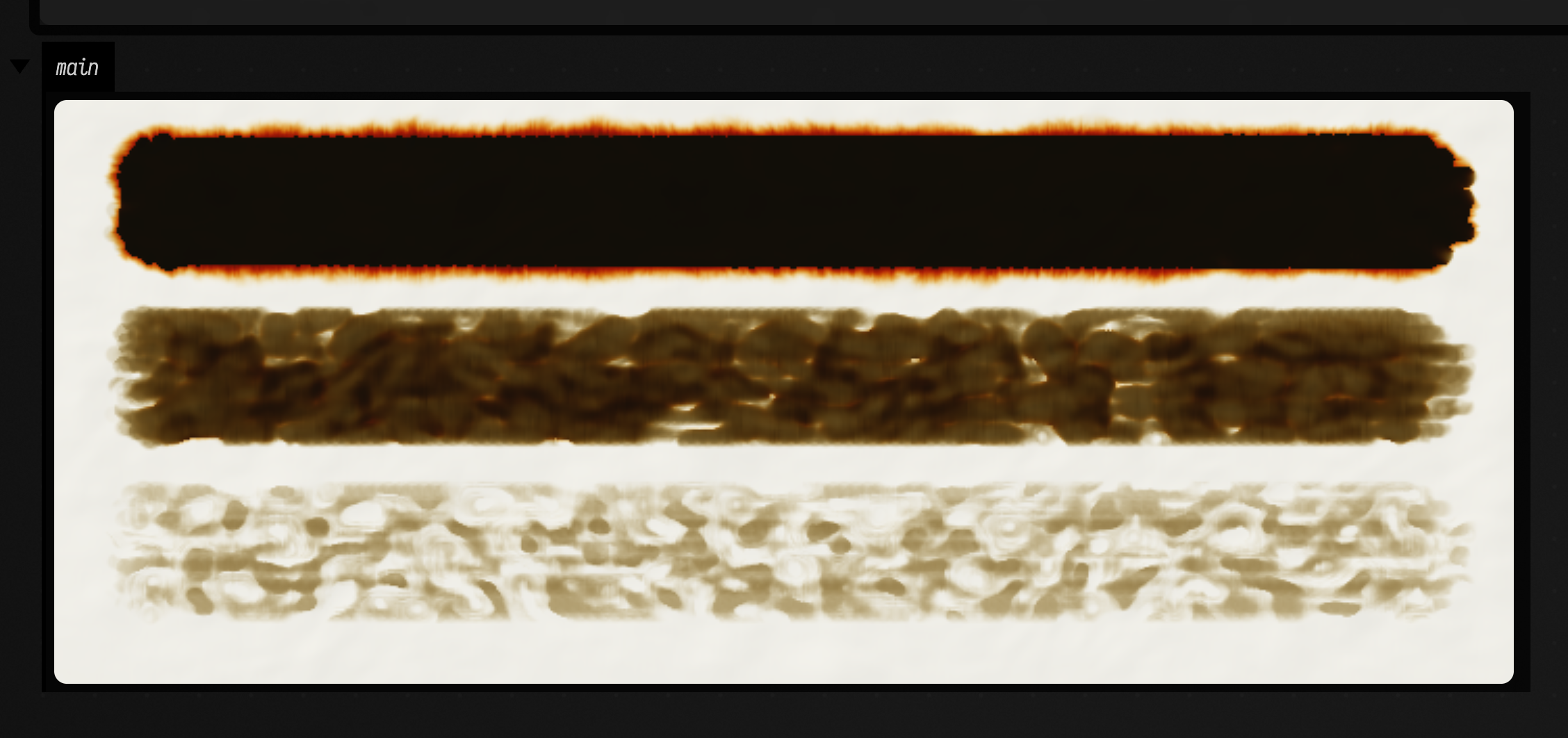
A finished piece
Broad black gestures in the manner of Robert Motherwell's Elegies and the Tachistes need a big
brush and a big canvas, real ones: here two metres of canvas and a house painter's brush about
15 cm wide, with soft, uneven hairs (stiffness = 0.5, ragged = 0.5), held together
(splay = 0.0) so each slab stays one band.
Fat black paint, stiff enough to hold its edge (stiff = 0.5, oil = 1.5), laid as a thin film
(lay = 0.8) from a half-loaded brush (amount = 0.5), so the brush tracks show through it. Each
movement is fast, 260 to 320 mm/s, and ends lifted off the canvas (pressure -0.2), which is where
the edges come from: the hairs drag dry and part as they leave. The ovals spiral out from their
middles, so their outer edge is painted last, as the brush runs out.
:::static
// two metres of canvas, primed off-white
val canvas = PaintCanvas(1200, aspect = 2.1, groundColor = rgb(0.93, 0.9, 0.83), sizeMm = 2000.0, seed = 11)
val h = canvas.heightUnits

// a house painter's brush: soft, uneven hairs held together, laying a thin film of fat black
val housePainter = BrushConfig(stiffness = 0.5, ragged = 0.5, splay = 0.0, lay = 0.8, run = 1100.0)
fun brush(width: Double) =
    canvas
        .dynamicBrush(BrushKind.HogFlat, width, hairs = 48, segments = 6, config = housePainter)
        .load(rgb(0.05, 0.045, 0.04), hiding = 0.65, stiff = 0.5, oil = 1.5, amount = 0.5)

// an oval spiralling out from its middle, so its edge comes last, as the brush runs dry
fun oval(cx: Double, cy: Double, rx: Double, ry: Double): FLine {
    val line = FLine()
    line.breakNext()
    for (i in 0..120) {
        val u = i / 120.0
        val a = PI / 2 + 2 * PI * 1.8 * u
        val r = 0.2 + 0.8 * u
        line.lineTo(cx + rx * r * cos(a), cy + ry * r * sin(a))
    }
    return line
}

// three slabs, each one movement, pressed down and lifted off the canvas at its end
for ((x, width) in [120.0 to 70.0, 470.0 to 80.0, 905.0 to 65.0]) canvas.stroke(
    canvas.gesture(
        FLine().moveTo(x, 25).lineTo(x + 8, h - 25),
        speed = 260.0,
        pressure = [0.7, 1.0, 0.9, 0.4, -0.2],
        tilt = 25.0,
    ),
    brush(width),
)
// and two ovals between them
for ((cx, cy, rx) in [Triple(300.0, 250.0, 120.0), Triple(690.0, 230.0, 140.0)]) canvas.stroke(
    canvas.gesture(
        oval(cx, cy, rx, 170.0),
        speed = 320.0,
        pressure = [1.1, 1.0, 0.8, 0.4, -0.2],
        tilt = 35.0,
    ),
    brush(80.0),
)

display("main", canvas.png(relief = 0.3))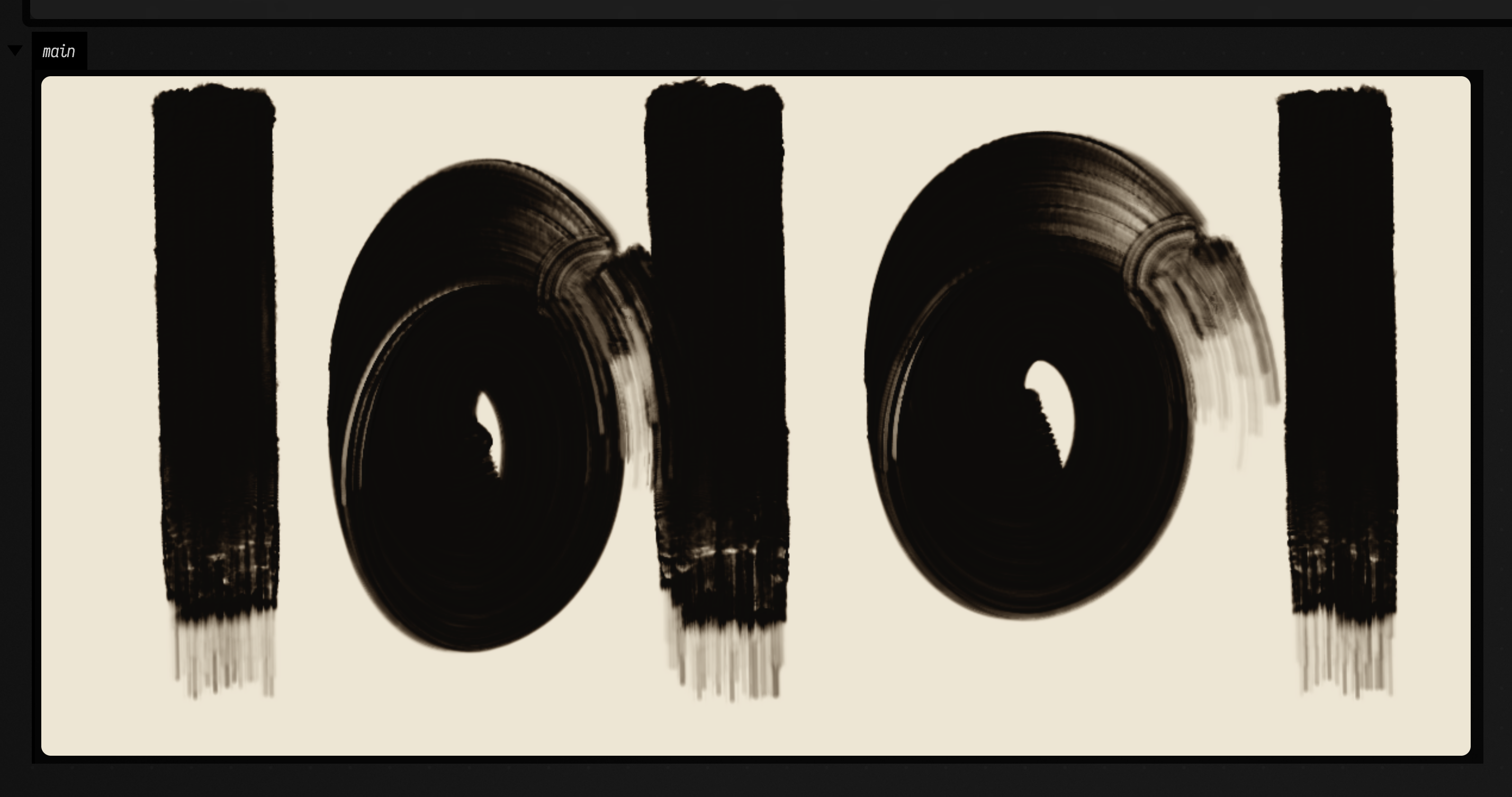
The same painting, with the black let down by a little painting medium (thinner = 0.15): the film
no longer covers, and breaks into a cellular veil over the ground while the edges stay dark.
:::static
// two metres of canvas, primed off-white
val canvas = PaintCanvas(1200, aspect = 2.1, groundColor = rgb(0.93, 0.9, 0.83), sizeMm = 2000.0, seed = 11)
val h = canvas.heightUnits

// the same brush, its black let down with a little painting medium
val housePainter = BrushConfig(stiffness = 0.5, ragged = 0.5, splay = 0.0, lay = 0.8, run = 1100.0)
fun brush(width: Double) =
    canvas
        .dynamicBrush(BrushKind.HogFlat, width, hairs = 48, segments = 6, config = housePainter)
        .load(rgb(0.05, 0.045, 0.04), hiding = 0.55, stiff = 0.5, thinner = 0.15, oil = 1.5, amount = 0.5)

// an oval spiralling out from its middle, so its edge comes last, as the brush runs dry
fun oval(cx: Double, cy: Double, rx: Double, ry: Double): FLine {
    val line = FLine()
    line.breakNext()
    for (i in 0..120) {
        val u = i / 120.0
        val a = PI / 2 + 2 * PI * 1.8 * u
        val r = 0.2 + 0.8 * u
        line.lineTo(cx + rx * r * cos(a), cy + ry * r * sin(a))
    }
    return line
}

// three slabs, each one movement, pressed down and lifted off the canvas at its end
for ((x, width) in [120.0 to 70.0, 470.0 to 80.0, 905.0 to 65.0]) canvas.stroke(
    canvas.gesture(
        FLine().moveTo(x, 25).lineTo(x + 8, h - 25),
        speed = 260.0,
        pressure = [0.7, 1.0, 0.9, 0.4, -0.2],
        tilt = 25.0,
    ),
    brush(width),
)
// and two ovals between them
for ((cx, cy, rx) in [Triple(300.0, 250.0, 120.0), Triple(690.0, 230.0, 140.0)]) canvas.stroke(
    canvas.gesture(
        oval(cx, cy, rx, 170.0),
        speed = 320.0,
        pressure = [1.1, 1.0, 0.8, 0.4, -0.2],
        tilt = 35.0,
    ),
    brush(80.0),
)

display("main", canvas.png(relief = 0.3))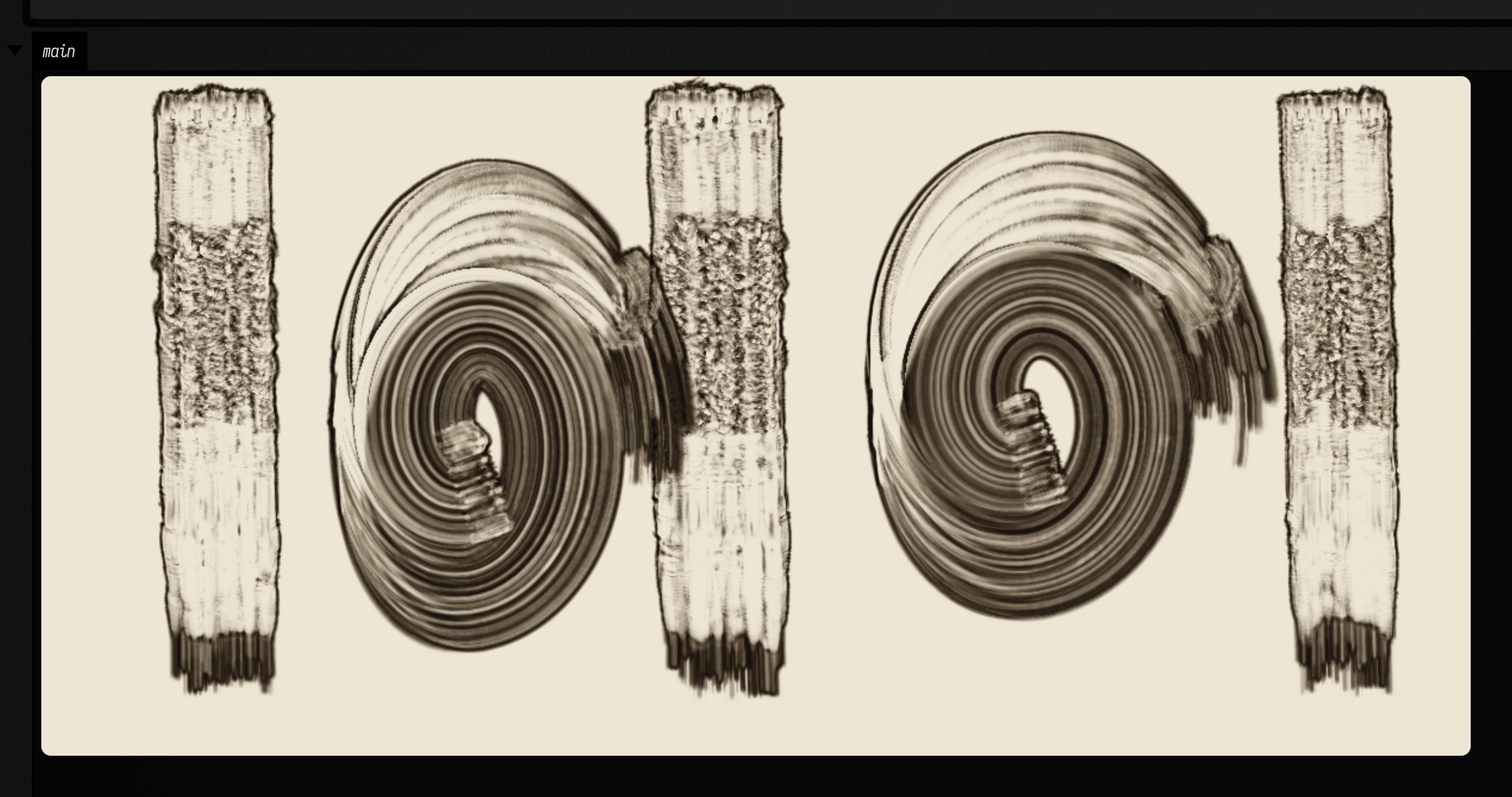
Note
Medium changes the black all at once, not by degrees: none gives a covering film, and even
thinner = 0.03 gives nearly the veil above. hiding does little to black at any value, since
black absorbs almost everything in any film. For a black that is only a little less dense, lay
less of it (lay, amount) instead.
Keeping a brush
A moving brush keeps its paint or water, and the set of its hairs, from one stroke to the next. A
PaintToolbox keeps it by name with the other tools (tools.dynamicBrush("hog")), and
brush.state() and DynamicBrush.restore(state, kind) snapshot it exactly: every hair's
position and rest bend, and every bristle's paint. AI4 paints keeps its
painter's moving brushes this way, so rewinding a conversation brings back a brush as splayed as
it was then.
What is simulated
| how | ||
|---|---|---|
| The hairs | chains of segments under position-based dynamics (Verlet integration, constraint projection, 1 ms steps): each segment keeps its length, each joint is pulled toward its rest angle, more strongly the stiffer the hair | simulated |
| Contact | a node below the surface (paper, dry paint, wet paint) is put back on it | simulated |
| Friction | Coulomb's: a node sticks until its slip exceeds static friction times how hard it presses, then slides against kinetic friction | simulated |
| Splay | a hair pressed into the surface is pushed out from the brush's middle by splay (in BrushConfig) times how far it is pressed in, against the same grip: hard enough, a flat parts in two |
an approximation of buckling by one number |
| A set | a joint bent past its yield (2% strain at the surface of a fibre whose thickness is estimated from the brush's stiffness) moves its rest angle toward the bend, and recovers slowly | simulated, with estimated rates |
| Clumping | by default the liquid in a full brush draws neighbouring tips together; with clumping 1, a liquid bridge forms where two wet hairs come near each other and pulls them together, harder toward the tips and the wetter and thinner the paint, and snaps when they are pulled a few spacings apart, further the more liquid it holds, so splay tears a wet brush into clumps |
the tip pull is one strength; the bridges are simulated, their strength and reach estimates |
| Oil paint | each of the brush's dense bristles follows the hair nearest it and trades paint where it touches, through claude-paint's own paint model | the paint is claude-paint's; the contact is Field's |
| Watercolour | every touching hair trades with the sheet over a disc a clump of hairs wide, through the watercolour model | simulated |
| Hair count | 16–64 hairs stand for the thousands in a real brush; the dense bristles copy their hair's contact; hairs do not collide with each other except through their bridges | approximated |
Where the code is
The hairs are native/field-paint/vendor/paint/src/field/bristles.rs, Field's addition to
alice's claude-paint crate; oil paint
goes through claude-paint's own bristle exchange, which VENDORED.md lists among the places
Field opened up in alice's code. DynamicBrushTest checks contact, tilt, the set,
keeping and restoring, watercolour's books, and gesture headings.
See also: Paint settings, swept, where one gesture is painted with each setting in turn, Paint and pencil from FLines, Watercolour and ink, AI4 paints.