Ray Reconstruction for the path tracer
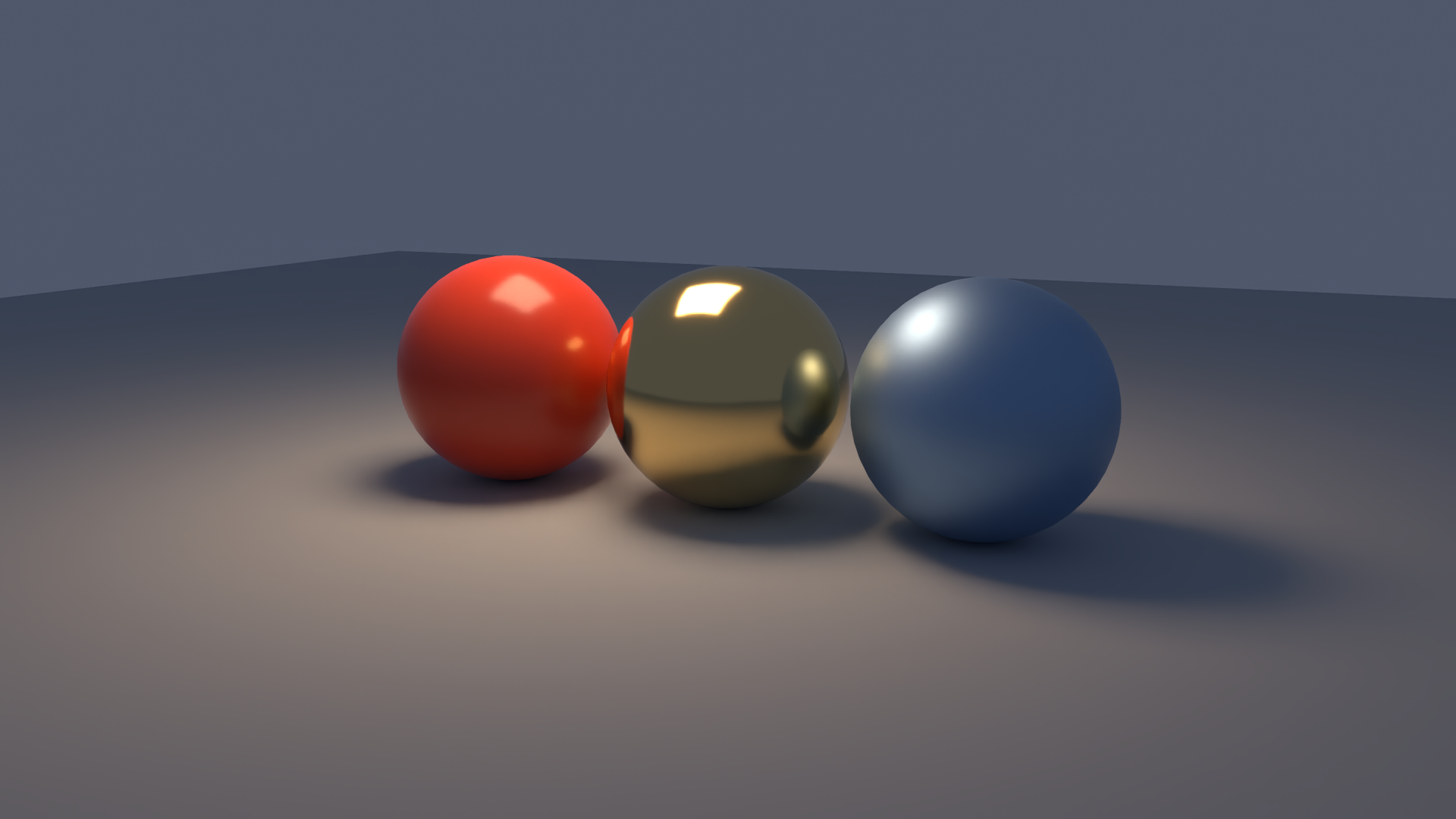
The path tracer can send its current frame to the Ray Reconstruction adapter used by RTXDI lighting. This scene includes indirect bounces, glossy reflections and an area emitter. You can compare the result with the raw signal and progressive accumulation.
Open the scene
Open the path_traced_reconstruction Starting Point, after the optional NGX setup. The scene contains a diffuse floor, plastic and metallic spheres, and an area emitter. It renders at 1920 × 1080 with one sample per pixel per frame.
Choose Raw, Progressive or RR without restarting. Move camera tests reprojection; Cut camera and reset deliberately changes the view and discards reconstruction history. Samples per frame controls the actual integrator. The raw view stays noisy because it shows a single dispatch before any temporal accumulation.
The plumbing
Create your scene and an uninstalled PathTracingRenderer, then give it to PathTracedReconstruction. The adapter owns dispatch order and closes that tracer when it closes.
val tracer = PathTracingRenderer(
    renderer,
    scene,
    environment,
    1920,
    1080,
    camera,
)
val lab = PathTracedReconstruction(tracer).install()
lab.view = PathTracedReconstruction.View.RECONSTRUCTED
// On a camera cut or an appearance change:
lab.reset("camera cut")
This records path tracing → guide conversion → NGX on Field's graphics queue. The tracer writes raw linear radiance before progressive accumulation, together with primary-surface data. A GPU pass exposes those records as seven image attachments. No pixels cross the JVM/native boundary; the existing NGX adapter receives image handles and records reconstruction into the command buffer.
| Input | Source and convention |
|---|---|
| Color | Current dispatch's unclamped linear RGB, before exposure or tone mapping |
| Depth | Perspective Vulkan 0…1; near 0.01, far 10,000, background 1 |
| Motion | Previous minus current position, in input pixels, without jitter; camera motion for the scene snapshot |
| Diffuse guide | Actual primary-surface diffuse reflectance |
| Specular guide | View-dependent BRDF approximation from the NGX guide, using the actual material |
| Normal / roughness | World-space shading normal and primary-surface roughness |
| Specular hit distance | A traced stochastic GGX reflection distance; documented sky sentinel |
The primary visibility sample uses the adapter's Halton jitter. UI and display tone mapping occur afterwards. Material shader revisions and tracer configuration resets invalidate reconstruction history; explicit cuts and other appearance edits use lab.reset(). Recreate the adapter for changed input/output dimensions. The input images belong to the tracer and are borrowed by NGX until the tracer closes.
tracer.enableFrameOutput() also exposes these images without NGX. That lets your own Target inspect or process raw lighting, depth, motion and guides. The reconstruction plumbing page explains the generic image contract; the difference here is that the path integrator produces the guides itself.
Put a material shader in the box
The scene above starts with Kotlin material values. To edit their appearance in GLSL, replace its PathTracingRenderer(...) construction and lab = ... assignment with the following. pathTracingHere() seeds the box's compute property with the material hook and connects it to Field's normal shader reload actions.
val tracer = pathTracingHere(
    scene,
    PathTraceEnvironment.constant(.08f, .1f, .15f),
    width = 1920,
    height = 1080,
    camera = camera,
    name = "rr-materials",
)
// install() takes over the standalone passes pathTracingHere scheduled.
lab = PathTracedReconstruction(tracer).install()
Now open compute and replace the identity material hook with this shader. The two template lines supply the integrator and its types; leave them in place. This edits the floor, whose material ID is zero in this Starting Point.
{{ pathTracing.preamble }}

Material shadeMaterial(Material material, PathTraceSurface surface) {
    if (surface.materialId == 0) {
        float stripe = smoothstep(.35, .65,
        .5 + .5 * sin(surface.position.x * 8.0));
        material.base.rgb = mix(vec3(.06, .12, .3), vec3(.8, .18, .04), stripe);
        material.base.w = 0.0; // metallic
        material.emission.w = .3; // roughness
    }
    return material;
}

{{ pathTracing.integrator }}
After the update, through RR:
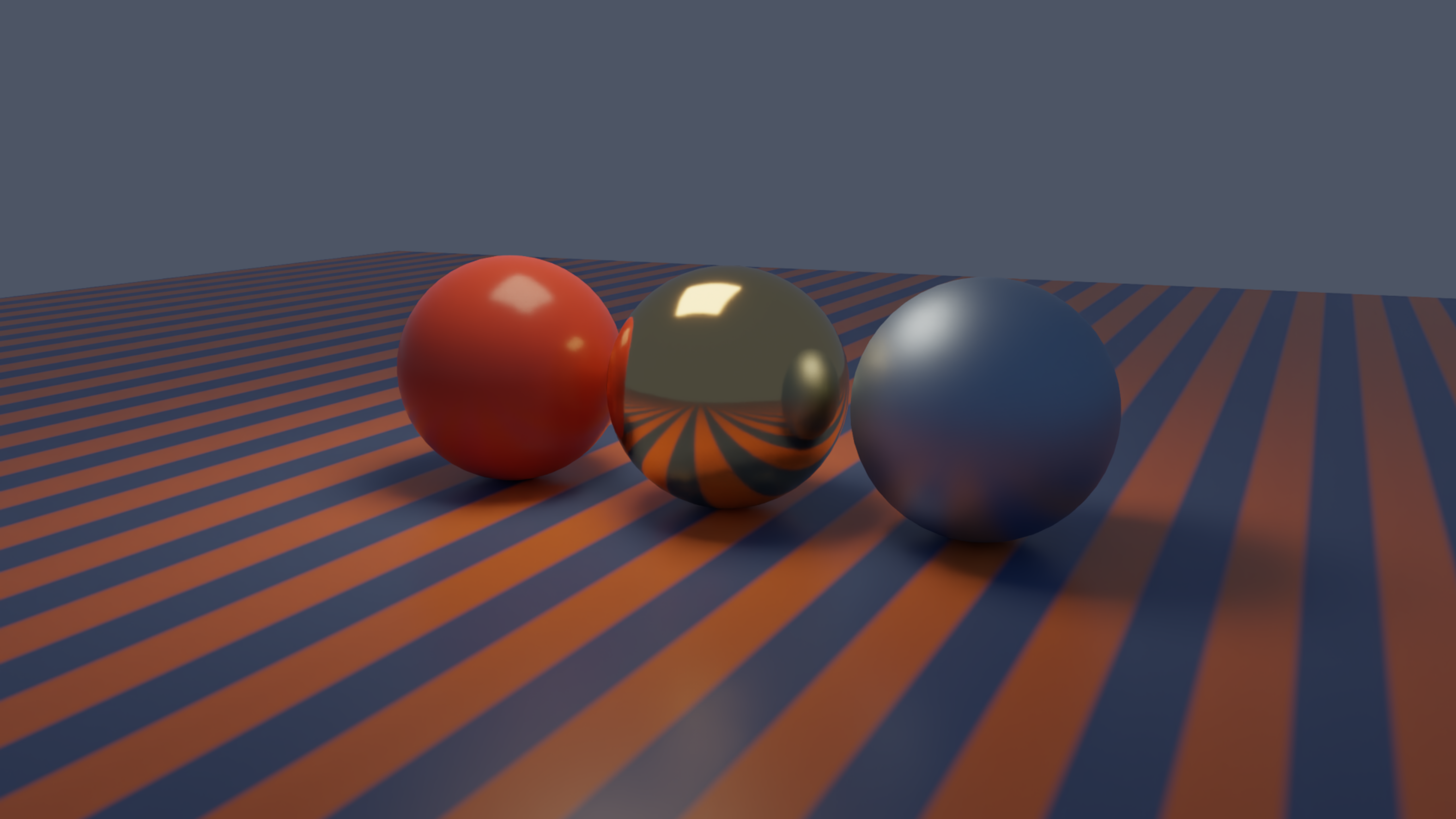
With 3.0 for the frequency and .05 for the roughness, the stripes widen and the floor turns glossy, mirroring the spheres and the emitter:
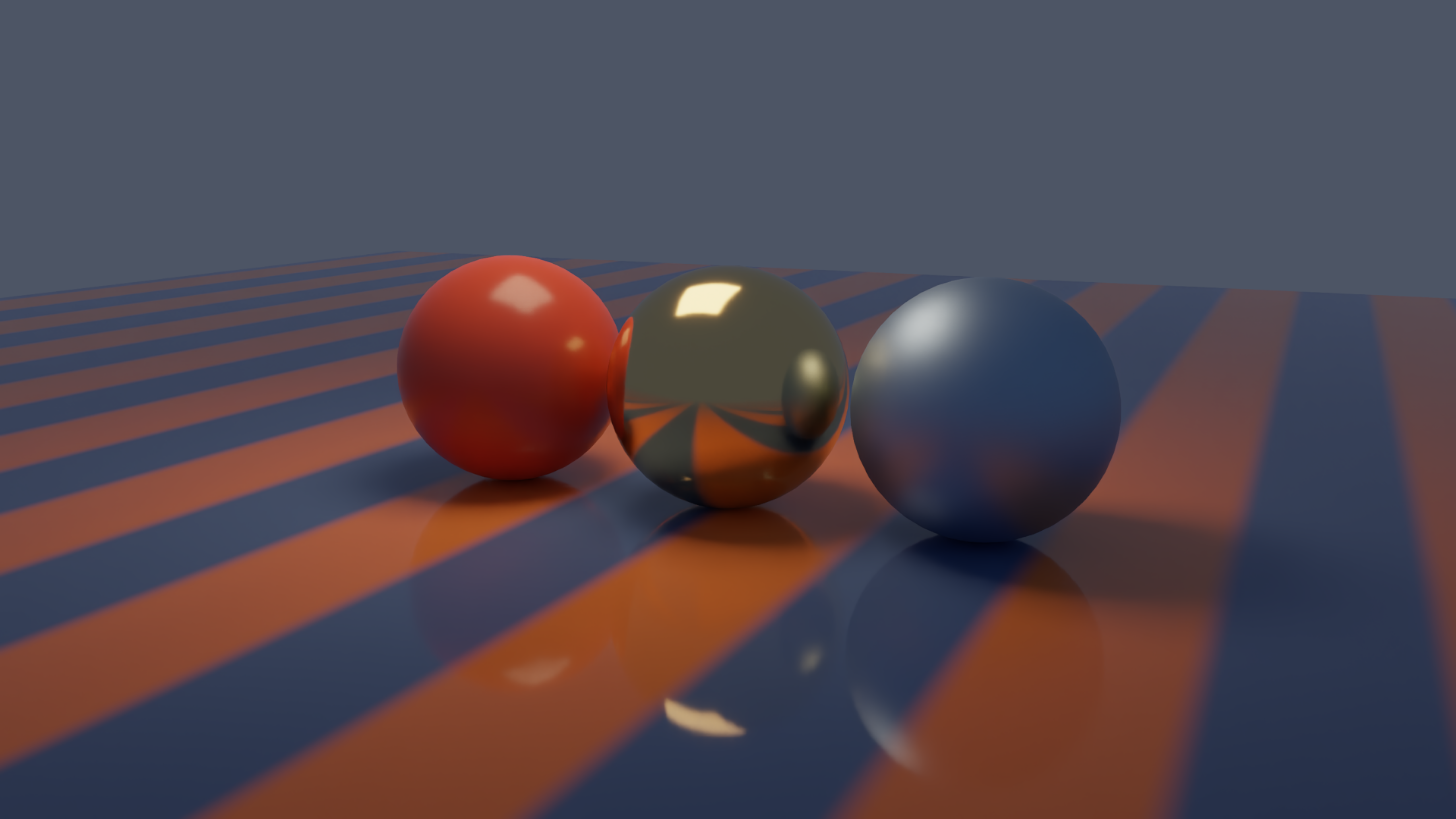
Use Update Compute Shader, then change 8.0 to vary the stripe frequency or .3 to change roughness. The function runs at surface hits, so the material affects direct light, indirect light and reflections; the primary-surface RR guides use its result too. Successful reload resets accumulation and reconstruction history; a compile error preserves the working pipeline. Keep materials opaque for this adapter. If you later animate a material uniform, call lab.reset("material parameter changed") when its value changes—geometric motion vectors do not describe that appearance change. See material shaders for the full Material and PathTraceSurface contracts.
Quality and cost
Error is measured against a much longer progressive reference of the same static scene. At 1920 × 1080 on the RTX 4090, a warmed run measured 11.86 ms median / 12.16 ms p95 for the complete pass, including 6.09 / 6.22 ms in NGX. Raw RGB MSE was 0.01934, versus 0.0000689 after RR against the progressive reference. Guide storage was 308 MiB; NGX’s internal allocation query returned zero, so its memory remains unknown. These are this scene’s results with automatic GPU clocks and Wayland presentation, not fixed-clock throughput benchmarks.
The measurement record contains raw/reference error, reconstructed/reference error, separate NGX and complete-pass time distributions, and guide storage at 960 × 540 and 1920 × 1080. Timings come from a continuous warmed run, separate from PNG capture. The guide path uses a 96-byte record per input pixel plus seven images, so its memory cost is substantial.
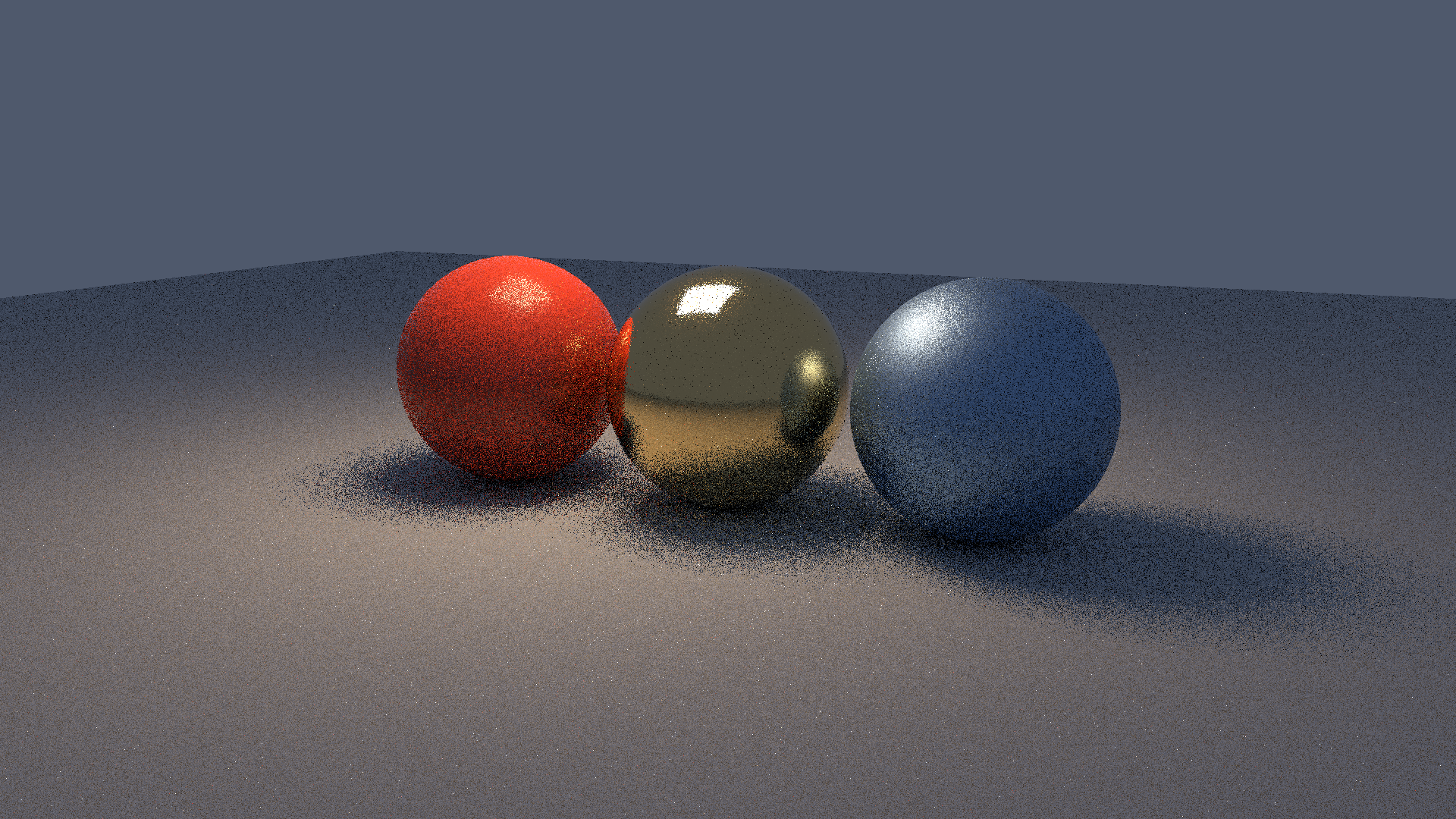
What the GPU check covers
Besides the error comparison above, the GPU check verifies an analytical plane's radiance, depth and known camera translation in both compute-BVH and ray-query backends, then exercises moving cameras, cuts, two resolutions and recreation under Vulkan validation.
Current boundaries
This adapter supports opaque diffuse and glossy surfaces with a pinhole camera. It explicitly rejects transmission/coverage materials, participating media, fog and depth of field. Those effects need different correspondence and guide treatment; use the progressive path-tracing modes for them. Scene geometry is a snapshot: changing geometry recreates the tracer rather than implying that object motion vectors have been supplied.
RR is optional. It may suppress an intentional noisy or unstable appearance, and a lower static error does not prove that every moving highlight remains faithful. Keep the raw view and test your own shader edits and abrupt changes.