FieldML's JVM bridge
FieldML's prelude covers geometry (fline, vec3, draw, animate). Everything else in Field is Kotlin, and the bridge is how a FieldML box calls it.
From a FieldML box you can call a Kotlin method with any number of arguments, positionally or by name; pass a FieldML function where Kotlin wants a lambda, including a suspend one; and use Field's box-code macros such as prop, moduleHere and println. A lambda you hand to a Kotlin method gets its parameter types from that method's signature, so .x on a Vec3 parameter is checked before the box runs. The exceptions are listed under what it will not do.
One box, end to end
This box is written in FieldML, and the drawing is done by Kotlin. A FieldML function of (x, y) is handed to Img.generate, which rasterises it; the result goes through Field's colormap extension and out through showImg.
let Img = hostClass "afield.media.image.Img"
let Imaging = hostClass "afield.media.image.Imaging_fieldKt"

// The whole picture is this function. x and y are Ints; the result is one
// sample. Kotlin calls it once per pixel.
let sample x y =
  let u = (toFloat x - 120.0) / 120.0 in
  let v = (toFloat y - 120.0) / 120.0 in
  let r = sqrt (u * u + v * v) in
  sin (r * 11.0) * cos (u * 5.0) * exp (0.0 - r * 1.1) * 0.5 + 0.5

let picture =
  Img
    |> hostGet "Companion"
    |> hostCall "generate" (240, 240, sample)
    |> hostExt Imaging "colormap" ("viridis", hostNull, hostNull)

hostStaticCall "showImg" (thisBox, picture, "main", 480, "Img.generate, driven by a FieldML function") Imaging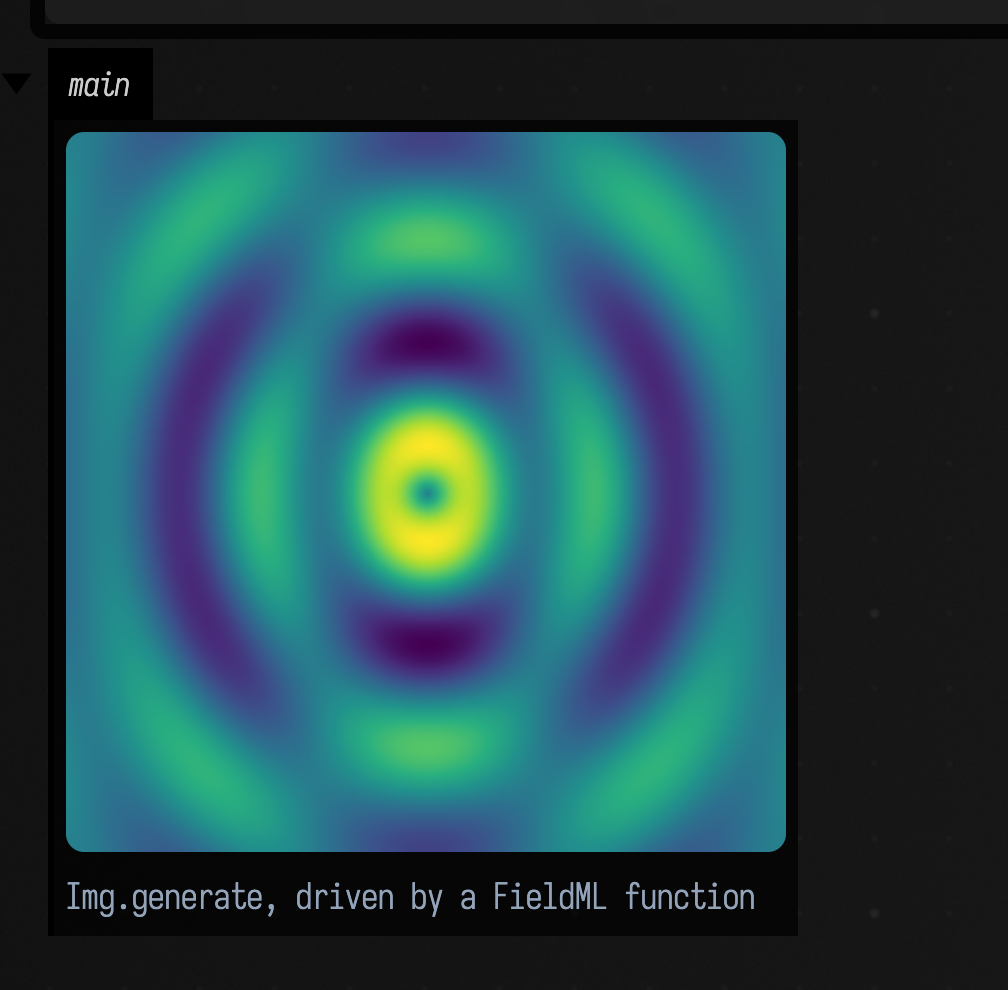
Change 11.0 in sin (r * 11.0) and the ring spacing changes; change "viridis" to "magma" or "coolwarm" and the palette does.
The last two steps show the two ways to call a Kotlin extension function. colormap is an extension on Img, so the piped picture is its receiver and hostExt fits. showImg is an extension on Box, so its receiver is thisBox and the picture is an ordinary argument; that call uses hostStaticCall, with every parameter written out in order.
Calling a method
hostCall name arguments target calls a method. The target comes last, so it can sit at the end of a pipe:
let Img = hostClass "afield.media.image.Img"
let img = hostNew (4, 4, 1, [0.0, 0.1, 0.2, 0.3, 0.4, 0.5, 0.6, 0.7, 0.8, 0.9, 1.0, 0.9, 0.8, 0.7, 0.6, 0.5]) Img

img |> hostCall "index" (1, 0, 0)
The arguments are a tuple, and a tuple is spread, so (1, 0, 0) is three arguments. A list written in place is spread the same way, () is no arguments at all, and anything else is one argument. That last rule is the only place to be careful: to pass a single list as one argument, use hostCall1, which never spreads.
| Form | Arguments |
|---|---|
hostCall "m" () t |
Calls m on target t with no arguments; () is the empty bundle. |
hostCall0 "m" t |
Calls the same zero-argument method without an explicit bundle. |
hostCall1 "m" x t |
Passes exactly one argument, preserving x even when it is a list, tuple or record. |
hostCall "m" (a, b, c) t |
Spreads the tuple into three positional arguments, in order. |
hostCall "m" [a, b, c] t |
Spreads the list into three positional arguments. |
hostCall1 "m" [a, b, c] t |
Passes the list as one argument, without spreading it. |
hostNew arguments class and hostNew0 class are the same for constructors, and hostStaticCall name arguments class is the same for statics. hostExt class name arguments is a static called with the piped value in front of the written arguments. That is how a Kotlin extension function compiles, and most of Field's API is extension functions.
When a method is overloaded, each candidate is scored argument by argument, so hostStaticCall "max" (3, 7) reaches Math.max(int, int) and (3.5, 7.25) reaches Math.max(double, double). FieldML has one integer type and one float type, so a conversion happens on nearly every call: Int reaches long/short/Number, Float reaches float and Double, a FieldML list reaches a JVM array or a vararg, and hostNull reaches anything nullable. That last one fills an optional Kotlin parameter, since a reflective call cannot use Kotlin's defaults.
A parameter of the same kind wins (floating point for a FieldML Float, integral for an Int), and a lossy conversion scores worst. Vector2f declares both void set(int, float) and Vector2f set(float, float); a FieldML (3.0, 4.0) fits both, and reaches the second. The type checker and the runtime score the same way, so the overload completion shows you is the one the call reaches.
Passing a function
A FieldML function can go wherever Kotlin expects a function: a Kotlin lambda parameter ((Int, Int) -> Float), a receiver lambda (Box.() -> Unit, whose receiver arrives as the first argument), or a Java interface such as Runnable, Supplier or Comparator. This one moves the points of a line through FLine.transform, and draws the line before and after:
let straight =
  fline
    |> moveTo 0.0 0.0
    |> lineTo 100.0 0.0
    |> lineTo 100.0 60.0
    |> stroked true
    |> filled false
    |> color (vec4 0.5 0.5 0.5 1.0)
    |> thickness 2.0

let warped =
  straight
    |> hostCall1 "transform" (fun p ->
         vec3 (p.x) (p.y + 20.0 * sin (p.x / 25.0)) (p.z)
       )
    |> color (vec4 1.0 0.55 0.2 1.0)

hostStaticCall "lines"
  (thisBox, [straight, warped], "main", 360.0, 240.0, true, false, false, false, hostNull)
  (hostClass "afield.ui.visualization.SomeSkikoKt")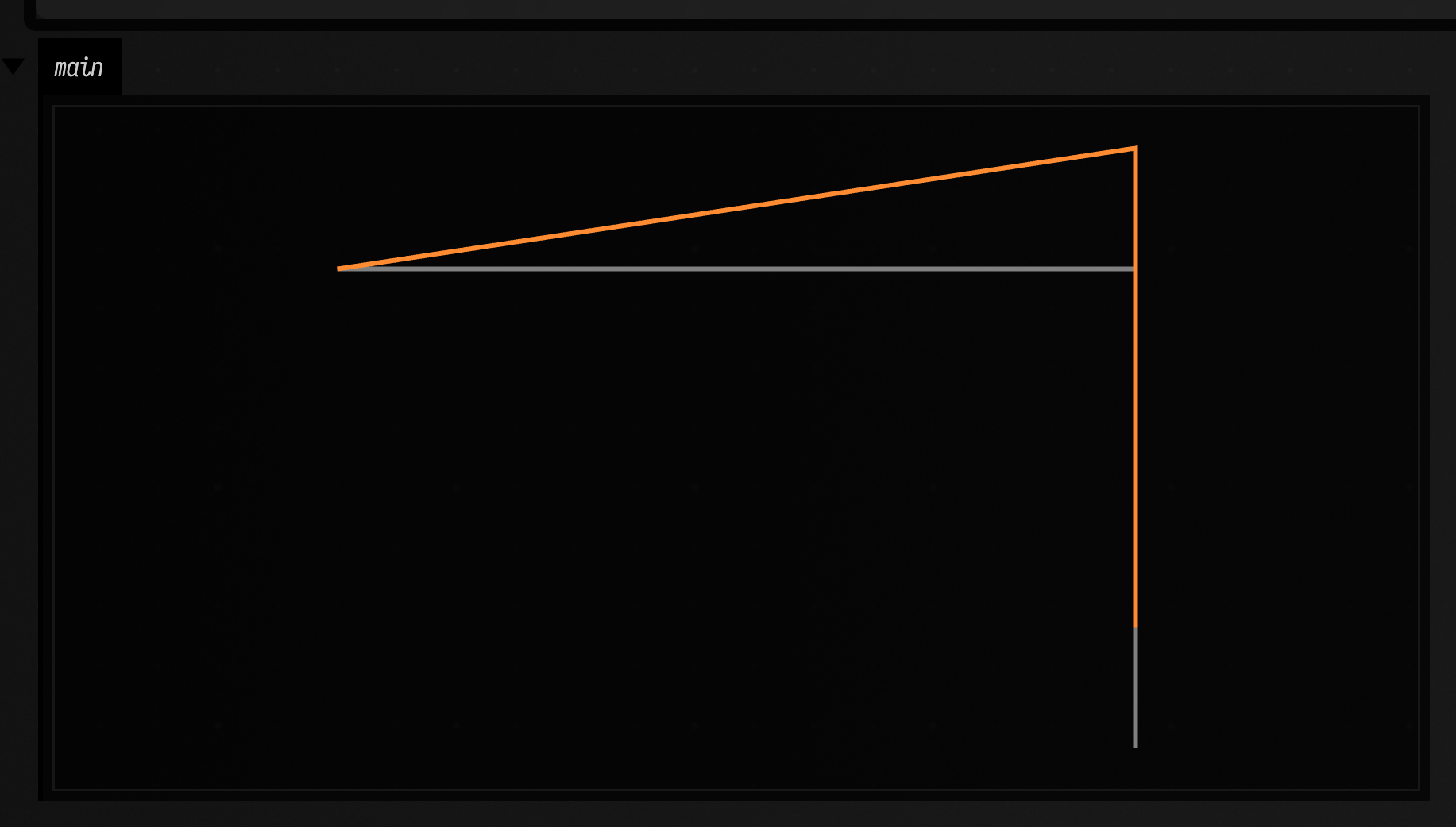
transform calls the function once for each stored point, so this three-point line keeps its three
points: the corner and the end move, and the segments between them stay straight. Sample the line
more finely first if you want the sine to show along it.
p is a Vec3 without you saying so. FLine.transform takes a Kotlin (Vec3) -> Vec3, and the type checker reads that signature, so .x, .y and .z are checked, p.xx is an error before the box runs, and completion works inside the body. The same goes for Img.generate(w, h) { x, y -> … } and Img.mapIndexed { x, y, c, v -> … }, where x and y are Ints and x + y is integer arithmetic, and for a receiver lambda (BufferParameters.() -> Unit), whose receiver is typed as its first parameter.
Two kinds of parameter are left for FieldML to infer:
- An erased generic.
Collections.max(collection, Comparator<? super T>)has noTat the call, sofun a b -> b - agets ordinary inferred parameters, which is what lets the subtraction through. - A nullable Kotlin parameter.
FLine.byFiltering((Vec3?, Node) -> Boolean)is handed a null for the first node's predecessor, so that parameter stays open while the second is typedNode.
You still need hostAs when the receiver is not known where the call is written. Inside let warp line = line |> hostCall1 "transform" (fun p -> …) there is no class to read, because line is just a function parameter. Written as part of a pipeline, it is typed.
A function taking no arguments (Runnable) is written fun ignored -> ….
Types
A value that comes from Kotlin keeps its JVM class, and the type checker uses it. Here img.width is an Int:
let Img = hostClass "afield.media.image.Img"
let img = hostNew (8, 4, 1, tabulate (fun i -> toFloat i / 32.0) 32) Img

// Int, inferred from Img.getWidth() — not Host, and no cast anywhere.
img.width * img.height + img.channels
So:
thisBoxis aBox,flineis anFLine,hostClass "afield.media.image.Img"is aClass<Img>, andhostGet "Companion"on it is anImg.Companion;- dot access on a host value reads a JVM member, so
img.widthis anInt; - a member or an overload that does not exist is a type error, reported where the name was written, rather than a crash on the first run — misspell
hostGet "widht"and the box saysBox has no member 'widht'before it runs; - completion offers the members of a typed receiver: inside
img |> hostGet "withe list iswidth, and it saysInt.
Host, the type reflection falls back to
When the class cannot be known (a generic erased to Object, an array, a Map, a nullable Kotlin return), the type is Host. Host unifies with numbers, strings, booleans and other host values, and satisfies the numeric, vector and equality constraints, so such a result is usable without a cast.
It never stands for a FieldML function or a FieldML structure, because a value coming from Kotlin is never converted into one. Calling it, or treating it as a list, is a type error that says what to do instead:
(hostInput |> hostGet "whatever") 42
  A Host cannot be used as (Int -> 'a): reflection could not type this
  value, so call it with hostCall1 "invoke" instead

hostInput |> hostGet "whatever" |> head
  A Host cannot be used as ['a]: reflection could not type this value,
  so convert it with hostAsList
Two host types whose classes are both known and unrelated do not unify either: if true then img else fline is Img is not FLine (afield.media.image.Img and afield.geometry.path.FLine are unrelated). Two where one is assignable from the other do, so a Vector2f reaches a parameter declared as its read-only Vector2fc interface.
hostAsList turns a host value into a FieldML list: it converts a JVM List, Set, array or Map, which is also how you walk Box.parents. The rest of the hostAs… family turns a value into a scalar:
let Collections = hostClass "java.util.Collections"

// Collections.max returns T, which erases to Object, so it stays Host.
hostStaticCall "max" ([5, 1, 9, 3], fun a b -> b - a) Collections
|> hostAsInthostAsInt, hostAsFloat, hostAsBool and hostAsString read a scalar out; hostAs "SomeClass" is a checked cast to a class, and doubles as the way FieldML names one.
Reaching Field 4
Field 4 is Field's Vulkan layer. A small complete scene (a window, a compute shader over particles, a draw pass) can be written in FieldML statement for statement, including defaultBuffer { size = N.vec4s }, whose argument is a Kotlin receiver lambda and whose vec4s only exists inside it, and the per-frame builders. Imports have no FieldML counterpart because FieldML names every class in full. Several of the calls such a scene makes are source macros, covered next.
Source macros
prop<Double>(speed), moduleHere { }, computeModuleHere { } and println(x) are macros: they rewrite a Kotlin box's source before it is compiled. FieldML is not compiled as Kotlin, so it reaches them another way. A macro that rewrites a call turns it into an ordinary Box extension function (moduleHere becomes _moduleHere), and does its real work while it expands: moduleHere seeds this box's vertex and fragment properties and compiles both shaders. FieldML runs the expansion, then calls the function it rewrote to. This box uses prop, println and the raw expansion of prop:
// `prop<Double>(swirl)` in a Kotlin box declares an inheritable slot. FieldML has
// no declarations, and does not need one -- the slot is made by writing it, and
// reading it is the same breadth-first walk up `parents` the generated delegate does.
let _ = setProp "swirl" 0.85
let swirl = prop "swirl" |> hostAsFloat

// Field's own `println` macro, expanded and then called. The 7 is the line number
// the Kotlin pass would have supplied.
let _ = hostMacro "println" "(x)" (7, "from a FieldML box")

// And when there is nothing to call, the generated Kotlin comes back as text.
(hostMacroExpand "prop" ("<Double>", "(speed)")).declarations
That last line is var Box.speed by Inheritance<Double>() and its Once counterpart, the text a Kotlin box would have compiled into its preamble.
The functions for reaching macros:
| Name | For |
|---|---|
hostMacroExpand "name" args |
any registered macro. Runs the expansion against this box, side effects and all, and hands the rewrite back as a record: .call, .here, .declarations, .preamble |
hostMacro "name" args values |
the macros that rewrite a call. Expands, then calls the Box extension it rewrote to, with values as the arguments |
prop propOr setProp rootProp setRootProp once |
the macros that generate a declaration. No expansion involved: these read and write the same box slot the generated delegate would have |
A macro's arguments are source text, one string per piece: hostMacroExpand "prop" ("<Double>", "(speed)") is the call prop<Double>(speed). hostMacro takes those and then the values for the rewritten call. The values can be a record, which makes a named call; _fieldStatsHere has a default for each of its parameters, so you can name the one you want to change.
A Kotlin box's speed and a FieldML box's prop "speed" are the same property, read the same way up the box graph. A FieldML box can hold a live parameter that a Kotlin box below it uses, or read one a Kotlin box exports, and the property inspector shows either.
The macros that only generate Kotlin declarations cannot be used from FieldML: sourceBlock (a lambda whose body is Kotlin), jsonParser (a generated class), graphLens (a property reference built from a path) and ai. hostMacroExpand still returns their generated source as text.
Two more things to know:
- You do not get a macro's generated accessors.
moduleHere's expansion also returns typed Kotlin declarations (val Mesh.pos by FromInput(), an accessor per push-constant member, thetrianglesconstant). In FieldML the same members are reached throughhostGetandhostCall. - A FieldML integer is a JVM
Long. Writing one into a slot a Kotlin box declared asprop<Int>would change what is in the slot even though the Kotlin read still works, sosetPropkeeps the width that is already there. Nothing protects you from a value too large for the declared type; that truncates silently, as it would in Kotlin.
Every frame
Field's animation helpers, eachFrame { … }, loop { … }, forever { … } and animate { … }, take a suspend Frames.() -> Unit, and a FieldML function can fill it. Write it with one parameter, the Frames, and start it with launchFrames:
let Phased = hostClass "afield.runtime.lifecycle.PhasedKt"

// `f` is a Frames, typed off the JVM signature -- so `f.frameNumber` is checked
// here, not on the first frame.
let animation =
  hostStaticCall "eachFrame" (fun f -> f |> hostGet "frameNumber") Phased

// ...and run it on Field's Runloop, with this box as the owner: Stop on this box
// stops the animation, and re-running the box replaces it rather than stacking a
// second one.
thisBox |> hostExt Phased "launchFrames" (animation, "spin", "frames", true)
Your result is converted to the type the helper expects, so returning false from a forever body stops it.
The FieldML body cannot itself suspend: Frames.frame() and Frames.delay() are out of reach, so use eachFrame, loop or forever, which call your body once per frame, rather than frames { }, whose body has to call frame() itself.
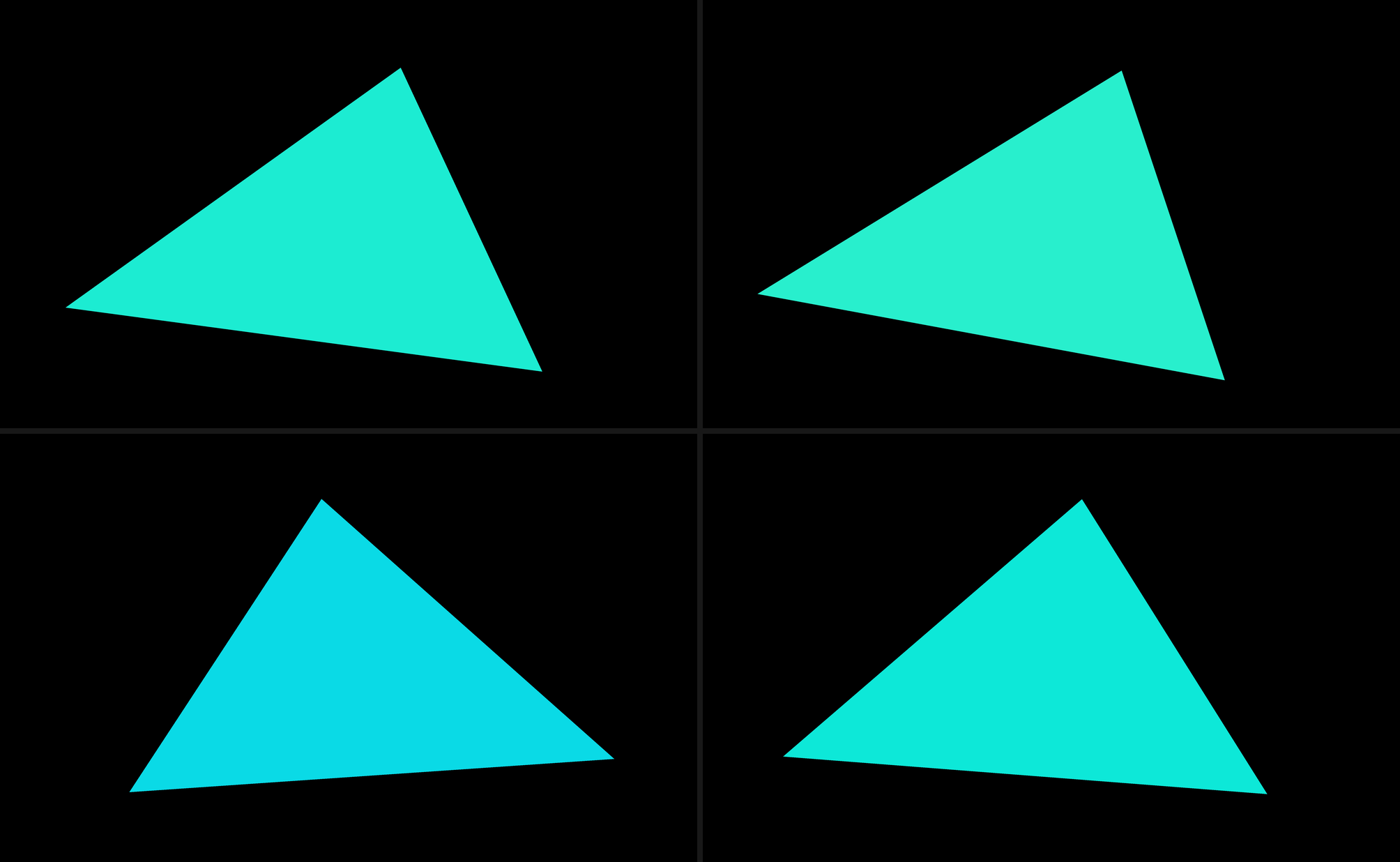
These are four frames of the spinning-triangle demo below, a second apart:
Calling a suspend method
A Kotlin suspend method, such as Renderer.run, is called with hostLaunch: the method name, its arguments, the object, and then a function that receives the result once the method returns.
let openWindow title =
  let w = hostNew {title = title} (hostClass "afield.graphics.vulkan.util.Window") in
  let r = hostNew {mainWindow = w} (hostClass "afield.graphics.vulkan.Renderer") in
  let _ = setProp "renderer" r in
  // `run` renders until the window closes; the function runs then.
  hostLaunch "run" () r (fun ignored -> print "renderer stopped")

openWindow
hostLaunch returns at once with the call's Job, which you can cancel. The method starts inside the hostLaunch call, so one that returns without suspending hands its result to your function before hostLaunch returns, and an error it throws before suspending is reported on your box. After its first suspension it continues on Field's main loop, as start(renderer::run) does in a Kotlin box. An error after that point is shown on your box as an error, because the box that called it has already finished.
hostCall refuses a suspend method, and hostLaunch refuses one that is not suspend.
The suspend demo has no Kotlin box: one FieldML box opens the window and starts the renderer this way, and a second rewrites a ribbon's vertices every frame. Run window and renderer (FieldML), then A ribbon rewritten every frame. The renderer box wraps the window in once "renderer" (fun u -> …), which makes it the first time the box runs and returns the same renderer on every later run, so running the box again does not open a second window. The ribbon box ends by calling snapshotWindow, which puts a picture of the window in the box's window output, so the preview below shows what the window drew.

By name
To pass arguments by name, and leave out the ones with Kotlin defaults, write a record where a tuple would go. A positional call cannot skip a parameter, so named arguments are the only way to use a default:
let Img = hostClass "afield.media.image.Img"
let img = hostNew {width = 2, height = 2, channels = 3, data = [0.0, 0.0, 0.0, 0.0, 0.0, 0.0, 0.0, 0.0, 0.0, 0.0, 0.0, 0.0]} Img

// Img.index(x, y, c = 0) -- `c` is left to Kotlin, which is something no
// positional call can express. Order is not position, either.
(img |> hostCall "index" {x = 1, y = 0}, img |> hostCall "index" {c = 2, y = 0, x = 1})
This works with hostCall, hostStaticCall, hostExt and hostNew alike: a tuple or a list spreads positionally, () is no arguments, and a record spreads by name. hostCall1, which never spreads, passes one value.
| Written | Means |
|---|---|
hostNew (w, []) Renderer |
Calls the constructor positionally with both arguments present. The empty list explicitly supplies additionalWindows. |
hostNew {mainWindow = w} Renderer |
Matches constructor parameters by name. Omitting additionalWindows uses its Kotlin default. |
img \|> hostExt Imaging "colormap" {name = "magma"} |
Calls the extension with a named palette. Omitted lo and hi use Kotlin’s defaults, computed from the image. |
hostCall1 "m" {a = 1} t |
Passes the record as one value. It does not use the record’s fields as named JVM arguments. |
A name the method does not have is an error where it is written. When two overloads both accept the names you gave, the call is refused with the candidates listed, and a ? on each parameter that has a default.
Waiting inside a frames body
hostAwait calls a suspend method and waits for it: the method name, its arguments, and the object. The result is the value of the expression, as with hostCall. It works inside a function that Kotlin calls as a suspend block, which is what frames, eachFrame, loop, forever and Box.launchFrames take. Inside frames, whose body runs once and moves the frame clock itself, that means a FieldML script can have a middle:
let raiseColumn k = print k

let script =
  hostStaticCall "frames" (fun f ->
    let grow k =
      if k <= 48 then
        let _ = raiseColumn k in
        // Continue on the next line 40 ms (and at least one frame) later.
        let _ = hostAwait "delay" 40 f in
        grow (k + 1)
      else Unit
    in grow 0
  ) (hostClass "afield.runtime.lifecycle.PhasedKt")

script
frames only builds the script. Start it with thisBox |> hostExt (hostClass "afield.runtime.lifecycle.PhasedKt") "launchFrames" (script, "script", "frames", true), which runs it on Field's main loop and stops it when the box is stopped.
hostAwait "frame" () f waits exactly one frame. A function that Kotlin calls in the ordinary way cannot wait: the function given to map, or to Mesh.write as its builder, runs to the end before Kotlin continues, so hostAwait inside it stops the box with an error naming the problem. Use hostLaunch there to start the method without waiting.
A loop that waits can run for as long as the box does, provided the call that goes round again is the last thing the function does, as grow (k + 1) is above. Such a loop holds the same small amount of memory on its hundred-thousandth turn as on its first. A loop that does more work after the recursive call returns keeps every turn alive until it ends.
The same holds for a loop that does not wait. A function that calls itself last, with no way to stop, runs forever: the box does not fail with a stack overflow, it keeps running until you stop it. Give such a loop a condition that ends it.
The frames sequence demo raises a band one column at a time, holds it, and starts again in the other colour, all from one FieldML frames body. Run window and renderer (FieldML), then a script across frames.

What it still will not do
- A JVM
Mapcomes back as a FieldML record, so passing one tohostCallas one argument needshostCall1, which never spreads. Lists work the same way. - A callback written inside a helper has untyped parameters.
line |> hostCall1 "transform" (fun p -> …)in a pipeline is typed; the same call insidelet warp line = …is not, becauselineis a function parameter with no known class. UsehostAs "Vec3"there. - A lambda's result is not checked against what Kotlin wants. It is converted, which is why
fun x y -> 0satisfies a function returningFloat, but a result of the wrong shape fails when it runs. - A
suspendmethod is called withhostLaunch, nothostCall, and its result arrives in a function rather than as the value of the expression (see Calling a suspend method).hostAwaitwaits for one, but only inside a body Kotlin calls as asuspendblock (see Waiting inside a frames body). internalKotlin members cannot be reached by their source names, because the compiler renames them.- Buffers, kernels and anchors, which FieldML cannot build and which have no constructor to call, are out of reach.
Open it
Each of these documents demonstrates part of the page. Start with the macro demo: it needs no GPU and nothing wired up.
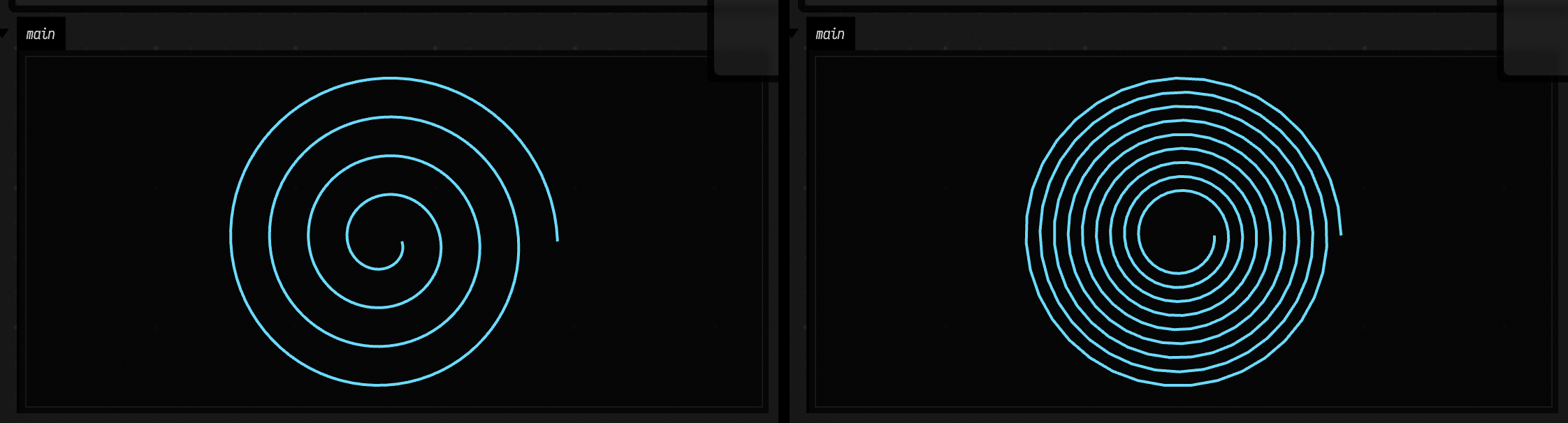
The fieldml_macro_demo starting point has four boxes: a prop written in one and inherited by another that draws a spiral from it, Field's own println macro expanded and called, and the generated Kotlin of prop and sourceBlock as readable text. Run the parameter box, run the drawing box, then change swirl or turns in the first and run both again.
Open ↗, or open the fieldml_macro_demo starting point from the welcome screen.
| In | Change | What happens |
|---|---|---|
| the parameter box | setProp "turns" 4 → setProp "turns" 9 |
re-run both boxes: nine turns instead of four. The drawing box is unchanged — it inherits the value |
| the parameter box | setProp "swirl" 0.85 → 0.35 |
a tighter spiral; the swirl scales the radius |
| the parameter box | run it twice | firstRunAt does not move. That is once: computed on the first read and stored |
| the parameter box | propOr "neverWritten" "not set" → prop "neverWritten" |
an error naming the slot, because nothing up the graph has it. propOr is the read that does not fail |
| the println box | (4, "…") → (12, "…") |
the output claims to come from line 12, and the gutter marker moves |
| the println box | {line = 5} → {line = 5, a = "named"} |
the vararg named rather than omitted |
| the expansion box | "prop" → "rootProp" |
the call site becomes root.speed instead of speed |
| the expansion box | "sourceBlock" → "jsonParser" |
...and an error: jsonParser wants a type argument and a schema string |
| the drawing box | disconnect it from the FieldML root | it becomes a Kotlin box, and reports Kotlin errors. Only the direct children of a FieldML root are FieldML, which is why it has two parents |
The host bridge demo has five boxes: the raster above, a line warped by a FieldML lambda through FLine.transform, a box whose host member types are all inferred, one that exercises overload resolution, varargs and hostNull, and one that calls Kotlin by name and leaves its defaults alone.
Open ↗, or open the fieldml_host_bridge_demo starting point from the welcome screen.
Things to change:
| In | Change | What happens |
|---|---|---|
| the raster box | sin (r * 11.0) → sin (r * 5.0) |
fewer, wider rings |
| the raster box | "viridis" → "magma" |
the palette; anything in Field's Colormaps works |
| the raster box | (240, 240, sample) → (96, 96, sample) |
a coarser raster, rendered faster |
| the warp box | 24.0 → 60.0 |
a taller wave |
| the types box | img.width → img.widht |
a type error, before the box runs |
| the types box | put the caret inside hostGet "" |
completion lists Img's members with their types |
| the named box | {x = 1, y = 0} → {x = 1, yy = 0} |
a type error listing the names you gave, before the box runs |
| the named box | {name = "magma"} → {name = "magma", lo = 0.0, hi = 0.5} |
the two defaults stop being computed from the image |
On a machine with a GPU, the Field 4 demo builds a scene from FieldML. One box finds the Renderer above it, builds a shader module from two GLSL strings through parameters(renderer) { vertex = …; fragment = … }, attaches a three-vertex mesh, and registers it with the render target. Connect it to whichever box owns your renderer.
Open ↗, or open the fieldml_afield_four_demo starting point from the welcome screen.
The frames demo is the same scene with a Frames loop on it, the spinning triangle pictured above. Its first box is a small Kotlin box that opens the window and owns the Renderer, so there is nothing to wire up. Open it, run window and renderer, then run the FieldML box.
Open ↗, or open the fieldml_frames_demo starting point from the welcome screen.
| In | Change | What happens |
|---|---|---|
| the FieldML box | * 0.04 → * 0.2 |
it spins five times faster, and the colour cycles with it |
| the FieldML box | spin |> hostCall "set" (t, 0.0, 0.0, 1.0) → (0.0, 0.0, 0.0, 1.0) |
it stops dead: the loop still runs, it just writes the same value |
| the FieldML box | "eachFrame" → "loop" |
no visible difference — loop advances a frame only when the body did not |
| the FieldML box | f |> hostGet "frameNumber" → f |> hostGet "frameNumbr" |
a type error naming Frames, before the box runs: the callback parameter has a type |
| the fragment shader | vec3(0.0, 2.1, 4.2) → vec3(0.0, 0.0, 0.0) |
it cycles through greys instead of hues |
In the macro module demo, a macro builds the scene: instead of hand-writing parameters(renderer) { vertex = …; fragment = … } and Module(params), the box calls Field's moduleHere, so its GLSL lives in the box's own vertex and fragment properties, exactly where a Kotlin graphics box keeps it. Self-contained: run the Kotlin window and renderer box, then the scene box.
Then run the fourth box while it is spinning. It writes spinRate with setRootProp, and the scene reads that slot on every frame, so another box changes the speed of the running scene.
Open ↗, or open the fieldml_macro_module_demo starting point from the welcome screen.
| In | Change | What happens |
|---|---|---|
| the live box | setRootProp "spinRate" 0.30 → 0.02 |
the triangle slows, immediately, without the scene box being run |
| the live box | run it twice | framesDrawn grows — that is the per-frame body reporting from inside the render loop |
| the scene box | propOr "spinRate" 0.04 inside eachFrame → move it above the lambda |
it becomes a constant: changing the live box does nothing |
| the scene box | edit the fragment string's vec3(0.0, 2.1, 4.2) |
different hues, because moduleHere recompiles from the box's properties |
| the scene box | break the GLSL | the shader error is reported onto this box, which is the thing moduleHere gives you over hand-built parameters |
Its output record says what the macro did: builtBy = "_moduleHere" names the function it rewrote to, and pushConstantBytes describes the push-constant block moduleHere compiled from the box's vertex and fragment properties.
The mesh demo has a vertex shader with real inputs, whose data FieldML recomputes every frame: two layout(location = …) in variables, both written through Mesh.write, one positionally and one by name, leaving out Mesh.write's inside default. Like the frames demo, it opens its own window.
Open ↗, or open the fieldml_mesh_demo starting point from the welcome screen.
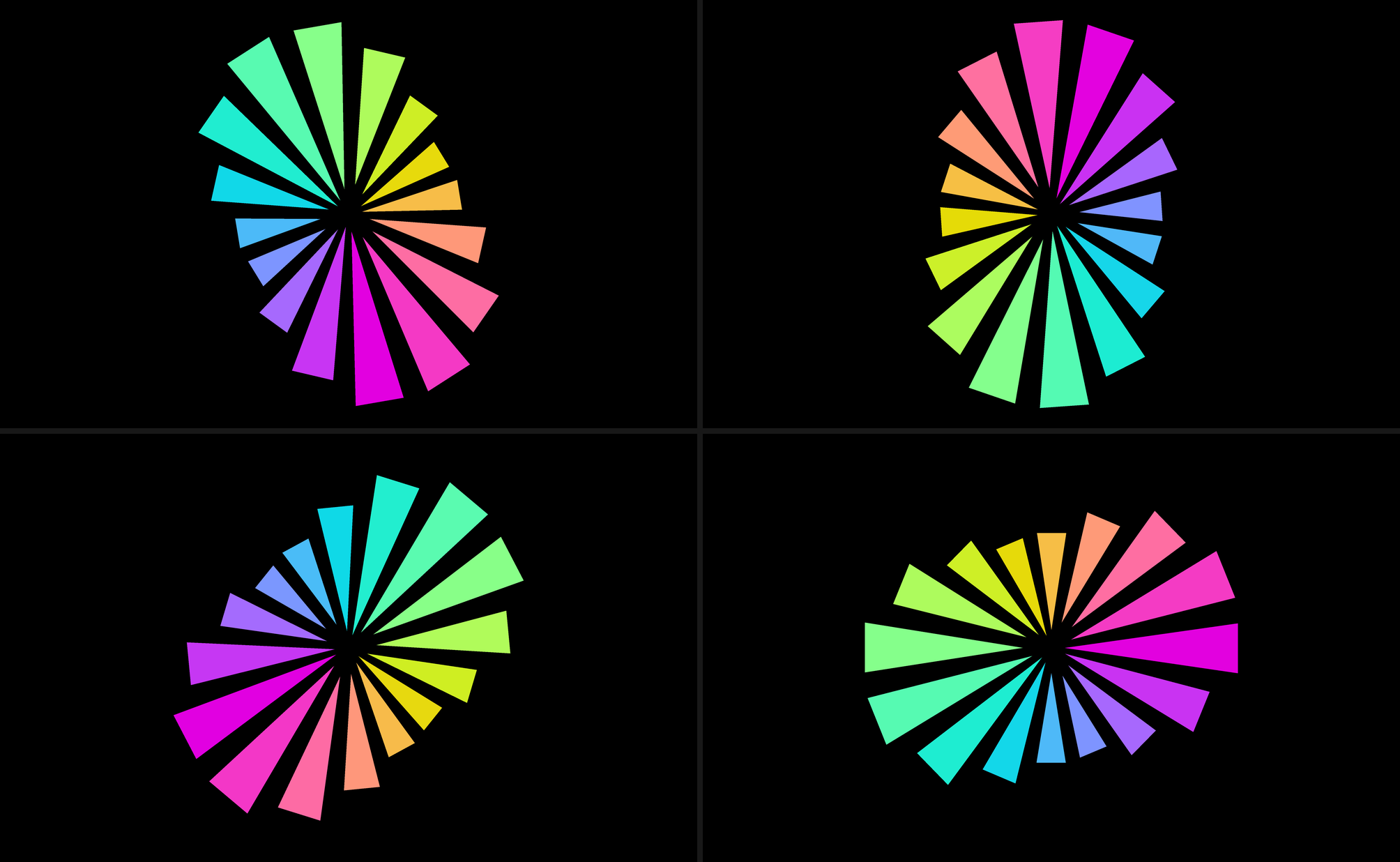
The lambda demo is about callback parameter types: a warp with no hostAs in it, a raster whose two callbacks have typed parameters, a box of inferred types, and a box showing where a parameter stays untyped.
Open ↗, or open the fieldml_lambda_demo starting point from the welcome screen.
| In | Change | What happens |
|---|---|---|
| the warp box | p.x → p.xx |
a type error naming Vec3's components, before the box runs |
| the warp box | 26.0 → 60.0 |
a taller wave |
| the warp box | put the caret after p. inside the lambda |
completion lists Vec3's components — the callback parameter has a type |
| the raster box | 13.0 → 5.0 |
fewer, wider rings |
| the raster box | "magma" → "viridis" |
the palette |
| the limits box | delete hostAs "Vec3" from scale |
a type error: inside a helper, the parameter has no type without it |
Where to look
The reflection lives in afield.lang.fieldml.core.FieldMLHostBridge (candidates, scoring, coercion, SAM proxies) and afield.lang.fieldml.type.FieldMLHostTypes (JVM types to FieldML types, member and overload resolution at type-check time). Inferencer.refineHostIntrinsic is where the two meet, and Inferencer.preInferHostSpine is what threads a JVM parameter type into a lambda's parameters. The macro layer is afield.lang.fieldml.FieldMLMacroLayer: expansion, the callee extraction, and the ledger of which macro is reachable how. afield.document.properties.inheritedPropertyRaw is the walk prop and Kotlin's Inheritance delegate share. The design notes are in dev_docs/FIELDML_HOST_BRIDGE.md.
Which test holds which claim
FieldMLHostBridgeTest has one test per capability. FieldMLHostSurfaceCoverageTest is the
reachability-and-agreement measurement. FieldMLHostAgreementTest holds the semantically interesting
calls beside the Kotlin they should equal. FieldMLLambdaExpectedTypeTest covers the typed callback
parameters and the cases that stay untyped. FieldMLSuspendCallbackTest is the per-frame
surface: every test in it asserts that the closure ran, not that a proxy exists.
FieldMLAfieldFourReachTest is the threebox-2 survey with its citations, and FieldMLSourceMacroTest
holds the macro ledger to the live contents of afield.runtime.macros.MacroRegistry in both directions.