SMPTE Timecode: LTC and MIDI Time Code
SMPTE timecode is the HH:MM:SS:FF clock that lighting desks, video servers, DAWs and show
controllers share. It travels two ways. LTC (linear timecode) is an audio signal, a square-ish
buzz on a spare audio track or cable. MTC (MIDI Time Code) is the same time carried in MIDI
messages. Field reads and writes both, and turns either into a clock a box can ask "what time is
it?" from its draw loop.
Everything is in the package afield.io.timecode, which box code imports:
import afield.io.timecode.*Timecode values and drop-frame
A Timecode is a frame count at a TimecodeRate: FPS_24, FPS_25, FPS_30, or FPS_2997_DF,
29.97 frames a second with drop-frame labels. Adding and subtracting frames is integer arithmetic on
the count; the hours, minutes, seconds and frame fields are worked out from it.
NTSC video runs at 30000/1001 frames a second, slightly slower than 30. Without drop-frame labels,
timecode counting 30 frames per second would fall about 3.6 seconds behind the clock each hour.
Drop-frame keeps up by skipping the labels ;00 and ;01 at the start of every minute except every
tenth minute. No frames are dropped, only labels. A ; before the frames marks a drop-frame
timecode, and parse reads it that way:
:::static
import afield.io.timecode.*

val t = Timecode.parse("00:00:59;29")
val tenth = Timecode.parse("00:09:59;29")
val hour = Timecode.parse("01:00:00;00").totalSeconds
markdown(
    "main",
    "`$t` + 1 frame = `${t + 1}`  \n`$tenth` + 1 frame = `${tenth + 1}`  \n" +
        "an hour of drop-frame labels is ${hour.f3} s of wall time",
)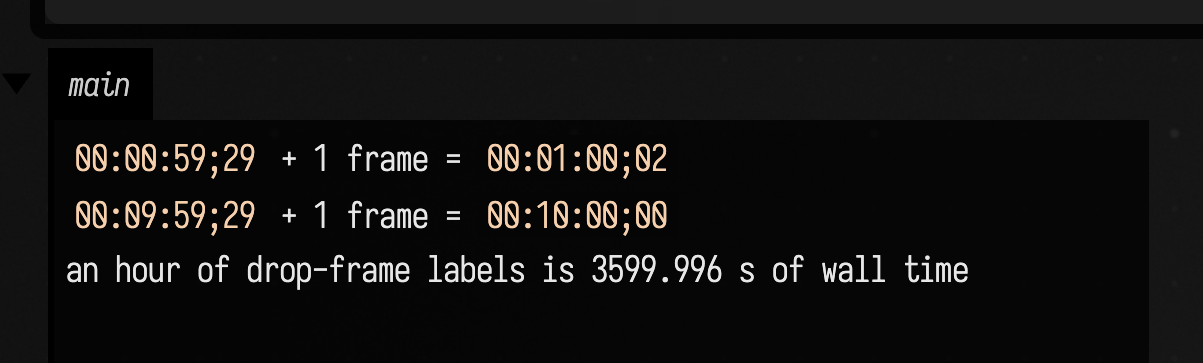
At minute 1 the label jumps from ;29 to ;02. At minute 10 it does not skip. totalSeconds is
real time, so an hour of drop-frame labels comes to an hour of wall time within a few
milliseconds. Timecode.of(h, m, s, f, rate) builds one from fields and refuses a label that does
not exist, such as 00:01:00;00. Timecode.fromSeconds(seconds, rate) goes the other way. A
timecode wraps at 24 hours.
LTC: timecode as audio
Each LTC frame is 80 bits: the time in binary-coded decimal, 32 user bits, and a fixed 16-bit sync word that marks where a frame ends and which way it is playing. The bits are written biphase-mark: the signal flips at the start of every bit, and flips again half-way through a 1. A reader therefore only needs the time between flips, not the signal level, and the level can be inverted.
LtcEncoder.render(start, seconds) returns the samples as a FloatArray, and TimecodeWav.write
saves them as a mono .wav to play out of an interface into a desk or a video server:
import afield.io.timecode.*

val ltc = LtcEncoder.render(Timecode.parse("10:00:00:00", TimecodeRate.FPS_25), seconds = 60.0)
TimecodeWav.write(java.io.File("/tmp/ltc_25fps.wav"), ltc, sampleRate = 48000)
LtcDecoder reads it back. It is streaming: hand it blocks of samples of any size with feed, and
it returns the frames completed in that block, each with the timecode, its user bits, the sample it
started at, whether it was read backwards, and the playback speed it measured. A box below renders
four seconds of drop-frame LTC across the minute boundary, plays it back badly (a tenth of the
level, a DC offset, noise, and a speed that ramps from 0.9× to 1.1×), and decodes it:
:::static
import afield.io.timecode.*

// Four seconds of 29.97 drop-frame LTC across the one-minute boundary.
val start = Timecode.parse("00:00:58;00")
val ltc = LtcEncoder.render(start, 4.0, sampleRate = 48000)

// Play it back badly: quiet, offset, noisy, and speeding up from 0.9x to 1.1x.
val rng = java.util.Random(1)
val played = ArrayList<Float>()
var p = 0.0
while (p < ltc.size - 1) {
    val k = p.toInt()
    val v = ltc[k] + (ltc[k + 1] - ltc[k]) * (p - k).toFloat()
    played += v * 0.1f + 0.2f + rng.nextGaussian().toFloat() * 0.01f
    p += 0.9 + 0.2 * p / ltc.size
}

val frames = LtcDecoder(48000, TimecodeRate.FPS_2997_DF).decodeAll(played.toFloatArray())

// Decoded frame number against playback time, and the speed the decoder measured.
val w = 640.0
val h = 220.0
val tMax = played.size / 48000.0
val fMax = frames.maxOf { it.timecode - start }.toDouble()
val pts = frames.joinToString(" ") {
    "%.1f,%.1f".format(it.sampleStart / 48000 / tMax * w, h - (it.timecode - start) / fMax * h)
}
val spd =
    frames.joinToString(" ") { "%.1f,%.1f".format(it.sampleStart / 48000 / tMax * w, h - (it.speed - 0.8) / 0.4 * h) }
display(
    "main",
    """<svg width="${w + 60}" height="${h + 40}" style="font: 12px sans-serif">
  <g transform="translate(40,10)">
    <rect width="$w" height="$h" fill="none" stroke="#999"/>
    <polyline points="$pts" fill="none" stroke="#2a7" stroke-width="2"/>
    <polyline points="$spd" fill="none" stroke="#c52" stroke-width="1.5"/>
    <text x="4" y="14" fill="#2a7">decoded frame (0 … ${fMax.toInt()})</text>
    <text x="4" y="${h - 6}" fill="#c52">measured speed (0.8 … 1.2)</text>
    <text x="${w / 2 - 40}" y="${h + 22}" fill="#999">playback time, s (0 … ${tMax.f2})</text>
  </g></svg>""",
)
markdown(
    "info",
    "decoded **${frames.size}** frames, ${frames.first().timecode} … ${frames.last().timecode}; " +
        "consecutive: ${frames.zipWithNext().all { (a, b) -> a.timecode + 1 == b.timecode }}; " +
        "across the minute: ${frames.map { it.timecode.toString() }.filter { it.startsWith("00:00:59;2") || it.startsWith("00:01:00;0") }}",
)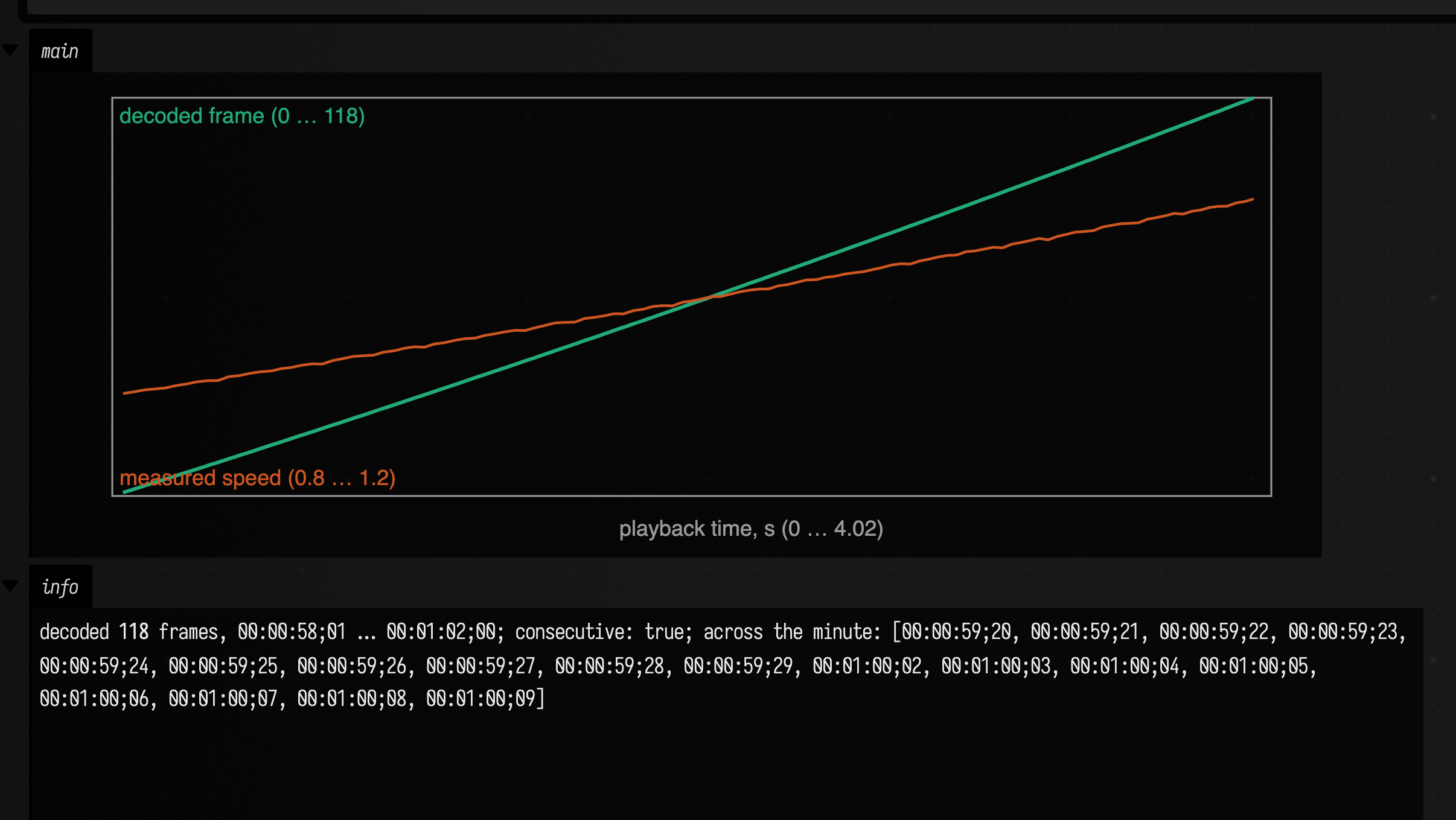
Four seconds at 29.97 is 120 frames. The decoder reports 118: it spends the first frame learning the bit length, and the last frame is only complete when the signal flips after it, which it never does at the end of a buffer. In a running stream neither costs anything after the first frame.
The decoder follows the level (it tracks the signal's envelope), removes a DC offset, and tracks the
bit length rather than assuming it, so speed changes of ±10 % and a ramp between them decode
cleanly. Played backwards, frames come out in descending order with reverse set. Two checks keep
noise from producing a frame: the polarity bit makes every genuine frame's count of ones even, and a
frame's 80 bits must be evenly spaced.
Tell the decoder the frame rate
The bits carry a drop-frame flag and nothing else about the rate. Pass the rate to
LtcDecoder(sampleRate, rate) when you know it. Without one it guesses from the measured bit
length, which is right only when the source plays at close to real time: 24 and 25 fps are 4 %
apart.
MIDI Time Code
While a MIDI clock source runs, it sends eight quarter-frame messages every two frames, each
carrying one 4-bit piece of the time. A receiver has the whole time only after the eighth, by which
point two more frames have passed, and MtcDecoder adds them back. When the time jumps, the source
sends one full-frame SysEx (F0 7F 7F 01 01 hh mm ss ff F7) instead. Mtc.quarterFrames(tc) and
Mtc.fullFrame(tc) build the bytes, and MtcDecoder.accept takes any MIDI message and ignores
what is not timecode.
Through a MIDI port opened with MidiDevices, MidiOutput.sendMtcQuarterFrames(tc) and
sendMtcFullFrame(tc) send, and MidiInput.mtcDecoder() listens:
import afield.io.timecode.*

val input = MidiDevices.openInput(MidiDevices.findInput("IAC")!!)
val clock = TimecodeClock(TimecodeRate.FPS_25).followMtc(input)
A clock a box can read
TimecodeClock turns any of these into one answer. now() is the current Timecode, seconds the
same as a Double for an animation or a keyframe timeline, and locked says whether the source is
still arriving. It can generate time itself, generate(start), or follow LTC (followLtc, then
feedLtc(samples) from whatever delivers the audio) or MTC (followMtc). Between frames it
extrapolates on the wall clock at the measured speed, so a draw loop reading it 60 times a second
sees smooth time even though LTC arrives 24 to 30 times a second. When a followed source stops, the
clock runs on for freewheelSeconds (half a second) and then holds.
import afield.io.timecode.*

val clock = TimecodeClock(TimecodeRate.FPS_30).generate(Timecode.parse("00:59:50:00", TimecodeRate.FPS_30))
println(clock.now()) // 00:59:50:00, counting from the moment generate was called
This box follows LTC delivered in 512-sample blocks at the pace audio would bring them, stops the source after a second and a half, and reads the clock 60 times a second throughout:
:::static
import afield.io.timecode.*

// LTC at 24 fps, delivered in 512-sample blocks at the pace audio would bring them, for 1.5 s; then
// the source stops. The clock is read every 1/60 s throughout, as a draw loop would.
val clock = TimecodeClock(TimecodeRate.FPS_24).followLtc(48000)
val ltc = LtcEncoder.render(Timecode.parse("01:00:00:00", TimecodeRate.FPS_24), 2.0)
val stopAt = 1.5
val t0 = System.nanoTime()
var fed = 0
val readings = ArrayList<Triple<Double, Double, Boolean>>()
while (true) {
    val now = (System.nanoTime() - t0) / 1e9
    if (now > 3.0) break
    while (now < stopAt && fed < ltc.size && fed / 48000.0 < now) {
        clock.feedLtc(ltc, fed, minOf(512, ltc.size - fed))
        fed += 512
    }
    readings += Triple(now, clock.seconds, clock.locked)
    Thread.sleep(16)
}

// clock.seconds (from the first locked reading) against wall time, green while locked, grey after.
val first = readings.first { it.third }
val w = 640.0
val h = 220.0
fun x(t: Double) = t / 3.0 * w
fun y(s: Double) = h - (s - first.second) / 2.0 * h
val dots = readings.filter { it.first >= first.first }.joinToString("") { (t, s, locked) ->
    "<circle cx='${x(t).f1}' cy='${y(s).f1}' r='1.6' fill='${if (locked) "#2a7" else "#999"}'/>"
}
display(
    "main",
    """<svg width="${w + 60}" height="${h + 40}" style="font: 12px sans-serif">
  <g transform="translate(40,10)">
    <rect width="$w" height="$h" fill="none" stroke="#999"/>
    <line x1="${x(stopAt).f1}" x2="${x(stopAt).f1}" y1="0" y2="$h" stroke="#c52" stroke-dasharray="4 3"/>
    <text x="${x(stopAt) + 4}" y="14" fill="#c52">LTC stops</text>
    $dots
    <text x="4" y="14" fill="#2a7">clock.seconds, read at 60 Hz</text>
    <text x="${w / 2 - 40}" y="${h + 22}" fill="#999">wall time, s (0 … 3)</text>
  </g></svg>""",
)
val last = readings.last()
markdown("info", "${readings.size} readings; held at **${clock.now()}**, locked: ${last.third}")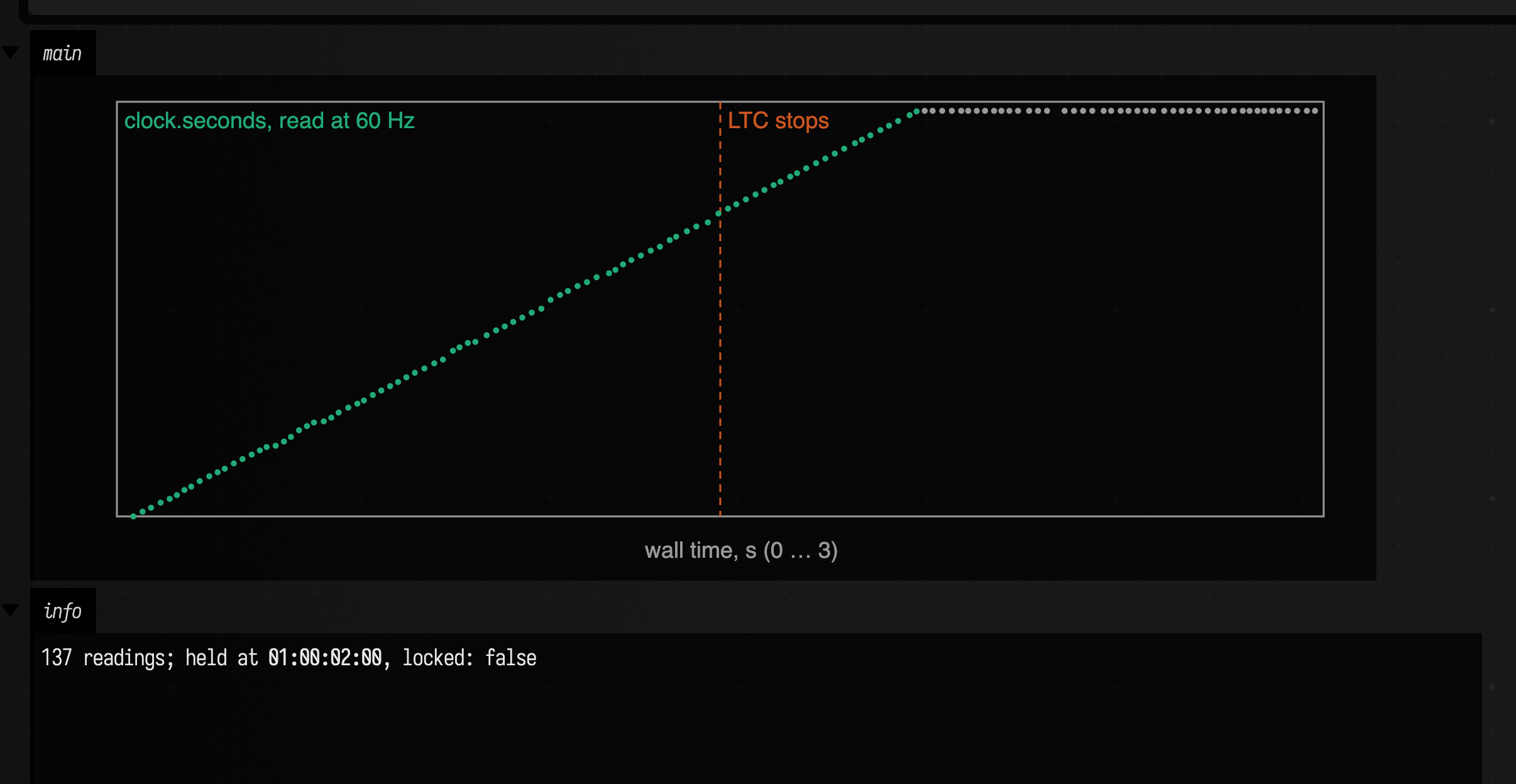
Feed feedLtc from the thread that owns the audio buffers. The decoder holds per-sample state and
is not thread-safe. now(), seconds and locked are safe to read from any thread.
The four boxes behind this page, including MTC into a clock and a clock following LTC in 512-sample blocks, are the smpte_timecode starting point.