Braitenberg vehicles with memory
A Braitenberg vehicle is two light sensors, two wheels and some wires between them. Cross the wires and make them excitatory, and the sensor nearer a light speeds up the far wheel, so the vehicle turns toward the light and drives into it. Leave them uncrossed and make them inhibitory, and the vehicle slows down as it faces a light and parks in front of it. Braitenberg called those two the aggressor and the lover, and Aatish Bhatia's Let's build a brain is a good playable introduction to them.
Those vehicles have no memory: the wheel speeds depend only on what the sensors read right now. On this page each motor neuron is a small dynamical system instead of a wire, with state on three timescales:
| Level | Timescale | Mechanism | Switched off by |
|---|---|---|---|
| membrane | a few steps | leaky integration of the input | tauMembrane = 1.0 |
| hysteresis | while a neuron is on | self-excitation makes the activation bistable | selfExcitation = 0.0 |
| homeostasis | hundreds of steps | the threshold integrates rate − targetRate |
adaptationRate = 0.0 |
| plasticity | thousands of steps | reward-modulated eligibility traces rewire the sensors | learningRate = 0.0 |
Each section turns one of these on, runs it beside the same seed with it turned off, and prints the
number that differs. The code is alife_vehicles.kt, next to the boids and Physarum
it is modelled on, and like them it runs on the CPU.
1. One neuron, swept up and back
Per step, a motor neuron with input I, rate r and threshold \( \theta \) does
u += (−u + I + selfExcitation·r − θ − bias) / tauMembrane
r  = activation(gain · u)
θ += adaptationRate · (r − targetRate)
The activation is one of four Activation values. SIGMOID, TANH and RELU are switches of
different shapes; BUMP (\( e^{-x^2} \)) is tuned to a preferred input and is quiet above and below it.
With selfExcitation = 0 the neuron is a smoothed function of its input. Feed enough of its own
output back, and a sigmoid becomes bistable: once on, the neuron's own rate holds it on after the input
has fallen below the level that turned it on. hysteresisSweep drives the input slowly from −2.5 to 2
and back and reports where the rate crosses 0.5 on each leg.
val plain = hysteresisSweep(NeuronParams(selfExcitation = 0.0))
val latched = hysteresisSweep(NeuronParams(selfExcitation = 1.5))
for ((name, s) in ["no feedback" to plain, "selfExcitation 1.5" to latched]) {
    println(name + ": on at " + s.switchOn.f2 + ", off at " + s.switchOff.f2 + ", loop width " + s.width.f2)
}
showImg(
    montage(
        [
            "no feedback: width " + plain.width.f2 to plain.toImg(),
            "feedback 1.5: width " + latched.width.f2 to latched.toImg(),
        ],
        columns = 2,
    ),
)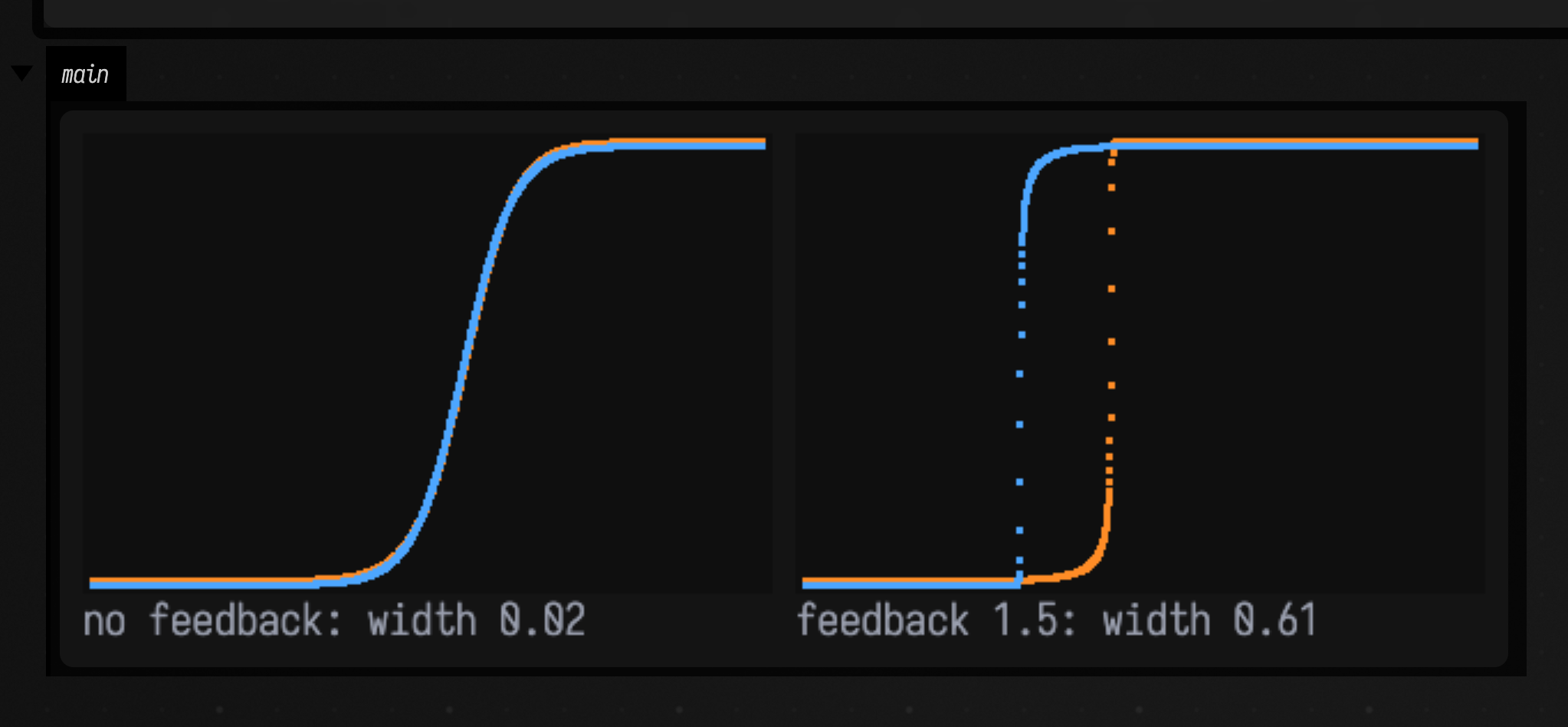
Orange is the rising sweep and blue the falling one. Without feedback the two lie on top of each other (the small width left is the membrane's lag). With it, the neuron switches on at an input of −0.45 and stays on until −1.06, a loop 0.61 wide. In a vehicle this means that a motor neuron that has committed to driving keeps driving through a brief dip in the light.
2. Four wirings
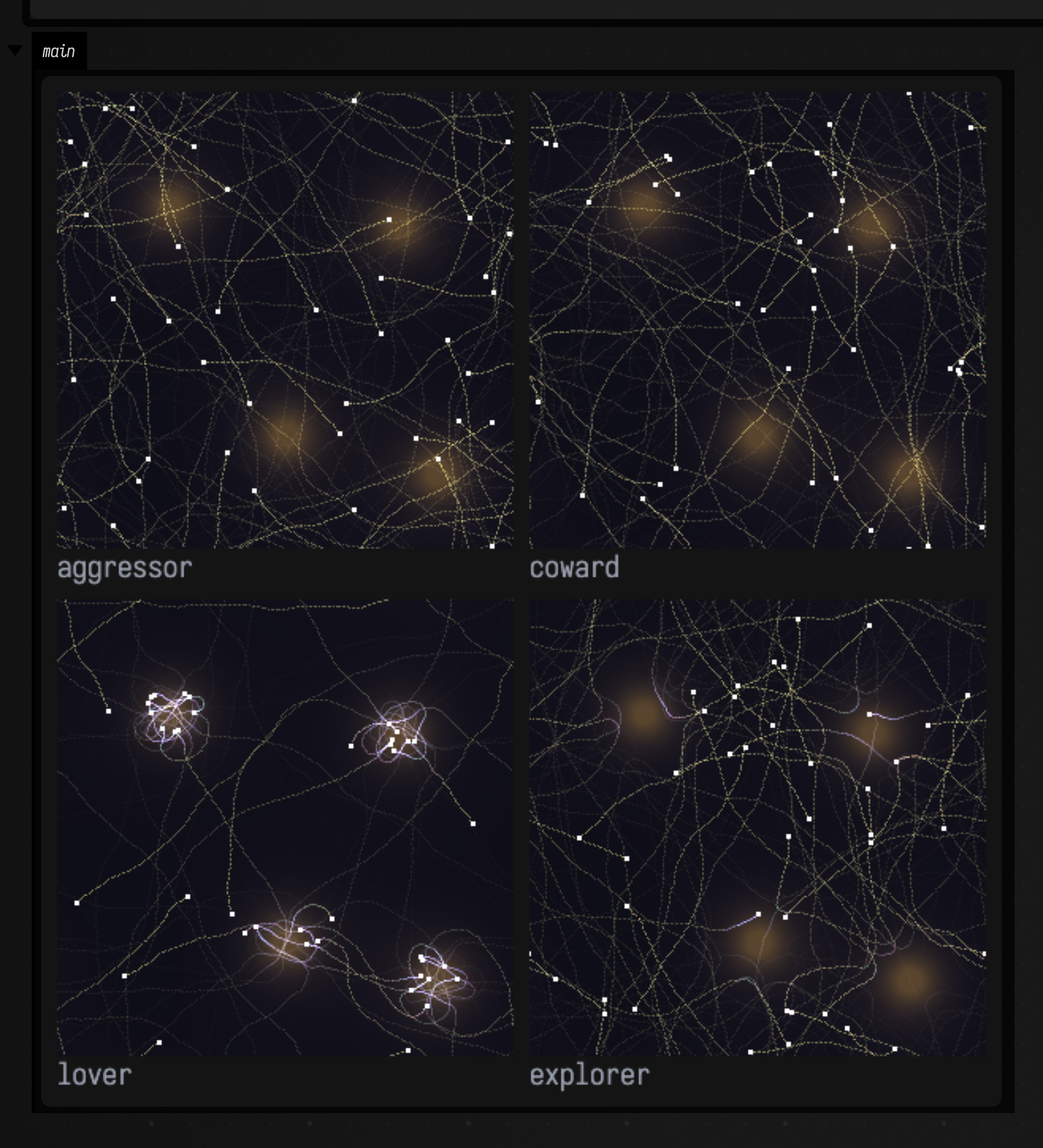
VehicleWorld.random(count, lights, wiring = ...) places vehicles at random on a torus among some
lights. The four companion wirings are Braitenberg's: AGGRESSOR (crossed, excitatory), COWARD
(uncrossed, excitatory), LOVER (uncrossed, inhibitory) and EXPLORER (crossed, inhibitory).
VehicleCanvas draws a fading trail behind each vehicle, red for the left motor neuron's rate and green
for the right, so a vehicle driving flat out is yellow and a turning one is red or green.
The inhibitory pair use bias = −1.0, so their neurons are on in the dark and switched off by light.
val lights = [Light(60.0, 60.0), Light(180.0, 70.0), Light(120.0, 180.0), Light(200.0, 200.0)]
val excite = VehicleParams()
val inhibit = VehicleParams(neuron = NeuronParams(bias = -1.0))

fun run(name: String, wiring: DoubleArray, p: VehicleParams): Pair<String, Img> {
    val world = VehicleWorld.random(40, lights, wiring = wiring, seed = 3L)
    val canvas = VehicleCanvas(world, scale = 1.2)
    repeat(1500) {
        world.step(p)
        canvas.record()
    }
    println(name + ": mean light at the body " + world.meanLight().f3)
    return name to canvas.image()
}

showImg(
    montage(
        [
            run("aggressor", VehicleWorld.AGGRESSOR, excite),
            run("coward", VehicleWorld.COWARD, excite),
            run("lover", VehicleWorld.LOVER, inhibit),
            run("explorer", VehicleWorld.EXPLORER, inhibit),
        ],
        columns = 2,
        cellSide = 300,
    ),
)
The same four, at driving speed
The still shows where the vehicles have been. This clip shows how they move, at two steps per displayed frame: the aggressors swerve into a light and accelerate through it, the cowards turn away from each light and speed off, the lovers slow down and come to rest facing a lamp, and the explorers slow down near a lamp and then turn and leave.
val lights = [Light(60.0, 60.0), Light(180.0, 70.0), Light(120.0, 180.0), Light(200.0, 200.0)]
val excite = VehicleParams()
val inhibit = VehicleParams(neuron = NeuronParams(bias = -1.0))

class Arm(val name: String, wiring: DoubleArray, val p: VehicleParams) {
    val world = VehicleWorld.random(24, lights, wiring = wiring, seed = 3L)
    val canvas = VehicleCanvas(world, scale = 1.2, fade = 0.97f)
}

val arms = [
    Arm("aggressor", VehicleWorld.AGGRESSOR, excite),
    Arm("coward", VehicleWorld.COWARD, excite),
    Arm("lover", VehicleWorld.LOVER, inhibit),
    Arm("explorer", VehicleWorld.EXPLORER, inhibit),
]

animateEvolution(
    Unit,
    totalSteps = 600,
    seconds = 15.0,
    framesTarget = 300,
    columns = 2,
    cellSide = 300,
    step = {
        for (arm in arms) {
            arm.world.step(arm.p)
            arm.canvas.record()
        }
    },
    panels = { _, n -> arms.map { it.name + " " + n to it.canvas.image() } },
)
3. Getting bored: homeostasis
A lover parks in front of the first light it finds and stays there. That is a fixed point, and nothing
in a memoryless vehicle can leave it. Give the threshold a slow integrator instead, so that a neuron
held below its targetRate for long enough lowers its own threshold, and the parked vehicle's motors
creep back on until it drives away to find another light. Its neurons then run hot in the dark, the
thresholds climb again, and it arrives at the next light able to be stopped by it.
LightVisits counts arrivals at a light other than the last one.
val lights = [Light(60.0, 60.0), Light(180.0, 70.0), Light(120.0, 180.0), Light(200.0, 200.0)]
val fixed = VehicleParams(baseSpeed = 0.0, neuron = NeuronParams(bias = -1.0))
val bored = fixed.copy(neuron = fixed.neuron.copy(adaptationRate = 0.002))

fun run(name: String, p: VehicleParams): Pair<String, Img> {
    val world = VehicleWorld.random(60, lights, wiring = VehicleWorld.LOVER, seed = 3L)
    val canvas = VehicleCanvas(world, scale = 1.2, fade = 0.998f)
    val visits = LightVisits(world)
    repeat(6000) {
        world.step(p)
        visits.observe(world)
        canvas.record()
    }
    println(name + ": " + visits.mean().f2 + " lights visited per vehicle")
    return name + ": " + visits.mean().f2 to canvas.image()
}

showImg(montage([run("fixed", fixed), run("homeostatic", bored)], columns = 2, cellSide = 300))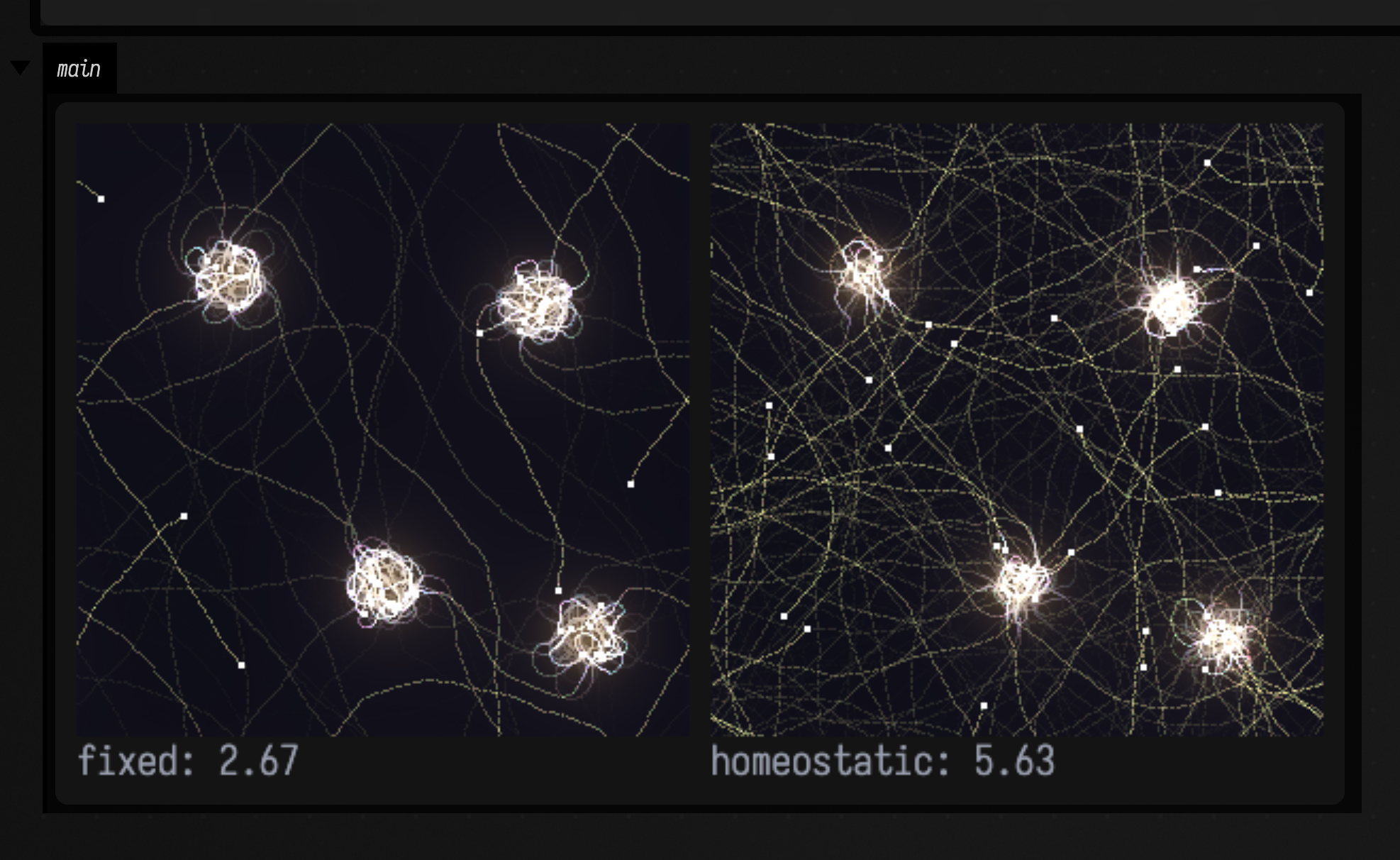
With the same 60 vehicles from the same seed over 6000 steps, the fixed-threshold lovers visit 2.7 lights each and the homeostatic ones visit 5.6. The mean light at their bodies falls from 0.82 to 0.71: boredom costs them light, which is the trade the next level has to deal with.
4. Learning the wiring
The slowest level changes the four sensor→motor weights. Each motor neuron's output carries a little
noise ξ. An eligibility trace low-passes ξ · sensor over tauTrace = 30 steps, recording which
twitches happened while which sensor was lit. The reward is the light at the vehicle's body, compared
with its own average over the last tauBaseline = 50 steps, and the weights move by
learningRate · (reward − average) · trace. A twitch followed by more light than usual is written into
the wiring. This is node perturbation, REINFORCE with a baseline; it needs no gradient and no model of
the world.
The population starts with every weight drawn uniformly from ±2, so it contains every kind of vehicle in some mixture. With learning on, the weights drift negative: the population discovers that slowing down in the light keeps it in the light, which is the lover's strategy. Each caption is the step count and the mean light at the vehicles' bodies.
val lights = [Light(60.0, 60.0), Light(180.0, 70.0), Light(120.0, 180.0), Light(200.0, 200.0)]
val learn = VehicleParams(
    neuron = NeuronParams(bias = -1.0),
    plasticity = PlasticityParams(learningRate = 3.0),
)
val control = learn.copy(plasticity = learn.plasticity.copy(learningRate = 0.0))

val a = VehicleWorld.random(80, lights, seed = 5L)
val b = a.copy(seed = 6L)
val canvasA = VehicleCanvas(a, scale = 1.2)
val canvasB = VehicleCanvas(b, scale = 1.2)

animateEvolution(
    Unit,
    totalSteps = 30000,
    seconds = 12.0,
    framesTarget = 240,
    columns = 2,
    cellSide = 300,
    step = {
        a.step(learn)
        b.step(control)
        canvasA.record()
        canvasB.record()
    },
    panels = { _, n ->
        [
            "learning " + n + ": " + a.meanLight().f2 to canvasA.image(),
            "fixed " + n + ": " + b.meanLight().f2 to canvasB.image(),
        ]
    },
)
The clip runs 30 000 steps. The learning population climbs for about the first 20 000 and then levels
off near 0.59, with the summed weight per vehicle settled around −1.6; out to 80 000 steps neither changes by more than its own wobble. Over three seeds, after 15 000 steps, the mean light at the body in the last 2000 steps is 0.58, 0.55
and 0.62 with learning against 0.41, 0.42 and 0.44 without, and the summed weight per vehicle has moved
down by between 0.6 and 1.5. A much larger learningRate overshoots: at 80 the weights
become inhibitory enough that the faint background light between the lamps stops the vehicles too, and
the mean light falls to about 0.3.
5. Circling at a set distance
BUMP is quiet below its preferred input and quiet above it. Put it into the aggressor's crossed
excitatory wiring and the vehicle behaves like an aggressor while the light is dimmer than the preferred
level and like a coward once it is brighter, so it neither reaches the lamp nor leaves it: it circles.
orbitBias(distance) returns the bias that puts the bump's peak at the brightness a sensor sees
distance away from a lamp. The membrane has to be fast (tauMembrane = 1.0): with the default 4 steps
of lag the vehicle has driven past the ring before its neurons notice, and the population scatters
again.
OrbitRadii records every vehicle's distance to its nearest lamp once per step. The box tunes four
populations to four distances, lets them settle for 6000 steps, draws each population's trails
(captioned tuned distance -> median) and
hands the last 2000 steps of distances to violin, one violin per tuned distance on a shared 0 to 60
axis, with the tuned distance as a dashed yellow line across its own violin.
val lights = [Light(60.0, 60.0), Light(180.0, 70.0), Light(120.0, 180.0), Light(200.0, 200.0)]
val panels = mutableListOf<Pair<String, Img>>()
val groups = mutableListOf<Pair<String, List<Double>>>()
for (d in [8.0, 12.0, 16.0, 20.0]) {
    val p = VehicleParams(
        neuron = NeuronParams(activation = Activation.BUMP, gain = 4.0, tauMembrane = 1.0, bias = orbitBias(d)),
    )
    val world = VehicleWorld.random(60, lights, wiring = VehicleWorld.AGGRESSOR, seed = 3L)
    val canvas = VehicleCanvas(world, scale = 1.2, fade = 0.99f)
    world.stepTimes(p, 6000)
    val radii = OrbitRadii()
    repeat(2000) {
        world.step(p)
        radii.observe(world)
        canvas.record()
    }
    println(
        "tuned ${d.f2}: median ${radii.median().f2}, middle half ${radii.quantile(0.25).f2} to ${radii.quantile(0.75).f2}",
    )
    panels += (d.f2 + " -> " + radii.median().f2) to canvas.image()
    groups += ("tuned " + d.f2) to radii.distances(every = 40)
}
showImg(montage(panels, columns = 2, cellSide = 300))
display(
    "radii",
    violin(
        *groups.toTypedArray(),
        references = [8.0, 12.0, 16.0, 20.0],
        yRange = 0.0..60.0,
        yTitle = "distance to nearest lamp",
    ),
)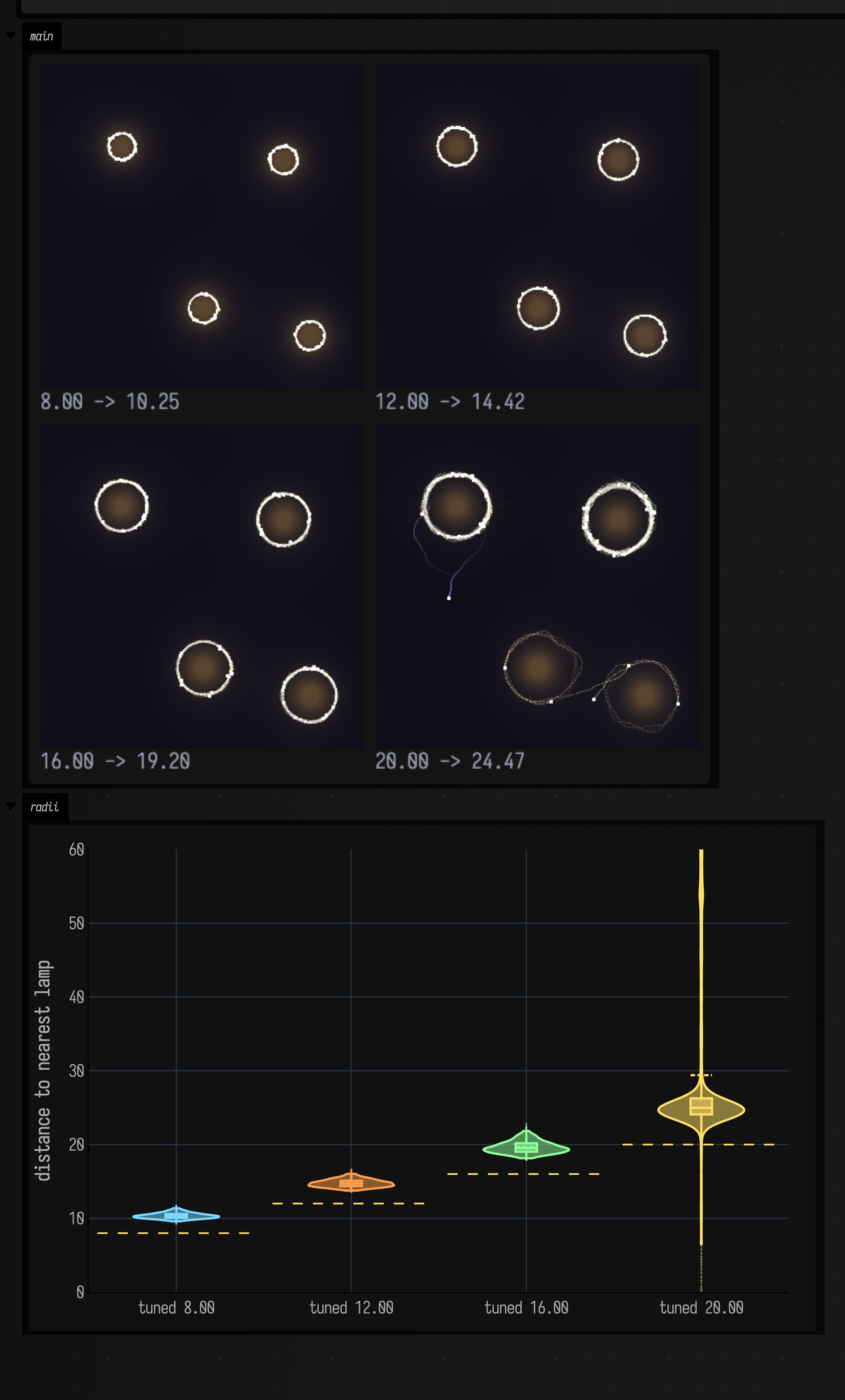
Tuned to 8, 12, 16 or 20, the vehicles settle on rings of median radius 10.2, 14.4, 19.2 and 24.5: wider than asked for, because the sensors sit 3 units ahead of the body and the inner sensor has to be just past the peak for the turn to balance. The middle half of each distribution is under a unit wide at 8 and 12 and about one and a half at 20. At 20 a few vehicles are not on a ring yet: the tails of the bump are too faint 60 units from a lamp to steer by, so a vehicle that starts far away has to drift close before it is caught.
6. A price on speed
The reward on the learning level is the light at the body. PlasticityParams.speedCost subtracts
speedCost · speed from it, so a vehicle that keeps the same light while driving slower is the better
one. Each arm below is the same 80 randomly wired vehicles from section 4, learning for 15 000 steps,
with four prices; each caption is the price and the mean speed over the last 2000 steps.
val lights = [Light(60.0, 60.0), Light(180.0, 70.0), Light(120.0, 180.0), Light(200.0, 200.0)]
val panels = mutableListOf<Pair<String, Img>>()
for (cost in [0.0, 0.2, 0.5, 1.0]) {
    val p = VehicleParams(
        neuron = NeuronParams(bias = -1.0),
        plasticity = PlasticityParams(learningRate = 3.0, speedCost = cost),
    )
    val world = VehicleWorld.random(80, lights, seed = 5L)
    val canvas = VehicleCanvas(world, scale = 1.2)
    world.stepTimes(p, 15000)
    var light = 0.0
    var speed = 0.0
    repeat(2000) {
        world.step(p)
        canvas.record()
        light += world.meanLight() / 2000
        speed += world.meanSpeed() / 2000
    }
    println(
        "speedCost ${cost.f2}: light ${light.f3}, speed ${speed.f3}, summed weight ${(world.w.sum() / world.count).f2}",
    )
    panels += ("cost " + cost.f2 + ": " + speed.f2) to canvas.image()
}
showImg(montage(panels, columns = 4, cellSide = 240))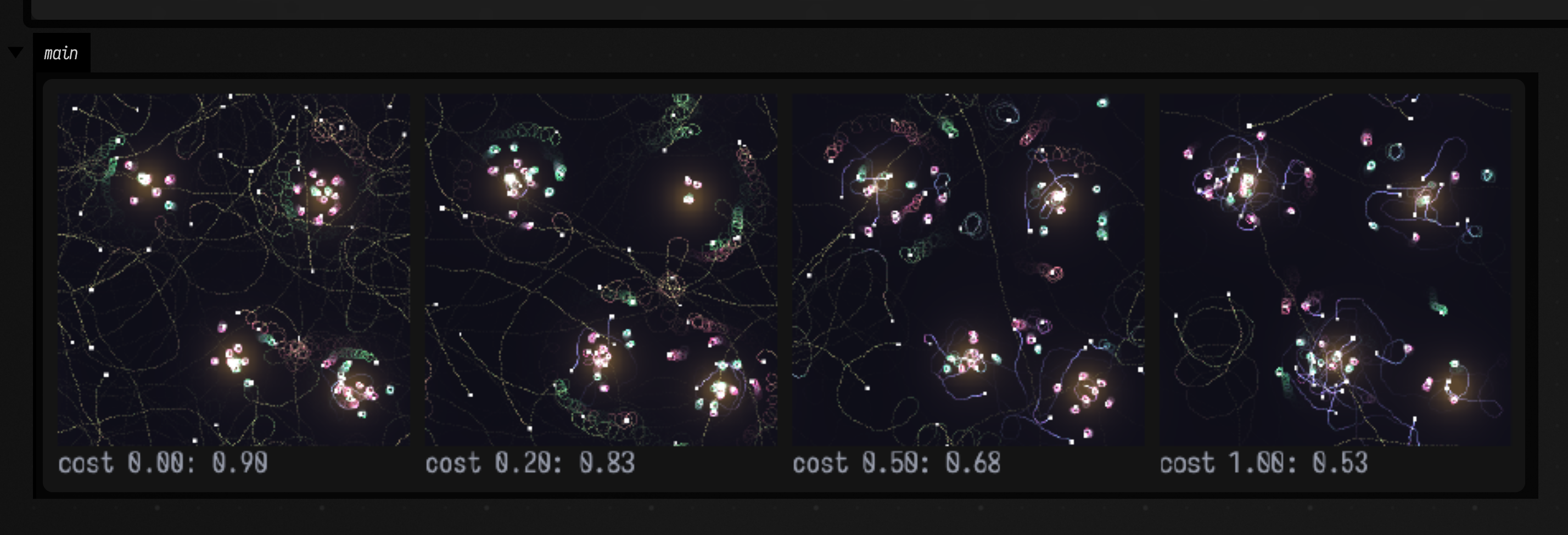
Without a price the learned population drives at 0.90 and holds 0.58 of light. At a price of 0.5 it drives at 0.68 and holds 0.54; at 1.0, 0.53 and 0.51. The weights carry the difference: the summed weight per vehicle goes from −1.4 to −6.3 and −7.6, more inhibitory, so the motors are quieter everywhere, not just at the lamps. The trails get shorter and the vehicles spend their time parked.
7. Learning and homeostasis together
Homeostasis made the fixed lovers of section 3 forage; learning made random wirings into lovers in section 4. Turning both on in the same population gives neither result in full. The box runs the four combinations from one seed for 20 000 steps and reports the last 5000.
val lights = [Light(60.0, 60.0), Light(180.0, 70.0), Light(120.0, 180.0), Light(200.0, 200.0)]
val base = VehicleParams(neuron = NeuronParams(bias = -1.0))

fun arm(name: String, adaptation: Double, learning: Double): Pair<String, Img> {
    val p = base.copy(
        neuron = base.neuron.copy(adaptationRate = adaptation),
        plasticity = PlasticityParams(learningRate = learning),
    )
    val world = VehicleWorld.random(80, lights, seed = 5L)
    val canvas = VehicleCanvas(world, scale = 1.2, fade = 0.998f)
    world.stepTimes(p, 15000)
    val visits = LightVisits(world)
    var light = 0.0
    repeat(5000) {
        world.step(p)
        visits.observe(world)
        canvas.record()
        light += world.meanLight() / 5000
    }
    println(name + ": light " + light.f3 + ", lights visited " + visits.mean().f2)
    return (name + ": " + light.f2) to canvas.image()
}

showImg(
    montage(
        [
            arm("neither", 0.0, 0.0),
            arm("homeostasis", 0.002, 0.0),
            arm("learning", 0.0, 3.0),
            arm("both", 0.002, 3.0),
        ],
        columns = 2,
        cellSide = 300,
    ),
)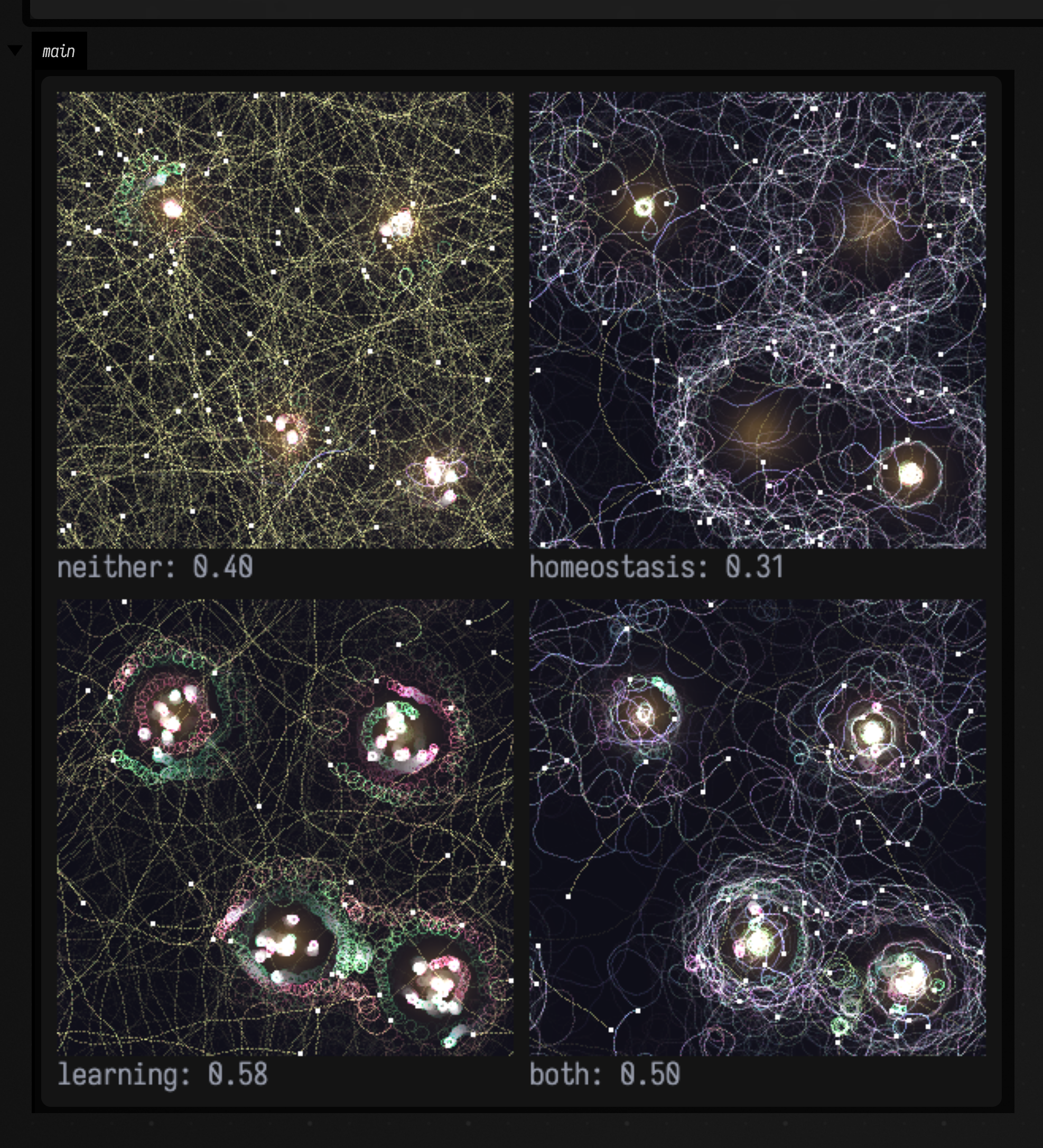
The untrained random population holds 0.40 and drifts through 3.8 lights each in 5000 steps, because most of its vehicles are aggressors and cowards that never stop. Homeostasis on its own makes that population worse (0.31): boredom is a way out of a parked state, and these vehicles were not parked. Learning alone holds 0.58. Both together hold 0.50, between the two, and visit 0.9 lights where learning alone visits 0.6. Over seeds 5, 7 and 9 that order holds every time: with both on, the mean light is 0.46 to 0.51 against 0.55 to 0.59 for learning alone. The learned weights are less inhibitory with homeostasis on (−0.5 to −1.1 against −0.3 to −1.5 summed), because the threshold is doing part of the stopping for them.
8. Moving lights
A Light takes a velocity, vx and vy in units per step, and VehicleWorld.step moves it across the
torus, and withLights moves a population onto a different set of lamps. The box below trains the
section 4 population on still lamps for 15 000 steps, freezes its
weights, then sets every lamp drifting at 0.1 units per step in a different direction. Beside it are
Braitenberg's lovers on the same moving lamps.
val still = [Light(60.0, 60.0), Light(180.0, 70.0), Light(120.0, 180.0), Light(200.0, 200.0)]
val moving = still.mapIndexed { k, l -> l.copy(vx = 0.1 * cos(k * 1.7), vy = 0.1 * sin(k * 1.7)) }
val p = VehicleParams(neuron = NeuronParams(bias = -1.0))

val trained = VehicleWorld.random(80, still, seed = 5L)
trained.stepTimes(p.copy(plasticity = PlasticityParams(learningRate = 3.0)), 15000)
val learned = trained.withLights(moving, seed = 11L)
val lovers = VehicleWorld.random(80, still, wiring = VehicleWorld.LOVER, seed = 5L).withLights(moving, seed = 11L)
val canvasA = VehicleCanvas(learned, scale = 1.2, fade = 0.98f)
val canvasB = VehicleCanvas(lovers, scale = 1.2, fade = 0.98f)

animateEvolution(
    Unit,
    totalSteps = 3000,
    seconds = 12.0,
    framesTarget = 240,
    columns = 2,
    cellSide = 300,
    step = {
        learned.step(p)
        lovers.step(p)
        canvasA.record()
        canvasB.record()
    },
    panels = { _, n ->
        [
            "learned " + n + ": " + learned.meanLight().f2 to canvasA.image(),
            "lovers " + n + ": " + lovers.meanLight().f2 to canvasB.image(),
        ]
    },
)
The learned wiring does not follow. On still lamps it held 0.58; on lamps drifting at 0.1, measured
over 4000 steps after a 1000-step settle, it holds about 0.41, and keeping the learning on while the lamps move does not recover it (0.38). The lovers
hold 0.75, more than they did on still lamps, because a lamp moving toward a parked lover brings its
light with it. trailAlong() measures how far behind a moving lamp the vehicles near it sit, along the
lamp's direction of travel: the lovers trail by about 0.8 units at 0.1, 7 units at 0.2, and 14 at 0.4,
where they are being dragged at the edge of what their sensors can see. What the learned population
found is the lover's strategy only on average: a mixture of weakly inhibitory wirings that slow down in
bright places, which is enough for a lamp that waits and not enough for one that leaves.
9. Searching for a wiring
The four wirings are four corners of a four-dimensional space, and learning is one way to move through
it. VehicleWiringGenome puts the same four weights on PopulationSearch, the
engine the Lenia and Life-rule searches use, and vehicleForageObjective(lights) scores a wiring by
giving it to 30 vehicles and taking the mean light at their bodies over the last 1000 of 3000 steps.
As on the ALife page, a random-sampling control at the same budget and seed runs beside the search.
val lights = [Light(60.0, 60.0), Light(180.0, 70.0), Light(120.0, 180.0), Light(200.0, 200.0)]
val ops = VehicleWiringGenome()
val objective = vehicleForageObjective(lights)

val control = PopulationSearch.random(ops, objective, 300, seed = 13L, label = "random")
val evolved =
    PopulationSearch.evolve(ops, objective, 300, seed = 13L, mu = 6, lambda = 12, crossoverRate = 0.3, label = "evolve")
println(control.summary())
println(evolved.summary())
println("lover " + objective.evaluate(VehicleWorld.LOVER).fitness.f3)
val best = evolved.best!!.genome
println("evolved wiring " + best.joinToString { it.f2 })

fun trails(name: String, wiring: DoubleArray): Pair<String, Img> {
    val world = VehicleWorld.random(30, lights, wiring = wiring, seed = 1L)
    val canvas = VehicleCanvas(world, scale = 1.2)
    repeat(3000) {
        world.step(VehicleParams(neuron = NeuronParams(bias = -1.0)))
        canvas.record()
    }
    return (name + ": " + world.meanLight().f2) to canvas.image()
}
showImg(montage([trails("lover", VehicleWorld.LOVER), trails("evolved", best)], columns = 2, cellSide = 300))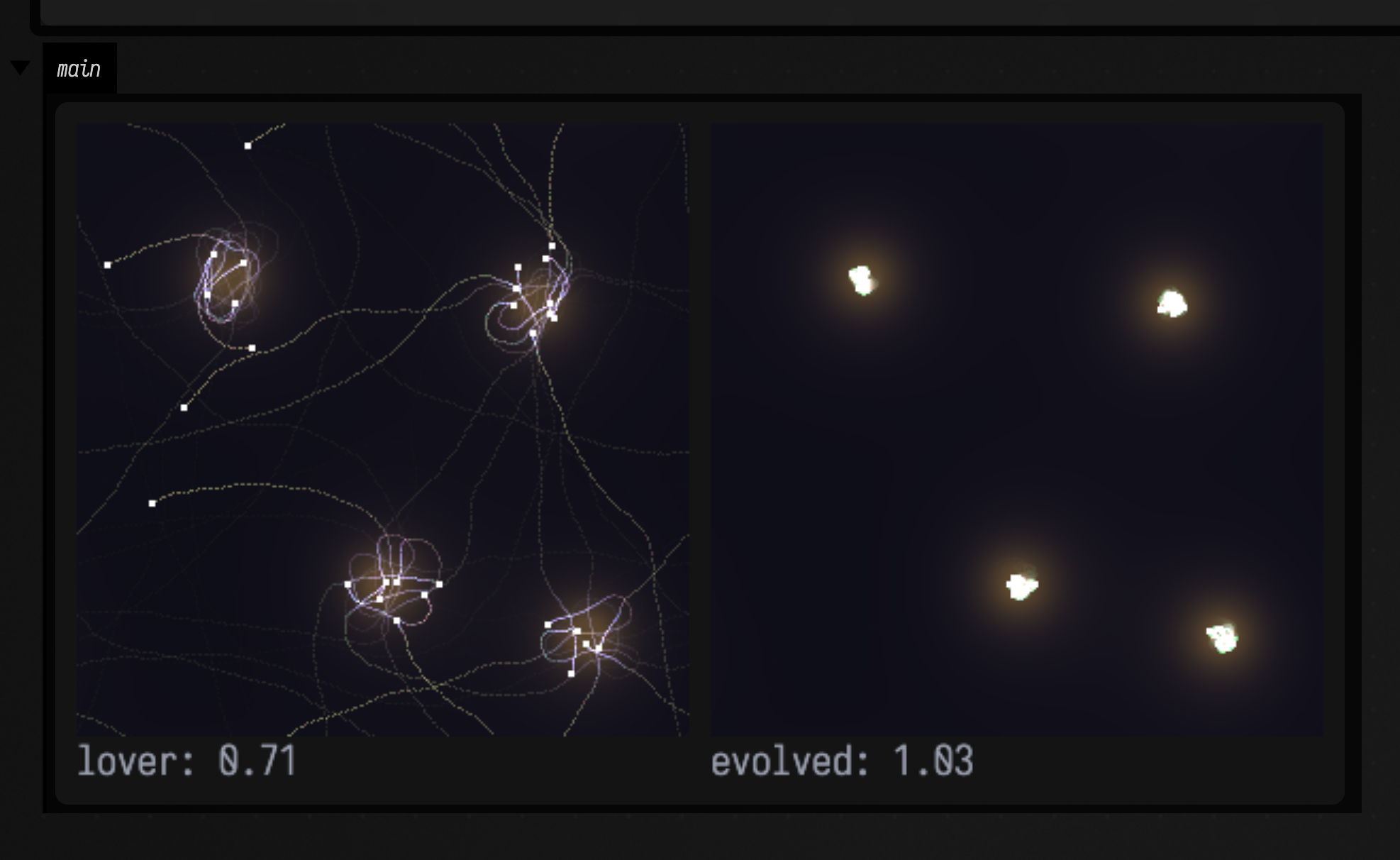
Both arms find wirings that hold about 1.0 of light (0.99 for the random control, 1.02 for evolution), against 0.64 for the lover on the same test and 0.58 for the learned population. The trails show the evolved wiring on a different set of starting positions. The evolved wiring is not one of the four corners: it is lopsided, one motor strongly driven by one sensor and inhibited by the other, so the vehicle turns in a tight circle on top of the lamp it found instead of parking in front of it. Evolution does not beat random sampling by much here (at seeds 17 and 19 the two are within 0.01), for the reason the radius-1 Life rules gave on the ALife page: four numbers is a space a few hundred independent draws cover on their own. A genome that carried the neuron parameters as well, or a test with moving lamps, would give the search something to do; §10 tries both.
10. A larger genome: does evolution beat random sampling?
VehicleBrainGenome(hidden) gives the search everything the vehicle can express besides its four
wires: the angle the sensors point at, a gain on what they read, a bias on each motor, and hidden
recurrent neurons between the sensors and the motors, each with its own inputs, bias, outputs and a
weight from every other hidden neuron. With no hidden neurons that is 8 numbers; with 4 it is 44; with
16 it is 344. Three tasks from earlier sections score it: forage (§9's four lamps with §6's price on
speed, light − 0.5 × speed), orbit (circle one lamp at distance 20 while moving, the §5 behaviour)
and track (two drifting lamps, §8). compareVehicleSearch runs random sampling, a hill climber and
the evolver at exactly the same number of evaluations at every seed, and reports the spread across
seeds rather than one best.
The box below runs it on the orbit task with 4 hidden neurons and six seeds, twice: once with the evolver set up as in §9 (6 parents, 12 children), once with 12 parents, 24 children and a quarter of the children drawn fresh. The plots are best-so-far fitness against evaluations, the median of the six seeds as a line, the middle half as a band and the final median written at the right: random sampling grey, hill climbing blue, evolution orange; both plots share one scale. The trails are the median seed's best brain from three arms (random sampling, and each evolver setting), twelve vehicles released from new positions and drawn for their last 300 steps.
val task = VehicleBrainTask.orbit(radius = 20.0)
val seeds = [1L, 2L, 3L, 4L, 5L, 6L]
val narrow = compareVehicleSearch(task, hidden = 4, budget = 300, seeds = seeds)
val wide =
    compareVehicleSearch(task, hidden = 4, budget = 300, seeds = seeds, mu = 12, lambda = 24, immigrantRate = 0.25)
println(narrow.table() + narrow.perSeed())
println(wide.table())

val range = 0.0..1.0
fun trails(name: String, run: SearchRun<DoubleArray>): Pair<String, Img> {
    val world = task.world(run.best!!.genome, hidden = 4, seed = 7L, vehicles = 12)
    world.stepTimes(1200)
    return (name + " " + run.bestFitness.f2) to world.trails(300)
}
showImg(
    montage(
        [
            "mu 6, lambda 12" to narrow.plot(yRange = range),
            "mu 12 + immigrants" to wide.plot(yRange = range),
            trails("median random", wide.medianRun(VehicleSearchDriver.RANDOM)),
            trails("median mu 6", narrow.medianRun(VehicleSearchDriver.EVOLVE)),
            trails("median mu 12+imm", wide.medianRun(VehicleSearchDriver.EVOLVE)),
        ],
        columns = 3,
        cellSide = 300,
    ),
)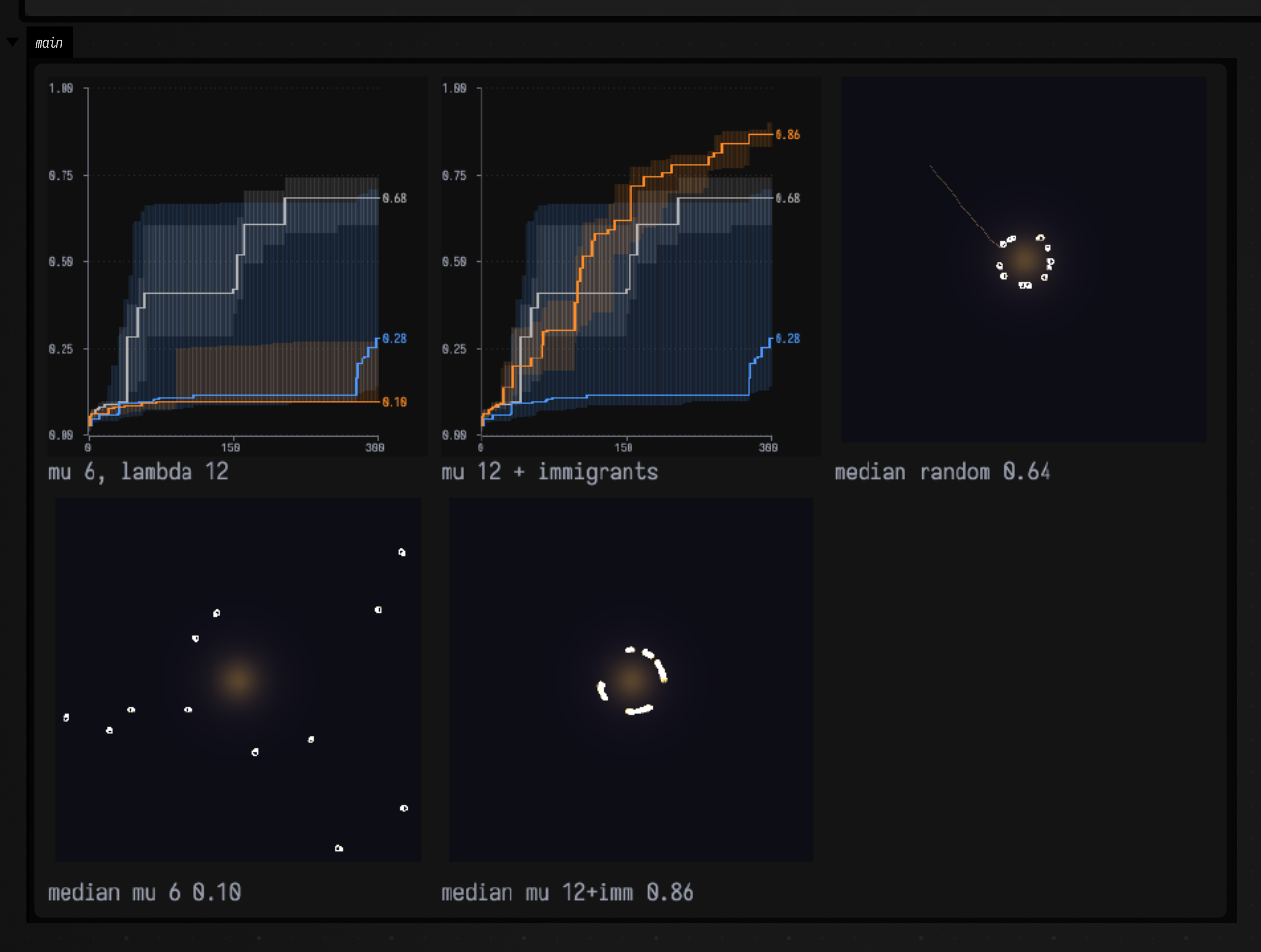
The §9 setting loses to random sampling. At six seeds its median best is 0.10 against random's 0.68, and the per-seed table shows why: four of the six runs end at about 0.095, the score of vehicles that drive past the lamp and never come back, while the other two reach 0.88 and 0.32. Six random starting genomes all landed on that flat region, every mutation of them scored the same, and an elitist population with nothing to tell its members apart stays where it is. In the trails the median §9 brain is the stuck one: its vehicles sit still wherever they started. Random sampling never gets stuck, because it never builds on anything, and its median brain gathers its vehicles close around the lamp, inside the ring of 20 it is scored on. The wider population with immigrants keeps drawing fresh genomes, and once one of them lands on the slope the population climbs it: median 0.86, ahead of random at five seeds of six, and its median brain holds the ring.
Over twelve seeds (1–12), 300 evaluations each, the medians of the per-seed bests (the number in brackets is how many of the twelve seeds beat random sampling at the same seed):
| Task | Hidden (genes) | Random | Hill climb | Evolve, µ 6 λ 12 | Evolve, µ 12 λ 24, immigrants |
|---|---|---|---|---|---|
| forage | 0 (8) | 0.51 | 0.39 (5/12) | 0.30 (3/12) | 0.63 (9/12) |
| forage | 4 (44) | 0.50 | 0.29 (3/12) | 0.34 (4/12) | 0.65 (8/12) |
| forage | 16 (344) | 0.60 | 0.33 (2/12) | 0.51 (4/12) | 0.66 (8/12) |
| orbit | 0 (8) | 0.48 | 0.78 (7/12) | 0.10 (3/12) | 0.85 (11/12) |
| orbit | 4 (44) | 0.65 | 0.10 (3/12) | 0.21 (5/12) | 0.85 (9/12) |
| orbit | 16 (344) | 0.67 | 0.38 (4/12) | 0.56 (5/12) | 0.89 (11/12) |
| track | 0 (8) | 0.36 | 0.37 (5/12) | 0.40 (7/12) | 0.59 (11/12) |
| track | 4 (44) | 0.44 | 0.31 (3/12) | 0.35 (5/12) | 0.61 (11/12) |
| track | 16 (344) | 0.57 | 0.27 (3/12) | 0.30 (2/12) | 0.75 (8/12) |
The answer does not depend on genome size the way §9 guessed it would. The population with immigrants beats random sampling on the median at every size and on every task, at 8 genes as well as at 344. The small elitist population loses to it in eight of these nine rows, and the hill climber in seven; the exceptions (orbit at 8 genes for the climber, track at 8 genes for both, and the §9 setting on orbit at 112 genes, in the dev notes) do not line up with size either. Both losing searches are bimodal: their best seeds match or beat anything random sampling finds, and their other seeds stay on the plateau where they started. What decides the comparison is whether the search can leave that plateau, not how many numbers it is searching over. Random sampling's own median creeps up with size (0.48 to 0.67 on orbit), because a larger brain has more ways to be roughly right.
The wider setting at the two sizes the table leaves out holds the pattern: at 22 and 112 genes it beats random sampling at 9 and 12 seeds of 12 on forage, 12 and 12 on orbit, and 11 and 6 on track (medians 0.77, 0.69; 0.88, 0.87; 0.66, 0.58, against random's 0.61, 0.57; 0.65, 0.68; 0.44, 0.53).
The budget does change the picture. On orbit with 4 hidden neurons, over the same twelve seeds:
| Evaluations | Random | Hill climb | Evolve, µ 6 λ 12 | Evolve, µ 12 λ 24, immigrants |
|---|---|---|---|---|
| 100 | 0.56 | 0.10 (2/12) | 0.10 (4/12) | 0.33 (6/12) |
| 300 | 0.65 | 0.10 (3/12) | 0.21 (5/12) | 0.85 (9/12) |
| 1000 | 0.71 | 0.85 (11/12) | 0.65 (6/12) | 0.95 (11/12) |
At 100 evaluations nothing beats random sampling: a search needs time to find the slope before it can climb it. At 1000 the hill climber, whose restarts eventually land somewhere useful, beats random at 11 seeds of 12, while the §9 evolver is still split between seeds near 0.96 and seeds stuck at 0.10. Random sampling gains only 0.15 from ten times the budget.
How these numbers were measured
The twelve-seed tables are VehicleBrainSearchTest.fullSweep, run with
-Dafield.vehicleBrainSweep=true, =immigrants, =immigrants-mid and =budgets; the 2- and 8-hidden rows, measured only
for the §9 setting, are in dev_docs/vehicle_brain_search.md with every per-seed value. The
random and hill-climb arms are identical in both runs (same seeds, same genome). The box's six
seeds reproduce the first six rows of the twelve-seed per-seed table exactly; the seeds run in
parallel and theComparisonIsDeterministic pins that this changes nothing.