A function, played and read back
Turn a function into sound, then analyse the recording and compare what you recover with the original. We'll play the same curve as loudness and as pitch, and put the recording, measurements and a certified range (bounds on the function's values that interval arithmetic proves, not samples) on one timeline.
afield.math.functions.Functions builds the function and FnInterval certifies its range. A Dough
graph (Field's audio signal graph) plays it, rendered offline to a 16-bit .wav; PatOnsetDetection and PatPitchDetection
read the file back. The time-axis viewer brings the results together.
Most of what changes on the way is delay: one from how the function reaches the signal graph and one from how the pitch detector reports time. Both can be measured to the sample.
The function, and two ways to hear it
FnSoundDocs.contour is three seconds of a slow curve: a resting level, a
broad swell, a step up to a plateau that wobbles at 6 Hz, and one bump with a 3 ms sigma, narrower
than either analysis window. It is built only from ops that have a formula, so every interval of it
has a certified range.
val f = with(Functions) {
    val d = Functions.Domain(0.0, 3.0)
    c(0.2, d) +
        gaussian(0.8, 0.2, 0.5, d) +
        smoothStep(1.4, 2.0, d) * (c(0.3, d) + sin(6.0, amplitude = 0.08)) +
        gaussian(2.6, 0.003, 0.25, d)
}
It is played two ways. As loudness, it is the amplitude of a sine at 375 Hz, a frequency chosen so one period is exactly 128 samples at 48 kHz. As pitch, it is the frequency of a sine at constant level, \( 220 \cdot 2^f \) Hz, so the curve spans about half an octave. Neither render is normalised, so the amplitude in the file is the amplitude the function asked for, and both analyses read the file back from disk.
Here is the loudness render:
And the pitch render, the same curve as a glide:
Two bridges from an Fn to a signal
The first way to bring an Fn into a Dough graph is a Param whose supplier reads it,
Param { f(time.toDouble()).toFloat() }. A supplier is evaluated once per audio block,
at the block's start, and Param ramps from the previous block's value to this one across the
block. So at time t the audio hears, to first order, the function at t minus one block.
FnSignal, reached as f.toSignal(), is the per-sample alternative: sample i of a block is
f(time + i / sampleRate). Both routes are measured below, and the clips above use
toSignal(). In code, the two look like this:
val perSample = SineOsc(Param(375f)) * f.scaleY(0.8).toSignal()
val perBlock = SineOsc(Param(375f)) * Param { 0.8f * f(time.toDouble()).toFloat() }
What came back
The loudness is recovered by patEnergyEnvelope, an RMS per hop, with a window two periods of the
375 Hz sine long. Over a whole number of periods a steady sine's RMS is exactly its amplitude over
√2, so the window adds no ripple of its own. The pitch is recovered by patF0Frames, the YIN
estimator, told the pitch range to expect. The box below draws the function, both recovered curves
and their errors on one timeline, with the loudness render underneath.
:::static
import afield.audio.synth.FnSoundDocs.Encoding

/*
Each roundTrip renders through FnSignal, writes a 16-bit .wav with no normalisation, reads that
file back, and analyses what it read. `inside` is checked against the proven bounds of
certifiedRange over the samples each frame read, not against a sampled curve.
*/
val loud = FnSoundDocs.roundTrip(Encoding.LOUDNESS)
val pitch = FnSoundDocs.roundTrip(Encoding.PITCH)
val f = loud.fn

:::fold the viewer, the audio, and the numbers
val sync = "chain-fn-roundtrip"
val viewer = SignalViewer(
    [
        certifiedSignalChannel("f, and its loudness read back", f, 0.1, 0.95).copy(comparison = loud::recoveredAt),
        certifiedSignalChannel("f, and its pitch read back", f, 0.1, 0.95).copy(comparison = pitch::recoveredAt),
        SignalChannel("loudness − f", loud::errorAt, -0.1, 0.1),
        SignalChannel("pitch − f", pitch::errorAt, -0.1, 0.1),
    ],
    0.0,
    FnSoundDocs.SECONDS,
    sampleStep = 1.0 / 4000,
    gaps = true,
)
displaySignal(
    viewer,
    "viewer",
    SignalViewerOptions(
        width = 1100,
        laneHeight = 120,
        label = "one function, played two ways and read back",
        comparisonLabel = "read back from the .wav",
        syncGroup = sync,
        viewKey = "chain-fn-roundtrip:viewer",
    ),
)
displayAudioBytes(
    loud.wav.readBytes(),
    channel = "audio",
    durationSeconds = FnSoundDocs.SECONDS,
    label = "the loudness render, as analysed",
    options = AudioVisualizerOptions(width = 1100, syncGroup = sync),
)

fun row(label: String, t: FnSoundDocs.RoundTrip) =
    "| $label | ${t.measured.size} of ${t.frames.size} | ${t.rmsError.f5} | ${t.maxAbsError.f4} at ${t.maxErrorAtSeconds.f3} s | " +
        "${t.insideCount} of ${t.measured.size}, worst ${"%.1e".format(t.worstOutside)} outside | ${t.blip.survival.f2} |"
markdown(
    "readout",
    """
| read back from | frames | RMS error | worst error | inside the certified range | of the bump's height |
|---|---|---|---|---|---|
${row("loudness (RMS)", loud)}
${row("pitch (YIN)", pitch)}
""",
    width = 1080,
)
:::endfold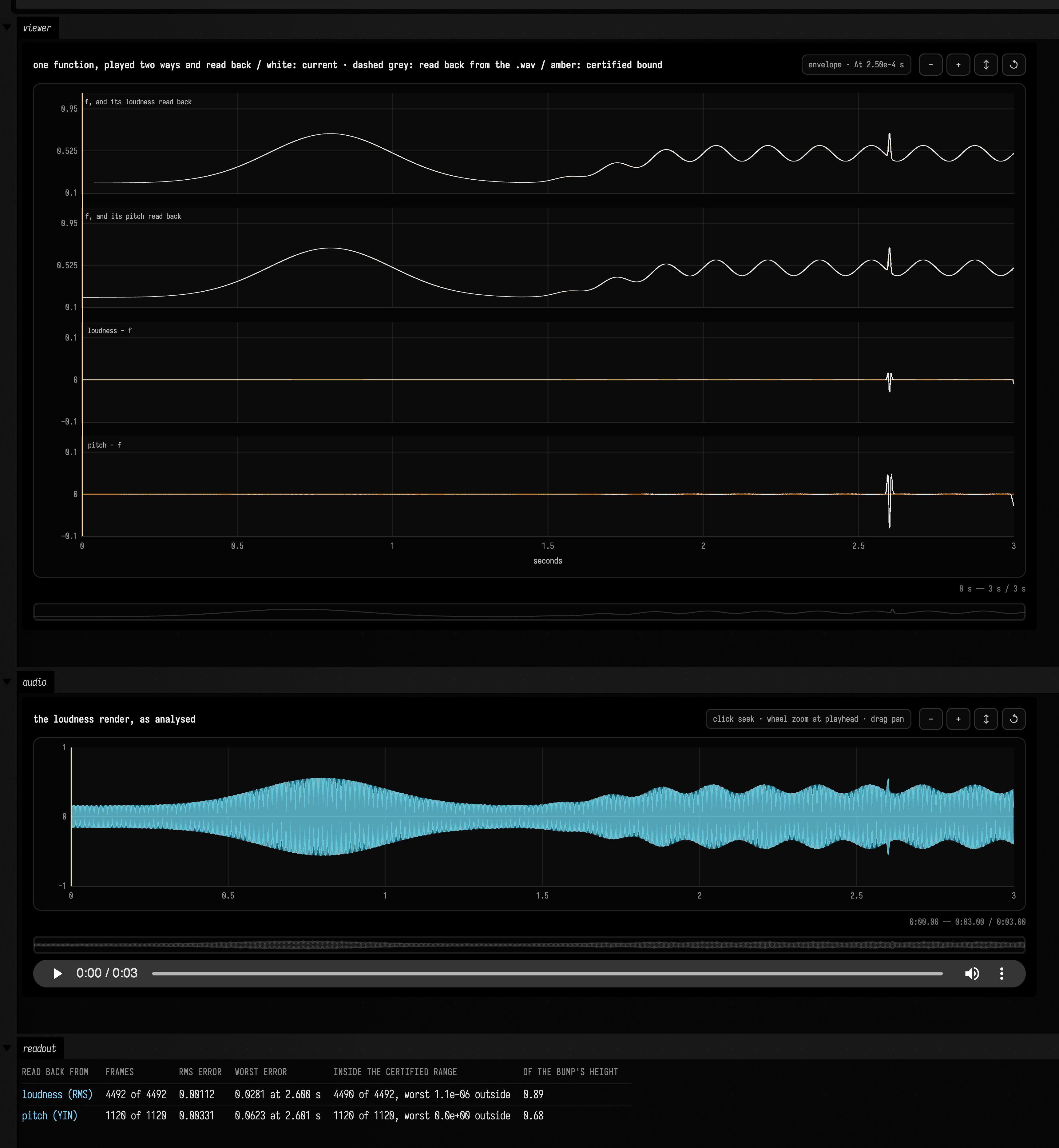
Over the slow parts both recovered curves sit on the function, close enough to hide under it at this zoom, and the error lanes are nearly flat. The worst error of each lies at the narrow bump, and the last column says how much of that bump's height each encoding kept. Neither window is much narrower than the bump, and a window can only report an average over what it read.
The certified band handles this. A windowed measurement cannot be expected to land on
the function's value at one instant. It can be expected to land inside the range the function
covers over the samples the window read, and certifiedRange bounds that range with a proof rather
than a sample grid. Nearly every loudness frame lands inside. The few that do not miss by less than
one 16-bit step. Every pitch frame lands inside, but a YIN frame reads nearly three times as many
samples as an RMS frame here, and a wider window has a wider range to land in.
Delays, measured to the sample
The harness also asks what delay best aligns each recovered curve with the function, searching two blocks either way at one-sample resolution. The box below plays both encodings through both bridges and zooms in on the narrow bump.
:::static
import afield.audio.synth.FnSoundDocs.Encoding
import afield.audio.synth.FnSoundDocs.Route

// Two encodings through two bridges. bestLagSamples reads f at each frame's reported time minus
// the lag that best aligns the two.
val trips = Encoding.values().flatMap { e -> Route.values().map { r -> FnSoundDocs.roundTrip(e, r) } }
fun trip(e: Encoding, r: Route) = trips.single { it.encoding == e && it.route == r }

:::fold the bump up close, and the four delays
val f = trips.first().fn
val viewer = SignalViewer(
    [
        SignalChannel(
            "loudness through toSignal()",
            f::eval,
            0.35,
            0.8,
            comparison = trip(Encoding.LOUDNESS, Route.PER_SAMPLE)::recoveredAt,
        ),
        SignalChannel(
            "loudness through Param { }",
            f::eval,
            0.35,
            0.8,
            comparison = trip(Encoding.LOUDNESS, Route.PER_BLOCK)::recoveredAt,
        ),
    ],
    0.0,
    FnSoundDocs.SECONDS,
    sampleStep = 1.0 / 48000,
    gaps = true,
)
displaySignal(
    viewer,
    "viewer",
    SignalViewerOptions(
        width = 1100,
        laneHeight = 150,
        label = "the bump at 2.6 s, 30 ms wide",
        comparisonLabel = "read back from the .wav",
        initialStart = FnSoundDocs.BLIP_AT - 0.015,
        initialDuration = 0.03,
        viewKey = "chain-fn-roundtrip:delays",
    ),
)

val rows =
    trips.joinToString("\n") { t ->
        "| ${t.encoding.name.lowercase()} | ${if (t.route == Route.PER_SAMPLE) "`toSignal()`" else "`Param { }`"} | " +
            "${t.rmsError.f5} | ${t.bestLagSamples} | ${t.rmsErrorAtBestLag.f5} |"
    }
markdown(
    "delays",
    """
One audio block is ${FnSoundDocs.BLOCK} samples, ${(1000.0 * FnSoundDocs.BLOCK / FnSoundDocs.SR).f2} ms.

| encoding | bridge | RMS error | best delay, samples | RMS error at that delay |
|---|---|---|---|---|
$rows
""",
    width = 1080,
)
:::endfold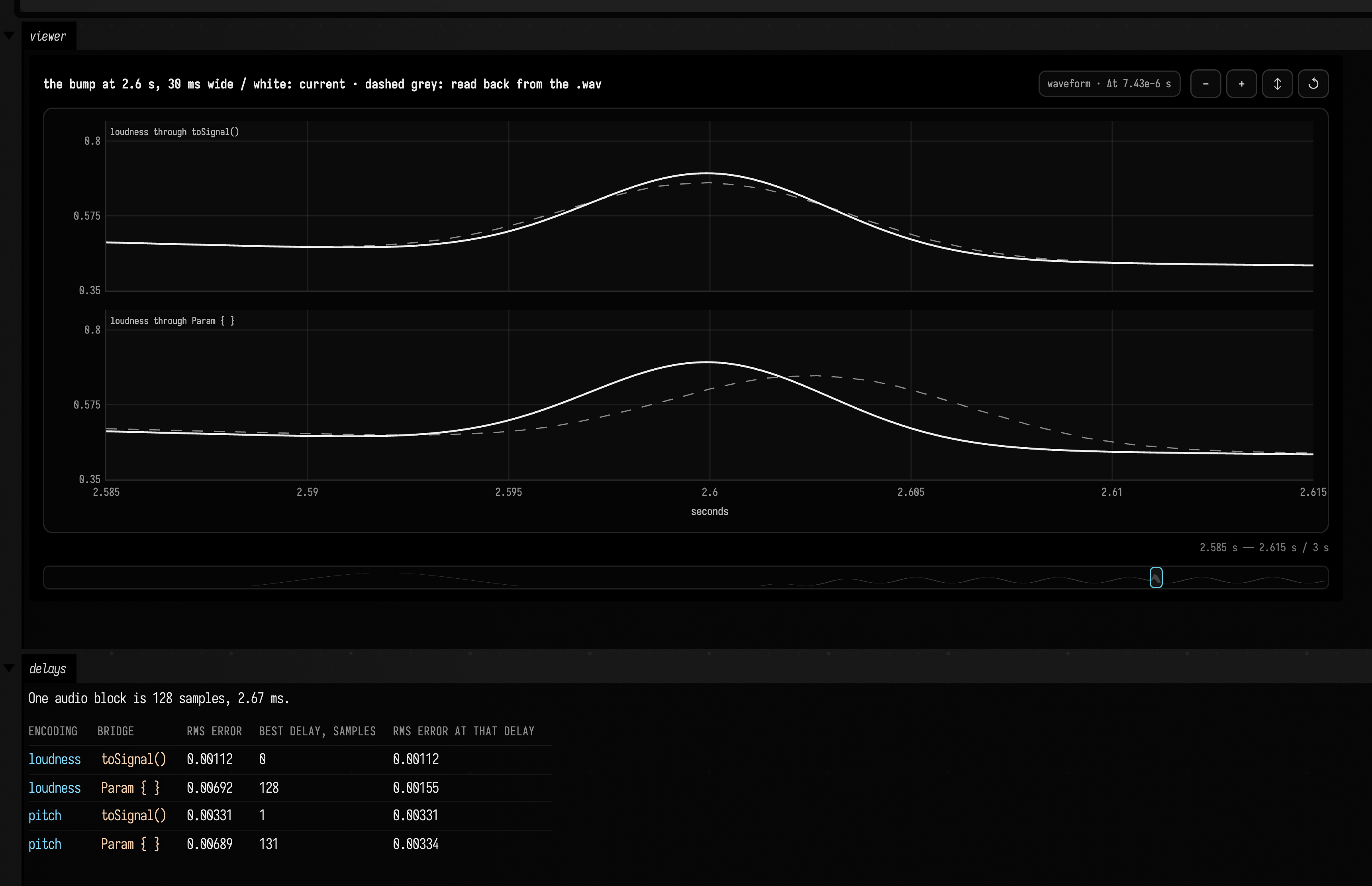
The first delay is the bridge. Through toSignal() the loudness comes back with no delay at all.
Through Param { } it comes back exactly one block late, and removing that block removes most of the
error. That is the ramp described above, and it is why a sharp feature driven through a supplier
arrives a block after it was asked for. Param is built for control values set once a block, and
it does that job. It is the wrong bridge for a function whose shape you mean to hear.
The analysis adds no delay of its own. Each pitch frame is reported at
PatF0Frame.measuredCenterSample, the centre of the samples YIN compared at the lag it chose, so
through toSignal() the pitch delay is within a sample or two of zero. Through Param { } it is one
block again.
Where each piece is documented
- Talking a Function into Existence and the
Functionspages for theFnalgebra, andFN_INTERVAL.mdfor the certified enclosures: what they contain, what they refuse, and why a bound a function attains cannot be proven exactly by bisection. - Visualizers for the time-axis
viewer, its
syncGrouptimeline, and the certified band. - DoughDSP: hear the primitives for the signal graph and
Param, and Render Field music, then analyse it for the same render-then-analyse loop through the Field Audio service, whose pYIN and Basic Pitch this page does not use. - Making a Sound, Every Path There Is for rendering sound offline.