Watercolour and ink
A PaintCanvas made with PaintCanvas.paper(...) is a sheet of watercolour
paper, and water laid on it moves by itself. It flows downhill and into the hollows of the paper,
sinks in, wicks along the fibres and evaporates. The pigment it carries settles, stains or dries
in place. A wash dries with a darker edge and the paper's grain in it, clean water dropped into a
damp wash pushes its colour out into a backrun, and a nearly dry brush skips over rough
paper. No rule paints these effects in; they come from what the water and the pigment do.
The oil paint, brushes and canvas underneath are alice's
claude-paint (see
Paint and pencil from FLines). The water model is Field's own addition to it,
written on the same pixel grid, so pencil and oil paint work over a watercolour and feel the
paper's tooth. It needs the same native library (./gradlew buildPaintNative).
Here is a sheet of cold-pressed paper, a round watercolour brush and a sky, with hills painted once the sky had dried:
:::static
val sheet = PaintCanvas.paper(700, aspect = 1.5, paper = Paper.ColdPress, sizeMm = 200.0, seed = 3)
val brush = sheet.waterBrush(width = 70.0)

// the sky, in overlapping strokes while it is wet
brush.load(Watercolors.ultramarine * 3.0 + Watercolors.burntSienna * 0.5)
sheet.wash(FLine().moveTo(60, 90).lineTo(940, 90).moveTo(940, 135).lineTo(60, 135), brush, speed = 50.0)
brush.load(Watercolors.ultramarine * 1.2, fill = 0.8)
sheet.wash(FLine().moveTo(60, 180).lineTo(940, 180).moveTo(940, 225).lineTo(60, 225), brush, speed = 50.0)

// let it dry, then the hills over it
sheet.dry()
brush.load(Watercolors.burntSienna * 3.0 + Watercolors.ultramarine * 2.0)
val hills = FLine().moveTo(40, 420).cubicTo(250, 300, 450, 420, 960, 340)
sheet.wash(hills, brush, pressure = [1.0], speed = 30.0)
sheet.wash(FLine().moveTo(40, 470).lineTo(960, 450), brush, pressure = [1.0], speed = 30.0)
sheet.dry()

display("main", sheet.png())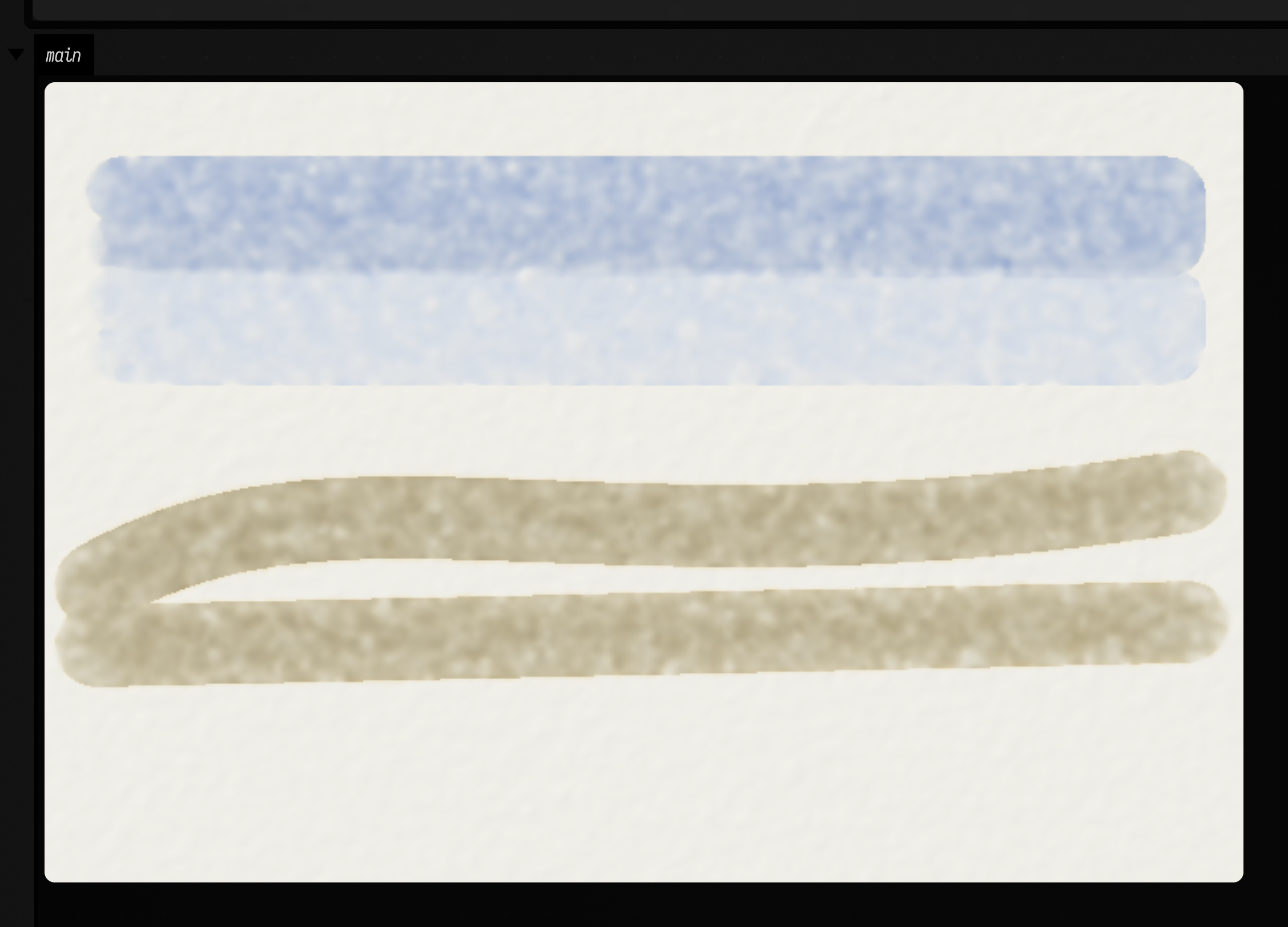
What is new compared with oil:
- Paint is pigment in water.
Watercolors.ultramarine * 3.0is ultramarine at 3 µg of pigment per mm³ of water (1 is pale, 6 strong), and+mixes pigments. The brush holds water, not paint:load(paint, fill)fills its belly tofillof what it holds. - Time passes. Every stroke takes as long as it would at its
speed(mm/s), and the water moves for that long.waitSeconds(s)lets more time pass anddry()waits until the sheet is dry. A stroke laid into a wet one runs into it; a stroke over a dry one keeps its edge. - The sheet has a real size.
sizeMmis how wide the paper is, so a brush 70 units wide on a 200 mm sheet is 14 mm across. Water and pigment are counted in mm³ and µg, and the paper's texture is in mm, so the same strokes on a smaller sheet look coarser.
Papers
Paper has five sheets. Each has its own capacity, absorbency, wicking, grain, tooth and sizing. The same drop
behaves differently on each sheet. Below, one 15 µl drop of sumi ink on each, left to dry: cold press, hot press, rough,
xuan (rice paper) and blotting paper. On the sized cotton sheets the drop stands as a small dome
and dries where it stood, a crisp black dot; xuan drinks it at once and feathers it out along its
long fibres; blotting paper takes it in quickly and softens its edge.
:::static
val sheets =
    Paper.entries.map { paper ->
        PaintCanvas.paper(220, aspect = 1.0, paper = paper, sizeMm = 50.0, seed = 2).also { sheet ->
            sheet.drop(500.0, 500.0, Watercolors.sumi * 3.0, volumeMm3 = 15.0)
            sheet.dry()
        }
    }
display("main", pngRow(sheets))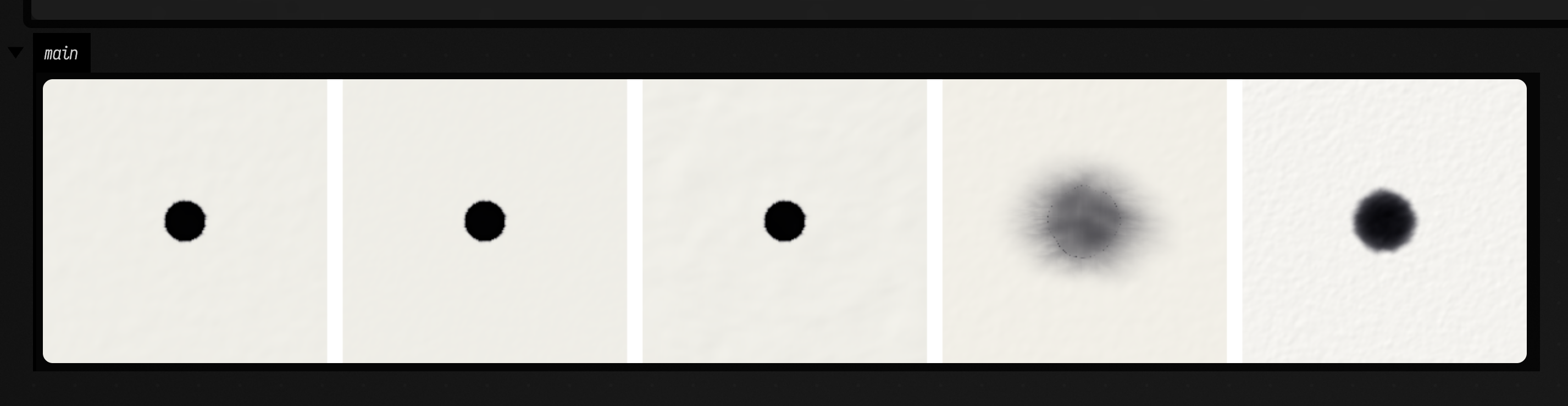
sheet.paper reports the make-up: how much water the sheet holds saturated (capacityMicrons),
how fast dry paper takes up standing water (absorbMicronsPerSecond), how fast water wicks through
it (wickMm2PerSecond), its tooth (roughnessMicrons) and how deep water must be to advance onto
dry paper (pinMicrons). The numbers are estimates in the ranges reported for each kind of paper,
not measurements of one maker's sheet.
Wet into wet, blooms and backruns
wet(region, microns) lays water over a region at once, as a wide mop would: clean water to paint
into, or, with paint = ..., a flat wash. Paint touched into wet paper spreads, because paint
lowers the water's surface tension and the cleaner water around it pulls the surface outward. How
far it goes depends on how wet the paper still is.
The left half below is paper dampened with 40 µm of clean water, with small drops of strong ultramarine and quinacridone rose let fall into it straight away: each spreads into a soft blob, densest where it fell, with a feathered edge. On wetter paper the paint flies further and leaves more of its colour at that edge. The right half is a wash of burnt sienna left for four minutes until it was damp, with one drop of clean water into it. The clean water floods through the settled pigment and pushes it out ahead of itself, and the colour dries where the flood stopped: a backrun, with a pale middle and a dark, frilled edge.
:::static
fun rectBetween(x0: Double, y0: Double, x1: Double, y1: Double) = FLine().rect(x0, y0, x1 - x0, y1 - y0)

val sheet = PaintCanvas.paper(700, aspect = 1.6, paper = Paper.ColdPress, sizeMm = 160.0, seed = 3)

// wet in wet: clean water, then drops of colour into it at once
sheet.wet(rectBetween(60.0, 80.0, 460.0, 540.0), microns = 40.0)
for ((x, y) in [150.0 to 180.0, 330.0 to 260.0, 200.0 to 420.0]) sheet.drop(
    x,
    y,
    Watercolors.ultramarine * 15.0,
    volumeMm3 = 4.0,
)
for ((x, y) in [260.0 to 160.0, 380.0 to 440.0]) sheet.drop(x, y, Watercolors.quinacridoneRose * 12.0, volumeMm3 = 4.0)

// a backrun: a wash left until damp, then clean water into it
sheet.wet(rectBetween(540.0, 80.0, 940.0, 540.0), microns = 110.0, paint = Watercolors.burntSienna * 2.5)
sheet.waitSeconds(240.0)
sheet.drop(740.0, 310.0, WaterPaint.Clear, volumeMm3 = 25.0)
sheet.dry()

display("main", sheet.png())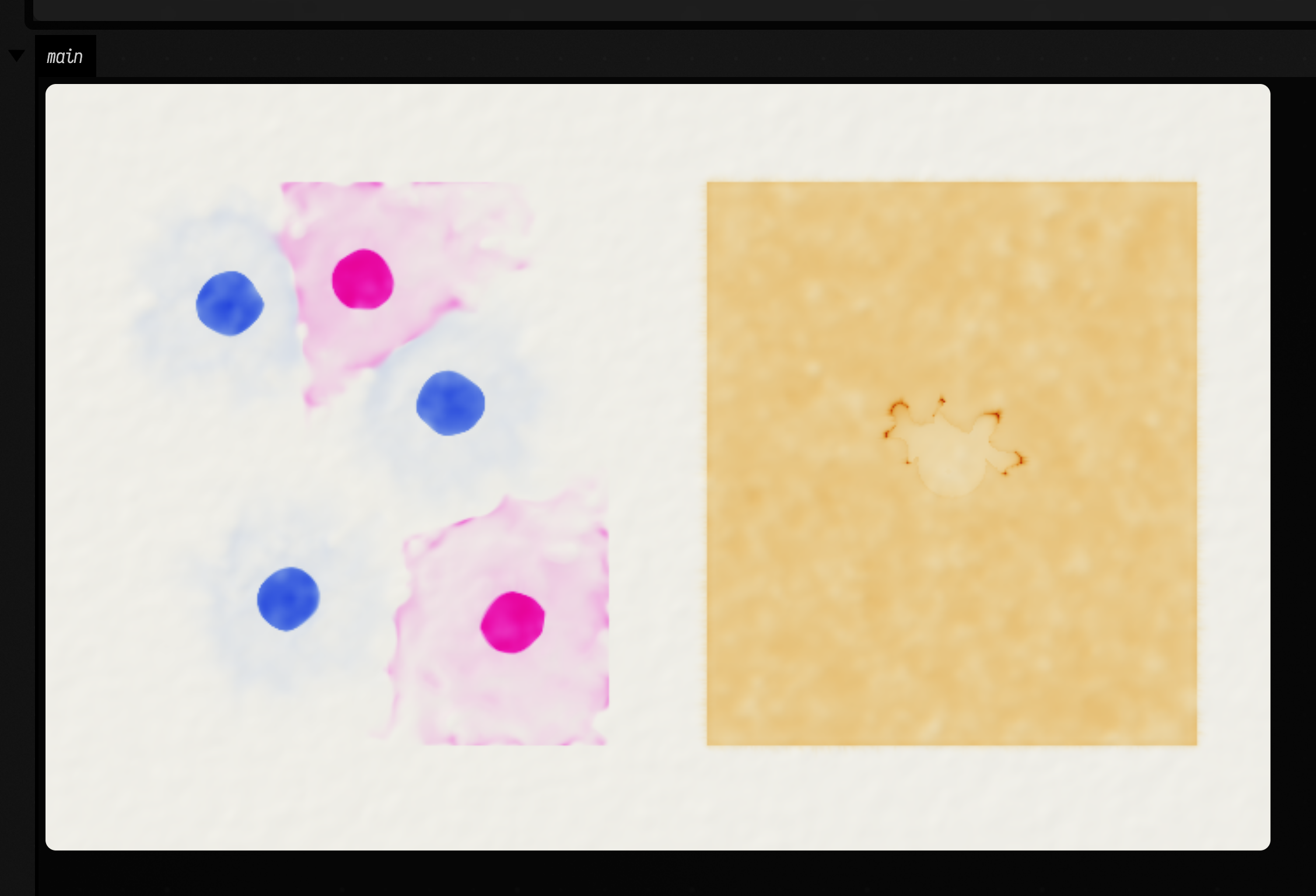
Tilting the board
tilt(degrees, direction) tilts the sheet, and wet washes run downhill and gather in a bead at
their lower edge. Dry paper holds a bead back until it is heavier than the paper can pin, about a
millimetre deep on sized paper; then it breaks out in drips that run down the sheet, and off it if
they reach the edge. Below, a wash laid all at once on hot-pressed paper tilted 15° toward the
bottom of the sheet: its colour drains with the water into the bead, and the bead has dripped.
tilt(0.0) lays the board flat again.
:::static
val wash = FLine().rect(200, 150, 600, 450)
val sheet = PaintCanvas.paper(400, aspect = 0.75, paper = Paper.HotPress, sizeMm = 120.0, seed = 4)
sheet.tilt(15.0, 90.0)
sheet.wet(wash, microns = 60.0, paint = Watercolors.ultramarine * 2.0 + Watercolors.quinacridoneRose * 1.2)
sheet.dry()
display("main", sheet.png())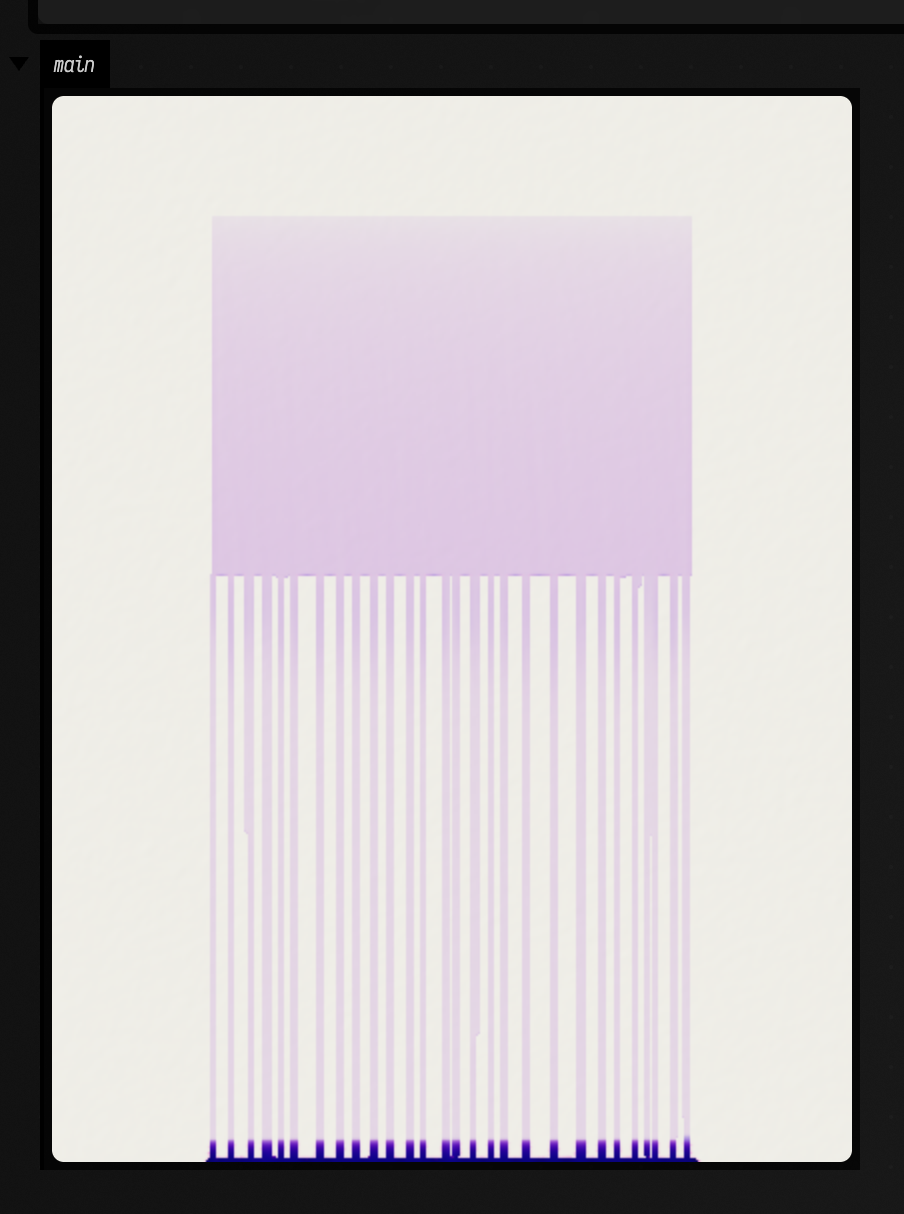
The brush
A watercolour brush lays water in proportion to how long it touches the paper and how full it is, so a slow stroke lays more than a fast one, and the belly runs down as it goes. Pressing harder widens the stroke and pushes the hairs into the paper's hollows. How full the brush is decides how far the water on it reaches down into the tooth: a full brush floods across everything; a nearly dry one, light and fast, touches only the top of the tooth, which is drybrush.
Drybrush wants paint nearly as strong as it comes off the pan, 20 to 80 µg/mm³, since so little water reaches the paper. Below, the same light, fast stroke of that paint from a brush loaded full, a third full and nearly dry, on rough paper (left) and hot-pressed paper (right). On rough paper even the full brush lays its paint in the hollows, the third-full one leaves scattered marks, and the nearly dry one only specks on the highest points of the tooth. On the smooth sheet the full and third-full strokes stay whole, and only the nearly dry one breaks up.
:::static
val sheets =
    [Paper.Rough, Paper.HotPress].map { paper ->
        val sheet = PaintCanvas.paper(420, aspect = 1.3, paper = paper, sizeMm = 120.0, seed = 5)
        for ((i, fill) in [1.0, 0.3, 0.1].withIndex()) {
            val brush =
                sheet
                    .waterBrush(90.0)
                    .load(Watercolors.burntSienna * 40.0 + Watercolors.ultramarine * 20.0, fill = fill)
            sheet.wash(
                FLine().moveTo(60, 130.0 + i * 230).lineTo(940, 130.0 + i * 230),
                brush,
                pressure = [0.3],
                speed = 200.0,
            )
        }
        sheet.dry()
    }
display("main", pngRow(sheets))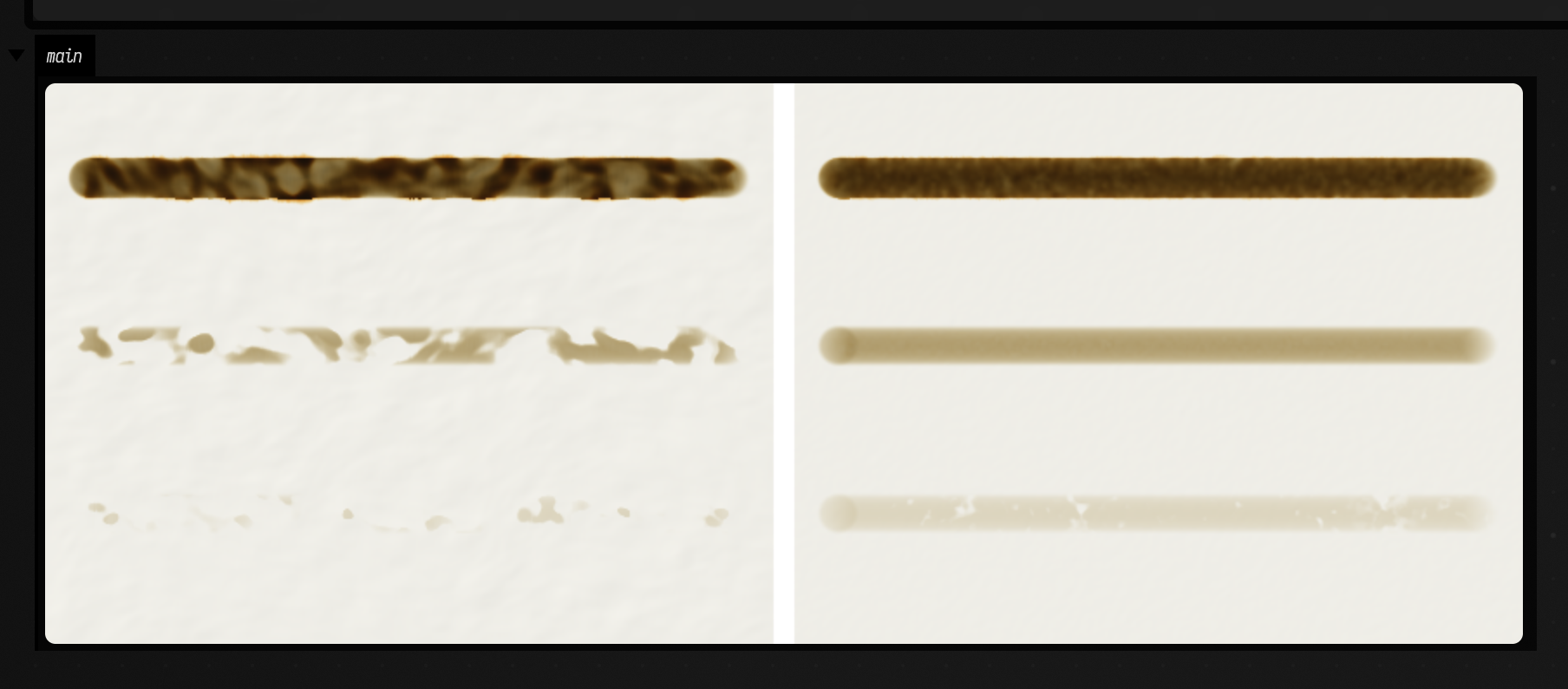
A brush also takes water back up. A clean, damp brush stroked through a wet wash drinks colour
out of it; squeezed out (load(WaterPaint.Clear, fill = 0.05)) it is thirsty and lifts more.
On dried paint the water from a damp brush redissolves the gum the pigment dried in, and scrubbing
lifts it, slowly. How much comes up depends on the pigment: ultramarine sits loose on the surface
and lifts back nearly to white, while phthalo blue has stained the fibres and barely moves.
:::static
fun rectBetween(x0: Double, y0: Double, x1: Double, y1: Double) = FLine().rect(x0, y0, x1 - x0, y1 - y0)

val sheet = PaintCanvas.paper(600, aspect = 1.5, paper = Paper.ColdPress, sizeMm = 150.0, seed = 6)
sheet.wet(rectBetween(100.0, 100.0, 460.0, 560.0), microns = 120.0, paint = Watercolors.ultramarine * 3.0)
sheet.wet(rectBetween(540.0, 100.0, 900.0, 560.0), microns = 120.0, paint = Watercolors.phthaloBlue * 1.0)
sheet.dry()

// scrub a band across both: wet the brush, scrub, squeeze it out, scrub again, six times
val brush = sheet.waterBrush(50.0)
val band = FLine().moveTo(150, 330).lineTo(850, 330)
repeat(6) {
    brush.load(WaterPaint.Clear, fill = 0.6)
    sheet.wash(band, brush, pressure = [0.9], speed = 120.0)
    brush.load(WaterPaint.Clear, fill = 0.05)
    sheet.wash(band, brush, pressure = [0.9], speed = 120.0)
}
sheet.dry()
display("main", sheet.png())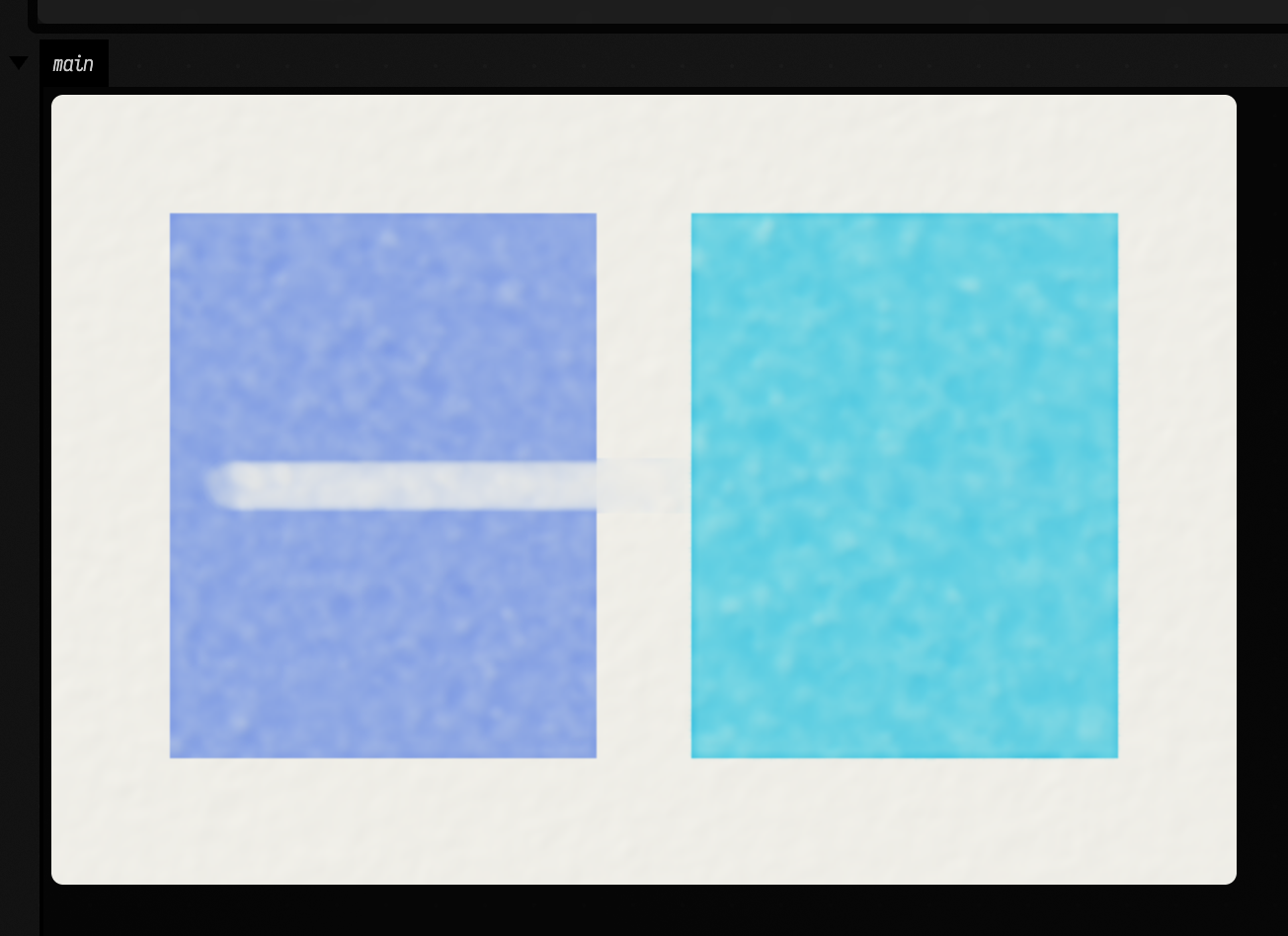
To come back to a brush later, with the water and pigment still in it, keep it in a
PaintToolbox as you would an oil brush: tools["wash"] = sheet.waterBrush(50.0), then
tools.waterBrush("wash").
Pigments
Watercolors has seven pigments by their common names: ultramarine, phthaloBlue,
burntSienna, quinacridoneRose, cadmiumYellow, viridian and sumi (carbon ink in animal
glue). Each one is its colour and the physics that decide how it behaves:
- density (g/cm³) and diameterUm, the particle size. Dense, coarse pigment (ultramarine, viridian, the earths) settles out onto the paper within a minute, where the water laid it. Fine pigment (phthalo, quinacridone, carbon) stays suspended and goes where the water goes: into the paper as it soaks in, and onto the fibres it diffuses to.
- stain: how fast it soaks into the fibres from water in the sheet, after which it no longer lifts.
- lift: how fast a dried deposit goes back into water standing on it.
WaterPigment.of(name, masstone, ...) makes another one from the colour it has laid thick, with
the same physical parameters, and its optics follow from that colour (Kubelka–Munk absorption and
scattering, the same optics the oil paint uses). Below, ultramarine, phthalo blue and the two
mixed, each laid as the same wash and left to dry. Each shows the paper's grain a little, because a
wash stands deeper over the hollows; the ultramarine has settled out onto the paper, while the
phthalo has soaked into its fibres and stained them, which is why it would not lift.
:::static
fun rectBetween(x0: Double, y0: Double, x1: Double, y1: Double) = FLine().rect(x0, y0, x1 - x0, y1 - y0)

val sheet = PaintCanvas.paper(700, aspect = 2.0, paper = Paper.ColdPress, sizeMm = 160.0, seed = 7)
val u = Watercolors.ultramarine * 3.0
val p = Watercolors.phthaloBlue * 0.8
for ((i, paint) in [u, p, u + p].withIndex()) sheet.wet(
    rectBetween(60.0 + i * 310, 70.0, 320.0 + i * 310, 430.0),
    microns = 120.0,
    paint = paint,
)
sheet.dry()
display("main", sheet.png(relief = 0.4))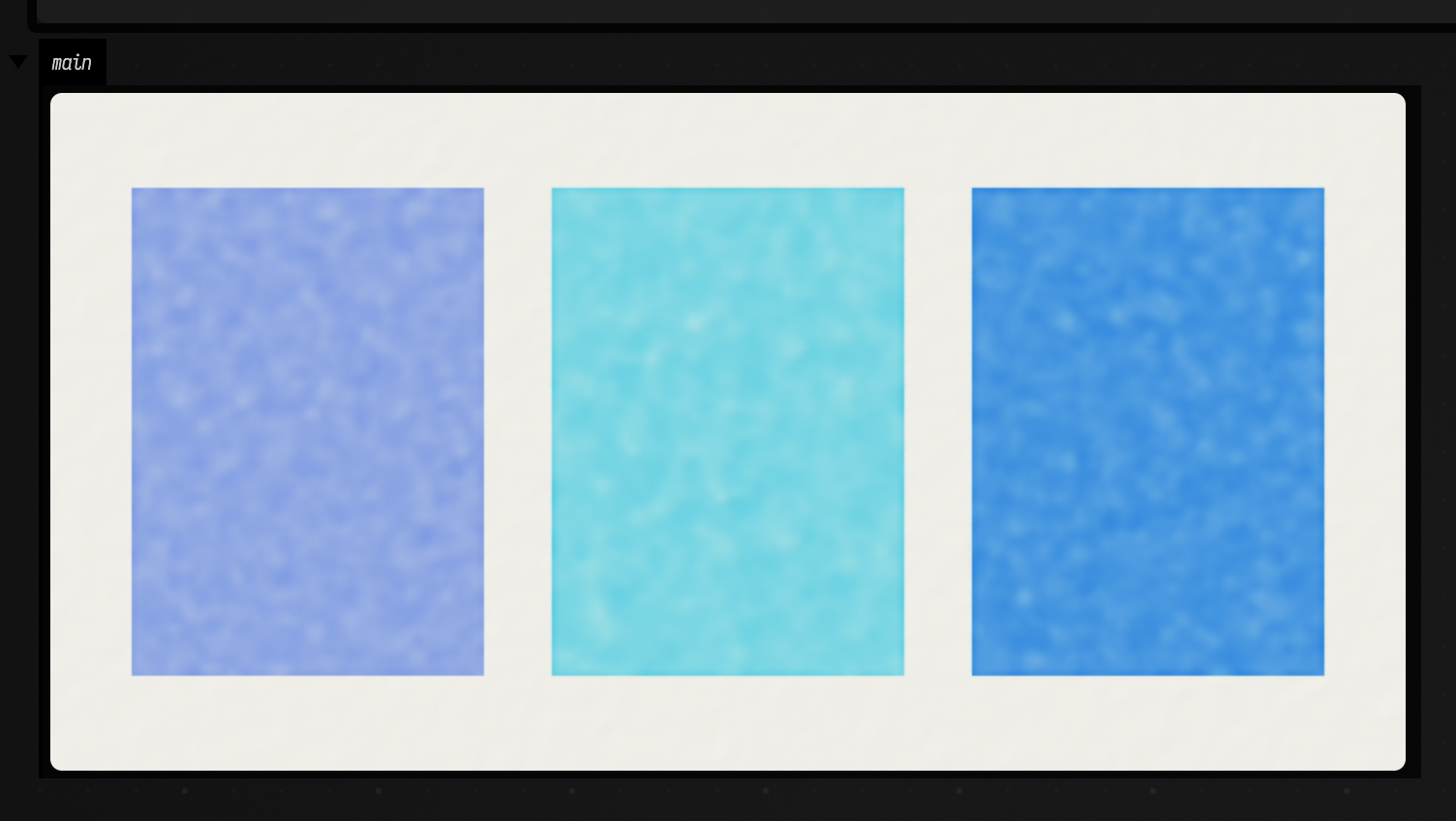
Oil, pencil and the knife on paper
A sheet of paper is a canvas like any other, so stroke, draw, knife and the rest work on it,
and the paper's tooth is the surface they feel. Oil paint laid over a watercolour seals the
watercolour under it into the picture: it no longer lifts, and water laid on the oil beads on it
instead of soaking in. Below, a dried ultramarine wash crossed by two strokes of pale oil paint,
then a wash of burnt sienna laid across everything: it soaks into the paper and stands off the
oil.
:::static
fun rectBetween(x0: Double, y0: Double, x1: Double, y1: Double) = FLine().rect(x0, y0, x1 - x0, y1 - y0)

val sheet = PaintCanvas.paper(600, aspect = 1.5, paper = Paper.ColdPress, sizeMm = 150.0, seed = 7)
sheet.wet(rectBetween(100.0, 100.0, 900.0, 300.0), microns = 120.0, paint = Watercolors.ultramarine * 2.5)
sheet.dry()

val oil = sheet.brush(BrushKind.HogFlat, 60.0).load(rgb(0.9, 0.85, 0.7), hiding = 0.6)
sheet.stroke(FLine().moveTo(300, 80).lineTo(300, 620).moveTo(650, 80).lineTo(650, 620), oil)

sheet.wet(rectBetween(100.0, 400.0, 900.0, 560.0), microns = 120.0, paint = Watercolors.burntSienna * 2.5)
sheet.dry()
display("main", sheet.png())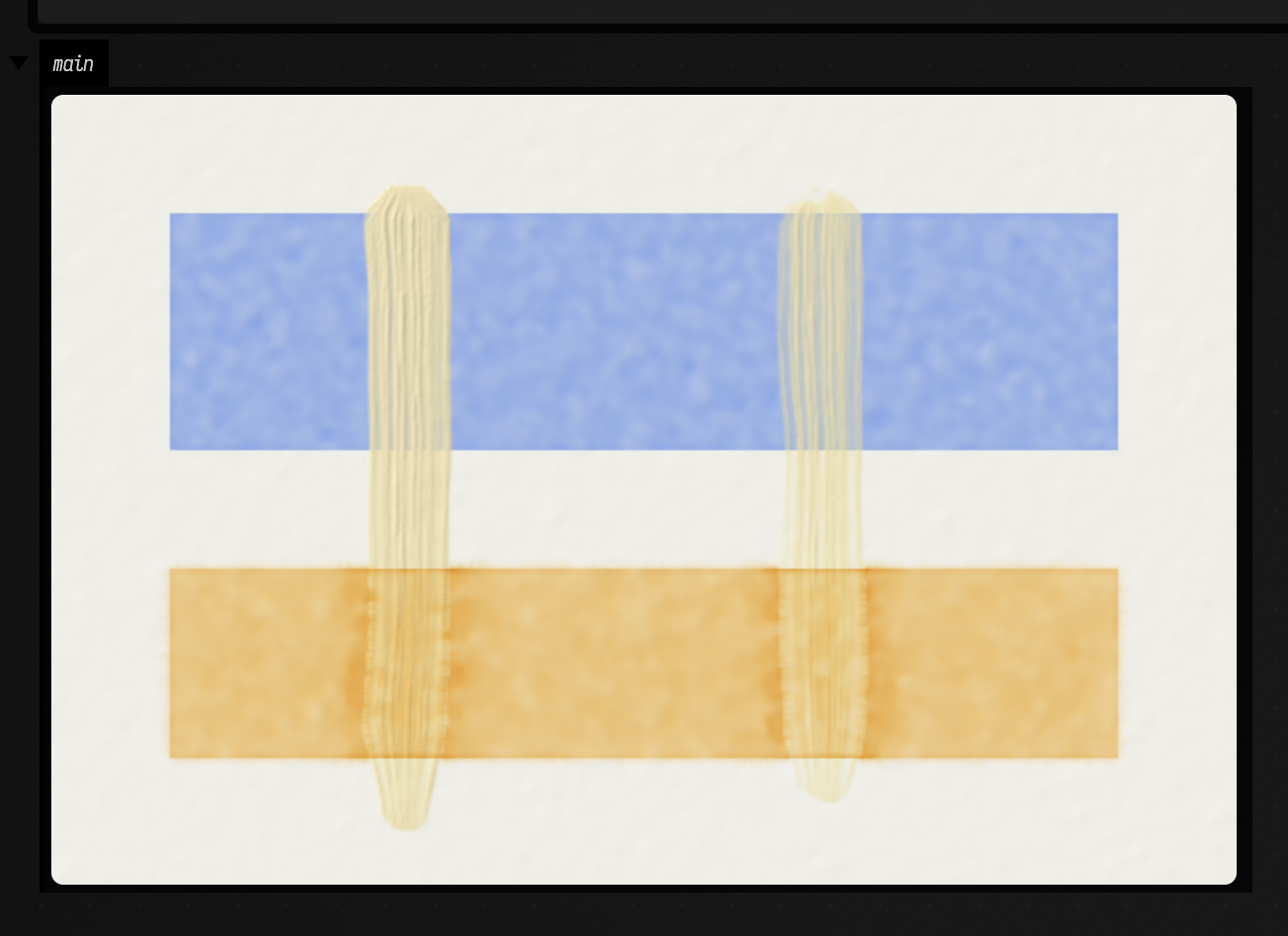
Watching the water
waterMap(map) reads one value per pixel of what the water is doing, and waterMapPng(map) draws
it, black at nothing and white at the most. WaterMap.SurfaceWater is the water standing on the
paper (µm), AbsorbedWater the water in it, Saturation how full its pores are, Pigment all the
pigment (µg/mm²), and Suspended, Carried, Deposited, Glued and Bound the pigment in each
of its states (below). Relief is the paper's surface and Sealed where oil paint has sealed it.
render(wet = true) shows the sheet as it looks at that moment, wet paper darker.
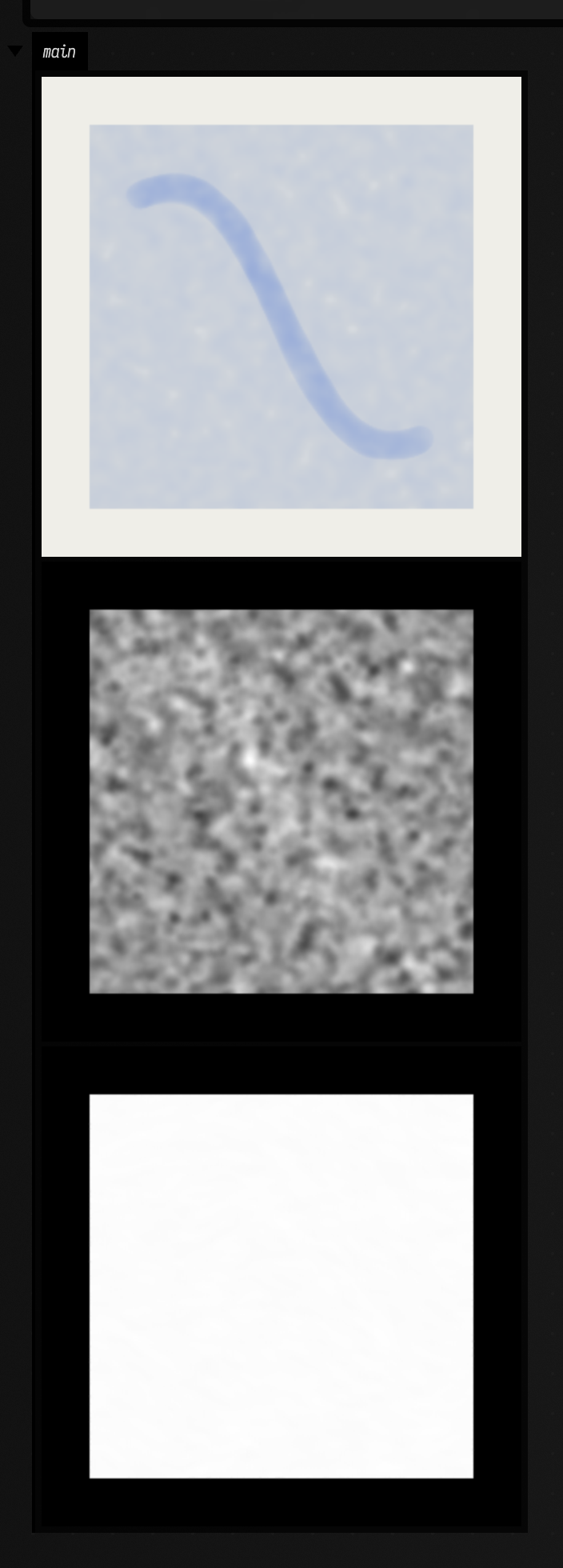
Below, a wash with a stroke laid into it, 20 seconds later: as it looks, the water standing on the paper (the stroke still puddled, the wash already sinking in), and the water in the paper.
:::static
import java.util.Base64

fun rectBetween(x0: Double, y0: Double, x1: Double, y1: Double) = FLine().rect(x0, y0, x1 - x0, y1 - y0)
fun img(png: ByteArray) = "<img width='300' src='data:image/png;base64,${Base64.getEncoder().encodeToString(png)}'>"

val sheet = PaintCanvas.paper(300, aspect = 1.0, paper = Paper.ColdPress, sizeMm = 80.0, seed = 8)
sheet.wet(rectBetween(100.0, 100.0, 900.0, 900.0), microns = 80.0, paint = Watercolors.ultramarine * 1.0)
val brush = sheet.waterBrush(80.0).load(Watercolors.ultramarine * 4.0)
sheet.wash(FLine().moveTo(200, 250).cubicTo(500, 100, 500, 900, 800, 750), brush, speed = 40.0)
sheet.waitSeconds(20.0)

display(
    "main",
    img(sheet.png(wet = true)) +
        " " +
        img(sheet.waterMapPng(WaterMap.SurfaceWater)) +
        " " +
        img(sheet.waterMapPng(WaterMap.AbsorbedWater)),
)
The books
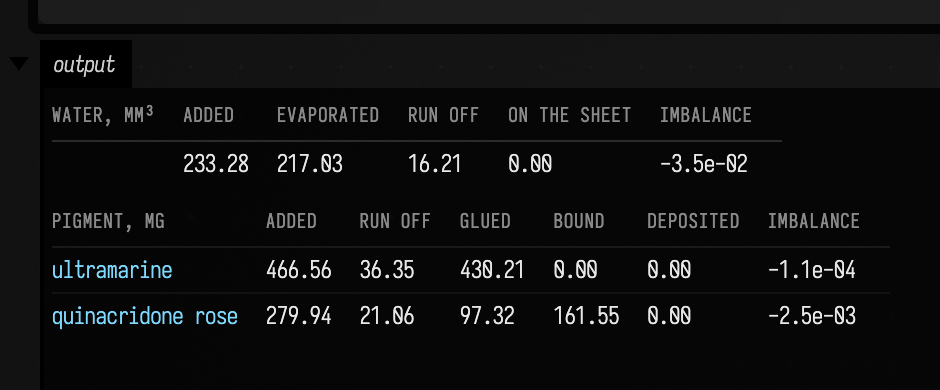
Every volume of water and mass of pigment on the sheet is accounted for. sheet.water is a
WaterLedger: the water standing on the paper and in it now, and everything added by tools, taken
up by brushes, evaporated and run off the edge (mm³). Its pigments are one PigmentLedger each,
in µg, with the pigment in each state:
suspendedin the water on the paper, moving with it;carriedin the water in the paper's pores, moving with it;deposited, settled out but loose: water flowing through carries it on;glued, dried in place in its gum: rewetting lifts it slowly, a brush faster;bound, stained into the fibres: it no longer lifts;- and
added,taken,runoffandsealed(under oil paint), what came and went.
What is on the sheet always equals what was added less what left, to rounding, and
imbalanceMm3 and imbalance say by how much. Here are the books of the tilted wash above:
:::static
val wash = FLine().rect(200, 150, 600, 450)
val sheet = PaintCanvas.paper(400, aspect = 0.75, paper = Paper.HotPress, sizeMm = 120.0, seed = 4)
sheet.tilt(15.0, 90.0)
sheet.wet(wash, microns = 60.0, paint = Watercolors.ultramarine * 2.0 + Watercolors.quinacridoneRose * 1.2)
sheet.dry()

val w = sheet.water!!
fun f(x: Double) = x.f2
markdown(
    """
| water, mm³ | added | evaporated | run off | on the sheet | imbalance |
| --- | --- | --- | --- | --- | --- |
| | ${f(w.addedMm3)} | ${f(w.evaporatedMm3)} | ${f(w.runoffMm3)} | ${f(w.surfaceMm3 + w.absorbedMm3)} | ${"%.1e".format(w.imbalanceMm3)} |

| pigment, µg | added | run off | glued | bound | deposited | imbalance |
| --- | --- | --- | --- | --- | --- | --- |
"""
        .trimIndent() +
        "\n" +
        w.pigments.joinToString("\n") { p ->
            "| ${p.name} | ${f(p.added)} | ${f(p.runoff)} | ${f(p.glued)} | ${f(p.bound)} | ${f(p.deposited)} | ${"%.1e".format(p.imbalance)} |"
        },
)
The sheet, the air and time
PaintCanvas.paper(widthPx, aspect, paper, sizeMm, seed, view, engine)makes a sheet.sizeMmis 560 mm (a half imperial sheet) unless you say otherwise. Coordinates are the same as any canvas: 1000 units wide, y down.evaporation(micronsPerSecond)sets how fast open water evaporates: about 0.15 µm/s in still air at 20 °C and 50 % humidity, several times that in a warm draught.marangoni(newtonsPerMetre)sets how far paint lowers the surface tension of the water it is in (0.008 by default): it drives the spreading of wet-in-wet. 0 turns it off.dispersion(mm2PerSecond), 0 by default, adds an extra spreading of pigment through standing water. It is not simulated (see below), a dial for when you want softer mixing.saveState(path),PaintCanvas.load(path)andcopy()keep the water and every pigment in it exactly, wet or dry, and the copy carries on as the original would have.
How the water model works
The water model keeps, for every pixel, the water standing on the sheet and the water in its pores, and for each pigment its mass in each of the five states of the books above. On every step:
| how | simulated or approximated | |
|---|---|---|
| Flow on the surface | a thin film driven by gravity and the paper's relief (lubrication theory), the sheet's tilt included | simulated; surface tension is not, so shapes finer than about 3 mm (water's capillary length) are not resolved |
| Wetting dry paper | water advances only from a film deeper than the paper's pinMicrons |
an approximation of contact-angle hysteresis by one number |
| Absorption and wicking | surface water drawn into the pores at the paper's sizing rate; capillary diffusion through the sheet, faster along the fibres | simulated, with a linear stand-in for the slowing of uptake as the sheet fills |
| Evaporation | from the surface water, faster near the edge of a wet patch (Deegan et al., Nature 389, 1997); then from the pores | simulated; the dark edge of a dried wash is the flow toward the edge carrying pigment, not a rule |
| Settling | each pigment falls through the water at its Stokes velocity, from its density and particle size | simulated |
| Diffusion to the fibres | fine particles diffuse through the water to the paper (Stokes–Einstein) and stick there, the same amount per area wherever the water stands deep enough | simulated |
| Texture in a wash | a wash's surface lies level, so it stands deeper over the paper's hollows and leaves more there; how much shows depends on the paper's relief | simulated; the reliefs are estimates |
| Granulation | coarse pigment gathering in the hollows beyond what the water's depth leaves there, so that ultramarine speckles more than phthalo | not simulated: here every pigment follows the depth about equally |
| Filtering and staining | particles larger than the pores stay on the surface; staining pigments adsorb onto the fibres | simulated with estimated rates |
| Backruns | settled pigment is carried on by water flowing through it; drying glues it down | simulated |
| Blooms | paint lowers surface tension, and the cleaner water pulls the surface outward (Marangoni flow) | simulated with an estimated tension drop; the wetting agents are carried and adsorbed |
| Colour | Kubelka–Munk absorption and scattering per pigment, laid over the sheet | simulated optics; wet paper's darkening is a fixed factor |
| The paper | flocs of fibre and the felt's texture | generated, not made by a simulated papermaking |
| Every number for a paper or pigment | an estimate in the reported range, not a measurement of a product |
Time steps are adaptive: short while water is moving fast, long while the sheet is only drying. The wetter and larger the sheet, the longer a wait takes to compute; a 700-pixel sheet drying a full wash takes some seconds.
Where the code is
The model is in native/field-paint/vendor/paint/src/field/aqueous.rs (the sheet, its water
and pigments) and watercolor.rs (brushes, drops and washes). Its module documentation gives
every equation with its units and source. It lives inside the vendored claude-paint crate so
that it can share the canvas's grid, height and optics, but it is Field's code, not alice's;
VENDORED.md there lists exactly what Field changed in alice's files. WaterMediaTest checks
the books, saving and restoring, the brushes and gestures.
See also: Paint and pencil from FLines for the canvas, oil paint and the other tools, Brushes with moving hairs for a brush whose hairs bend and splay in watercolour as in oil, and AI4 paints, where the AI chat paints in watercolour too.