Nano examples
Nano is a tiny machine you can watch as it runs. It has four registers, a handful of arithmetic and branch instructions, and just 32 bytes of RAM. Load a program and its code goes into that RAM alongside its data, so a single view can show the whole machine at once.
A store past the end of the program writes into the same bytes that hold instructions, and reads
wrap around at 32. The eight-deep stack used by call and ret lives outside those bytes.
A RAM cell's border says what happened to that byte, and where two things are true of the same cell the earlier case in this list wins. Brightest orange with a fill is the cell the last step wrote. Cyan with a fill is the program counter. Plain orange is a byte that changed earlier in the run, cyan is a program byte still holding the value it was loaded with, and dim is a byte no program ever occupied. The run of dim cells at the end of the grid is where RAM stops being code.
The embedded viewer's "Open in Field4" button opens a prepared Nano document with a Nano root already set up.
In a fresh document, Nano boxes live under a parent box that is a language root: run Set Main Language: Nano on the parent and its children become Nano boxes. The examples below are written as Nano assembly, and each was assembled and executed by Field; the state you see under it is what came out.
Registers, output, and the first RAM write
Let's start with arithmetic: compute a value, emit it with out, and put it in RAM where we can
see it.
:::static
ldi r0, 7
ldi r1, 9
add r0, r1
sta r0, 24
out r0
hlt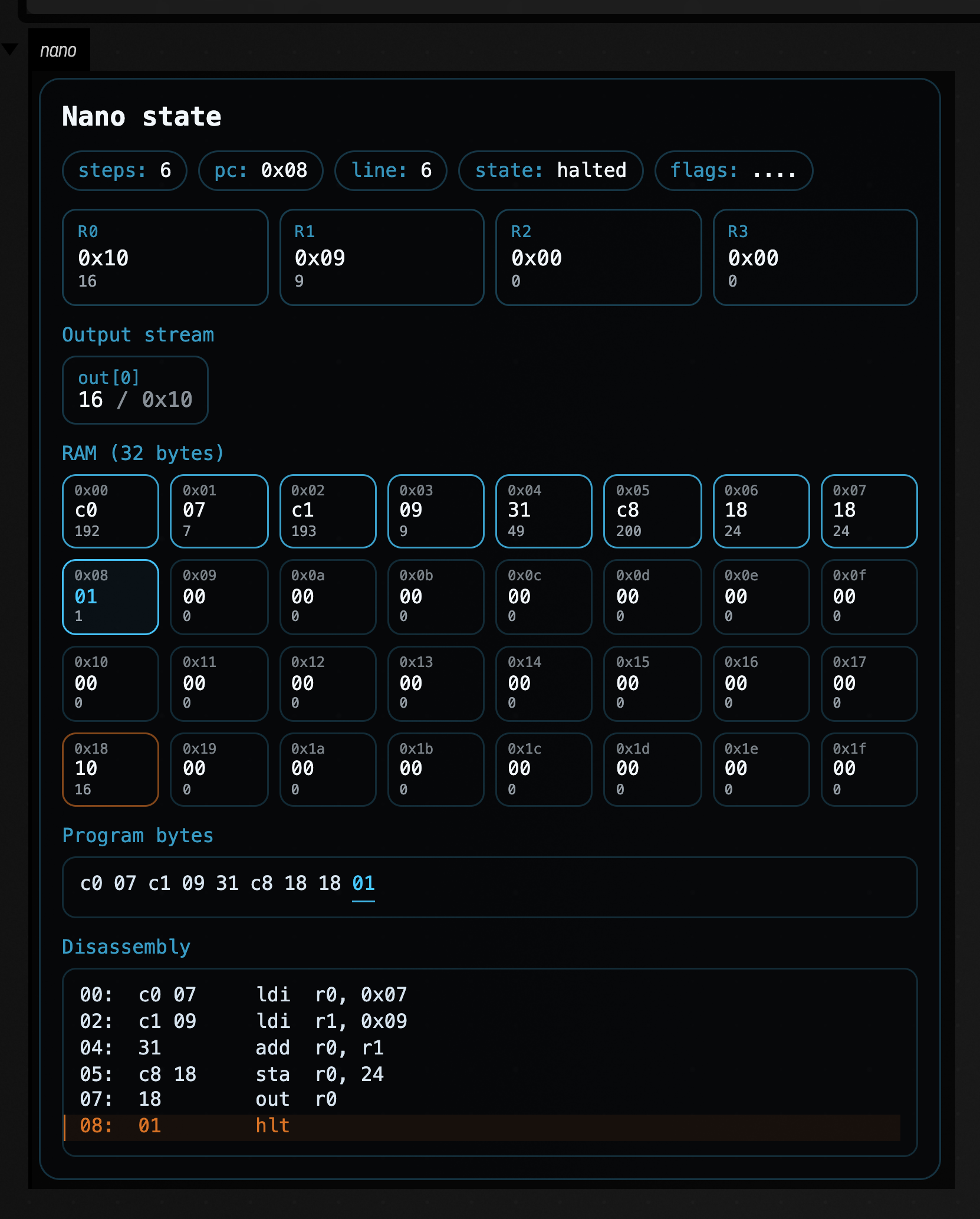
r0 starts as 7, r1 starts as 9, and add r0, r1 leaves 16 in r0. The program assembles to nine bytes, 0x00 through 0x08, so the orange cell at 0x18 is the first byte this sketch writes outside its own code.
A loop that paints a strip of RAM
str rD, rS writes rS into RAM[rD], which is the only indirect store Nano has. So the loop below uses r0 as an address cursor, r1 as the value, and r2 as the countdown, and walks a run of consecutive values into memory.
:::static
ldi r0, 20
ldi r1, 1
ldi r2, 8

loop:
    str r0, r1
    inc r0
    inc r1
    dec r2
    jnz loop

out r1
hlt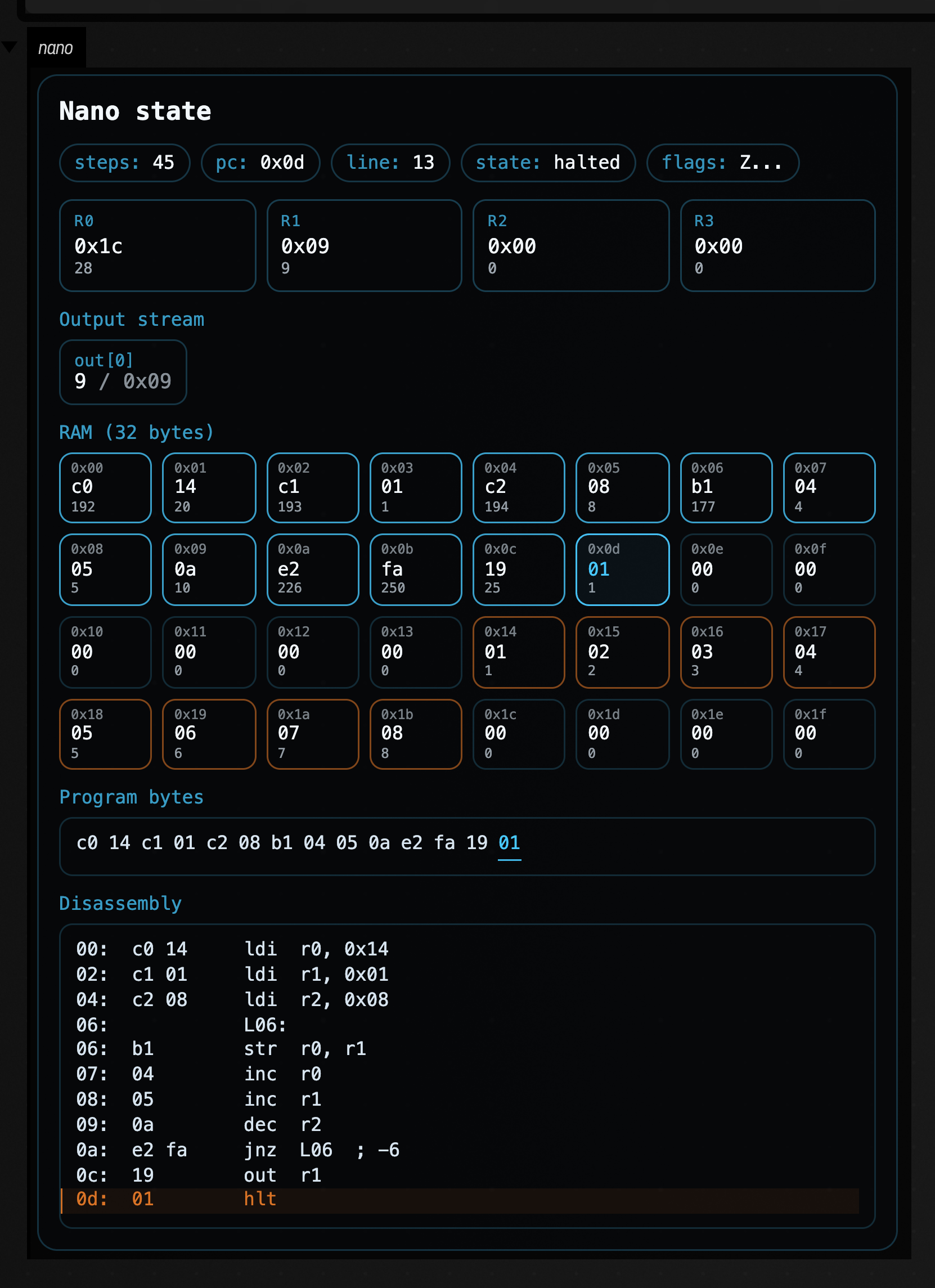
The address register walks forward one cell at a time, and ldi r2, 8 sets how far: the orange run is exactly eight cells, 0x14 to 0x1b.
Summation by counting down to zero
Every instruction that computes a value into a register sets the zero flag, ldr and and included; mov and the two stores are the ones that leave it alone. jnz reads whatever the last of them left behind, so for a countdown, put dec immediately before the branch and the loop tests the counter.
:::static
ldi r0, 10
ldi r1, 0

loop:
    add r1, r0
    dec r0
    jnz loop

sta r1, 28
out r1
hlt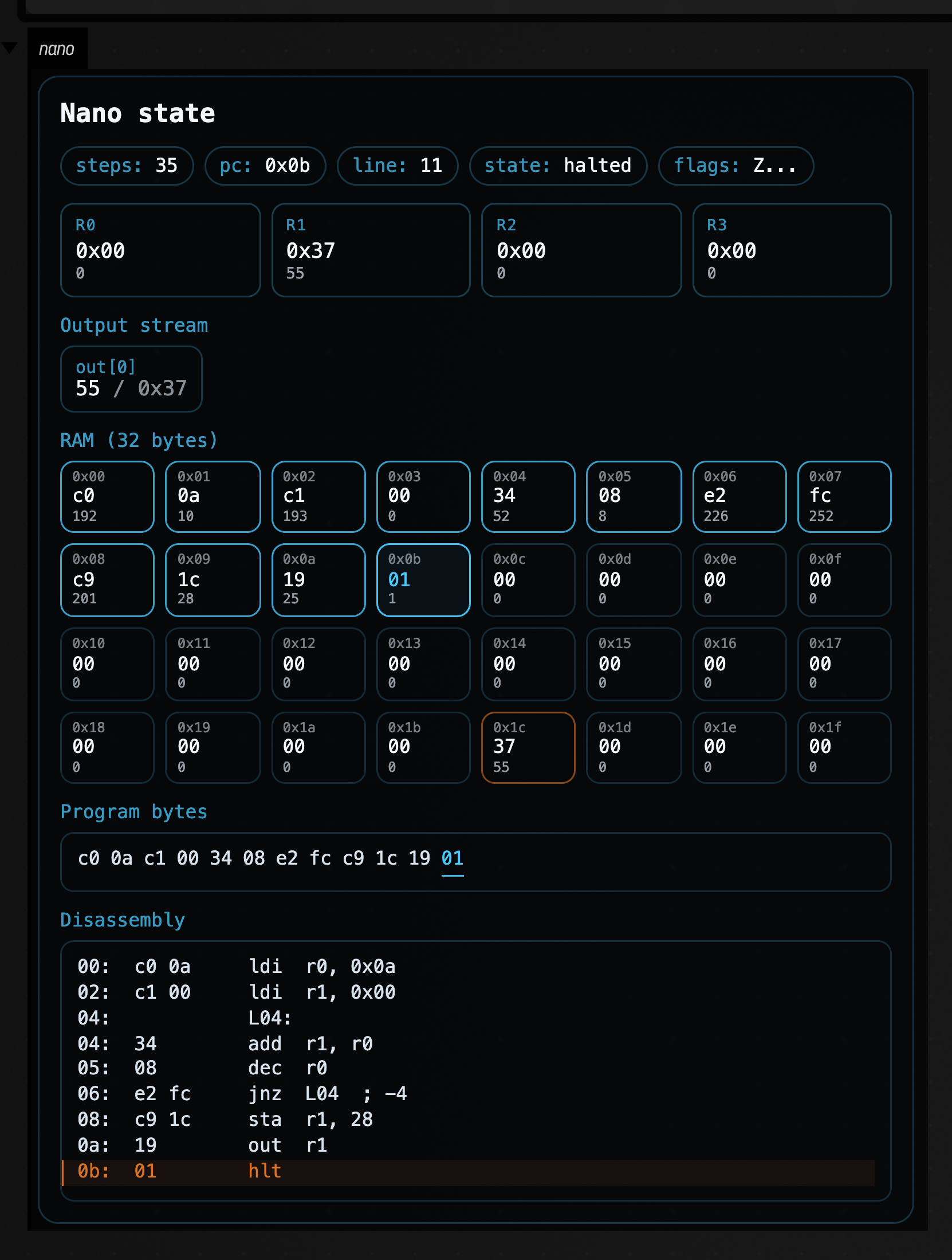
This sums 10 + 9 + ... + 1 into r1, leaving 55 in both the output stream and RAM address 0x1c. add r1, r0 sets the flag too; it is only because dec r0 runs after it that jnz sees the counter rather than the accumulator.
.data turns the tail of the program into a lookup table
Nano has no separate ROM section. If you want a table of bytes, you put those bytes in the program stream and load them relative to the current instruction pointer.
:::static
ldrr r0, 12
ldrr r1, 11
ldrr r2, 10
add r0, r1
add r0, r2
sta r0, 29
out r0
hlt

.data 5 8 13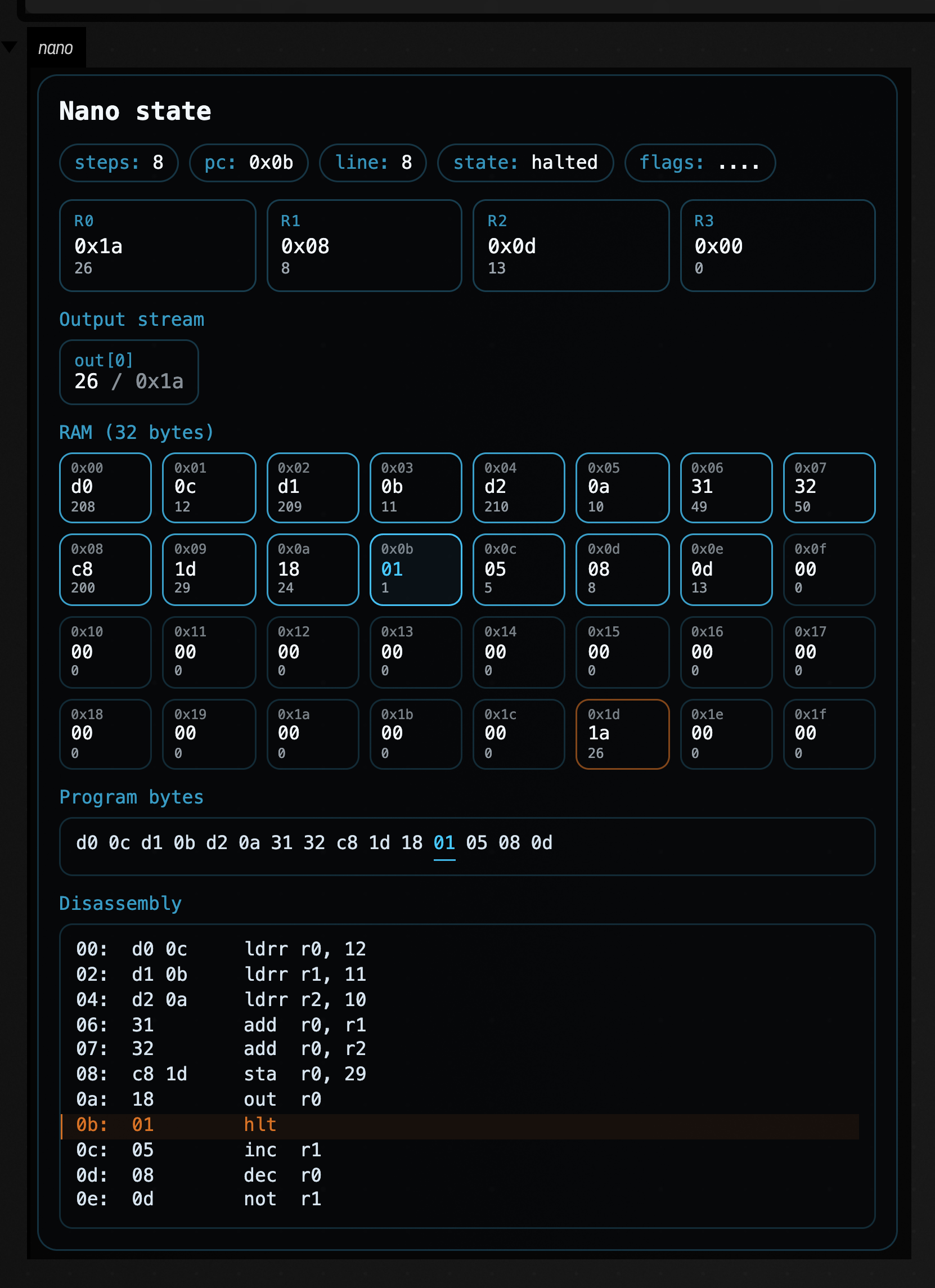
ldrr rX, rel reads RAM[PC + rel], and the program is already sitting in RAM, so the .data bytes are reachable by counting forward from the instruction that loads them. There is no symbol table to look them up in: the three offsets 12, 11 and 10 are hand-computed distances, and moving any instruction above them changes all three. Nothing marks those bytes as data either, so the disassembly under the run carries on past hlt and reports 5 8 13 as inc r1, dec r0, not r1. That is the disassembler being literal about where the program ends, not the machine executing anything after it halts.
call and ret let you factor repeated work
call and ret package a tiny operation for reuse. Return addresses go on a separate eight-deep stack, not into RAM, and a ninth nested call halts the machine with Call stack overflow.
:::static
ldi r0, 6
call dbl
call dbl
sta r0, 30
out r0
hlt

dbl:
    add r0, r0
    ret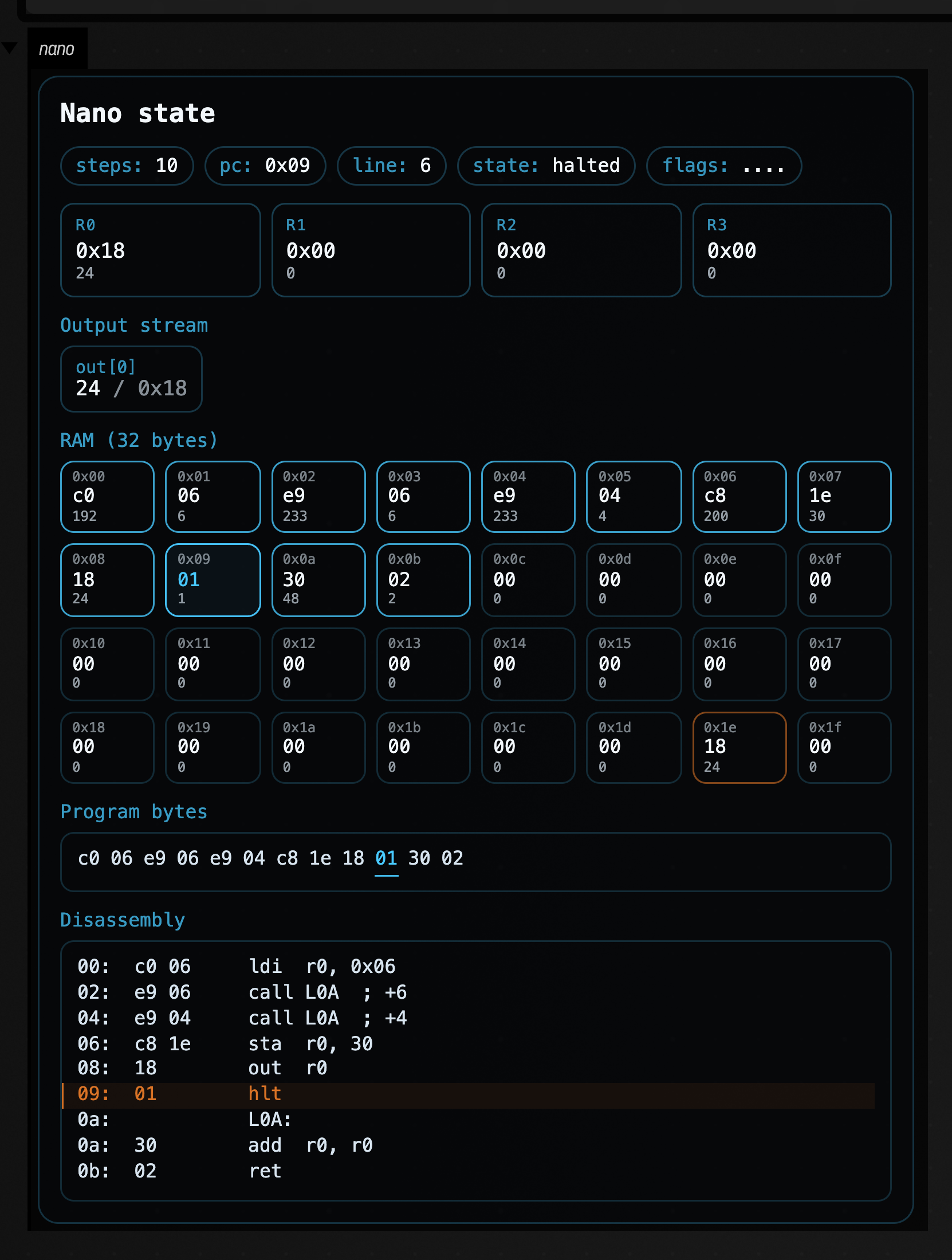
Starting from 6, one call to dbl gives 12, and the second gives 24.
When a sketch misbehaves
The panels under each run answer different questions. The register cards and RAM grid say what the machine ended up holding. The disassembly says what the assembler thought you wrote, which is where a mis-counted ldrr offset or a branch that landed one byte off shows up. And the state chip reads either halted or running, where running means the step budget ran out before any hlt did. A VM error such as Call stack overflow gets its own orange banner above the registers instead.