RectSL Inverse Animation
You can animate a rectangle by writing its motion tracks. You can also work backwards: say where it should be, and when, and let Field fit the numbers that put it there. Let's try that with a rectangle passing through three points.
The box below asks a rect to pass through three points at three given times. Its motion is a
circle with six unknown numbers (an amplitude, a phase and a centre on each axis), and
fitParameters solves for them. The box draws the figure beside it.
import afield.lang.rectsl.*

val duration = 4.0

:::fold build each axis as amp · trig(rate · t + phase) + centre, with amp, phase and centre unknown
// A clamped identity in time: RectSL's way of saying "follow the clock".
fun clock(d: Double): Track<Double> = LinearScalarTrack([TcbKey(0.0, 0.0), TcbKey(d, d)])

fun channel(axis: String, rate: Double, op: TrackOp1): Track<Double> = BinaryDoubleTrack(
    BinaryDoubleTrack(
        MappedDoubleTrack(
            BinaryDoubleTrack(
                BinaryDoubleTrack(clock(duration), constantTrack(rate), TrackOp2.MUL),
                FreeParamTrack("$axis-phase", 0.0),
                TrackOp2.ADD,
            ),
            op,
        ),
        FreeParamTrack("$axis-amp", 1.0),
        TrackOp2.MUL,
    ),
    FreeParamTrack("$axis-centre", 0.0),
    TrackOp2.ADD,
)

:::endfold

val seedX = channel("x", 1.1, TrackOp1.COS)
val seedY = channel("y", 1.1, TrackOp1.SIN)

// Where the rect must be, and when.
val waypoints = [
    RectSLFitFigure.Marker(0.4, -6.5, 2.6),
    RectSLFitFigure.Marker(1.8, 0.5, -2.4),
    RectSLFitFigure.Marker(3.4, 6.2, 1.8),
]
val window = Functions.Domain(0.0, duration)
val fitX = seedX.fitParameters(waypoints.map { TrackFitTarget(it.time, it.x) }, window, iterations = 1500)
val fitY = seedY.fitParameters(waypoints.map { TrackFitTarget(it.time, it.y) }, window, iterations = 1500)

fun miss(x: Track<Double>, y: Track<Double>): Double = waypoints.maxOf {
    hypot(x.sample(it.time) - it.x, y.sample(it.time) - it.y)
}

:::fold draw the target, the seed and the fit as three strips
display(
    "figure",
    RectSLFitFigure.render(
        bands = [
            RectSLFitFigure.Band(
                "target",
                constantTrack(0.0),
                constantTrack(0.0),
                Color4(0.86, 0.88, 0.91),
                note = "3 waypoints",
                strobe = false,
            ),
            RectSLFitFigure.Band(
                "seed",
                seedX,
                seedY,
                Color4(1.0, 0.42, 0.28),
                note = "worst miss %.2fm".format(miss(seedX, seedY)),
            ),
            RectSLFitFigure.Band(
                "fitted",
                fitX.fitted,
                fitY.fitted,
                Color4(0.29, 0.83, 0.7),
                note = "worst miss %.1em".format(miss(fitX.fitted, fitY.fitted)),
            ),
        ],
        markers = waypoints,
        wall = WallSpec(18.0, 8.0, UnitKind.Meters),
        rectSize = Vec2d(1.5, 1.5),
        times = (0..32).map { it * duration / 32.0 },
    ),
)

:::endfold

"""x: ${fitX.initialParameters} -> ${fitX.parameters}
|   residual ${fitX.initialResidual} -> ${fitX.finalResidual}
|y: ${fitY.initialParameters} -> ${fitY.parameters}
|   residual ${fitY.initialResidual} -> ${fitY.finalResidual}"""
    .trimMargin()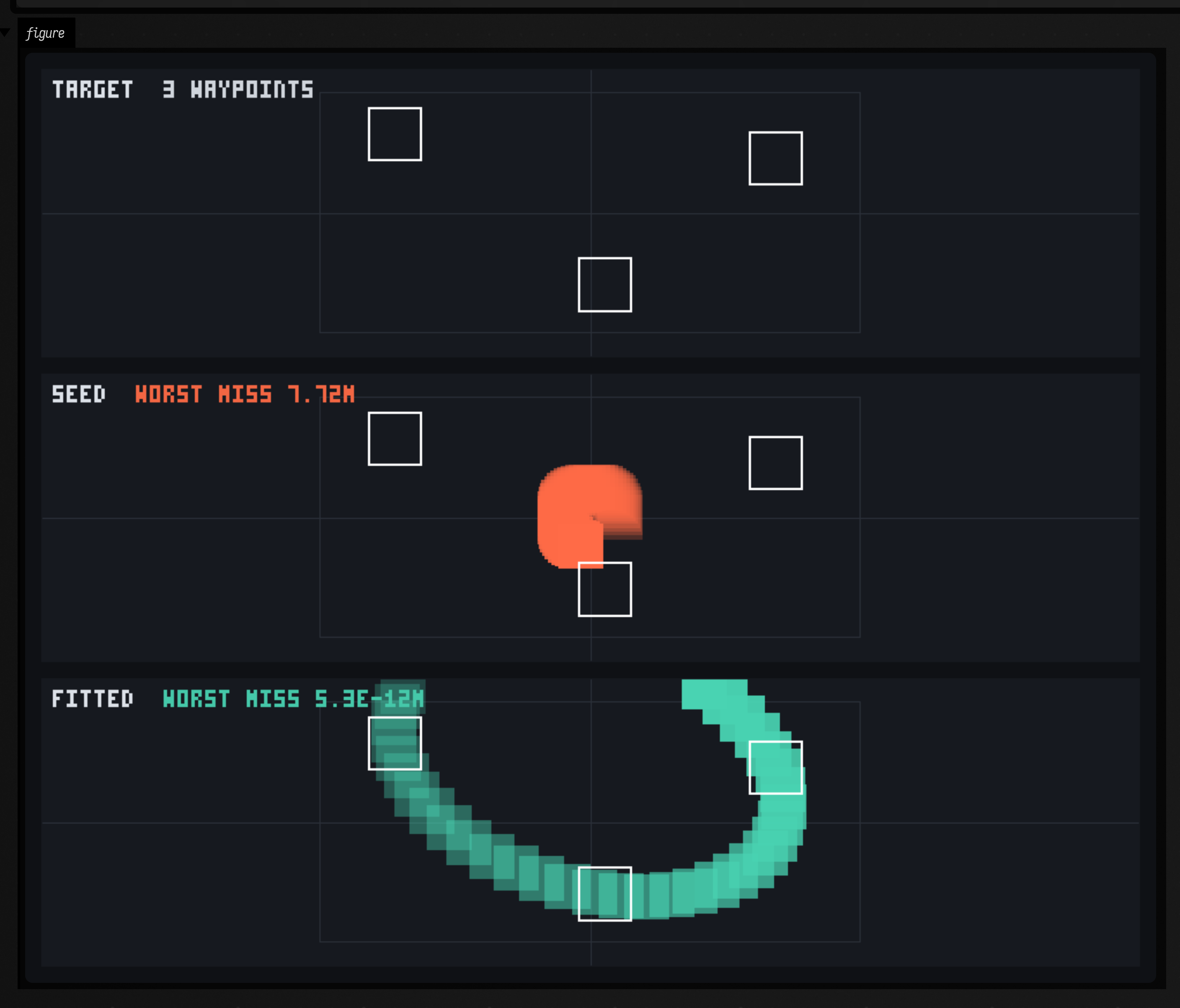
The top band shows where the rect was asked to go: three waypoints at three instants. The middle band is what the starting values do: a small circle near the origin that misses every waypoint. The bottom band is the same animation with the six numbers solved, passing through all three. The faint rectangle is the wall. The solved arc leaves it, which is allowed, so the figure draws a little more than the wall rather than cropping the answer.
Declaring an unknown
In RectSL source, free-param turns a number into an unknown. This line moves a bar along a sweep
track, with its scale and offset left for the fitter:
# a bar whose height and offset are to be solved for, not authored
"sweep" track-ref 1.0 free-param gain * 0.0 free-param bias + ->x
Until you fit it, a free-param is just its current value, so a scene with unknowns in it plays and
renders exactly as written.
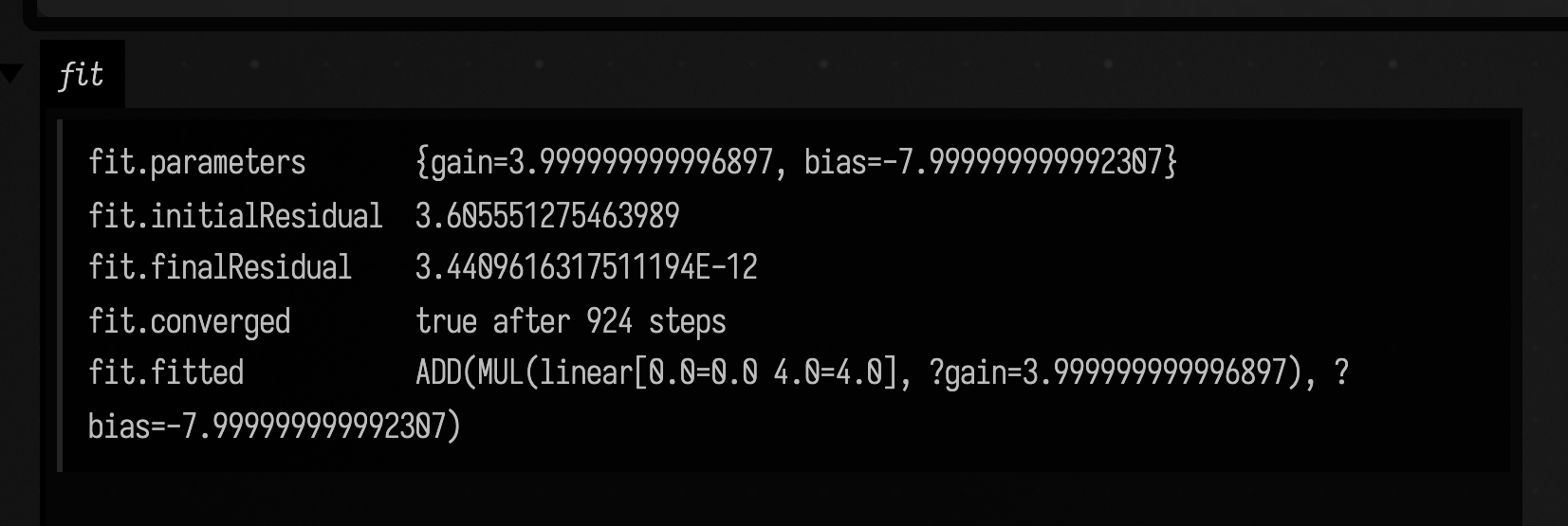
From Kotlin, any track with FreeParamTrack leaves in it can be solved with fitParameters. It
steps until the residual stops changing, up to iterations = 5000 at lr = 0.05, and converged
says whether it got there before the bound; when it is false, give it more iterations or a larger
lr before trusting parameters. The box below builds the same sweep track and fits it with the
defaults.
import afield.lang.rectsl.*

// A sweep that follows the clock, times gain, plus bias: the same track as the scene below.
val track = BinaryDoubleTrack(
    BinaryDoubleTrack(
        LinearScalarTrack([TcbKey(0.0, 0.0), TcbKey(4.0, 4.0)]),
        FreeParamTrack("gain", 1.0),
        TrackOp2.MUL,
    ),
    FreeParamTrack("bias", 0.0),
    TrackOp2.ADD,
)

val targets = [TrackFitTarget(1.0, -4.0), TrackFitTarget(3.0, 4.0)]

val fit = track.fitParameters(targets)

markdown(
    "fit",
    """
    ~~~
    fit.parameters       ${fit.parameters}
    fit.initialResidual  ${fit.initialResidual}
    fit.finalResidual    ${fit.finalResidual}
    fit.converged        ${fit.converged} after ${fit.steps.size} steps
    fit.fitted           ${fit.fitted.describe()}
    ~~~
"""
        .trimIndent(),
)
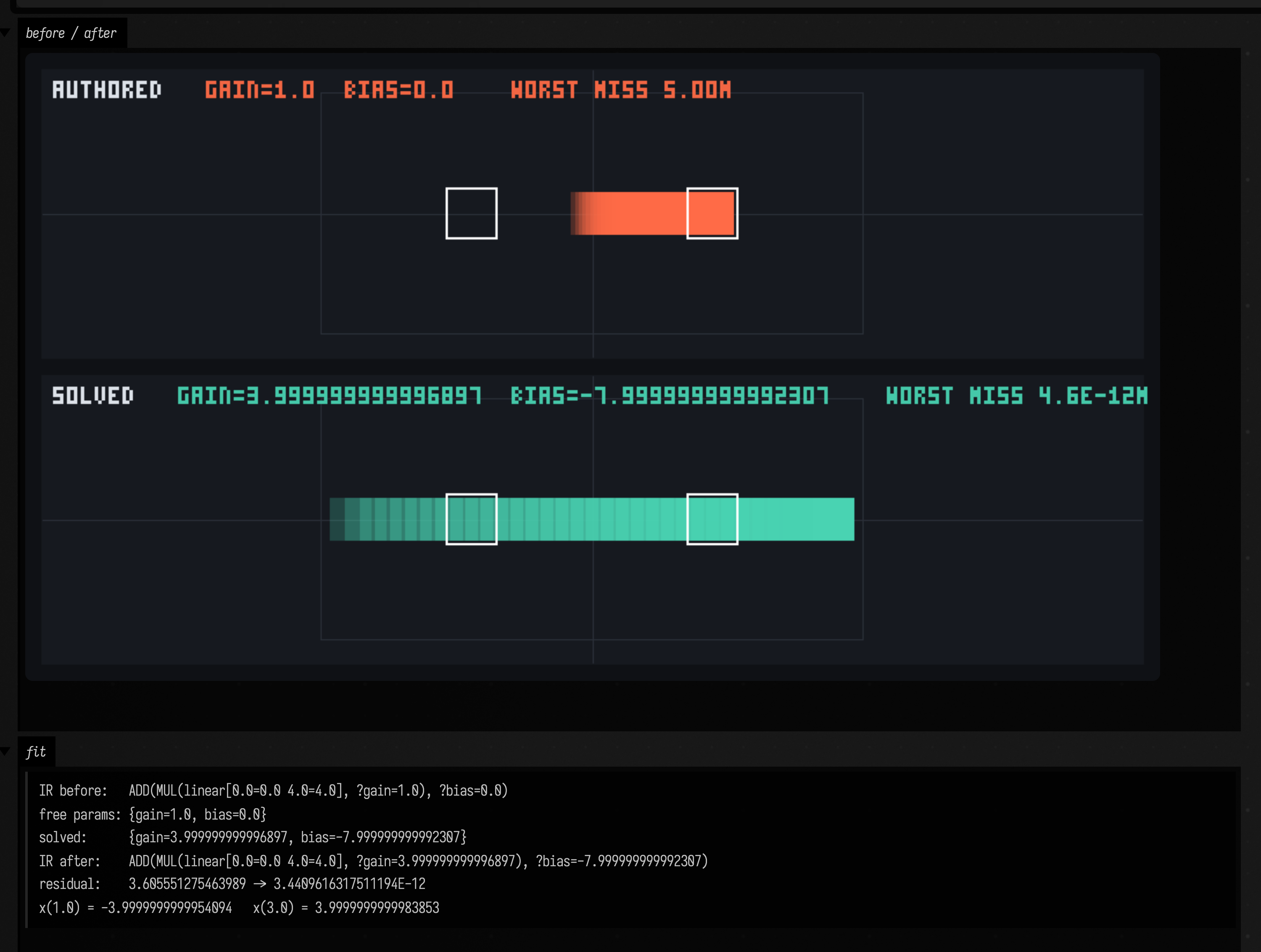
The next box does the same from RectSL source. It compiles a scene with two free-param numbers in
it, prints the track before and after the fit, and draws the scene as authored and as solved. The
authored band is what you get without fitting (gain=1.0, bias=0.0): the marker sweeps the wrong
span and misses both waypoints. The solved band lands on gain=4.0, bias=-8.0, the exact answer for
t·gain + bias through both waypoints.
import afield.lang.rectsl.*

// `free-param` marks a number to be solved for. Until it is, every backend reads it as the
// constant it is now, so the scene plays as written.
val program =
    RectAnimationOracle.compile(
            """
    #rectsl
    ->wall 18 8 meters
    ->duration 4
    ->fps 30

    linear-track "sweep" '( 0=0   4=4 )

    "marker" rect
      0 0 ->xy
      1.4 1.4 ->wh
      "sweep" track-ref 1.0 free-param gain * 0.0 free-param bias + ->x
      0x44d4b4 solid ->fill
    ;
    """
                .trimIndent(),
        )
        .program

val node = program.nodes.filterIsInstance<RectNode>().single()
val x = node.x

// Two waypoints and two unknowns. The sweep follows the clock, so -4 at t=1 and +4 at t=3 means
// gain = 4 and bias = -8.
val targets = [TrackFitTarget(1.0, -4.0), TrackFitTarget(3.0, 4.0)]
val fit = x.fitParameters(targets, Functions.Domain(0.0, 4.0), iterations = 2000)

fun missOf(track: Track<Double>): Double = targets.maxOf { abs(track.sample(it.time) - it.value) }

:::fold draw the scene as written and as solved; only ->x has unknowns, so both bands share the node's y
display(
    "before / after",
    RectSLFitFigure.render(
        bands = [
            RectSLFitFigure.Band(
                "authored",
                x,
                node.y,
                Color4(1.0, 0.42, 0.28),
                note = "${x.freeParameters()} — worst miss %.2fm".format(missOf(x)),
            ),
            RectSLFitFigure.Band(
                "solved",
                fit.fitted,
                node.y,
                Color4(0.29, 0.83, 0.7),
                note = "${fit.parameters} — worst miss %.1em".format(missOf(fit.fitted)),
            ),
        ],
        markers = targets.map { RectSLFitFigure.Marker(it.time, it.value, 0.0) },
        wall = WallSpec(18.0, 8.0, UnitKind.Meters),
        rectSize = Vec2d(1.4, 1.4),
        times = (0..32).map { it * 4.0 / 32.0 },
    ),
)

:::endfold

markdown(
    "fit",
    """
    ~~~
    IR before:   ${x.describe()}
    free params: ${x.freeParameters()}
    solved:      ${fit.parameters}
    IR after:    ${fit.fitted.describe()}
    residual:    ${fit.initialResidual} -> ${fit.finalResidual}
    x(1.0) = ${fit.fitted.sample(1.0)}   x(3.0) = ${fit.fitted.sample(3.0)}
    ~~~
"""
        .trimIndent(),
)
fitParameters moves only the named free-params. The general fitGradient, which moves every
number in a graph, refuses a track that declares free parameters and points you here.
Unknowns inside keys
A key's value can be a free-param too, so a fit can change a keyed track and not only the
arithmetic around it. Here the top of a ramp is the unknown:
'( 0=0 2=4 free-param peak ) linearA key value can be any track that does not change with time: a constant, a free-param, or
arithmetic over them. A key's time cannot be a free-param; only its value can.
Open it
The two Kotlin boxes from this page are on the welcome screen's starting points, as RectSL inverse
animation. The first box solves the six-parameter arc at the top of the page; the second fits the free-param scene from
RectSL source.
How the fit works
The rest of the page looks at how Field differentiates a track and which tracks can be fitted.
The three backends
A RectSL track is built from named operations rather than Kotlin closures, so it can be printed, compared, rewritten and turned into GLSL. Each operation has three implementations:
| column | what it is | where it runs |
|---|---|---|
eval: |
(Double) -> Double |
the CPU sampler |
glsl: |
a shader expression | the SDF backend |
fn: |
an afield.math.functions.Functions.Fn transform |
the exact gradient |
Fn is Field's own function type, and Field can differentiate an Fn exactly. Turning a track into
an Fn (lowering it) is what lets a fit take its gradient.
Two identities
Fn lacks two things a track needs: applying a function to another function's value, and a
piecewise definition. An identity supplies each.
Fn has no "apply a unary function to another Fn's value" op. Its differentiable value
transforms are flip, abs, exp, log, pow, clamp, scaleY, offsetY and pointwise
arithmetic. There is no sin: Functions.sin is an oscillator over the sample position,
\( \mathrm{offset} + \mathrm{amplitude}\cdot\sin(2\pi\cdot\mathrm{frequency}\cdot x + \mathrm{phase}) \), which is not a composition. But its phase child
is evaluated at x, so a zero-frequency oscillator is a composition. The box below checks that
sin(frequency = 0, phase = u) matches sin(u(x)) across a range of x:
// A zero-frequency oscillator whose phase is u(x): 0 + 1·sin(2π·0·x + u) is sin(u(x)).
val (composed, u) = with(Functions) {
    val u = identity(Functions.Domain.ALL) // any inner function will do; u(x) = x
    sin(
        frequency = 0.0.c,
        phase = u,
        amplitude = 1.0.c,
        offset = 0.0.c,
        domain = Functions.Domain.ALL,
    ) to u
}

val xs = (0..4000).map { -2.0 + it * 4.0 / 4000.0 }
val worst = xs.maxOf { x -> abs(composed.eval(x) - sin(u.eval(x))) }
val notBitEqual = xs.count { x -> composed.eval(x) != sin(u.eval(x)) }

markdown(
    "identity",
    """
    ~~~
    sin(frequency = 0, phase = u, amplitude = 1, offset = 0)   vs   sin(u(x))
    samples:               ${xs.size} over x in [-2, 2]
    worst difference:      $worst
    samples not bit-equal: $notBitEqual
    ~~~
"""
        .trimIndent(),
)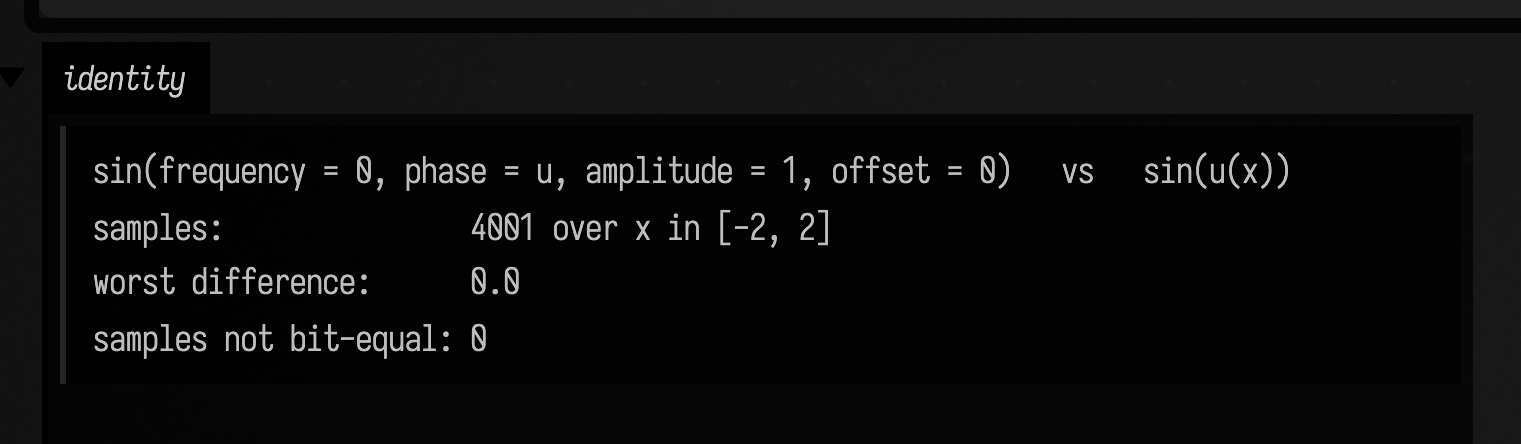
The two agree exactly, because \( 0 + 1\cdot\sin(2\pi\cdot 0\cdot x + u) \) involves no rounding. This identity covers the trigonometric functions, and with them most of the Penner easings.
Fn has no piecewise-in-x op, and every keyframed track is piecewise. A sum of clamped ramps
stands in for it. For keys \( (t_i, v_i) \) and any segment shape \( S_i \) with \( S_i(0) = v_i \) and \( S_i(1) = v_{i+1} \),
v(t) = v₀ + Σᵢ [ Sᵢ(clamp01((t - tᵢ) / (tᵢ₊₁ - tᵢ))) - vᵢ ]is identically the clamped piecewise interpolant. Inside span j every earlier term is
\( v_{i+1} - v_i \) and every later one is zero, so the sum telescopes to \( v_j + (v_{j+1} - v_j)\,S_j(u) \); before
the first key everything is 0 and after the last everything is 1, which is exactly what the sampler's
clamping does. It needs only clamp, divide, multiply and add, so linear, eased and TCB tracks all
lower, and so do the *-in-out easings, which are piecewise but continuous.
Hard edges
Gates, holds and looped clocks all jump, and they lower through Fn.floor. The derivative of
floor is zero wherever it exists, so a parameter that reaches the output only through a floor
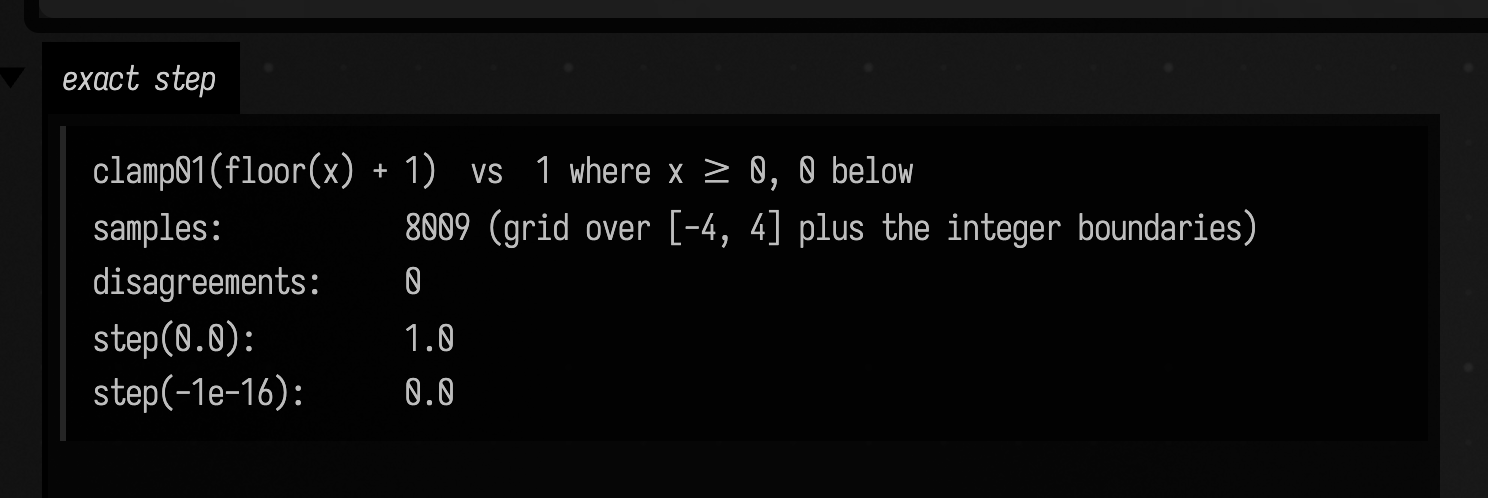
cannot be fitted. Used inside a larger expression, though, it gives an exact step. The box below
checks clamp01(floor(x) + 1) against the ideal step, including at the boundary:
// clamp01(floor(x) + 1): 1 where x >= 0, 0 below. The samples include x = 0 and the negative
// integers, where a floor-based step could get the boundary wrong.
val step = with(Functions) { identity(Functions.Domain.ALL).floor().offsetY(1.0).clamp(0.0, 1.0) }

val grid = (-4000..4000).map { it / 1000.0 }
val edges = [-3.0, -2.0, -1.0, -1e-16, 0.0, 1e-16, 1.0, 2.0]
val xs = grid + edges

val wrong = xs.filter { x -> step.eval(x) != (if (x >= 0.0) 1.0 else 0.0) }

markdown(
    "exact step",
    """
    ~~~
    clamp01(floor(x) + 1)  vs  1 where x >= 0, 0 below
    samples:           ${xs.size} (grid over [-4, 4] plus the integer boundaries)
    disagreements:     ${wrong.size}${if (wrong.isEmpty()) "" else " at " + wrong.take(6)}
    step(0.0):         ${step.eval(0.0)}
    step(-1e-16):      ${step.eval(-1e-16)}
    ~~~
"""
        .trimIndent(),
)
The same step handles the expo-* and elastic-* easings, whose formulas do not quite reach their
own endpoints (expo-in is 2⁻¹⁰ at u=0, not 0):
closed(u)·(1−floor(u))·(1−floor(1−u)) + floor(u).
->face-travel builds a HeadingTrack, the atan2 of a central finite difference, so Fn also
has atan, atan2 and hypot. A heading agrees with the sampler less closely than other tracks,
because differencing two nearby positions magnifies their rounding error.
Refusals
Track.toFn() never guesses. A track it cannot lower comes back as
RectSLFnLowering.Refused(why, closable, missing). closable tells you whether a lowering is
possible but not written yet, or impossible; for a closable refusal, missing says what it would
take.
| refused | closable? | why |
|---|---|---|
mod |
yes | Kotlin's % on doubles is the exact remainder, and rebuilding it from floor gives a different answer for very large quotients. A mod of two constants still works. |
| the pattern tracks | no | a pattern is interpreted, not an expression of fixed shape. |
Division by a varying value and smoothstep with varying edges do lower, with a guard against
dividing by zero.
fitParameters refuses in the same way. A parameter that reaches the output only through a floor,
a gate or a hold has a zero derivative, and fitParameters names it instead of returning a residual
that never moved. A parameter alongside a gate, rather than under it, fits normally.
Tests compare lowered tracks with the sampler and their gradients with finite differences. If a fit leaves a large residual, inspect the track, targets and convergence before relying on it.
Printing, comparing and simplifying tracks
Because the track IR is data, a few other things come with it:
Track.describe()prints a track as algebra, for exampleADD(MUL(linear[0.0=0.0 4.0=4.0], ?gain=1.0), ?bias=0.0).- Two tracks built the same way are
==. Track.simplify()shrinks a track, mostly by folding constants, andsubstituteParametersreplaces free parameters with values, as a fit does.
simplify() only makes rewrites that sample identically, so it leaves x + 0, 0 - x and
mix(a, b, 1) alone: in floating point they can differ from x, -x and b in the sign of a zero
or the last bit, and a signed zero can turn a ->face-travel rect half a turn.
The opening figure is a CPU raster, not a GPU capture
Its rectangles are sampled from the tracks at the instants shown, so they are the eval:
column's answer and not the shader's. Measurements of the lowering against the gallery are in
dev_docs/RECTSL_FN_BACKEND_MEASUREMENTS.md.
Keyed tracks
A key's value is itself a track, so it can be a free parameter too. TCB tracks recompute their tangents from the fitted key values, so a moved key bends the spline the way the sampler would.