Place a world-space marker from binocular gaze
The openxr_eye_intersection starting point draws a small white wire cube where the two
HTC eye rays come closest. It follows the editable Mesh and shader pattern in
canonicalGraphics, with direct OpenXR eye rendering as in helloXR. The renderer box
is the scene box's parent. Launch the renderer first, wait for its window/headset views,
then launch the scene. On macOS it shows a desktop reference scene without simulated eyes.
Both extensions remain optional. XR_HTC_eye_tracker supplies the two origins and
orientations needed for binocular depth. XR_EXT_eye_gaze_interaction supplies a single
combined gaze pose, drawn as a dashed grey ray; it cannot by itself supply an intersection
depth. Enable eye tracking and calibration in the headset runtime. The status panel shows
which interfaces exist, per-eye validity, the HTC sample time, and why a marker is hidden.
Coordinate contract
OpenXR eye poses returned by these bindings are already located in the target's LOCAL reference space, in metres. Each orientation rotates eye-forward (0, 0, -1) into that same space. Applying the headset pose again would move and rotate the rays twice.
BinocularGazeIntersection.update(xr.htcEyeState()) solves in LOCAL space. Real measured
rays often do not cross exactly: it finds their closest points and uses the midpoint,
provided both points lie forward and the gap is small. Defaults reject angles below
0.25 degrees, distances outside 0.05–8 metres, and gaps above 0.03 metres. These editable
thresholds avoid unstable far-away or divergent intersections; no smoothing hides the raw result.
The scene puts its application world somewhere other than LOCAL, so the conversion is never the
identity: translation (+0.35, +0.10, -0.20) metres and a 30-degree yaw. With W = worldFromLocal:
markerWorld = W * midpointLocal
clip = eyeProjection * eyeViewLocal * inverse(W) * modelWorld * vertex
The inverse in the view path is essential. Both gaze data and eye views refer to LOCAL;
the marker and reference geometry refer to application world. The shader uses p * m
with m = eyeViewLocal * inverse(W) * modelWorld. The scene reads the current tracking
sample before drawing the left eye and uses that same result for both rendered eyes.
Headset check
- Look at the grey reference cubes, whose world centres are
(0, 0, -1),(0, 0, -2)and(0, 0, -4)metres. Cyan and orange are the HTC left and right rays; the white marker should approach the fixation point. A magenta segment shows the accepted gap. - Check Hold the last valid marker in world space, then translate and rotate your head while looking elsewhere. The reported WORLD position must stay constant and the cube must remain anchored in the scene. With hold off, invalid tracking hides the cube.
- Change
worldFromLocaland relaunch the scene. WORLD coordinates should change while the LOCAL result and its physical location continue to agree with the new view conversion. - Lose focus or eye validity: live rays and the live marker must disappear. An explicitly held marker remains. An EXT-only runtime must show its ray without inventing a depth.
This hold assumes the same LOCAL reference-space origin. Restart the scene after a runtime recenter; this starter does not compensate saved placements for reference-space resets. Vergence depth becomes noisy at distance, so a rejected sample is a useful diagnostic.
On the desktop
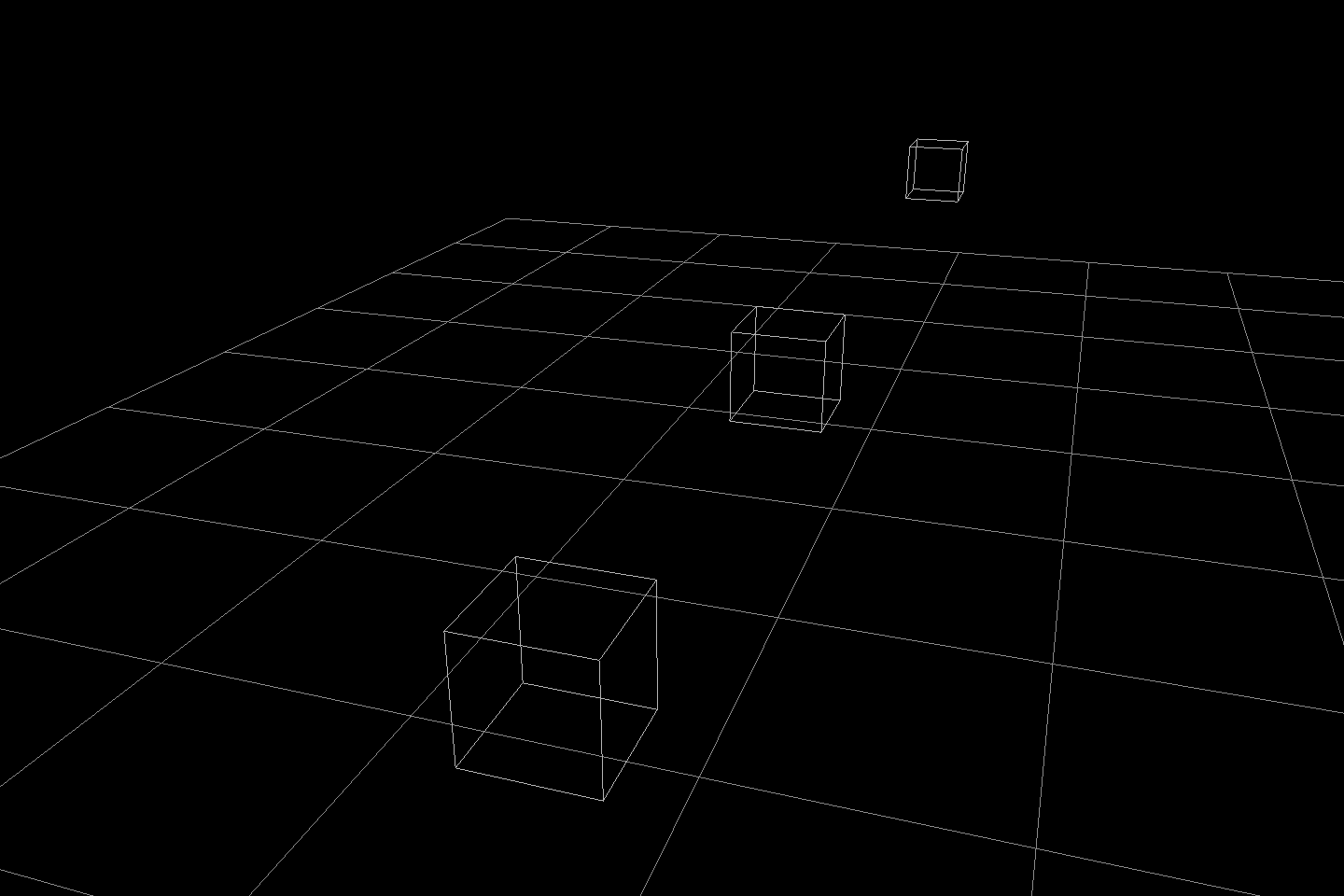
The desktop preview has no simulated eyes, so NO_TRACKING is the right answer there and the
binocular marker stays hidden. So does the dashed EXT ray, which needs a runtime that reports a
combined gaze. What you can check is the floor grid and the three grey reference cubes. On a Mac the starter looks like this:
Nobody has run the four-step check above on an HTC-capable headset. Tests cover the
coordinate conversion and the native bindings, and dev_docs/OPENXR_EYE_INTERSECTION_AGREEMENT.md
says which; a real eye tracker's calibration is not among them.
The saved document
The working document is eyeRayIntersection in the local AField workspace. Its
launch-eye-rays macro launches the renderer and scene in order. The repository transcript
dev_docs/agents/transcripts/openxr_eye_intersection.yaml recreates the two-box graph in a
new document; the generated starting point ships the same Kotlin and shaders.