Searching for MorphoHDL Circuits
Describe what you want a circuit to compute and Field can search for a MorphoHDL program that does it. The result is source code you can read, edit and run in a Morpho box.
The search tools live in afield.lang.morpho. MorphoSpec and MorphoEvaluator describe and
check the task; MorphoGenome and MorphoProgramGenerator produce candidates and variations;
MorphoSearch offers random sampling, hill climbing, a (μ+λ) population and a width curriculum.
The genome is MorphoHDL source text. Every candidate is compiled by MorphoHDL's own
compileModule() and run by MorphoSim. What the search finds is the program itself, ready to
read, change or paste into a Morpho box.
:::static
import afield.lang.morpho.*

/*
A problem is what the circuit should compute, the widths to test it at, and the cells a
candidate may use. The only thing said about addition is `sum, c_out = a + b + c_in`;
the cells are morpho's own eight standard ones.
*/
val problem = MorphoProblems.fullAdderCell()
val budget = 4000
println(problem)
println("palette: " + MorphoPalette.standard.luts.joinToString { it.name })
println(
    "input space at 1 bit: ${problem.spec.inputSpace(1)} vectors, " + "exhaustive = ${problem.spec.isExhaustiveAt(1)}",
)

// Three drivers with the same generator, seed and budget. One unit of budget is one
// invocation of morpho's compiler.
val runs = [
    MorphoSearch.random(problem.spec, problem.generator, budget, seed = 2),
    MorphoSearch.hillClimb(problem.spec, problem.generator, budget, seed = 2),
    MorphoSearch.evolve(problem.spec, problem.generator, budget, seed = 2),
]
runs.forEach { println(it.summary()) }

// What was actually found, in MorphoHDL. This is paste-into-a-morpho-box text.
runs
    .firstOrNull { it.solved }
    ?.best
    ?.let { winner ->
        println()
        println(winner.genome.phenotype().cells[0].render())
        println("cost: ${winner.fitness.cost}")
    }

/*
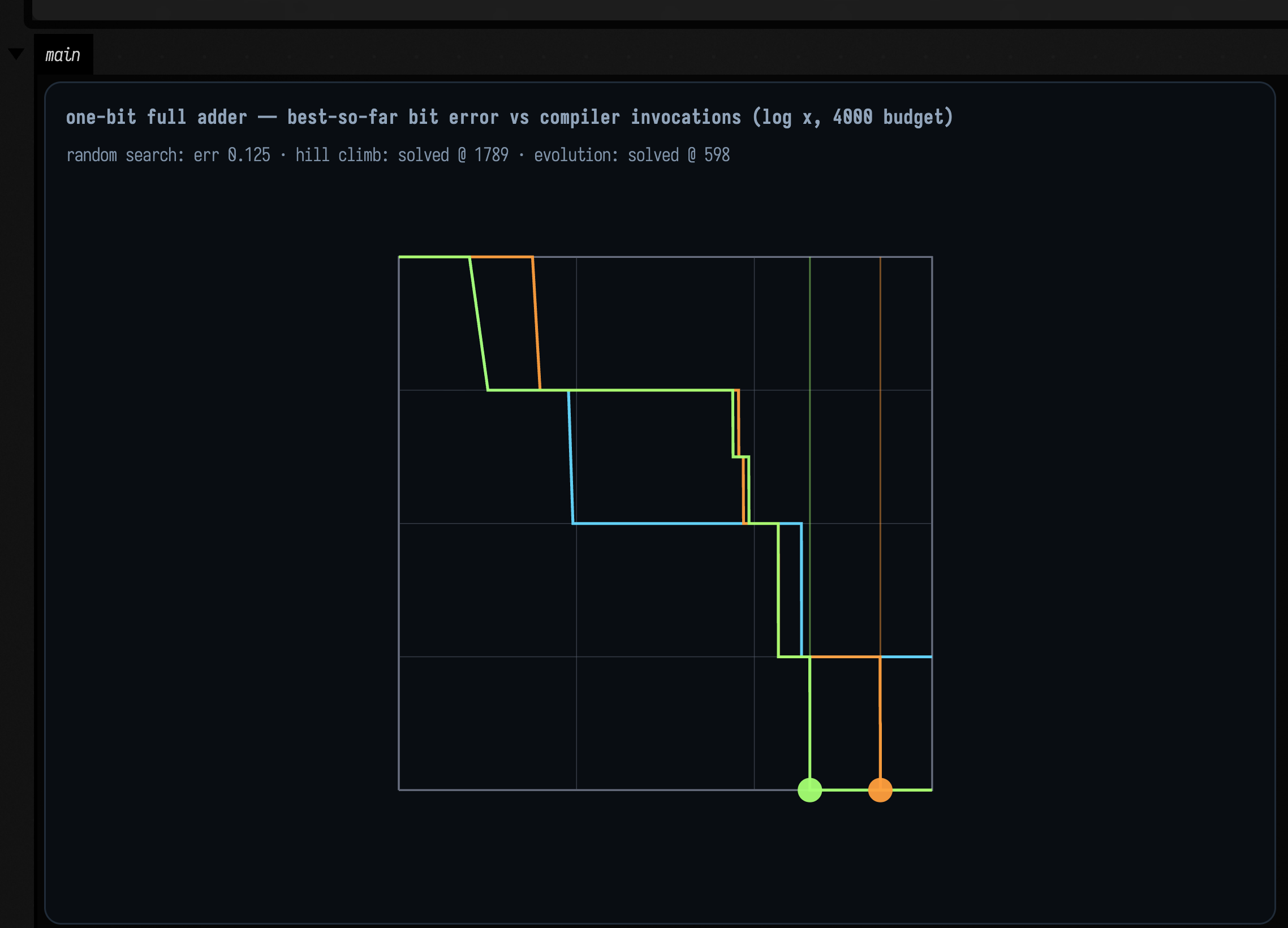
Cyan is random sampling, orange the hill climb, green the population. A dropped tick
marks the invocation at which a run first became exactly correct, since a curve that
reaches zero and one that reaches 0.004 look the same at this scale.
*/
showPlaneGrid(
    "one-bit full adder — best-so-far bit error vs compiler invocations (log x, $budget budget)\n" +
        morphoRunCaption(runs) to morphoConvergenceFLines(runs),
    columns = 1,
    cellWidth = 700,
    cellHeight = 420,
    window = morphoPlotWindow(),
)
One unit of budget is one invocation of morpho's compiler, which on a three-width adder problem
(parse, compile, expand, extract, simulate, three times over) costs about 1 ms once Graal is
warm. Roughly a thousand candidates a second, single-threaded because a Graal Context is not safe
for concurrent access.
What it found, with the control arm next to it
Each cell counts the seeds that found an exactly correct circuit: five seeds per cell, three for the last two rows.
| problem | widths | budget | random (control) | hill climb | evolution |
|---|---|---|---|---|---|
| bitwise xor (the harness canary) | 2/4/8 | 2 000 | 5/5 | 5/5 | 5/5 |
| one-bit full adder | 1 | 4 000 | 0/5 | 4/5 | 5/5 |
or-reduce, y = (x != 0) |
2/3/5 | 6 000 | 3/5 | 0/5 | 3/5 |
and-reduce, y = (x == ~0) |
2/3/5 | 6 000 | 3/5 | 0/5 | 3/5 |
| recursive 8-bit adder | 2/4/8 | 20 000 | 0/3 | 0/3 | 0/3 |
the same, with both SPLITs given |
2/4/8 | 20 000 | 0/3 | 0/3 | 0/3 |
The full adder is where selection earns its keep. Random sampling never finds it and plateaus at
a bit-error rate of 0.125: that is sum = Xor3(a, b, c) with c_out = And(a, b), right on six of
the eight truth-table rows and one gate swap short. Evolution finds it every time, in 165 to 1152
invocations. Same generator, same seeds, same budget: the only difference is selection.
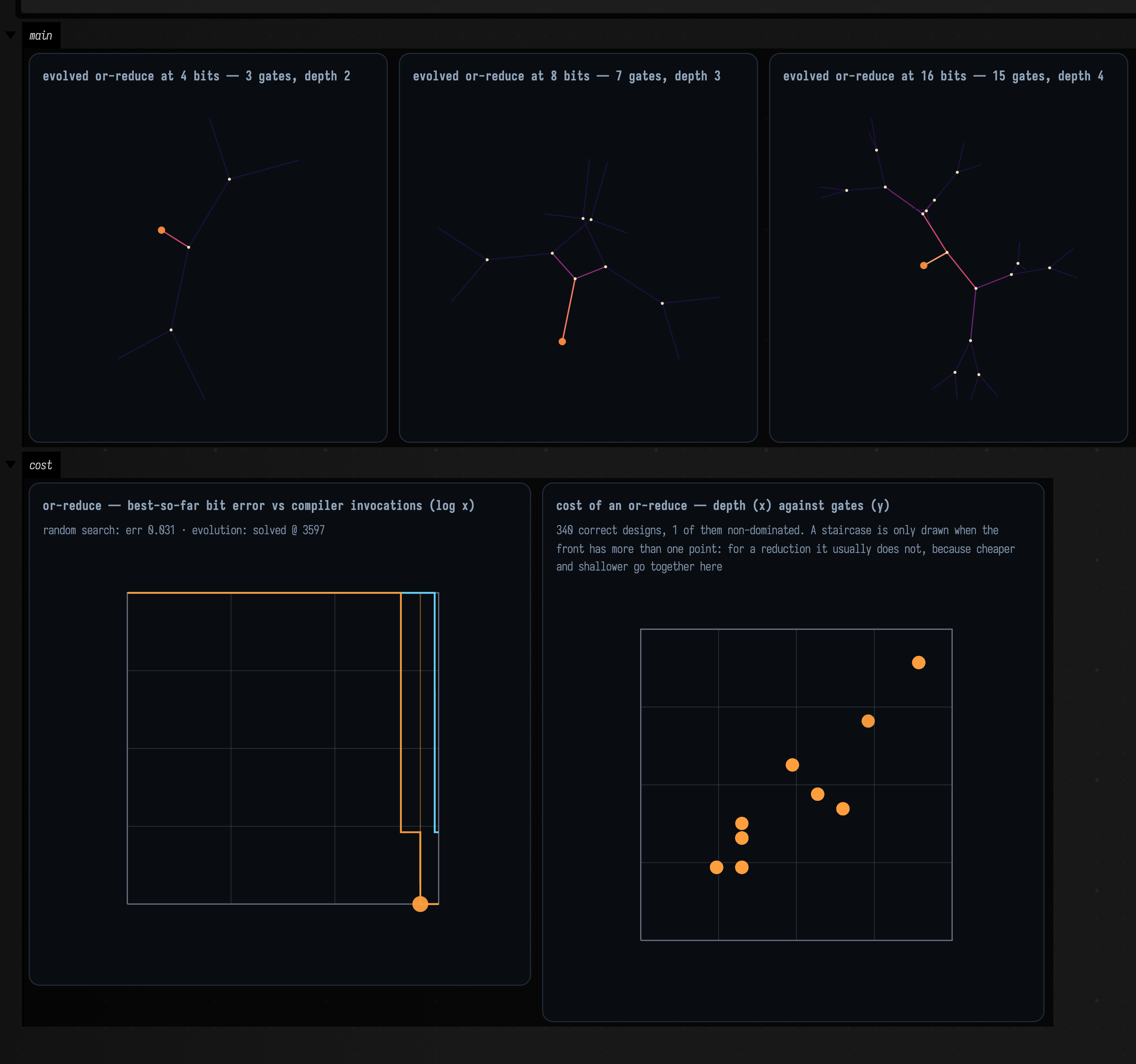
In these runs, the full adder is the only row where selection helps. On the two reductions, random sampling matches evolution (3/5 each) and hill climbing finds nothing at all: it converges on a two-gate design that is 3% wrong and cannot get off it. Those spaces are small enough that sampling them is a perfectly good algorithm.
Or-reduce cannot be done without recursion, which is what makes it the positive result.
Morpho sizes a LUT cell to its widest operand and broadcasts the narrow ones (compiler.js:964):
no gate and no combination of gates turns eight wires into one bit. The only route down is to keep
SPLITting, and any design that gets the answer right has recursed to reach it.
The designs found come out at four gates and depth 3 at five bits (n - 1 two-input gates,
arranged as a balanced tree) and the same source text is then re-compiled and checked at 16, 32 and
48 bits, widths nothing was ever selected on.
:::static
import afield.lang.morpho.*

// y = (x != 0). No combination of gates turns eight wires into one bit, so the only way
// down is SPLIT: every correct answer divides and recurses.
val problem = MorphoProblems.orReduce()
println(problem)

val runs = [
    MorphoSearch.random(problem.spec, problem.generator, 6000, seed = 2),
    MorphoSearch.evolve(problem.spec, problem.generator, 6000, seed = 2, mu = 24, lambda = 40),
]
runs.forEach { println(it.summary()) }

// The cheapest correct design across both runs, or the closest one if neither solved it.
val correct = runs.mapNotNull { it.best }.filter { it.fitness.correct }
val best = correct.minByOrNull { it.gates } ?: runs.mapNotNull { it.best }.minWith(MorphoIndividual.BY_QUALITY)
println()
println(if (correct.isEmpty()) "(nothing exactly correct this run; showing the best found)" else "")
println(best.genome.phenotype().cells[0].render())

// Selected at widths 2, 3 and 5 (see "Why the width family is 2, 3 and 5" below), then
// re-compiled from the same source at widths it was never tested on.
[7, 9, 16, 32, 48].forEach { w ->
    val f = MorphoSearch.generalization(best.genome, problem.spec, [w])
    println("  at %2d bits: %s".format(w, f))
}

// The Pareto front over every correct design the two runs produced, drawn as a step
// function because there is no design at a fractional gate count.
val found = runs.flatMap { it.costPoints() }
println()
println(
    "Pareto front (gates, depth) at %d bits: %s"
        .format(
            problem.spec.widths.max(),
            runs.flatMap { it.front }.joinToString(", ") { "(${it.gates}, ${it.depth})" },
        ),
)

// The found circuit itself at three widths: one source, three signatures, three circuits.
val source = best.genome.render()
val panels =
    [4, 8, 16].map { w ->
        val c = morphoCircuit(MorphoProblems.ROOT, w, source = source)
        c.growFully(relaxSteps = 220)
        "evolved or-reduce at %d bits — %d gates, depth %d".format(w, c.netlist.gateCount, c.depth.toInt()) to
            c.flines(fit = true)
    }
showPlaneGrid(
    *panels.toTypedArray(),
    columns = 3,
    cellWidth = 300,
    cellHeight = 300,
    window = morphoUnitWindow(),
)

showPlaneGrid(
    "or-reduce — best-so-far bit error vs compiler invocations (log x)\n" + morphoRunCaption(runs) to
        morphoConvergenceFLines(runs),
    "cost of an or-reduce — depth (x) against gates (y)\n" +
        "${found.size} correct designs, ${runs.sumOf { it.front.size }} of them non-dominated. " +
        "A staircase is only drawn when the front has more than one point: for a reduction " +
        "it usually does not, because cheaper and shallower go together here" to morphoParetoFLines(found),
    channel = "cost",
    columns = 2,
    cellWidth = 430,
    cellHeight = 380,
    window = morphoPlotWindow(),
)
Why the width family is 2, 3 and 5
Selecting on widths 2, 4 and 8 produced 400 distinct correct or-reduce designs. Re-compiled at
twelve other widths, all 400 are correct at 3, 6, 12, 16, 32 and 48; 399 of them are wrong at
5, 7 and 9. Exactly one design in four hundred is actually parametric. The dual, and-reduce,
gives zero of 400.
The mechanism is a hole in the language, not a quirk of the search. SPLIT halves a bus as
floor(w/2), w - floor(w/2) (primitives.js:42), so the two halves are the same width exactly when
the width is even; 5, 7 and 9 are the small widths where they differ and both are wider than one
bit. A LUT applied to both halves (Or(x0, x1), which is what these designs do) then has operands
of two different widths, and materializeLut (compiler.js:962-973) takes the maximum and
broadcasts only operands of width 1. Unequal wider operands are neither broadcast nor rejected:
the extra pins simply read past the end of the shorter bus. The circuit is silently wrong, and a search that has never been shown an odd width has
no way to find out.
Change the family to 2, 3 and 5 (one line) and 400 of 400 designs are correct at every width
tried, from 2 to 48. That family is MorphoProblems.ODD_FAMILY, the default for the reduction
problems, and a power of two width family selects designs that are not parametric is the test that
holds the claim in place.
A parametric design is a claim about all N, and one width is one point: that on its own is the case for scoring at several widths. What several widths also catch is undefined behaviour in the compiler, exploited by a search that had no idea it was cheating.
The recursive adder
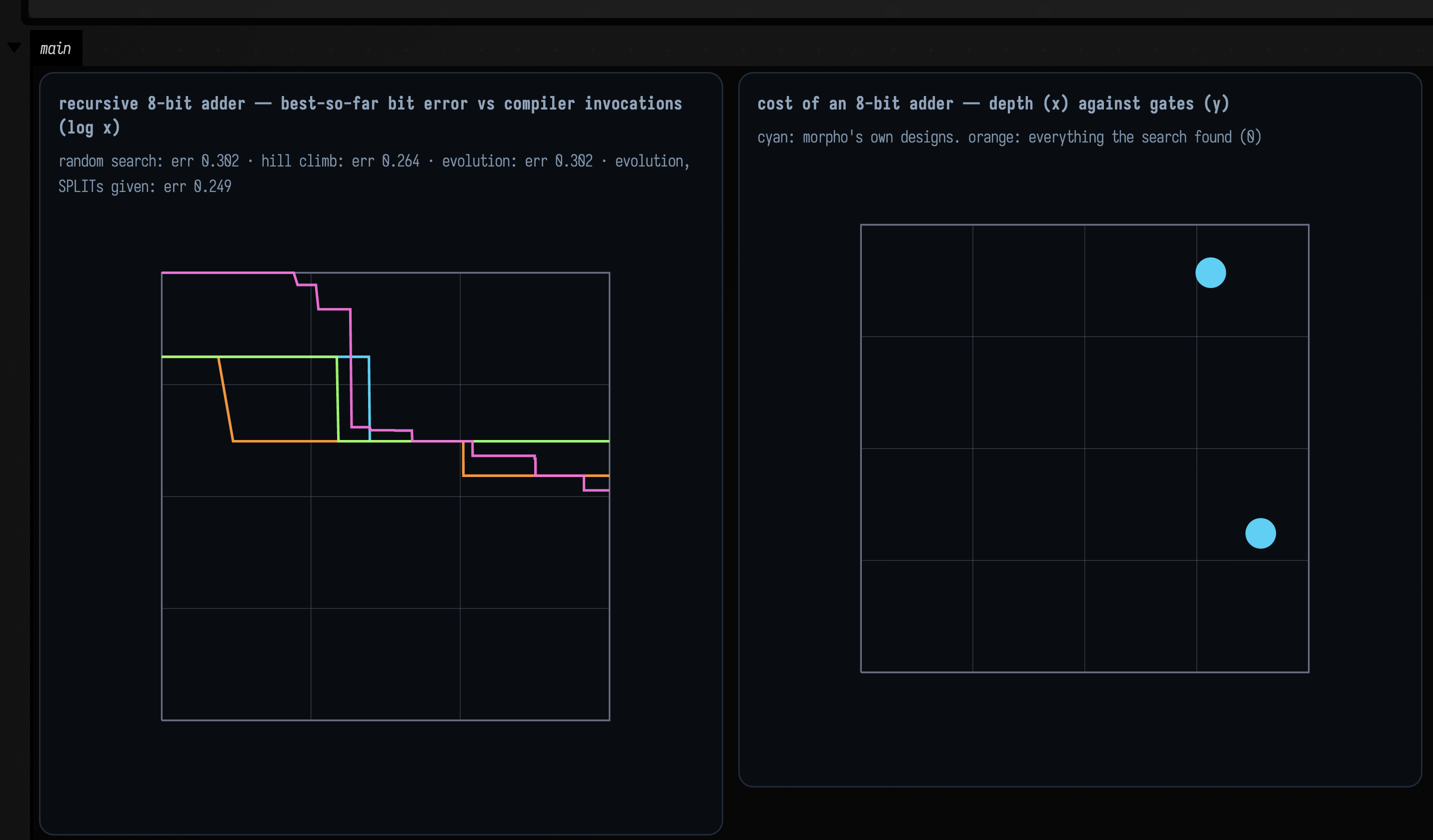
Nothing finds a divide-and-conquer adder. Not random sampling, not hill climbing, not a population,
not with lexicase selection over per-bit test cases, not with a width curriculum, and not with both
SPLITs handed over as an unremovable prologue.
The near miss is not uniform across the drivers, and the difference is informative. Random sampling
and hill climbing stop on depth-1 circuits: broadcast logic, no recursion at all, bit-error rates
around 0.25 to 0.27. Evolution at 20 000 invocations gets to 16 gates and depth 8, which is
ripple_adder's cost profile exactly, and is still 17.9% wrong. It has found the shape and not
the wiring: eight levels of something chained across the width, carrying the wrong thing.
Three measurements say why the rest of the way is so far.
The target is in the space. The ripple skeleton, written by hand in the generator's own grammar,
is five statements and scores exactly ripple_adder: 16 gates and depth 8 at eight bits, 64 gates
and depth 32 at thirty-two. the recursive adder is reachable in the genome grammar asserts it.
The recursion is being tried and is not paying. Of 4 000 random programs on the guided problem,
511 (12.8%) contain a self-call in the compiled circuit. The best of those scores 0.2880 and the
best purely combinational candidate scores 0.3017. An eighth of the population is recursing, for
1.4% of the error. On the unguided problem only 2.8% recurse, and the best of those is worse than
the best combinational one (0.3753 against 0.3017); the two SPLITs are the difference.
(MorphoSearchMeasurements.recursionDensity.)
And the reason is arithmetic about the answer. A correct adder needs both halves recursed, both
carries chained in the right order, and the two sums CATed back: four statements worth nothing
until all four are right and wired to the outputs. Or-reduce needs two, and half of it already pays.
:::static
import afield.lang.morpho.*

// Four drivers on a recursive 8-bit adder, two of them with both SPLITs given.
val free = MorphoProblems.recursiveAdder()
val guided = MorphoProblems.guidedRecursiveAdder()
val budget = 6000
val runs = [
    MorphoSearch.random(free.spec, free.generator, budget, seed = 1),
    MorphoSearch.hillClimb(free.spec, free.generator, budget, seed = 1),
    MorphoSearch.evolve(free.spec, free.generator, budget, seed = 1),
    MorphoSearch.evolve(
        guided.spec,
        guided.generator,
        budget,
        seed = 1,
        label = "evolution, SPLITs given",
    ),
]
runs.forEach { println(it.summary()) }

// The ripple adder written by hand in the generator's own grammar, scored by the same
// evaluator: the answer is in the search space.
val target = MorphoGenome(
    [
        MorphoCellGenome(
            name = MorphoProblems.ROOT,
            inputs = ["a", "b", "c"],
            statements = [
                MorphoStatement(["a0", "a1"], "SPLIT", ["a"]),
                MorphoStatement(["b0", "b1"], "SPLIT", ["b"]),
                MorphoStatement(["s0", "cm"], MorphoProblems.ROOT, ["a0", "b0", "c"]),
                MorphoStatement(["s1", "co"], MorphoProblems.ROOT, ["a1", "b1", "cm"]),
                MorphoStatement(["sum"], "CAT", ["s0", "s1"]),
            ],
            outputs = ["sum", "co"],
            fallback = "full_adder",
        ),
    ],
    free.generator.preamble,
)
println()
println(target.cells[0].render())
println("  scored at 2/4/8: " + MorphoEvaluator(free.spec).evaluate(target.render(), target.rootName))
println("  at 16 bits:      " + MorphoSearch.generalization(target, free.spec, [16]))
println("  at 32 bits:      " + MorphoSearch.generalization(target, free.spec, [32]))

// morpho's own adders, scored by the same evaluator.
val references =
    ["ripple_adder", "brent_kung_adder"].mapNotNull { design ->
        free.reference(design).cost?.let { MorphoCostPoint(design, it.gates, it.depth, reference = true) }
    }
references.forEach { println("  reference ${it.label}: ${it.gates} gates, depth ${it.depth}") }

// Left: the four runs' error curves. Right: the cost plane for an 8-bit adder, with
// morpho's designs and whatever the search found.
val found = runs.flatMap { it.costPoints() }
println("correct designs found by any driver: ${found.size}")
showPlaneGrid(
    "recursive 8-bit adder — best-so-far bit error vs compiler invocations (log x)\n" + morphoRunCaption(runs) to
        morphoConvergenceFLines(runs),
    "cost of an 8-bit adder — depth (x) against gates (y)\n" +
        "cyan: morpho's own designs.  orange: everything the search found (${found.size})" to
        morphoParetoFLines(found + references),
    columns = 2,
    cellWidth = 430,
    cellHeight = 400,
    window = morphoPlotWindow(),
)
Agents: regenerating these numbers
The table is regenerated with
./gradlew jvmMeasurements --tests "afield.lang.morpho.MorphoSearchMeasurements" --rerun -i.
MorphoSearchTest asserts the claims above, including that the recursive adder is reachable
in the grammar and not solved at this budget. The design notes are in
dev_docs/morpho_circuit_search.md.
See also
- MorphoHDL in Field for writing and drawing MorphoHDL circuits.
- morpho_circuit_search, a starting point with these searches as boxes you can run.