Physics: particles, constraints and cloth
Make a sheet of cloth, pin some of its particles, and watch it settle. Field's particle solver
uses distance constraints to hold the sheet together; Cloth sets up the rectangular grid for you.
SimdVerlet.debugLines() draws the solver's state, so you can see the particles and their
connections as you adjust it.
The solver runs on the CPU. Its debug drawing is made of FLines: show them in a box with
showPlane, use Box.lines for a 3D view, or send them to a Field 4 renderer.
The API is in the codebase reference. This page covers the thing that
surprises people: stiffness and iterations act as one knob.
If you just want the cloth on screen
Open the cloth_simdverlet_start starting point
from Field's welcome screen: a 20 × 10 sheet, an explicit loop { },
and the debug view, already hanging. Come back here when you want to change the numbers.
Frames and the Animation Loop has the same
scene as a moving picture, and explains why an integrator wants a fixed dt.
What the solver holds
A SimdVerlet.State3 is structure-of-arrays: x, y, z, the previous positions px, py, pz,
the force accumulators ax, ay, az, and an optional invMass. A particle is an index into all
of those at once, not an object. SimdVerlet.State3.empty() gives you an empty one; the simulation
grows it as things are added.
Two consequences of that layout:
invMass == 0means pinned. There is nopinnedflag. Infinite mass is how a particle is nailed down, and it is whyCloth.pinneeds a state that actually has aninvMassarray.- The accumulators are scratch.
step()zeroesax/ay/azat the top of every frame, then rebuilds them from gravity, the per-particle force generators, the registeredbulkForces, theaccumulateForcesargument, and finally the constraint solve. Anything you write intoaxbefore callingstep()is thrown away. Inject forces through a generator or throughaccumulateForces, never by pre-accumulating.
Two more stages run after integration, and they are not forces at all: every registered
positionProjections pass (colliders move particles directly), then every constraintEdits pass
(tearing removes constraint slots). See the world layer below. The reason they
are projections and edits rather than forces is the equivalence this page is about.
Constraints are directed, and there are four of them
DirectedConstraints4 gives every particle four outgoing slots: four neighbour indices, four
rest lengths, four stiffnesses, in parallel arrays. Four because that is exactly the
up/down/left/right neighbourhood of an interior particle in a grid: a cloth's whole topology fits
with nothing spare.
Directed is literal: a constraint i → j writes its correction only to i. It
never scatters back to j, and that restriction is what makes the solve fast: with no scatter
writes, disjoint particle ranges can be solved on separate threads with a scratch buffer each, and
the whole inner loop vectorises through the JDK Incubator Vector API.
The price is that a symmetric spring is two constraints, and it is entirely possible to wire only one of them. A one-way constraint is a real, useful thing — and also the classic bug. Keep it in mind for the debug view at the bottom of this page.
The two knobs are one knob
Here is the intuition you are probably importing from somewhere else. In a position-based or
Gauss–Seidel solver, each iteration moves the particles and the next iteration sees the result, so
more iterations means a better-converged solve at the same stiffness: iterations buys you accuracy
and stiffness sets the material.
That is not this solver. solveDirectedDist4InPlaceRange runs its iterations passes over the
same unchanged positions, and each pass adds its correction into ax/ay/az. Nothing moves in
between; the integrator runs once, afterwards, on the sum. So
N iterations at stiffness k are one iteration at stiffness N·k.
iterations does not buy convergence. It multiplies your spring constant. The only number the sheet
can feel is the product.
So take one product and split it four ways. Same cloth, same gravity, same dt, same 200 frames;
the only difference is where the factors of stiffness × iterations = 960 sit.
:::static
import afield.simulation.physics.*

:::fold the sheet, and a ruler for comparing two of them
/*
A 20 x 10 sheet hanging from every fourth particle of row 0. The plane view has y growing DOWN
the screen, so row 0 is the top and gravity is +y. Curvature is off: springs only, so that the
only thing in the picture is the thing being tested.
*/
fun sheet(stiffness: Float) =
    SimdVerlet(SimdVerlet.State3.empty())
        .addCloth(
            width = 20,
            height = 10,
            spacing = 0.5f,
            stiffness = stiffness,
            curvatureStrength = 0f,
            pinned = { col, row -> row == 0 && col % 4 == 0 },
        )

// The largest distance between corresponding particles of two sheets, in world units. Spacing is
// 0.5, so anything below ~1e-3 is invisible and anything below ~1e-6 is arithmetic noise.
fun apart(a: Cloth, b: Cloth): Double {
    var worst = 0.0
    for (k in 0 until a.count) {
        val i = a.base + k
        val j = b.base + k
        val dx = (a.sim.state.x[i] - b.sim.state.x[j]).toDouble()
        val dy = (a.sim.state.y[i] - b.sim.state.y[j]).toDouble()
        val dz = (a.sim.state.z[i] - b.sim.state.z[j]).toDouble()
        worst = maxOf(worst, kotlin.math.sqrt(dx * dx + dy * dy + dz * dz))
    }
    return worst
}

// Frame every panel identically, on a window that just contains all of them — so the panels are
// comparable AND none of them is mostly empty. cellHeight then follows the window's aspect.
fun fit(cloths: List<Cloth>, pad: Double = 0.5): Rect {
    var x0 = Double.MAX_VALUE
    var y0 = Double.MAX_VALUE
    var x1 = -Double.MAX_VALUE
    var y1 = -Double.MAX_VALUE
    for (c in cloths) for (i in c.base until c.end) {
        x0 = minOf(x0, c.sim.state.x[i].toDouble())
        x1 = maxOf(x1, c.sim.state.x[i].toDouble())
        y0 = minOf(y0, c.sim.state.y[i].toDouble())
        y1 = maxOf(y1, c.sim.state.y[i].toDouble())
    }
    return Rect(x0 - pad, y0 - pad, (x1 - x0) + 2 * pad, (y1 - y0) + 2 * pad)
}
:::endfold
// Four splits of one product. 60 x 16 is what the starting point ships.
val splits = [60f to 16, 120f to 8, 240f to 4, 960f to 1]
val cloths = splits.map { (k, _) -> sheet(k) }

repeat(200) {
    splits.forEachIndexed { n, (_, iterations) ->
        cloths[n].step(dt = 1f / 60f, damping = 0.99f, gravity = 2f, iterations = iterations)
    }
}

// Every sheet measured against the last one — one iteration at the full product.
val reference = cloths.last()
val gaps = cloths.map { apart(it, reference) }
:::fold draw the four sheets on one shared window
val window = fit(cloths)
showPlaneGrid(
    *splits
        .mapIndexed { n, (k, iterations) ->
            val gap =
                if (n == splits.lastIndex) "the reference"
                else "furthest particle from the 960 x 1 sheet: ${"%.3g".format(gaps[n])} world units"
            "stiffness ${k.toInt()} x $iterations iterations\n$gap" to cloths[n].sim.debugLines()
        }
        .toTypedArray(),
    columns = 2,
    cellWidth = 470,
    cellHeight = (470 * window.h / window.w).toInt(),
    window = window,
)
:::endfold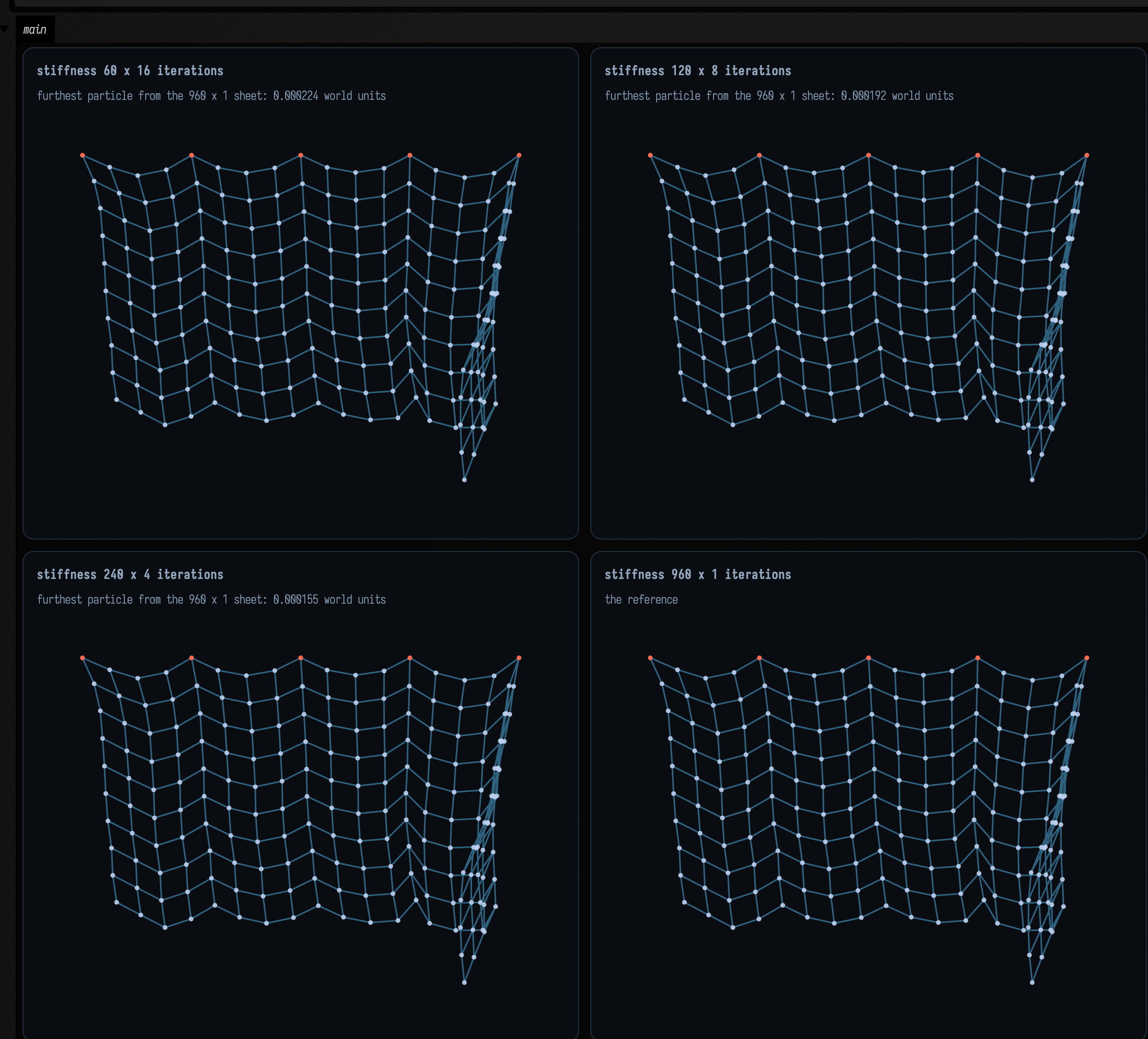
The four settings give one sheet. The captions show how far the furthest particle strays from the
reference: a tiny fraction of the grid spacing, after two hundred frames. Turning iterations up to
tighten the drape turns stiffness up by the same factor, and setting stiffness directly gets
there at a fraction of the cost.
Where floating point catches up
The equivalence is exact in real arithmetic and not quite exact in float: adding k·e sixteen
times is not the same rounding as adding 16k·e once. A hanging sheet amplifies small differences,
so that last-bit difference does not stay last-bit. Below is the same four runs with the gap measured
every frame, plotted as its base-10 logarithm.
:::static
import afield.simulation.physics.*

:::fold the same sheet and ruler as above
fun sheet(stiffness: Float) =
    SimdVerlet(SimdVerlet.State3.empty())
        .addCloth(
            width = 20,
            height = 10,
            spacing = 0.5f,
            stiffness = stiffness,
            curvatureStrength = 0f,
            pinned = { col, row -> row == 0 && col % 4 == 0 },
        )

fun apart(a: Cloth, b: Cloth): Double {
    var worst = 0.0
    for (k in 0 until a.count) {
        val i = a.base + k
        val j = b.base + k
        val dx = (a.sim.state.x[i] - b.sim.state.x[j]).toDouble()
        val dy = (a.sim.state.y[i] - b.sim.state.y[j]).toDouble()
        val dz = (a.sim.state.z[i] - b.sim.state.z[j]).toDouble()
        worst = maxOf(worst, kotlin.math.sqrt(dx * dx + dy * dy + dz * dz))
    }
    return worst
}
:::endfold
val splits = [60f to 16, 120f to 8, 240f to 4, 960f to 1]
val cloths = splits.map { (k, _) -> sheet(k) }
val traces = splits.dropLast(1).map { mutableListOf<Number>() }

repeat(400) {
    splits.forEachIndexed { n, (_, iterations) ->
        cloths[n].step(dt = 1f / 60f, damping = 0.99f, gravity = 2f, iterations = iterations)
    }
    // Floor the log at 1e-12 so a frame where two sheets are bit-identical stays on the axis
    // instead of going to negative infinity.
    for (n in traces.indices) {
        traces[n] += kotlin.math.log10(maxOf(apart(cloths[n], cloths.last()), 1e-12))
    }
}
:::fold plot the three gaps
showSignals(
    *splits
        .dropLast(1)
        .mapIndexed { n, (k, iterations) ->
            "${k.toInt()} x $iterations  vs  960 x 1" to traces[n].toList()
        }
        .toTypedArray(),
    channel = "main",
    title = "Same product, different rounding: gap to the 960 x 1 sheet",
    xTitle = "frame",
    yTitle = "log10(furthest particle, world units)",
)
:::endfold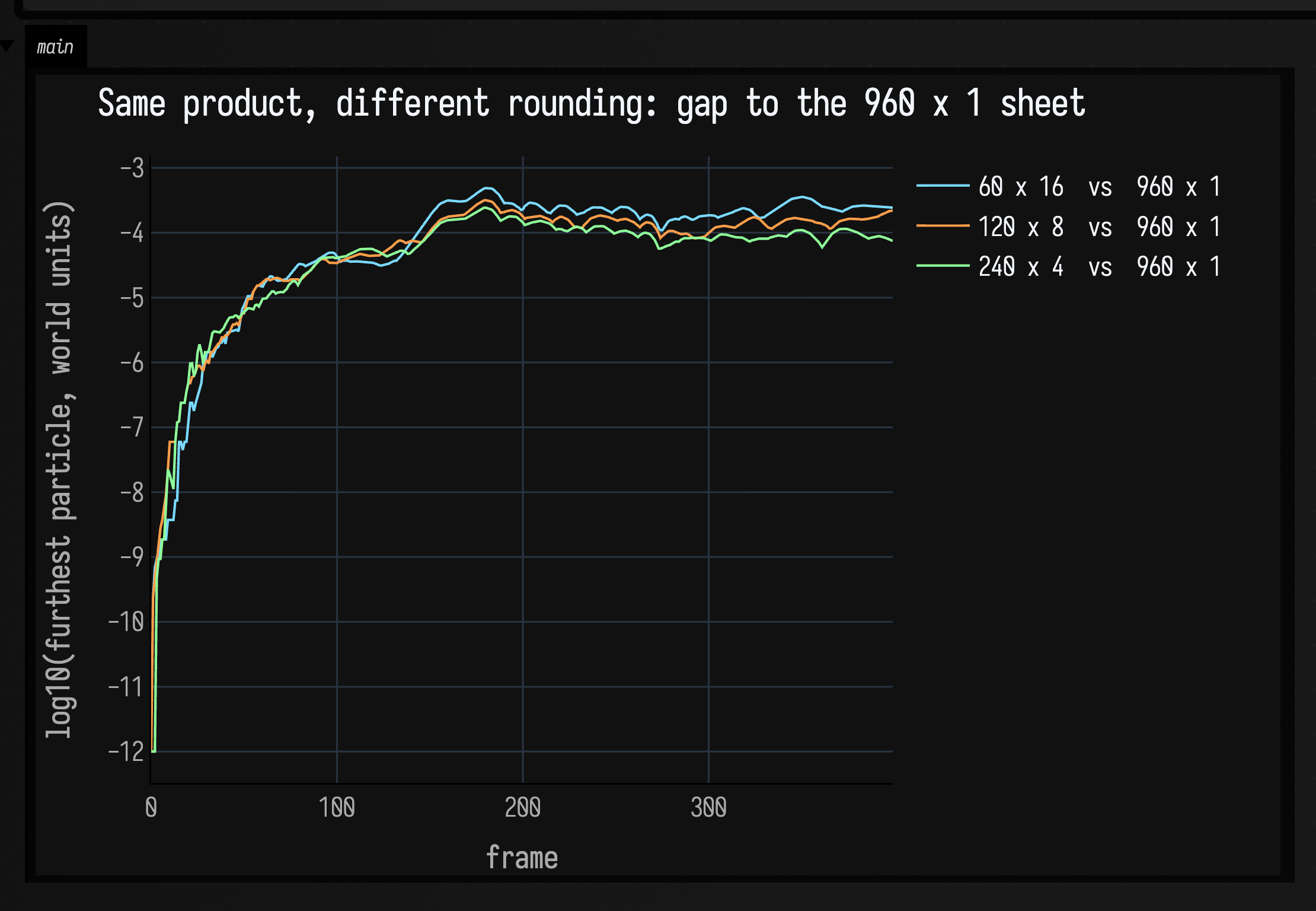
The gap climbs by many orders of magnitude in the first hundred frames, then levels off and stays flat. Damping and a sheet that has found its drape put a ceiling on the amplification, so the difference settles far below anything you could see.
Two algebraically identical settings therefore give the same-looking cloth, but not the same array of floats. If you need a run to reproduce bit-exactly (for a recording or a regression test), pin the split as well as the product.
Tune the product
Because there is only one number, there is only one ladder to climb. Same sheet, same 400 frames, and
the worst strain any single constraint reaches at any point in the run: |length − rest| / rest,
where 100 % means a spring stretched to twice its rest length.
:::static
import afield.simulation.physics.*

:::fold the sheet, and a strain meter that reads the solver's own rest lengths
fun sheet(stiffness: Float, curvature: Float = 0f) =
    SimdVerlet(SimdVerlet.State3.empty())
        .addCloth(
            width = 20,
            height = 10,
            spacing = 0.5f,
            stiffness = stiffness,
            curvatureStrength = curvature,
            pinned = { col, row -> row == 0 && col % 4 == 0 },
        )

// Worst |length - rest| / rest over every live slot of every particle. Read straight out of the
// constraint set, so it is the strain the SOLVER thinks it has, not one recomputed from the grid.
fun strain(cloth: Cloth): Double {
    val c = cloth.constraints
    val s = cloth.sim.state
    var worst = 0.0
    for (i in cloth.base until cloth.end) {
        val neighbours = intArrayOf(c.n0[i], c.n1[i], c.n2[i], c.n3[i])
        val rests = floatArrayOf(c.r0[i], c.r1[i], c.r2[i], c.r3[i])
        val stiffs = floatArrayOf(c.s0[i], c.s1[i], c.s2[i], c.s3[i])
        for (slot in 0 until 4) {
            val j = neighbours[slot]
            if (j < 0 || stiffs[slot] == 0f || rests[slot] <= 0f) continue
            val dx = (s.x[i] - s.x[j]).toDouble()
            val dy = (s.y[i] - s.y[j]).toDouble()
            val dz = (s.z[i] - s.z[j]).toDouble()
            val length = kotlin.math.sqrt(dx * dx + dy * dy + dz * dz)
            worst = maxOf(worst, kotlin.math.abs(length - rests[slot]) / rests[slot])
        }
    }
    return worst
}

// Frame every panel identically, on a window that just contains all of them — so the panels are
// comparable AND none of them is mostly empty. cellHeight then follows the window's aspect.
fun fit(cloths: List<Cloth>, pad: Double = 0.5): Rect {
    var x0 = Double.MAX_VALUE
    var y0 = Double.MAX_VALUE
    var x1 = -Double.MAX_VALUE
    var y1 = -Double.MAX_VALUE
    for (c in cloths) for (i in c.base until c.end) {
        x0 = minOf(x0, c.sim.state.x[i].toDouble())
        x1 = maxOf(x1, c.sim.state.x[i].toDouble())
        y0 = minOf(y0, c.sim.state.y[i].toDouble())
        y1 = maxOf(y1, c.sim.state.y[i].toDouble())
    }
    return Rect(x0 - pad, y0 - pad, (x1 - x0) + 2 * pad, (y1 - y0) + 2 * pad)
}
:::endfold
// Run one setting for 400 frames. If it blows up, stop at the first non-finite frame and rewind the
// positions to the last finite one, so the panel shows the last state that was still a cloth.
fun runLadder(stiffness: Float, iterations: Int, curvature: Float = 0f): Triple<Cloth, Double, Int> {
    val cloth = sheet(stiffness, curvature)
    val s = cloth.sim.state
    val lastX = s.x.copyOf()
    val lastY = s.y.copyOf()
    val lastZ = s.z.copyOf()
    var peak = 0.0
    var blewUpAt = -1
    for (frame in 1..400) {
        cloth.step(dt = 1f / 60f, damping = 0.99f, gravity = 2f, iterations = iterations)
        val now = strain(cloth)
        if (!now.isFinite()) {
            blewUpAt = frame
            break
        }
        peak = maxOf(peak, now)
        s.x.copyInto(lastX)
        s.y.copyInto(lastY)
        s.z.copyInto(lastZ)
    }
    if (blewUpAt > 0) {
        lastX.copyInto(s.x)
        lastY.copyInto(s.y)
        lastZ.copyInto(s.z)
    }
    return Triple(cloth, peak, blewUpAt)
}

// Each rung twice: springs alone, and again with the curvature force the starting place ships,
// because that is the difference between this ladder and the one in dev_docs.
val ladder =
    [0.8f to 8, 8f to 8, 20f to 16, 60f to 16].map { (k, i) ->
        Triple(k to i, runLadder(k, i), runLadder(k, i, curvature = 100f))
    }
:::fold draw the ladder on one shared window, so the rungs are comparable
fun verdict(result: Triple<Cloth, Double, Int>): String {
    val (_, peak, blewUpAt) = result
    return if (blewUpAt > 0) "NOT FINITE from frame $blewUpAt" else "${(peak * 100).f0} %"
}

val window = fit(ladder.map { it.second.first })
showPlaneGrid(
    *ladder
        .map { (setting, bare, curved) ->
            val (k, iterations) = setting
            "stiffness $k x $iterations  (product ${(k * iterations).f0})\n" +
                "peak strain ${verdict(bare)}  ·  with curvature 100: ${verdict(curved)}" to bare.first.sim.debugLines()
        }
        .toTypedArray(),
    columns = 4,
    cellWidth = 380,
    cellHeight = (380 * window.h / window.w).toInt(),
    window = window,
)
:::endfold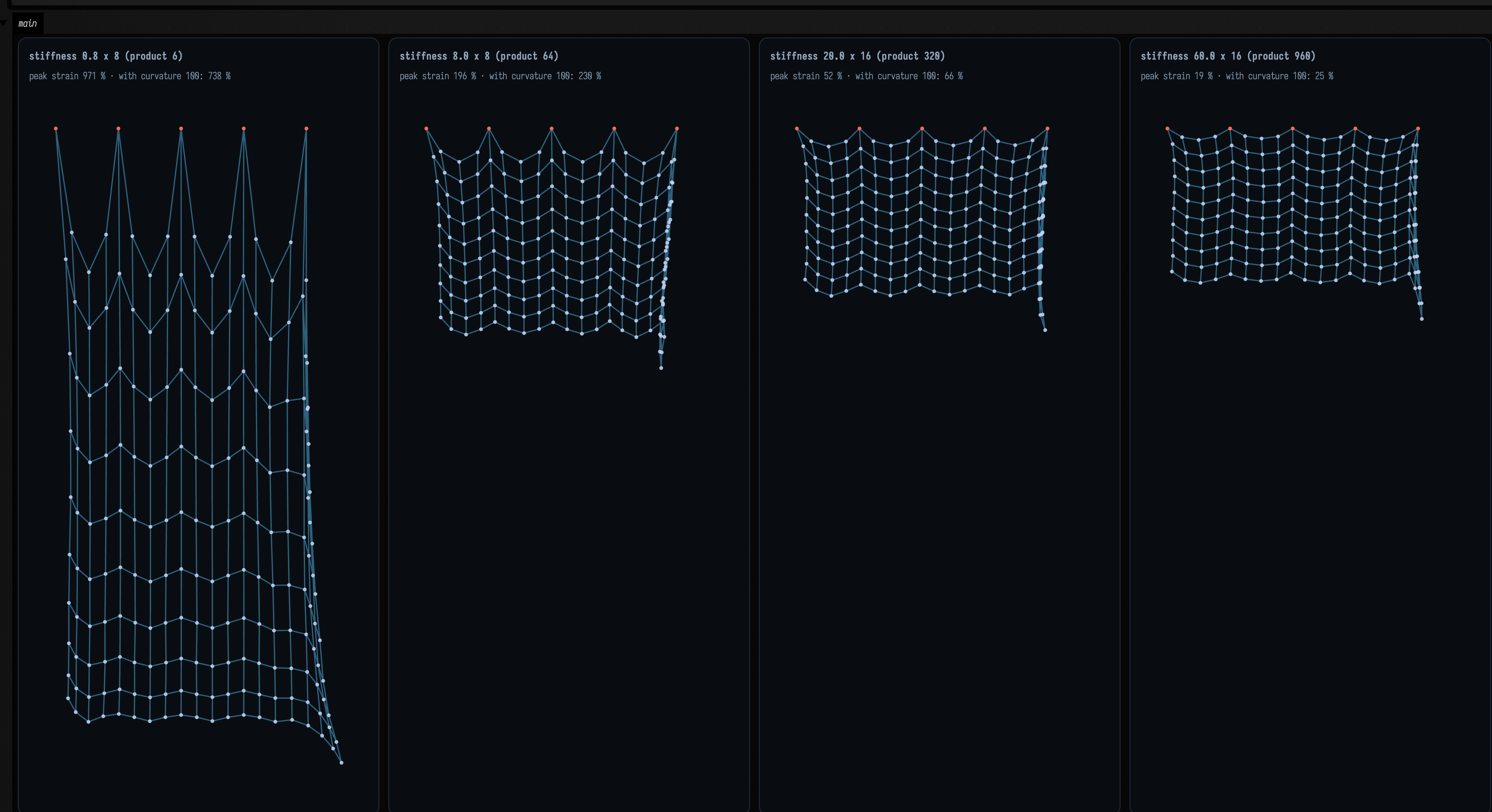
At the lowest product some springs stretch to many times their rest length, which is why that panel is a tall web rather than a cloth. Strain falls as the product rises, up to the 960 the starting point ships.
Strain falls more slowly than the product rises. The captions are peaks over the whole run, reached while the sheet is still falling, so they are not the sag at rest. Measure the strain in your own scene rather than interpolating these.
The second half of each caption adds the curvature force, and it does not give you strain headroom.
At 100 it tightens the floppiest rung a little and makes every other rung worse. The curvature pass
adds into the same ax/ay/az the springs do, so at these strengths it is one more load on the sheet
rather than a stiffener.
The repository records a different ladder
SIMDVERLET_4_CONSTRAINTS.md runs the same four rungs and reports different
numbers. Those are settled values read off a box that has stopped moving, on a scene with the
curvature force on; the captions here are peaks over the fall with curvature off. The ordering
is the same.
Divergence at the high end
At a high enough product the solve does what explicit integration does: the correction overshoots,
the overshoot is corrected harder, and the run stops being a number. Nothing is clamped. The first
step that leaves a coordinate non-finite prints a warning in the box's output naming the step size
and iteration count, and sim.diverged turns true.
The strain trace carries plenty of warning before the NaN arrives, for anyone who is watching it.
:::static
import afield.simulation.physics.*

:::fold the sheet and the strain meter, exactly as above
fun sheet(stiffness: Float) =
    SimdVerlet(SimdVerlet.State3.empty())
        .addCloth(
            width = 20,
            height = 10,
            spacing = 0.5f,
            stiffness = stiffness,
            curvatureStrength = 0f,
            pinned = { col, row -> row == 0 && col % 4 == 0 },
        )

fun strain(cloth: Cloth): Double {
    val c = cloth.constraints
    val s = cloth.sim.state
    var worst = 0.0
    for (i in cloth.base until cloth.end) {
        val neighbours = intArrayOf(c.n0[i], c.n1[i], c.n2[i], c.n3[i])
        val rests = floatArrayOf(c.r0[i], c.r1[i], c.r2[i], c.r3[i])
        val stiffs = floatArrayOf(c.s0[i], c.s1[i], c.s2[i], c.s3[i])
        for (slot in 0 until 4) {
            val j = neighbours[slot]
            if (j < 0 || stiffs[slot] == 0f || rests[slot] <= 0f) continue
            val dx = (s.x[i] - s.x[j]).toDouble()
            val dy = (s.y[i] - s.y[j]).toDouble()
            val dz = (s.z[i] - s.z[j]).toDouble()
            val length = kotlin.math.sqrt(dx * dx + dy * dy + dz * dz)
            worst = maxOf(worst, kotlin.math.abs(length - rests[slot]) / rests[slot])
        }
    }
    return worst
}
:::endfold
// The rung that settles, and the next one up, traced frame by frame. Once a trace stops being
// finite it stops: there is nothing after that to plot.
val watched = [60f to 16, 100f to 16, 150f to 16]
val traces = watched.map { (k, iterations) ->
    val cloth = sheet(k)
    val trace = mutableListOf<Number>()
    var diedAt = -1
    var warnedAt = -1
    for (frame in 1..400) {
        cloth.step(dt = 1f / 60f, damping = 0.99f, gravity = 2f, iterations = iterations)
        val now = strain(cloth)
        if (!now.isFinite()) {
            diedAt = frame
            break
        }
        // 100 % strain — a spring at twice its rest length — is the point of no return here.
        if (warnedAt < 0 && now > 1.0) warnedAt = frame
        trace += kotlin.math.log10(maxOf(now, 1e-4))
    }
    Triple("${k.toInt()} x $iterations", trace, if (diedAt > 0) warnedAt to diedAt else null)
}

// The headline goes in the title rather than in a series label, so the legend stays narrow and the
// plot keeps the width.
val blewUp = traces.first { it.third != null }
val (past100, nan) = blewUp.third!!
:::fold plot the three traces
showSignals(
    *traces.map { (label, trace, _) -> label to trace.toList() }.toTypedArray(),
    channel = "main",
    title = "Peak strain per frame — ${blewUp.first}: 100 % at $past100, NaN at $nan",
    xTitle = "frame",
    yTitle = "log10(peak strain)",
)
:::endfold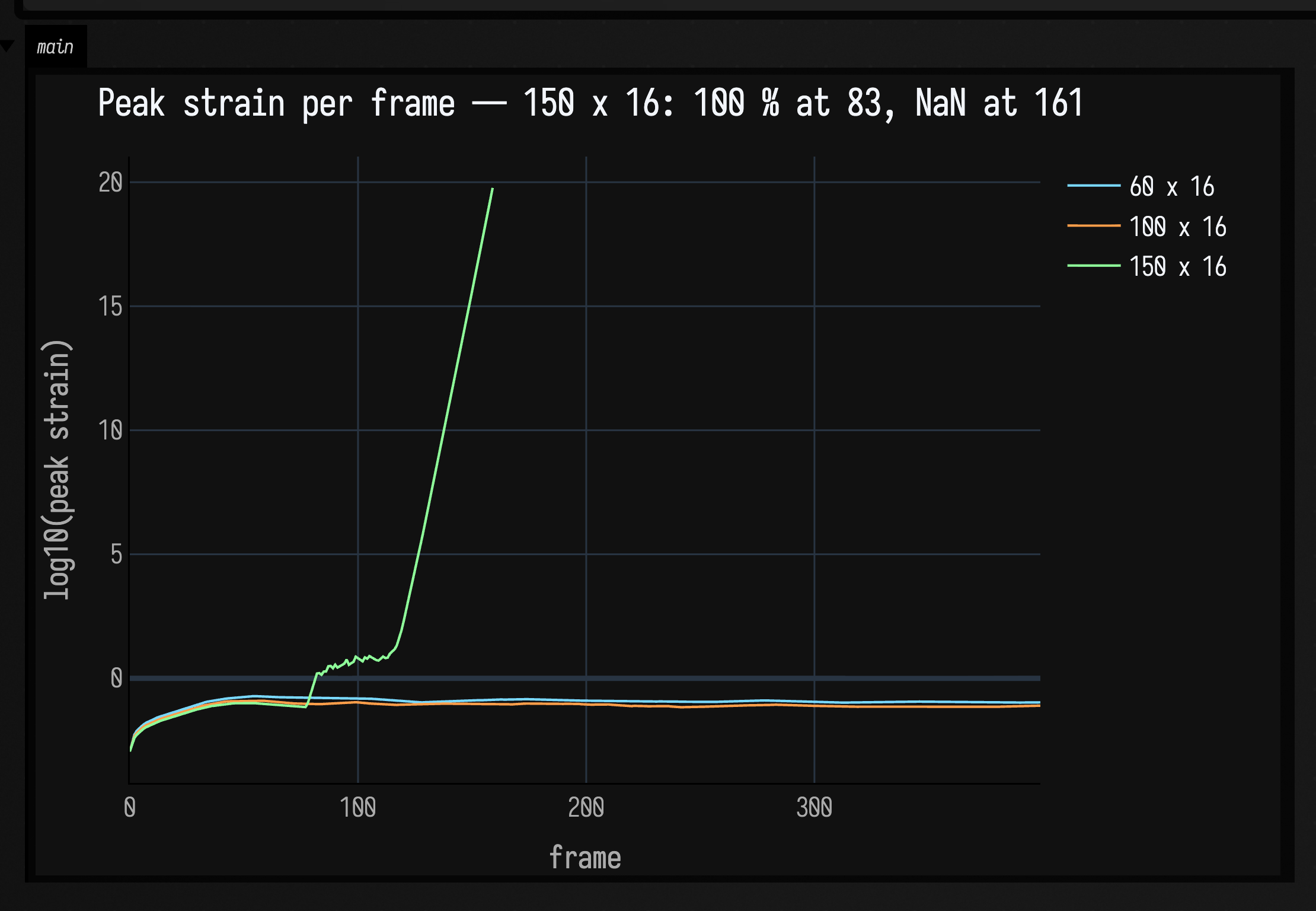
Two of the three settle and stay flat for the whole run. The third leaves them, and the title gives
the frame where it passes 100 % strain and the frame where its coordinates become NaN: about a
second at 60 fps between visibly wrong and gone. Once it is past 100 % it never comes back.
The middle trace, 100 × 16, settles, so the ceiling at this dt lies between its product and the
top one's. Do not carry that number to another scene: a smaller or lighter sheet takes more.
Watch the peak strain rather than the picture. The measurement is the short strain function folded
into the block above. It is cheap, and it goes wrong long before the drawing does.
Stability goes as stiffness × iterations × dt²
All the numbers on this page are at dt = 1/60. Run the same settings at dt = 1/30 and you
have multiplied the term that decides stability by four. This is the main reason the frames
page argues for handing the solver a
fixed dt rather than the wall-clock time since the last frame: a dt that jitters with the
frame rate is a stiffness that jitters with the frame rate.
Curvature
Distance constraints alone give you a net, not a fabric. Nothing in them resists bending: a sheet
can fold to a crease and every spring is still at rest length. Cloth adds an optional curvature
force: each interior particle is pulled toward the mean of its four axis neighbours, which flattens
the sheet and takes the kink out of the festoons.
It is registered as one bulk pass over the whole patch, in SimdVerlet.bulkForces, rather than as
a force generator per particle: the per-particle path would charge width × height coroutine
resumes every frame for what is a single scalar sweep. cloth.curvatureStrength = 0f switches it off
live without unregistering anything.
curvatureStrength accumulates into the same ax/ay/az the constraint solve does, so its scale is
the springs', and it defaults to a third of stiffness: 20 for the sheet below.
:::static
import afield.simulation.physics.*

:::fold the sheet, now with a curvature strength, and the same ruler
fun sheet(curvature: Float) =
    SimdVerlet(SimdVerlet.State3.empty())
        .addCloth(
            width = 20,
            height = 10,
            spacing = 0.5f,
            stiffness = 60f,
            curvatureStrength = curvature,
            pinned = { col, row -> row == 0 && col % 4 == 0 },
        )

fun apart(a: Cloth, b: Cloth): Double {
    var worst = 0.0
    for (k in 0 until a.count) {
        val i = a.base + k
        val j = b.base + k
        val dx = (a.sim.state.x[i] - b.sim.state.x[j]).toDouble()
        val dy = (a.sim.state.y[i] - b.sim.state.y[j]).toDouble()
        val dz = (a.sim.state.z[i] - b.sim.state.z[j]).toDouble()
        worst = maxOf(worst, kotlin.math.sqrt(dx * dx + dy * dy + dz * dz))
    }
    return worst
}

// Frame every panel identically, on a window that just contains all of them — so the panels are
// comparable AND none of them is mostly empty. cellHeight then follows the window's aspect.
fun fit(cloths: List<Cloth>, pad: Double = 0.5): Rect {
    var x0 = Double.MAX_VALUE
    var y0 = Double.MAX_VALUE
    var x1 = -Double.MAX_VALUE
    var y1 = -Double.MAX_VALUE
    for (c in cloths) for (i in c.base until c.end) {
        x0 = minOf(x0, c.sim.state.x[i].toDouble())
        x1 = maxOf(x1, c.sim.state.x[i].toDouble())
        y0 = minOf(y0, c.sim.state.y[i].toDouble())
        y1 = maxOf(y1, c.sim.state.y[i].toDouble())
    }
    return Rect(x0 - pad, y0 - pad, (x1 - x0) + 2 * pad, (y1 - y0) + 2 * pad)
}
:::endfold
// Off, a weak 0.05, the default at this stiffness (60 / 3 = 20), and 100. Everything else is identical.
val strengths = [0f, 0.05f, 20f, 100f]
val cloths = strengths.map { sheet(it) }

repeat(300) { cloths.forEach { it.step(dt = 1f / 60f, damping = 0.99f, gravity = 2f, iterations = 16) } }

// Measured against the sheet with no curvature force at all.
val gaps = cloths.map { apart(it, cloths.first()) }
:::fold draw the four
val window = fit(cloths)
showPlaneGrid(
    *strengths
        .mapIndexed { n, strength ->
            val label = if (strength == 0f) "curvature off" else "curvatureStrength = $strength"
            "$label\nfurthest particle from the sheet with none: ${"%.3g".format(gaps[n])} world units" to
                cloths[n].sim.debugLines()
        }
        .toTypedArray(),
    columns = 2,
    cellWidth = 470,
    cellHeight = (470 * window.h / window.w).toInt(),
    window = window,
)
:::endfold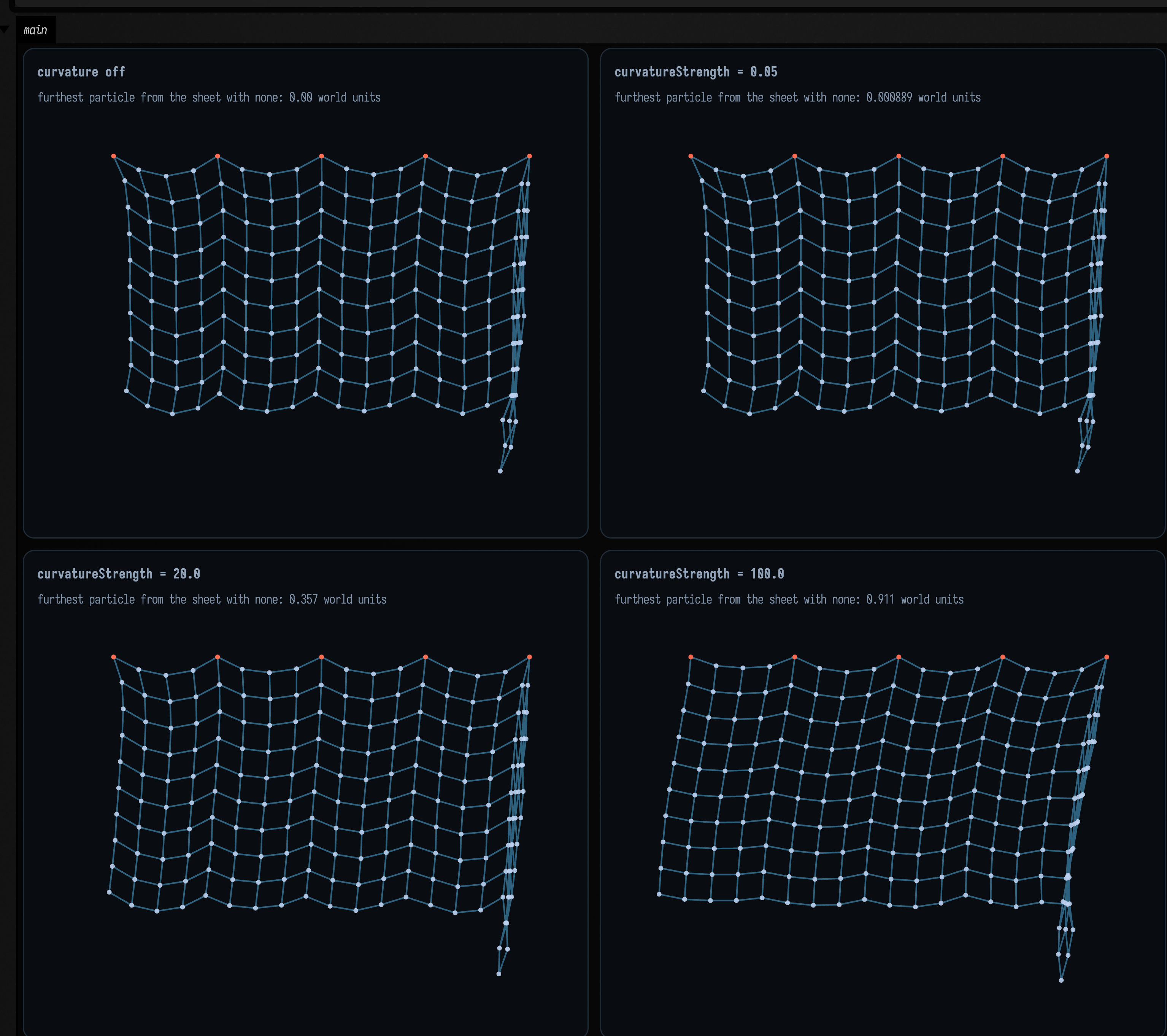
At stiffness × iterations = 960, 0.05 barely moves the sheet: the caption's distance is a tiny
fraction of one grid spacing. The default of 20 and 100 move it visibly, giving a flatter sheet
with shallower festoons.
Cloth
sim.addCloth(width, height, ...) appends a grid patch to a simulation that may already contain
other particles, wires the four slots, pins what pinned selects, registers the curvature pass, and
hands back a handle that speaks grid coordinates: cloth[col, row] is a particle index, position,
pin, teleport, grabNearest and lines() all address the grid rather than the flat arrays.
Three rules follow from that shape.
One constraint set per simulation, not per cloth. The solver walks 0 until state.size and
indexes the slot arrays by particle index, so a set cannot cover only part of a simulation. A cloth
adopts sim.constraints4 if there already is one and otherwise publishes the one it creates. Two
cloths in one simulation therefore share a single set, and sim.step(dt, damping, gravity,
iterations) solves it.
cloth.step(...) steps the whole simulation. It is a convenience for the common case where the
cloth is the simulation. With other systems in the same SimdVerlet, drive it yourself.
A cloth is a contiguous index range. Its particles are [base, base + count), and both the
slots and the curvature sweep are written in those terms. Appending particles after a cloth is fine;
queueRemove refuses a particle inside or below one, since removing it would renumber the cloth.
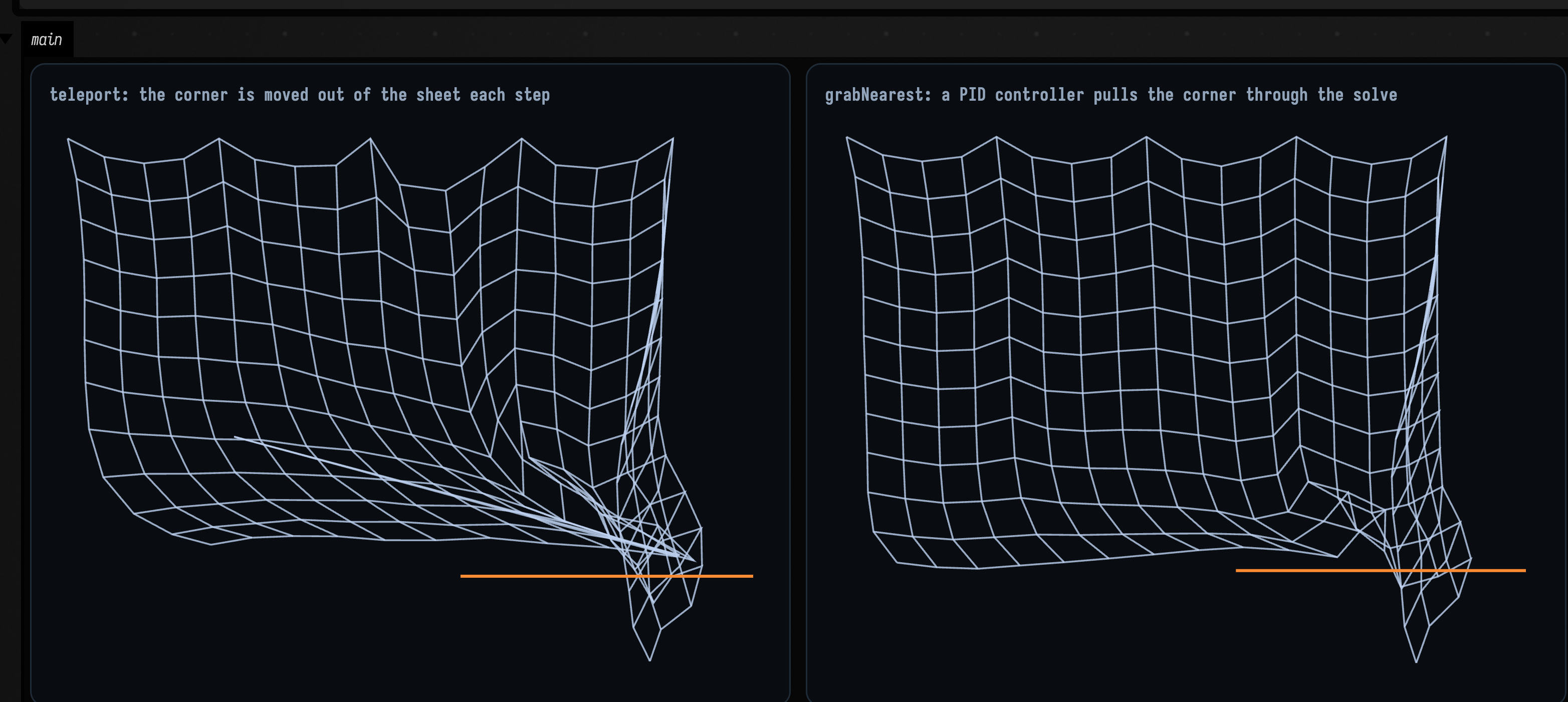
Dragging goes through grabNearest, which installs a PID position controller on the nearest
particle rather than teleporting it. The difference matters: a teleport moves one particle out of the
sheet and lets the solve fight it back, while a controller pulls through the constraint solve, so
the sheet follows the hand instead of snapping at it.
Here two copies of the same hanging sheet have their bottom-centre corner carried four units to the
right over thirty steps (the orange line is the hand's path). One is teleported each step and one is
held by grabNearest:
import afield.simulation.physics.*

fun sheet() =
    SimdVerlet(SimdVerlet.State3.empty())
        .addCloth(
            width = 20,
            height = 12,
            spacing = 0.5f,
            stiffness = 60f,
            pinned = { col, row -> row == 0 && col % 4 == 0 },
        )

val snapped = sheet()
val followed = sheet()
repeat(120) {
    snapped.step(dt = 1f / 60f, damping = 0.99f, gravity = 2f, iterations = 16)
    followed.step(dt = 1f / 60f, damping = 0.99f, gravity = 2f, iterations = 16)
}

// The bottom-centre corner of each sheet, and a hand that carries it 4 units right over 30 steps.
val start = followed.position(10, 11)
followed.grabNearest(start.x(), start.y(), start.z())
val hand = FLine()
repeat(30) { k ->
    val target = vec(start.x() + 4.0 * (k + 1) / 30, start.y().toDouble(), start.z().toDouble())
    hand.lineTo(target.x, target.y)
    snapped.teleport(10, 11, target)
    followed.moveGrabbed(target.x.toFloat(), target.y.toFloat(), target.z.toFloat())
    snapped.step(dt = 1f / 60f, damping = 0.99f, gravity = 2f, iterations = 16)
    followed.step(dt = 1f / 60f, damping = 0.99f, gravity = 2f, iterations = 16)
}

fun drawn(c: Cloth) = c.lines().onEach {
    it.color = vec(0.74, 0.82, 0.94, 0.8)
    it.thickness = 1.2
} +
        hand.also {
            it.color = vec(1.0, 0.55, 0.2, 1.0)
            it.thickness = 2.0
        }
showPlaneGrid(
    "teleport: the corner is moved out of the sheet each step" to drawn(snapped),
    "grabNearest: a PID controller pulls the corner through the solve" to drawn(followed),
    columns = 2,
    cellWidth = 480,
)
The debug view draws what the solver holds
SimdVerlet.debugLines() returns FLines: one segment per live distance constraint, a dot per
particle, pinned particles in their own colour, and optional velocity whiskers. It draws the
constraint set, where cloth.lines() draws the grid you asked for.
Those are different pictures exactly when something is wrong. Below, one interior particle has had one of its four slots re-pointed at a particle most of a sheet away, with the rest length measured from the layout so that the constraint starts satisfied and never announces itself as a snap or a crease.
:::static
import afield.simulation.physics.*

:::fold the sheet, and the ruler
fun sheet() =
    SimdVerlet(SimdVerlet.State3.empty())
        .addCloth(
            width = 20,
            height = 10,
            spacing = 0.5f,
            stiffness = 60f,
            curvatureStrength = 0f,
            pinned = { col, row -> row == 0 && col % 4 == 0 },
        )

fun apart(a: Cloth, b: Cloth): Double {
    var worst = 0.0
    for (k in 0 until a.count) {
        val i = a.base + k
        val j = b.base + k
        val dx = (a.sim.state.x[i] - b.sim.state.x[j]).toDouble()
        val dy = (a.sim.state.y[i] - b.sim.state.y[j]).toDouble()
        val dz = (a.sim.state.z[i] - b.sim.state.z[j]).toDouble()
        worst = maxOf(worst, kotlin.math.sqrt(dx * dx + dy * dy + dz * dz))
    }
    return worst
}

// Frame every panel identically, on a window that just contains all of them — so the panels are
// comparable AND none of them is mostly empty. cellHeight then follows the window's aspect.
fun fit(cloths: List<Cloth>, pad: Double = 0.5): Rect {
    var x0 = Double.MAX_VALUE
    var y0 = Double.MAX_VALUE
    var x1 = -Double.MAX_VALUE
    var y1 = -Double.MAX_VALUE
    for (c in cloths) for (i in c.base until c.end) {
        x0 = minOf(x0, c.sim.state.x[i].toDouble())
        x1 = maxOf(x1, c.sim.state.x[i].toDouble())
        y0 = minOf(y0, c.sim.state.y[i].toDouble())
        y1 = maxOf(y1, c.sim.state.y[i].toDouble())
    }
    return Rect(x0 - pad, y0 - pad, (x1 - x0) + 2 * pad, (y1 - y0) + 2 * pad)
}
:::endfold
val good = sheet()
val bad = sheet()

/*
The bug. Particle (4, 7) keeps four slots, but slot 0 — its downward neighbour — now points at
(16, 2), most of a sheet away. The rest length is measured from the layout, so the constraint starts satisfied
and contributes almost no force: this is the kind of wiring mistake that does not announce itself.
*/
val from = bad[4, 7]
val to = bad[16, 2]
val s = bad.sim.state
val rest =
    kotlin.math
        .sqrt(
            ((s.x[from] - s.x[to]).toDouble()).let { it * it } +
                ((s.y[from] - s.y[to]).toDouble()).let { it * it } +
                ((s.z[from] - s.z[to]).toDouble()).let { it * it },
        )
        .toFloat()
bad.constraints.setSlot(from, 0, to, rest, 60f)

repeat(200) {
    good.step(dt = 1f / 60f, damping = 0.99f, gravity = 2f, iterations = 16)
    bad.step(dt = 1f / 60f, damping = 0.99f, gravity = 2f, iterations = 16)
}

val divergence = apart(good, bad)
:::fold four panels: the wireframe of each, then the solver's own view of each
val window = fit([good, bad])
val pale = vec(0.74, 0.82, 0.94, 0.8)
fun wire(c: Cloth) = c.lines().onEach {
    it.color = pale
    it.thickness = 1.2
}

showPlaneGrid(
    "cloth.lines() — correctly wired\nthe grid, drawn row by row and column by column" to wire(good),
    "cloth.lines() — one slot mis-wired\nfurthest particle from the correct sheet: ${"%.3g".format(divergence)} world units" to
        wire(bad),
    "sim.debugLines() — correctly wired\none segment per live constraint, pins in red" to good.sim.debugLines(),
    "sim.debugLines() — one slot mis-wired\nthe same sheet; the bug is the long diagonal" to bad.sim.debugLines(),
    columns = 2,
    cellWidth = 470,
    cellHeight = (470 * window.h / window.w).toInt(),
    window = window,
)
:::endfold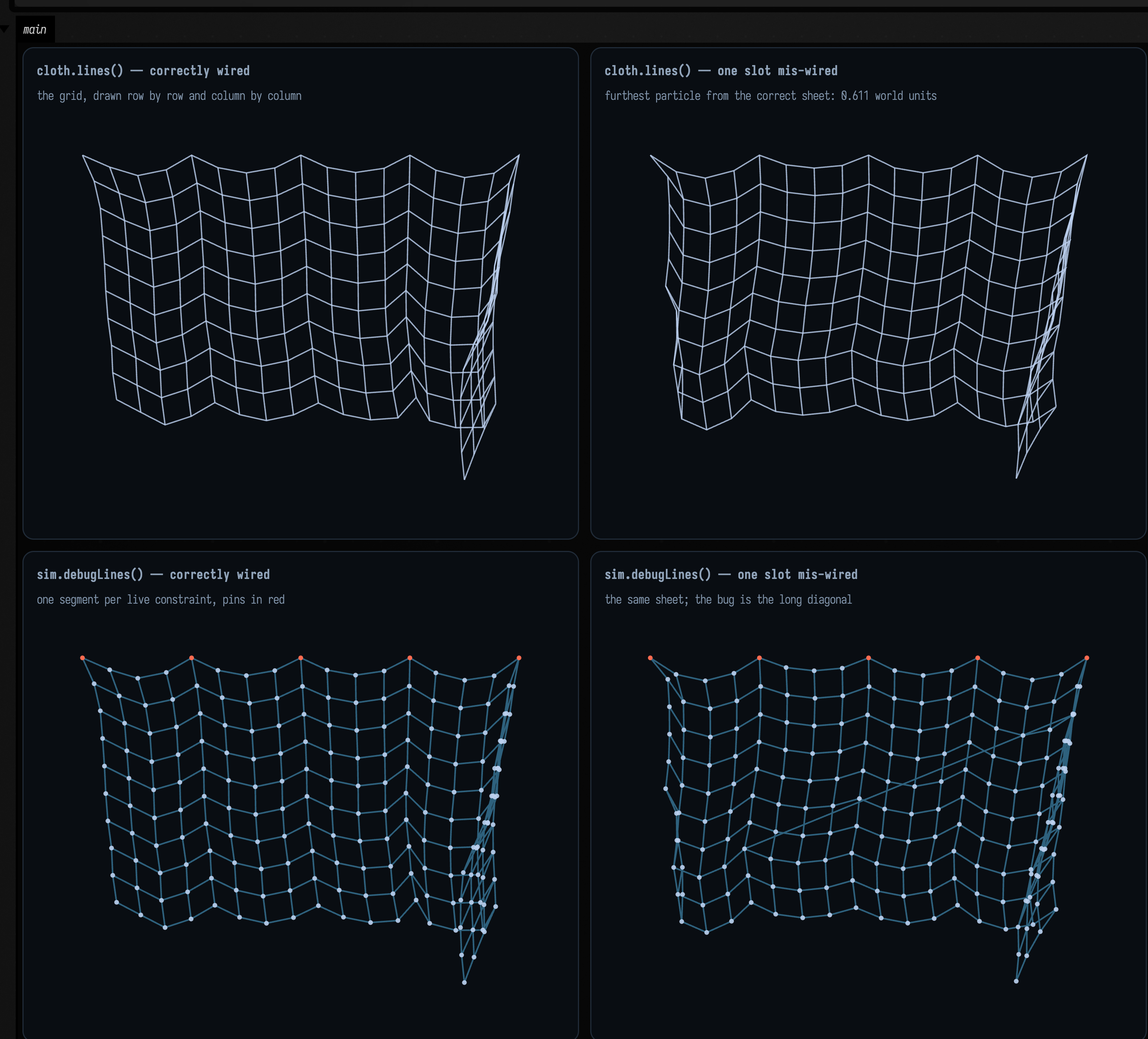
The top row is the picture you would naturally draw. The caption shows the two sheets more than a
grid spacing apart at their furthest particle, yet the bug is invisible in that drawing, because
cloth.lines() walks rows and columns by index, so the grid it draws is still the grid you asked
for. The bottom row is the same two sheets with the constraint set drawn instead, and the bug is the
long diagonal running up across the right-hand panel.
The dedup rule keeps that bug visible. A symmetric pair (i → j and j → i, as a Cloth
grid wires it) is drawn once; a one-way constraint is drawn by its owner. Deduplicating on
j < i alone would hide the asymmetry the view exists to show.
Two more things about the drawing:
- It follows the set the simulation actually solves —
constraints4if there is one, otherwise the 3-slotconstraints. An unused slot (neighbour-1, or zero stiffness) draws nothing, so a constraint that was never wired shows up as a gap. thicknessandpointSizeare in the units the output uses. Pixels of the mapped frame forshowPlane/showPlaneGrid; world units forBox.linesand the Field 4 renderers, where they want to be very much smaller. The dot radius convention ispointSize * 3.
Pass particles = cloth.base until cloth.end to draw one cloth out of a busier simulation, and
velocityScale to get a whisker per particle of one frame's travel, which is the fastest way to see
that a sheet has begun to vibrate before it becomes visible as motion.
Also in the box
afield.simulation.physics holds more than the particle solver, and the rest is not covered here:
- The world layer —
Collider/ColliderSet(sphere, plane, box, capsule and a general signed distance function),Tearing,Wind, andStrand, a rope that can be knotted to a cloth. These are what let a sheet drape, come apart and fly. A collider is a post-solve position projection rather than a force, and that choice falls straight out of the equivalence above: a penalty force runs once against springs that are acting atstiffness × iterations, so it either fails to hold or explodes. OctreeBarnesHut— an octree with Barnes–Hut summarisation, for the n-body case where every particle pulls on every other one.PointDriver, inPointController.kt— a standalone position controller, position in and force out, which identifies the host integrator as it runs. It is not whatgrabNearestuses; that is the much plainer PID inSimdVerlet.addPidPositionController.JoltPhysicsWorldandDyn4jScene— bridges to a full rigid-body engine, in 3D and 2D respectively. Different tool, different problem:SimdVerlethas no notion of a rigid body. Its colliders project particles out of shapes rather than resolving two-body contacts, so you can move a collider between frames but nothing the cloth touches is pushed back by it.SimdVerletDyn4jBridge— the two of them talking.
Where to look next
- Simulation, in the codebase reference — every public declaration in this package, with the KDoc that sits beside it, on one browsable page. It is also where the two neighbours this page does not cover live: Kratos, which solves structural and other physical problems with a different set of numerical methods, and tetrahedral meshing, which is what stands between a solid and a solver that wants elements.
- Frames and the Animation Loop — the same
cloth as a moving picture, and the argument for a fixed
dt. It also has the generator layer thataddPidPositionControlleris written in. - Agent Transcript Gallery —
cloth_simdverlet_start, the openable starting point. - FLine Examples —
debugLines()andcloth.lines()both returnFLines, so everything you can do to a line applies to them. - Visualizers & Controls and Field's 3D Output — where
to send those lines other than
showPlane.
Design notes
SIMDVERLET_4_CONSTRAINTS.md has the four-slot design
rationale and the list of runnable entry points;
SIMDVERLET_5_WORLD.md has the argument and measurements behind
colliders as projections.