Polytopes: topology first, coordinates later
afield.geometry.polytope builds polyhedra with Conway operators (conway("kbD"), cube().kis())
and keeps track of which element of the input each output element came from. A polyhedron here is
a ranked incidence topology first: vertices, edges and faces with identities, which of them touch,
and an ordered boundary for every face. Coordinates are a separate layer on top, which you can
drop, replace or solve for. Triangles for drawing are derived last, and each one knows which face
it belongs to.
Every declaration used below is listed, with its KDoc, in the codebase reference
Polytopes. The solver behind relax has its own page,
Solvers.
The example below applies three operators to a dodecahedron and colours each output face by the dodecahedron face it descends from. The colours come from the faces' history, not from their positions:
:::static
// One expression: kis of bevel of the dodecahedron. Three chained operators, 360 output faces.
val chain = conway("kbD")
val run = chain.polyhedron.canonicalize()
val solid = if (run.converged) run.polyhedron else chain.polyhedron

/*
Now colour every one of those faces by the element of the ORIGINAL DODECAHEDRON it descends
from. Not by position, not by normal, not by size — `sourceElements` walks each output face's
lineage back through kis, through truncate, through ambo, to a single seed element. The
symmetry you can see is therefore a picture of the incidence structure, not of the geometry.
*/
:::fold colour each face by the seed pentagon its lineage flattens to, and draw
fun hsv(hue: Double, s: Double, v: Double): Triple<Double, Double, Double> {
    val h = ((hue % 1.0) + 1.0) % 1.0
    val i = Math.floor(h * 6).toInt()
    val f = h * 6 - i
    val p = v * (1 - s)
    val q = v * (1 - f * s)
    val t = v * (1 - (1 - f) * s)
    return when (i % 6) {
        0 -> Triple(v, t, p)
        1 -> Triple(q, v, p)
        2 -> Triple(p, v, t)
        3 -> Triple(p, q, v)
        4 -> Triple(t, p, v)
        else -> Triple(v, p, q)
    }
}

/*
Which of the dodecahedron's twelve pentagons does an output face descend from? Element ids are
allocated rank by rank, so "the lowest source id" would silently pick a vertex every time — ask
for the rank-2 sources specifically. A face over the interior of one pentagon has exactly one; a
face straddling an original edge or corner has two or three, whose colors are blended.
*/
val faces = solid.topology.elements(2)
fun seedFacesOf(id: ElementId) = chain.sourceElements(id).filter { it.rank == 2 }.map { it.id.value }.sorted()

val pentagons = faces.flatMap { seedFacesOf(it.id) }.distinct().sorted()
val share = faces.groupingBy { seedFacesOf(it.id).size }.eachCount().toSortedMap()

/*
A face over one pentagon takes that pentagon's hue. A face straddling two or three of them takes
the blend — so the seams of the original dodecahedron colour themselves in between, and the
twelve-fold pattern reads without a single line being drawn. Saturation and brightness carry a
second signal: how many seed vertices and edges the face also touches.
*/
fun hueOf(pentagon: Int) = pentagons.indexOf(pentagon).toDouble() / pentagons.size
val faceLines = solid.toFaceFLines { face, line ->
    val owners = seedFacesOf(face.id)
    val sources = chain.sourceElements(face.id)
    val corners = sources.count { it.rank == 0 }
    val edges = sources.count { it.rank == 1 }
    val sat = (1.00 - 0.16 * corners).coerceIn(0.38, 1.0)
    val value = (0.78 + 0.16 * edges + 0.12 * owners.size).coerceIn(0.74, 1.0)
    val mixed =
        if (owners.isEmpty()) Triple(0.70, 0.74, 0.80)
        else
            owners
                .map { hsv(hueOf(it), sat, value) }
                .reduce { a, b -> Triple(a.first + b.first, a.second + b.second, a.third + b.third) }
                .let { Triple(it.first / owners.size, it.second / owners.size, it.third / owners.size) }
    line.filled = true
    line.stroked = false
    line.color = vec(mixed.first, mixed.second, mixed.third, if (owners.size == 1) 0.32 else 0.21)
    line.hoverColor = vec(0.98, 0.99, 1.00, 0.95)
}

threeLines(
    faceLines,
    channel = "hero",
    name = "kbD, canonical, coloured by seed provenance",
    height = 560,
    autoFrame = true,
    editable = false,
)
displayOpen("hero")

val topology = solid.topology
markdown(
    "what you are looking at",
    [
            "`kbD` = kis · bevel · dodecahedron, canonicalized",
            "${topology.elements(0).size} vertices · ${topology.elements(1).size} edges · " +
                "${topology.elements(2).size} faces · chi = ${topology.eulerCharacteristic()}",
            "seed pentagons found in the lineage: ${pentagons.size}",
            "output faces by how many of those pentagons they straddle: $share",
            "canonical: converged = ${run.converged}, reason = ${run.reason}, " +
                "tangency radius spread ${"%.3e".format(run.initialDiagnostics.tangencyRadiusSpread)} " +
                "→ ${"%.3e".format(run.finalDiagnostics.tangencyRadiusSpread)}",
        ]
        .joinToString("<br/>"),
)
:::endfold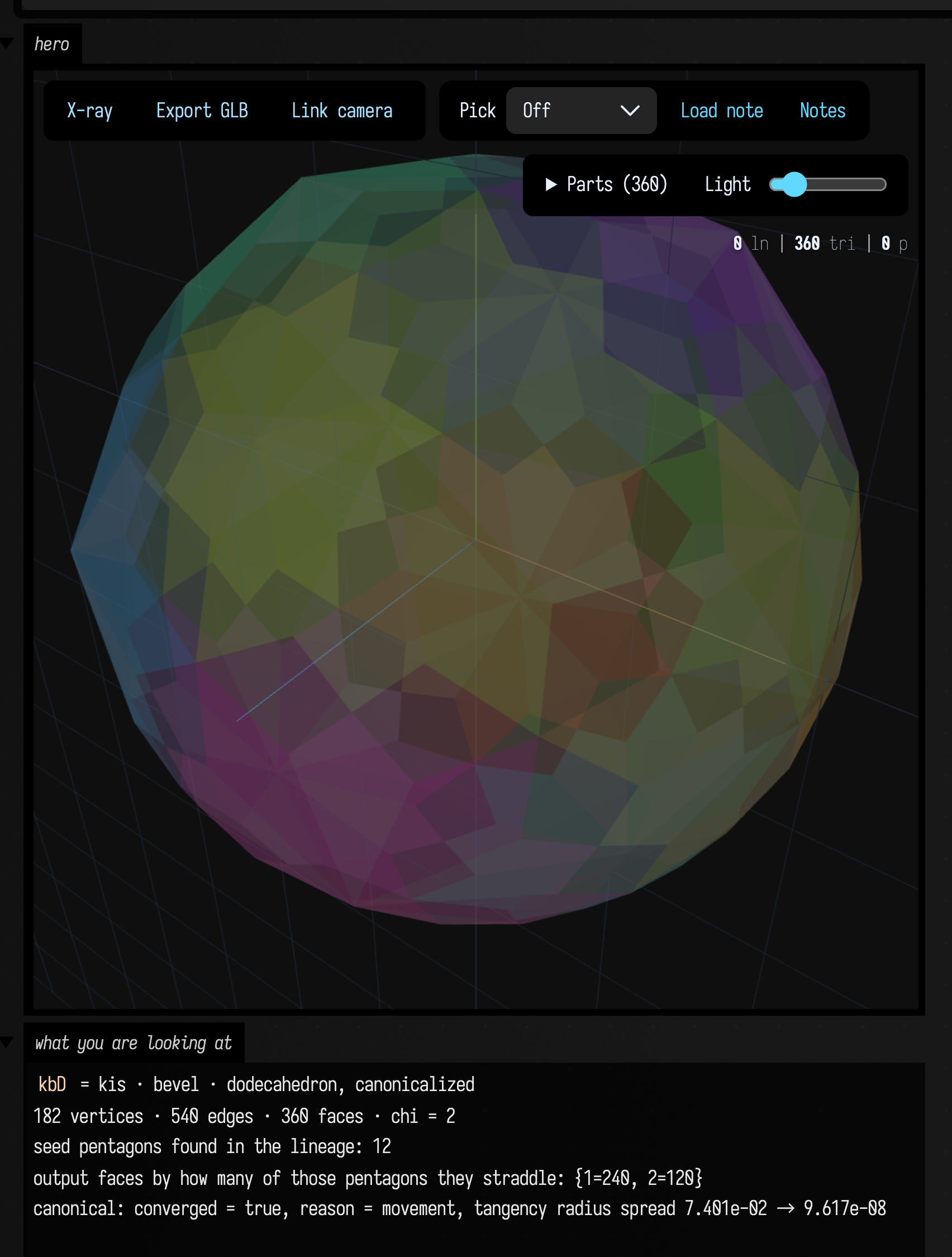
That is three chained Conway operators on a dodecahedron (kis · bevel · D, 360 output faces),
canonicalized, and drawn as translucent polygons. Each output face asks sourceElements which of
the dodecahedron's pentagons it descends from, back through kis, truncate and ambo, and takes
that pentagon's hue. Faces that straddle two pentagons take the blend, so the dodecahedron's
original edges show up in the in-between colours.
No position, normal or face size was used to choose a colour. The pattern comes from the incidence structure alone, which each operator carries through even though it computes new coordinates. The rest of this page shows how. The hero example is long; the sections below start small.
Where the pieces live
| what you want | where it is |
|---|---|
| ranked elements, incidence, face cycles, validation, abstract dual | Topology.kt — PolytopeTopology, PolytopeTopologyBuilder, Element, ElementId |
the five Platonic seeds, Realization3, PolyhedralObject |
Solids.kt |
| operators, realization policies, lineage, deployment records | Transforms.kt — ConwayOperator, RealizationPolicy3, PolytopeTransformResult |
prefix notation daC, k4aC |
Conway.kt — parseConwayExpression, conway |
| selectors and per-element scalar fields | Parameters.kt — ElementSelectors, ElementParameters |
| constraint relaxation and its diagnostics | RealizationSolver.kt — relax, solveRealization, geometryDiagnostics |
| the named constraint families a plan is made of | Constraints.kt — RealizationConstraint, RelaxationPlan |
| coordinates from combinatorics, and the gauge | Realize.kt — realize, SpectralRealization, RigidGauge |
| the canonical form and its diagnostics | Canonical.kt — canonicalize, CanonicalDiagnostics |
| combinatorial orbits and the symmetry readout | Symmetry.kt — combinatorialOrbits, symmetryDeviation |
| rank-4 seeds, derived face lattices, projections | Polytope4.kt — tesseract, twentyFourCell, Projection4 |
one FLine per face, provenance-preserving triangles |
FieldAdapters.kt — toFaceFLines, triangulate, toEdgeFLines |
| compact inspection values for a live prompt | Summaries.kt, PolytopeVisualizers.kt |
The full architecture note, including the roadmap this page does not cover, is
dev_docs/POLYTOPE_ALGEBRA.md.
Ranked elements and incidence
PolytopeTopology stores elements by rank (0 for vertices, 1 for edges, 2 for faces), the
incidences between adjacent ranks, and an ordered vertex cycle for each face, since knowing which
edges a face touches does not say which way round to walk it. For an ordinary polyhedron, rank 3 is
the single element standing for the whole solid. This example reads all of that back from a cube:
:::static
val t = cube().topology

val face = t.elements(2).first()
val cycle = t.faceCycle(face.id)
val edgesOfFace = t.incidentDown(face.id)
val anEdge = ElementId(edgesOfFace.first())

:::fold format the read-out as a table
val ranks =
    (0..t.rank).joinToString("\n") { r ->
        "| $r | ${["vertices", "edges", "faces", "the whole polyhedron"].getOrElse(r) { "?" }} | ${t.elements(r).size} |"
    }
markdown(
    "topology",
    """
#### `cube().topology` — everything that is actually stored

| rank | what it is | count |
|---|---|---|
$ranks

- **face ${face.id.value}**'s ordered boundary cycle: `${cycle.joinToString(" → ")}` (${cycle.size} vertices)
- that face is incident *down* to edges `${edgesOfFace.joinToString(", ")}`
- **edge ${anEdge.value}** is incident *down* to vertices `${t.incidentDown(anEdge).joinToString(", ")}`
  and *up* to faces `${t.incidentUp(anEdge).joinToString(", ")}`
- Euler characteristic over the proper ranks: **${t.eulerCharacteristic()}**
- `validate()` clean: **${t.validate().isValid}** ·
  `validate(checkManifold = true)` clean: **${t.validate(checkManifold = true).isValid}**

Not one coordinate was consulted above.
""",
    width = 720,
)
:::endfold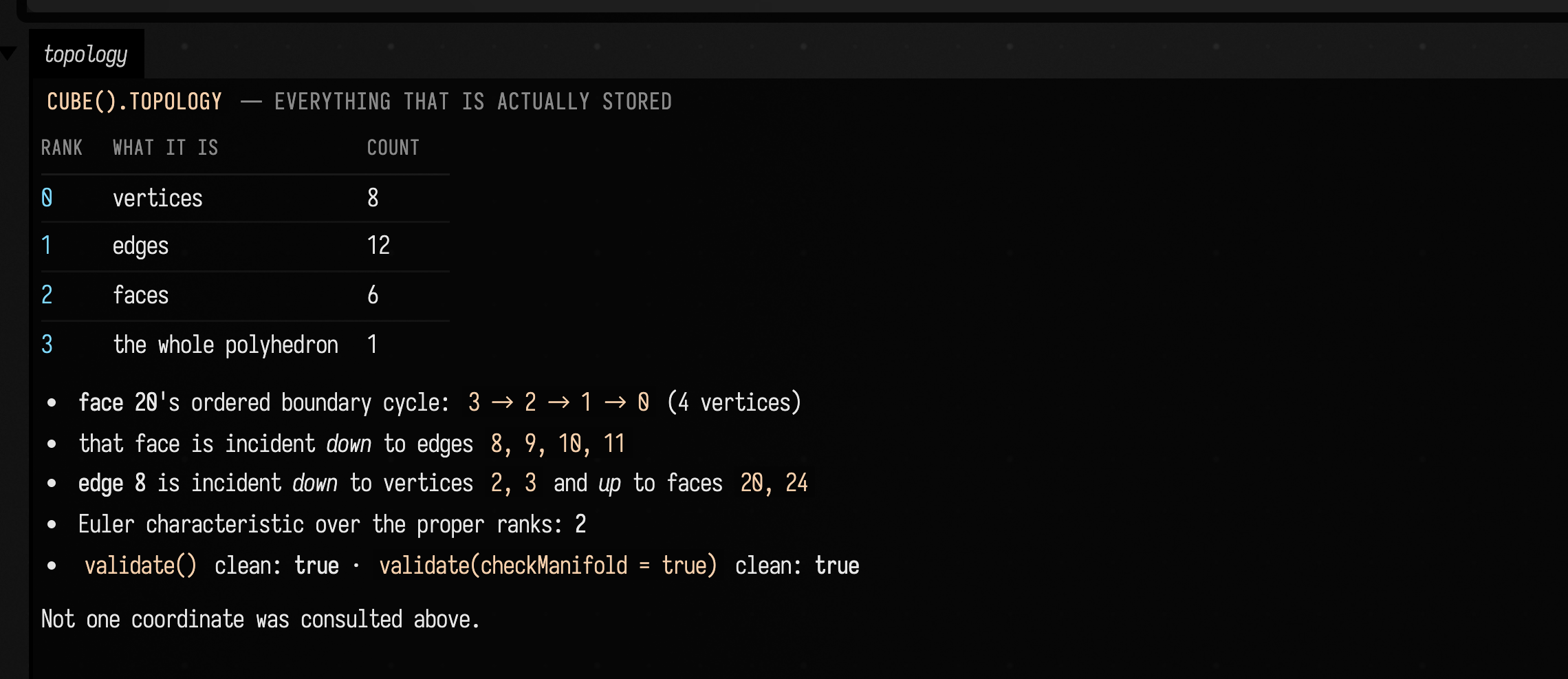
Element ids are numbered across the whole topology, not per rank, which is why the cube's first face is element 20 rather than face 0. An id names one element of one topology, so provenance can point at a source element without saying which rank it was.
- Only adjacent ranks are linked. No vertex-to-face incidence is stored; go through the edges.
validate()checks that incidences agree in both directions, that edges have two endpoints, and that each face's cycle matches its edges and forms a single loop. - Manifoldness is an extra check, not a requirement.
validate(checkManifold = true)also requires every edge to have exactly two faces. Topologies that are not closed surfaces are still legal.
Coordinates are optional
A PolyhedralObject is a topology, a Realization3 that may be null, and element attributes.
Realization3 holds the vertex positions in the same order as topology.elements(0), and hands
back copies when you read them.
This example drops the cube's coordinates, takes the dual anyway, and shows which calls still work:
:::static
// Drop the cube's coordinates. The topology survives verbatim.
val abstractCube = PolyhedralObject(cube().topology)
val d = abstractCube.transform(ConwayOperator.DUAL).polyhedron

// Ask it for geometry anyway, and keep whatever it says.
val refusal = try {
    d.toFaceFLines()
    "no exception — unexpected"
} catch (e: Throwable) {
        "${e::class.simpleName}: ${e.message}"
    }
val triRefusal = try {
    d.triangulate()
    "no exception — unexpected"
} catch (e: Throwable) {
        "${e::class.simpleName}: ${e.message}"
    }

// Now, and only now, choose a policy that says where the dual's vertices go.
val rd = cube().dual(DualCentroidRealization).polyhedron

:::fold lay the two columns side by side
markdown(
    "dual",
    """
#### A dual with no coordinates at all

| | abstract dual | dual + `DualCentroidRealization` |
|---|---|---|
| `polyhedron.realization` | `${d.realization}` | `Realization3(${rd.realization?.size} vertices)` |
| topology counts | ${d.topology.elements(0).size}v ${d.topology.elements(1).size}e ${d.topology.elements(2).size}f | ${rd.topology.elements(0).size}v ${rd.topology.elements(1).size}e ${rd.topology.elements(2).size}f |
| closed manifold | ${d.topology.validate(checkManifold = true).isValid} | ${rd.topology.validate(checkManifold = true).isValid} |
| isomorphic to `octahedron()` | ${d.topology.isCombinatoriallyIsomorphicTo(octahedron().topology)} | ${rd.topology.isCombinatoriallyIsomorphicTo(octahedron().topology)} |
| `toFaceFLines()` | `$refusal` | ${rd.toFaceFLines().size} FLines |
| `triangulate()` | `$triRefusal` | ${rd.triangulate().triangleCount} triangles |

The left column is a complete, valid, checkable octahedron. It simply has nowhere to be.
""",
    width = 900,
)
:::endfold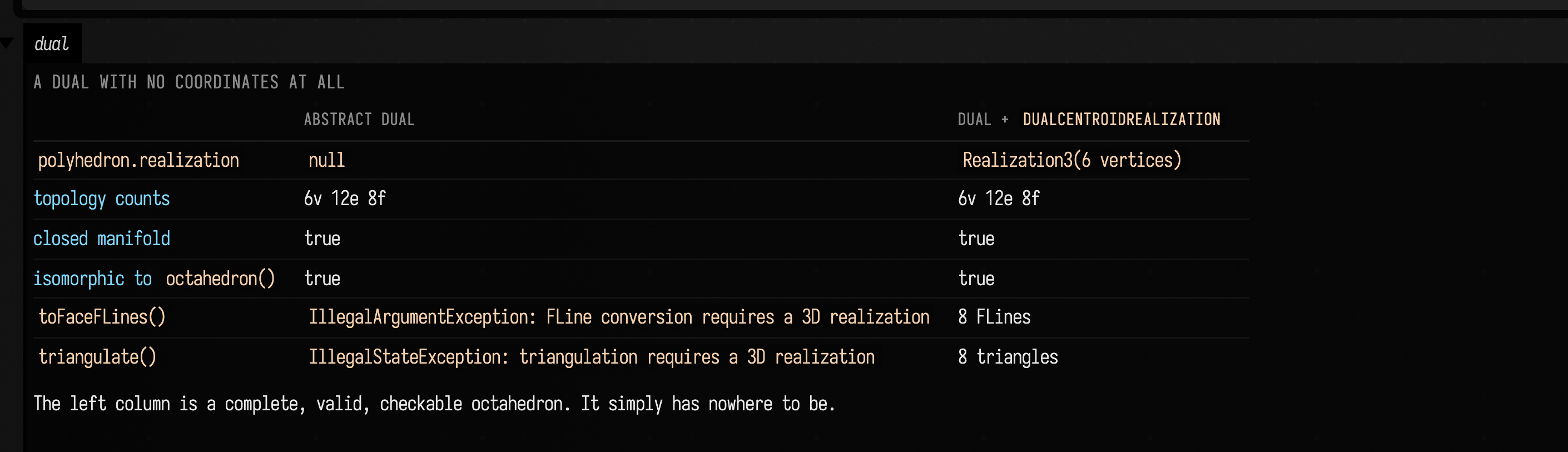
The combinatorial questions (valid, closed, isomorphic to an octahedron) all have answers without coordinates. The calls that need geometry throw, as shown, rather than making up positions.
isCombinatoriallyIsomorphicTo works for rank-3 polyhedra only: it compares vertex degrees, face
sizes and the edge and face lists up to rotation and reversal.
The operators
Some operators are primitives that work directly on the topology; the rest are named composites
that rewrite into primitives before anything runs. This table is generated from
ConwayOperator.entries and primitiveExpansion:
:::static
val rows =
    ConwayOperator.entries.joinToString("\n") { op ->
        // primitiveExpansion is in EXECUTION order (seed outward). Prefix notation writes it
        // the other way round, so reverse it to get the string you would actually type.
        val execution = op.primitiveExpansion.joinToString("") { it.symbol.toString() }
        val written = op.primitiveExpansion.reversed().joinToString("") { it.symbol.toString() }
        "| `${op.symbol}` | ${op.displayName} | ${if (op.primitive) "primitive" else "composite"} " +
            "| `$execution` | `${written}C` |"
    }
markdown(
    "ops",
    """
#### `ConwayOperator.entries`

| letter | name | kind | primitives, seed outward | equivalent notation |
|---|---|---|---|---|
$rows
""",
    width = 780,
)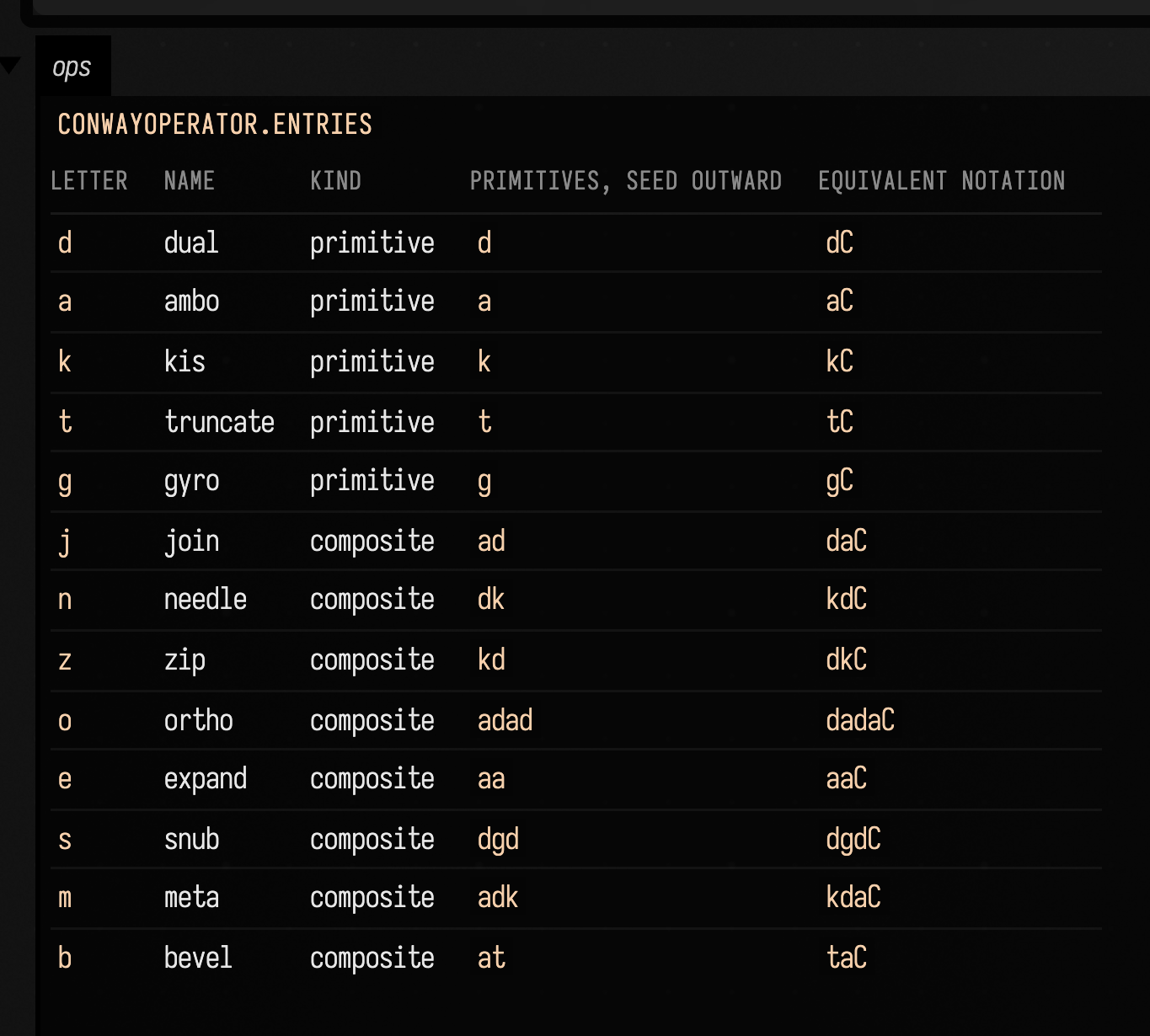
The last two columns run in opposite directions. primitiveExpansion lists operators in the order
they run, from the seed outward (join runs ambo, then dual), while prefix notation writes the
outermost operator first, so you type daC. A result reports both: notationHistory is what you
asked for, history is what ran.
The seeds
The seeds are the five Platonic solids, each with coordinates. The galleries below use Field's
Three.js viewer (threeGrid(...)) on toTriMesh(), so you can orbit every panel at once. The grey
line under each name is read from the topology.
:::static
:::fold one small gallery helper, reused by the two galleries below
fun Box.gallery(channel: String, columns: Int, cell: Int, panels: List<Pair<String, PolyhedralObject>>) {
    val view = MeshView(wireframe = false, distance = 2.3)
    val rows = (panels.size + columns - 1) / columns
    threeGrid(
        panels.map { (label, p) ->
            val t = p.topology
            ThreeMeshPanel(
                label,
                p.toTriMesh(),
                facts =
                    "${t.elements(0).size}v ${t.elements(1).size}e ${t.elements(2).size}f · " +
                        t.elements(2)
                            .groupingBy { t.faceCycle(it.id).size }
                            .eachCount()
                            .toSortedMap()
                            .entries
                            .joinToString(" ") { "${it.value}×${it.key}-gon" } +
                        " · χ=${t.eulerCharacteristic()}",
            )
        },
        channel = channel,
        name = "gallery-$channel",
        padding = 1.02,
        columns = columns,
        height = rows * (cell * 0.84).toInt(),
        cellWidth = cell,
        view = view,
    )
}

:::endfold

gallery(
    "seeds",
    columns = 3,
    cell = 380,
    panels = [
        "T  tetrahedron" to tetrahedron(),
        "C  cube" to cube(),
        "O  octahedron" to octahedron(),
        "I  icosahedron" to icosahedron(),
        "D  dodecahedron" to dodecahedron(),
    ],
)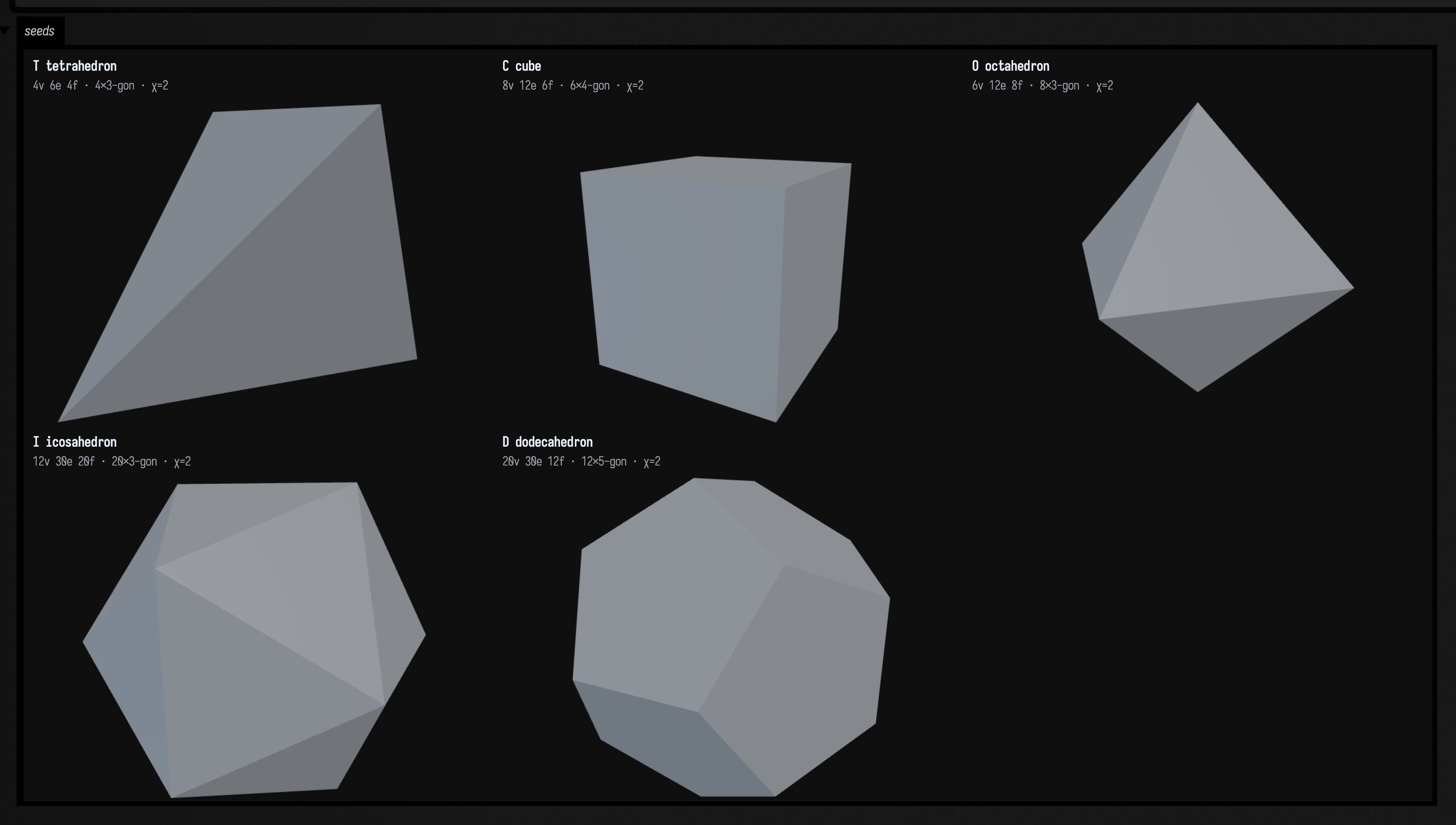
cube() is the odd one out: the other four place their vertices on the unit
sphere, while cube() has side length 2, so its vertices sit at radius √3. That matters later,
because the realization solver's default targets are derived from the incoming mean edge length
and mean radius.
The five primitives
This gallery applies each primitive to the cube, with the cube itself first for comparison:
:::static
:::fold the same gallery helper as above
fun Box.gallery(channel: String, columns: Int, cell: Int, panels: List<Pair<String, PolyhedralObject>>) {
    val view = MeshView(wireframe = false, distance = 2.3)
    val rows = (panels.size + columns - 1) / columns
    threeGrid(
        panels.map { (label, p) ->
            val t = p.topology
            ThreeMeshPanel(
                label,
                p.toTriMesh(),
                facts =
                    "${t.elements(0).size}v ${t.elements(1).size}e ${t.elements(2).size}f · " +
                        t.elements(2)
                            .groupingBy { t.faceCycle(it.id).size }
                            .eachCount()
                            .toSortedMap()
                            .entries
                            .joinToString(" ") { "${it.value}×${it.key}-gon" } +
                        " · χ=${t.eulerCharacteristic()}",
            )
        },
        channel = channel,
        name = "gallery-$channel",
        padding = 1.02,
        columns = columns,
        height = rows * (cell * 0.84).toInt(),
        cellWidth = cell,
        view = view,
    )
}

:::endfold

// One seed, five primitives. `conway(...)` parses and evaluates in one call.
gallery(
    "primitives",
    columns = 3,
    cell = 380,
    panels = [
        "C    the seed" to conway("C").polyhedron,
        "dC   dual" to conway("dC").polyhedron,
        "aC   ambo" to conway("aC").polyhedron,
        "kC   kis" to conway("kC").polyhedron,
        "tC   truncate" to conway("tC").polyhedron,
        "gC   gyro" to conway("gC").polyhedron,
    ],
)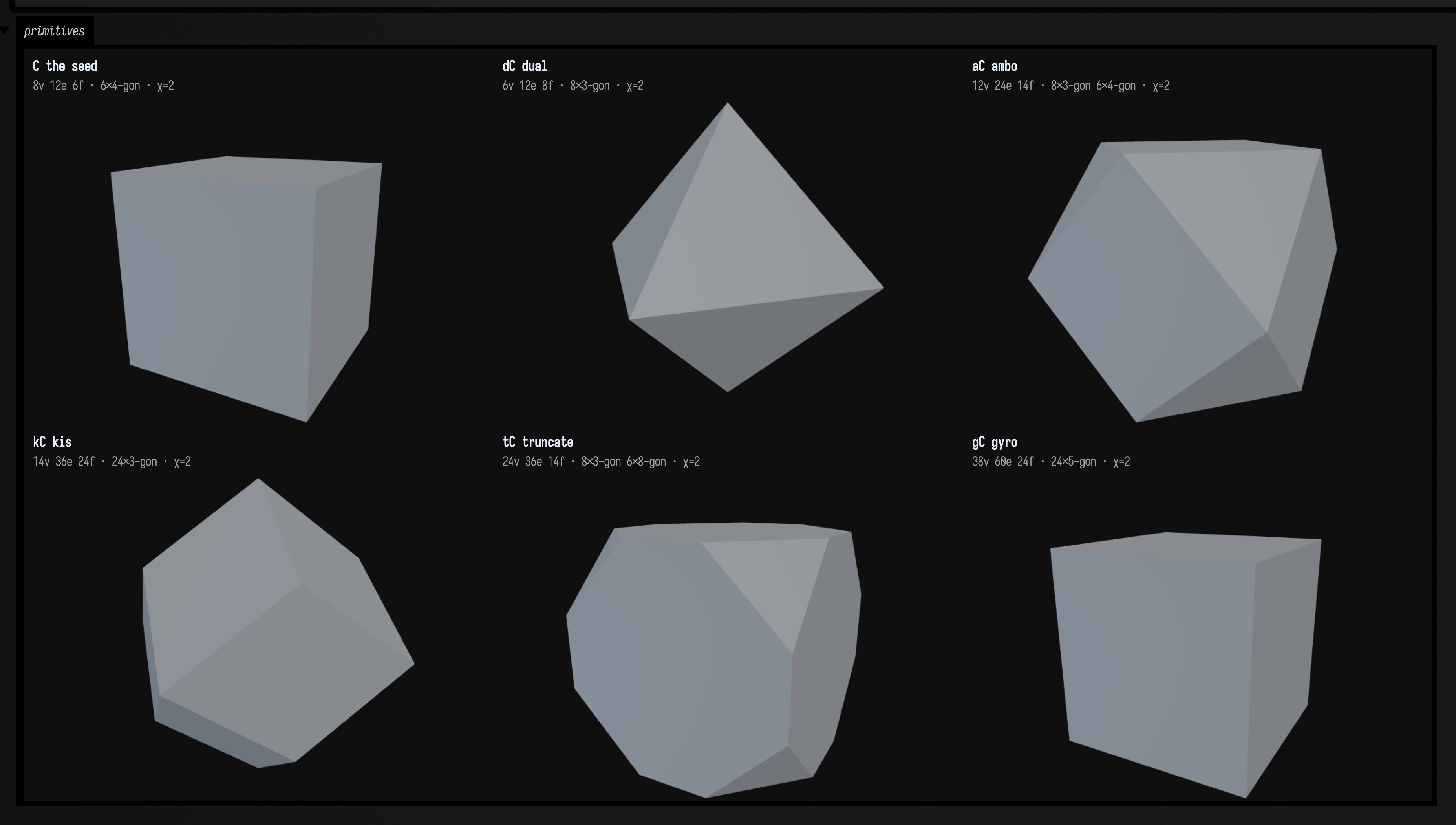
Each caption's face-degree histogram tells you what the operator did combinatorially:
ddual swaps vertices and faces and leaves edges alone: the cube's 8/12/6 becomes 6/12/8.aambo puts a vertex at every edge midpoint; the new faces are one per old face plus one per old vertex, soaChas 6 squares and 8 triangles.kkis raises an apex over every face and fans it into triangles.ttruncate cuts every vertex off; the old faces grow to twice as many sides (squares → octagons) and each cut leaves a new face.ggyro is a genuine topology transform: every directed half-edge becomes a pentagon, sogCis 24 pentagons and nothing else.
The gC panel's caption says 24 pentagons, but the picture is a cube. Both are right:
GyroSubdivisionRealization places the new points along the existing edges and the new face
centres at the old face centroids, so every pentagon lies flat in one of the cube's square faces,
and flat shading cannot tell them apart. The topology changed; the surface did not.
Giving each polygon its own colour, using the map from triangles back to polygons, shows the pentagons:
:::static
// Shading cannot separate coplanar faces, so give each polygon its own colour instead. The
// triangle -> source-polygon map is what makes that possible on a triangle mesh at all.
val gyro = conway("gC").polyhedron
val g = gyro.triangulate()
val faceOrder = gyro.topology.elements(2).mapIndexed { i, f -> f.id.value to i }.toMap()

val colors = FloatArray(g.mesh.vertexCount * 3)
for (tri in 0 until g.triangleCount) {
    // A hue wheel over the 24 pentagons; nothing here knows or cares where they are in space.
    val turn = faceOrder.getValue(g.sourceFace(tri).value) * 2.0 * Math.PI / faceOrder.size
    for (k in 0..2) {
        val vi = g.mesh.indices[tri * 3 + k]
        colors[vi * 3] = (0.55 + 0.42 * Math.cos(turn)).toFloat()
        colors[vi * 3 + 1] = (0.55 + 0.42 * Math.cos(turn - 2.09)).toFloat()
        colors[vi * 3 + 2] = (0.55 + 0.42 * Math.cos(turn + 2.09)).toFloat()
    }
}
val painted = TriMesh(g.mesh.positions, g.mesh.indices, g.mesh.normals, null, colors)

:::fold one figure with its own caption
// A separate channel from the caption below: `display` REPLACES a channel's content, so a caption
// written to "gyro" would silently take the viewer's place and the figure would lose its mesh.
three(
    painted,
    channel = "gyro3d",
    name = "gyro",
    view = MeshView(wireframe = false, width = 860, height = 560, distance = 2.4),
    padding = 1.02,
    facts = false,
)
// The count behind the flatness: 24 faces sharing only 6 distinct outward normals.
val distinctNormals =
    gyro.topology
        .elements(2)
        .map { gyro.faceNormal(it.id) }
        .map { "%.3f,%.3f,%.3f".format(it.x, it.y, it.z) }
        .distinct()

markdown(
    "gyro",
    """
    gC · ${gyro.topology.elements(2).size} faces, all
    ${gyro.topology.elements(2).map { gyro.topology.faceCycle(it.id).size }.distinct().joinToString("/")}-gons ·
    ${distinctNormals.size} distinct face normals: ${distinctNormals.joinToString(" ") { "($it)" }.md}
""",
)
:::endfold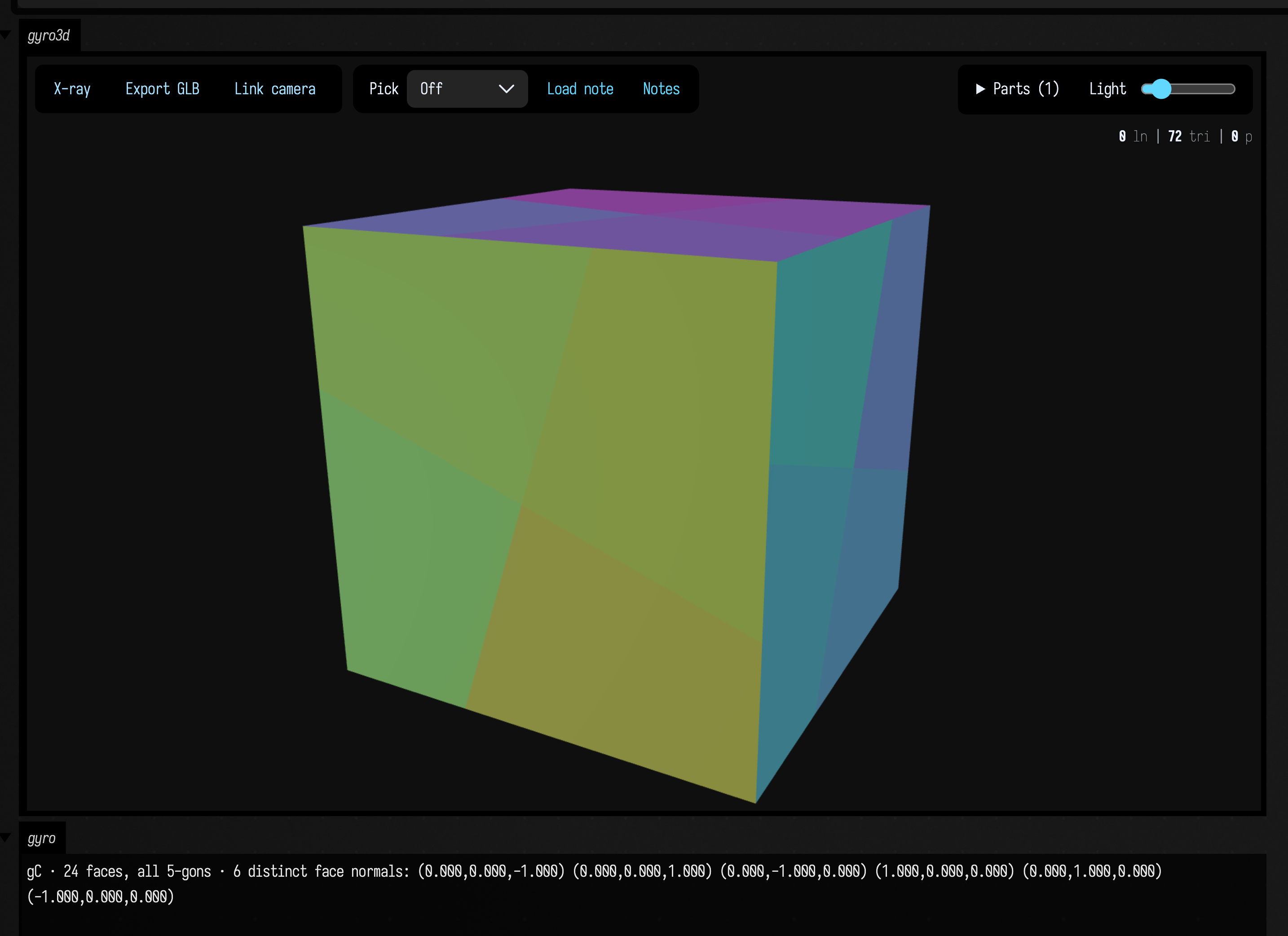
The operator decides the topology, and a realization policy, a separate argument you can replace,
decides where the new vertices go. Give gyro a different RealizationPolicy3 and the same
pentagons land somewhere else.
The named composites
The same gallery for the composites, each labelled with the primitives it expands to:
:::static
:::fold the same gallery helper as above
fun Box.gallery(channel: String, columns: Int, cell: Int, panels: List<Pair<String, PolyhedralObject>>) {
    val view = MeshView(wireframe = false, distance = 2.3)
    val rows = (panels.size + columns - 1) / columns
    threeGrid(
        panels.map { (label, p) ->
            val t = p.topology
            ThreeMeshPanel(
                label,
                p.toTriMesh(),
                facts =
                    "${t.elements(0).size}v ${t.elements(1).size}e ${t.elements(2).size}f · " +
                        t.elements(2)
                            .groupingBy { t.faceCycle(it.id).size }
                            .eachCount()
                            .toSortedMap()
                            .entries
                            .joinToString(" ") { "${it.value}×${it.key}-gon" } +
                        " · χ=${t.eulerCharacteristic()}",
            )
        },
        channel = channel,
        name = "gallery-$channel",
        padding = 1.02,
        columns = columns,
        height = rows * (cell * 0.84).toInt(),
        cellWidth = cell,
        view = view,
    )
}

:::endfold

gallery(
    "composites",
    columns = 4,
    cell = 290,
    panels = [
        "jC   join = da" to conway("jC").polyhedron,
        "nC   needle = kd" to conway("nC").polyhedron,
        "zC   zip = dk" to conway("zC").polyhedron,
        "oC   ortho = jj" to conway("oC").polyhedron,
        "eC   expand = aa" to conway("eC").polyhedron,
        "sC   snub = dgd" to conway("sC").polyhedron,
        "mC   meta = kj" to conway("mC").polyhedron,
        "bC   bevel = ta" to conway("bC").polyhedron,
    ],
)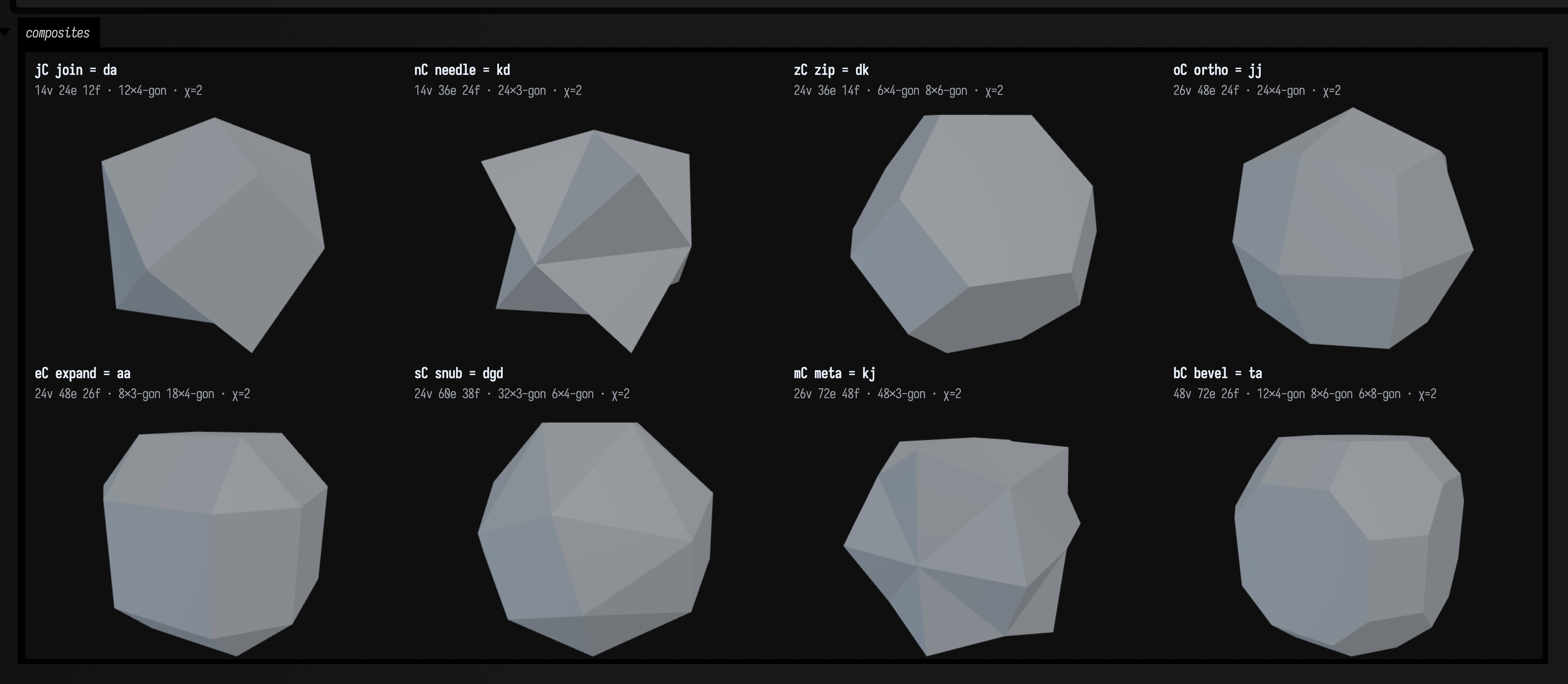
A composite is rewritten into its primitives: conway("bC") runs ambo and then truncate, and
the result says so.
Every operator is a method on both PolyhedralObject and a transform result, so you can chain them
directly, composites after primitives:
:::static
// Each of these is a composite applied to the result of a primitive.
val chains = [
    "cube().ambo().bevel()" to cube().ambo().bevel(),
    "cube().kis().needle()" to cube().kis().needle(),
    "cube().truncate().ortho()" to cube().truncate().ortho(),
    "cube().dual().zip()" to cube().dual().zip(),
]

:::fold one row per chain: what was asked for, and what actually ran
markdown(
    "chains",
    """
| chain | result | asked for | actually ran | χ |
|---|---|---|---|---|
${chains.joinToString("\n") { (source, r) ->
    val t = r.polyhedron.topology
    "| `$source` | ${t.elements(0).size}v ${t.elements(1).size}e ${t.elements(2).size}f " +
        "| `${r.notationHistory.joinToString(" ") { it.displayName }}` " +
        "| `${r.history.joinToString(" ") { it.displayName }}` " +
        "| ${t.eulerCharacteristic()} |"
}}

`notationHistory` keeps the operators you named; `history` is the primitive trace that ran. A
composite is rewritten before anything executes, so the two columns differ exactly where a chain
used one — `bevel` is `ta`.
""",
    width = 900,
)
:::endfold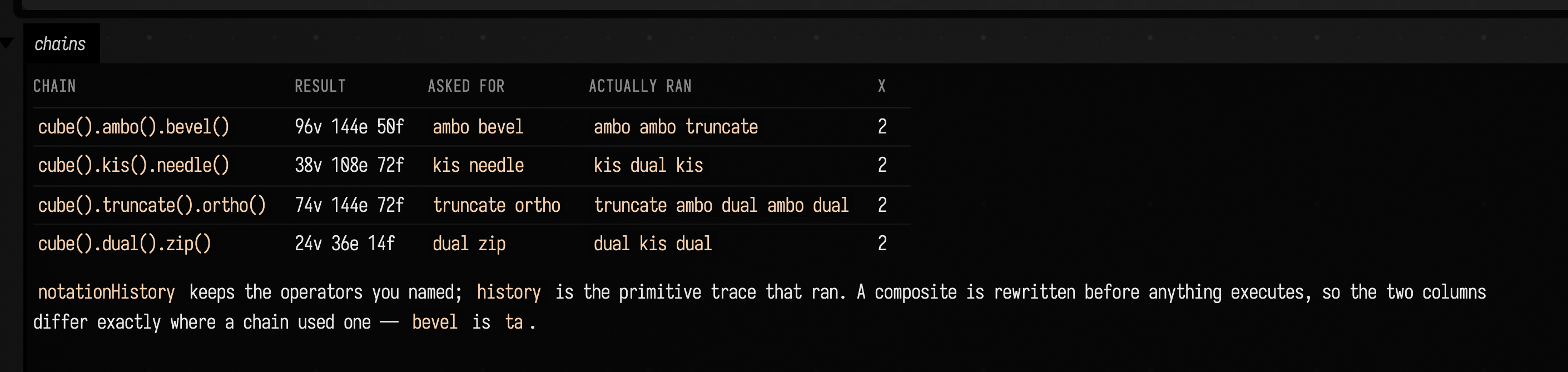
Where you asked for bevel, the result records both the bevel you named and the ambo truncate
that ran, so the lineage stays accurate wherever a composite sits in the chain.
Prefix notation
parseConwayExpression parses; conway parses and evaluates. Whitespace is ignored anywhere, the
seed must be the final character, and evaluation is right-to-left (daC is d(a(C))). Only k and
t accept a degree index; kN restricts kis to faces of degree N and tN restricts truncate to
vertices of degree N.
:::static
fun row(src: String): String = try {
    val e = parseConwayExpression(src)
    val r = e.evaluate()
    val t = r.polyhedron.topology
    "| `$src` | `${e.seed.symbol}` " +
        "| ${e.invocations.joinToString(" then ") { i -> i.operator.displayName + (i.degree?.let { "($it)" } ?: "") }.ifEmpty { "— (the bare seed)" }} " +
        "| ${r.history.joinToString("") { it.symbol.toString() }.ifEmpty { "—" }} " +
        "| ${t.elements(0).size}v ${t.elements(1).size}e ${t.elements(2).size}f |"
} catch (ex: ConwayParseException) {
        "| `$src` | — | **${ex.message.md}** | — | — |"
    }

val cases = ["C", "dC", "daC", "adC", "bC", "k4aC", "t4kC", "sD", "qC", "a4C", "4kC", "k2C", "dx"]
markdown(
    "parser",
    """
| written | seed | invocations, seed outward | primitives run | output |
|---|---|---|---|---|
${cases.joinToString("\n") { row(it) }}
""",
    width = 1020,
)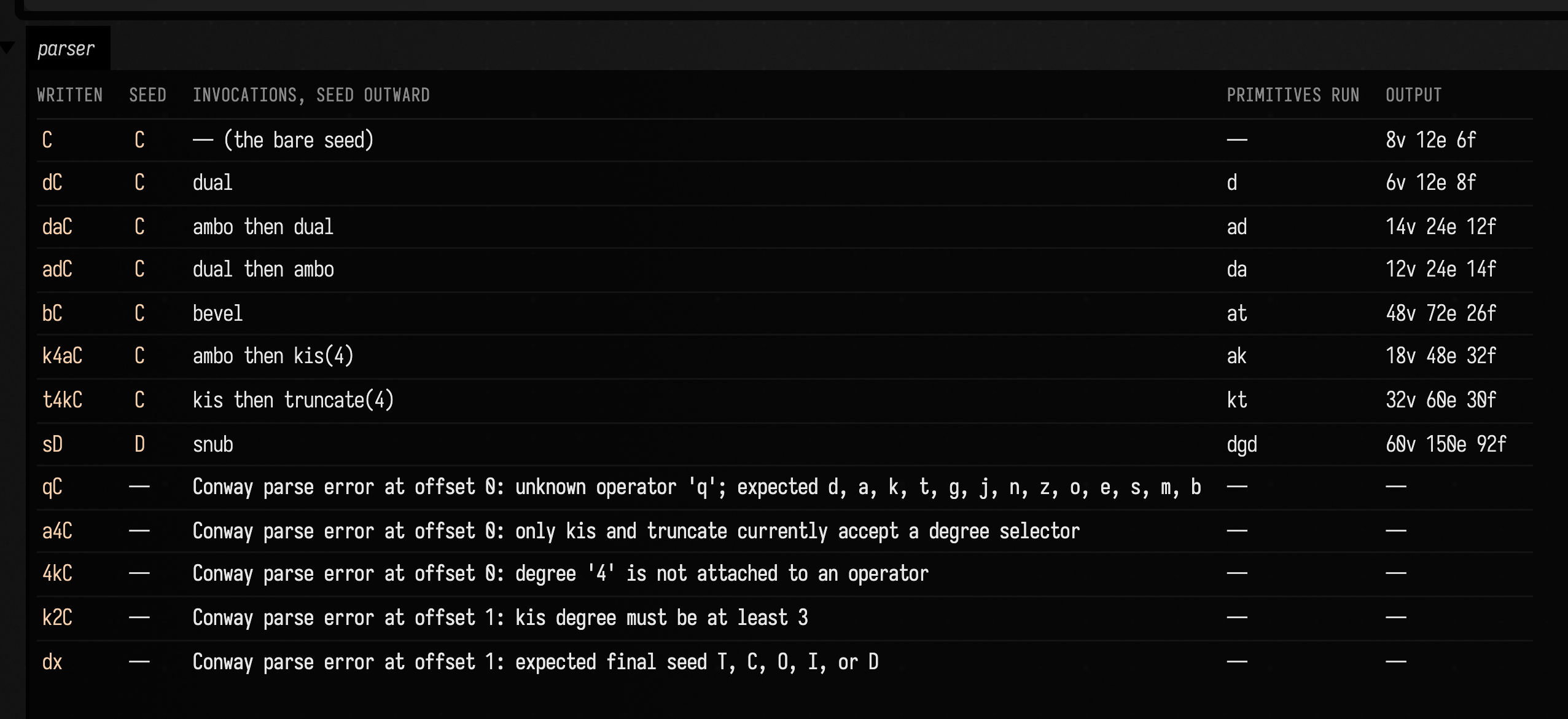
Compare rows two and three: daC and adC are different objects, 14v/24e/12f against 12v/24e/14f,
which is what right-to-left evaluation means. The last five rows are the parser's own messages,
including the byte offset it failed at.
Provenance: every output element remembers where it came from
Each PolytopeTransformResult carries, for every output element, an ElementLineage tree: either
Source (an element of the original seed) or Derived, with the operation, a role string and its
parents. sourceElements(id) flattens the tree back to the seed. This example prints the lineage
of a bevelled cube:
:::static
val result = conway("bC") // bevel = ambo then truncate

fun describe(l: ElementLineage): String = when (l) {
    is ElementLineage.Source -> "seed r${l.element.rank}#${l.element.id.value}"
    is ElementLineage.Derived ->
        "${l.operation.displayName}/${l.role}(" + l.parents.joinToString(", ") { describe(it) } + ")"
}

val faces = result.polyhedron.topology.elements(2)
val roles = faces.groupingBy { (result.lineage(it.id) as ElementLineage.Derived).role }.eachCount().toSortedMap()
val sample = faces.first()

:::fold format
markdown(
    "lineage",
    """
#### `conway("bC")` — what every output face remembers

- written: `${result.notationHistory.joinToString("") { it.symbol.toString() }}`
  (${result.notationHistory.joinToString { it.displayName }})
- primitives actually run, seed outward: `${result.history.joinToString("") { it.symbol.toString() }}`
- output: ${result.polyhedron.topology.elements(0).size}v ${result.polyhedron.topology.elements(1).size}e ${faces.size}f

| output face role | count |
|---|---|
${roles.entries.joinToString("\n") { "| `${it.key}` | ${it.value} |" }}

Output face **${sample.id.value}**, in full:

~~~
${describe(result.lineage(sample.id))}
~~~

flattened to seed elements: ${result.sourceElements(sample.id).joinToString { "rank ${it.rank} / id ${it.id.value}" }}
""",
    width = 920,
)
:::endfold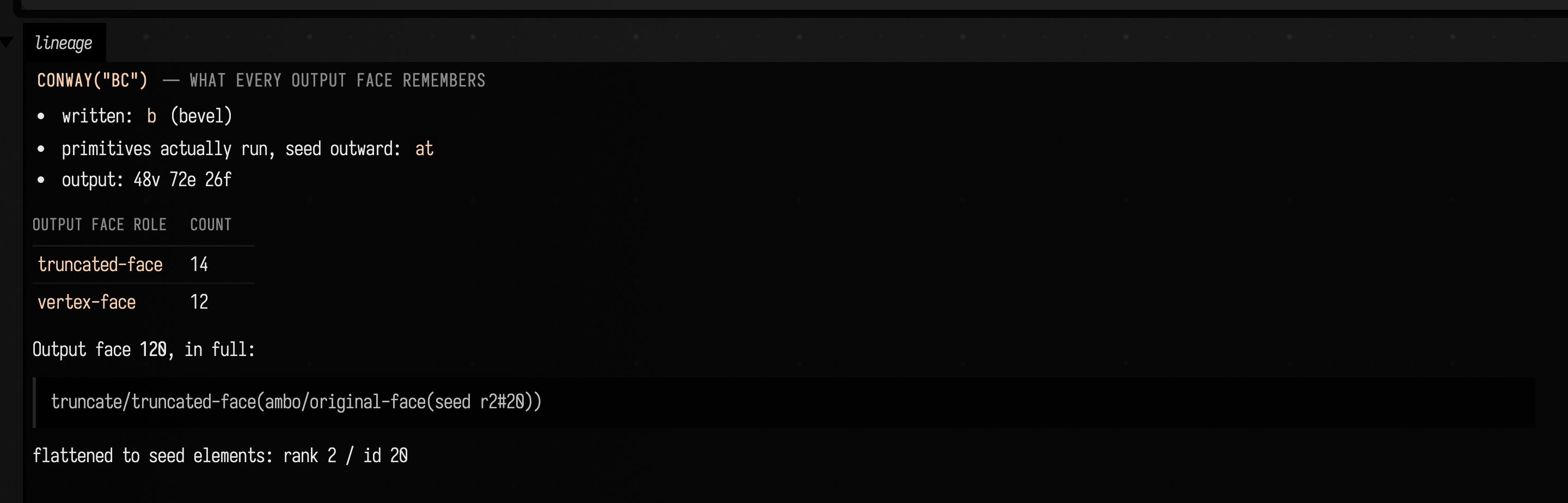
The role table answers questions geometry would make you guess at: after a bevel, 14 of the 26
faces descend from the cube's own faces and vertices through ambo, and 12 are the faces the
truncation cut.
The roles the primitives emit are a fixed list: face-center, vertex-face,
edge-midpoint, original-face, original-vertex, face-apex, kis-triangle,
vertex-edge-point, truncated-face, partially-truncated-face, directed-edge-point,
gyro-pentagon. Selectors, in the next section, can pick elements by role.
Selectors: choosing elements without naming indices
An ElementSelector is a predicate over an ElementSelectionContext: the object, the element, and
its lineage when there is one. ElementSelectors supplies the common ones, and they combine with
and, or and !. This example runs a set of them against a kis-ed cube:
:::static
val kisCube = cube().kis() // apex over every square

val cases = listOf<Pair<String, ElementSelector>>(
    "ElementSelectors.rank(0)" to ElementSelectors.rank(0),
    "ElementSelectors.rank(2)" to ElementSelectors.rank(2),
    "faceDegree(3)" to ElementSelectors.faceDegree(3),
    "vertexDegree(4)" to ElementSelectors.vertexDegree(4),
    "vertexDegree(6)" to ElementSelectors.vertexDegree(6),
    "provenanceRole(\"face-apex\")" to ElementSelectors.provenanceRole("face-apex"),
    "provenanceRole(\"original-vertex\")" to ElementSelectors.provenanceRole("original-vertex"),
    "vertexDegree(4) and !provenanceRole(\"face-apex\")" to
        (ElementSelectors.vertexDegree(4) and !ElementSelectors.provenanceRole("face-apex")),
)

// Two receivers that behave differently: a PolyhedralObject has no lineage to consult, so a
// provenance selector refuses there. A transform result can see it.
val rows =
    cases.joinToString("\n") { (label, s) ->
        val bare = runCatching { kisCube.polyhedron.selectElements(s).size }.fold({ "$it" }, { "refused" })
        "| `$label` | $bare | ${kisCube.selectElements(s).size} |"
    }
markdown(
    "selectors",
    """
#### `cube().kis()` — 14 vertices, 36 edges, 24 triangles

| selector | matches on the `PolyhedralObject` | matches on the `PolytopeTransformResult` |
|---|---|---|
$rows

The two columns differ exactly where a selector needs lineage.
""",
    width = 940,
)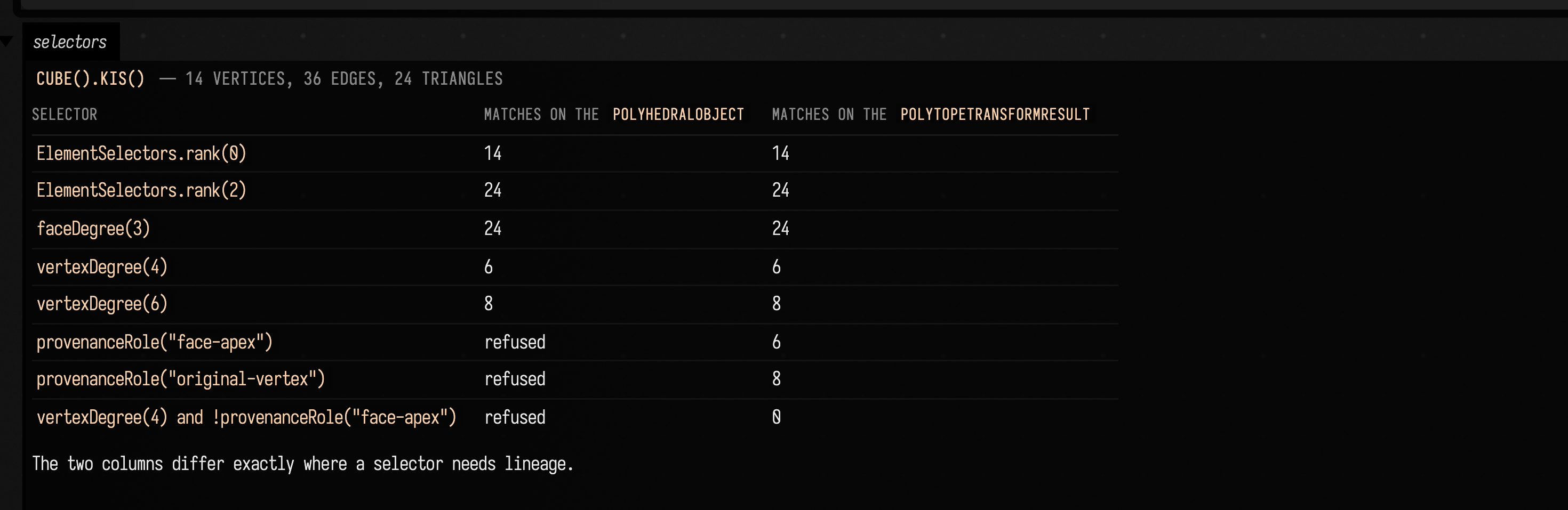
That difference follows from what a selector runs against: a bare PolyhedralObject has no
transform history to have a role in, and a transform result does.
In the last row, vertexDegree(4) matches the six apexes kis raised, and the transform result
correctly finds none once they are excluded by role. On the bare object every provenance row is
refused rather than answered.
Deployed parameters: a scalar field over the selected elements
A selector says where; an ElementDoubleParameter says how much, per element. The selective
kis, truncate and gyro overloads take both, evaluate the parameter once per selected element,
and record the values they used in a TransformDeployment, so you can inspect or replay the
operation afterwards.
Below, a scalar is written onto each of a dodecahedron's twelve faces as an ordinary attribute, kis
is deployed with ElementParameters.attribute("spike"), and then the same scalar is painted back
onto the rendered triangles by following triangulate()'s triangle → source-polygon map.
:::static
// One scalar per face of a dodecahedron: spike height rises from left to right.
var source = dodecahedron()
val realization = source.realization!!
val index = source.topology.elements(0).mapIndexed { i, v -> v.id.value to i }.toMap()
for (f in source.topology.elements(2)) {
    val x = source.topology.faceCycle(f.id).map { realization[index.getValue(it)].x }.average()
    source = source.withAttribute(f.id, "spike", 0.08 + 0.80 * (x + 1.0) / 2.0)
}

// Selection and parameter are separate arguments.
val result = source.kis(ElementSelectors.rank(2), ElementParameters.attribute("spike"))
val out = result.polyhedron
val g = out.triangulate()

val deployed = result.deployments.single().scalarParameters
val values = deployed.values.mapNotNull { it["heightScale"] }
val lo = values.min()
val hi = values.max()

// Paint the deployed scalar back onto the render mesh. This is only possible because
// triangulate() kept sourceFace(triangle) -> the polygon each triangle came from.
val colors = FloatArray(g.mesh.vertexCount * 3)
for (tri in 0 until g.triangleCount) {
    val v = (out.attributes[g.sourceFace(tri)]["spike"] as? Number)?.toDouble() ?: lo
    val u = ((v - lo) / (hi - lo)).coerceIn(0.0, 1.0)
    for (k in 0..2) {
        val vi = g.mesh.indices[tri * 3 + k]
        colors[vi * 3] = (0.20 + 1.10 * u).toFloat()
        colors[vi * 3 + 1] = (0.86 - 0.30 * u).toFloat()
        colors[vi * 3 + 2] = (1.00 - 0.78 * u).toFloat()
    }
}
val painted = TriMesh(g.mesh.positions, g.mesh.indices, g.mesh.normals, null, colors)

:::fold one figure, with its own caption, so nothing is read off a mesh-level summary
// Its own channel — see the note on the gyro figure: a later display() to the same channel replaces.
three(
    painted,
    channel = "field3d",
    name = "field",
    view = MeshView(wireframe = false, width = 820, height = 560, distance = 2.3, yawDegrees = 0.0, pitchDegrees = 6.0),
    padding = 1.02,
    facts = false,
)
markdown(
    "field",
    """
    kis deployed over ${deployed.size} faces ·
    heightScale resolved ${lo.f3} … ${hi.f3}

    output ${out.topology.elements(0).size}v ${out.topology.elements(1).size}e ${out.topology.elements(2).size}f ·
    ${g.triangleCount} triangles over ${g.triangleFaceIds.toSet().size} source polygons
""",
)
:::endfold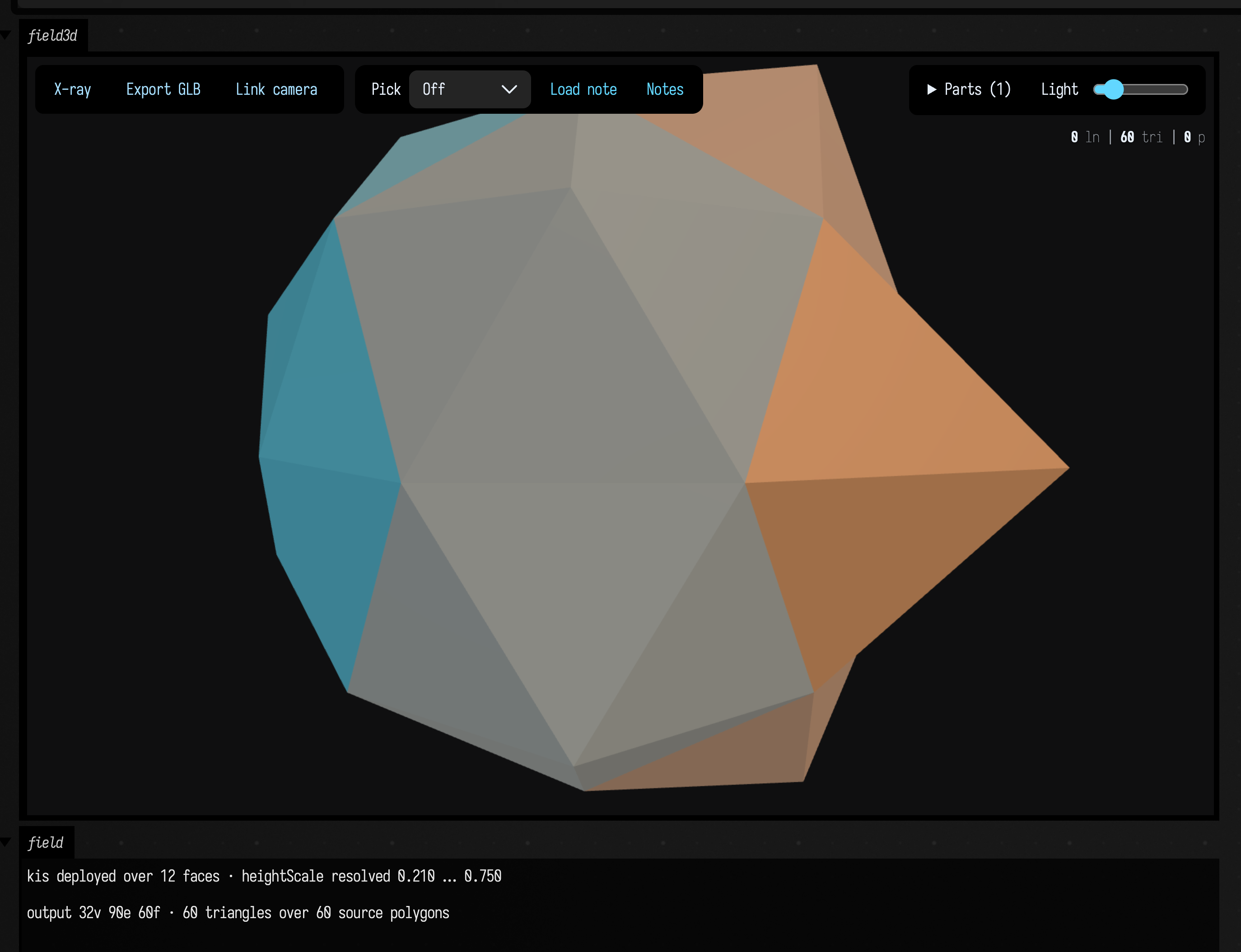
The spikes lengthen from left to right, and the printed range is the one the deployment record
holds. The colour reaches the triangles because the attribute lives on the polygon and
TriangulatedGeometry keeps sourceFace(triangle). Here the selector is every face and only the
height varies; restrict the selector as well and you get kis that is both selective and
non-uniform, as the demo at the bottom of this page does.
Realization: realize, relax and canonicalize
Everything so far has been combinatorics. There are three calls for turning it into coordinates, and they promise different things:
| verb | what you give it | what it promises |
|---|---|---|
realize(policy) |
a topology, with or without coordinates | coordinates built from the combinatorics by a declared construction |
relax(plan) |
an embedding you already have | that embedding, improved under a declared set of named constraints |
canonicalize(...) |
an embedding, or none | the symmetric representative, with stated guarantees, and a reported failure when they do not apply |
The realization policies each operator uses by default (centroid dual, edge-midpoint ambo,
face-normal kis, along-edge truncation, gyro subdivision) are local rules of thumb. In the gyro
figure the new faces stay flat on the squares they subdivided: the combinatorics of gC are those
of the pentagonal icositetrahedron, but its coordinates are not.
relax(...): repair the embedding you have
relax(plan) runs a pure-Kotlin nonlinear least-squares pass over the vertex coordinates. A
RelaxationPlan is a list of named, immutable constraint values (edge-length, face-planarity,
centroid, common-radius, proximity, edge-tangency, tangency-centroid, symmetry-orbit)
plus a least-squares configuration and an optional gauge. Because the plan is a value you can print, compare and reweight
(plan.withWeight("edge-length", 0.0)), and the result reports each family's error before and
after, you can see which constraint gave way. Topology and attributes are unchanged; only the
coordinates are replaced. The figure below calls solveRealization(), a shorthand that turns five
weights into RelaxationPlan.regularize().
relax is a local least-squares pass
Levenberg–Marquardt from the supplied embedding is a local method, and the referenceWeight
term biases it toward where it started, so what you get is a general constraint relaxation and
not the unique Conway canonical form. Nothing here checks for self-intersection or inversion,
and degenerate faces are reported rather than repaired.
The defaults suit the symmetric finite polyhedra this page produces. For a shape that is meant to be irregular, turn the common-radius and edge-tangency families off. For the canonical form, ask for it by name: that is the next section.
:::static
import kotlin.random.Random

// Take a real Conway output and jitter every vertex. The topology is not touched at all.
val clean = conway("aC").polyhedron
val rng = Random(7)
val jittered = clean.copy(
    realization = Realization3(
        clean.realization!!.vertexCoordinates.map {
            Vec3(it)
                .add(
                    (rng.nextDouble() - 0.5).toFloat() * 0.62f,
                    (rng.nextDouble() - 0.5).toFloat() * 0.62f,
                    (rng.nextDouble() - 0.5).toFloat() * 0.62f,
                )
        },
    ),
)

val solved = jittered.solveRealization()

:::fold render the three embeddings and their diagnostics as one figure
threeGrid(
    "aC as built" to clean.toTriMesh(),
    "every vertex jittered" to jittered.toTriMesh(),
    "solveRealization()" to solved.polyhedron.toTriMesh(),
    channel = "solve3d",
    name = "embeddings",
    columns = 3,
    height = 340,
    cellWidth = 400,
    view = MeshView(wireframe = false, distance = 2.5),
    padding = 1.02,
)
// A Table for the diagnostics — the numeric columns right-align themselves and each carries its
// own format — inside a markdown card that holds the solver's summary as prose.
val sci = { v: Any? -> "%.3e".format(v) }
fun row(label: String, d: RealizationDiagnostics) = [
    label,
    d.edgeLengthMean,
    d.edgeLengthRmsDeviation,
    d.maxFacePlanarityError,
    d.facePlanarityRmsError,
    d.degenerateFaces.size,
]

val metrics =
    Table(
            [
                "embedding",
                "edge mean",
                "edge RMS dev",
                "max planarity err",
                "planarity RMS",
                "degenerate",
            ],
        )
        .rows(
            [
                row("aC as built", clean.geometryDiagnostics()),
                row("jittered", solved.initialDiagnostics),
                row("after solveRealization()", solved.finalDiagnostics),
            ],
        )
        .format("edge mean") { (it as Number).f5 }
        .format("edge RMS dev", sci)
        .format("max planarity err", sci)
        .format("planarity RMS", sci)

markdown(
    "solve",
    """
    ${metrics.h}

    converged = ${solved.converged} · iterations = ${solved.iterations} ·
    rmsResidual = ${sci(solved.rmsResidual)} · reason = ${solved.reason} ·
    topology object identical = ${solved.polyhedron.topology === jittered.topology}
""",
)
:::endfold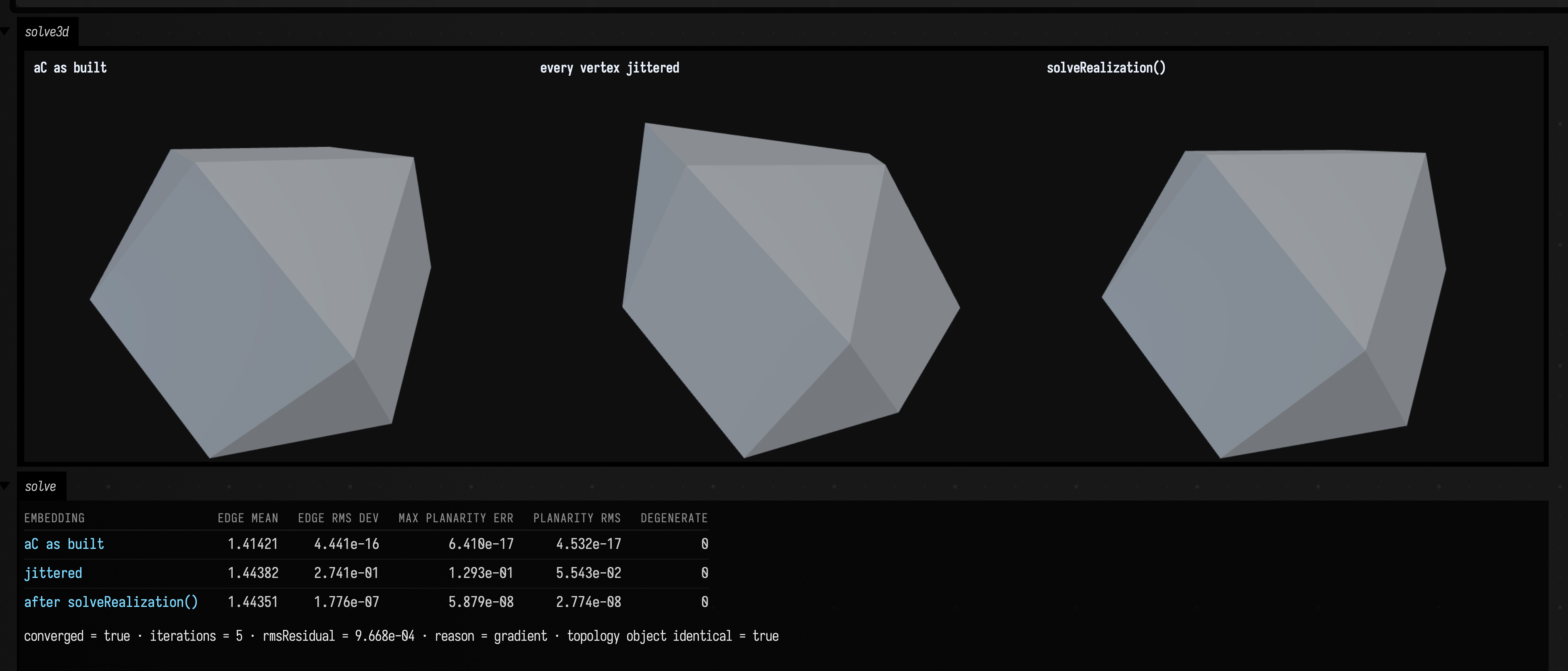
The pictures show the shape coming back; the table says by how much. The middle row is
solved.initialDiagnostics and the last is solved.finalDiagnostics, so a solve that did nothing
useful shows in the numbers.
The recovered edge mean is the jittered one, not the original: with targetEdgeLength = null the
target is the input's mean edge length. Pass a target if you want a particular size.
canonicalize(...): the form the combinatorics already determined
The canonical form of a polyhedron is the embedding where every edge is tangent to one common sphere, the centroid of those tangency points is the origin, and every face is planar. For the polyhedra this library produces, it is unique:
When the canonical form is unique
For a convex polyhedron (by Steinitz's theorem, for any 3-connected planar graph) the canonical form exists and is unique up to Möbius transformations of the sphere. Pinning the tangency centroid at the origin picks one representative; the gauge removes the remaining rigid and scale freedom. That covers every Conway operator over a Platonic seed, which is to say everything on this page.
Nothing is guaranteed for non-convex, self-intersecting, higher-genus or non-3-connected input.
There, the run still returns converged and its diagnostics, and expects you to look.
There are two methods. RECIPROCAL is Hart's dual reciprocation, which converges in tens of
iterations. LOCAL_RELAXATION alternates planarizing, tangentifying and recentring, and takes
thousands of small steps. The default runs the first and polishes with the second. This example
canonicalizes the gyro-cube from earlier:
:::static
// The gyro-cube, exactly as the operator built it, and the same combinatorics canonicalized.
val built = conway("gC").polyhedron
val run = built.canonicalize()

// Both panels are gauged to the same mean edge length, so the comparison is about shape, not size.
val gauge = RigidGauge()
val before = built.normalize(gauge)
val after = run.polyhedron.normalize(gauge)

:::fold render the two embeddings and the three defining conditions
threeGrid(
    "gC as the operator built it" to before.toTriMesh(),
    "gC.canonicalize()" to after.toTriMesh(),
    channel = "canon3d",
    name = "embeddings",
    columns = 2,
    height = 380,
    cellWidth = 430,
    view = MeshView(wireframe = false, distance = 3.2),
    padding = 1.26,
)
val sci = { v: Any? -> "%.3e".format(v) }
fun row(label: String, d: CanonicalDiagnostics) = [
    label,
    d.tangencyRadiusSpread,
    d.tangencyCentroidOffset,
    d.maxFacePlanarityError,
    d.dihedralAngleMean,
    d.dihedralAngleSpread,
]
fun degrees(o: PolyhedralObject) =
    o.topology.elements(2).mapNotNull { o.topology.faceCycleOrNull(it.id)?.size }.distinct().sorted()

val metrics =
    Table(
            [
                "embedding",
                "tangency radius spread",
                "tangency centroid offset",
                "max planarity err",
                "dihedral mean",
                "dihedral spread",
            ],
        )
        .rows([row("as built", run.initialDiagnostics), row("canonical", run.finalDiagnostics)])
        .format("tangency radius spread", sci)
        .format("tangency centroid offset", sci)
        .format("max planarity err", sci)
        .format("dihedral mean") { (it as Number).f4 }
        .format("dihedral spread", sci)

markdown(
    "canon",
    """
    ${metrics.h}

    converged = ${run.converged} · reason = ${run.reason} ·
    reciprocal iterations = ${run.reciprocalIterations} ·
    relaxation iterations = ${run.relaxationIterations} · reseeded = ${run.reseeded}

    distinct face degrees, before and after = ${degrees(before).md} →
    ${degrees(after).md} · topology object identical =
    ${run.polyhedron.topology === built.topology}
""",
)
:::endfold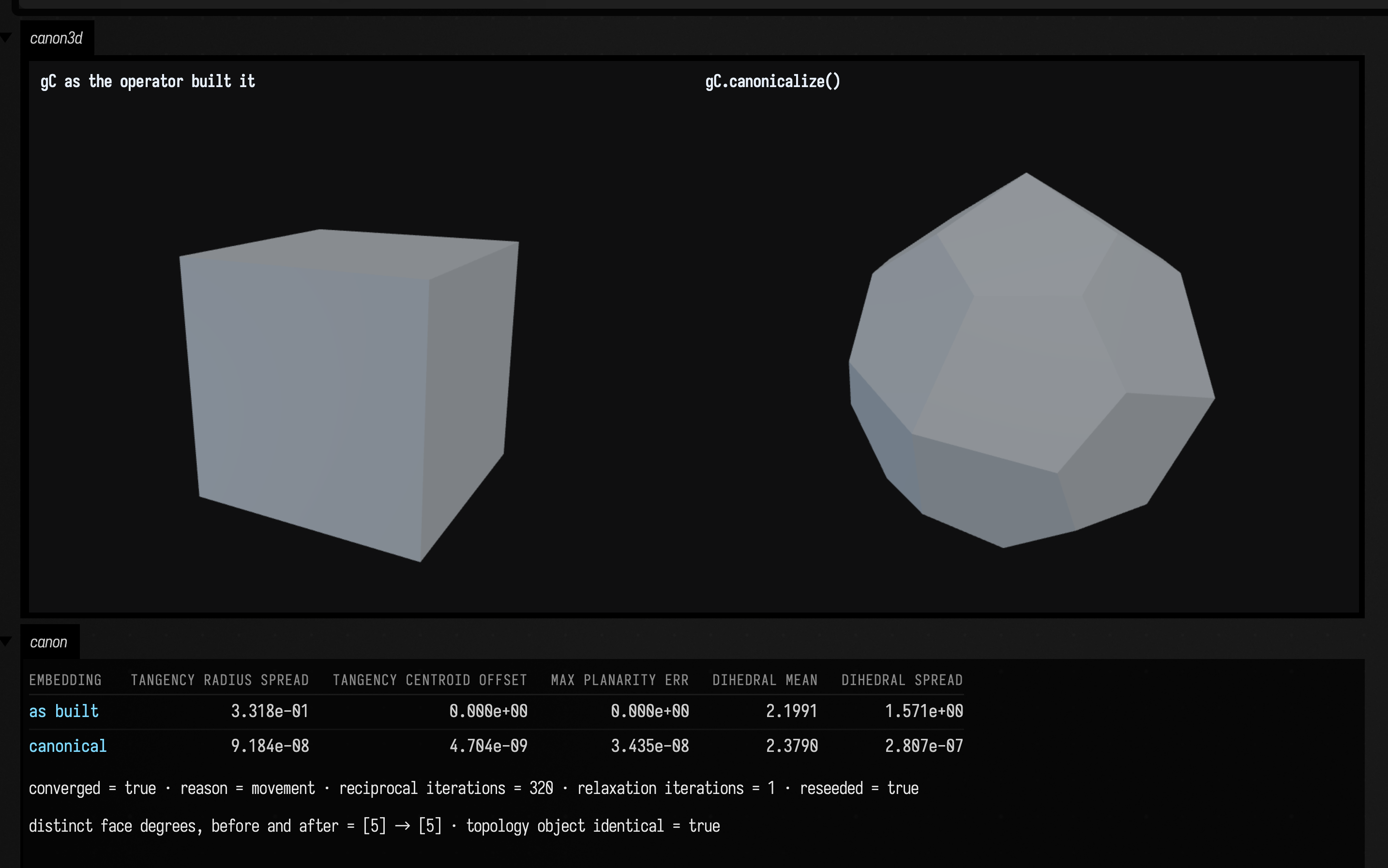
The left panel looks like a plain cube because its pentagons lie flat on the cube's squares. Both
panels share the same topology object (the readout checks it with ===), and both have only
pentagons; only the coordinates moved.
In the table, the flat cube's planarity error and tangency centroid offset are already zero: it is
planar and centred. What fails is tangencyRadiusSpread, the relative spread of distances from the
centre to each edge, which is zero only when one sphere touches every edge. That is the condition
canonicalization fixes, so an embedding can be planar and centred and still far from canonical.
The dihedral spread falls from 1.571 (π/2: the flat cube's faces meet at a right angle or are
coplanar) to 2.8e-07, so in the canonical form every pentagon meets its neighbours at one angle.
reseeded = true in the readout means the iteration could not get there from the flat cube and
restarted from a spectral embedding, described in realize(...) below.
Where it gives up
Because the canonical form is fixed by the combinatorics, a starting embedding the iteration
cannot use is not by itself a reason to fail: when an attempt diverges or plateaus, the run
restarts from a spectral embedding and CanonicalizeResult.reseeded records which embedding the
answer came from.
Not every input converges. Where one does not, the result has converged = false,
reason = "max iterations" and finite coordinates. kkC below is an example.
Realization3 stores Field's single-precision Vec3, so the achievable residual floor is about
1e-7 relative, however good the iteration is.
The counter-example: kkC
kkC (kis applied twice to the cube) is a case canonicalize() cannot handle. This example shows
three embeddings of the same topology: as built, after canonicalize(), and after
relaxWithCeres, which needs the Ceres native library:
:::static
// kis applied twice to the cube: 38 vertices, 108 edges, 72 faces. The standing counter-example.
// relaxWithCeres needs the native wrapper: ./gradlew buildCeresRedistributable
val seed = conway("kkC").polyhedron
val iterated = seed.canonicalize()
val solved = seed.relaxWithCeres(RelaxationPlan.canonicalConditions(), CeresRelaxationOptions(maxIterations = 500))

:::fold gauge all three to one scale, render them, and tabulate the three defining conditions
val gauge = RigidGauge()
val panels = [
    "kkC as built" to seed.normalize(gauge),
    "canonicalize()" to iterated.polyhedron.normalize(gauge),
    "relaxWithCeres()" to solved.realization.polyhedron.normalize(gauge),
]
threeGrid(
    panels.map { (label, p) -> ThreeMeshPanel(label, p.toTriMesh()) },
    channel = "kkc3d",
    name = "embeddings",
    columns = 3,
    height = 340,
    cellWidth = 380,
    view = MeshView(wireframe = false, distance = 3.2),
    padding = 1.26,
)
val sci = { v: Any? -> "%.3e".format(v) }
fun row(label: String, p: PolyhedralObject): List<Any?> {
    val d = p.canonicalDiagnostics()
    return [
        label,
        d.tangencyRadiusSpread,
        d.tangencyCentroidOffset,
        d.maxFacePlanarityError,
        d.dihedralAngleMin,
    ]
}

val metrics =
    Table(
            [
                "embedding",
                "tangency radius spread",
                "tangency centroid offset",
                "max planarity err",
                "min dihedral",
            ],
        )
        .rows(panels.map { (label, p) -> row(label, p) })
        .format("tangency radius spread", sci)
        .format("tangency centroid offset", sci)
        .format("max planarity err", sci)
        .format("min dihedral") { (it as Number).f3 }

markdown(
    "kkc",
    """
    ${metrics.h}

    canonicalize(): converged = ${iterated.converged} · reason = ${iterated.reason}

    relaxWithCeres(): ${solved.summary.md}
""",
)
:::endfold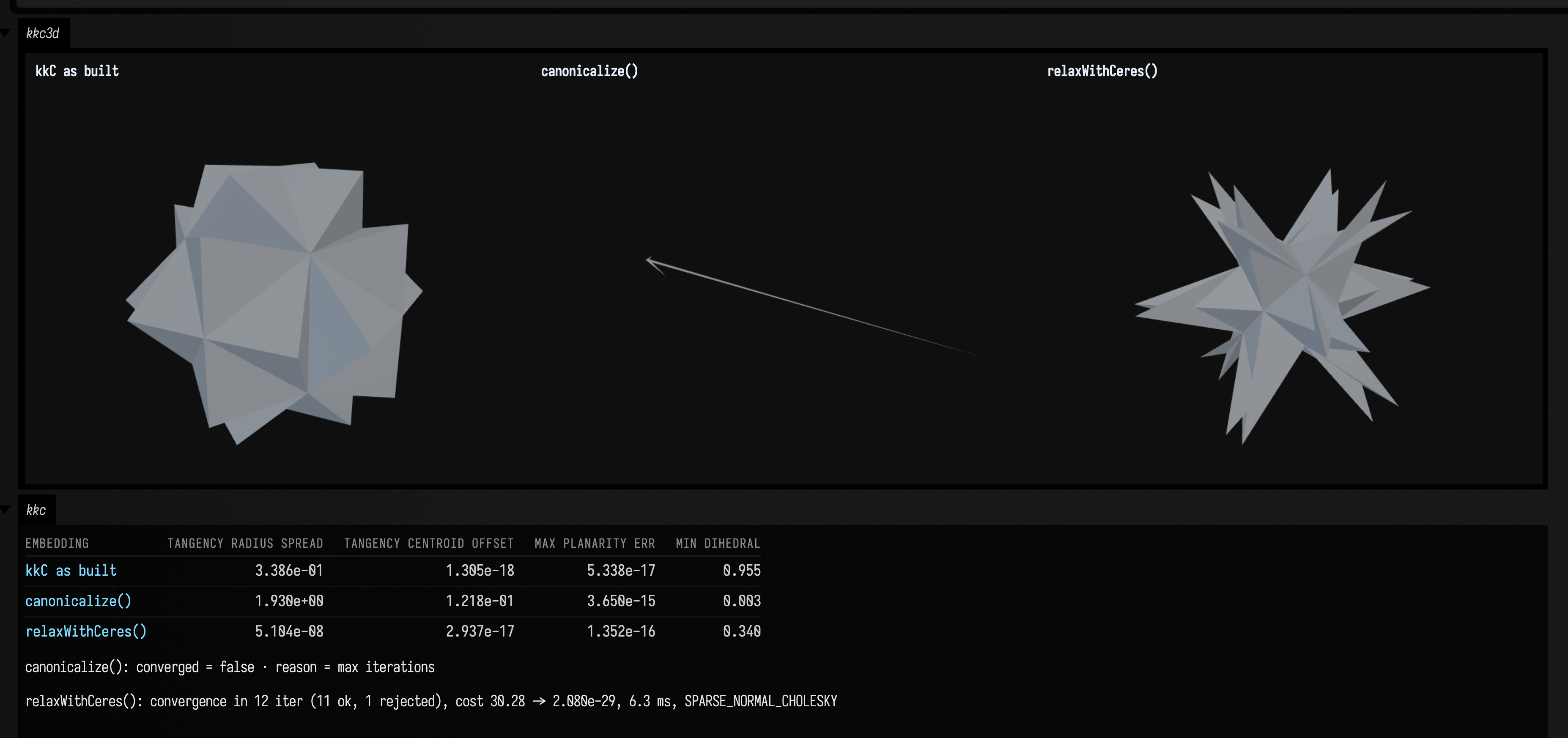
canonicalize() reports converged = false, and more iterations would not help: its result is
worse than its input, collapsed to a sliver with a minimum dihedral angle of 0.003 and a tangency
spread up from 3.4e-01 to 1.9e+00. Tangency is measured to the line through an edge, so a
shrinking edge satisfies its constraint for free, and the iteration finds that collapse instead of
the answer. When canonicalize() reports converged = false, try relaxWithCeres with
RelaxationPlan.canonicalConditions(), as in the right panel.
Why relaxWithCeres reaches kkC
relax minimises the same formula and collapses the same way on other solids (on kkT it
reports a small spread for a solid with a near-zero edge), so canonicalConditions() carries a
one-sided floor under edge length, MinEdgeLengthConstraint, which is zero on a healthy solid.
The Ceres path also carries each face's plane as a free unit normal plus an offset, and adds a
gauge term for the free rotation. dev_docs/CERES.md works through all three.
realize(...): coordinates from the combinatorics alone
realize builds coordinates from the topology alone. SpectralRealization uses the three
eigenvectors of the vertex graph Laplacian with the smallest non-zero eigenvalues, optionally
projected to the sphere. For a vertex-transitive polyhedron that is already the symmetric solid;
otherwise it is a good starting point for canonicalize(). This example takes the gyro-cube's
topology without its coordinates and compares the two routes to its canonical form:
:::static
// Throw the coordinates away and keep only the incidence structure.
val topologyOnly: PolytopeTopology = conway("gC").polyhedron.topology

val spectral = topologyOnly.realize(SpectralRealization())
val recovered = spectral.canonicalize()

// The same combinatorics reached the other way, for comparison.
val fromOperator = conway("gC").polyhedron.canonicalize()

:::fold render the two routes and their agreement
val gauge = RigidGauge()
threeGrid(
    "1 · spectral only" to spectral.normalize(gauge).toTriMesh(),
    "2 · canonicalize()" to recovered.polyhedron.normalize(gauge).toTriMesh(),
    "3 · canonicalize()" to fromOperator.polyhedron.normalize(gauge).toTriMesh(),
    channel = "spectral3d",
    name = "routes",
    columns = 3,
    height = 330,
    cellWidth = 380,
    view = MeshView(wireframe = false, distance = 3.2),
    padding = 1.26,
)
val dev = recovered.polyhedron.symmetryDeviation()
val spectralOnly = spectral.canonicalDiagnostics()
val sci = { v: Any? -> "%.3e".format(v) }
val routes =
    Table(["route", "tangency spread", "dihedral mean (rad)"])
        .rows(
            [
                ["1 · spectral only", spectralOnly.tangencyRadiusSpread, spectralOnly.dihedralAngleMean],
                [
                    "2 · from combinatorics alone",
                    recovered.finalDiagnostics.tangencyRadiusSpread,
                    recovered.finalDiagnostics.dihedralAngleMean,
                ],
                [
                    "3 · from the operator's coordinates",
                    fromOperator.finalDiagnostics.tangencyRadiusSpread,
                    fromOperator.finalDiagnostics.dihedralAngleMean,
                ],
            ],
        )
        .format("tangency spread", sci)
        .format("dihedral mean (rad)") { (it as Number).f4 }

markdown(
    "spectral",
    """
    ${routes.h}

    {muted:2 and 3 agree on the dihedral mean to} ${"%.2e".format(
        Math.abs(recovered.finalDiagnostics.dihedralAngleMean -
            fromOperator.finalDiagnostics.dihedralAngleMean,),)} rad

    {muted:symmetry readout of the recovered solid}

    vertex-radius spread ${sci(dev.vertexRadiusSpread)} ·
    edge-length spread ${sci(dev.edgeLengthSpread)} ·
    face-distance spread ${sci(dev.faceDistanceSpread)}

    combinatorial classes — vertices ${dev.orbits.vertexClassSizes.md} ·
    edges ${dev.orbits.edgeClassSizes.md} · faces ${dev.orbits.faceClassSizes.md} ·
    fully transitive = ${dev.orbits.fullyTransitive}
""",
)
:::endfold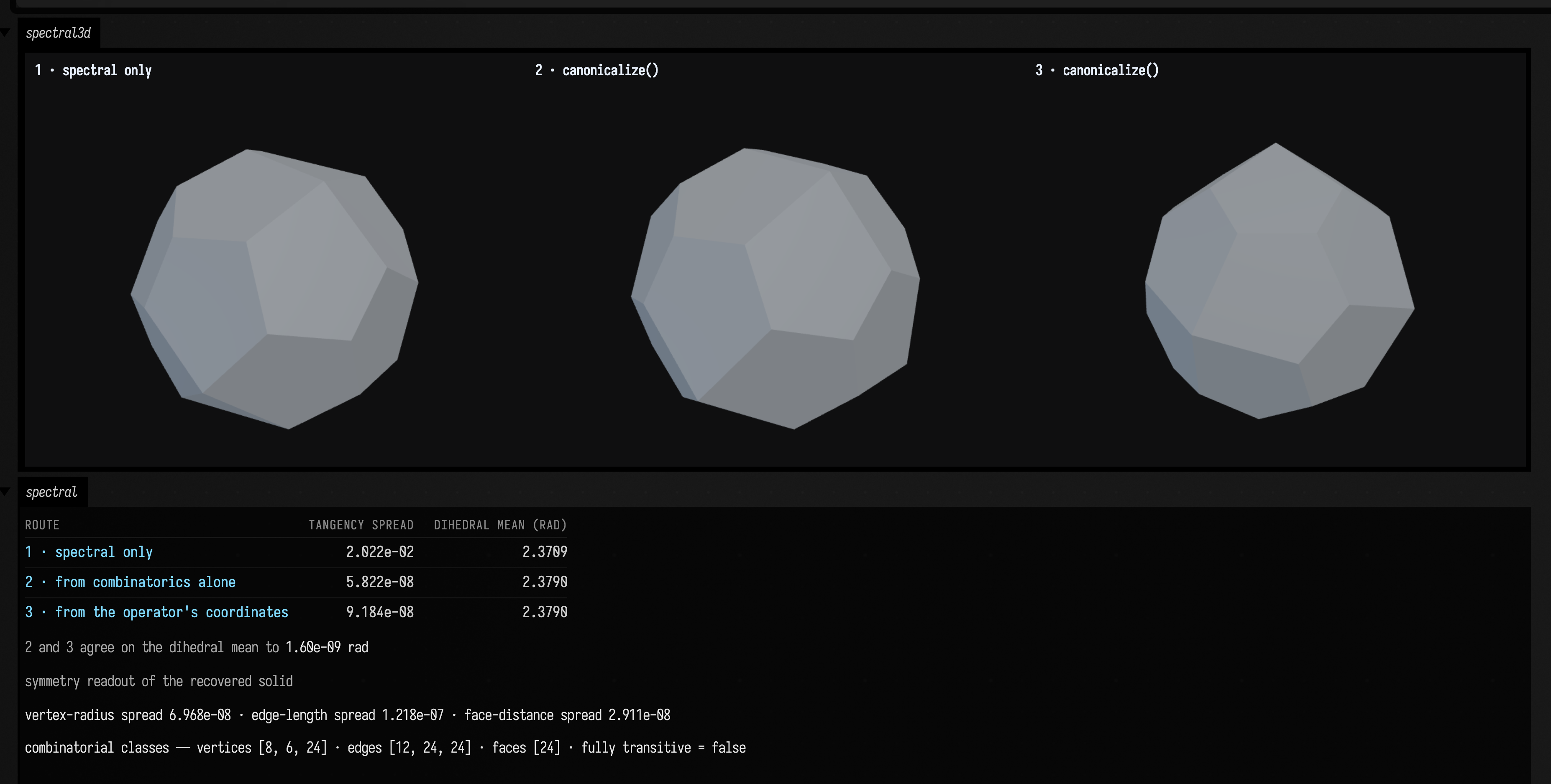
Panels 2 and 3 start from different coordinates, one from the graph alone and one from the
operator's placement, and reach the same solid, agreeing on the mean dihedral angle to around
1e-9 radians.
Panel 1, from the graph alone, already has a tangency spread of 2.0e-02 against the flat cube's
3.3e-01, and is close to the right dihedral angle. That is why canonicalize() reseeds from it
when an attempt fails.
The symmetry readout comes from combinatorialOrbits(), which groups elements by repeatedly
colouring them by their incidences. Each class contains one or more true symmetry orbits; where a
class is coarser than its orbits, the symmetry-orbit constraint reports a nonzero residual.
fullyTransitive = false is correct here: the pentagonal icositetrahedron is face-transitive but
not vertex-transitive, as the class sizes show.
Rank 4: the same core, one dimension up
PolytopeTopology works at any rank. Polytope4 uses it for four-dimensional polytopes, which the
Conway operators do not reach: the 5-cell, the tesseract, the 16-cell and the 24-cell, with
Realization4, an abstract dual(), and projections for viewing.
You do not declare a 4-polytope's faces; they are derived. convexPolytope4(coordinates,
facetNormals) takes vertex coordinates and outward facet normals. Each normal's hyperplane picks
out a cell, each pair of cells sharing a two-dimensional set of vertices gives a polygon, each
polygon is ordered by angle in its own plane, and the edges are consecutive polygon vertices.
An edge of a 4-polytope belongs to three or more polygons, so validate(checkManifold = true)
rejects a tesseract. Polytope4 refuses a rank-3 topology. PolyhedralObject accepts any rank, but
the Conway operators require rank 3 and triangulate, FLine conversion and face normals require a
3D realization. This example prints the four seeds' derived counts and draws a projected tesseract:
:::static
val seeds = [
    "5-cell" to fiveCell(),
    "tesseract" to tesseract(),
    "16-cell" to sixteenCell(),
    "24-cell" to twentyFourCell(),
]

// Viewing is a Projection4 above realization, not part of the geometry.
val projection = RotatedProjection4(
    a = 0,
    b = 3,
    angle = 0.30,
    then = PerspectiveProjection4(eye = 4.2),
)

val counts =
    Table(
            [
                "seed",
                "V",
                "E",
                "F",
                "C",
                "V-E+F-C",
                "polygons per cell",
                "closed 2-manifold?",
            ],
        )
        .rows(
            seeds.map { (name, p) ->
                val s = p.summary()
                val manifold = runCatching { p.topology.validate(checkManifold = true).isValid }.getOrDefault(false)
                [
                    name,
                    s.vertices,
                    s.edges,
                    s.polygons,
                    s.cells,
                    s.eulerCharacteristic,
                    s.cellPolygonCounts,
                    manifold,
                ]
            },
        )
        // A 4-polytope is not a surface, so the manifold check should answer false.
        .expect("V-E+F-C", because = "the Euler relation for a convex 4-polytope") { it == 0 }
        .expect("closed 2-manifold?", because = "a 4-polytope is not a surface") { it == false }

:::fold draw the tesseract's projected wireframe and print the four seeds' derived counts
val lines =
    tesseract().toEdgeFLines(projection) { _, line ->
        line.stroked = true
        line.thickness = 2.0
        line.color = vec(0.30, 0.82, 0.96, 0.85)
    }
threeLines(
    lines,
    channel = "rank4",
    name = "tesseract, rotated perspective projection",
    height = 430,
    autoFrame = true,
    editable = false,
)
displayOpen("rank4")

markdown("counts", counts.h)
:::endfold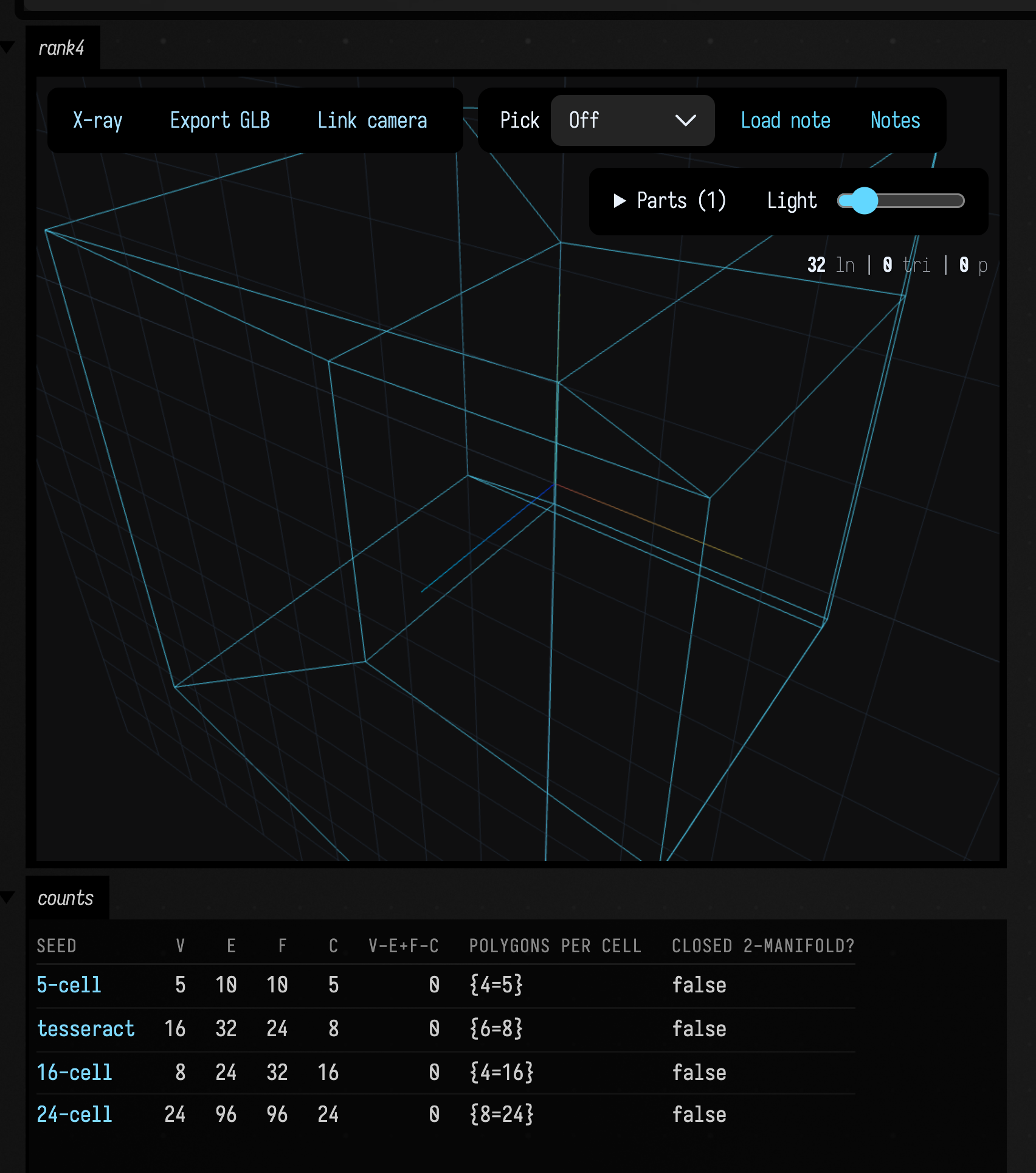
Every row satisfies \( V - E + F - C = 0 \), the Euler relation for a convex 4-polytope, and every row
reports false for the closed-2-manifold check, since a 4-polytope is not a surface.
There is no triangulate() for rank 4: a projected 4-polytope's polygons do not bound a surface,
so toEdgeFLines and toCellEdgeFLines give you a wireframe. OrthographicProjection4 maps the
tesseract's two cubes exactly onto each other; use a rotated or perspective projection to see both.
Into Field: one FLine per face
toFaceFLines() produces one closed, outward-wound FLine per face, with the face's id, rank and
attributes attached as line properties. Field's ordinary filled, stroked, hoverColor and
onClick then work per face. This example truncates four vertices of an ambo-ed cube and colours
each face by its lineage role:
:::static
// Truncate four of an ambo-ed cube's twelve vertices, then colour every output face by the
// role its lineage reports. Nothing here inspects a coordinate to decide a colour.
val seed = conway("aC")
val chosen = seed.polyhedron.topology.elements(0).filterIndexed { i, _ -> i % 3 == 0 }.map { it.id }
val result = seed.truncate(ElementSelectors.ids(chosen), ElementParameters.constant(0.30))
val out = result.polyhedron

val palette = mapOf(
    "original-face" to vec(0.30, 0.82, 0.96, 0.30),
    "truncated-face" to vec(1.00, 0.62, 0.24, 0.34),
    "partially-truncated-face" to vec(0.72, 0.58, 1.00, 0.32),
    "vertex-face" to vec(0.55, 0.95, 0.62, 0.32),
)
val faceLines = out.toFaceFLines { face, line ->
    val role = (result.lineage(face.id) as ElementLineage.Derived).role
    line.filled = true
    line.stroked = true
    line.thickness = 1.6
    line.color = palette[role] ?: vec(0.5, 0.5, 0.55, 0.25)
    line.hoverColor = vec(0.96, 0.98, 1.00, 0.95)
}

threeLines(
    faceLines,
    channel = "faces",
    name = "role-coloured faces",
    height = 460,
    autoFrame = true,
    editable = false,
)
displayOpen("faces")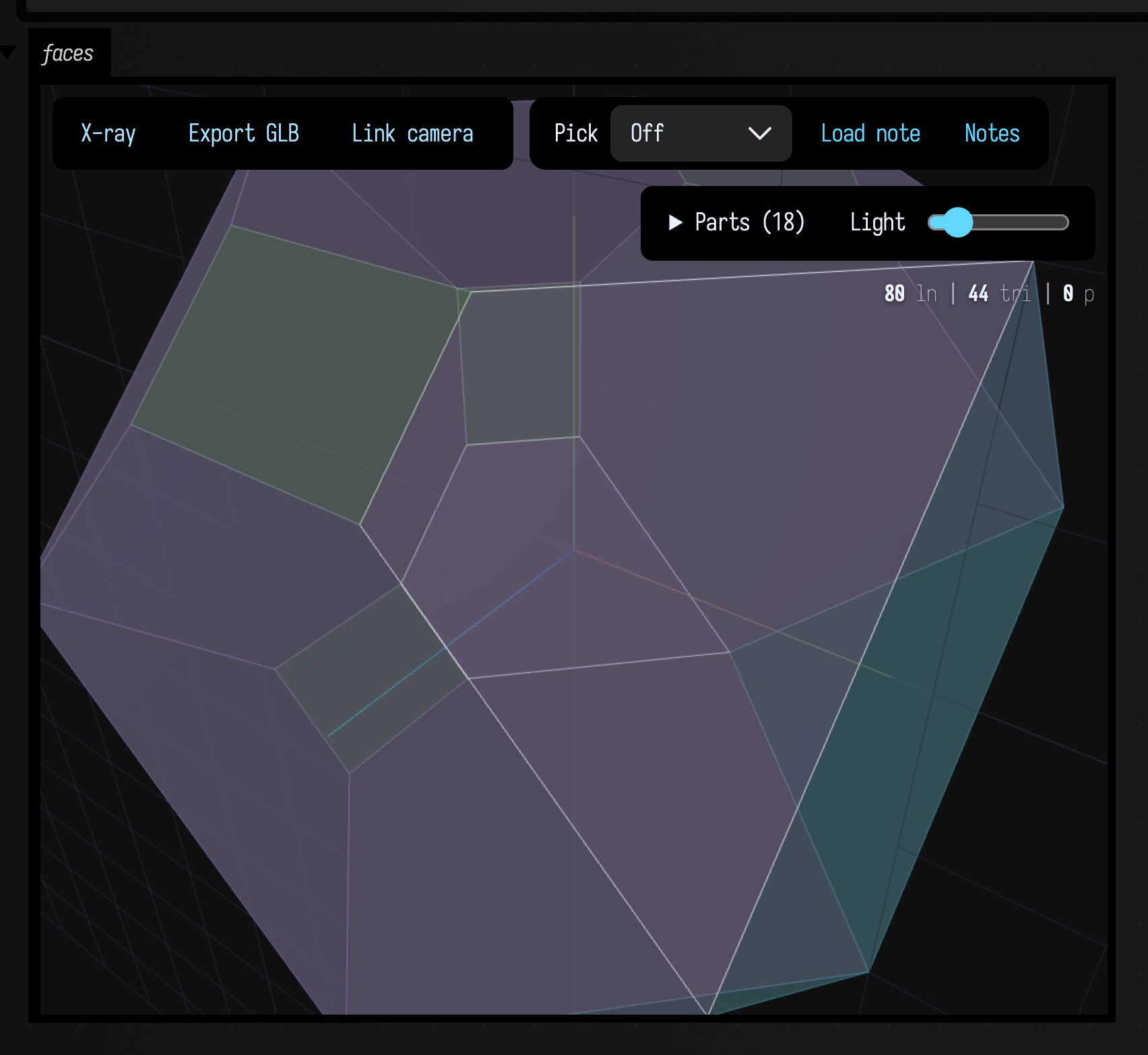
In a box this is the live threeLines(...) viewer: you can orbit it, hover a face and, with
onClick, pick one and read its provenance. The loadable demo at the foot of
this page does that.
This example prints what the same transform recorded and what each line carries:
:::static
val seed = conway("aC")
val chosen = seed.polyhedron.topology.elements(0).filterIndexed { i, _ -> i % 3 == 0 }.map { it.id }
val result = seed.truncate(ElementSelectors.ids(chosen), ElementParameters.constant(0.30))
val out = result.polyhedron
val faceLines = out.toFaceFLines()

val roles =
    out.topology
        .elements(2)
        .groupingBy { (result.lineage(it.id) as ElementLineage.Derived).role }
        .eachCount()
        .toSortedMap()
val first = faceLines.first()

markdown(
    "carried",
    """
| | |
|---|---|
| deployments recorded | ${result.deployments.joinToString(", ") { d -> "`${d.operation.displayName}` → " + (d.selectedSources?.let { "${it.size} selected" } ?: "whole natural domain (`null`)") }} |
| selected source vertices | ${result.deployments.last().selectedSources?.size} of ${seed.polyhedron.topology.elements(0).size} |
| output | ${out.topology.elements(0).size}v ${out.topology.elements(1).size}e ${out.topology.elements(2).size}f |
| `toFaceFLines()` returned | ${faceLines.size} FLines — one per polygonal face |
| roles present | ${roles.entries.joinToString(", ") { "`${it.key}` × ${it.value}" }} |
| properties on the first line | `${first.properties.filterKeys { it.startsWith("polytope") }}` |
| its node count | ${first.nodes.size} nodes for a ${out.topology.faceCycle(ElementId(first.properties[POLYTOPE_FACE_ID_PROPERTY] as Int)).size}-gon — the extra one is the `Close` marker |
""",
    width = 940,
)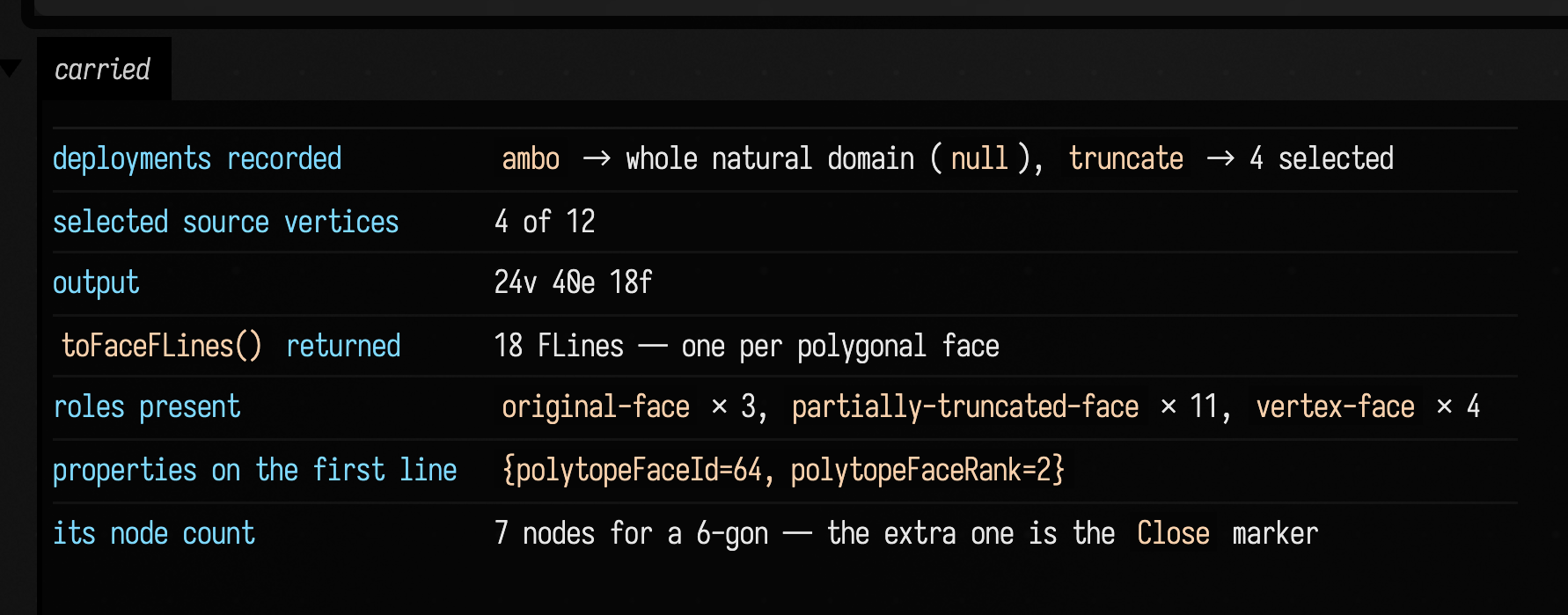
Both operations are recorded. A uniform operator's selectedSources is null, meaning every
element it applies to; a selective one records its set, so the chain can be re-run exactly.
Triangles, derived last, that still know where they came from
triangulate() projects each face into 2D, triangulates it with Field's FloatEarcut, and fixes
any triangle wound the wrong way. It duplicates polygon corners between faces, because TriMesh
stores normals per vertex and each side of a crease needs its own flat normal. This example
compares the polytope's counts with the render mesh's:
:::static
val p = conway("tC").polyhedron // truncated cube: octagons and triangles
val g = p.triangulate()

// The polytope's own view of the object, and the render mesh's view of the same object.
markdown(
    "tri",
    """
#### `conway("tC").polyhedron.triangulate()`

| | the polytope says | the render mesh says |
|---|---|---|
| vertices | ${p.topology.elements(0).size} abstract | ${g.mesh.vertexCount} render vertices |
| faces | ${p.topology.elements(2).size} polygons ${p.topology.elements(2).groupingBy { p.topology.faceCycle(it.id).size }.eachCount().toSortedMap().entries.joinToString(", ") { "(${it.value}×${it.key}-gon)" }} | ${g.triangleCount} triangles |
| Euler characteristic | ${p.topology.eulerCharacteristic()} | ${g.mesh.topology().eulerCharacteristic} |
| closed | ${p.topology.validate(checkManifold = true).isValid} | watertight = ${g.mesh.topology().isWatertight} |

Both are right. `triangulate()` duplicates every polygon corner so each face can carry its own flat
normal, so the *render* mesh is ${p.topology.elements(2).size} disconnected polygons. The topology
is the thing that knows the solid is closed.

- distinct source polygons across all triangles: **${g.triangleFaceIds.toSet().size}**
- distinct abstract vertices across all render vertices: **${g.vertexElementIds.toSet().size}**
- flat normals present: **${g.mesh.normals != null}**
- `mesh.summary()`: `${g.mesh.summary()}`
""",
    width = 980,
)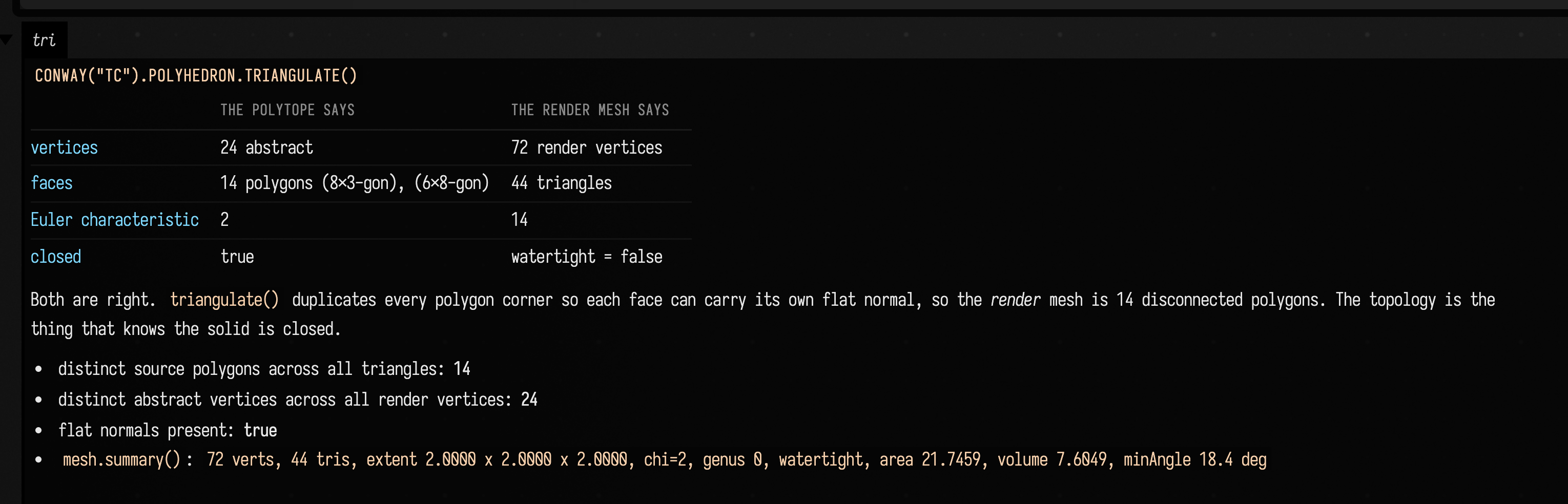
From the mesh alone, the truncated cube looks like loose polygons with a boundary. The topology
knows it is closed, and sourceFace / sourceVertex map each triangle and render vertex back to
it.
EarcutFaceTriangulator is the default; it handles concave faces and faces with holes.
FanFaceTriangulator is for convex faces only.
A face can have holes
A face is an outer cycle plus zero or more inner rings: faceCycle returns the outer one,
faceHoles the inner rings, and faceRings all of them.
An object with a holed face is no longer a closed manifold, so operations that need one refuse it
with a message. This example builds cubeWithWindow, a cube with a square hole in one face, and
lists what it reports and refuses:
:::static
val solid = cubeWithWindow(side = 0.45f)
val topology = solid.topology
val windowed = topology.elements(2).single { topology.faceHasHoles(it.id) }
val geometry = solid.triangulate()
val rimTriangles = (0 until geometry.triangleCount).count { geometry.sourceFace(it) == windowed.id }
val manifold = topology.validate(checkManifold = true)
// Everything a holed face refuses, and the message it refuses with.
val refusals =
listOf<Pair<String, () -> Any>>(
"topology.dual()" to { topology.dual() },
"solid.bevel()" to { solid.bevel() },
"solid.toOff()" to { solid.toOff() },
"solid.triangulate(FanFaceTriangulator)" to { solid.triangulate(FanFaceTriangulator) },
)
.map { (name, call) ->
name to (runCatching { call() }.exceptionOrNull()?.message ?: "no exception — unexpected")
}
:::fold the boundary, the two characteristics, and the refusals
markdown(
"window",
"""
#### One face, two boundary rings
| | value |
|---|---|
| outer cycle (`faceCycle`) | ${topology.faceCycle(windowed.id).size} vertices |
| inner rings (`faceHoles`) | ${topology.faceHoles(windowed.id).map { it.size }} |
| all rings (`faceRings`) | ${topology.faceRings(windowed.id).size} |
| χ counting elements | ${topology.eulerCharacteristic()} |
| χ counting cells | ${topology.cellularEulerCharacteristic()} |
| closed manifold | ${manifold.isValid}, with ${manifold.issues.size} one-sided window edges |
| triangles cut from that face | $rimTriangles — a solid square is 2 |
#### What a holed face refuses, by name
| call | message |
|---|---|
${refusals.joinToString("\n") { (call, message) -> "| `$call` | ${message.md} |" }}
""",
width = 940,
)
:::endfold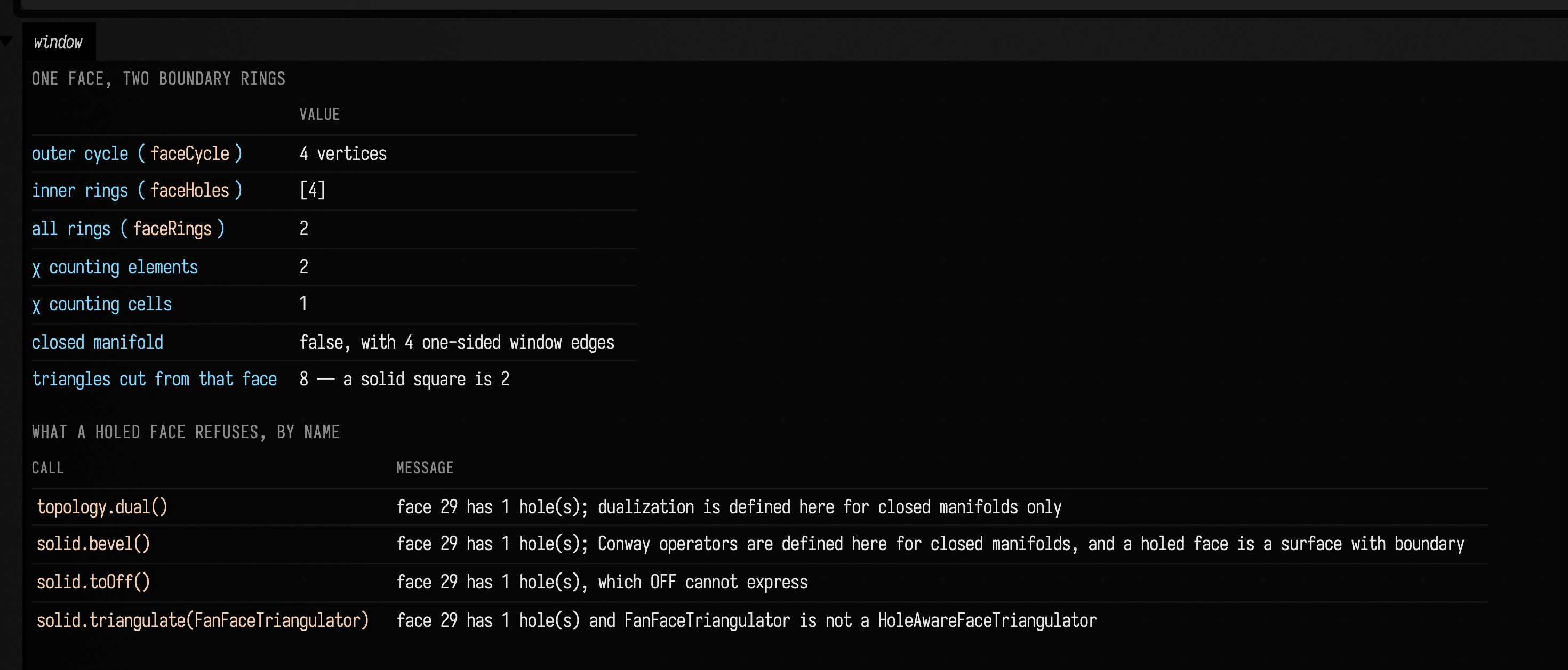
The two Euler characteristics answer different questions. Counting elements gives 2, because a cube
with a window has a cube's elements. Counting cells gives 1, because a face with one hole
contributes 1 - 1: a sphere with a window punched in it is a disk, and χ of a disk is 1.
The hole, in pixels, beside the same face without one
This example builds one square face by hand, once with an inner ring and once without, and renders
both with back-face culling on, so a triangle wound the wrong way would be missing. The folded part
shows how to declare a hole with PolytopeTopologyBuilder.addFaceHole:
:::static
val hole = 0.45f

:::fold one square face, built by hand, optionally with one inner ring
/*
This is the whole of the hole API from a caller's side: record the ring's edges as
incidences of the same face, then declare the ring with addFaceHole. Winding is a
convention — outer counter-clockwise about the normal, inner clockwise — and nothing
downstream leans on it, because the tessellator decides which ring is outer geometrically.
*/
fun plate(withRing: Boolean): PolyhedralObject {
    val outer = [Vec3(-1f, -1f, 0f), Vec3(1f, -1f, 0f), Vec3(1f, 1f, 0f), Vec3(-1f, 1f, 0f)]
    val inner = [
        Vec3(-hole, -hole, 0f),
        Vec3(-hole, hole, 0f),
        Vec3(hole, hole, 0f),
        Vec3(hole, -hole, 0f),
    ]
    // buildList, not `outer + inner`: a box has afield.geometry.path in scope, where
    // `List<Vec3> + List<Vec3>` is element-wise vector addition and returns four points.
    val points = buildList {
        addAll(outer)
        if (withRing) addAll(inner)
    }
    val rings = if (withRing) [[0, 1, 2, 3], [4, 5, 6, 7]] else [[0, 1, 2, 3]]

    val builder = PolytopeTopologyBuilder(rank = 3)
    val vertices = points.map { builder.addElement(0) }
    val face = builder.addElement(2)
    for (ring in rings) for (i in ring.indices) {
        val edge = builder.addElement(1)
        builder.addIncidence(vertices[ring[i]], edge)
        builder.addIncidence(vertices[ring[(i + 1) % ring.size]], edge)
        builder.addIncidence(edge, face)
    }
    builder.setFaceCycle(face, rings.first().map { vertices[it] })
    rings.drop(1).forEach { ring -> builder.addFaceHole(face, ring.map { vertices[it] }) }
    builder.addIncidence(face, builder.addElement(3))
    return PolyhedralObject(builder.buildValidated(), Realization3(points))
}

:::endfold

val view = MeshView(
    yawDegrees = 0.0,
    pitchDegrees = 0.0,
    distance = 2.2,
    width = 300,
    height = 260,
    wireframe = true,
    cullBackFaces = true,
)
val cells =
    [true, false].map { withRing ->
        val plate = plate(withRing)
        val t = plate.topology
        val face = t.elements(2).single()
        ThreeMeshPanel(
            label = if (withRing) "addFaceHole(face, ring)" else "the same plate, no ring",
            mesh = plate.toTriMesh(),
            facts =
                "${t.elements(0).size}v ${t.elements(1).size}e · ${t.faceRings(face.id).size} ring(s)" +
                    " · ${plate.triangulate().triangleCount} triangles",
        )
    }
threeGrid(cells, channel = "plates", name = "plates", columns = 2, height = 260, view = view, padding = 1.02)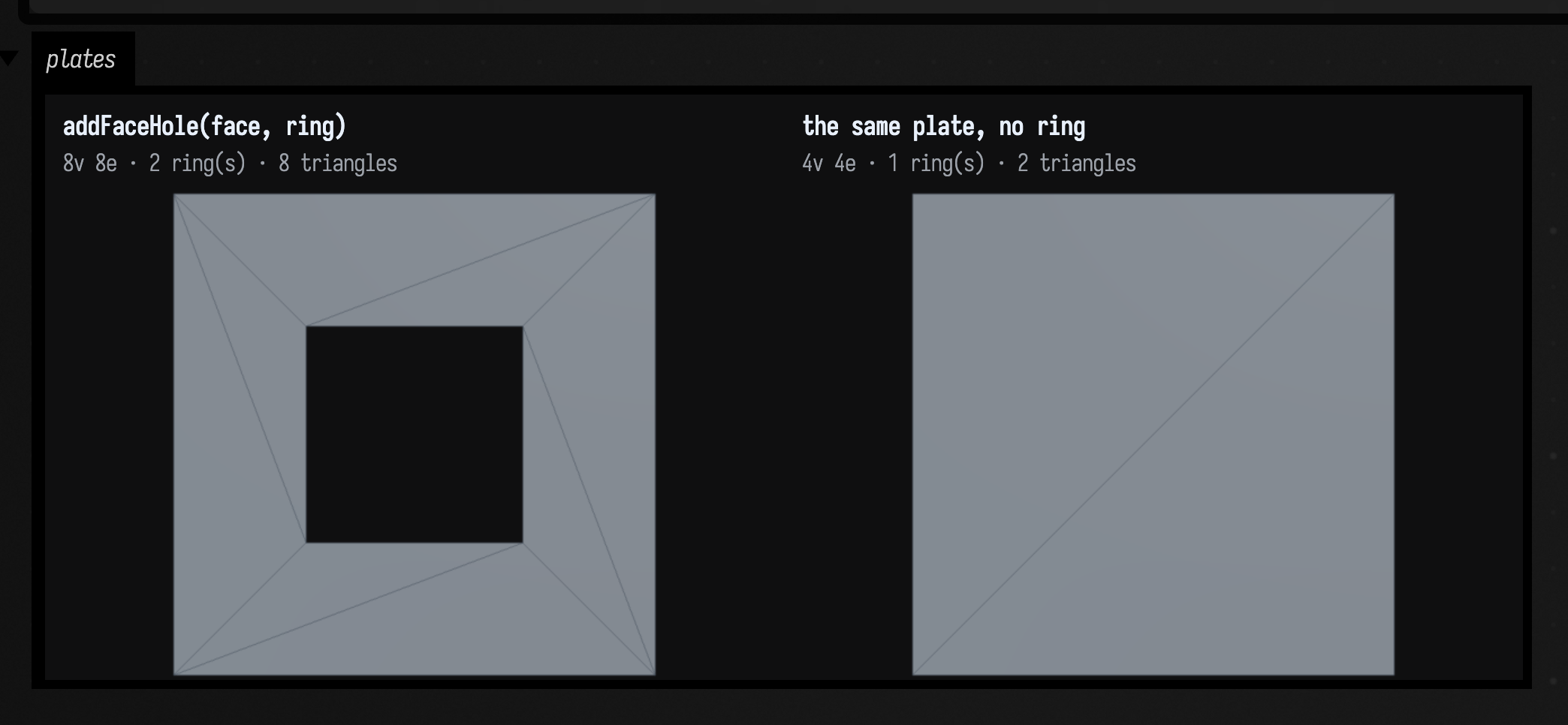
The holed face is cut into eight triangles around an empty window; without the ring it is two.
relax and canonicalize use outer rings only, so hole vertices are not constrained.
The registered value printers
Polytope values have registered printers, so a topology, a transform result or a triangulation
shows a readable summary when you viz it or leave it as a box's last expression. This example
shows a selective kis and its triangulation:
:::static
var seed = cube()
seed.topology.elements(2).take(2).forEach { seed = seed.withAttribute(it.id, "lift", 0.4) }
val result = seed.kis(ElementSelectors.attributeEquals("lift", 0.4), ElementParameters.attribute("lift"))

// Registered printers, not bespoke HTML: each of these reduces to a data class in Summaries.kt.
viz("inspection", [result, result.polyhedron.triangulate()])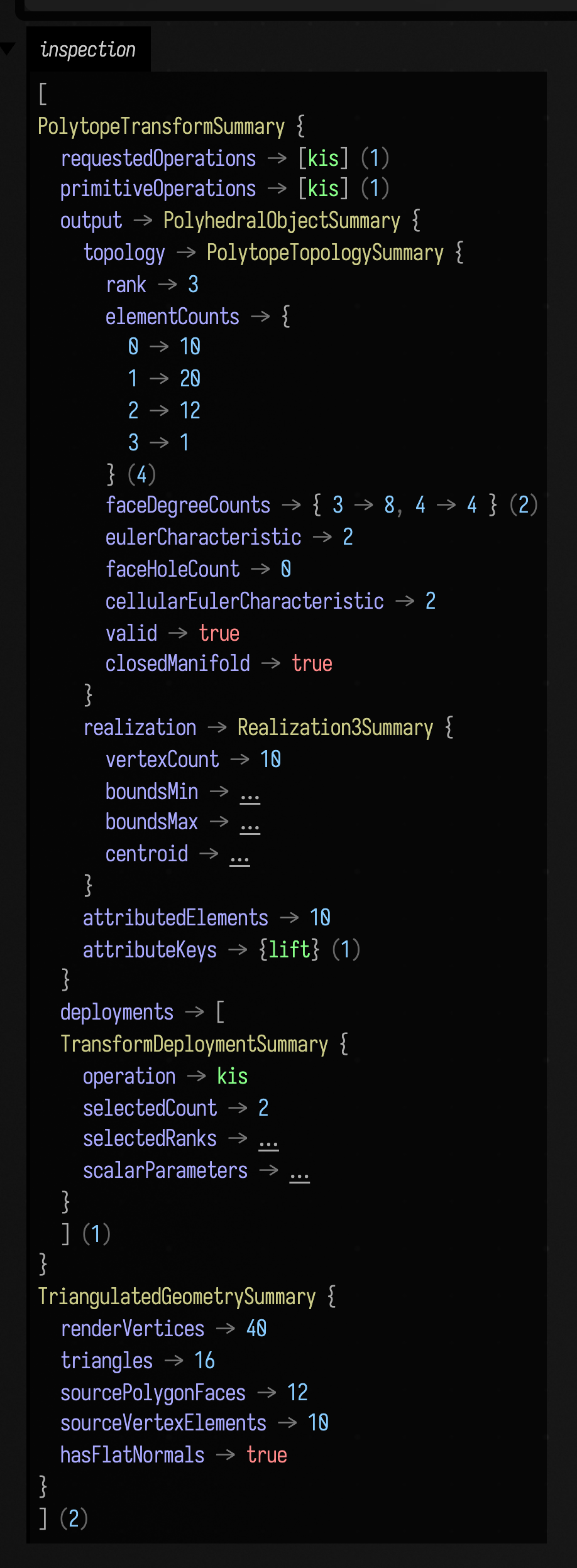
Click a … link in a live box to expand a nested value. println(result.summary()) prints the
same facts as text. Useful last expressions:
:::static
polyhedron
polyhedron.topology
result
result.deployments.first()
polyhedron.triangulate()
polyhedron.solveRealization()
A loadable demo
Each of these starting points is a document you can open, edit and re-run:
polytope_conway_demo: one compact box that marks two opposite cube faces with different heights, applieskisonly there, and sends the polygon faces to the on-canvas viewer. Hover a face, click it, and a provenance card reports the output face id, the transform role, the deployed height, the source elements and the 3D hit position.polytope_conway_gallery: small boxes for a Conway-expression gallery you can retype, a topology-only dual shown before a policy supplies coordinates, a non-uniform parameter field painted onto the output faces, and a realization before/after that leaves the diagnostics as its final value.polytope_canonical_gallery: one box that evaluates a Conway expression, canonicalizes it, and draws the realized and canonical forms side by side with the diagnostics underneath. Changeval expression = "gD"to"ktC","bD"or"sD"and re-run. Set it to"kkC"and the box reports thatcanonicalize()did not converge.polytope_holes_and_chains: thecubeWithWindowseed with its rings, Euler characteristics and refusals, as clickable polygon FLines; the hand-built plate with and without its hole; and every named composite chained off oneambo, with what each chain asked for beside what ran.
Limitations
- A face carries an outer cycle and any number of disjoint inner rings. A hole ring that touches its outer boundary, nested rings, and star/self-intersecting polygons are not represented; Earcut's winding and filling rules would be ambiguous for them.
- Transform parameters are maps of
StringtoDoublein the deployment records. There are no typed parameter descriptors, domains, units or composition yet. - There is no Wythoff construction, so the canonicalizer finds symmetry numerically instead of
being given it. For hard cases such as
kkC, userelaxWithCeres;kkT,kkOandkkIreach a spread of about1e-4even there. relax(...)builds its Jacobian by finite differences over3·Vparameters, so it suits polyhedra with tens of vertices, not large meshes.- Normals are flat only. Picking a face works through the
FLinepath (onClick), not throughtriangulate(). - Rank 4 has seeds, projections and a wireframe adapter, but no Conway operators. Ranks above 4 are allowed by the core but untested.
See also
- Polytopes reference — every public declaration in
afield.geometry.polytope, with the KDoc that lives beside it: the operator algebra and its composition rules, the realization verbs and their diagnostics, the attribute and selector algebra, and theFLine/TriMeshadapters. - Solvers reference — the Ceres constraint vocabulary behind
relaxandCeresRealization, plus the expression VM for residuals the vocabulary cannot say. - Meshes & 3D Geometry —
TriMesh,MeshView,showMeshand the Three.js viewer every gallery on this page is rendered by. - FLine Examples —
threeLines(...),onClick,hoverColorand the rest of the output surfacetoFaceFLines()plugs into. - Voronoi, Contours & Clusters — the other geometry family that hands back structure rather than pixels.
- Agent Transcript Gallery — how the loadable demos above are stored and replayed.