A λ-term you can hear
What might a computation sound like as it runs? Let's reduce a λ-term step by step and turn its
reactions into a rhythm you can listen to.
lambdaterms.kt parses the term and
compiles it to an interaction net (a graph of agents that rewrites itself one
connected pair, a reaction, at a time), and the Reducer in
interactionnets.kt fires one reaction at a time, reporting each as a ReductionStep.
LambdaSoundDocs records those steps
as a time series. patCondense, which runs the mini-notation parser backwards, finds the shortest
notation that plays the resulting step mask, and patRenderStereo plays it.
A pattern with a figure in it condenses to a shorter notation than one without, so the notation
patCondense returns tells you something about the order the reactions fired in. That order is
what changes when you change the scheduler.
One reduction, recorded
three two is Church exponentiation the other way round: the numeral three applied to the numeral
two, which is 2³. Most of its reactions are not β-steps (applying a function to its argument)
but the bookkeeping that keeps sharing
correct: fans copying, and scope delimiters (the agents that mark where a shared function body
begins and ends) moving and closing. The box below reduces it and plots the size of the net after
each reaction.
:::static
// trace() compiles, reduces and records; it does not relax the layout, because nothing is
// watching. The answer it read back is checked against the plain normal-order evaluator below.
val t = LambdaSoundDocs.trace("church-exp-two-cubed", ActivationOrder.FIRST_FOUND)

:::fold the net's size, the choice the scheduler had, and what came out
showSignals(
    "agents standing" to t.nodeSeries,
    "pairs a rule covers" to t.choiceSeries,
    // Short, because a plotly title wider than the plot is clipped rather than wrapped.
    title = "three two: after each of its 86 reactions",
    xTitle = "reaction",
    channel = "series",
)

markdown(
    "readout",
    """
| | |
|---|---|
| term | `${t.source}` |
| compiled to | ${t.initialNodes} agents, ${t.fans} fans |
| reactions | ${t.steps} |
| of those, β | ${t.betas} |
| rules fired | ${t.ruleTally.entries.joinToString(", ") { "`${it.key}` x${it.value}" }} |
| read back as | `${t.printed}` |
| left standing | ${t.remainingNodes} agents, ${t.trailingReduciblePairs} pairs a rule covers |
""",
    width = 1080,
)
:::endfold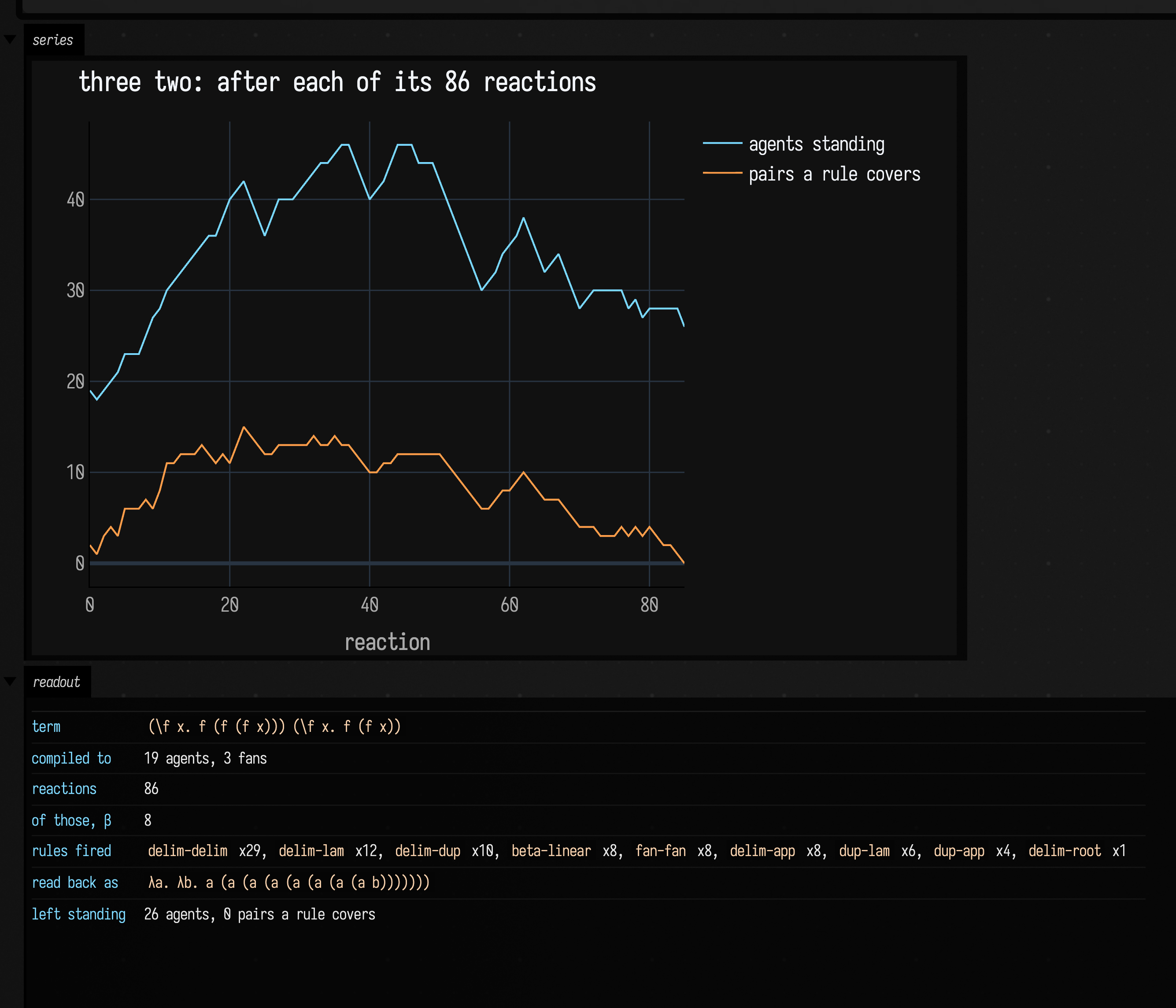
The lower trace is how many reactions were available at each moment, which is how much choice the scheduler had. It stays small throughout: only a handful of pairs are ready to react at any time, and the scheduler's job is to pick among them.
The scheduler does not change how long it takes
Reducer takes an ActivationOrder, which chooses the next active pair to fire. The order can
change, but the reaction count and the number of times each rule fires stay the same. The box below
reduces every term in the λ front end's corpus under all four schedulers and fails if any term
breaks either rule.
:::static
/*
Both of these throw rather than return false. Reaching the next line is the measurement:
stepCountIsScheduleInvariant names the term and the counts if any term breaks it, and
ruleMultisetIsScheduleInvariant is the stronger claim that the mixes match too.
*/
val sweep = LambdaSoundDocs.corpusSweep()
val counts = LambdaSoundDocs.stepCountIsScheduleInvariant(sweep)
val multisets = LambdaSoundDocs.ruleMultisetIsScheduleInvariant(sweep)
val spellings = LambdaSoundDocs.spellingsPerTerm(sweep)

:::fold the corpus, worst-spread first
val rows =
    sweep.entries
        .filter { counts.getValue(it.key) > 0 }
        .sortedWith(
            compareByDescending<Map.Entry<String, Map<ActivationOrder, LambdaSoundDocs.Trace>>> {
                    spellings.getValue(it.key)
                }
                .thenByDescending { counts.getValue(it.key) },
        )
        .joinToString("\n") { (name, traces) ->
            val first = traces.values.first()
            "| `$name` | ${counts.getValue(name)} | ${first.betas} | ${first.fans} | " +
                "${spellings.getValue(name)} | `${first.betaCondensation.notation}` |"
        }

markdown(
    "sweep",
    """
${sweep.size} terms x ${LambdaSoundDocs.ORDERS.size} schedulers = ${sweep.size * LambdaSoundDocs.ORDERS.size} reductions.
Reaction count is scheduler-invariant on **all ${counts.size}**; so is the rule multiset, on all $multisets.
Three corpus terms are already normal forms and are left out of the table.

| term | reactions | β | fans | distinct β spellings | the FIRST_FOUND spelling |
|---|---|---|---|---|---|
$rows
""",
    width = 1120,
)
:::endfold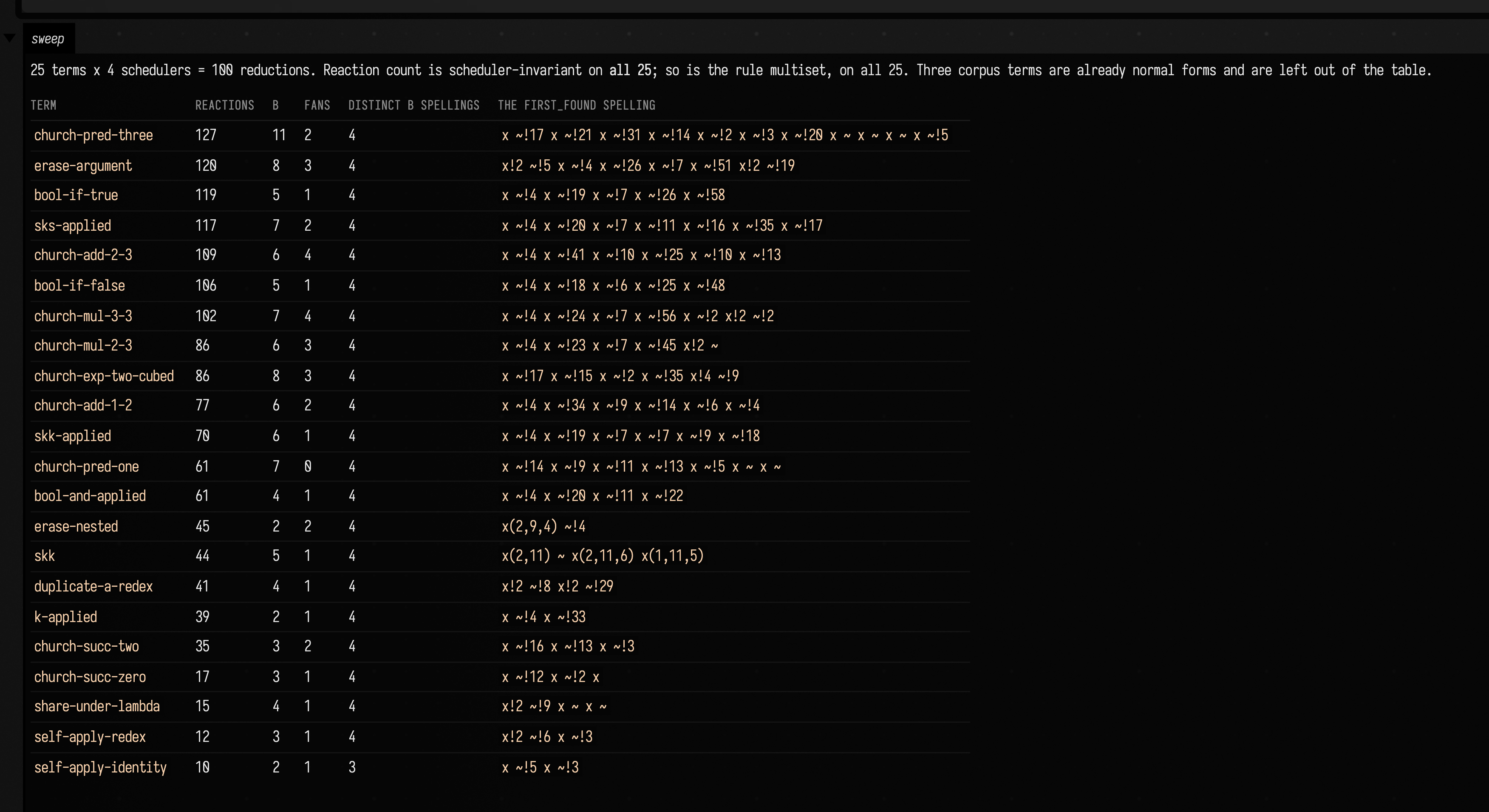
This follows from a result of Lafont's: interaction nets are strongly confluent. Two reactions available at once involve disjoint pairs of agents, so firing one cannot destroy the other, and a strongly confluent system that terminates reaches its normal form in the same number of steps down every path.
What the scheduler does change
Because the order differs, the β-steps land in different places, and patCondense can return a
different notation for each scheduler. The box below takes three two under all four schedulers
and draws where its β-steps fall.
:::static
/*
The same term the two clips below play, under each of the four reproducible schedulers.
answerIsScheduleInvariant checks all four against the plain normal-order evaluator, so the
"one answer" column is a measurement and not a caption.
*/
val traces = LambdaSoundDocs.traceAllOrders(LambdaSoundDocs.BAR_TERM)
val answer = LambdaSoundDocs.answerIsScheduleInvariant(traces)
val betas = LambdaSoundDocs.betaIsScheduleInvariant(traces)

:::fold the four beta masks as lanes, then their spellings
showPatRollOf(
    *traces.map { (order, t) -> order.name to t.betaCondensation.pattern }.toTypedArray(),
    title = "three two: where the $betas beta-steps fall, under four schedulers",
    subtitle = "one slot per reaction, ${traces.values.first().steps} reactions, one cycle each",
    cycles = 1,
    channel = "masks",
)

val rows =
    traces.entries.joinToString("\n") { (order, t) ->
        "| `${order.name}` | ${t.steps} | ${t.betas} | `${t.betaCondensation.notation}` | " +
            "${t.betaCompression.f2} | ${t.betaCondensation.exact} |"
    }
markdown(
    "spellings",
    """
All four read back as `$answer`.

| scheduler | reactions | β | shortest notation | against a flat spelling | the search signed for it |
|---|---|---|---|---|---|
$rows
""",
    width = 1080,
)
:::endfold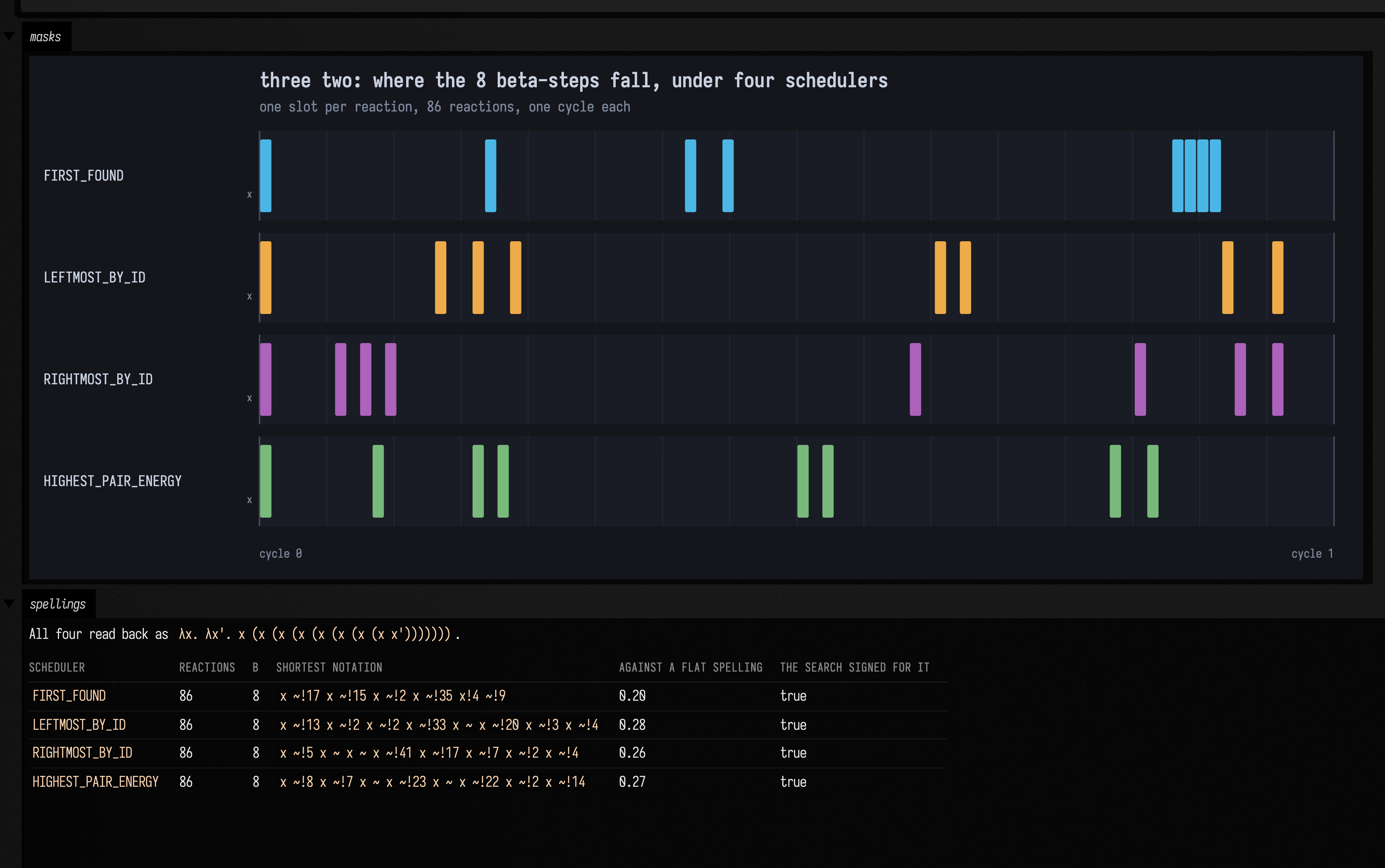
FIRST_FOUND lands its last four β-steps together near the end of the bar and the notation says so: a
long rest and then x!4. RIGHTMOST_BY_ID spreads its last four out, so its notation has no
replicate at all, only single strikes and rests. Nothing in the condenser knows what a λ-term is; it
is looking for the shortest string that plays what it was handed.
Compression is a ratio of characters, so the length of the atom affects it. Both bars above use
x, as the CA chain does. Compare two notations only when they use the same
atom.
Here is FIRST_FOUND's bar, three cycles at 0.4 cycles per second:
Now listen to RIGHTMOST_BY_ID. It reaches the same answer with eighty-six reactions and eight β-steps, but fires them in a different order:
The two clips have the same strikes, voice and tempo, so they match in length and loudness. They differ only in where the strikes fall.
The reduction as pitch
A rule emits an event when it fires. A closed term emits six kinds of event: beta, branch,
prune and annihilate, and scope and unscope for a scope delimiter moving and closing. Map
those to six degrees of a minor pentatonic and a reduction becomes a tune whose notes are its rule
sequence.
val notes = LambdaSoundDocs.trace("erase-argument").melody

// -> one MIDI note per reaction, pitched by the kind that reaction emitted
K I (mul 2 3) is the corpus's erasing term: it computes six and throws it away. Nine of its 120
reactions are prune, taking the discarded multiplication apart agent by agent, because an
interaction net cannot simply drop a wire; most of the rest are scope and unscope.
Where each piece is documented
- Interaction Nets examples for the agents, the rule book, the
Reducerand the λ front end, and for the rare untyped terms the readback cannot read. - Patterns & Rhythm for the event model and the mini-notation, and
PAT_CONDENSE.mdfor the condenser, the bounds it searches under and what it refuses. - Sound and Making a Sound, Every Path There Is for the voice used here and how audio is rendered offline for these pages.
- A cellular automaton you can hear uses the same mask, condense and play steps, fed by an elementary cellular automaton instead of a reduction.