Optical flow
Optical flow turns two images into a motion field you can use in another shader. It follows visible image patterns, so it can work on video, rendered geometry, or a changing procedural texture. It does not know which patterns belong to a real moving object.
Which backend runs where
Field has two implementations behind one contract. opticalFlow(...) picks between them for you:
| Backend | Class | Runs on | Cost channel |
|---|---|---|---|
HARDWARE |
HardwareOpticalFlow |
Devices with VK_NV_optical_flow enabled: NVIDIA Ada (RTX 40-series) and later |
The engine's raw matching cost |
PYRAMID |
PyramidOpticalFlow |
Every Vulkan device Field runs on, including macOS through MoltenVK | Mean absolute window residual, in grey levels 0–255 |
OpticalFlowBackend.AUTO, the default, chooses HARDWARE when the device reports the extension and PYRAMID otherwise. Both starting points below print the backend they used. The motion vectors mean the same thing on both. The cost scales differ, so a rejection threshold tuned on one backend does not transfer to the other.
PyramidOpticalFlow is a coarse-to-fine Lucas–Kanade tracker written as ordinary fragment passes. It builds a five-level image pyramid and searches the coarsest level exhaustively for integer offsets. Each finer level then refines the upsampled estimate with Gauss–Newton steps over a 9 × 9 window, and a 3 × 3 vector median rejects isolated wrong matches. It needs no extension. Its constructor exposes levels, radius, iterations, finestIterations and search.
Open the starting point
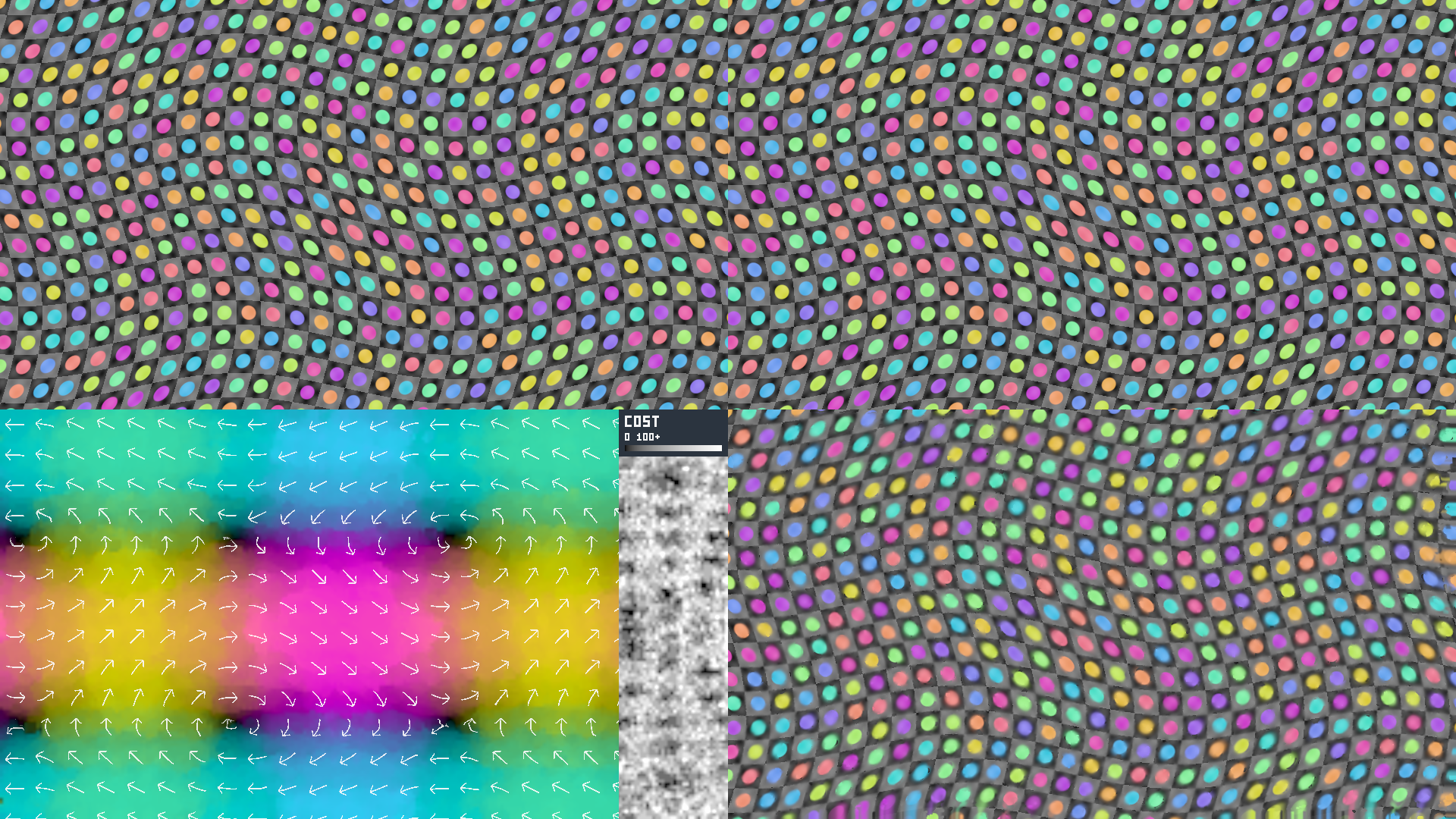
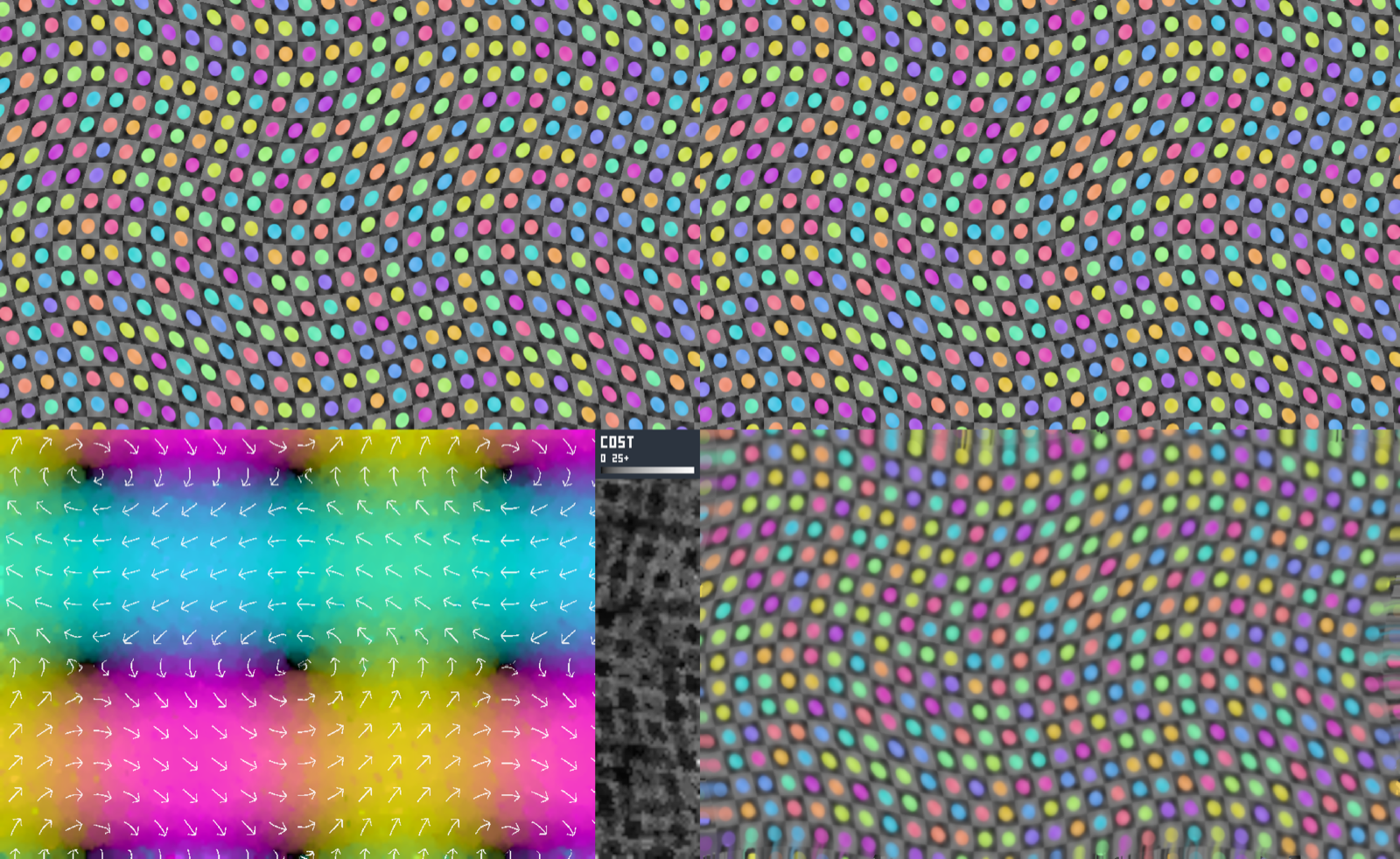
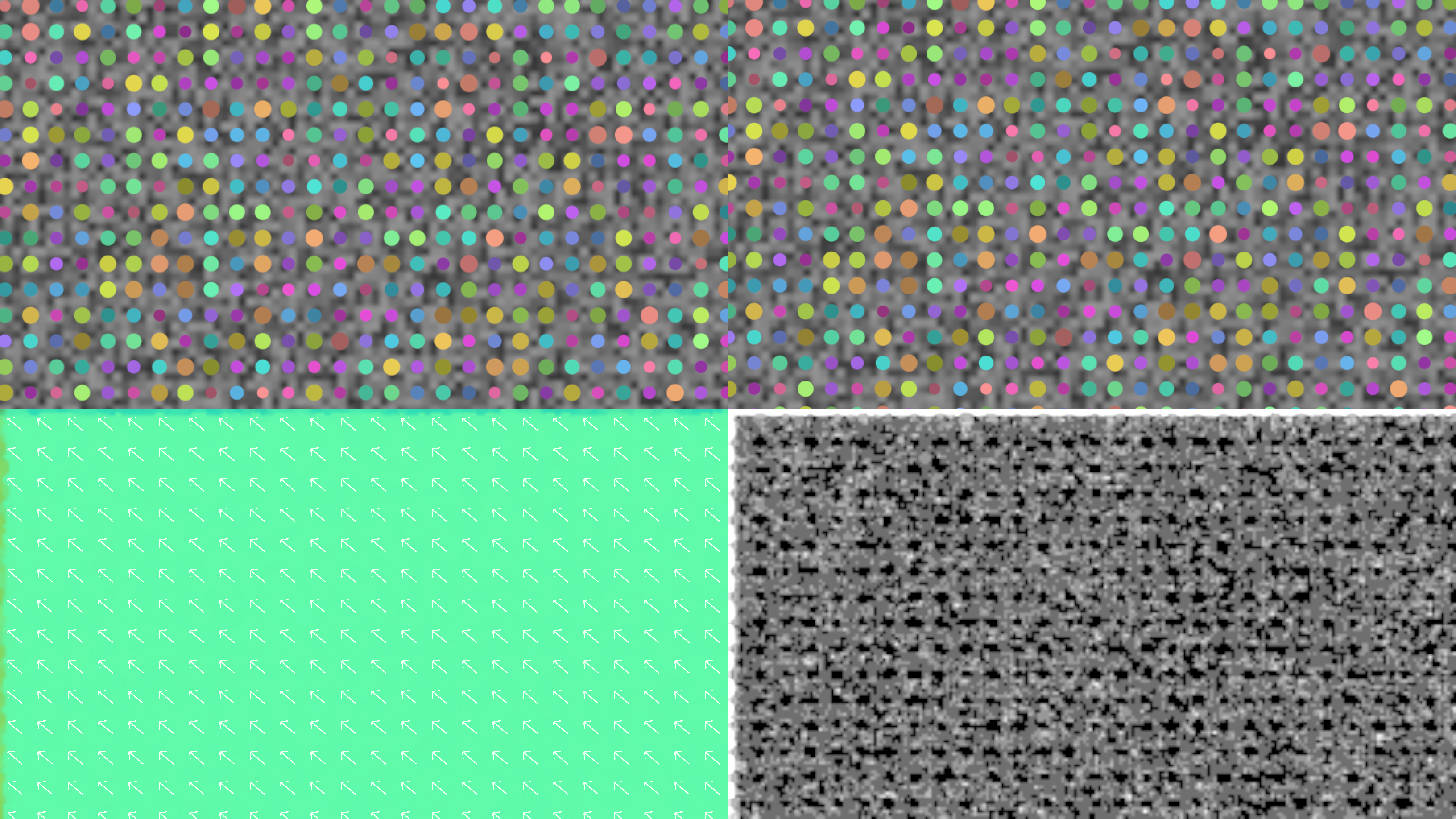
Open the optical_flow starting point. The top row shows the two input images. Below them are a color wheel and arrows for motion, a grayscale strip labelled COST, and a feedback image carried by that motion. The strip's scale label shows which backend is running: 0 100+ for the hardware cost, 0 25+ for the portable residual.
Consecutive-frame wiggle compares two frames of the same deforming image, 1/30 second apart. There is no added global translation: arrows should bend across the image and reverse as the source wiggles. Their lengths are normalized for readability; color intensity represents speed, with full intensity at 3 input pixels per pair.
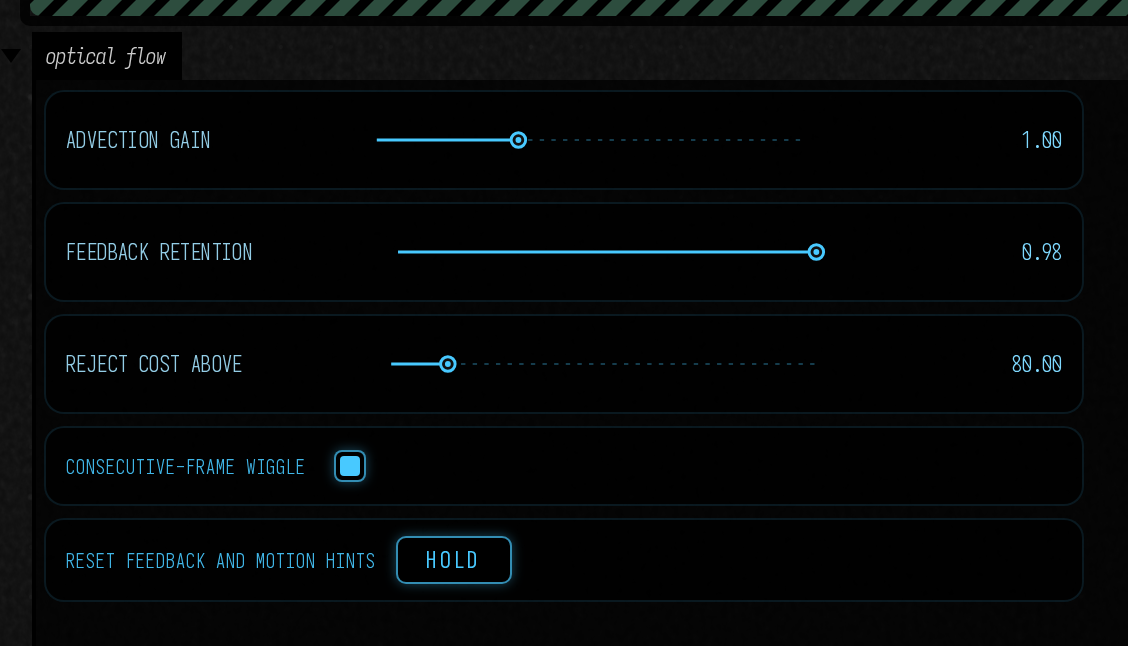
Turn off the wiggle to run the separate known translation check: exactly 12 pixels right and 8 pixels up. That setting should produce a mostly uniform up-right field. Advection gain, Feedback retention, and Reject cost above control how the measured field moves the feedback image. Reset clears feedback and the engine's temporal hints.
On the wiggle, away from the borders, expect a median endpoint error of about 0.15 input pixels against the known local deformation, and 0.35 pixels at p95, on the RTX 4090's hardware engine. Feed the same frame twice and the field stays under a quarter of a pixel everywhere.
The COST strip displays the backend's matching cost at those same image coordinates. On hardware its 0 100+ scale runs from black (low cost) to white (100 or above); on the portable backend 0 25+ covers 0 to 25 grey levels of residual. It occupies the rightmost 15% of the flow panel; it is not a compressed cost map of the whole image. The Reject cost above control uses this same signal when deciding whether to carry the previous image or take the fresh source at that pixel.
The field can be useful even when the correspondence is imperfect. Repetition, newly revealed regions, lighting changes, and abrupt procedural edits all make it less reliable. The cost strip exposes some of that uncertainty; neither backend's cost is a calibrated probability or confidence score.
Constructing the operation
opticalFlow(renderer, firstImage, secondImage, grid = 4) creates a reusable operation, an OpticalFlowOperation, on whichever backend AUTO picks. Pass backend = OpticalFlowBackend.PYRAMID to force the portable one. The two image arguments have type HasImageView, Field's interface for a GPU image view. A RenderToTexture implements that interface, so two RTTs can be passed directly:
// firstTarget and secondTarget are already-rendered RTTs of the same size.
val flow = opticalFlow(renderer, firstTarget, secondTarget, grid = 4)

// After the input producers have submitted, between Field frames:
flow.evaluate(reset = cameraCut)

// Publish the result for ordinary texture lookup by name.
prop<RenderToTexture>(motion) = flow.output| Argument or result | Meaning |
|---|---|
renderer |
Owns the Vulkan device and submission resources; both inputs must belong to that device. |
firstImage |
Earlier image. An RTT passed directly supplies its first color attachment. |
secondImage |
Later image, with the same width and height. |
grid = 4 |
One flow texel per 4 × 4 input pixels. A 960 × 540 pair produces a 240 × 135 field. Supported grids are checked on the device. |
backend |
OpticalFlowBackend.AUTO (the default), HARDWARE, or PYRAMID. |
quality |
Hardware only, on HardwareOpticalFlow(...): HardwareOpticalFlow.Quality.FAST, MEDIUM, or SLOW (the default). |
flow.output |
An owned RenderToTexture, containing a sampled RGBA32F motion texture. |
For two attachments of one RTT, select them explicitly:
val flow = opticalFlow(
    renderer,
    pair.imageViewArray[0],
    pair.imageViewArray[1],
    grid = 4,
)
The inputs are borrowed: keep them alive while the operation uses them. evaluate() reads their current contents; it neither renders them nor keeps a previous input frame for you. Recreate the operation when dimensions, grid, quality, or input resources change. Call flow.close() when finished, after removing consumers of its output.
Inputs are opaque linear RGB images of equal size. Both backends apply the same tone map and gamma conversion to each. The hardware path then makes the engine's BGRA8 inputs and unpacks its signed fixed-point vectors on the GPU; the portable path tracks the resulting luma. None of the images cross the CPU boundary during evaluation.
Sample the motion as a texture
flow is the operation; flow.output is the texture. Publishing the latter as prop<RenderToTexture>(motion) lets a moduleHere() in this box or a child resolve sampler2D motion by name, just like a color RTT. A fragment or compute shader can read it with:
layout(set=0,binding=0) uniform sampler2D motion;

// In your shader, at normalized image coordinates uv:
vec4 field = texture(motion, uv);
vec2 displacementPixels = field.xy;
float matchingCost = field.z;
XY is first-image → second-image displacement in input pixels: X points right and Y points down. Z is the backend's matching cost, where lower is better; W is 1. The vectors remain in input pixels even though the texture has fewer texels. Divide by the input image size, not the motion-texture size, to obtain a UV displacement. This is numerical data: do not apply color grading or gamma conversion to the motion field.
The hardware adapter submits to a dedicated optical-flow queue; the portable one records its passes into a graphics-queue command buffer. Both wait for a final fence before returning. Call evaluate() between frames, after the producers have submitted, rather than inside a Target.render callback that is already recording a frame. Its output is ready for the following Field rendering. It does not yet overlap several image pairs; account for the wait in your frame budget.
A forward–backward confidence map
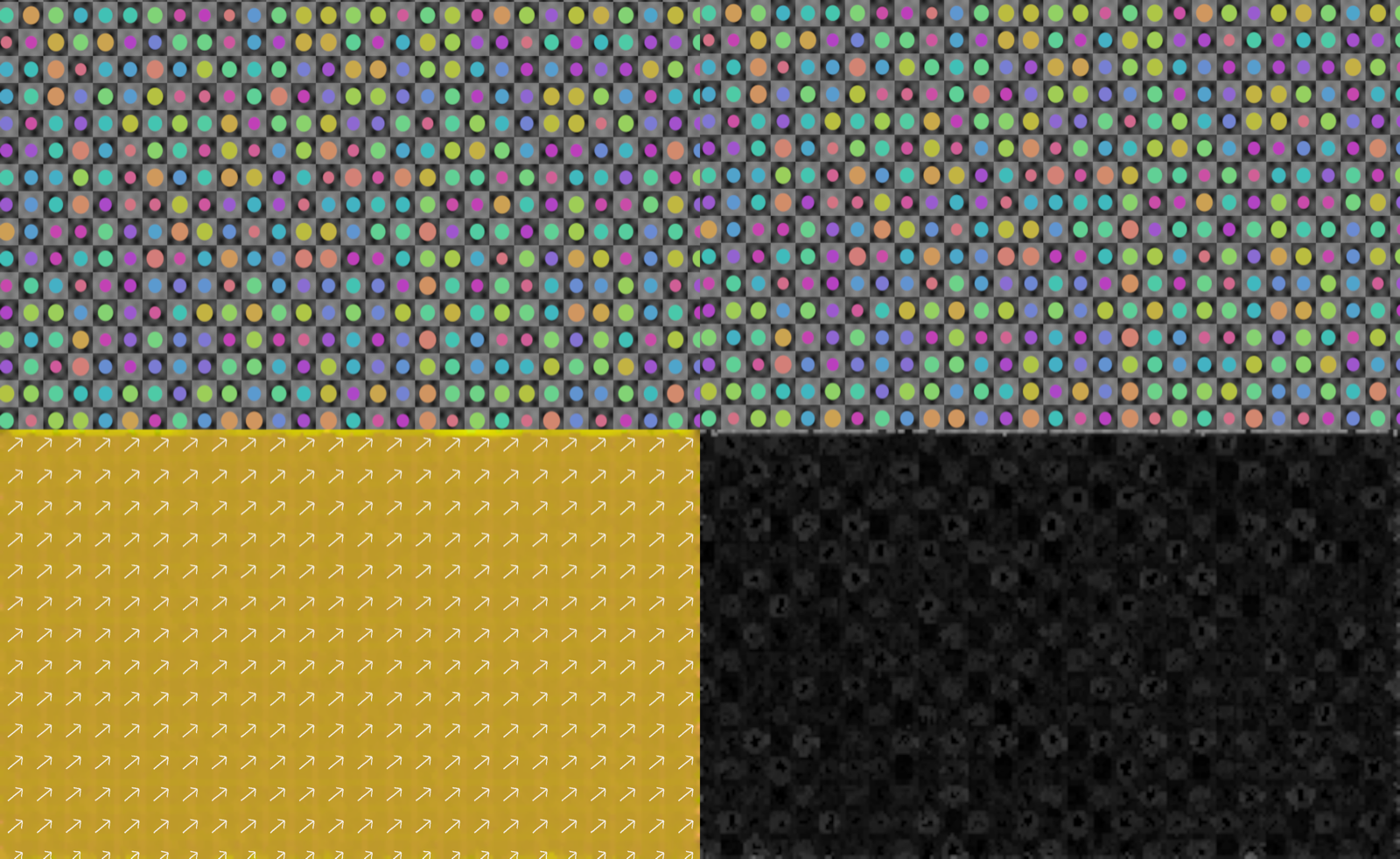
PyramidOpticalFlow(renderer, first, second, consistency = true) also tracks the images in reverse, inside the same submission, and fills consistencyMap: a texture the size of output whose .x is the forward–backward error in input pixels. It follows each forward vector, reads the backward vector where it lands, and reports how far the pair fails to return to the start. The residual in output.z asks whether the pixels look alike; this map asks whether the two directions agree about where they went. It is high where content is occluded, revealed, or leaves the frame, even when a wrong match happens to look plausible.
val flow = PyramidOpticalFlow(renderer, previousImage, currentImage, consistency = true)
prop<RenderToTexture>(motion) = flow.output
prop<RenderToTexture>(motionConfidence) = flow.consistencyMap!!
The hardware engine has no equivalent output.
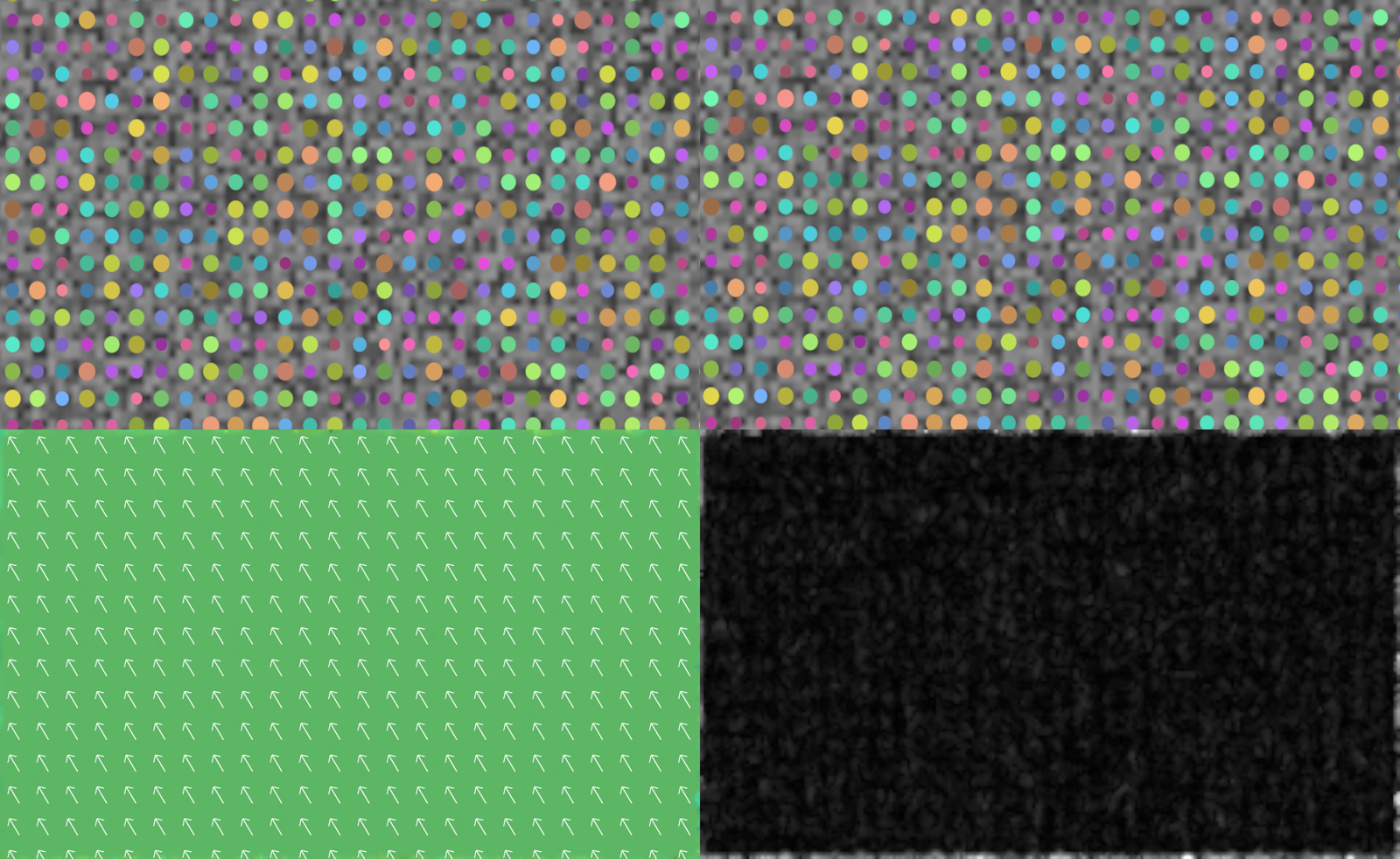
The figure is the optical_flow_pingpong starting point with PyramidOpticalFlow(..., consistency = true) and the matching-cost panel replaced by consistencyMap.x, white at 4 pixels of error.
Keep the previous frame with ping-pong
Open the optical_flow_pingpong starting point for the complete editable example. The parent box renders one moduleHere() into a PingPongRenderToTexture; its child samples the previous image, current image, and motion texture. The four panels show previous / current above motion / matching cost.
propDown<PingPongRenderToTexture>(history) = PingPongRenderToTexture(renderer) {
    width = 960
    height = 540
    useDepth = false
    format = VK_FORMAT_R16G16B16A16_SFLOAT
}

val flow = opticalFlow(
    renderer,
    history.previousImageView,
    history.latestImageView,
    grid = 4,
)
propDown<RenderToTexture>(motion) = flow.output
Those two image-view providers follow the ring as it rotates; keep the providers themselves, rather than caching their .imageView handles. After each source render, latestImageView is the new completed frame and previousImageView is the one before it. No manual swap is needed.
The example's frame loop is:
// renderSource() is a helper defined in the example: it records history.render(),
// submits that command buffer, and waits for the source to finish.
if (reset) renderSource() // Seed both slots with the same time on startup/reset.
renderSource()
flow.evaluate(reset = reset || !animate)
frame() // The child now samples the completed motion texture.
Edit the parent's fragment to change the source; edit the child's fragment to use the motion. Animate source pauses time: both slots receive the paused frame, and motion should settle near zero. Repeated paused pairs disable temporal hints on every evaluation. Reset the pair seeds both slots and disables hints for that pair. A successful source shader edit does the same, so unrelated old and new patterns are not treated as consecutive animation frames. The parent publishes its textures as propDown slots, so relaunching it relaunches the child too, and the child's samplers bind the new allocation.
This source also publishes expectedMotion, its analytical displacement in input pixels. The live check compares the measured interior field against it through movement, pause, reset, and relaunch. The brightness texture between the circles gives the matcher distinctive details to follow. If you replace it with a repeating pattern, one circle can match a neighboring cell instead of itself. The example shows the raw field: matching cost often rises in wrong patches, but a wrong match can also have low cost. Cost is useful for rejecting vectors, not a guarantee of their accuracy.
Why the source has a brightness texture
The original 32-command NVIDIA result was one successful run. Repeating it exposed a raw p95 endpoint error of 48.04 pixels despite a median of 0.106 pixels: 7.43% of the interior matched neighboring cells. Another phase had 14.46% large errors, including low-cost wrong matches. A larger border exclusion and cost filtering did not solve the ambiguity.
The source now has an aperiodic brightness pattern that moves with the circles. The check keeps its original limits: median error below 0.5 input pixel and p95 below 1 pixel over the whole measured interior, with no cost filtering. Repeated runs retain raw fields and both inputs, check that readback stays within one evaluation, and exercise pause, reset, relaunch and shutdown. The raw cost and outlier statistics remain visible in the report. On 26 September, three complete runs on the RTX 4090 passed all 111 commands: 72 moving pairs and six paused pairs. The worst moving p95 was 0.324 pixels, with no interior errors above five pixels and no Vulkan validation errors. This checks the revised source; arbitrary repeating images can still produce ambiguous matches.
On the M1 Max, the original repeating-circle source's moving pair had a median error against
expectedMotion of 0.13 and 0.07 pixels in two checks on 29,464 samples each (p95 0.35 and
0.13), and exactly 0 while paused. The brightness-textured source has not yet been rerun
on the M1 Max.
Measured
These two sets of numbers come from different machines running different algorithms. Read each set as what that backend does on that GPU, not as a head-to-head comparison.
Hardware engine, RTX 4090
On the RTX 4090, a 960 × 540 pair at SLOW quality and a 4 × 4 grid costs 0.039 ms for conversion, 0.523 ms for flow, and 0.083 ms for unpacking, all median. Budget for the complete call — 1.20 ms median, 1.56 ms p95 — because evaluate() waits for its fence. The adapter owns about 10.6 MB of visible allocations, not counting driver-private session memory. On the same pair, a known pure translation comes back with zero median error and 1/32 pixel at p95, away from the borders.
The measurements retain the distribution summaries and numerical check. The implementation uses VK_NV_optical_flow through the existing LWJGL bindings, with no additional native library. Feature, format, grid, and queue checks decide availability; a missing extension does not affect other Field workflows.
Portable backend, Apple M1 Max (MoltenVK)
The same 960 × 540 pair was run through PyramidOpticalFlow at grid 4 with its defaults. Every error is an endpoint error in input pixels, measured over interior samples at least 64 pixels from the border.
| Case | Samples | Median | p95 |
|---|---|---|---|
| Known translation (+12, −8) | 21,424 | 0.00001 | 0.00002 |
| Translation (+40, −24) | 21,424 | 0.00001 | 0.00002 (1.2% of samples over 1 px) |
| Consecutive-frame wiggle, four phases | 85,696 | 0.080 | 0.26 |
| Identical frames | 32,400 | 0 | 0 (maximum 0) |
A zero field would score a median of 1.98 pixels on the wiggle, so these errors are small compared with the motion they measure. On this synthetic wiggle the portable tracker's error is below the 4090 engine's 0.15 / 0.35. That result does not rank the two backends in general: the source is a clean procedural image with none of the noise, blur or lighting change of real footage, and it matches Lucas–Kanade's assumptions unusually well.
With consistency = true, interior samples of the (+12, −8) pair return to within 0.00003 pixels (p95, 21,424 samples). The two rightmost flow columns, whose content moves out of the second image, miss by a median of 43 pixels. On one wiggle phase the p95 is 0.19 pixels. A checked pair costs about twice an ordinary one, 24.6 ms median.
The residual flags the same content leaving the frame. The two rightmost flow columns have a median residual of 17.3 grey levels, while no interior sample exceeds 0.0002; the starting point's default rejection threshold for this backend is 8.
The known translations are almost exact because the second image is the first shifted by whole pixels, the easiest possible case for this method. At (+40, −24), about 1.2% of samples lock onto the checkerboard's 64-pixel repeat. That is why the coarse search compares colour and not only brightness: on brightness alone the same pair mislocks on 11.5% of samples, an order of magnitude more.
The portable backend is slower. One pair takes 11.9 ms median and 12.8 ms p95 of wall time, including submission and the final fence (100 warmed pairs). GPU timestamps put 0.43 ms on the pyramid and 5.2 ms on the finest level, which reads widely spaced windows from the full-resolution image; the four coarser levels take 0.7 to 1.6 ms each. It allocates 30.3 MB. In the RTX 4090 run the hardware engine took 1.20 ms per pair. The portable measurements come from PortableOpticalFlowSmoke, the four.vision.portable-optical-flow smoke test. It forces the portable backend on any machine and asserts regression floors just above these numbers.
Use this as an image-processing primitive. Engine motion vectors for DLAA/SR or RR have a different contract and should not silently be replaced with optical flow.