Continuing a Gesture: Sequence Memory and Forecasting
Record a few seconds of a performed gesture: a mouse trace, two sliders moved together, the envelope of a phrase. Then ask Field to keep going: continue it in the same style, for as long as you like, while you take over one channel and give it back. This page covers two ways of doing that, with no training step:
- A Variable Markov Oracle (Wang and Dubnov) remembers the recording and recombines its passages. It records where they came from and applies a fading correction at joins.
- Timestral, Mistral's pretrained forecasting model, has never seen your recording and does not need to. It reads the recent history and predicts what comes next, with an uncertainty band. It runs in an optional Python worker.
Both sit behind the same player, so a box that drives one can drive the other. Everything is in two packages:
import afield.math.oracle.* // Trajectory, VariableMarkovOracle, Improviser
import afield.math.temporal.* // RecedingHorizon, OracleSession, TimestralSession
Recordings
A Trajectory is a uniformly sampled multichannel recording: named channels, one sample rate,
and a list of where each separate demonstration (an episode) begins. Trajectory.of builds one
from named lists, and Trajectory.join puts several episodes end to end without ever treating
the last sample of one as leading into the first sample of the next.
Choose the sample rate for the gesture, not for the screen: 10–30 Hz resolves most hand
movements, giving 600–1,800 samples per minute at those rates. resample(rate) converts a
recording made at frame rate.
Remembering and recombining
The box below records two coupled oscillators (one at 0.5 Hz with a slow swell, one at 0.75 Hz),
45 seconds at 20 Hz, builds the oracle, and lets an Improviser play two minutes from it.
:::static
import afield.math.oracle.*

val rate = 20.0
val n = (45 * rate).toInt()
val demo = Trajectory.of(
    rate,
    "x" to
        n {
            val t = it / rate
            sin(2 * PI * 0.5 * t) * (1 + 0.3 * sin(2 * PI * 0.05 * t))
        },
    "y" to
        n {
            val t = it / rate
            0.7 * sin(2 * PI * 0.75 * t + 0.6)
        },
)

val memory = VariableMarkovOracle.build(demo)
val played = Improviser(memory, seed = 1).take(120.0)

print("$memory\n$played: ${played.segments.size} segments")
val seconds = List(played.output.length) { it / rate }
showSignals(
    *played.output.series(),
    x = seconds,
    title = "two minutes from 45 seconds of memory",
    channel = "main",
    width = 1000,
    height = 260,
    floatingLegend = true,
)
showSignals(
    "memory position (s)" to played.sourceSeconds(),
    x = seconds,
    xTitle = "seconds",
    channel = "memory",
    width = 1000,
    height = 260,
)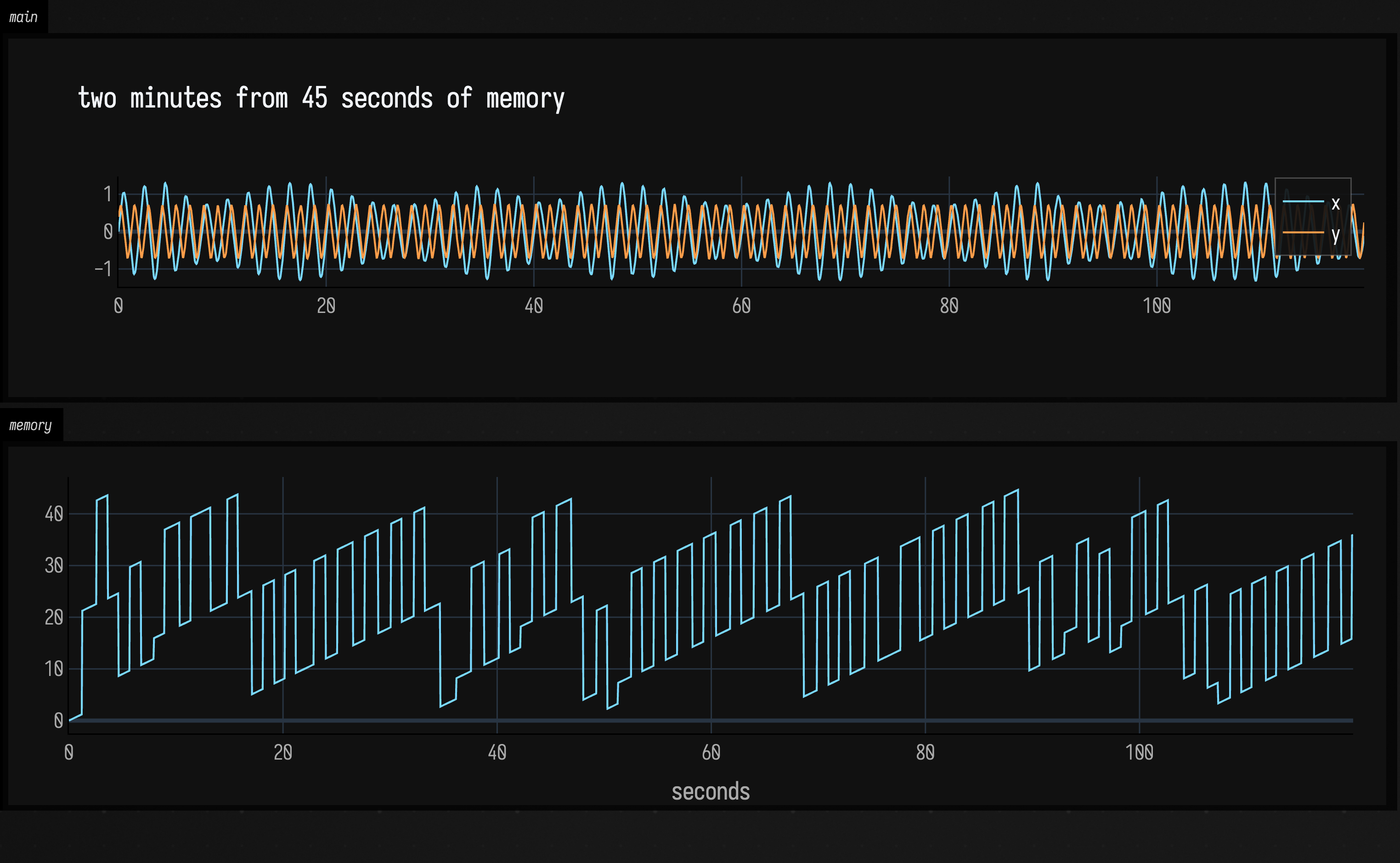
The staircase is the memory position: which second of the recording each output sample came from. A straight run is the improviser following the recording; a jump is a recombination. The oscillators keep their shape and their phase relationship across every jump, because a jump is only taken between places where the recent past matches in both channels, in position and velocity.
How the oracle decides what matches
VariableMarkovOracle.build turns each sample into a feature frame: every channel, centred and
scaled by its spread, followed by its first difference, scaled the same way. Two frames closer than a
threshold count as the same symbol, and the oracle (a Factor Oracle built over those symbols)
links each moment to the earlier moment that ends the longest repeat of what led up to it.
lrs[i] is the length of that shared past, and sfx[i] is where it is.
The threshold matters. Too small, and nothing ever repeats. Too large, and everything is the
same symbol, so a match says nothing. build tries a range of thresholds and keeps the one with
the highest information rate, the measure from the reference implementation of how much the
past tells you about the present. VariableMarkovOracle.thresholdScan returns every candidate if
you want to see the choice:
val scan = VariableMarkovOracle.thresholdScan(demo)
showSignals("information rate" to scan.map { it.second }, x = scan.map { it.first.threshold }, xTitle = "threshold")
Matching uses velocity as well as position, so a path that crosses itself is not confused with
itself going the other way. GestureFeatures.fit(demo, velocityWeight = …, channelWeights = …)
changes the balance; shapeOnly = true matches motion wherever it happens.
What the improviser does
Improviser plays the memory forward one sample at a time:
- It follows the current passage for at least
minPhraseseconds (default 1), then, with probabilityjumpProbabilityper sample, considers a jump. - Candidates are the oracle's suffix links from where it is and, when the memory holds several
takes, its
bridges: the nearest moments in other takes. Each candidate is scored by how much context it shares, how far its preceding sample is from where the output is now, and how much of what follows it was played in the lastreuseMemoryseconds (weighted byreuseWeight). One is drawn with a seeded softmax (temperature), so a seed replays the same performance. - While it is playing something it played in the last
reuseMemoryseconds, it considers a jump on every step after a phrase (escapeReplays, on by default), so it does not coast through a repeat. - A candidate further than
maxJointhresholds from the current position, needing a correction larger thanmaxCorrection, or too close to the end of its take to play a phrase, is rejected, not smoothed over. The correction that is applied fades overjoinTimeseconds, and its size is recorded per sample inPerformance.correction. - At the end of a take a jump is compulsory. If no candidate is acceptable it begins another take
whose first pose is close enough (
restartTolerance), the one played least recently. Failing that it looks for the best match for the lastcueWindowseconds anywhere in memory, and if nothing is closer thandeclineDistanceit holds, for at most a phrase, then restarts from the closest place it can find.
Performance.segments records every jump: where in memory it went, which take, why (SuffixLink,
EpisodeEnd, Cue, Takeover, Hold, Restart), the join distance and the shared context.
Three measures describe a performance without plotting it:
coverage(memory length)is how much of the memory got used.outputRepetition()is how much the output repeats itself: the share of two-second stretches that closely match an earlier stretch. Two copies of the same gesture from different places in memory count here.joinRoughness(memory)is how sharp the joins are, compared with the recording's own motion (1 is as smooth as the recording on average).
Several demonstrations: a dancer's memory
Separate recordings stay separate, and the improviser moves between them only where one take
resembles another. The memory below is six takes of modern dance from the CMU motion capture
database: one dancer, about a minute in all, with arabesques, pirouettes, jumps and arm phrases in
different orders. Bvh.read loads each take. toTrajectory turns it into the positions of all 38
joints and end points (114 channels) in the dancer's own frame, with travel and turning removed,
so that a gesture matches wherever she is facing.
Several takes begin and end with the dancer standing still, and trimStill() removes that
before the takes are joined. The improviser gets reuseWeight = 3.0 and reuseMemory = 60.0, so
it steers away from anything it played in the last minute. The box below plays a minute of new
dance from that memory and draws a pose every half second, coloured by the take it came from.
:::static
import afield.io.mocap.*
import afield.math.oracle.*

:::fold load six takes and build the memory
// six takes of modern dance (CMU subject 05): every joint, in the dancer's own frame, at 30 Hz,
// without the standing still before and after each take
val dir = "public/docs/assets/temporal_memory/cmu_05"
val takes = ["05_02", "05_07", "05_09", "05_12", "05_14", "05_18"].map { Bvh.read("$dir/$it.bvh.gz") }
val dance = Trajectory.join(takes.map { it.toTrajectory(rate = 30.0).trimStill() })
val memory = VariableMarkovOracle.build(dance)
val colours = [
    vec(0.48, 0.85, 1.0, 1.0),
    vec(1.0, 0.62, 0.29, 1.0),
    vec(0.56, 1.0, 0.6, 1.0),
    vec(1.0, 0.88, 0.4, 1.0),
    vec(0.77, 0.55, 1.0, 1.0),
    vec(1.0, 0.48, 0.62, 1.0),
]
:::endfold

// one minute of new dance from 61 seconds of memory
val played = Improviser(memory, seed = 2, reuseWeight = 3.0, reuseMemory = 60.0).take(60.0)

// a pose every half second for the first sixteen seconds, two rows, coloured by take
val poses =
    (0 until 32).flatMap { k ->
        val t = k * 15
        val take = dance.episodeOf(max(0, played.source[t]))
        val at = doubleArrayOf((k % 16) * 14.0, if (k < 16) 0.0 else -42.0, 0.0)
        takes[0].skeleton(played.output.frame(t), dance.channels, at).onEach {
            it.color = colours[take]
            it.thickness = 2.0
        }
    }
print("${played.segments.size - 1} jumps; every take used: coverage ${played.coverage(dance.length).f2}")
// an invisible point above the rows leaves room for the viewer's toolbar
val headroom = fline {
    moveTo(0.0, 70.0, 0.0)
    color = vec(0, 0, 0, 0)
}
three(name = "dance-strip", width = 1000, height = 420) {
    lines(poses + headroom)
    helpers(false)
    camera(yaw = 0.0, pitch = 4.0)
    title("one minute from six takes, first sixteen seconds, a pose every half second")
    caption("colour = which take the pose was played from")
}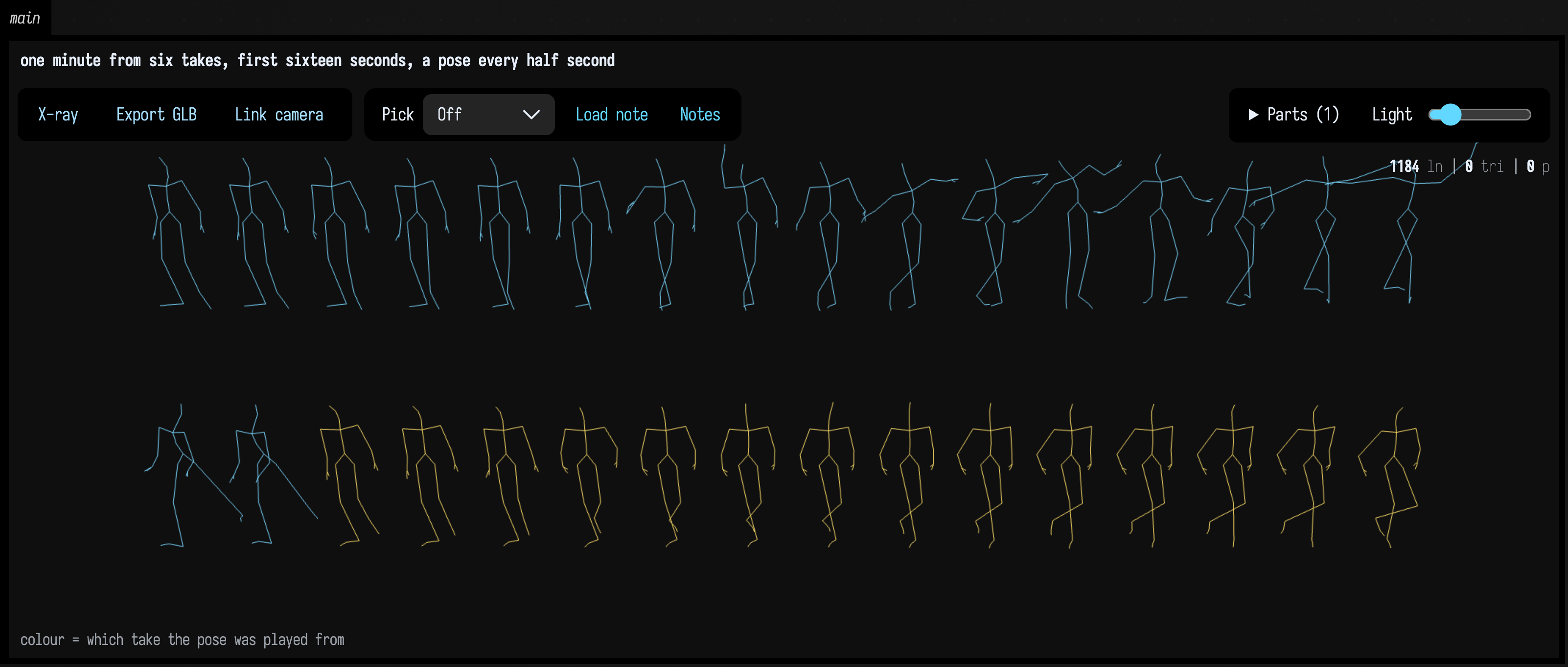
The poses run on without a visible join. The improviser changes take at moments where the body in one take is moving like the body in another.
Pictures of poses can hide a loop, so plot the signal itself. The box below draws the height of both hands and the head over the same minute, on bands numbered by take:
:::static
import afield.io.mocap.*
import afield.math.oracle.*

:::fold load six takes and build the memory
// six takes of modern dance (CMU subject 05): every joint, in the dancer's own frame, at 30 Hz,
// without the standing still before and after each take
val dir = "public/docs/assets/temporal_memory/cmu_05"
val takes = ["05_02", "05_07", "05_09", "05_12", "05_14", "05_18"].map { Bvh.read("$dir/$it.bvh.gz") }
val dance = Trajectory.join(takes.map { it.toTrajectory(rate = 30.0).trimStill() })
val memory = VariableMarkovOracle.build(dance)
val colours = [
    vec(0.48, 0.85, 1.0, 1.0),
    vec(1.0, 0.62, 0.29, 1.0),
    vec(0.56, 1.0, 0.6, 1.0),
    vec(1.0, 0.88, 0.4, 1.0),
    vec(0.77, 0.55, 1.0, 1.0),
    vec(1.0, 0.48, 0.62, 1.0),
]
:::endfold

val played = Improviser(memory, seed = 2, reuseWeight = 3.0, reuseMemory = 60.0).take(60.0)
val seconds = List(played.output.length) { it / 30.0 }
fun height(joint: String) = played.output.channel("$joint.y").toList()

// shade each stretch of output by the take it was played from
val hex = ["#7ad9ff", "#ff9e4a", "#8fff9a", "#ffe066", "#c58cff", "#ff7a9e"]
val bands = (played.segments + Segment(played.output.length, -1, -1, Reason.Continue, 0.0, 0, 0.0)).zipWithNext().mapNotNull {
    (a, b) ->
    if (a.episode < 0) null
    else SignalRegion("${a.episode + 1}", a.outputStart / 30.0, b.outputStart / 30.0, hex[a.episode])
}
showSignals(
    "right hand" to height("RightHand"),
    "left hand" to height("LeftHand"),
    "head" to height("Head"),
    x = seconds,
    xTitle = "seconds",
    yTitle = "height",
    regions = bands,
    title = "heights of hands and head; bands numbered by take",
    channel = "main",
    width = 1000,
    height = 380,
)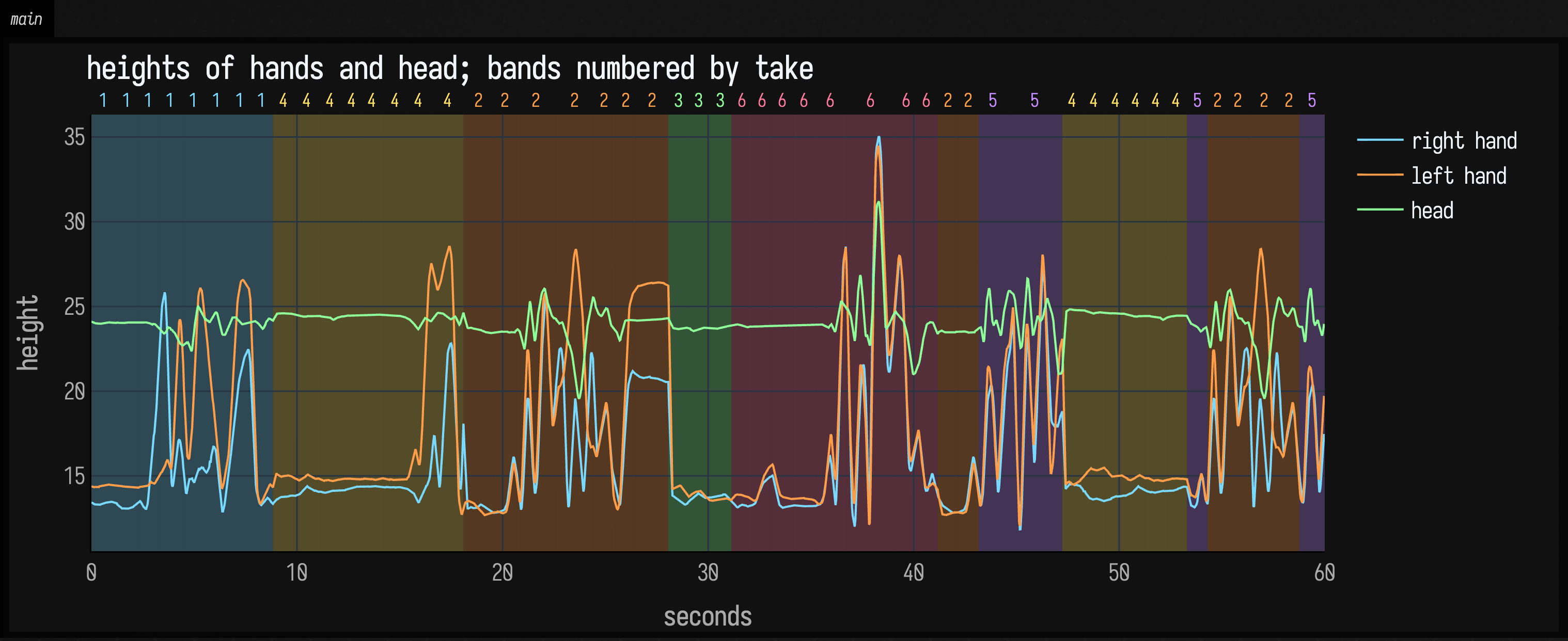
The arms rise and fall in phrases that come from different takes, joined where the body was doing
the same thing. A minute of output from about a minute of memory returns to some passages, such as the take-4
stretch at 10 s and again near 50 s. When it notices a repeat, the improviser leaves after a phrase if it can
find somewhere acceptable to go. outputRepetition() puts a number on how much it returns.
And as a figure, stepped at 30 frames a second. The same box runs live in the starting point below, and goes on for as long as you let it.
:::static
import afield.io.mocap.*
import afield.math.oracle.*

:::fold load six takes and build the memory
// six takes of modern dance (CMU subject 05): every joint, in the dancer's own frame, at 30 Hz,
// without the standing still before and after each take
val dir = "public/docs/assets/temporal_memory/cmu_05"
val takes = ["05_02", "05_07", "05_09", "05_12", "05_14", "05_18"].map { Bvh.read("$dir/$it.bvh.gz") }
val dance = Trajectory.join(takes.map { it.toTrajectory(rate = 30.0).trimStill() })
val memory = VariableMarkovOracle.build(dance)
val colours = [
    vec(0.48, 0.85, 1.0, 1.0),
    vec(1.0, 0.62, 0.29, 1.0),
    vec(0.56, 1.0, 0.6, 1.0),
    vec(1.0, 0.88, 0.4, 1.0),
    vec(0.77, 0.55, 1.0, 1.0),
    vec(1.0, 0.48, 0.62, 1.0),
]
:::endfold

// the continuation as a figure, stepped at 30 Hz; the floor square and an invisible point
// above head height keep the framing still, with room for raised arms
val player = Improviser(memory, seed = 2, reuseWeight = 3.0, reuseMemory = 60.0)
val floor = fline {
    moveTo(-12.0, 0.0, -12.0)
    lineTo(12.0, 0.0, -12.0)
    lineTo(12.0, 0.0, 12.0)
    lineTo(-12.0, 0.0, 12.0)
    lineTo(-12.0, 0.0, -12.0)
    color = vec(1, 1, 1, 0.25)
}
frames {
    val period = (1e9 / 30).toLong()
    var next = System.nanoTime()
    while (frame()) {
        if (System.nanoTime() < next) continue
        next += period
        val pose = player.step()
        val take = dance.episodeOf(max(0, player.position))
        val c = colours[take]
        three(name = "dancer", width = 640, height = 480) {
            // solid tubes rather than lines, so the figure stays visible at any size
            mesh(
                takes[0].skeletonMesh(
                    pose,
                    dance.channels,
                    radius = 0.6,
                    color = doubleArrayOf(c.x.toDouble(), c.y.toDouble(), c.z.toDouble()),
                ),
                wireframe = false,
            )
            lines(
                floor,
                fline {
                    moveTo(0.0, 48.0, 0.0)
                    color = vec(0, 0, 0, 0)
                },
            )
            helpers(false)
            camera(yaw = 30.0, pitch = 12.0)
        }
    }
}
Why the dance needs bridges, a runway and fresh starts
With 114 channels the oracle's suffix links almost never cross from one take to another, so
without bridges half the takes would never be entered. The takes also end alike, with the
dancer coming to rest, so the best match for the end of one take is the end of another; without
the runway rule, which rejects a candidate that has less than a phrase left before its take
ends, the improviser would loop around those last seconds. A take that does end begins
another, the one played least recently. The measurements are in the starting point's lab
notebook.
Taking over a channel
A performer can drive any channel while the rest keep going. perform(channel, value) makes the
improviser play your value on that channel, and every cueInterval seconds it re-aligns the
other channels with the memory by matching only the channels you are driving.
release(channel) gives it back, with a fade from your last value. The script below holds x still for five
seconds, then lets go.
:::static
import afield.math.oracle.*

val rate = 20.0
val n = (45 * rate).toInt()
val demo = Trajectory.of(
    rate,
    "x" to
        n {
            val t = it / rate
            sin(2 * PI * 0.5 * t) * (1 + 0.3 * sin(2 * PI * 0.05 * t))
        },
    "y" to
        n {
            val t = it / rate
            0.7 * sin(2 * PI * 0.75 * t + 0.6)
        },
)

val from = (10 * rate).toInt()
val to = (15 * rate).toInt()
val played =
    Improviser(VariableMarkovOracle.build(demo), seed = 2).take(25.0) { i ->
        if (i in from until to) perform("x", 0.8)
        if (i == to) release("x")
    }
val reasons = played.segments.groupingBy { it.reason }.eachCount()
print("takeover: $reasons, largest join correction ${played.correction.max().f2}")
showSignals(
    *played.output.series(),
    x = List(played.output.length) { it / rate },
    xTitle = "seconds",
    regions = [SignalRegion("x performed", from / rate, to / rate)],
    channel = "main",
    width = 1000,
    height = 380,
    floatingLegend = true,
)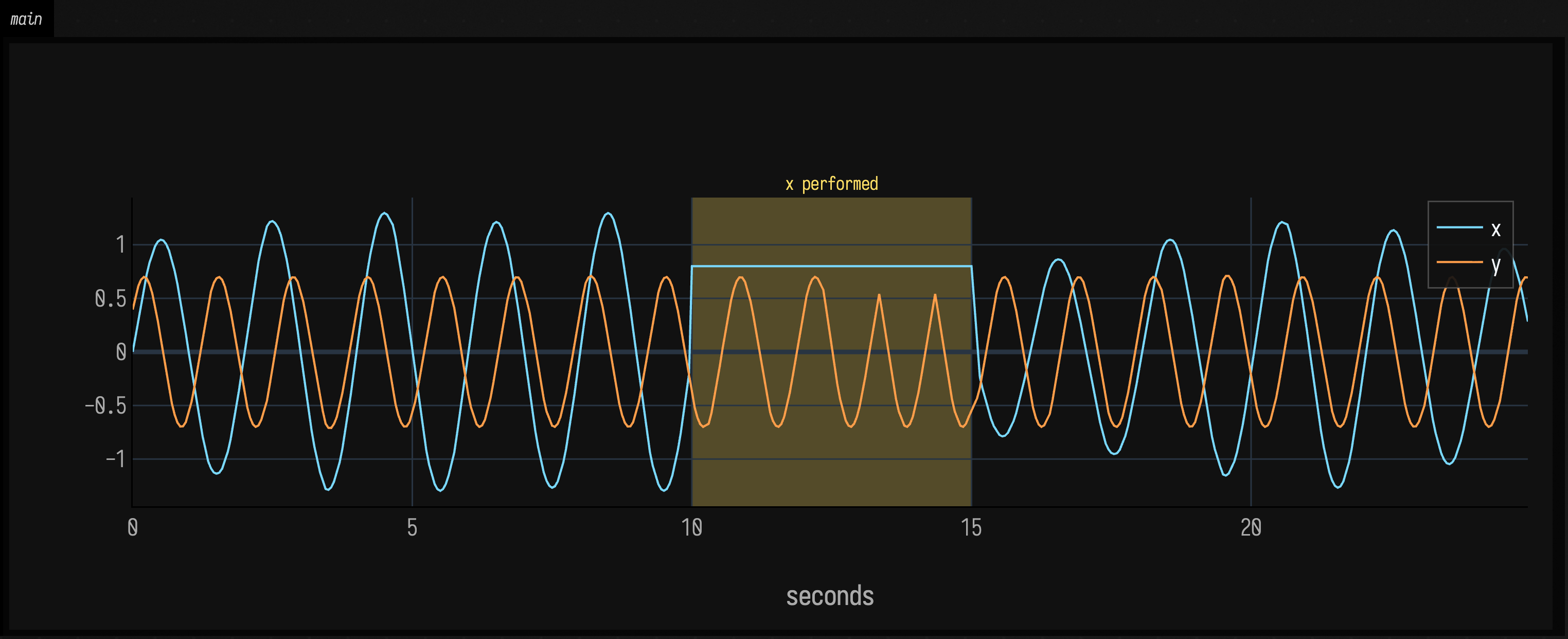
While x is held, y keeps going. Holding still at 0.8 is something the recording never does, so no
place in memory matches it well, and the improviser stays on its current passage rather than jumping
around looking for one. It re-checks once a phrase (minPhrase, one second here), and moves only to a match clearly better
than where it is (takeoverMargin). The short peaks in y are those moves.
Playing live
Improviser.step() returns one frame and does no waiting and almost no allocation, so it can run
directly in a frame loop. For anything slower — a forecaster, or a memory you want cued by
recent history on every replan — use RecedingHorizon, which never waits:
- It keeps a buffer of planned samples and returns the next one on every
step(). - After
commitseconds of a plan have played, it asks the session for a new plan from the history that actually played, including your interventions. One request is in flight at a time. performandreleasebump a revision number. A reply computed from the old history is thrown away when it arrives (staleReplies), so a slow plan can never undo a takeover.- If the buffer runs dry, it holds the last frame (or, with
Underflow.Stop, stops) and counts the underrun rather than extrapolating.
OracleSession(memory) puts the oracle behind this player; TimestralSession() puts the
forecaster there. RecedingHorizon(..., lockstep = true) waits for every reply instead, which is
what the offline renders on this page use so that they do not depend on machine speed.
Forecasting with Timestral
Timestral is a family of transformer forecasting models (5M to 209M parameters) trained by Mistral on a large collection of time series. Given up to 32 768 steps of multichannel history, it predicts the future as 21 quantiles per step, without being shown any examples of your signal. Field runs it in a separate Python process so that PyTorch never loads into Field.
Installing Timestral
It needs uv and a download. In a box:
import afield.math.temporal.*
print(TimestralSession.status())                       // Missing(... not downloaded ...)
print(TimestralSession.install("mistralai/Timestral-28M"))
install builds the worker's own Python environment from the pinned versions in
python/fieldtemporal/timestral_worker.py
and downloads the checkpoint (5M: 21 MB, 28M: 111 MB, 123M: 490 MB, 209M: 837 MB). After
that, sessions start without the network, and with AFIELD_OFFLINE=1 they never use it. The code is Apache-2.0;
the weights are under Mistral's Modified MIT license, linked from each model page on
Hugging Face.
A forecast and its uncertainty
TimestralSession() starts a worker for the 28M model (pass model = "mistralai/Timestral-209M"
for the largest). propose sends the recent history and returns two things: a median forecast,
which is the proposal, and 21 quantiles per step, from 1% to 99%. bandFLine, quantileFLine
and medianFLine turn these into lines in the same style as
the Gaussian process pages. The box below forecasts ten seconds of one
oscillator from twenty seconds of history, and draws the 1–99%, 10–90% and 25–75% bands as a fan
around the median.
:::static
import afield.math.oracle.*
import afield.math.temporal.*

val rate = 20.0
val n = (20 * rate).toInt()
val history = Trajectory.of(
    rate,
    "x" to
        n {
            val t = it / rate
            sin(2 * PI * 0.5 * t) * (1 + 0.3 * sin(2 * PI * 0.05 * t))
        },
)
val forecast = TimestralSession().use { it.propose(ContinuationRequest(0, history, horizon = 200)).get() }

// seconds across, values up; the SVG is y-down, so flip and scale into pixels
fun plot(line: FLine) = line.transform { vec(it.x * 30, -it.y * 120, 0) }
val ahead = DoubleArray(forecast.horizon) { (n + it) / rate }

val past =
    plot(
            FLine().apply {
                for (t in 0 until n) if (t == 0) moveTo(0.0, history.values[0][0])
                else lineTo(t / rate, history.values[0][t])
            },
        )
        .apply {
            color = vec(1, 1, 1, 0.9)
            thickness = 1.5
        }
val fan =
    [0.01 to 0.99, 0.1 to 0.9, 0.25 to 0.75].map { (lo, hi) ->
        plot(forecast.bandFLine(0, lo, hi, ahead)).apply {
            filled = true
            stroked = false
            color = vec(1, 0.5, 0.2, 0.18)
        }
    }
val median = plot(forecast.medianFLine(0, ahead)).apply {
    color = vec(1, 0.5, 0.2, 1)
    thickness = 3.0
}

print("forecast in ${(forecast.diagnostics["roundTripSeconds"] as Double * 1000).f0} ms")
lines(fan + past + median, w = 900.0, h = 320.0, fitToSize = true)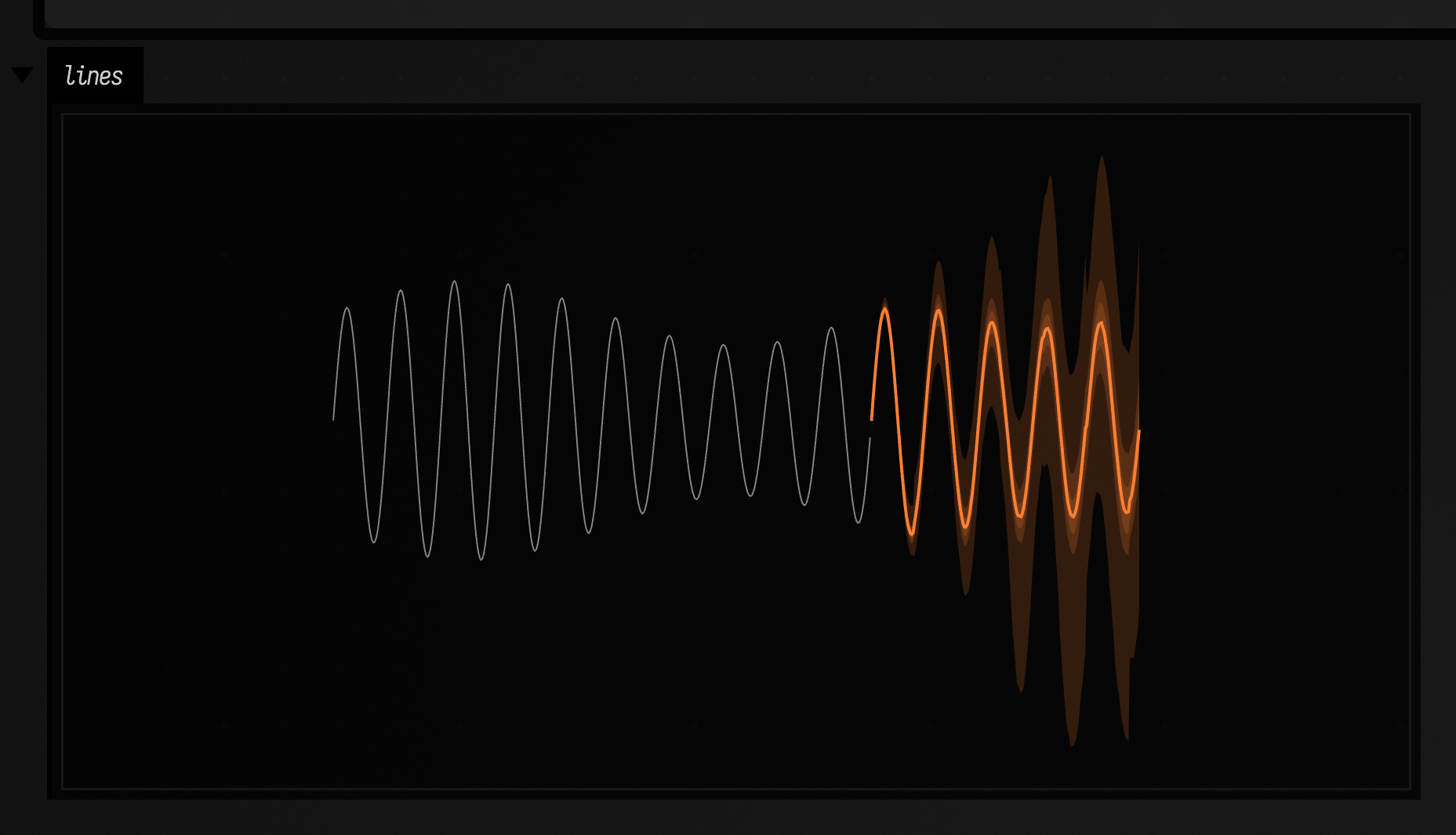
The Gaussian process page separates three things to draw: the mean, the pointwise uncertainty, and a sample, one entire possible function. A forecast gives you the first two. The median is the thick line. Each band is pointwise: at every step, the model expects the true value to be inside the 10–90% band 80% of the time. No single future is expected to stay inside it, and the bands widen with the horizon because the model is less sure further out.
What Timestral does not give is the third thing. A Gaussian process has a covariance between
every pair of positions, and that is what makes its samples smooth curves. Timestral's quantiles
are separate for every step and channel: they say nothing about whether a high value now goes
with a high value a second later. Drawing each step from its own quantiles produces jagged noise
the model never predicted, so TimestralSession does not offer samples. Play the median, and
use the fan to see how sure the model is. For alternatives that really are possible performances,
use the oracle, whose every output is a passage that happened.
Feeding the forecast back
A forecast one block ahead is not a performance. To keep going, RecedingHorizon plays the
first second of each forecast, then forecasts again from what was actually played, generated
samples included. The box below does that for two minutes of the figure-eight path, with the 28M
and the 209M model.
:::static
import afield.math.oracle.*
import afield.math.temporal.*

val rate = 20.0
val demo = Trajectory.of(rate, "x" to 800 { sin(4 * PI * it / 120.0) }, "y" to 800 { sin(2 * PI * it / 120.0) })

val runs =
    ["28M", "209M"].map { size ->
        RecedingHorizon(
                TimestralSession("mistralai/Timestral-$size"),
                demo,
                history = 20.0,
                horizon = 4.0,
                commit = 1.0,
                lockstep = true,
            )
            .use { size to it.take(120.0) }
    }
for ((size, p) in runs) print(
    "$size: replanning p50 ${(p.latency(50.0) * 1000).f0} ms, p95 ${(p.latency(95.0) * 1000).f0} ms\n",
)
showSignals(
    *runs.map { (size, p) -> "x, $size" to p.output.values[0].toList() }.toTypedArray(),
    x = List(2400) { it / rate },
    xTitle = "seconds",
    channel = "main",
    width = 1000,
    height = 380,
    floatingLegend = true,
)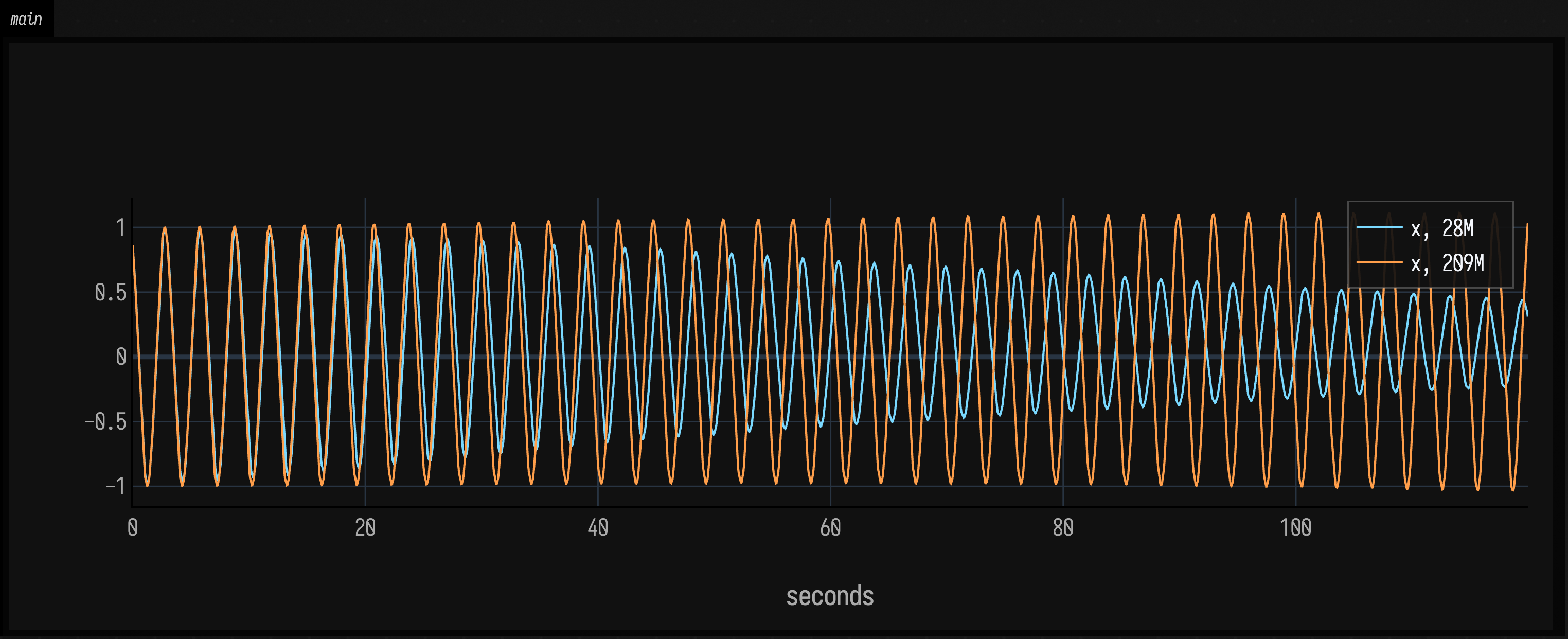
Fed its own output, a forecaster tends to drift towards the average. The small models drift fastest: over five minutes of this loop the 28M model's figure-eight shrinks to about a tenth of its size, while the 209M model's holds its size and frequency. Material made of bursts and silences fares worse than smooth periodic motion: on a recording of rises, bursts and pauses, both sizes settle into the pause within the first minute. The oracle has no such drift, because it only ever plays back what it was given.
On a laptop CPU, replanning four seconds ahead from twenty seconds of two channels takes a few tens of
milliseconds with the 28M model and a few hundred with the 209M model. The printed numbers
above are from the machine that built this page. Set commit (how much of each plan is played)
comfortably above the slowest replan, or the player will run dry and hold.
Steering with a known future
A covariate is a channel the model reads but does not forecast. If you know where one channel
is going (because you are about to play it, or it follows a score), pass its history and
future as known, and the forecast of the other channels can follow it. In the box below, y
is x one second late. The forecast of y with x's future given is compared with the
forecast from y's own history alone.
:::static
import afield.math.oracle.*
import afield.math.temporal.*

// an irregular control signal x, and y following it one second (20 samples) late
val r = java.util.Random(3)
var level = 0.0
val x = 720 {
    level = 0.9 * level + 0.1 * r.nextGaussian()
    3 * level
}
val lead = x.drop(20) // x, known over history and future
val y = x.take(700) // y[t] = x[t - 20]
val n = 600
val h = 100

val history = Trajectory.of(20.0, "y" to y.take(n))
val (steered, alone) =
    TimestralSession().use { s ->
        s.propose(ContinuationRequest(0, history, h, known = arrayOf(lead.toDoubleArray()))).get().proposal[0] to
            s.propose(ContinuationRequest(0, history, h)).get().proposal[0]
    }
fun error(p: DoubleArray) = (0 until h).sumOf { abs(p[it] - y[n + it]) } / h
print("mean error with x known ${error(steered).f2}, without ${error(alone).f2}")

// the last five seconds of history and the five-second horizon
val from = n - 100
val gap = 100 { Double.NaN }
showSignals(
    "y" to y.drop(from),
    "forecast, x known" to gap + steered.toList(),
    "forecast, y alone" to gap + alone.toList(),
    x = List(200) { (from + it) / 20.0 },
    xTitle = "seconds",
    marks = ["now" to n / 20.0],
    channel = "main",
    width = 1000,
    height = 380,
)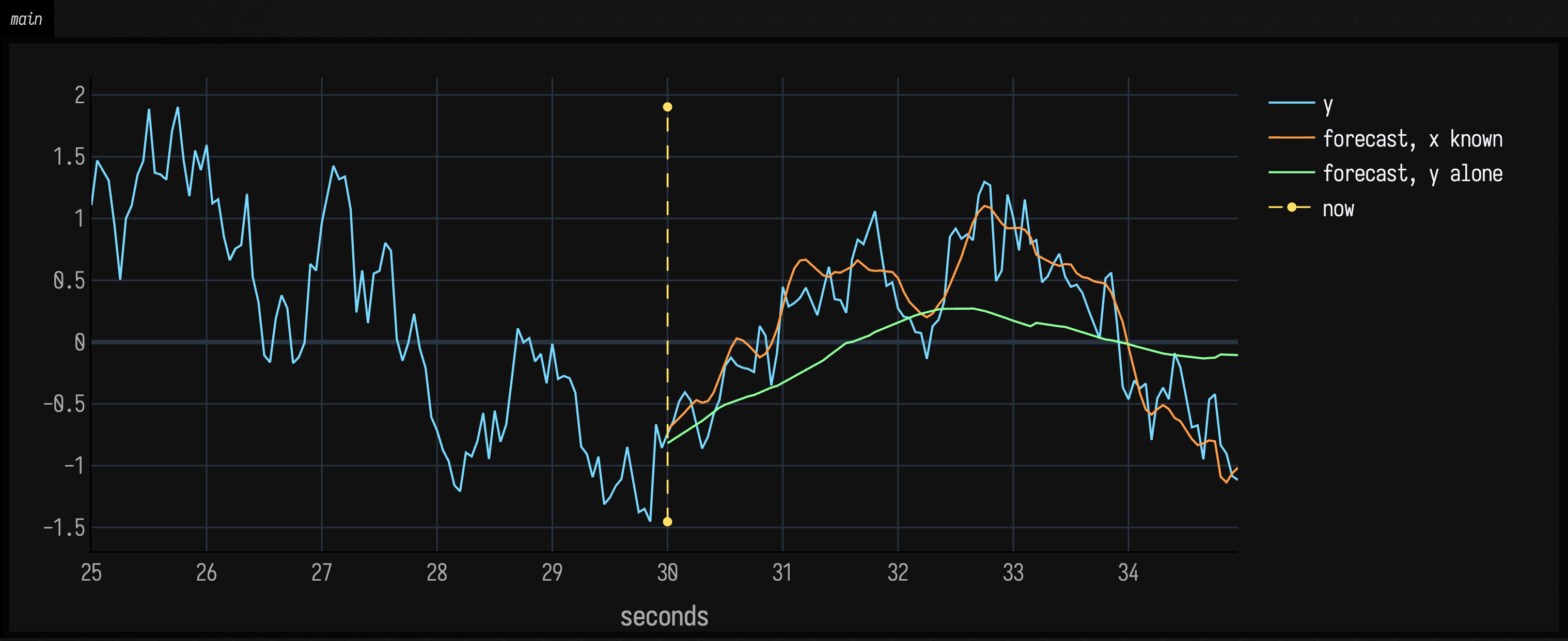
The model learns the one-second lag from the history alone, without any training, and uses it over the horizon. This only works where the history shows the relationship: a covariate called "energy" with no visible effect on the other channels gives the model nothing to go on.
A known value is a hint, not a constraint: the forecast is not forced to pass through it.
Memory proposes, the forecaster judges
The two can work together. The oracle keeps proposing passages from the recording, so nothing
fades towards the average, and Timestral rates each proposal against its forecast of what has
been playing. Give the improviser a ForecastJudge:
val judge = ForecastJudge(TimestralSession(), memory)
val played = Improviser(memory, judge = judge).take(60.0)
At every jump decision the improviser plays each candidate two seconds ahead (judgeAhead), and
the judge scores each path by how well it sits inside the forecast's quantile fan, step by step
(the mean pinball loss). The forecast is refreshed every second in the background; until one has
arrived, the improviser decides alone. The passages still come from the recording, with corrections at joins. There are
two ways to use the score:
judgeMode = JudgeMode.Prefer(the default) adds it to the oracle's own preferences, weighted byjudgeWeight, and lets the judge keep the improviser on its current passage when that scores best.judgeMode = JudgeMode.Vetoonly removes jumps whose score is more thanvetoRatiotimes that of staying, and leaves the choice among the rest to the oracle.
judgedDecisions, judgeChanged, judgeVetoed and judgeStayed count what the judge did.
Performance.sourceReuse(), coverage() and joinRoughness(memory) measure the result without
asking the judge: how much of the output replays a recently played passage of the memory, how much of the recording gets
used, and how sharp the joins are compared with the recording itself (1 means as smooth as the
recording on average).
The box below plays two minutes of the dance five ways from the same seed, with Timestral forecasting all 114 channels for the judged versions, and prints the measures for each.
:::static
import afield.io.mocap.*
import afield.math.oracle.*
import afield.math.temporal.*

:::fold load six takes and build the memory
// six takes of modern dance (CMU subject 05): every joint, in the dancer's own frame, at 30 Hz,
// without the standing still before and after each take
val dir = "public/docs/assets/temporal_memory/cmu_05"
val takes = ["05_02", "05_07", "05_09", "05_12", "05_14", "05_18"].map { Bvh.read("$dir/$it.bvh.gz") }
val dance = Trajectory.join(takes.map { it.toTrajectory(rate = 30.0).trimStill() })
val memory = VariableMarkovOracle.build(dance)
val colours = [
    vec(0.48, 0.85, 1.0, 1.0),
    vec(1.0, 0.62, 0.29, 1.0),
    vec(0.56, 1.0, 0.6, 1.0),
    vec(1.0, 0.88, 0.4, 1.0),
    vec(0.77, 0.55, 1.0, 1.0),
    vec(1.0, 0.48, 0.62, 1.0),
]
:::endfold

// two minutes, five ways, same seed; the judged ones forecast all 114 channels with Timestral-28M
val seconds = 120.0
val key =
    ["LeftHand", "RightHand", "Head", "LeftToeBase", "RightToeBase"].flatMap { j ->
        ["x", "y", "z"].map { dance.channels.indexOf("$j.$it") }
    }
val runs =
    TimestralSession().use { session ->
        fun judged(mode: JudgeMode) =
            ForecastJudge(session, memory, lockstep = true).use { judge ->
                Improviser(memory, seed = 1, jumpProbability = 0.1, judge = judge, judgeMode = mode).take(seconds)
            }
        linkedMapOf(
            "loop the first take" to Improviser(memory, policy = Policy.Loop).take(seconds),
            "nearest history" to
                Improviser(memory, seed = 1, policy = Policy.NearestHistory, jumpProbability = 0.1).take(seconds),
            "oracle" to Improviser(memory, seed = 1, jumpProbability = 0.1).take(seconds),
            "oracle, Timestral vetoes" to judged(JudgeMode.Veto),
            "oracle, Timestral prefers" to judged(JudgeMode.Prefer),
        )
    }
markdown(
    "main",
    "| two minutes from 61 s of dance | coverage | repeats itself | join roughness | jumps |\n|---|---|---|---|---|\n" +
        runs.entries.joinToString("\n") { (name, p) ->
            "| $name | %.2f | %.2f | %.2f | %d |"
                .format(
                    p.coverage(dance.length),
                    p.outputRepetition(channels = key),
                    p.joinRoughness(dance),
                    p.segments.size - 1,
                )
        },
)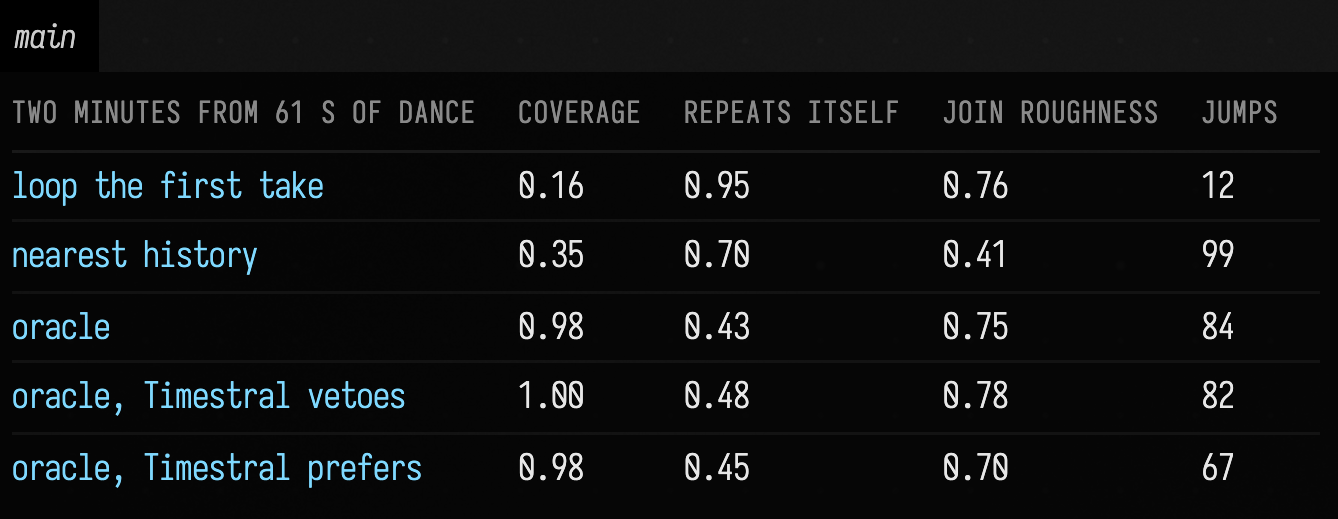
Looping one take repeats itself almost entirely. Matching recent history without the oracle makes the smoothest joins, because it always jumps to the closest match, but it uses only a third of the memory and repeats itself more. The oracle uses all of it and repeats itself least. Judging it with Timestral changes most of its decisions, but the result moves only a little. Neither judged version repeats itself less than the oracle alone. Preferring makes fewer, longer jumps with slightly smoother joins. With 114 channels each forecast also takes a few hundred milliseconds. Use the oracle alone first, and try the judge when you want fewer, longer phrases.
Choosing between them
| Oracle | Timestral | |
|---|---|---|
| What it needs | the recording | the recent history, and the optional worker |
| What it plays | passages of the recording, recombined | new values predicted from the history |
| Over long performances | keeps the recording's character indefinitely | drifts towards the average; less with the larger models |
| After a takeover | finds the place in memory that matches what you played | forecasts from what you played |
| Uncertainty | match distances and the join corrections | a quantile band per step |
| Says where it came from | yes: segments, source |
no |
| Speed | microseconds per sample, in the frame loop | tens to hundreds of milliseconds per replan, in the background |
Use the oracle to get the recorded material back: phrases, gestures, a particular way of moving. Use Timestral to continue the dynamics (a smooth continuation of whatever is happening now, or a forecast steered by a channel whose future you know), and to see how predictable a signal is from its band.
See also
-
The
temporal_memorystarting point: every example on this page as a document to open and change, plus a live box where a slider takes over a channel, and a lab notebook with the measurements behind the design. -
Motifs, Discords and Contrast: finding what repeats in a signal, rather than continuing it.
- Signal Examples: filters and spectra for the signals you record.
- Wang, C. and Dubnov, S. (2014), Variable Markov Oracle: A Novel Sequential Data Points
Clustering Algorithm with Application to 3D Gesture Query-Matching. The oracle here is a Kotlin
port of the reference implementation, checked against it
by
VmoReferenceTest. - Timestral, Mistral's inference code and model cards.