Speech-reactive learned spaces
Listen to a recording of someone talking and you can hear changes in timbre, prosody and the
sounds of the words. analysis.embed_speech lets you explore those changes as a path through a
learned space. Two models are available, each attentive to different aspects of speech.
To run the examples on this page, open the audio_ai_speech_embeddings starting point.
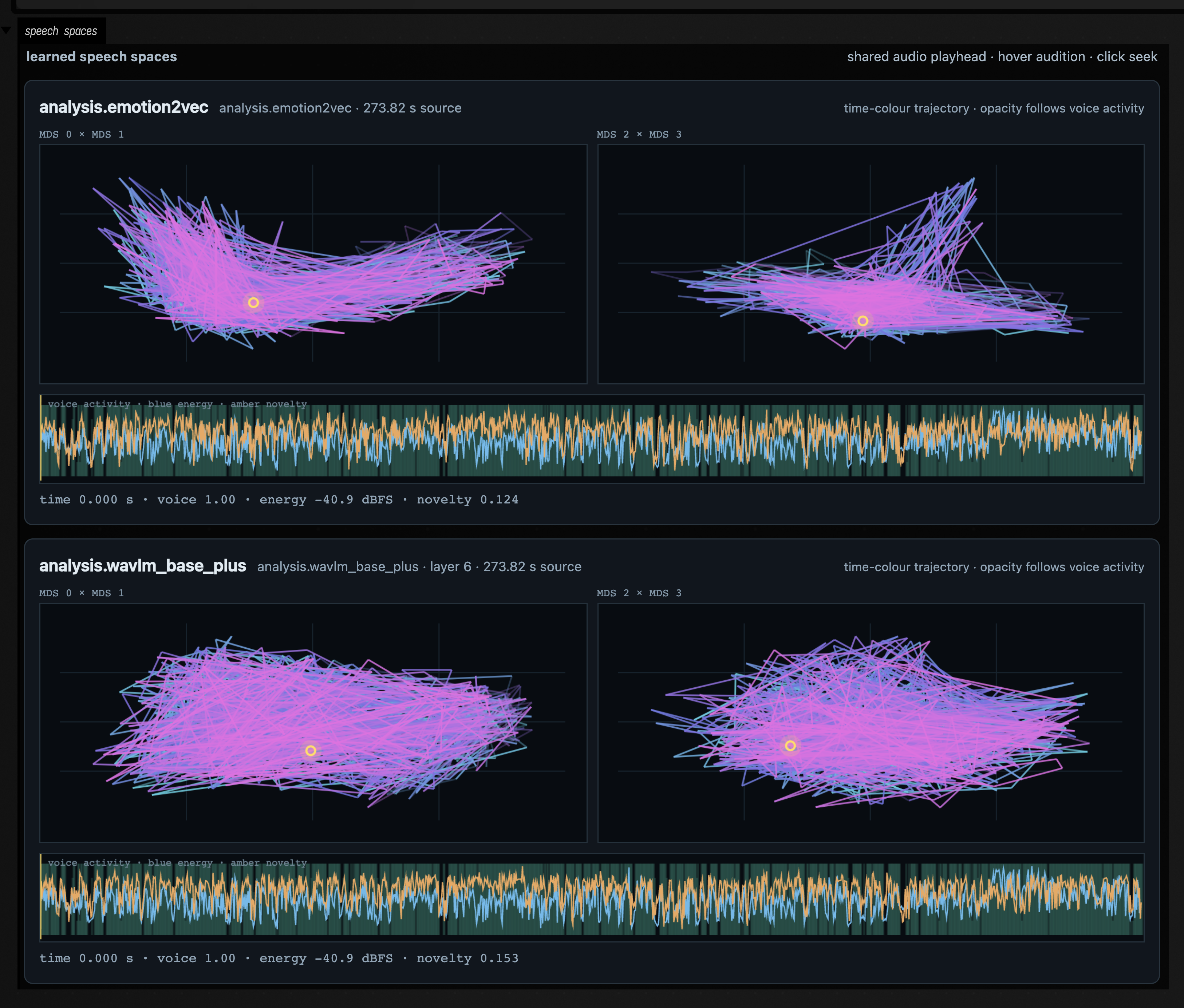
These are the two workers' landmark MDS views of near_drowning.wav. The workflow below fits
fresh t-SNE views of a selected ten-second interval from the same cached learned features.
| Backend | Bias | Useful first reading |
|---|---|---|
analysis.emotion2vec |
affect, vocal texture, prosody, speaker state | where the manner and energy of speech change |
analysis.wavlm_base_plus |
general self-supervised speech structure | voice/timbre/phonetic motion; layer 6 is the default compromise |
Neither backend is a transcript or a sentence-meaning model. WavLM's middle and later layers can organize phonetic structure, but spoken meaning needs a separate ASR or language embedding lane. Both report a position in a learned speech space every 20 ms; neither reports a word.
Start the optional worker
From the Field Audio AI checkout (or Field4's services/field-audio-ai submodule):
./scripts/run-speech-worker.sh
./scripts/run-api.sh
The speech worker listens on 127.0.0.1:8768; the API stays on 127.0.0.1:8765. Each model is
downloaded and loaded the first time a job asks for it. The models have their own licence terms,
separate from Field's.
Plotting a recording
This box uses an imported recording if one is available, or imports
~/Downloads/near_drowning.wav. It displays the source, starts both analyses and shows their
progress. When they finish, four views share a timeline with the audio player.
import java.nio.file.Files
import java.nio.file.Path
import kotlinx.coroutines.*
import kotlinx.coroutines.future.await

val client = cached { FieldAudioClient() }
val local = Path.of(System.getProperty("user.home"), "Downloads", "near_drowning.wav")
val sync = "near-drowning-speech"
val projectionStart = 0.0
val projectionDuration = 10.0
val projectionPoolMillis: Double? = 500.0
val projectionHopMillis: Double? = 40.0 // 25 Hz: just above a 24 fps display
display("all jobs", fieldAudioJobMonitor(heightPixels = 340))

go {
    try {
        val matches = client.assetsByFilename("*near_drowning*").await()
        val source = when {
            matches.size == 1 -> matches.single()
            matches.isEmpty() && Files.isRegularFile(local) -> client.importWav(local).await()
            matches.isEmpty() ->
                throw IllegalStateException("near_drowning.wav is neither imported nor present at $local")
            else -> throw IllegalStateException("near_drowning filename matched ${matches.size} assets")
        }
        val audio =
            source.representations.firstOrNull { it.role == "canonical_project" }
                ?: source.representations.first { it.mediaType in setOf("audio/wav", "audio/x-wav") }
        val duration = requireNotNull(audio.durationSeconds)
        val region = AssetRegion(source.id, 0.0, duration)
        display(
            "source",
            audio.audioVisualizerHtml(
                options = AudioVisualizerOptions(
                    initialDurationSeconds = minOf(projectionDuration, duration),
                    syncGroup = sync,
                ),
            ),
        )
        val requests = [
            "emotion2vec" to emotion2VecEmbeddingAnalysis(region),
            "WavLM Base+" to wavlmBasePlusEmbeddingAnalysis(region, layer = 6),
        ]
        val results = coroutineScope {
            requests
                .map { (label, request) ->
                    async {
                        client
                            .trackAnalysis(
                                request,
                                onAccepted = { display("$label job", fieldAudioJobStatusHtml(it)) },
                                onProgress = { job, event ->
                                    display("$label job", fieldAudioJobStatusHtml(job, event))
                                },
                                onCompleted = { display("$label job", fieldAudioJobStatusHtml(it)) },
                                onError = {}, // The surrounding coroutine reports the combined failure.
                            )
                            .await()
                    }
                }
                .awaitAll()
        }
        val projectionDescription =
            "start ${projectionStart}s · duration ${projectionDuration}s · pool ${projectionPoolMillis?.let { "${it} ms" } ?: "raw"} · hop ${projectionHopMillis?.let { "${it} ms" } ?: "native"}"
        display("projection", "Fitting Field Smile t-SNE · $projectionDescription…")
        val previews = coroutineScope {
            results
                .map { result ->
                    async {
                        client
                            .speechEmbeddingSmileTsnePreview(
                                result,
                                maxFrames = 600,
                                startSeconds = projectionStart,
                                durationSeconds = projectionDuration,
                                poolMillis = projectionPoolMillis,
                                hopMillis = projectionHopMillis,
                                dimensions = 4,
                                distance = SmileMdsDistance.COSINE,
                                perplexity = 30.0,
                                seed = 184921L,
                                previewPoints = 1800,
                            )
                            .await()
                    }
                }
                .awaitAll()
        }
        display(
            "speech spaces",
            speechEmbeddingPreviewDashboardHtml(
                previews,
                phaseHeight = 270,
                syncGroup = sync,
            ),
        )
    } catch (cancelled: CancellationException) {
        throw cancelled
    } catch (failure: Throwable) {
        markdown("speech analysis error", "Speech analysis failed: ${(failure.message ?: failure.toString()).md}")
    }
}
Stop or rerun cancels both local subscriptions and pending projection futures through the box-owned coroutine. Status captions are built from the current range, pool and hop controls.
Re-running the unchanged box returns the cached neural results: source identity, exact range, model
revision, layer, chunking, MDS parameters, and preprocessing are part of the operation hash.
Change any of those inputs, or set forceRegenerate = true, to make a new operation. Changing a
Field-side range, pooling, sampling or distance recomputes the projection locally and leaves the
cached analysis where it is.
The settings above give 250 points across the first ten seconds: each averages 500 ms of evidence,
and a new one arrives every 40 ms, just faster than a 24 fps display. That smooths frame-level
jitter without turning the path into sparse half-second steps. Set both parameters to null for the
original 50 Hz vectors. Raising maxFrames toward the recording's full raw frame count is the one
expensive move, because an exact fit grows with the square of the point count: pool to a practical
hop, take a short exact window, or use the worker's all-frame landmark projection instead. As with
every t-SNE plot, local proximity is the evidence, and global distances, rotations and the
individual axis values are not.
What one job records
The worker converts the selected source range to 16 kHz mono without replacing the original, processes long recordings in overlapping contextual chunks, and stores:
- the full 50 Hz × 768 frame embedding as float16;
- raw and smoothed 20 ms WebRTC voice activity;
- frame energy in dBFS and embedding novelty;
- four worker-side classical-MDS coordinates over cosine distance for immediate previews;
- a MessagePack artifact containing the full float16 frame vectors and float64 frame times for Field;
- the pinned model revision, WavLM layer, chunking, resampling, source format, and worker revision.
poolMillis controls how much evidence contributes to each point; hopMillis independently
controls point spacing. Both round to the native 20 ms grid, and omitting them preserves the
original 50 Hz vectors. Pooling happens before maxFrames sampling, so changing the range, pool,
hop, dimensions, distance, perplexity, or seed never reruns either neural model. Exact MDS remains
available through speechEmbeddingSmilePreview; Smile's
t-SNE is the better first view for short-time local
neighbourhoods, and the worker's own projection stays as an immediate cached preview and a
provenance reference.
MDS is a navigational view, not the model's latent space. Its axes are specific to one operation; do not compare coordinate 0 numerically between emotion2vec and WavLM, or between two independently fitted recordings. Use the stored 768-dimensional vectors for retrieval or cross-recording distance. The worker fixes eigenvector signs so an identical cached request has an identical view, but rotations of a newly fitted corpus still have no semantic name.
See also the general audio visualizers and beat and pitch analysis.