Why does this value resolve here?
When a box reads a value inherited from another box, where did that value come from? Ask
why.speed and Field will show you which box supplied speed, the path to it, and any other
boxes that had an answer. You can inspect the lookup without running the code that uses it.
This works for inherited properties, variables left by a parent's code, and context values such as
Renderer. Field looks for the nearest answer up the graph; if two are equally near, their order
in parents decides. For the full search, see Property
inheritance.
A tie and a shadowed ancestor
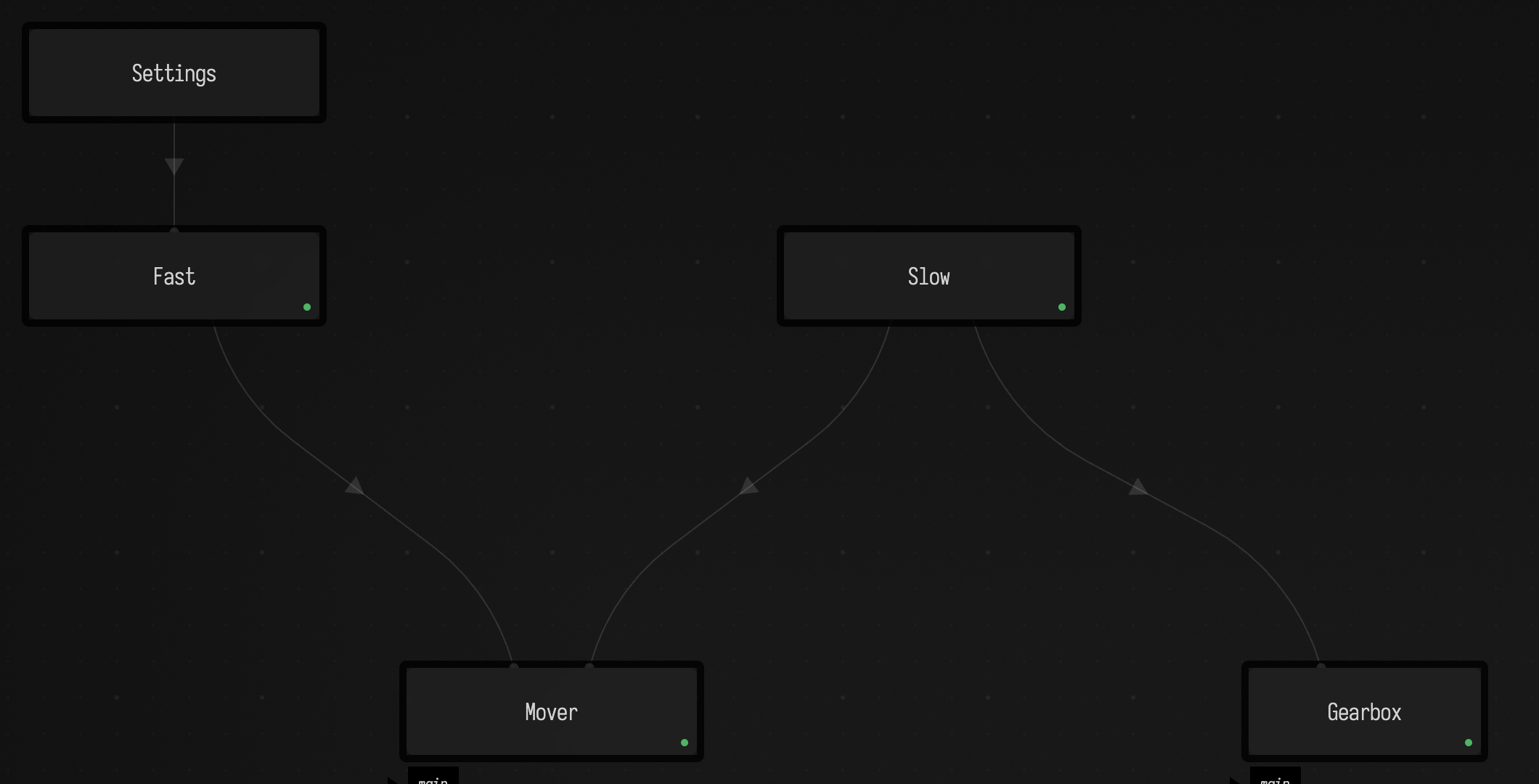
Settings declares prop<Double>(speed) and sets it to 0.25. Fast, under it, sets
speed = 3.0. Slow has no parent; it declares its own prop<Double>(speed), sets 0.5, and also
leaves a plain variable, val gear = 2. Mover is connected under Fast first and Slow second.
Gearbox sits under Slow alone.
Mover's code is one line:
display("main", why.speed.h)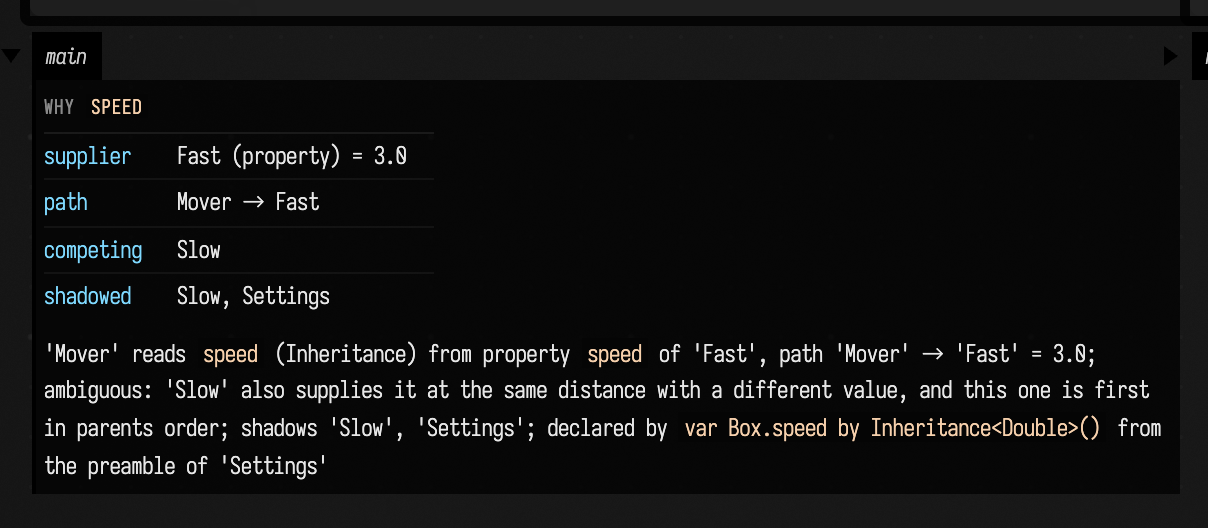
Fast and Slow are both one edge from Mover and hold different values. Slow appears as
competing: the answer depends on the order in which the parents were connected. Shadowed
lists the other boxes with an answer, including Slow and the more distant Settings. The sentence
under the table also names the preamble line (the preamble is the block of declarations Field compiles ahead of
every box's code) that declared speed and where it came from.
why.speed exists because prop<Double>(speed) writes three lines into the preamble, and children
inherit all three: var Box.speed by Inheritance<Double>(), val Once.speed by Onceing<Double>(), and
val Why.speed by Whying(). So every prop name is a member of why and completes there. .h is
the card above; .h2 is the explorer, with the whole answer under json; print(why.speed) prints
the sentence.
The walk goes one generation at a time, the box itself, then all its parents, then all of theirs,
and stops at the first generation with an answer; that is why Settings, two edges up, never reaches
Mover. Within a generation the earlier connection wins. Disconnect Mover from Fast and connect it
again, and Fast is now the later connection: Slow answers from then on. A tie between different
values also writes a warning on the context log channel.
Names no prop declared
A plain variable has no accessor in the preamble, so there is no why.gear. You can call
ContextResolution.explain directly, as why.speed does. Here's Gearbox's code:
display("main", ContextResolution.explain(thisBox, "gear").h)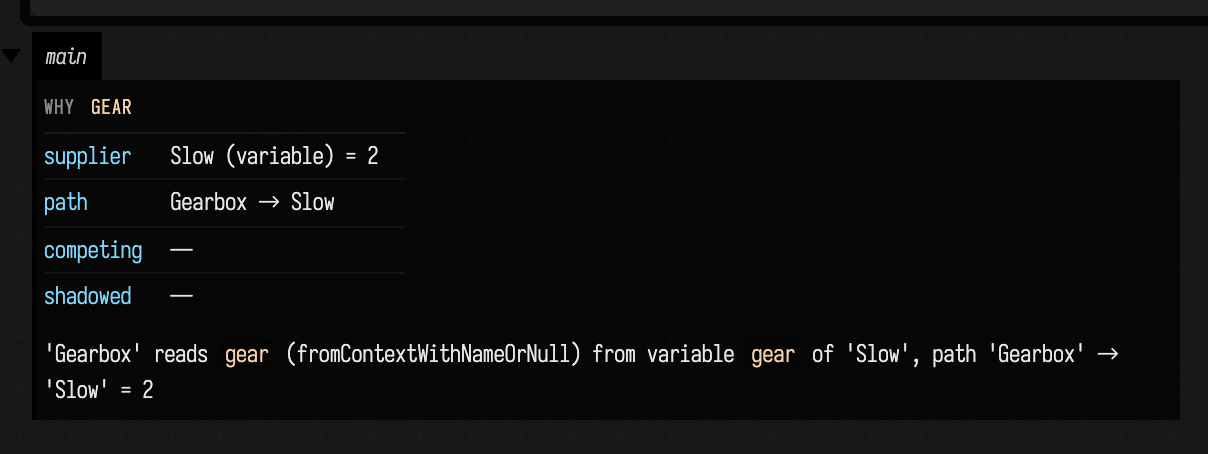
A value found by type, as fromContext<Renderer>() finds it, is asked the same way:
ContextResolution.explain(thisBox, type = "Renderer").h. The type is matched by the name of the
value's class, one of its superclasses or one of its interfaces, simple or fully qualified.
The answer is ContextResolution.explain's JSON, which .json returns unchanged: mechanism,
supplier, matchKind (PROPERTY, VARIABLE or SELF), matchedName, depth, path, value,
valueType, ambiguous, competing, shadowed (the first 24, with shadowedCount), the
declaration and its from: tag, stalePreambleLines, preambleConflicts, and summary.
Found by type or by name
fromContext<T>() finds the nearest value of a type, and fromContextWithNameOrNull<T>("name") the
nearest value with a name. Both see the plain top-level variables of the boxes above, so a parent
needs no prop at all. Studio has two variables:
val ink = java.awt.Color(200, 40, 40)
val title = "Spring"Sketch, beneath it, asks for the first Color, for title, and for subtitle, which nothing
defines:
val ink = fromContext<java.awt.Color>()
val title = fromContextWithNameOrNull<String>("title")
val missing = fromContextWithNameOrNull<String>("subtitle")
markdown("ink = (${ink.red}, ${ink.green}, ${ink.blue}), title = $title, subtitle = $missing")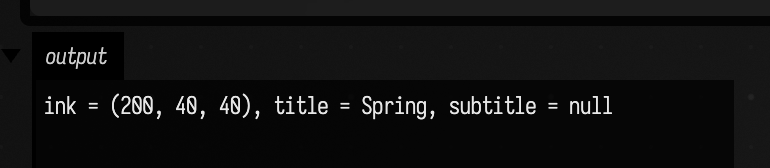
fromContext<T>() looks at the box itself, if it is a T; then the box's own properties; then each
generation of ancestors, nearest first, at each box's properties and then its top-level variables.
The asking box's own top-level variables are left out on purpose: Sketch's val ink = fromContext<Color>()
leaves a Color among Sketch's variables, and if Sketch searched those it would find its own previous
answer on every later run and never see Studio's again. Pass includeLocalVariables = true when a
box does want a value it made itself. fromContextWithNameOrNull never matches the box itself, and
returns null (or the defaultValue you pass) when nothing has the name.
From outside the box
The same answer is available without writing any box code:
- the backdoor:
why <box> <name>orwhy <box> --type <class>, with--expect-supplier,--expect-competing,--expect-shadowedand--expect-not-foundfor smoke tests (see "Why does this value resolve here?" in FIELD_BACKDOOR.md); - the MCP bridge:
field_why; - AI4 chat: the tool
WhyDoesThisResolve, offered whenever a box is focused.