Petri nets
A Petri net has places that hold tokens and transitions that move them along arrows. Draw one and you can ask practical questions about it: how long is this loop? Can the system get stuck? The Petri cheatsheet summarises the notation; open the petri_sound starting point to try the musical examples.
In Field a Petri net can be used as a rhythm, as the structure of a piece, or as a control signal.
That works because a net whose conflicts are always resolved the same way gives the same firings
for the same span of time, so net.emits() can be a PatPattern: a function from a span of time
to the events inside it. Everything in the pattern language (every, jux,
off, fast, rev, with gain(sine())), the offline renderer, the piano roll and respond {}
work on a Petri net as they do on any other pattern.
A net that plays a rhythm
This net has one token, two places and two transitions. Each transition plays a sound when it fires. The token can only be in one place at a time, so the two transitions take turns, and that alternation is the rhythm. The example draws the net and prints the first few steps; a recording of it playing follows the figure.
:::static
import afield.simulation.petri.*

val net =
    petri(
        """
    #petri
    !grid 1/8

    kick : 1
    kick -[ hit  @1/8 : bd ]-> hats
    hats -[ back @1/8 : sd ]-> kick
""",
    )

:::fold draw the net and print what it plays
showPetriNet(net, w = 760.0, h = 420.0)
markdown(
    "main",
    """
    #### one token, going round

    ~~~
${net.asciiTimeline(6).trimEnd()}
    ~~~

    ~~~
${net.report().trimEnd()}
    ~~~
""",
)
displayOpen("main")
:::endfold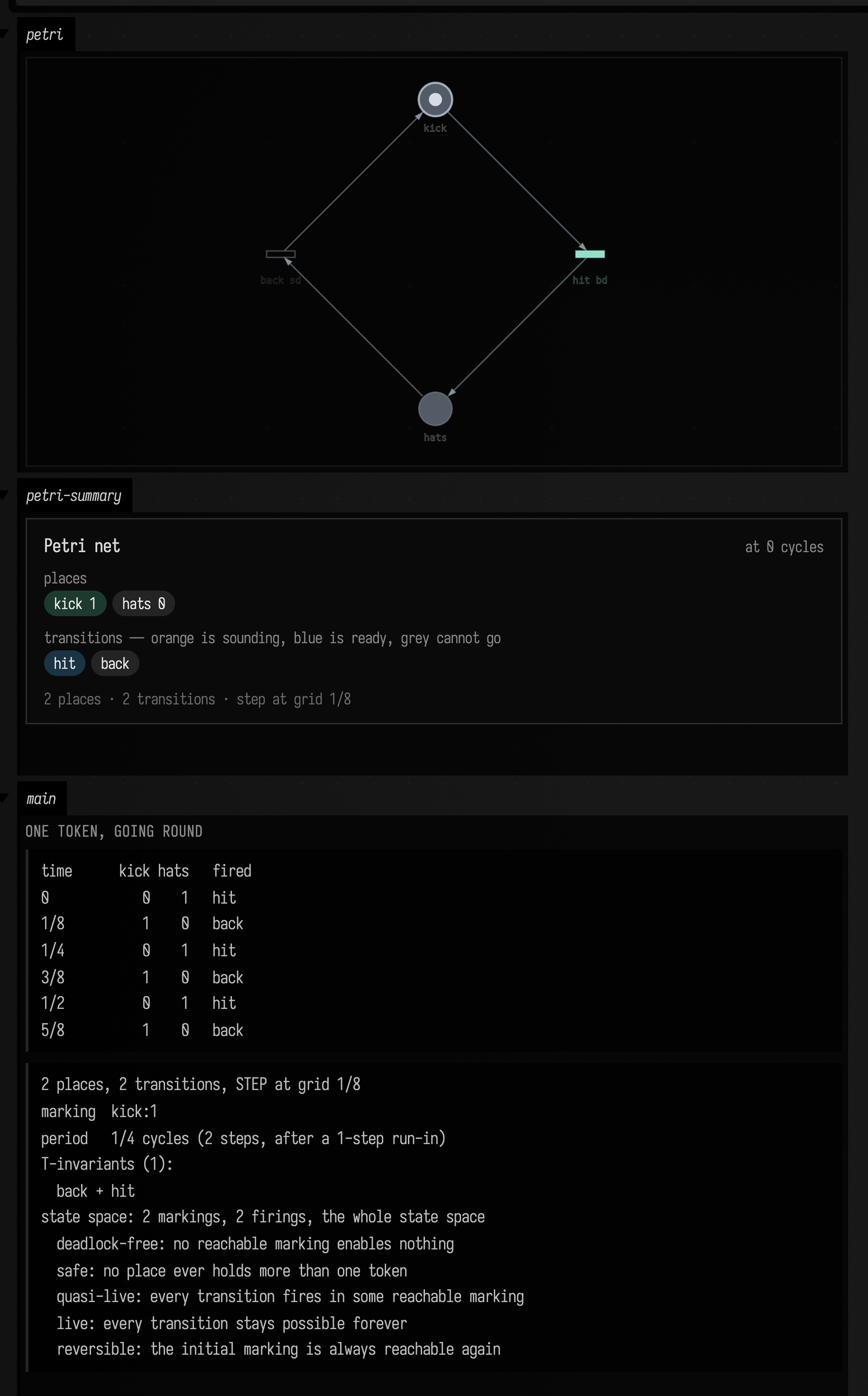
Places are circles, tokens are dots inside them, transitions are bars: bright when they are ready to fire, dim when they are not. A net that is a single cycle is drawn as a ring.
Here is the same net played: hit fires the bd sample and back fires sd, through the
Dirt-Samples the pattern language uses. Four cycles at half a cycle a second, eight seconds of kick and
snare taking turns.
The report ends with the net's period, worked out from the net itself: nothing in the source says how long a bar is.
Finding a net's loop length
A T-invariant is a set of firings that brings the net back to where it started: a loop. A net's smallest T-invariants are its natural periods, and Field works them out from the arcs alone, without running the net.
This example puts two token rings in one net, one of five steps and one of three, and asks how long the whole net takes to repeat. The answer, fifteen, appears nowhere in the source.
:::static
import afield.simulation.petri.*

val net =
    petri(
        """
    #petri
    !grid 1/15

    a0 : 1
    a0 -[ a0.go : x ]-> a1
    a1 -[ a1.go     ]-> a2
    a2 -[ a2.go : x ]-> a3
    a3 -[ a3.go     ]-> a4
    a4 -[ a4.go     ]-> a0

    b0 : 1
    b0 -[ b0.go : y ]-> b1
    b1 -[ b1.go     ]-> b2
    b2 -[ b2.go : y ]-> b0
""",
    )

val lasso = net.settle()!!

:::fold draw it and report the period it found
showPetriNet(net, w = 820.0, h = 520.0)
markdown(
    "main",
    """
    #### five against three

    The two rings are independent, which the analysis states as *two separate T-invariants*
    rather than one combined one. Independence is exactly what lets them be played at
    different tempi without the net coming apart.

    - settles after **${lasso.loopSteps} steps** = **${lasso.duration} cycle**
    - T-invariants: **${net.tInvariants().size}**, of sizes ${net.tInvariants().map { it.size }}
    - the loop the engine ran is a genuine invariant: **${net.checkLoopIsInvariant() == null}**
""",
)
displayOpen("main")
:::endfold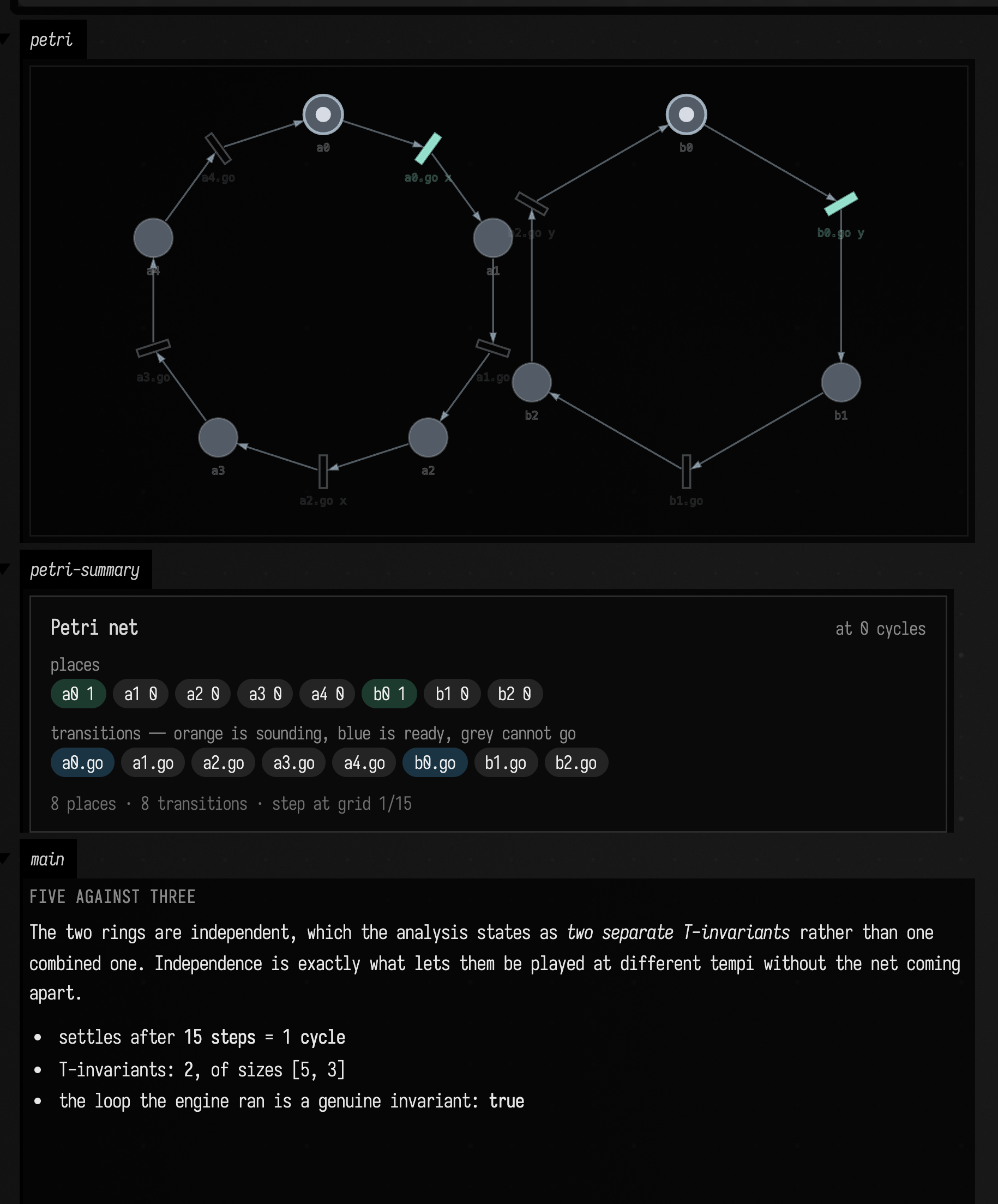
You can also ask whether a net will get stuck, before you play it:
net.willDeadlock() // false — it loops
net.deadTransitions() // [] — every voice is sounding

petri(
    """
    armed : 1
    src   : 4
    ~armed + src -[ blocked : bd ]-> dst
""",
).willDeadlock() // true — nothing can ever empty 'armed'
~armed is an inhibitor arc: the transition is enabled only while that place is empty. Nothing
here ever empties it, so blocked never fires, and willDeadlock() tells you so before you hear
the silence.
Using a net as a pattern
net.emits() is a PatPattern<String>, so everything in the pattern language works on it. This
example builds a kick and a hat as two token rings, doubles the speed every fourth cycle and adds a
reversed copy in the other channel, then counts the onsets. It also checks that a token walking a
ring of eight places plays the same rhythm as euclid(3, 8).
:::static
import afield.simulation.petri.*

// A four-on-the-floor kick and a syncopated hat, as two Euclidean token rings in one net.
val kit = petri {
    grid = cyc(1, 16)
    petriRingInto(this, "kick", 4, 16, emit = "bd")
    petriRingInto(this, "hat", 11, 16, emit = "hh")
}

// From here it is just a pattern.
val voice = kit.emits().every(4) { it.fast(2) }.jux { it.rev() }.with(gain(sine().range(0.4, 1.0)))

:::fold count what came out, and check it against the language's own euclid
val fromNet =
    petriRing("k", 3, 8, emit = "bd")
        .emits()
        .events(PatArc(PatQ.ZERO, PatQ.ONE))
        .filter { it.hasOnset }
        .map { it.arc.start }
val fromLanguage = euclid(3, 8).events(PatArc(PatQ.ZERO, PatQ.ONE)).filter { it.value }.map { it.arc.start }

fun onsets(p: PatPattern<*>, c: Long) = p.events(PatArc(PatQ.of(c), PatQ.of(c + 1))).count { it.hasOnset }

showPetriNet(kit, w = 900.0, h = 560.0)
markdown(
    "main",
    """
    #### a net, put through the pattern language

    | | onsets in cycle 0 | onsets in cycle 1 |
    | --- | --- | --- |
    | `kit.emits()` | ${onsets(kit.emits(), 0)} | ${onsets(kit.emits(), 1)} |
    | `.every(4) { it.fast(2) }` | ${onsets(kit.emits().every(4) { it.fast(2) }, 0)} | ${onsets(kit.emits().every(4) { it.fast(2) }, 1)} |
    | `.jux { it.rev() }` on top | ${onsets(voice, 0)} | ${onsets(voice, 1)} |

    A token walking a ring of eight places lands on the same positions as `euclid(3, 8)`:

    - from the net: `${fromNet.joinToString(" ")}`
    - from `euclid`: `${fromLanguage.joinToString(" ")}`
    - equal: **${fromNet.sorted() == fromLanguage.sorted()}**
""",
)
displayOpen("main")
:::endfold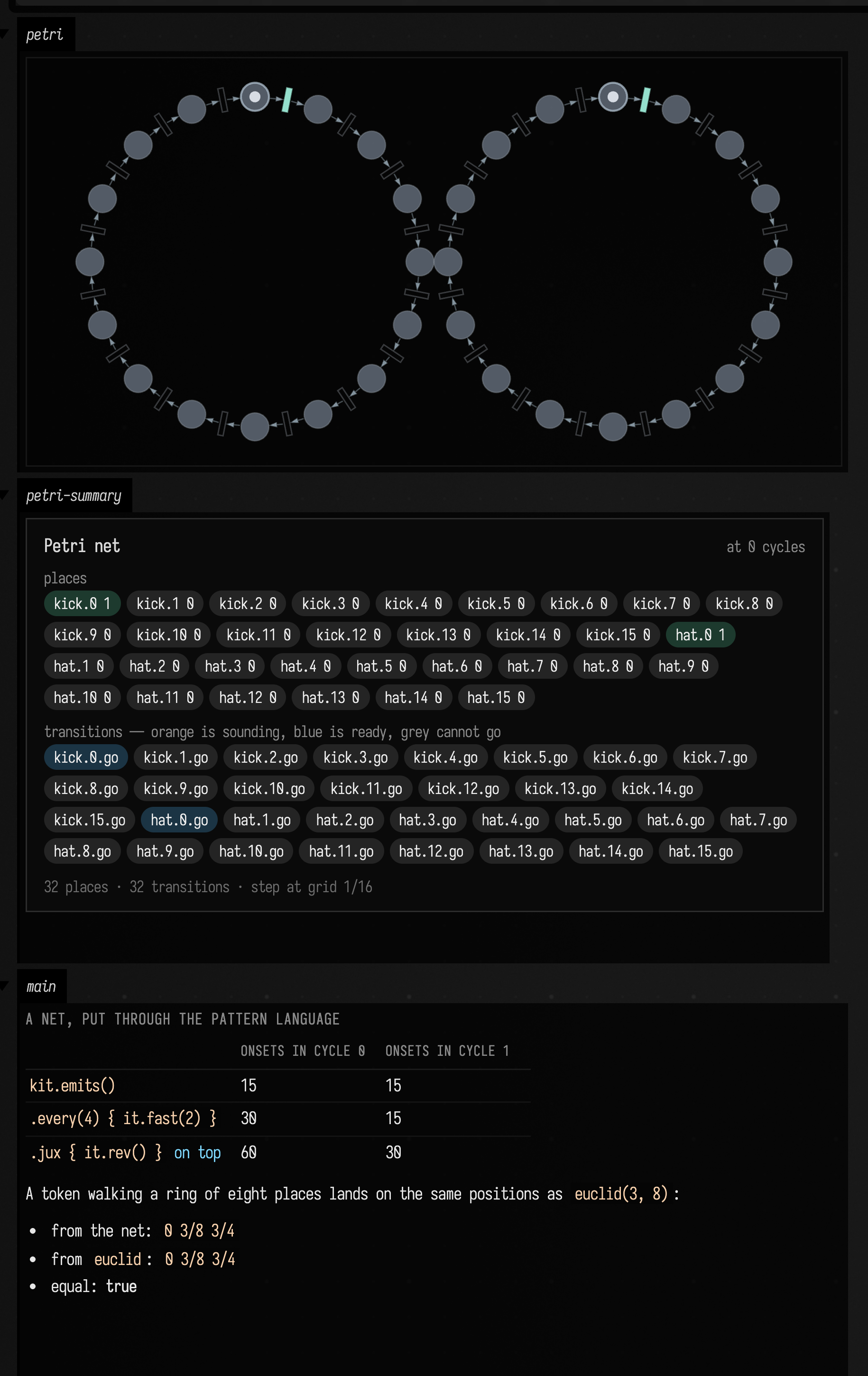
To play it, hand it to respond like any other pattern:
kit.emits().respond(cps = 2.0) { event -> dirt(event.value) }Tokens that carry rhythms
A token can carry a value, called its colour, and the value can be a whole PatPattern. Then a
place is a section of a piece, a transition moves from one section to the next, and a slow net
whose tokens are rhythms arranges the piece. This example builds a verse and a chorus with
petriSong and prints eight bars.
:::static
import afield.simulation.petri.*

// One place per section, one token circulating, each section held for its own number of cycles.
// The token carries the pattern that should be sounding next.
val song = petriSong(
    "verse" to (pat("bd ~ sd ~") to 4),
    "chorus" to (pat("bd*4") to 4),
)

// `unfold` plays whatever pattern each firing consumed, across that firing's arc.
val notes = song.pattern().unfold<String>()

:::fold render eight bars of the arrangement
fun bar(c: Long) =
    notes
        .events(PatArc(PatQ.of(c), PatQ.of(c + 1)))
        .filter { it.hasOnset }
        .sortedBy { it.arc.start }
        .joinToString(" ") { it.value }

showPetriNet(song, w = 700.0, h = 380.0)
markdown(
    "main",
    """
    #### eight bars, from a two-place net

    ~~~
${(0L..7L).joinToString("\n") { "    cycle %d   %s".format(it, bar(it)) }}
    ~~~

    Four bars of one rhythm, four of the other, and then round again — from two places and
    two transitions. Only one place is marked: exactly one section can be sounding, which is
    what "an arrangement" means and is enforced by the net rather than by a scheduler.
""",
)
displayOpen("main")
:::endfold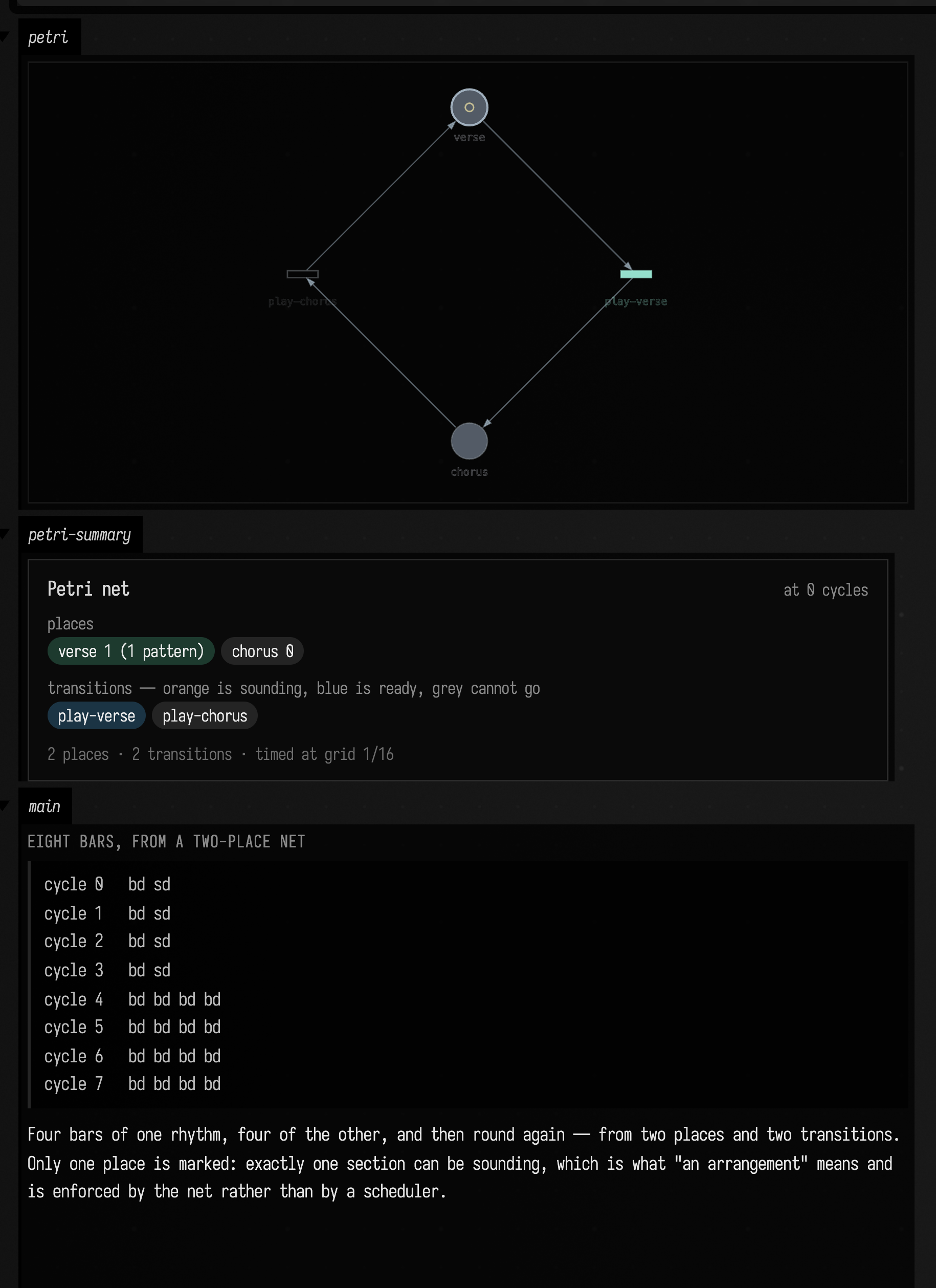
Written in the notation, a net like this looks as follows. !timing timed makes each firing take
its duration, so a transition with @4 holds its section for four cycles instead of passing the
token on at once:
#petri
!timing timed

verse : "bd ~ sd ~"        // the only marked place, so only one section can sound

verse  -[ play-verse  @4 ]-> chorus
chorus -[ play-chorus @4 => rev ]-> verse
The word after => is a colour combinator, which changes the pattern a transition passes on:
stack layers the rhythms a transition consumed, cat plays them one per cycle, fast2 doubles
the speed of one, degrade thins it out. The cheatsheet lists them all.
Token counts as control signals
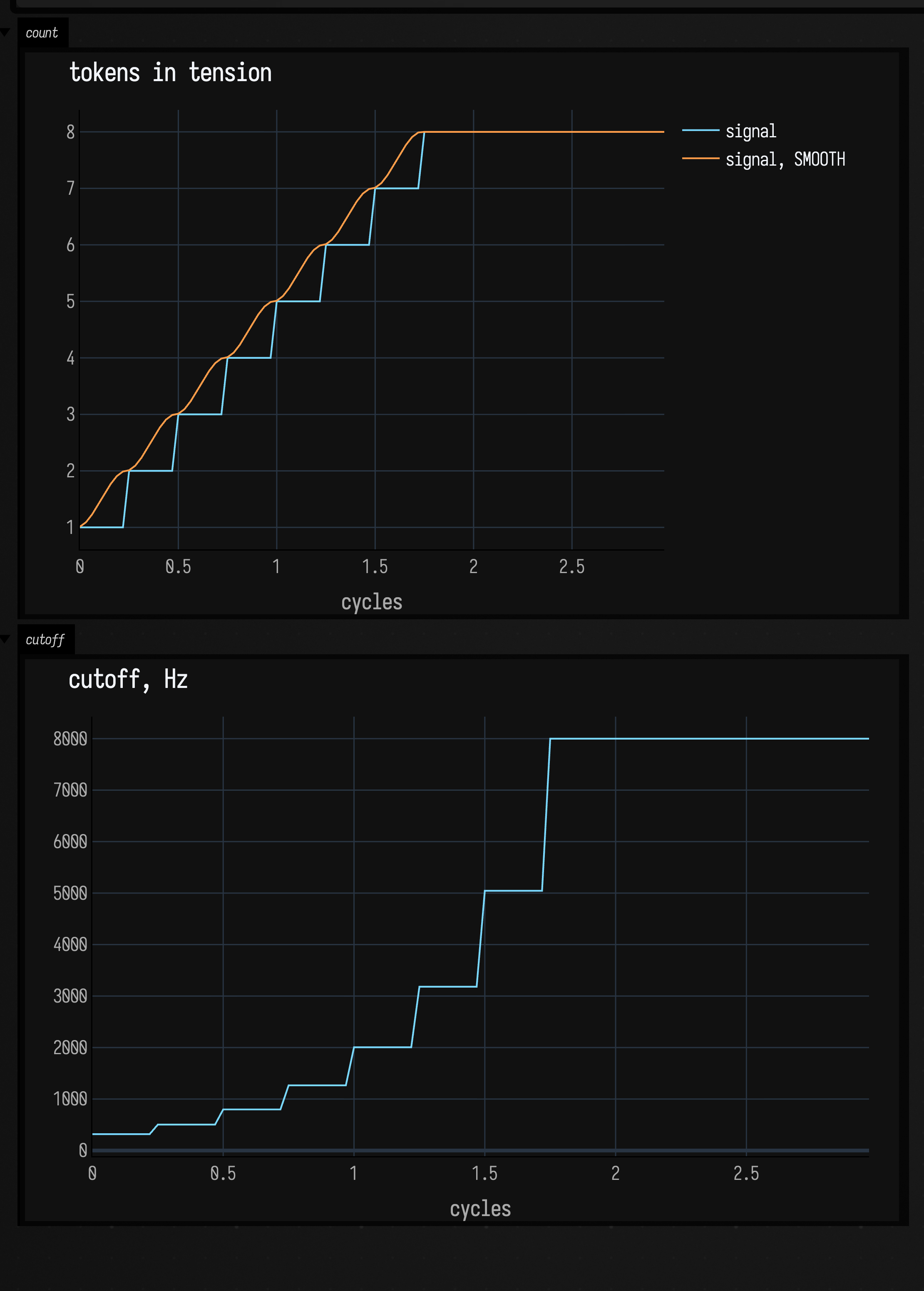
The number of tokens in a place changes over time, and net.run() turns that into a signal you
can use like any other. Here tokens pile up in tension and open a filter on the kit from the
previous section:
val net = petri(
    """
    !grid 1/4
    src     : 8
    tension : 0 ^8
    src -[ build @1/4 ]-> tension
""",
)
val run = net.run()

// `level` normalises against the place's declared capacity, which is the form `rangex` wants.
kit.emits() with cutoff(run.level("tension").rangex(200, 8000))

// and the raw count, a gate, and a smoothed ramp are all there too
run.signal("tension") // 0, 1, 2, … as a continuous pattern
run.gate("armed") // 1 while occupied, 0 when not
run.signal("tension", PetriInterp.SMOOTH) // no corners, safe on a cutoff
Use level rather than signal when the value is going into range or rangex: those map
0..1 onto their interval and extrapolate outside it, so a raw count of 3 would send a sweep
three times past the top.
This box samples the same run over three cycles. build moves one token every quarter cycle, so the
count climbs a step at a time until all eight are in tension, and the cutoff climbs with it,
evenly in octaves because rangex is exponential:
import afield.audio.synth.*
import afield.simulation.petri.*

val net = petri(
    """
    !grid 1/4
    src     : 8
    tension : 0 ^8
    src -[ build @1/4 ]-> tension
""",
)
val run = net.run()

// Sample each signal 32 times a cycle over the first three cycles.
val steps = 0 until 96
fun sampled(p: PatPattern<Double>) = steps.map { k ->
    p.events(PatArc(PatQ.of(k, 32), PatQ.of(k + 1, 32))).firstOrNull()?.value ?: 0.0
}
val x = steps.map { it / 32.0 }
showSignals(
    "signal" to sampled(run.signal("tension")),
    "signal, SMOOTH" to sampled(run.signal("tension", PetriInterp.SMOOTH)),
    x = x,
    title = "tokens in tension",
    xTitle = "cycles",
    channel = "count",
)
showSignals(
    "level.rangex(200, 8000)" to sampled(run.level("tension").rangex(200, 8000)),
    x = x,
    title = "cutoff, Hz",
    xTitle = "cycles",
    channel = "cutoff",
)
Playing a net live
Everything above plays the same way every time. net.live() makes a net you can change while it
plays, by clicking on its drawing:
val live = net.live()

showPetriNet(live) // click a place to inject a token, a transition to fire it
live.play(cps = 2.0) { firing -> firing.emit?.let { dirt(it.toString()) } }
Clicking a place in the drawing adds a token; clicking a transition fires it, whether or not it was
about to fire. play drives the net through respond, so a live net starts, stops and re-runs in
a box like any other pattern. If you leave it alone it plays exactly what net.emits() plays; once
you click, it follows your changes from that moment on.
Deadlock and starvation
A Petri net doesn't have to make sound. The same analysis that finds a drum loop's length can tell you whether processes that share resources can get stuck.
These examples use the Kotlin DSL, petri { }, instead of the #petri notation. The notation is
easier to edit while a net plays; the DSL lets you compute a net's shape, so five philosophers is
a for loop rather than five copies of the same lines.
Dining philosophers
Five philosophers sit round a table with a fork between each pair. Each needs the fork on their left and the fork on their right to eat. If everyone reaches left first, all five forks are taken at once and nobody can pick up a second. This example builds that table and two fixes, and asks each one whether it deadlocks and which transitions never fire.
:::static
import afield.simulation.petri.*

// The shape of this net is computed, which is exactly what the notation cannot express.
fun table(reverseLast: Boolean, fairly: Boolean) = petri {
    conflict = if (fairly) PetriConflict.ROUND_ROBIN else PetriConflict.ORDER
    grid = cyc(1, 4)
    for (i in 0 until 5) place("fork.$i", tokens = 1)
    for (i in 0 until 5) {
        val left = i
        val right = (i + 1) % 5
        // The classic fix: the last philosopher reaches right first, breaking the symmetry.
        val reversed = reverseLast && i == 4
        t("grab.$i") {
            from("fork.${if (reversed) right else left}")
            to("holding.$i")
        }
        t("eat.$i") {
            from("holding.$i")
            from("fork.${if (reversed) left else right}")
            to("eating.$i")
        }
        t("done.$i") {
            from("eating.$i")
            to("fork.$left")
            to("fork.$right")
        }
    }
}

val naive = table(reverseLast = false, fairly = false)
val asymmetric = table(reverseLast = true, fairly = false)
val fairTable = table(reverseLast = true, fairly = true)

:::fold draw the deadlocked table, then compare all three
fun row(label: String, net: PetriNet) =
    "| $label | " +
        (if (net.willDeadlock()) "**yes**" else "no") +
        " | " +
        net.deadTransitions().ifEmpty { ["—"] }.joinToString(", ") +
        " |"

showPetriNet(naive, w = 900.0, h = 560.0)
markdown(
    "main",
    """
    #### five philosophers, three tables

    | table | deadlocks? | never fires |
    | --- | --- | --- |
    ${row("all left-handed", naive)}
    ${row("one reaches right first", asymmetric)}
    ${row("…and round-robin conflict", fairTable)}

    The deadlocked table stops with **${naive.deadlockMarking()!!.occupied.count { it.startsWith("holding") }}**
    philosophers each holding one fork and no fork left on the table.
""",
)
displayOpen("main")
:::endfold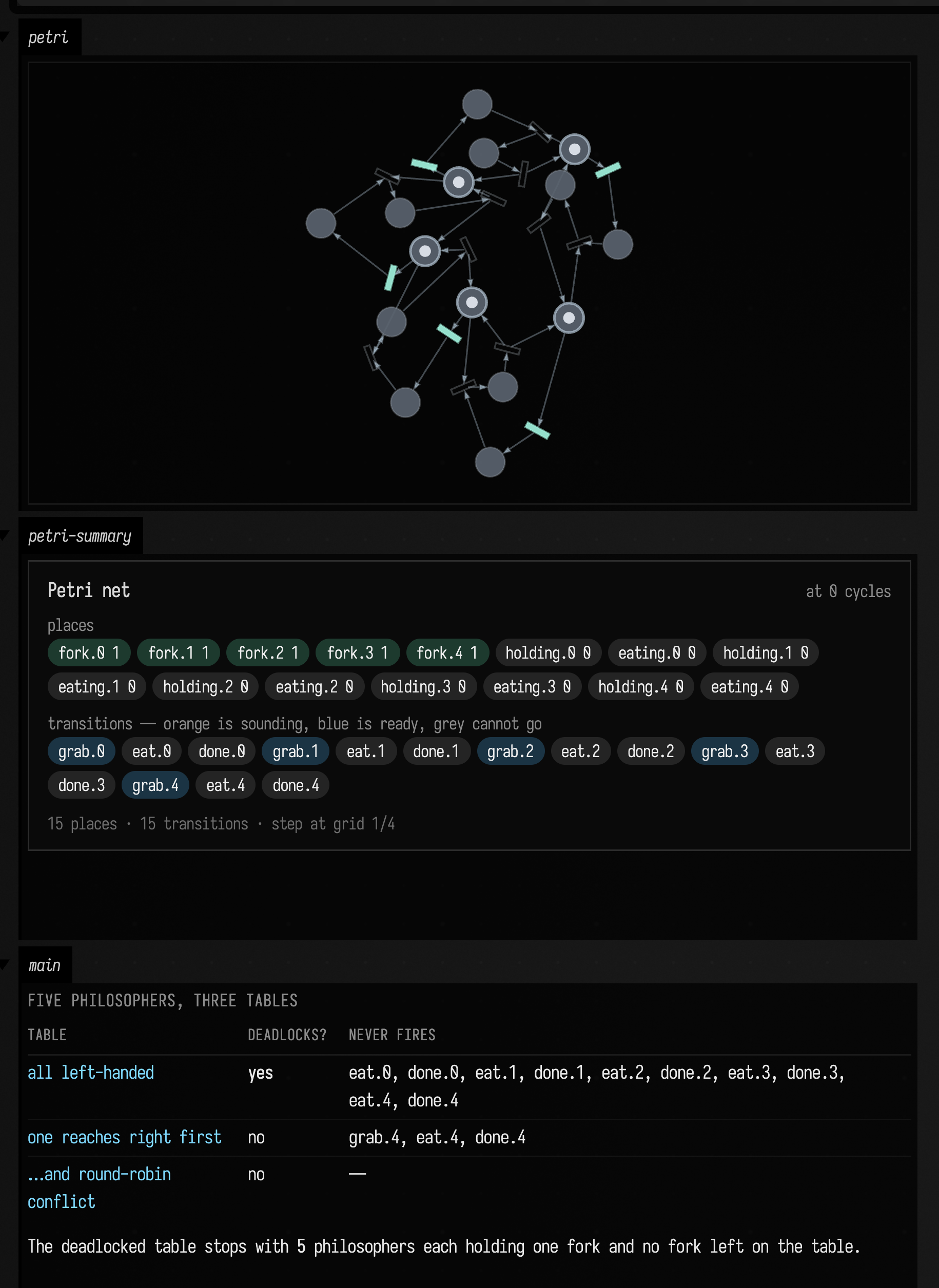
The middle row reverses one philosopher, which removes the deadlock. But under
PetriConflict.ORDER the first-declared claimant always wins the contested fork, so the reversed
philosopher never gets it and never eats. This is starvation: the net keeps running but one
philosopher is permanently left out. willDeadlock() says no, and deadTransitions() says who
is starving. Reversing a philosopher fixes the deadlock; a fair conflict policy fixes the
starvation.
Conservation laws in a bounded buffer
A P-invariant is a weighted sum of token counts that no transition can change, worked out from the arcs. This example builds a four-slot buffer between a producer and a consumer, lists its P-invariants, and checks one of them against a run.
:::static
import afield.simulation.petri.*

val buffer = petri {
    grid = cyc(1, 8)
    place("free", tokens = 4) // four empty slots
    place("items", capacity = 4) // …and never more than four full ones
    place("producer", tokens = 1)
    place("consumer", tokens = 1)
    // Each worker holds a token it puts straight back: that is what makes it *one* worker
    // rather than an unbounded supply of them.
    t("produce") {
        from("producer")
        from("free")
        to("items")
        to("producer")
    }
    t("consume") {
        from("consumer")
        from("items")
        to("free")
        to("consumer")
    }
}

:::fold draw it, state the laws, and check them against a real run
val laws =
    buffer.pInvariants().joinToString("\n    ") { invariant ->
        "- `" +
            invariant.entries
                .sortedBy { it.key }
                .joinToString(" + ") { if (it.value == 1) it.key else "${it.value}·${it.key}" } +
            "` never changes"
    }
val run = buffer.run()
val totals = run.steps(40).map { it.after.count("items") + it.after.count("free") }.distinct()

showPetriNet(buffer, w = 760.0, h = 420.0)
markdown(
    "main",
    """
    #### a four-slot buffer that provably cannot leak

    $laws

    Over 40 steps `items + free` took the values **$totals** — a set of one element, which is
    what a conservation law looks like from the outside. The capacity on `items` is belt and
    braces: the invariant already makes overflow impossible.
""",
)
displayOpen("main")
:::endfold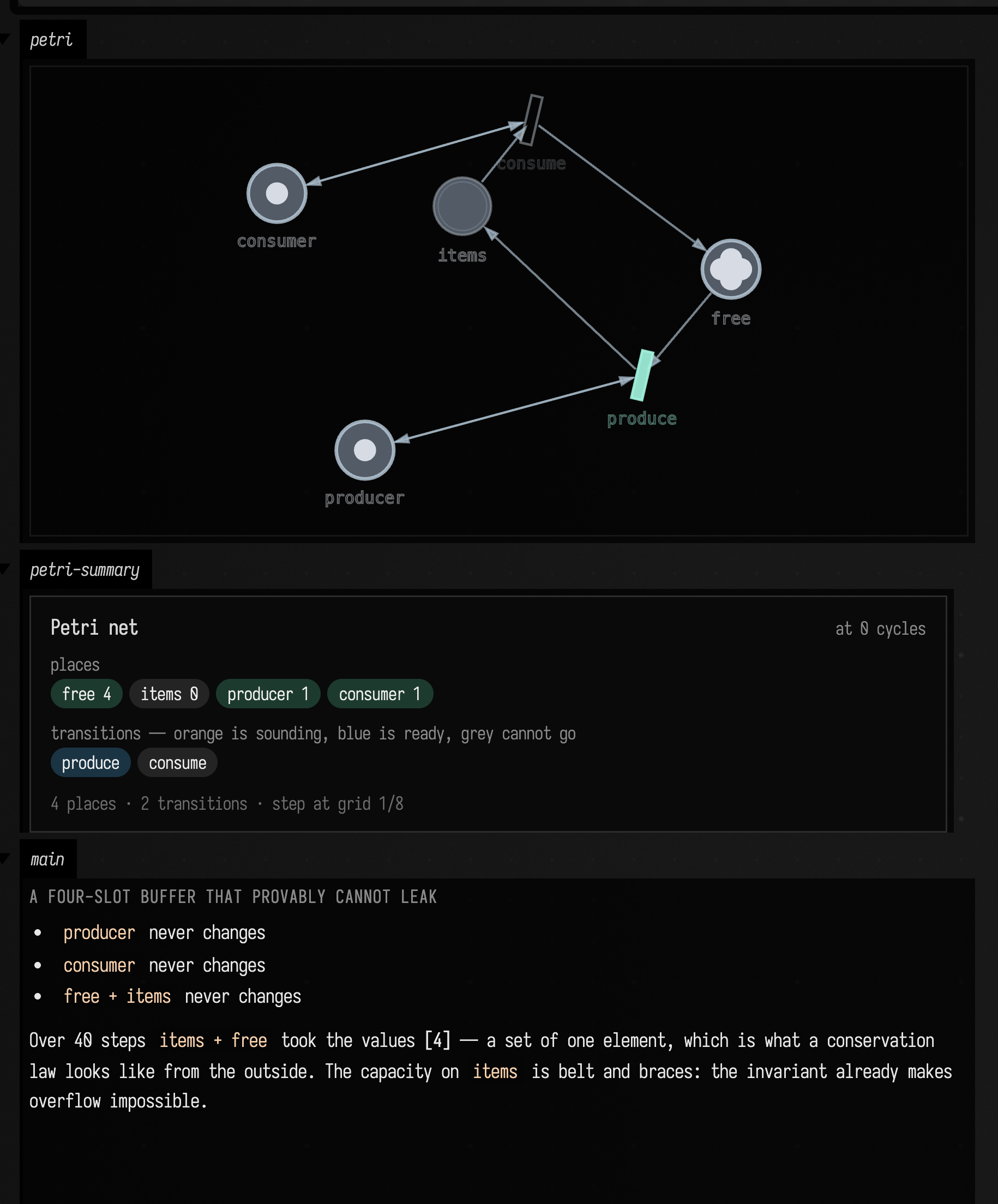
free + items never changing means a slot can never be lost or invented, so the buffer cannot leak
or overflow. The other two say the producer and the consumer are each exactly one worker. None of
these are declared anywhere; they come from the arcs.
Checking every possible order
willDeadlock() and deadTransitions() run the net once, resolving each conflict with the net's
own conflict policy, and report what happened in that one run. For music that is usually the
question you want answered, because the conflict policy is part of how the piece plays.
But a table of philosophers can deadlock in some orders of events and not in others, so one run
that keeps going proves nothing. net.stateSpace() finds every marking (every arrangement of
tokens) the net can reach in any order, and answers questions about all of them. This example
draws the state space of the deadlocking table, with the shortest route to the deadlock marked.
The petri_state_space starting point has these examples
as runnable boxes.
:::static
import afield.simulation.petri.*

fun table(reverseLast: Boolean) = petri {
    conflict = PetriConflict.ORDER
    grid = cyc(1, 4)
    for (i in 0 until 5) place("fork.$i", tokens = 1)
    for (i in 0 until 5) {
        val left = i
        val right = (i + 1) % 5
        val reversed = reverseLast && i == 4
        t("grab.$i") {
            from("fork.${if (reversed) right else left}")
            to("holding.$i")
        }
        t("eat.$i") {
            from("holding.$i")
            from("fork.${if (reversed) left else right}")
            to("eating.$i")
        }
        t("done.$i") {
            from("eating.$i")
            to("fork.$left")
            to("fork.$right")
        }
    }
}

val graph = table(reverseLast = false).stateSpace()
val trace = graph.deadlockTrace()!!

:::fold draw the state space with the counterexample on it
showPetriStateSpace(graph, w = 1080.0, h = 560.0)
markdown(
    "main",
    """
    #### ${graph.stateCount} reachable markings, and the ${trace.length} firings that ruin them

    ~~~
${graph.report().trimEnd()}
    ~~~

    The counterexample, re-fired through the engine's own enabling test:
    **${trace.verify() ?: "it checks out"}**. Breaking the symmetry (`reverseLast = true`)
    leaves **${table(reverseLast = true).stateSpace().stateCount}** markings and *proves*
    there is no deadlock among them.
""",
)
displayOpen("main")
:::endfold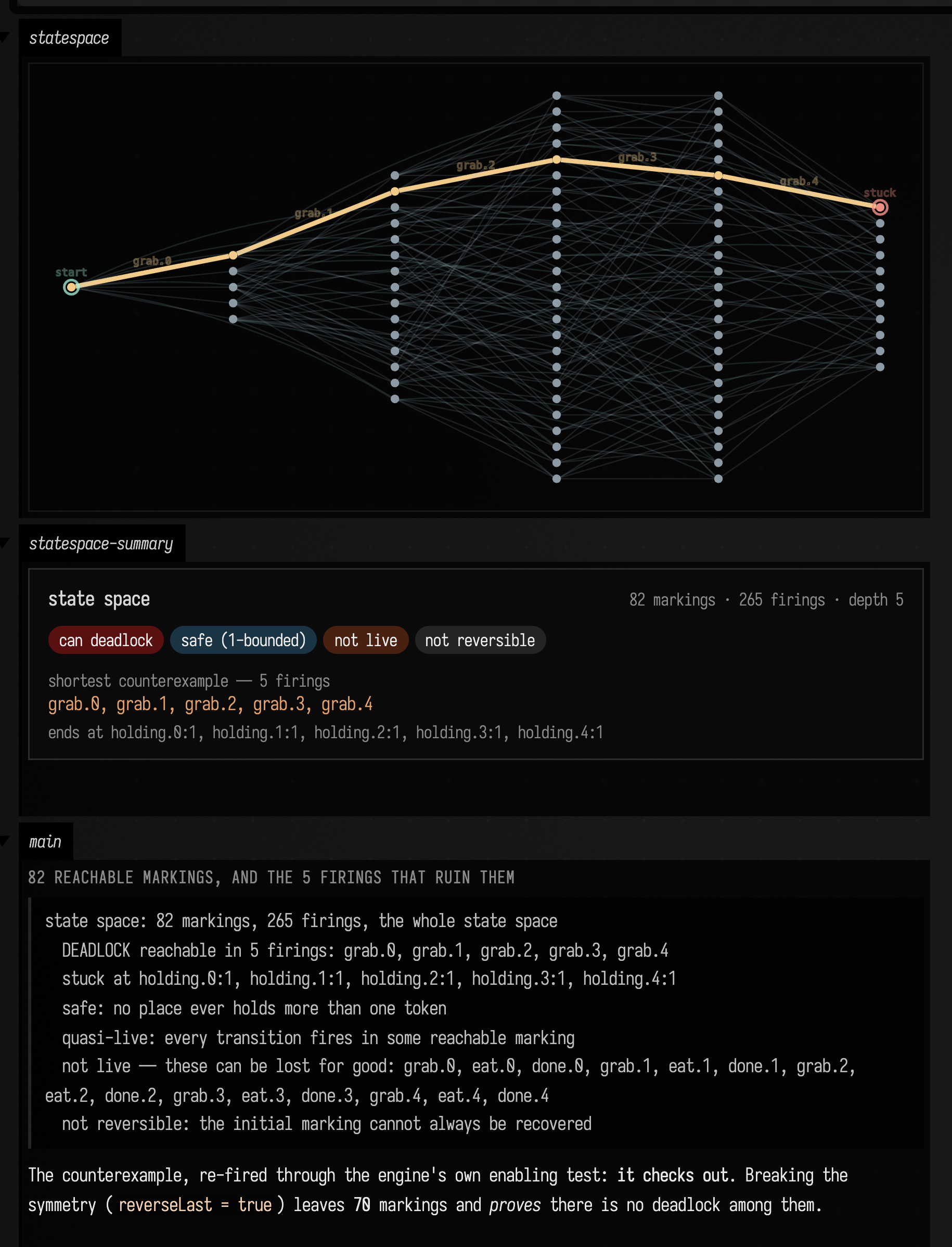
Each dot is a reachable marking, arranged left to right by how many firings it takes to reach it. The orange path is the shortest route to the deadlock, with its transitions written on it, and the red ring is the marking where it gets stuck: every philosopher holding one fork.
A drawing of the whole state space is only readable for small nets. Above
PETRI_STATE_DRAW_LIMIT (400 markings) the dots and layers would overlap, so the figure shows the
counterexample alone, one firing per column, over a histogram of how many markings sit at each
breadth-first depth, and says on the figure that it has done so. graph.tooDenseToDraw() tells you
in advance; maxNodes on toFLines, toSvg and showPetriStateSpace moves the limit, and
Int.MAX_VALUE draws every marking regardless.
The state space answers three things that running the net once cannot:
- Whether it can deadlock at all.
canDeadlockistrue,falseornull, andnullmeans the search ran out of budget. Any answer about markings the search did not visit comes back asnull, never asfalse. - How it goes wrong.
graph.witness { … }finds the shortest route to a marking with a property (EF), andgraph.invariant { … }returns the shortest route to a marking that breaks one (AG), somutuallyExclusive("crit.a", "crit.b")either proves the property or gives you the two firings that break it.PetriTrace.verify()replays a route through the net to confirm it. - What read and inhibitor arcs do. Invariants only see how arcs change token counts, so they miss read and inhibitor arcs, which test a place without changing it. The state space follows the real firing rules, so it sees them.
On the table with one reversed philosopher, the two kinds of check disagree, and that tells you what is wrong:
val net = table(reverseLast = true) // asymmetric, PetriConflict.ORDER
net.deadTransitions() // [grab.4, eat.4, done.4]  ← starved by the policy
net.stateSpace().neverFires() // []                       ← the *net* is fine
The starving philosopher comes from the conflict policy, not from the net: some order of events
lets every transition fire. report() prints both results and says which case you are in: this
run got stuck; some order gets stuck, and here is the sequence; no order gets stuck; or the search
ran out of budget and the answer is unknown.
Drawing a net
showPetriNet uses PetriLayout.AUTO unless you choose another layout. AUTO draws a net that is a
single cycle as a ring, and anything else with FORCE, a spring model that tries several starting
positions and keeps the drawing with the fewest crossings and overlaps. The same net always draws
the same way. RING draws a circle in the order the net was built, and LAYERED draws left to
right by distance from the places that start with tokens.
PetriLayout.TALA uses TALA, the layout engine of the d2 diagram tool, which places each node at
its real size and routes the arcs around nodes. This example draws one net both ways and labels
each drawing with its number of arc crossings. The petri_tala_layout
starting point has a smaller net to compare on.
:::static
import afield.simulation.petri.*

fun table() = petri {
    for (i in 0 until 5) place("fork.$i", tokens = 1)
    for (i in 0 until 5) {
        val left = i
        val right = (i + 1) % 5
        t("grab.$i") {
            from("fork.$left")
            to("holding.$i")
        }
        t("eat.$i") {
            from("holding.$i")
            from("fork.$right")
            to("eating.$i")
        }
        t("done.$i") {
            from("eating.$i")
            to("fork.$left")
            to("fork.$right")
        }
    }
}

val net = table()

:::fold draw it twice, labelling each panel with the engine and what it cost in crossings
/*
Both labels are generated, so the figure reports itself rather than asking you to take a claim
on trust. On a machine with no helper the right-hand panel says so, instead of showing FORCE's
drawing under TALA's name.
*/
val forceDrawing = net.frame(PetriLayout.FORCE)
val talaDrawing = net.frame(PetriLayout.TALA)
val engine = if (D2Layout.available) "TALA, d2 " + D2Layout.version else "helper absent: FORCE again"

fun label(name: String, drawing: PetriDrawing) = name + " - " + drawing.arcCrossings() + " arc crossings"

showPlaneGrid(
    label("FORCE, spring model", forceDrawing) to forceDrawing.toFLines(),
    label(engine, talaDrawing) to talaDrawing.toFLines(),
    columns = 2,
    cellWidth = 560,
    cellHeight = 470,
)
displayOpen("main")
:::endfold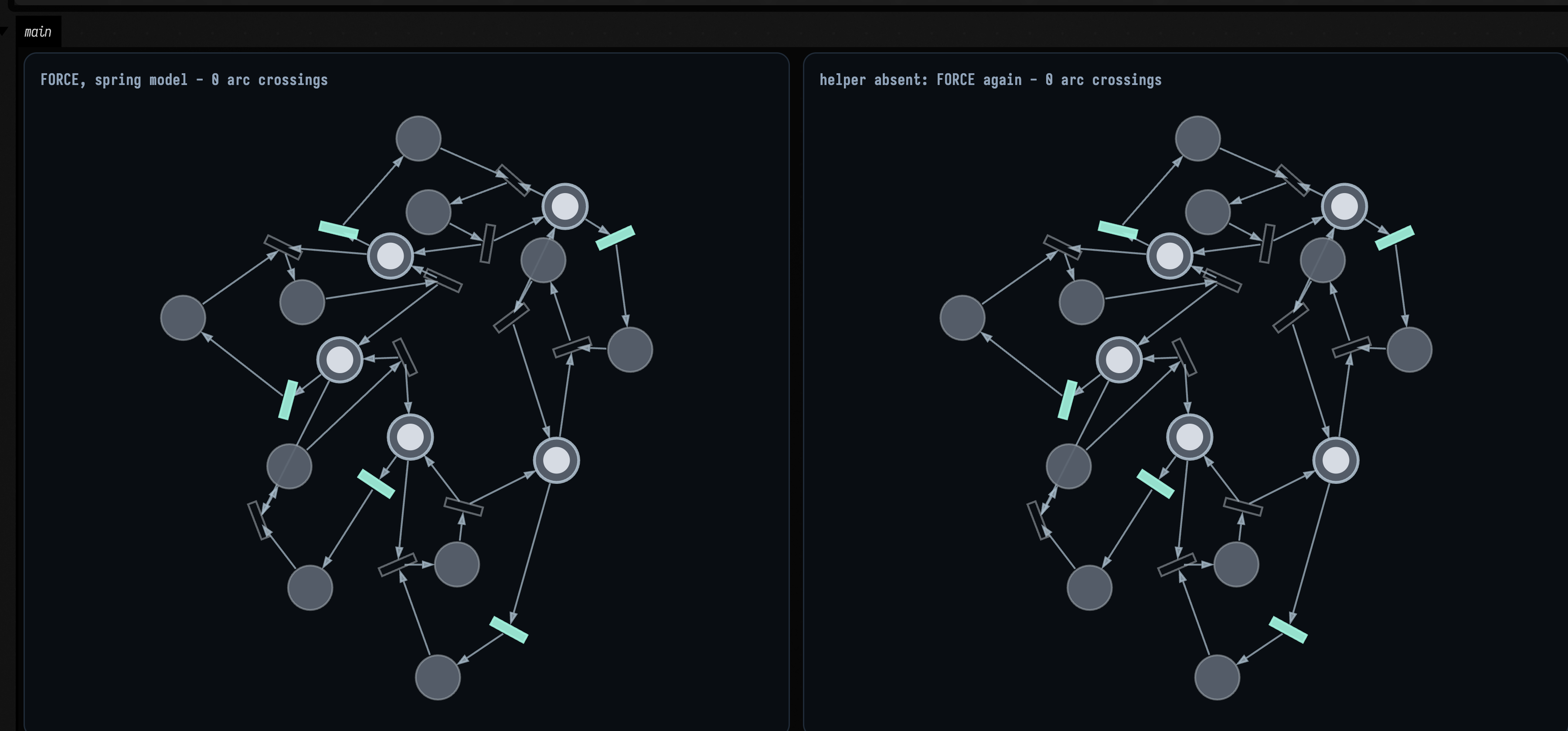
Each panel counts its own crossings. FORCE often has fewer, because crossings are what it
minimises; on other nets TALA wins, and is sometimes faster too, so AUTO never picks TALA for you
— try both on your net. Neither drawing has labels, because toFLines drops them on nets this
large.
The arcs are drawn differently as well. FORCE places the nodes and draws each arc as a straight
line from centre to centre. TALA routes each arc around the nodes in its way, so the right-hand
panel turns corners and reads more like a schematic than a graph drawing. PetriLayout.TALA also
lays the net out once per direction (up, down, right, and no preference) and keeps the drawing with
the fewest crossings.
TALA needs a helper program, native/field-d2-layout, written in Go. With Go installed,
./gradlew buildD2LayoutHelper builds it and enables TALA; a helper built while Field is running is
used from the next draw. Without it PetriLayout.TALA falls back to FORCE, so a document that asks
for TALA still opens, and D2Layout.available tells you which one you got.
Limits
- Invariants only see token counts. Read and inhibitor arcs don't change token counts, so the
invariants can't see them.
net.report()says so when a net uses them and suggestsstateSpace(), which does see them. - A net that makes a new colour on every firing never repeats. Loop detection and
stateSpace()both compare colours by equality, so such a net finds no loop, andstateSpace()runs out of search budget. - The editor checks spelling, not behaviour. The editor marks
@1/0as a bad duration and=> wobbleas an unknown combinator as you type. It can't tell that a transition will never fire; the Kotlin parser reports that when the box runs.
Large and unbounded nets
How large a net can be searched
The number of markings grows exponentially with the number of things that can happen at once, so large concurrent nets exhaust the search budget. These are the sizes at the default 20 000-marking budget:
| net | markings | note |
|---|---|---|
| the examples on this page | 2 – 82 | far inside the budget |
| an N-slot buffer | N + 1 | linear |
an N-section petriSong |
N | linear, even though every token carries a PatPattern |
| N philosophers | 6, 14, 34, 82, 198, 478, 1154, 2786 … | a(n) = 2a(n-1) + a(n-2) — about 2.41× per philosopher |
Musical nets stay far inside the budget; concurrency puzzles can exceed it. Eleven philosophers
still fit; twelve do not, and the search reports BUDGET and returns null from canDeadlock
rather than guessing.
A petriSong stays linear even though each token carries a whole PatPattern, because its
sections live in separate places and only one token circulates. Colour multiplies the state space
only when the same place can hold different colours; a net that mints a fresh colour per firing has
no finite state space at all, and gets BUDGET.
Searching larger nets: stubborn sets
Most of those philosopher markings are the same firings in a different order: five philosophers each reaching for their left fork can happen in 5! orders, and a full search visits all of them. A partial-order reduction explores one order when the others cannot change the answer:
net.stateSpace(reduction = PetriReduction.STUBBORN)At each marking it explores a stubborn set, a subset of the enabled transitions chosen so that
the transitions it skips cannot change whether a deadlock is reachable. On the philosophers the
number of markings grows as \( 2n^2 - 2n + 2 \) instead of about 2.41ⁿ:
| philosophers | full | reduced |
|---|---|---|
| 5 | 82 | 42 |
| 8 | 1 154 | 114 |
| 11 | 16 238 | 222 |
| 12 | budget exhausted | 266 |
Nets where many things happen independently reduce the most. A net where only one thing can happen at a time, like the bounded buffer, does not reduce at all.
Three limits bound what it will answer:
- It answers only deadlock questions. A reduced graph does not contain every reachable
marking, so bounds read off it would be wrong.
graph.exactiscomplete && reduction == NONE, andbounds,isSafe,isLive,isReversible,homeMarkings,neverFires(),mutuallyExclusiveandproves { }all returnnullon a reduced graph.canDeadlockanddeadlockTracedo not. - It is not a shortest path. The reduced search reaches a deadlock that really is reachable, by a
route at least as long as the true shortest. Every trace still passes
verify(); it is just not guaranteed to be the shortest. In practice the two are usually the same length, but do not rely on it. - A colour-dependent net is not reduced. The closure reasons about arcs, and a guard or an
enabledIfis an arbitrary predicate no arc analysis can see, sostateSpace(reduction = STUBBORN)on such a net returns an unreduced (and therefore stillexact) graph, andgraph.caveatsandreport()say so.
How the reduction is checked
A differential test runs both searches over generated nets and compares the set of reachable
terminal markings, the length of the counterexample, containment of the reduced state set in the
full one, and that every accessor gated on exact refuses. PETRI_REDUCTION_AGREEMENT.md
has the corpus, the floors and a run's numbers.
Half of that corpus uses read arcs, inhibitor arcs, capacities and arc weights. A stubborn set
must be closed under "this transition may disable that one" as well as under the reverse. In a
plain place/transition net the two coincide: if firing t disables t' they share an input
place, so t' is in the set already. They stop coinciding once a transition can starve a read
arc it does not consume from, or arm an inhibitor arc by producing into its place, and a
one-directional closure could then call a net deadlock-free that the full search deadlocks. A
three-transition net and a four-transition net pin each case.
When the state space is infinite
A net whose token counts can grow forever has infinitely many markings, so the search can only
report BUDGET on it. net.coverability() builds the Karp–Miller graph instead: a place that can
grow without limit is written as ω, which keeps the graph finite for every net.
val leak = petri {
    place("run", tokens = 1)
    t("make") {
        from("run")
        to("run")
        to("queue")
    }
}

leak.stateSpace(budget = 500).outcome // BUDGET — and bounds, isSafe, neverFires() are all null
leak.coverability().unboundedPlaces // [queue]
leak.coverability().bound("queue") // null — which here means ω, not "unknown"
Use the two together. stateSpace() handles every feature (read arcs, inhibitor arcs, colour
guards, enabledIf, capacities) but may run out of budget. coverability() always finishes, but
is only correct for nets without inhibitor arcs, place capacities or colour-dependent behaviour.
When a net has any of those, it adds a line to coverability().caveats and sets sound to false.
See also: Interaction nets, the pattern language, A Petri net that throws sparks, A Deadlock, Sculpted and Traced.