A Generator, Graded by Datalog
A flow-matching generator makes new points shaped like a cloud. To find out whether it kept the cloud's shape, you can hand its output to a Datalog program. Datalog doesn't need to know where the points came from: it reads them as facts, and its rules say which points are near each other, which ones have no target point nearby, and how many separate pieces there are.
In this example the target is two interlocking half-moons, 200 points in two pieces that do not touch. The generator's 200 points are drawn below, coloured by the piece Datalog put them in. Grey is the target. The red points are the ones Datalog calls strays.
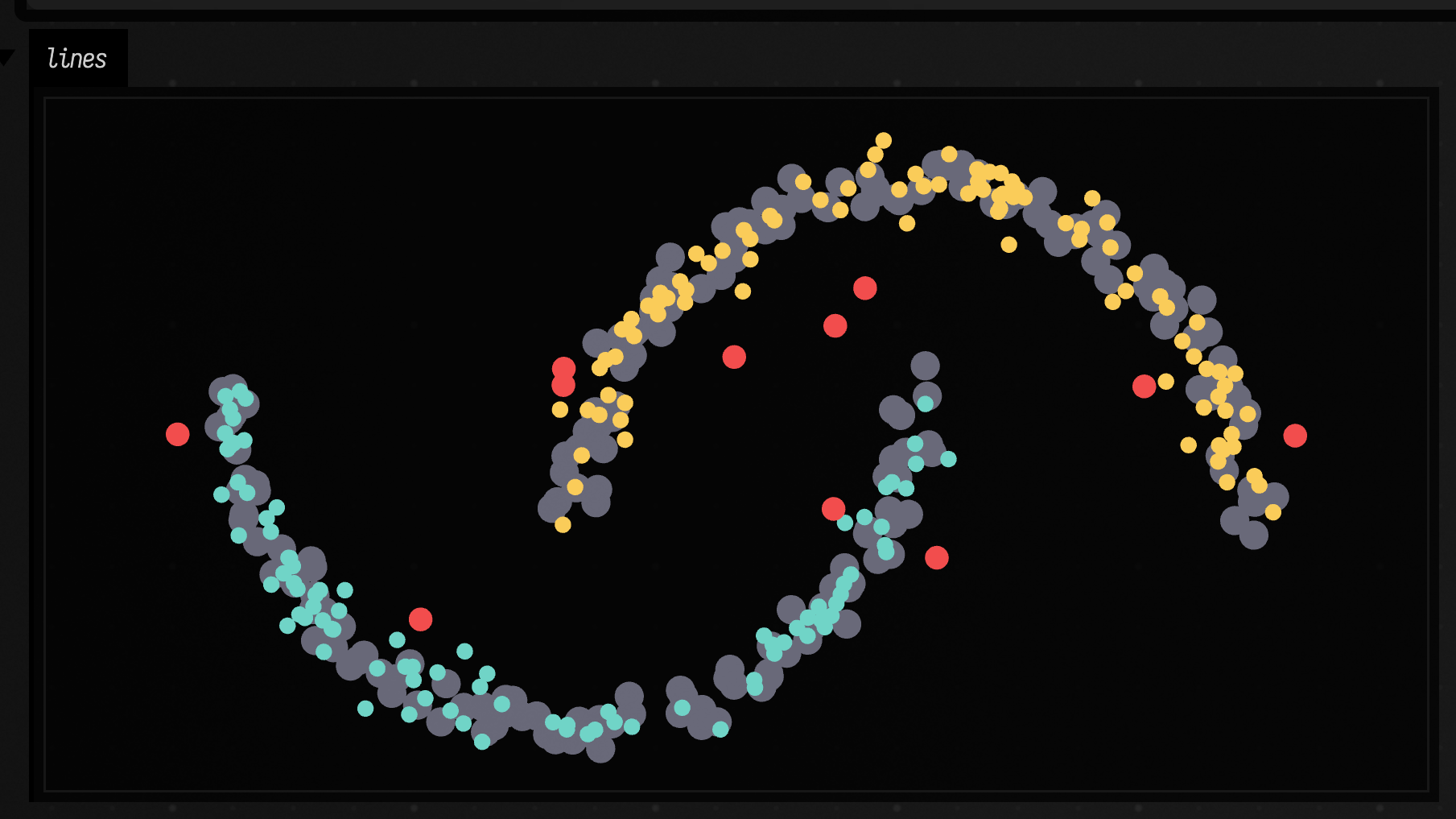
The example has three boxes, each a child of the one before. The first trains the generator, the second runs the Datalog program, and the third draws what the program found.
The generator
flowMatch with no from cloud learns to carry a Gaussian onto the target, and sample draws
new points through the trained field. The box publishes both clouds, so the boxes below it can
read them:
prop<List<Vec3>>(moonTarget)
prop<List<Vec3>>(moonSamples)

val field = flowMatch(moonTarget, options = FlowMatchOptions(steps = 6000, seed = 11))
moonSamples = field.sample(200, seed = 12)
A field like this is continuous, so it cannot split one Gaussian into two pieces cleanly: some samples end up partway between the moons. Flow Matching shows the same limit when it moves one shape onto another.
The points as facts
The second box writes each cloud into a Datalog as rows of an id and two coordinates:
d.facts("pt", moonSamples.mapIndexed { i, p -> [i, p.x.toDouble(), p.y.toDouble()] })
d.facts("tgt", moonTarget.mapIndexed { i, p -> [i, p.x.toDouble(), p.y.toDouble()] })
The rules then measure distance with hypot and do the rest:
"""
#datalog
% how many target points lie within 12 units of each generated one
support(A, N) :- pt(A, X, Y), N = count : { tgt(_, U, V), hypot(X - U, Y - V) < 12 }.
stray(A) :- support(A, 0).

% join kept points closer than 18, and label each piece by its smallest id
near(A, B) :- kept(A), kept(B), pt(A, X, Y), pt(B, U, V), A != B, hypot(X - U, Y - V) < 18.
reach(A, A) :- kept(A).
reach(A, C) :- reach(A, B), near(B, C).
island(A, L) :- kept(A), L = min B : { reach(A, B) }.
size(L, N) :- island(_, L), N = count : { island(B, L) }.
"""
A stray is a generated point with no target point within 12 units. reach follows near as far
as it goes, so each point's island is the smallest id it can reach. kept is the one rule the
program leaves out. The box adds it twice, to two separate models: once as every point, and once
as every point that is not a stray.
val everything = model("kept(A) :- pt(A, _, _).")
islandModel = model("kept(A) :- pt(A, _, _), !stray(A).")
What the program found
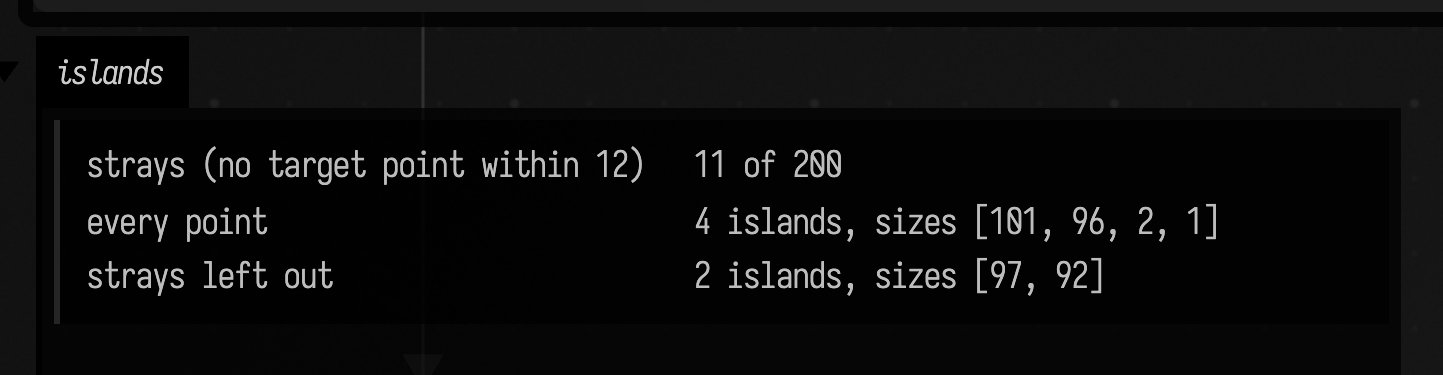
Eleven of the 200 samples are strays. Counted with every point, the cloud has four islands: two big ones, and two small ones made only of strays. Eight strays are close enough to a moon to join its island, and the other three form islands of their own. Leave the strays out and two islands are left, one for each moon. So the generator kept the two pieces apart, and Datalog shows exactly which samples fall outside them.
The two radii are choices, and the counts depend on them: a smaller support radius calls more
points strays, and a larger near radius lets more of them join a moon.
Drawing what it found
The third box asks the model for island(A, L) and stray(A), and draws one FLine of points
per island and one for the strays:
val island = islandModel.query("island(A, L)").rows.associate { (it[0] as Long).toInt() to it[1] as Long }
val strays = islandModel.query("stray(A)").column("A").map { moonSamples[(it as Long).toInt()] }
Datalog stores every whole number as a Long, so an id that went in as an Int comes back as a
Long and has to be converted before it can index the list.
Where each piece is documented
- Flow Matching for
flowMatch,sampleandFlowMatchOptions. - Datalog in a box for facts, rules, aggregates and negation.
- Agent transcripts to replay the three boxes into a document.