Evolving Creatures
afield.simulation.creatures evolves small 2D creatures: bodies of points joined by springs, where
every point is a foot that steps on its own cycle and the joints between edges bend to cyclic target
curves. A genetic algorithm breeds the shape, the foot timing and the joint curves together. The
idea comes from Karl Sims'
Evolved Virtual Creatures (1994).
You supply the world: write how a foot meets its surroundings in a ContactModel, and what counts
as doing well in a fitness. The same search can then evolve water bugs, floor crawlers or another
creature whose environment you can express as forces on its feet.
The evolving_water_bugs starting point is the live version of this page: two boxes that evolve on their own thread and animate the current champion.
A water surface
Seen from above, with no gravity, a water bug stands on the surface film. A foot that touches down
grips the film where it landed and is pulled back toward that spot. A foot that is up just drags
through the water. That rule is one class: foot(index) makes one Foot per point, so each foot can
remember where it planted, and force returns the force for this physics step.
FootStep.contact is how firmly the foot's program wants to be down right now, from 0 to 1. The
genome carries the evolved gains: freeDrag, footDrag and footStickiness.
import afield.simulation.creatures.*
import kotlin.random.Random

class WaterSurface : ContactModel {
    override fun foot(index: Int) = object : ContactModel.Foot {
        var planted: Float2? = null
        override var grip = 0f
        override val anchor
            get() = planted

        override fun force(step: FootStep): Float2 {
            val g = step.genome
            grip = step.contact
            if (step.contact <= 0.02f) {
                planted = null
                return step.velocity * -g.freeDrag
            }
            val at = planted ?: step.position.also { planted = it }
            val drag = max(g.freeDrag, g.footDrag * step.contact)
            return (at - step.position) * (g.footStickiness * step.contact) - step.velocity * drag
        }
    }
}

val bug = CreatureEvolution.randomGenome(Random(4), minPoints = 6, maxPoints = 6)
val run = CreatureEvolution.simulate(bug, CreatureSimulationConfig(measuredCycles = 4, contact = WaterSurface()))

showPlaneGrid(
    "start" to run.frameLines(0),
    "half way" to run.frameLines(run.frames.size / 2),
    "end\nmoved ${run.netCentroidMotion.f2}" to run.frameLines(run.frames.lastIndex),
    columns = 3,
    cellWidth = 280,
    cellHeight = 300,
    yUp = true,
)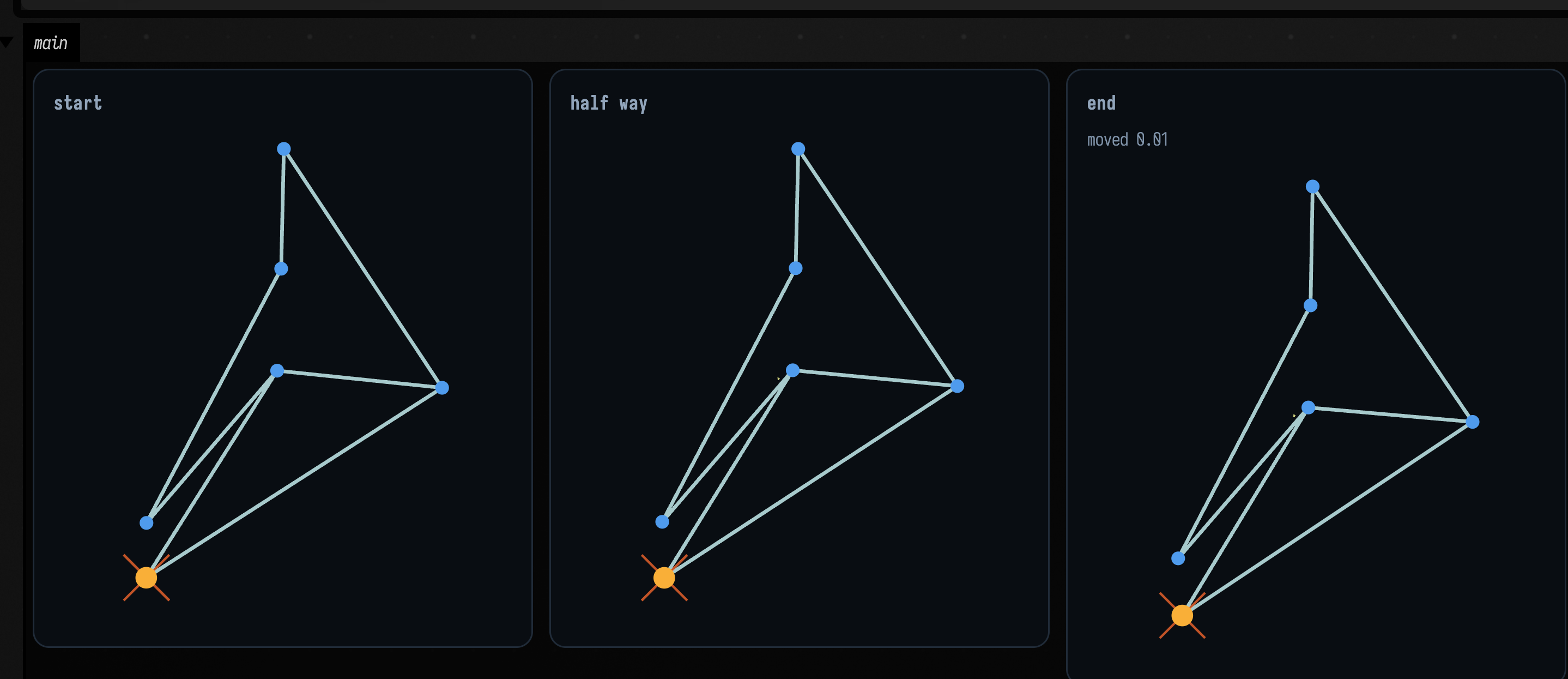
A random body gets almost nowhere. Its feet are blue while they are up and orange while they grip, a cross marks where a gripping foot planted, and the yellow line is the path of the body's centre.
Evolving one
CreatureEvolution.evolve runs a whole search and calls you back once per generation with the
generation's statistics and the champion so far. EvolutionConfig sets the population and the size
of the bodies; alwaysUpFootFraction and cyclingFootFraction say how many points are body and how
many must actually step. The fitness here rewards distance, and charges for stretching the springs
and for motor effort.
import afield.simulation.creatures.*

:::fold the WaterSurface contact model, as above
class WaterSurface : ContactModel {
    override fun foot(index: Int) = object : ContactModel.Foot {
        var planted: Float2? = null
        override var grip = 0f
        override val anchor
            get() = planted

        override fun force(step: FootStep): Float2 {
            val g = step.genome
            grip = step.contact
            if (step.contact <= 0.02f) {
                planted = null
                return step.velocity * -g.freeDrag
            }
            val at = planted ?: step.position.also { planted = it }
            val drag = max(g.freeDrag, g.footDrag * step.contact)
            return (at - step.position) * (g.footStickiness * step.contact) - step.velocity * drag
        }
    }
}

:::endfold

val config = EvolutionConfig(
    populationSize = 24,
    generations = 25,
    minPoints = 5,
    maxPoints = 8,
    targetEdgeCount = 8,
    alwaysUpFootFraction = 0.5f,
    cyclingFootFraction = 0.5f,
    simulation = CreatureSimulationConfig(
        measuredCycles = 6,
        contact = WaterSurface(),
        fitness = { e -> e.netCentroidMotion - 2f * e.meanStretchError - 0.05f * e.meanActuationEffort },
    ),
)

val best = mutableListOf<Double>()
val mean = mutableListOf<Double>()
val result =
    CreatureEvolution.evolve(config) { update ->
        best += update.champion.fitness.toDouble()
        mean += update.generation.meanFitness.coerceAtLeast(-2f).toDouble()
    }

val bug = result.best
showSignals("champion" to best, "population mean" to mean, title = "fitness by generation", xTitle = "generation")
showPlane(
    bug.frameLines(bug.frames.lastIndex, trailLength = bug.frames.size),
    channel = "swimmer",
    title = "the champion after ${config.generations} generations",
    caption = "moved ${bug.netCentroidMotion.f2} over ${config.simulation.measuredCycles} cycles",
    width = 480,
    height = 360,
    yUp = true,
)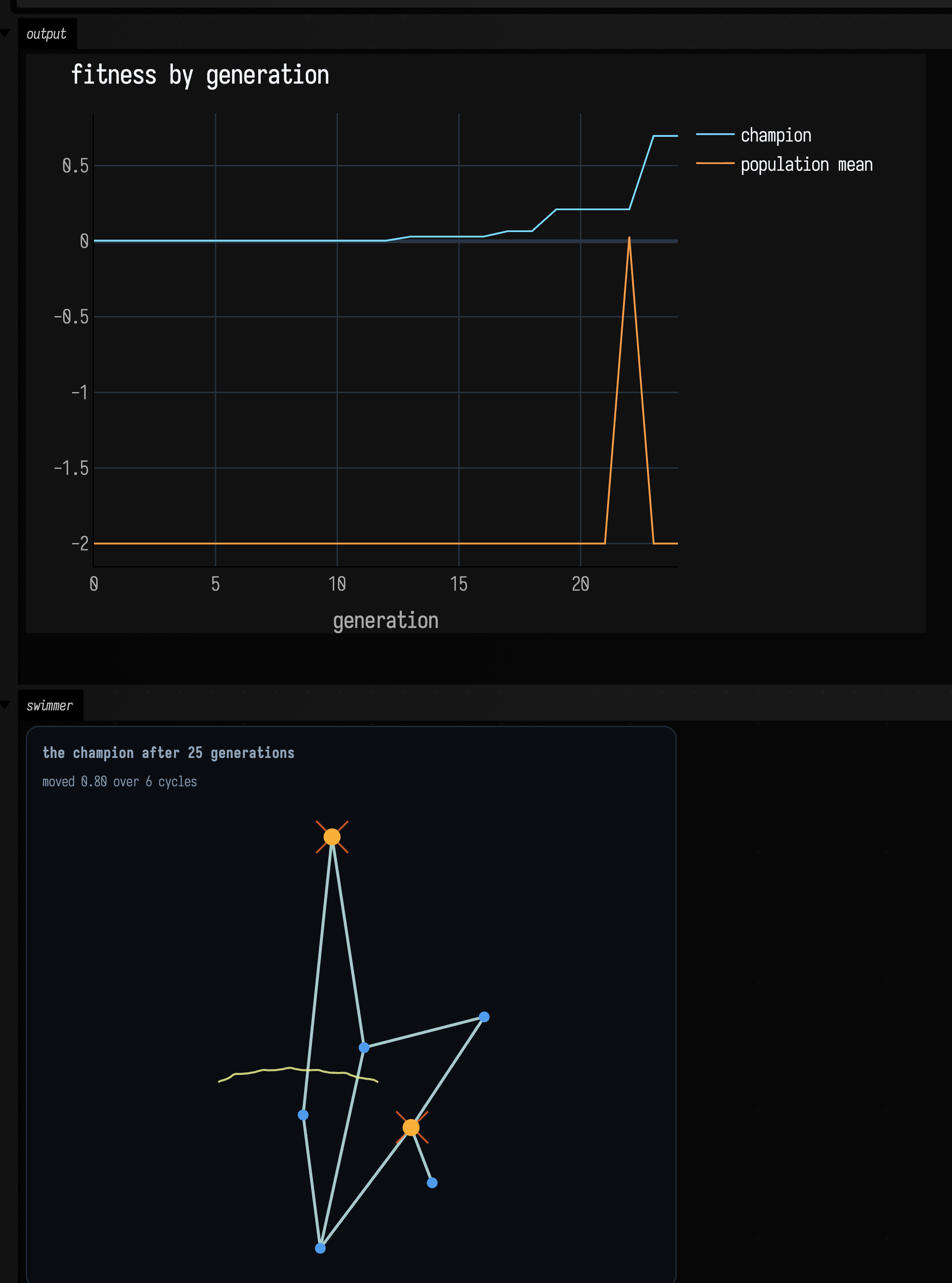
result.best is a CreatureEvaluation: the genome that won, its fitness, the measurements the
fitness was computed from (displacement, netCentroidMotion, meanStretchError,
meanActuationEffort and others), and its recorded frames. Pass a seed in EvolutionConfig(randomSeed = ...)
to get a different lineage; the same seed always gives the same champion.
Watching it move
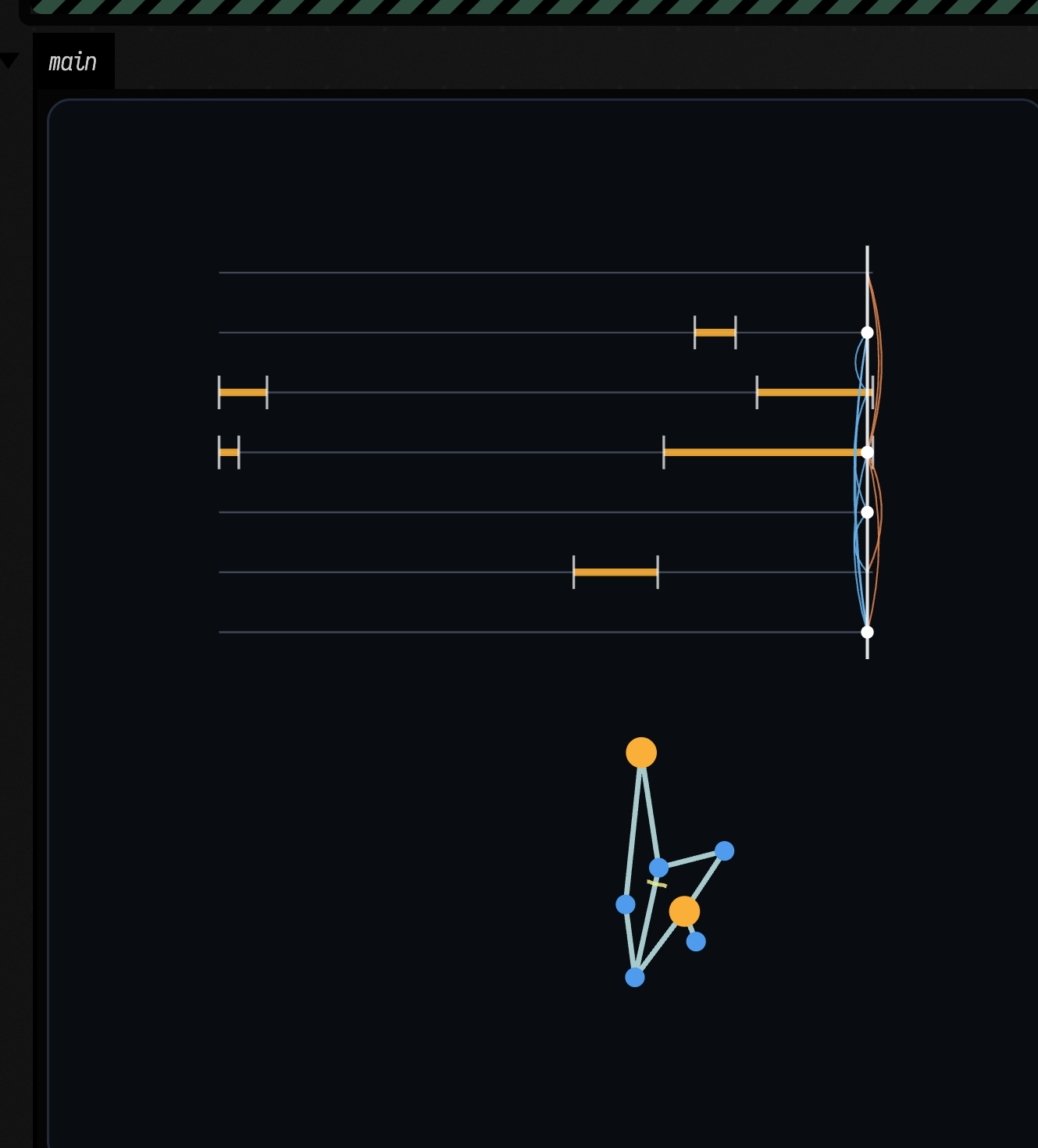
frameLines(i) draws frame i, and notationLines(i) draws the creature's score: one row per point,
with a bar wherever that foot's program has it down, a playhead at the current phase, and bows
between rows for the joints that are pushing. To animate either, draw a frame per pass of a loop.
Evolution takes seconds, so go runs the search in a cancellable worker coroutine. An atomic
reference publishes the latest completed champion to the drawing loop. Stopping or relaunching the
box cancels its search; worker failures appear in the editor.
import afield.simulation.creatures.*
import java.util.concurrent.atomic.AtomicReference
import kotlinx.coroutines.Dispatchers
import kotlinx.coroutines.withContext

:::fold the WaterSurface contact model, as above
class WaterSurface : ContactModel {
    override fun foot(index: Int) = object : ContactModel.Foot {
        var planted: Float2? = null
        override var grip = 0f
        override val anchor
            get() = planted

        override fun force(step: FootStep): Float2 {
            val g = step.genome
            grip = step.contact
            if (step.contact <= 0.02f) {
                planted = null
                return step.velocity * -g.freeDrag
            }
            val at = planted ?: step.position.also { planted = it }
            val drag = max(g.freeDrag, g.footDrag * step.contact)
            return (at - step.position) * (g.footStickiness * step.contact) - step.velocity * drag
        }
    }
}

:::endfold

:::fold the config from "Evolving one"
val config = EvolutionConfig(
    populationSize = 24,
    generations = 25,
    minPoints = 5,
    maxPoints = 8,
    targetEdgeCount = 8,
    alwaysUpFootFraction = 0.5f,
    cyclingFootFraction = 0.5f,
    simulation = CreatureSimulationConfig(
        measuredCycles = 6,
        contact = WaterSurface(),
        fitness = { e -> e.netCentroidMotion - 2f * e.meanStretchError - 0.05f * e.meanActuationEffort },
    ),
)
:::endfold

// The worker publishes complete evaluations; the drawing loop reads one snapshot per frame.
val champion = AtomicReference<CreatureEvaluation?>(null)
go {
    withContext(Dispatchers.Default) {
        CreatureEvolution.evolveSuspend(config) { champion.set(it.champion) }
    }
}

var i = 0
loop {
    val bug = champion.get() ?: return@loop
    val c = bug.frames[i % bug.frames.size].center
    showPlane(
        bug.frameLines(i) + bug.notationLines(i, origin = Float2(c.x - 3f, c.y + 6f)),
        window = Rect(c.x - 4.0, c.y - 1.5, 8.0, 8.5),
        width = 400,
        height = 425,
        yUp = true,
    )
    i++
}
In 3D
frameLines3d(i) draws frame i in three dimensions. The water is the x–y plane: a planted foot
sits on it, with a ring where it is holding, and the rest of the body rides just above on arched
legs, with a line dropped from every point to its shadow. Show the lines with three, and give the
camera upAxis = ThreeUpAxis.Z so that the viewer's grid is the water. follow = true keeps the
camera with the creature while the grid stays put, so the grid going by is the creature's speed.
Drag to orbit while it plays.
First, before any evolution: the random bug from the top of the page, watched for 24 cycles.
import afield.simulation.creatures.*
import kotlin.random.Random

:::fold the WaterSurface contact model, as above
class WaterSurface : ContactModel {
    override fun foot(index: Int) = object : ContactModel.Foot {
        var planted: Float2? = null
        override var grip = 0f
        override val anchor
            get() = planted

        override fun force(step: FootStep): Float2 {
            val g = step.genome
            grip = step.contact
            if (step.contact <= 0.02f) {
                planted = null
                return step.velocity * -g.freeDrag
            }
            val at = planted ?: step.position.also { planted = it }
            val drag = max(g.freeDrag, g.footDrag * step.contact)
            return (at - step.position) * (g.footStickiness * step.contact) - step.velocity * drag
        }
    }
}

:::endfold

val genome = CreatureEvolution.randomGenome(Random(4), minPoints = 6, maxPoints = 6)
val bug = CreatureEvolution.simulate(genome, CreatureSimulationConfig(measuredCycles = 24, contact = WaterSurface()))
val started = AnimationClock.nowSeconds()
var shown = -1

loop {
    // Sixty recorded frames a second; the last one holds for two seconds, then it starts over.
    val t = ((AnimationClock.nowSeconds() - started) * 60).toInt() % (bug.frames.size + 120)
    val i = t.coerceAtMost(bug.frames.lastIndex)
    if (i != shown) {
        three {
            lines(bug.frameLines3d(i))
            camera(yaw = 0.0, pitch = 10.0, padding = 1.5, upAxis = ThreeUpAxis.Z, follow = true)
        }
        shown = i
    }
}
Then after: forty bodies a generation for sixty generations, and the winner watched for four times as long as it was judged, so that it has room to go somewhere.
import afield.simulation.creatures.*

:::fold the WaterSurface contact model, as above
class WaterSurface : ContactModel {
    override fun foot(index: Int) = object : ContactModel.Foot {
        var planted: Float2? = null
        override var grip = 0f
        override val anchor
            get() = planted

        override fun force(step: FootStep): Float2 {
            val g = step.genome
            grip = step.contact
            if (step.contact <= 0.02f) {
                planted = null
                return step.velocity * -g.freeDrag
            }
            val at = planted ?: step.position.also { planted = it }
            val drag = max(g.freeDrag, g.footDrag * step.contact)
            return (at - step.position) * (g.footStickiness * step.contact) - step.velocity * drag
        }
    }
}

:::endfold

val config = EvolutionConfig(
    populationSize = 40,
    generations = 60,
    randomSeed = 3,
    minPoints = 5,
    maxPoints = 8,
    targetEdgeCount = 8,
    alwaysUpFootFraction = 0.5f,
    cyclingFootFraction = 0.5f,
    simulation = CreatureSimulationConfig(
        measuredCycles = 6,
        contact = WaterSurface(),
        fitness = { e -> e.netCentroidMotion - 2f * e.meanStretchError - 0.05f * e.meanActuationEffort },
    ),
)

val champion = CreatureEvolution.evolve(config).best
val bug = CreatureEvolution.simulate(champion.genome, config.simulation.copy(measuredCycles = 24))
val started = AnimationClock.nowSeconds()
var shown = -1

loop {
    // Sixty recorded frames a second; the last one holds for two seconds, then it starts over.
    val t = ((AnimationClock.nowSeconds() - started) * 60).toInt() % (bug.frames.size + 120)
    val i = t.coerceAtMost(bug.frames.lastIndex)
    if (i != shown) {
        three {
            lines(bug.frameLines3d(i))
            camera(yaw = 0.0, pitch = 10.0, padding = 1.5, upAxis = ThreeUpAxis.Z, follow = true)
        }
        shown = i
    }
}
Calling three again with the same camera keeps the view where you left it, and only a changed
camera moves it. The evolution takes about half a minute before the second video starts.
A different world: a floor
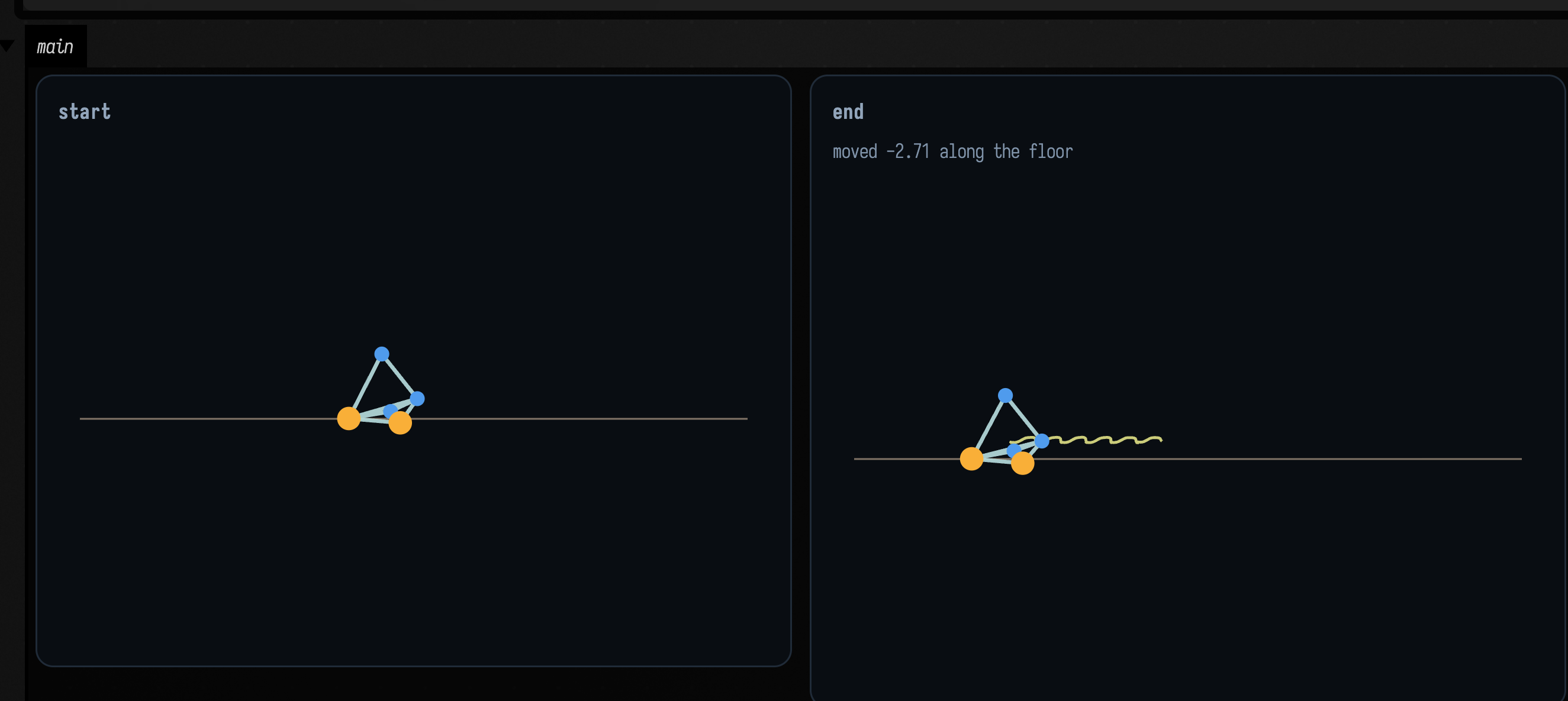
Nothing above is specific to water except the contact model and the fitness. Seen side-on, under
gravity, a floor pushes back anything that sinks below y = 0. A foot grips only when its program
says so and it is on the floor; a point that is not gripping slides with a little friction.
place lifts the body onto the floor before the run starts.
Two things differ from the water. The fitness is sustainedTravel, the smaller of the distances
covered in the first and second halves of the measured run. A body that topples over once and then
lies still covers nothing in the second half, so it scores nothing, however far it fell. And the
motors get more strength (maxActuationBudgetPerCycle, maxJointImpulsePerStep): at the defaults,
tuned for water, a joint cannot lift a limb against gravity.
import afield.simulation.creatures.*

class Floor(val stiffness: Float = 900f, val damping: Float = 40f, val friction: Float = 1f) : ContactModel {
    override fun place(points: List<Float2>): List<Float2> {
        val lowest = points.minOf { it.y }
        return points.map { Float2(it.x, it.y - lowest) }
    }

    override fun foot(index: Int) = object : ContactModel.Foot {
        var planted: Float2? = null
        override var grip = 0f
        override val anchor
            get() = planted

        override fun force(step: FootStep): Float2 {
            val g = step.genome
            val p = step.position
            val v = step.velocity
            val onFloor = p.y <= 0.02f
            val up = if (p.y < 0f) -p.y * stiffness - min(v.y, 0f) * damping else 0f
            grip = if (onFloor) step.contact else 0f
            if (grip <= 0.02f) {
                planted = null
                val slide = if (onFloor) friction else g.freeDrag * 0.1f
                return Float2(-v.x * slide, up - v.y * g.freeDrag * 0.1f)
            }
            val at = planted ?: Float2(p.x, 0f).also { planted = it }
            return Float2((at.x - p.x) * g.footStickiness * grip - v.x * g.footDrag * grip, up)
        }
    }
}

val config = EvolutionConfig(
    populationSize = 40,
    generations = 60,
    minPoints = 5,
    maxPoints = 8,
    targetEdgeCount = 8,
    alwaysUpFootFraction = 0.5f,
    cyclingFootFraction = 0.5f,
    simulation = CreatureSimulationConfig(
        warmupCycles = 2,
        measuredCycles = 6,
        gravity = -9.8f,
        contact = Floor(),
        fitness = { e ->
            2f * max(e.sustainedTravel(Float2(1f, 0f)), e.sustainedTravel(Float2(-1f, 0f))) - e.meanStretchError
        },
        maxActuationBudgetPerCycle = 40f,
        maxJointImpulsePerStep = 0.2f,
        maxCenterSpeed = 4f,
    ),
)

val crawler = CreatureEvolution.evolve(config).best
val floor = fline {
    moveTo(-6f, 0f)
    lineTo(6f, 0f)
}
    .apply { color = vec(0.5, 0.45, 0.4, 1.0) }

showPlaneGrid(
    "start" to [floor] + crawler.frameLines(0, alignNetMotionToPositiveX = false),
    "end\nmoved ${crawler.displacement.x.f2} along the floor" to
        [floor] +
            crawler.frameLines(
                crawler.frames.lastIndex,
                trailLength = crawler.frames.size,
                alignNetMotionToPositiveX = false,
            ),
    columns = 2,
    cellWidth = 400,
    cellHeight = 280,
    yUp = true,
)
Judged over six cycles, the champion is then watched for twenty-four. Every forty recorded frames leave a copy of its body on the floor, fainter the older it is.
import afield.simulation.creatures.*

:::fold the Floor contact model and the evolution, as above
class Floor(val stiffness: Float = 900f, val damping: Float = 40f, val friction: Float = 1f) : ContactModel {
    override fun place(points: List<Float2>): List<Float2> {
        val lowest = points.minOf { it.y }
        return points.map { Float2(it.x, it.y - lowest) }
    }

    override fun foot(index: Int) = object : ContactModel.Foot {
        var planted: Float2? = null
        override var grip = 0f
        override val anchor
            get() = planted

        override fun force(step: FootStep): Float2 {
            val g = step.genome
            val p = step.position
            val v = step.velocity
            val onFloor = p.y <= 0.02f
            val up = if (p.y < 0f) -p.y * stiffness - min(v.y, 0f) * damping else 0f
            grip = if (onFloor) step.contact else 0f
            if (grip <= 0.02f) {
                planted = null
                val slide = if (onFloor) friction else g.freeDrag * 0.1f
                return Float2(-v.x * slide, up - v.y * g.freeDrag * 0.1f)
            }
            val at = planted ?: Float2(p.x, 0f).also { planted = it }
            return Float2((at.x - p.x) * g.footStickiness * grip - v.x * g.footDrag * grip, up)
        }
    }
}

val config = EvolutionConfig(
    populationSize = 40,
    generations = 60,
    minPoints = 5,
    maxPoints = 8,
    targetEdgeCount = 8,
    alwaysUpFootFraction = 0.5f,
    cyclingFootFraction = 0.5f,
    simulation = CreatureSimulationConfig(
        warmupCycles = 2,
        measuredCycles = 6,
        gravity = -9.8f,
        contact = Floor(),
        fitness = { e ->
            2f * max(e.sustainedTravel(Float2(1f, 0f)), e.sustainedTravel(Float2(-1f, 0f))) - e.meanStretchError
        },
        maxActuationBudgetPerCycle = 40f,
        maxJointImpulsePerStep = 0.2f,
        maxCenterSpeed = 4f,
    ),
)
:::endfold

val champion = CreatureEvolution.evolve(config).best
val crawler = CreatureEvolution.simulate(champion.genome, config.simulation.copy(measuredCycles = 24))
val xs = crawler.frames.flatMap { f -> f.points.map { it.x } }
val floor = fline {
    moveTo(xs.min() - 1f, 0f)
    lineTo(xs.max() + 1f, 0f)
}
    .apply { color = vec(0.5, 0.45, 0.4, 1.0) }

val copies =
    (0..crawler.frames.lastIndex step 40).flatMap { i ->
        val fade = 0.15 + 0.85 * i / crawler.frames.lastIndex
        crawler.frameLines(i, trailLength = 1, alignNetMotionToPositiveX = false).onEach {
            it.color = vec(it.color.x, it.color.y, it.color.z, it.color.w * fade)
        }
    }

showPlane(
    [floor] +
        copies +
        crawler.frameLines(
            crawler.frames.lastIndex,
            trailLength = crawler.frames.size,
            alignNetMotionToPositiveX = false,
        ),
    title = "24 cycles: ${crawler.displacement.x.f1} along the floor",
    window = Rect(xs.min() - 1.0, -0.5, xs.max() - xs.min() + 2.0, 3.5),
    width = 860,
    height = 260,
    yUp = true,
)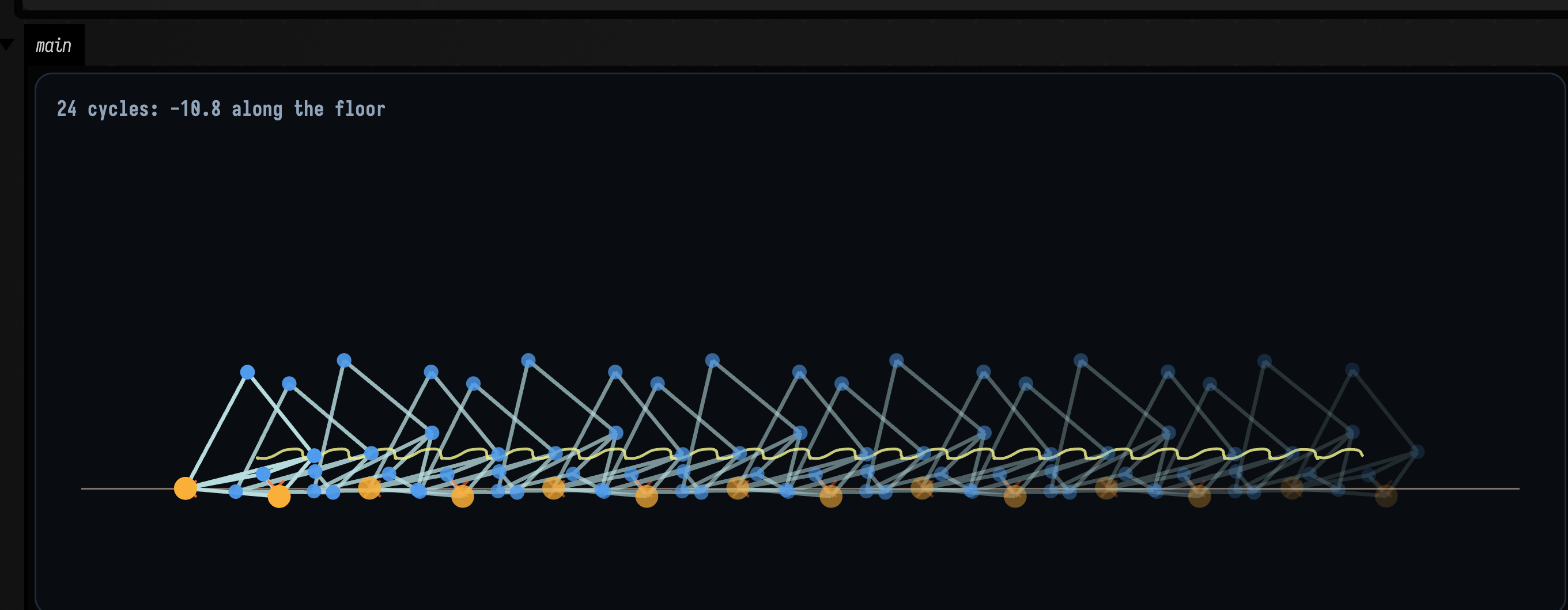
The copies are evenly spaced from the first cycle to the last: the crawler keeps going rather than falling once. It holds its body up as a triangle and shuffles on two feet (orange while gripping) that plant and release in turn. It went left; the fitness counts either direction.
And moving, a cycle a second for all twenty-four cycles, with the view following it; the ticks on the floor are a unit apart:
import afield.simulation.creatures.*

:::fold the Floor contact model and the evolution, as above
class Floor(val stiffness: Float = 900f, val damping: Float = 40f, val friction: Float = 1f) : ContactModel {
    override fun place(points: List<Float2>): List<Float2> {
        val lowest = points.minOf { it.y }
        return points.map { Float2(it.x, it.y - lowest) }
    }

    override fun foot(index: Int) = object : ContactModel.Foot {
        var planted: Float2? = null
        override var grip = 0f
        override val anchor
            get() = planted

        override fun force(step: FootStep): Float2 {
            val g = step.genome
            val p = step.position
            val v = step.velocity
            val onFloor = p.y <= 0.02f
            val up = if (p.y < 0f) -p.y * stiffness - min(v.y, 0f) * damping else 0f
            grip = if (onFloor) step.contact else 0f
            if (grip <= 0.02f) {
                planted = null
                val slide = if (onFloor) friction else g.freeDrag * 0.1f
                return Float2(-v.x * slide, up - v.y * g.freeDrag * 0.1f)
            }
            val at = planted ?: Float2(p.x, 0f).also { planted = it }
            return Float2((at.x - p.x) * g.footStickiness * grip - v.x * g.footDrag * grip, up)
        }
    }
}

val config = EvolutionConfig(
    populationSize = 40,
    generations = 60,
    minPoints = 5,
    maxPoints = 8,
    targetEdgeCount = 8,
    alwaysUpFootFraction = 0.5f,
    cyclingFootFraction = 0.5f,
    simulation = CreatureSimulationConfig(
        warmupCycles = 2,
        measuredCycles = 6,
        gravity = -9.8f,
        contact = Floor(),
        fitness = { e ->
            2f * max(e.sustainedTravel(Float2(1f, 0f)), e.sustainedTravel(Float2(-1f, 0f))) - e.meanStretchError
        },
        maxActuationBudgetPerCycle = 40f,
        maxJointImpulsePerStep = 0.2f,
        maxCenterSpeed = 4f,
    ),
)
:::endfold

val champion = CreatureEvolution.evolve(config).best
val crawler = CreatureEvolution.simulate(champion.genome, config.simulation.copy(measuredCycles = 24))
val started = AnimationClock.nowSeconds()
var shown = -1

loop {
    // A frame is recorded every 4 of the 120 steps in a cycle, so 30 a second is a cycle a second.
    val i = (((AnimationClock.nowSeconds() - started) * 30).toInt()).coerceAtMost(crawler.frames.lastIndex)
    if (i != shown) {
        val c = crawler.frames[i].center
        // A tick every unit, so the floor slides past as the view follows.
        val floor = fline {
            moveTo(c.x - 5f, 0f)
            lineTo(c.x + 5f, 0f)
            for (x in floor(c.x - 5f).toInt()..ceil(c.x + 5f).toInt()) {
                moveTo(x.toFloat(), 0f)
                lineTo(x.toFloat(), -0.15f)
            }
        }
            .apply { color = vec(0.5, 0.45, 0.4, 1.0) }
        showPlane(
            [floor] + crawler.frameLines(i, trailLength = crawler.frames.size, alignNetMotionToPositiveX = false),
            title =
                "cycle %d of 24: %.1f along the floor"
                    .format(i * 24 / crawler.frames.size + 1, c.x - crawler.frames[0].center.x),
            window = Rect(c.x - 4.0, -0.5, 8.0, 3.5),
            width = 860,
            height = 380,
            yUp = true,
        )
        shown = i
    }
}
What you can change
| Where | What it does |
|---|---|
ContactModel.foot(index) |
The force a foot receives each step. The whole environment lives here. |
ContactModel.place(points) |
Where the body starts. Move it rigidly; rest lengths come from the genome. |
CreatureSimulationConfig.fitness |
The score. Exploded creatures score explodedFitness (default -1000) instead. |
CreatureSimulationConfig.gravity |
Added to every point as an acceleration (negative is down). |
measuredCycles, warmupCycles, stepsPerCycle |
How long each creature is watched, and how finely. |
maxCenterSpeed, maxMeanStretchError, maxPeakStretchError |
Stability limits; a creature past one counts as exploded. |
jointTargetAngleScale, jointMotorKp, jointMotorKd |
How far and how hard the joints bend. |
EvolutionConfig.populationSize, generations, randomSeed |
The size and the seed of the search. |
minPoints, maxPoints, targetEdgeCount, targetJointActivations |
The size of the bodies. |
alwaysUpFootFraction, cyclingFootFraction |
How many points are body only, and how many must step. |