Solids that cannot fail: Manifold in Field
Build a part from solid shapes, subtract holes, measure it and slice it into layers. Field's
Manifold binding gives you Solid for 3D work and Section
for 2D outlines. Its Boolean operations keep the result a closed manifold, including difficult
cases such as coincident faces.
The manifold_solids starting point has the examples below ready to run. We'll begin with a plate and drill four bores through it:
val plate = Solid.cube(60.0, 40.0, 8.0, center = true)
val bore = Solid.cylinder(30.0, 3.0, segments = 64, center = true)
val part = plate - Solid.union((0..3).map { bore.translated(it * 15.0 - 22.5, 0.0, 0.0) })

part.volume // 18296.674 — measured, not estimated
part.genus // 4 — you can count the holes
part.status // NO_ERROR — and it says so when it is not
part.triangleCount // 1052
display(part.toTriMesh())
Measuring a solid
Manifold measures the solid rather than summing over float triangles, so Solid.cube(2,3,4).volume
is 24.0 and not 23.999998. That changes how the API feels: the results are arithmetic you can do
and assert on, instead of a render you eyeball.
| you want | on a Solid |
on a Section |
|---|---|---|
| how much material | volume |
area |
| how much skin | surfaceArea |
— |
| how many holes | genus |
contourCount |
| the mesh size | triangleCount, vertexCount |
vertexCount |
| the extent | bounds, an AxisAlignedBoundingBox3D |
bounds, a corner pair |
| the clearance between two of them | minGap(other, searchLength) |
— |
| whether it worked | status, isEmpty |
isEmpty |
Two of those will read oddly the first time. triangleCount on a cube is 12, the minimal closed
mesh rather than the 24 a per-face mesh would have; and genus counts holes through the solid, so
the four-bore plate above is genus 4.
Booleans
Use Solid.union(list) to combine a batch: Manifold can plan the operations together.
Solid.scope { } releases intermediate solids when the block ends.
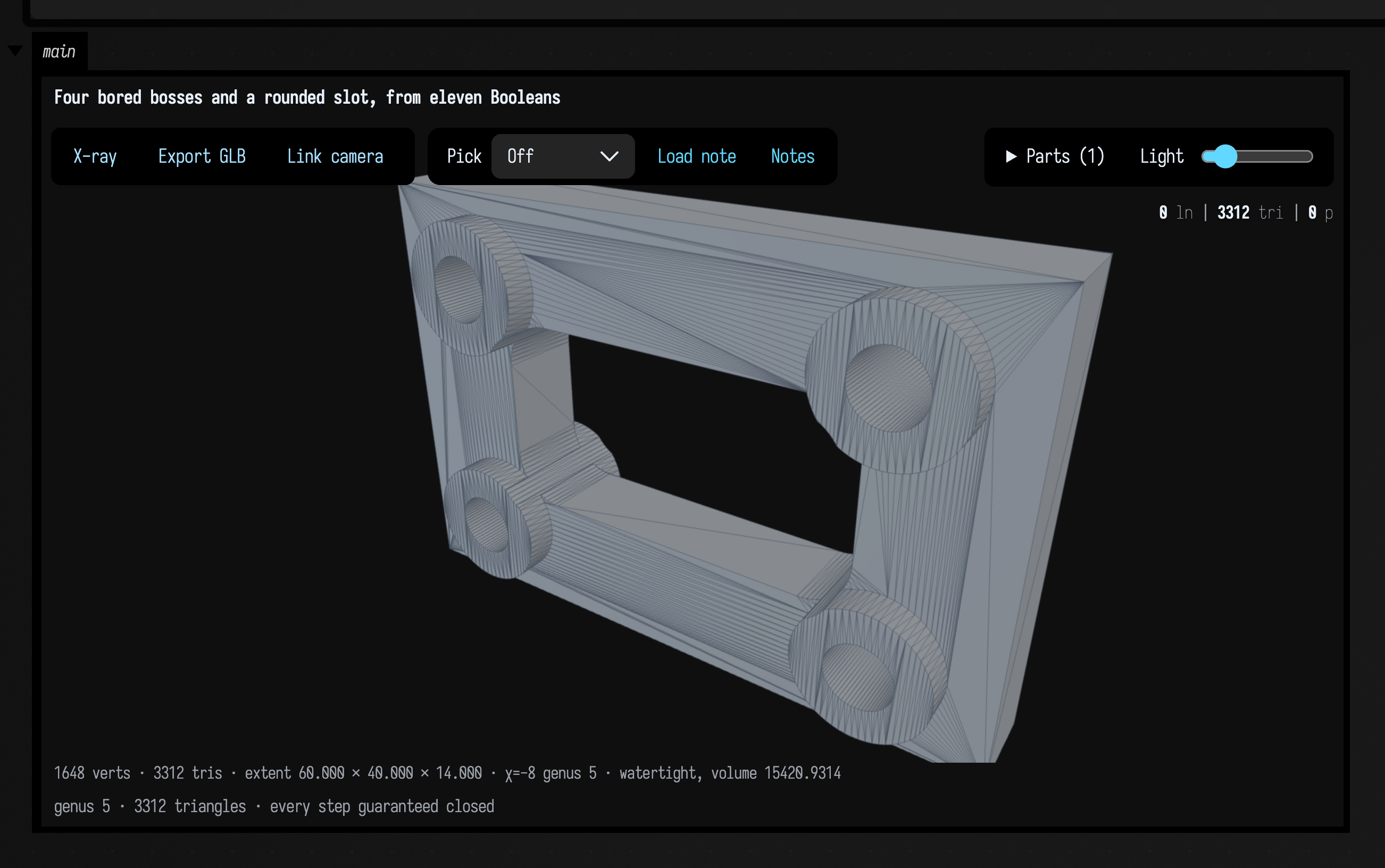
:::static
import afield.geometry.solid.manifold.*

val part = Solid.scope {
    val plate = Solid.cube(60.0, 40.0, 8.0, center = true)
    val corners = [-20.0 to -12.0, 20.0 to -12.0, -20.0 to 12.0, 20.0 to 12.0]

    // Bosses standing on the plate, and a bore straight through each.
    val bosses = corners.map { (x, y) ->
        Solid.cylinder(14.0, 6.0, segments = 64, center = true).translated(x, y, 0.0)
    }
    val bores = corners.map { (x, y) ->
        Solid.cylinder(30.0, 3.0, segments = 64, center = true).translated(x, y, 0.0)
    }

    // A slot with properly rounded ends: that is a 2D offset, extruded. There is no correct way to
    // get those end caps by moving points around.
    val slot =
        Section.square(26.0, 9.0, center = true)
            .offset(4.5, JoinType.ROUND, circularSegments = 64)
            .extruded(30.0)
            .translated(0.0, 0.0, -15.0)

    Solid.union([plate] + bosses) - Solid.union(bores + slot)
}
:::fold measure it — including the wall thickness that decides whether it survives being cut
// The plain mesh for measuring, because `normals = true` splits vertices at every crease and
// Field's isWatertight()/genus() read indices. See "Two meshes" below.
val mesh = part.toTriMesh()
println("volume  ${part.volume.f3} mm³  (${(part.volume * 0.0027).f1} g in 6061)")
println("area    ${part.surfaceArea.f3} mm²")
println("genus   ${part.genus}   — four bores and the slot")
println("status  ${part.status}")
println()
println("Field's own mesh family, which shares no code with Manifold, on the same surface:")
println(
    "  watertight ${mesh.isWatertight()},  genus ${mesh.genus()},  " + "volume ${mesh.signedVolume().f3}",
)

// A clearance check. This is the number a drawing would call out, and `minGap` is how you get it.
val nearestBore = Solid.cylinder(30.0, 3.0, segments = 64, center = true).translated(-20.0, -12.0, 0.0)
val slotSolid =
    Section.square(26.0, 9.0, center = true)
        .offset(4.5, JoinType.ROUND, circularSegments = 64)
        .extruded(30.0)
        .translated(0.0, 0.0, -15.0)
println()
println(
    "wall between the slot and the nearest bore: " +
        "${slotSolid.minGap(nearestBore, searchLength = 30.0).f3} mm",
)

/*
The plain mesh, not the shaded one: showMesh prints its own topology footer, and a crease-split
mesh would make that footer read "open (42 boundary loops)" directly under a caption claiming the
solid is closed. Both statements would be true of different meshes, which is worse than either.
*/
showMesh(
    mesh,
    title = "Four bored bosses and a rounded slot, from eleven Booleans",
    caption = "genus ${part.genus} · ${part.triangleCount} triangles · every step guaranteed closed",
    view = MeshView(yawDegrees = 34.0, pitchDegrees = 26.0, width = 760, height = 470),
)
Manifold's Booleans are lazy: a - b builds a node and the work happens when something asks for a
number. So volume, genus and toTriMesh() are the expensive calls, not the operators, and timing
an operator measures nothing.
Invalid input comes back as a status
Manifold never throws and never returns null. A failed operation gives you a Solid whose status is
not NO_ERROR and whose volume is 0.0. Upstream chose that so a twenty-step chain does not need
twenty checks; the cost is that an unchecked pipeline can end in silence. Either make the
pipeline throw, or check the status yourself:
// 1. `checked()` throws, naming the status and the repair, instead of yielding 0 mm³.
val part = (body - bore).checked("the bracket")

// 2. Or branch on it, when empty is a legitimate answer.
if (part.status.isError) println("could not build it: ${part.status}")
The commonest failure by far is a mesh that came off disk. An STL has no index buffer at all, so every triangle owns its three vertices and the mesh is 36 loose vertices rather than a closed cube.
Do not guess which repair to try. toSolid()'s refusal carries TriMesh.diagnose()'s report, so
it names the defect instead of handing you a list of things to try in order:
this TriMesh is not a valid manifold: NOT_MANIFOLD.
mesh: 8 vertices, 10 triangles, chi=1, 1 component(s)
1 blocking defect(s) — Manifold will refuse this mesh.
1. [BLOCKING] OPEN_BOUNDARY x4
     4 boundary edges in 1 traced loop(s), edge counts [4]
     fix: TriMesh.fillHoles() — flat holes fill cleanly; a non-planar loop gets a flat cap over a wavy rim.
Two calls, both in afield.geometry.mesh, both documented at length under
geometry from disk:
| you want | call |
|---|---|
| to know why this mesh is not a solid | println(mesh.diagnose().report()) |
| to fix it, and be told what could not be fixed | mesh.repairToSolid() |
| to see where the trouble is | showMeshDiagnosis(mesh), or mesh.defectFLines() |
repairToSolid() welds, drops degenerate and duplicated faces, removes dangling fins, fixes the
winding, fills the holes, and fixes the winding again, then hands back a MeshRepairResult
rather than a mesh, because what you need next is unfixed: the blocking defects still present,
each with the reason it was left alone. ToyCar.glb in this repo goes through it and comes out a
solid you can boolean.
repaired() is the right call for a mesh whose only problem is unwelded vertices. It does not fill
holes, so it rescues far fewer broken meshes than repairToSolid(). A repaired mesh is a valid
solid, but not always the shape you started with; geometry from disk shows
the difference.
toSolid() also refuses an inside-out mesh, one closed and consistently wound but inward, which
Manifold itself would accept with a negative volume; fixWinding() flips it. Zero-area triangles,
pinch vertices and disjoint components pass, and the volumes of disjoint pieces add up.
NON_FINITE_VERTEX is a NaN in the positions, usually a degenerate normal upstream.
repairToSolid() refuses that one outright rather than repairing around it — dropping the affected
triangles and capping the gap would produce a plausible solid missing an unknown amount of the model.
TriMesh.isValidSolid() is the cheap pre-flight, and toSolid() checks by default.
2D sections and offsets
Section is Manifold's CrossSection, which is Clipper2
underneath. Field draws and booleans 2D outlines already, through FLine and the Java2D Area
bridge, and FLine.byOffsetting displaces a curve along its own normals — which self-intersects
wherever the offset exceeds the local radius of curvature. Section.offset computes a true parallel
curve at distance d, resolves those self-intersections, and gives you a choice of what happens at a
corner.
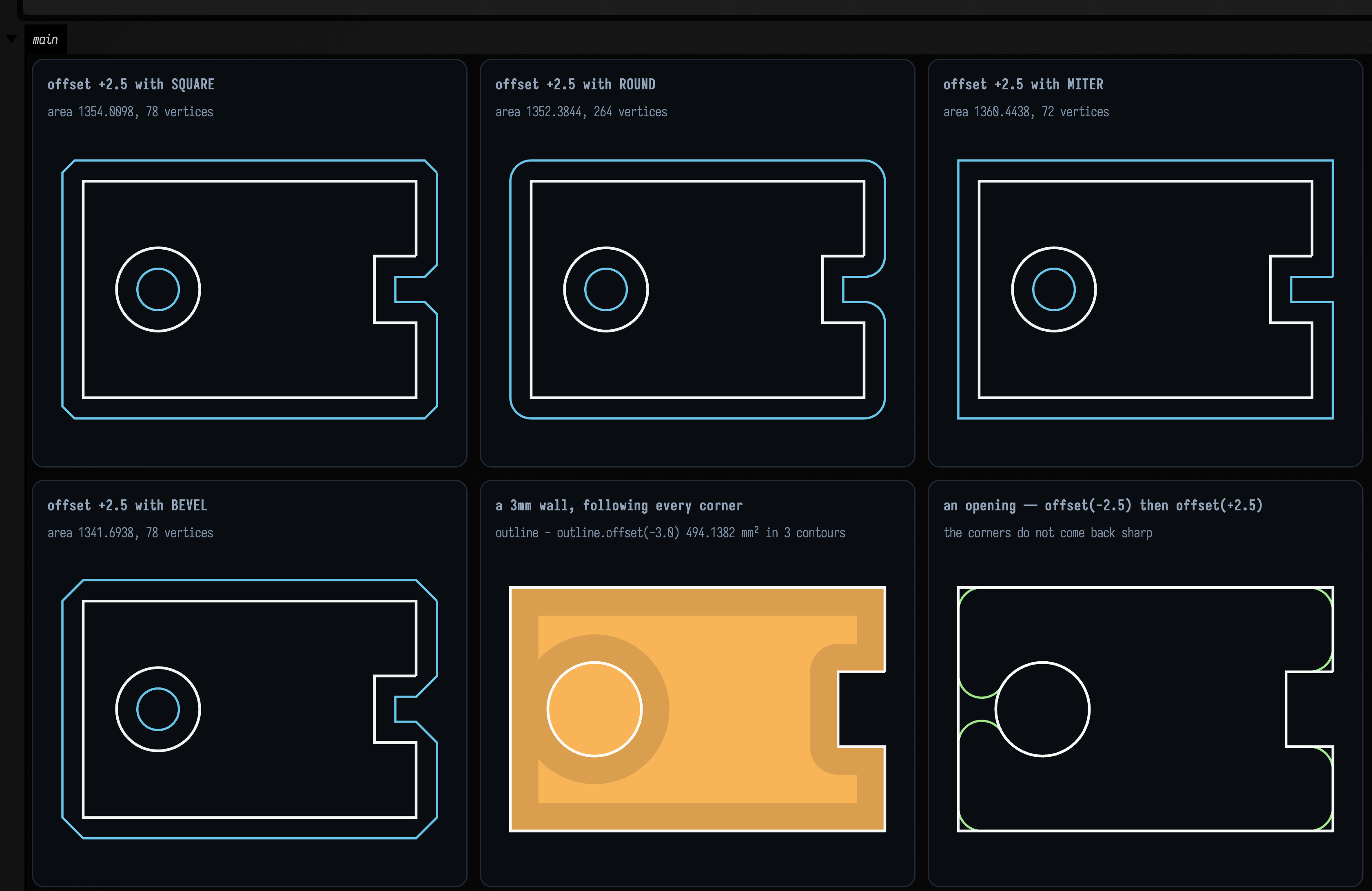
That single operation is a fillet, a wall thickness, a tool radius, a clearance, a press fit, and a stroke that is a shape rather than a rendering hint.
:::static
import afield.geometry.solid.manifold.*

// A plate with a hole and a notch — concave and convex corners, so the join types have somewhere
// to show themselves.
val outline = Solid.scope {
    (Section.square(40.0, 26.0, center = true) -
            Section.circle(5.0, segments = 64).translated(-11.0, 0.0) -
            Section.square(10.0, 8.0, center = true).translated(20.0, 0.0))
        .copy()
}

// Each join type on the same shape, and the areas they come out at.
val joins = JoinType.entries.map { it to outline.offset(2.5, it, circularSegments = 128) }

// A wall of constant thickness, following every corner: the shape minus itself eroded.
val wall = outline - outline.offset(-3.0, JoinType.ROUND, circularSegments = 128)

// And an opening on the real outline, so the corner rounding is visible rather than only measured.
val opened2 =
    outline.offset(-2.5, JoinType.ROUND, circularSegments = 128).offset(2.5, JoinType.ROUND, circularSegments = 128)
:::fold the numbers, then draw them
println("outline area ${outline.area.f4}, ${outline.contourCount} contours")
joins.forEach { (join, grown) ->
    println(
        "  offset +2.5 ${join.name.padEnd(6)} -> area ${grown.area.f4}, " + "${grown.vertexCount} verts",
    )
}
println()
println("a 3mm wall is ${wall.area.f4} mm², in ${wall.contourCount} contours")

/*
A closing (dilate then erode) is EXACTLY the identity on a convex region — the two offsets are
true inverses where nothing was rounded away. An opening (erode then dilate) is not, and the
difference is precisely the corners the erosion cut off.
*/
val square = Section.square(2.0, 2.0, center = true)
val closed =
    square.offset(0.5, JoinType.ROUND, circularSegments = 512).offset(-0.5, JoinType.ROUND, circularSegments = 512)
val opened =
    square.offset(-0.5, JoinType.ROUND, circularSegments = 512).offset(0.5, JoinType.ROUND, circularSegments = 512)
println()
println("closing a 2x2 square: ${closed.area.f6} (the identity, 4.0)")
println(
    "opening it:           ${opened.area.f6} (4 - (4-pi)/4 = " +
        "${(4.0 - (4.0 - Math.PI) * 0.25).f6})",
)

fun white() = outline.toFLines().onEach {
    it.color = vec(1.0, 1.0, 1.0, 0.95)
    it.thickness = 2.2
}

showPlaneGrid(
    *joins
        .map { (join, grown) ->
            "offset +2.5 with ${join.name}\narea ${grown.area.f4}, ${grown.vertexCount} vertices" to
                (grown.toFLines().onEach {
                    it.color = vec(0.45, 0.85, 1.0, 0.9)
                    it.thickness = 1.8
                } + white())
        }
        .toTypedArray(),
    "a 3mm wall, following every corner\noutline - outline.offset(-3.0)\n" +
        "${wall.area.f4} mm² in ${wall.contourCount} contours" to
        (wall.toFLines().onEach {
            it.color = vec(1.0, 0.72, 0.35, 0.85)
            it.filled = true
            it.stroked = false
        } + white()),
    "an opening — offset(-2.5) then offset(+2.5)\nthe corners do not come back sharp" to
        (opened2.toFLines().onEach {
            it.color = vec(0.7, 1.0, 0.6, 0.9)
            it.thickness = 1.8
        } + white()),
    columns = 3,
    cellWidth = 330,
)
Winding is what decides which contours are holes, under a FillRule. Read a region back with
toPolygons() and the outlines are counter-clockwise (positive signed area) and the holes clockwise —
measured on an annulus, +3.1413 outer and −0.7853 inner. Field's default is FillRule.POSITIVE
rather than Clipper's EVEN_ODD, because it is the rule under which winding means something: two
overlapping same-wound outlines are one shape, where EVEN_ODD would punch their overlap out as a
hole.
Solids from a field
Solid.levelSet takes a Kotlin lambda of x, y, z and marches it into a solid. Manifold calls the
lambda itself, once per sample, from the calling thread.
The difference from Field's own marchingCubes is not resolution or speed, it is
the guarantee: whatever the field did (a sheet thinner than the grid, a surface that touches itself, a
feature below the cell size), the output is a valid closed manifold, and therefore something you
can immediately subtract from.
:::static
import afield.geometry.solid.manifold.*

/*
A gyroid-thickened torus: a shape that only really exists as a function, and exactly the sort of
field where plain marching cubes produces a soup wherever the surface nearly touches itself.
Positive inside, which is Manifold's convention (Field's own sdf* family is negative inside —
Solid.levelSetOf flips the sign for you).
*/
fun field(x: Double, y: Double, z: Double): Double {
    val q = hypot(x, y) - 22.0
    val tube = 8.0 - sqrt(q * q + z * z)
    val s = 0.32
    val g = sin(s * x) * cos(s * y) + sin(s * y) * cos(s * z) + sin(s * z) * cos(s * x)
    return tube - 0.55 * 8.0 * abs(g) * 0.5
}

val bounds = boundsOf(vec(-32.0, -32.0, -10.0), vec(32.0, 32.0, 10.0))

val t0 = System.nanoTime()
val solid = Solid.levelSet(bounds, edgeLength = 1.1, field = ::field)
val marchMs = (System.nanoTime() - t0) / 1e6

// March the same field again and compare triangle count and volume below.
// These aggregate checks do not establish identical vertex/index arrays.
val again = Solid.levelSet(bounds, edgeLength = 1.1, field = ::field)
:::fold check it is reproducible, then draw it
println("level set ${marchMs.f0} ms")
println(
    "same triangle count twice: ${solid.triangleCount == again.triangleCount} " + "(${solid.triangleCount})",
)
println("same volume to the last bit: ${solid.volume == again.volume}")
println()
println("status ${solid.status}, genus ${solid.genus}, volume ${solid.volume.f1} mm³")
// And Field's own topology code, which shares nothing with Manifold, agrees it is closed.
println("watertight by Field's own reckoning: ${solid.toTriMesh().isWatertight()}")

// Plain, so showMesh's own footer agrees with the caption — see the note on the Booleans figure.
showMesh(
    solid.toTriMesh(),
    title = "A gyroid-thickened torus, marched from a Kotlin function",
    caption = "${solid.triangleCount} triangles · genus ${solid.genus} · guaranteed closed",
    view = MeshView(yawDegrees = 24.0, pitchDegrees = 52.0, width = 720, height = 440),
)
again.close()
solid.close()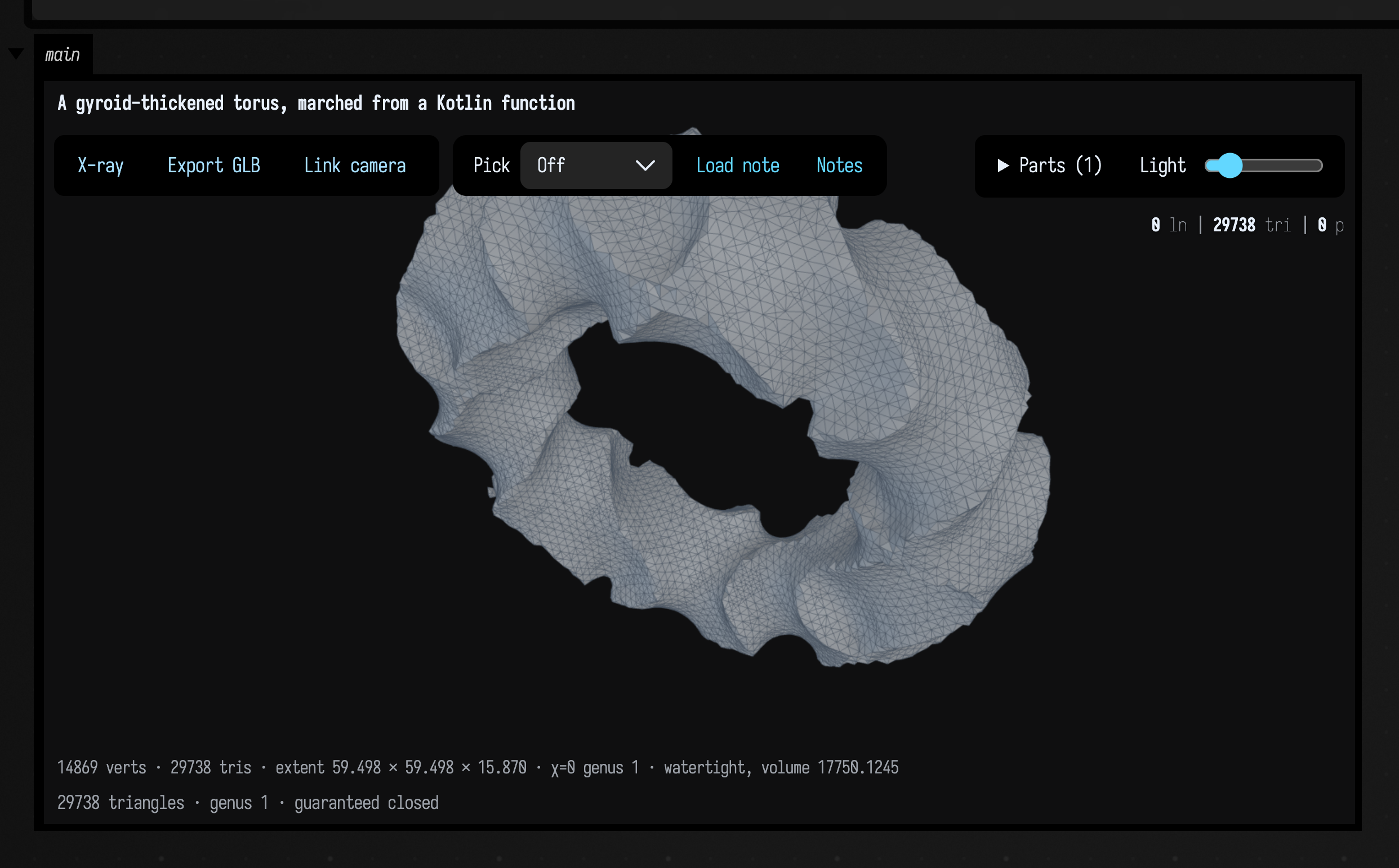
An exception thrown by the lambda cannot escape. There are C++ frames between the lambda and the
caller; unwinding through them is undefined, and FFM's response to an escaping exception is to abort the VM. So the bridge catches it, returns a
far-outside sentinel, and levelSet rethrows once the native call is over: you get an
IllegalStateException with your own exception as its cause.
Solid.warped { } is the same mechanism for moving every vertex: a bend, a twist, a taper. It does
not re-mesh, so put refined() in front of it or a 12-triangle cube's eight corners move and
nothing looks different.
Back down to 2D: slicing
slice(z) is a real cross section, not a silhouette — the primitive under every fabrication path.
Each layer is a Section, so it offsets, which is how a layer outline becomes a toolpath.
:::static
import afield.geometry.solid.manifold.*

// A part with internal structure, so the slices have something to say.
val part = Solid.scope {
    val body = Solid.cylinder(30.0, 18.0, segments = 96, center = true)
    val bore = Solid.cylinder(40.0, 7.0, segments = 64, center = true)
    val webs = (0 until 6).map {
        Solid.cube(30.0, 3.0, 40.0, center = true).rotated(0.0, 0.0, it * 30.0)
    }
    ((body - bore) -
            Solid.union(webs).let { w ->
                // Keep the webs only in the middle band, so the top and bottom slices differ from the rest.
                w and Solid.cylinder(14.0, 20.0, segments = 64, center = true)
            })
        .copy()
}

val nozzle = 1.2
val outlines = mutableListOf<FLine>()
val paths = mutableListOf<FLine>()
var contours = 0
for (i in 0 until 11) {
    val z = -14.0 + 28.0 * i / 10.0
    Solid.scope {
        val layer = part.slice(z)
        contours += layer.contourCount.toInt()
        outlines +=
            layer.toFLines(z = z).onEach {
                it.color = vec(0.55, 0.78, 0.95, 0.5)
                it.thickness = 1.0
            }
        paths +=
            layer.offset(-nozzle / 2, JoinType.ROUND, circularSegments = 32).toFLines(z = z).onEach {
                it.color = vec(1.0, 0.72, 0.35, 0.9)
                it.thickness = 1.7
            }
        Unit
    }
}
:::fold and the projection, which is the union of every slice
println("genus ${part.genus}, volume ${part.volume.f1} mm³")
println("11 layers, $contours contours in total")
println("orange = where a ${nozzle}mm nozzle centre may go")
println()
// project() is the shadow of the whole solid — the union of every slice, in one call.
part.project().use { shadow ->
    println("projected footprint ${shadow.area.f2} mm² in ${shadow.contourCount} contours")
}
part.slice(0.0).use { mid ->
    println("the mid slice alone is ${mid.area.f2} mm² in ${mid.contourCount} contours")
}

/*
These are plan views: all 11 layers superimposed, since showPlaneGrid projects to 2D. The webs
only exist in the middle band, so the 6 layers outside it contribute the plain annulus you can
see through the spokes.
*/
showPlaneGrid(
    "11 layers superimposed in plan\nblue = each slice's outline" to outlines,
    "the same layers offset inward by ${nozzle / 2}mm\norange = where the nozzle centre may go" to paths,
    "both together" to (outlines + paths),
    columns = 3,
    cellWidth = 330,
)
part.close()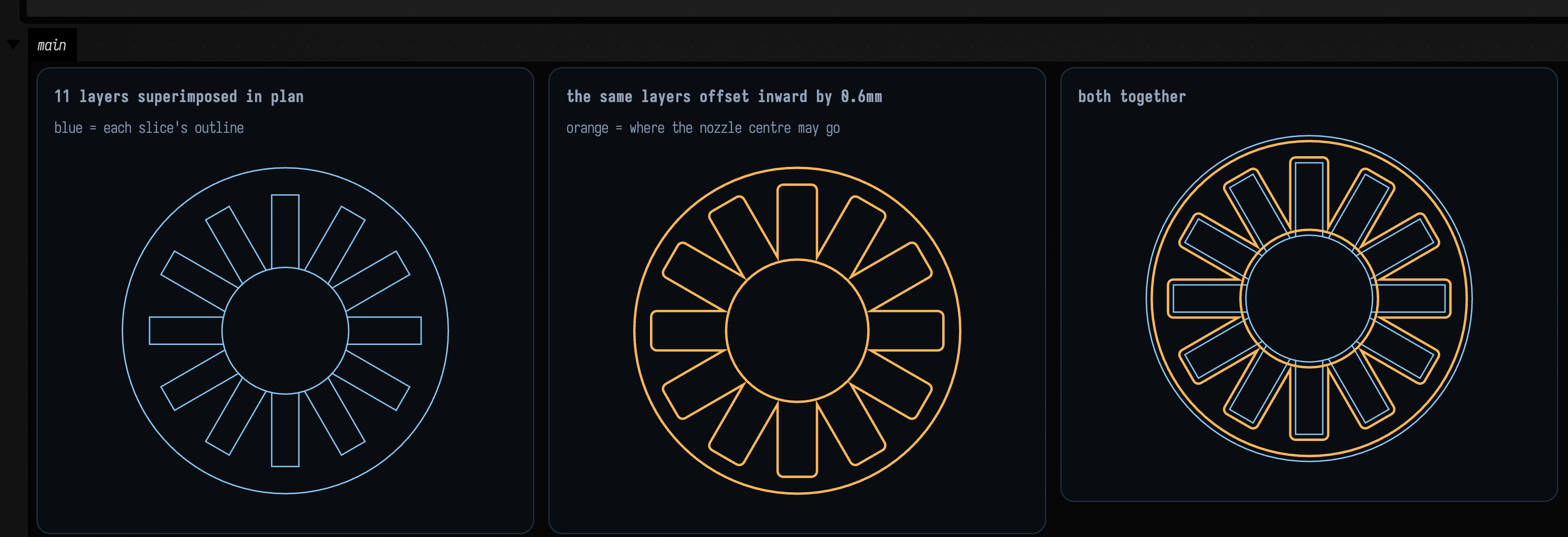
The bridges, both ways
Manifold does not replace Field's mesh family; a Solid converts to and from a TriMesh:
// In: a TriMesh from anywhere — a generator, a file, a march, a scan.
val scan = triMeshFromObj(File("scan.obj")).toSolid(weldTolerance = 1e-6)
val trimmed = scan.trimByPlane(0.0, 0.0, 1.0, 0.0) // keep the half the normal points at

// Out: back into everything Field already does with a mesh.
val mesh = trimmed.toTriMesh()
display(mesh) // the inline mesh card
display(mesh.toFLines()) // as a wireframe FLine
mesh.loopSubdivide().saveStl(File("part.stl"))

// And 2D, from anything you drew — here a type outline, swollen by a true offset.
val letters = layoutText("Fi", typeface("Helvetica", 96.0)).toFLines()
val swollen = Section.ofFLines(letters, sampleDistance = 0.5).offset(3.0, JoinType.ROUND)
display(swollen.toFLines())TriMesh's positions are Float and Manifold's MeshGL is float32, so going in is exact and
coming out narrows Manifold's internal doubles to precisely the precision TriMesh stores anyway.
Two meshes from toTriMesh
toTriMesh(normals = true) is the form for a picture, because a vertex on a hard edge needs a
different normal per face and therefore cannot be shared:
| Conversion | vertices | topology().isWatertight |
isWatertight() |
signedVolume() |
|---|---|---|---|---|
cube.toTriMesh() |
8 | true |
true |
8.0 |
cube.toTriMesh(normals = true) |
24 | false |
true |
8.0 |
isWatertight(), genus() and showMesh's footer weld a mesh that carries normals by position
before measuring, so both forms report the same surface. topology() reads the indices as they are,
and toSolid needs the plain form: Manifold refuses a crease-split mesh. Ask for the plain form when
the mesh goes back into Manifold, and weld() a shaded one if you need to.
Lifetime
A Solid owns memory the JVM heap does not account for, so it is AutoCloseable — and because a
live-coding box is the last place anyone wants try/finally, it is also registered with a
Cleaner. Abandon one and it is released when the JVM collects it; close() it and the release is
immediate and the object refuses further use rather than reading freed memory.
For a box that runs every frame, Solid.scope { } is the answer: it closes everything built inside it
and keeps whatever came back, including solids nested in a returned List or Pair.
val part = Solid.scope {
    val body = Solid.cube(2.0, 2.0, 1.0, center = true)
    val bore = Solid.cylinder(4.0, 0.3, center = true)
    body - bore // kept; body and bore are released here
}
Installing it
Manifold is optional. A clone of Field builds, tests and runs without it; only boxes that reach for
Solid need it, and each one says so when it is missing.
brew install manifoldOn Linux, your package manager or a source build with -DMANIFOLD_CBIND=ON. The binding then finds
libmanifoldc by itself, or takes -Dafield.manifold.library=<path> or AFIELD_MANIFOLD_LIBRARY if
you built your own. ManifoldLibrary.describe() reports what was found, and
ManifoldLibrary.isAvailable is cheap enough to branch on in a box.
Verify it end to end with the smoke. It checks every volume, area, genus and offset on this page against its closed form, prints how many checks it ran, and skips cleanly with exit code 0 if the library is absent:
./gradlew smokeManifoldRetain precision and inspect finite contacts
Use solid.toPlanarMesh() when coordinates must remain double precision. The returned
SolidPlanarMesh contains positions, triangle indices and connected polygonal-face
provenance. mesh.toSolid() rebuilds a native solid without converting coordinates to
Float32. mesh.toTriMesh() is the final conversion for drawing. Face provenance alone
does not establish a crease: adjacent Boolean patches can be coplanar.
Solid.hullOfPointsD(doubleArrayOf(...)) accepts flat xyz triples at full precision.
Solid.scope { ... } also closes its temporary native objects if the block throws.
planarContact(a, b, plane) intersects the actual boundary polygons on a specified
plane. It reports a contact only where the finite polygons overlap, not wherever two faces
lie in the same plane. planarContacts(a, b) finds those patches without being given a plane.
:::static
import afield.geometry.path.planning.Point3D
import afield.geometry.solid.manifold.*

val area = Solid.scope {
    val a = Solid.cube(10.0).toPlanarMesh()
    val b = Solid.cube(10.0).translated(10.0, 0.0, 0.0).toPlanarMesh()
    val plane = ContactPlane(Point3D(10.0, 0.0, 0.0), Point3D(1.0, 0.0, 0.0))
    planarContact(a, b, plane).area
}
println(area) // 100 square units
auditApertures(...) compares removed boundary regions on both sides against an
independently supplied expected region. It also reports material outside the contact
and an optional required margin. GeometryTolerances separates length, area and volume
thresholds in caller-chosen units. These are geometric comparisons within native
Boolean tolerances. They do not establish mechanical suitability.
Approximate a cubic with an explicit error bound
CubicBezier3D is an immutable cubic over double-precision Point3D values.
valueAt(t) evaluates its position; tangentAt(t) returns its unnormalised derivative.
flatten(maximumDeviation) subdivides until each subcurve's control hull lies within
the requested distance of its finite chord, returning a polyline including both endpoints.
:::static
import afield.geometry.path.planning.*

val curve = CubicBezier3D(
    Point3D(10.0, 0.0, 0.0),
    Point3D(10.0, 5.5, 0.0),
    Point3D(5.5, 10.0, 0.0),
    Point3D(0.0, 10.0, 0.0),
)
val polyline = curve.flatten(maximumDeviation = 0.01)
val radiusBound = curve.minimumRadiusBound(minimum = 9.0)
Tightening the bound adds vertices only where the curve needs them. The same cubic at three bounds:
import afield.geometry.path.planning.*

val curve = CubicBezier3D(
    Point3D(10.0, 0.0, 0.0),
    Point3D(10.0, 5.5, 0.0),
    Point3D(5.5, 10.0, 0.0),
    Point3D(0.0, 10.0, 0.0),
)

// The same quarter-turn flattened at three bounds, side by side, each with its vertices as dots.
val bounds = [1.0, 0.1, 0.01]
val counts = mutableListOf<String>()
val drawn = bounds.flatMapIndexed { i, bound ->
    val points = curve.flatten(maximumDeviation = bound)
    val dx = i * 14.0
    val chord = FLine().apply {
        points.forEachIndexed { k, p -> if (k == 0) moveTo(p.x + dx, p.y) else lineTo(p.x + dx, p.y) }
        color = vec(0.32, 0.82, 1.0, 1.0)
    }
    val dots = chord.copy().apply {
        stroked = false
        pointed = true
        pointSize = 0.9
        color = vec(1.0, 0.5, 0.25, 1.0)
    }
    counts += "maximumDeviation $bound: ${points.size} vertices"
    val pair: List<FLine> = [chord, dots]
    pair
}
display("vertices", counts.joinToString(" · "))
lines(drawn, w = 720.0, h = 260.0, fitToSize = true)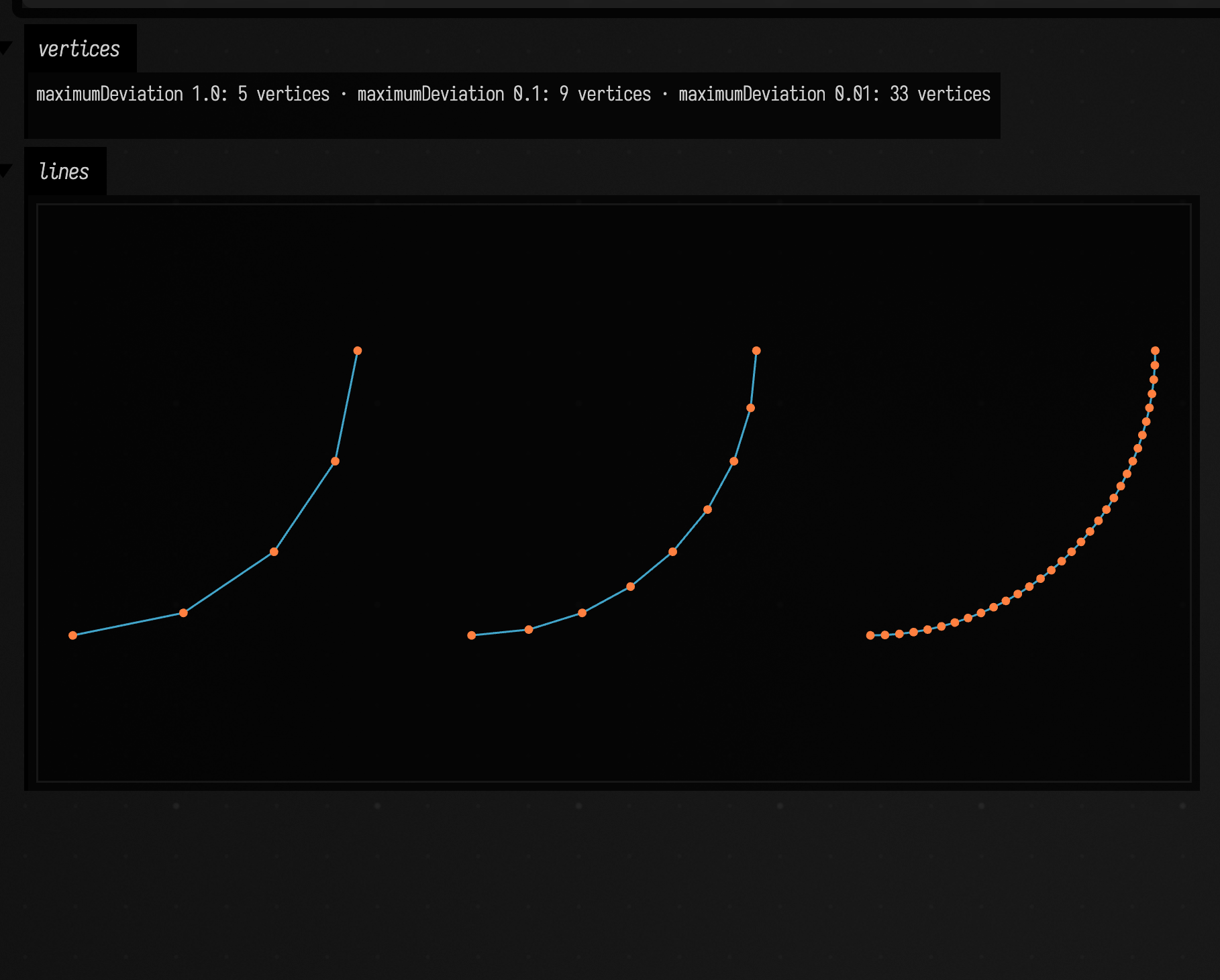
minimumRadiusBound recursively bounds speed and the derivative cross product using
Bernstein control hulls. It returns a conservative numerical lower bound on radius,
or throws if it cannot establish the requested minimum within its subdivision budget.
Failure does not prove that the curve violates the threshold. Cusps, degenerate chords
and arithmetic overflow are rejected. This uses floating-point arithmetic, not formal
interval certification; the polyline error bound does not prove containment in another solid.
Internals: how the binding is built
afield.geometry.solid.manifold binds Manifold through Java's foreign-function interface (FFM, "Panama"), with no
C++ of its own. Manifold ships a C binding library beside its C++ one (libmanifoldc, from
manifoldc.h), and Homebrew's bottle contains it. That is what makes this binding small, and it is
the whole argument for FFM over JNI, because the alternative needs a compiled shim per platform and
this needs nothing:
| Property | Ceres, the other native solver here | Manifold |
|---|---|---|
| upstream API | C++ templates only | C++ and a C ABI |
| so Field needs | a hand-written C++ wrapper (native/ken-ceres) |
nothing |
| build step | ./gradlew buildCeresRedistributable, minutes |
brew install manifold, seconds |
| ABI drift guarded by | a version string we invented | upstream's own SO version |
The binding makes three shapes of call:
- Plain downcalls.
size_tisJAVA_LONG,intisJAVA_INT, every pointer isADDRESS. Handles are looked up eagerly, so a library that is present but too old fails on first touch, naming the missing symbol, rather than mid-pipeline. - Structs returned by value.
manifold_box_minreturns three doubles, which AArch64 returns inv0..v2. FFM unpacks that from aStructLayoutwith no help; what it wants in exchange is aSegmentAllocatoras an extra leading argument. - Upcalls, as in Solids from a field: a thread-safe Kotlin lambda, and a sentinel to carry an exception back across the C++ frames.
Memory is the library's own malloc, via its manifold_alloc_* / manifold_delete_* pair, rather
than an FFM Arena. A confined Arena can only be used from the thread that made it, and a Solid
built in a box is routinely read from the runloop thread; a shared one costs a thread handshake to
close. malloc has neither problem, and the Cleaner sits behind it.