Generating with a LoRA
This example generates new music from a LoRA trained on one album, using Field Audio. The checkpoint, a rank-16 Underfit LoRA, trained for 1,000 steps on 165 lossless 12-second chunks from all 12 tracks on Henry Mancini's Experiment in Terror, is applied to Stable Audio 3's small-music base model.
To run the examples on this page, open the audio_ai_underfit_mancini starting point.
The source is a 12-second excerpt of the Modern Jazz Quartet’s “Skating”, separate from the
Mancini album used for training. The request imports that excerpt and asks for a 30-second
candidate with a modest guidance value (cfg = 1.5). initNoiseLevel = 0.65 sets how far the
result may move from the source; the LoRA applies at strength 0.85 over the denoising interval
0..0.92. The candidate board records the source, seed, model revisions, checkpoint and every
sampling control, so a take can be reproduced.
Listen to the experiment
Listen to the source first, then compare the base model with the LoRA take. Both outputs use
seed 1962, 50 steps, cfg = 1.5, cfgRescale = 0, initNoiseLevel = 0.65, two seconds of
padding and chunked decoding. The only request parameter that changes is checkpoint strength:
zero for the baseline and 0.85 for the LoRA, so the difference you hear is the checkpoint's.
Source · MJQ, “Skating” · 12 seconds
Stable Audio 3 Small Music Base · no LoRA · 30 seconds
Mancini step-1000 checkpoint · strength 0.85 · 30 seconds
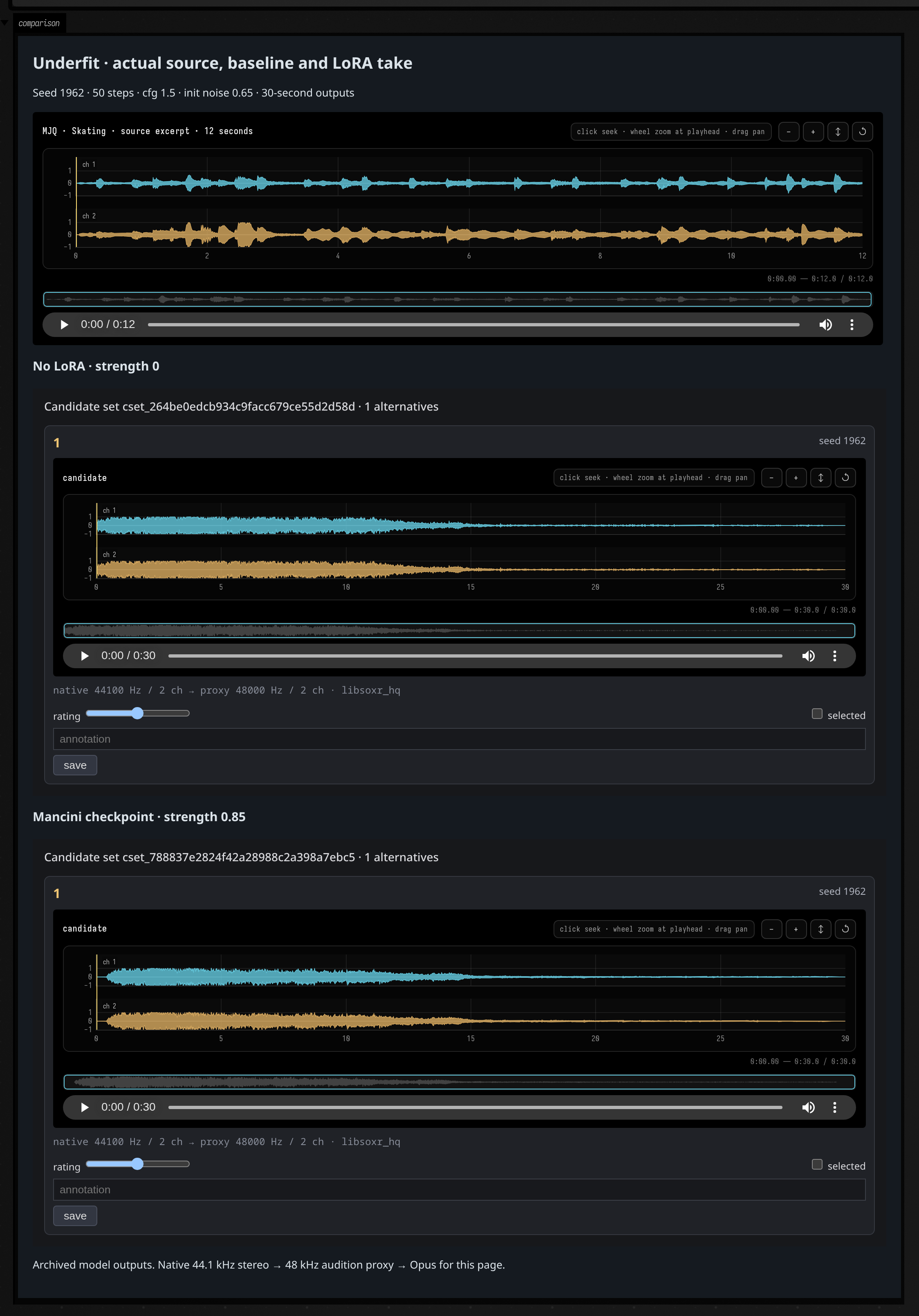
The board above shows the source waveform and both takes. In a live document you audition and rate candidates on the board itself.
Where these examples came from
The LoRA take is the successful 13 September 2026 render retained on the Linux RTX 4090
machine, not a new replacement. Its native WAV hash is
572545c7809e33ad00e642d40c5b3c65ebecfa3abbf233b8924292e26d30a5ad.
The matched strength-zero baseline was rendered on 3 October 2026 with the same pinned
Underfit and Stable Audio 3 revisions and request controls. The checkpoint digest is
3769f0e3282ea970a5c953933216f84c847478cfc51213c7adfa3f5a98762364.
Candidate proof,
baseline proof and the
export manifest preserve the original
asset hashes, model revisions and encoding provenance. Opus copies use the real audition
proxies without gain normalization. The captured board omits the unavailable archived
splice preview; the source is provided separately. Refresh these exports before recapture;
a normal HTML build reuses the genuine results and does not run a model.
Run it
Start the isolated worker and API from the field-audio-ai checkout:
export FIELD_AUDIO_UNDERFIT_SOURCE_WAV=/path/to/your-source.wav  # at least 12 seconds
export FIELD_AUDIO_UNDERFIT_LORA_ROOT=/path/to/audio-project/underfit-loras
./scripts/run-underfit-worker.sh
./scripts/run-api.sh
The worker also needs the Stable Audio 3 base model, found through
FIELD_AUDIO_UNDERFIT_MODELS_ROOT. Then open the Underfit Mancini example:
its first box explains the setup, and its second imports the source, sends the LoRA request and
shows the candidates on a board you can listen through.