Field Audio AI
Point Field at a recording you already have, choose four and a half seconds of it, and ask for eight variations that keep its room and its grain. Or ask which other stretches in a folder sound like the passage you picked. Field Audio AI lets you generate from recordings and explore a collection by how it sounds.
The models run in long-lived Python workers behind an HTTP and WebSocket protocol. Swap a checkpoint and Field keeps the rest of your work together: source selections, operations, candidate sets, ratings, annotations, provenance and arrangement.
The companion service is experimental, and pinned under services/field-audio-ai as a Git submodule
while its architecture moves. In a box its API needs no import; it names
operations such as generate.style, codec.reconstruct, and analysis.pitch_poly.
Running any of it needs that submodule initialized, the analysis and AudioCraft packages installed, and weights on disk. Short of that, what you can still read is a committed, model-free snapshot of the service contract: the generated service reference lists the current pinned HTTP objects, states, and error vocabulary, and needs none of the above.
What the service does
- immutable content-addressed source assets and 48 kHz project representations;
- asynchronous, cached and reproducible operations with progress and structured errors;
- source-window MusicGen-Style candidate families and automatic splice previews;
- checksummed Underfit LoRA and Stable Audio 3 source-conditioned candidate families;
- typed temporal gesture boards with prompt compilation and waveform-based candidate scoring;
- EnCodec token capture, reconstruction, metrics, waveform and spectrogram comparison;
- multi-scale beat and tempo trajectories;
- monophonic pYIN and polyphonic Basic Pitch analysis;
- revision-pinned emotion2vec and WavLM Base+ speech trajectories with voice activity and live Field projections;
- zoomable waveform, pitch, beat and token views, plus the embedded job monitor.
Variations of a source
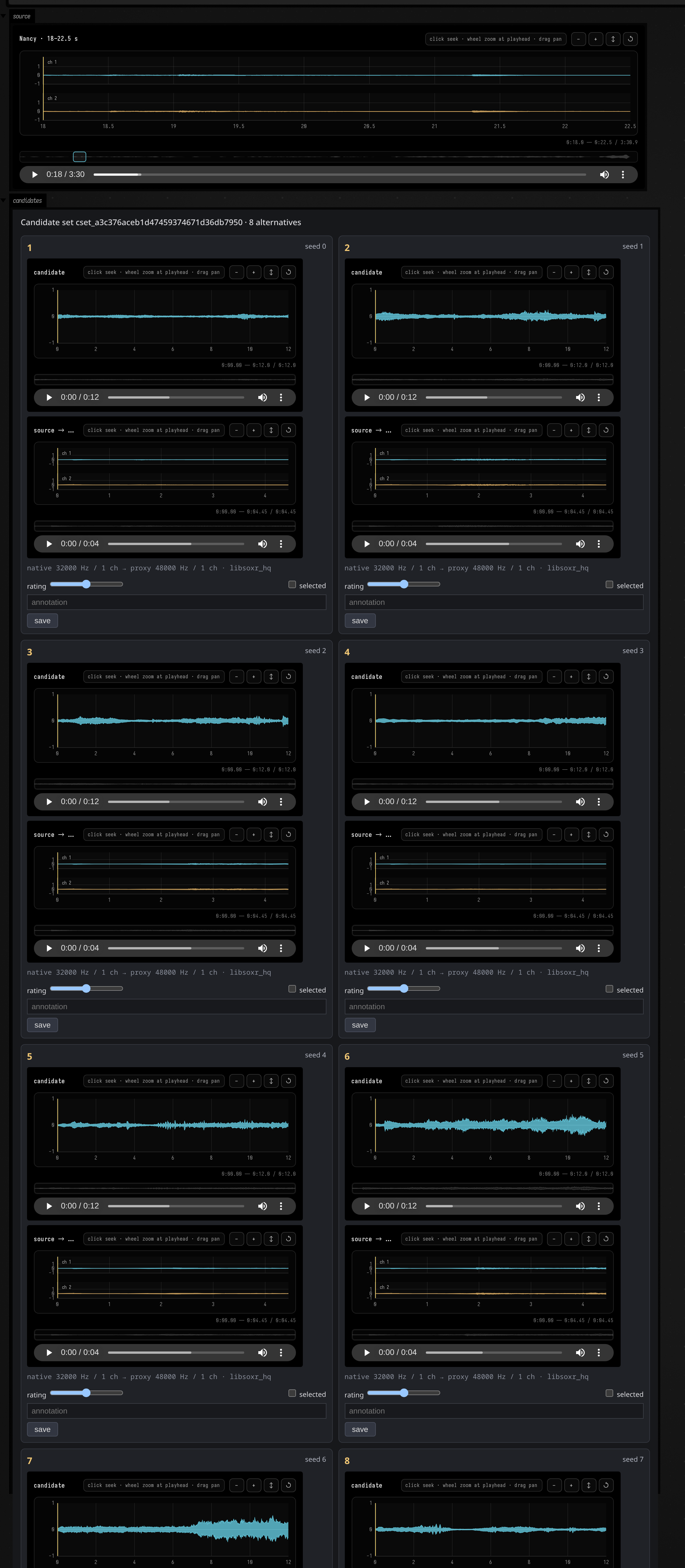
This box takes four and a half seconds of a recording, asks MusicGen-Style for eight twelve-second variations, one per seed, and shows the source window while it waits and a candidate board when they arrive:
val client = cached { FieldAudioClient() }
runAsync(
    onResult = { result: CandidateSet ->
        display("candidates", candidateBoardHtml(result))
    },
    onError = { failure ->
        markdown("generation error", "Generation failed: ${(failure.message ?: failure.toString()).md}")
    },
) {
    val showSource = progress<String> { display("source", it) }
    val lookup = client.assetByFilename("*Nancy*")
    onCancel { lookup.cancel(false) }
    lookup.thenCompose { source ->
        if (future.isDone) throw java.util.concurrent.CancellationException("run ended")
        val region = AssetRegion(source.id, startSeconds = 18.0, durationSeconds = 4.5)
        val canonical = source.representations.first { it.role == "canonical_project" }
        showSource(
            canonical.audioVisualizerHtml(
                label = "Nancy · 18–22.5 s",
                options = AudioVisualizerOptions(
                    width = 1100,
                    waveformHeight = 110,
                    initialStartSeconds = 18.0,
                    initialDurationSeconds = 4.5,
                    initialPositionSeconds = 18.0,
                ),
            ),
        )

        val request = styleCandidates(
            source = region,
            prompt = "sparse suspended orchestral tension",
            durationSeconds = 12.0,
            seeds = 0L until 8L,
            backend = "audiocraft.musicgen_style",
            controls = MusicGenStyleControls(
                temperature = 1.1,
                topK = 180,
                cfg = 3.2,
                styleQuantization = 2,
            ),
        )

        val submitted = client.submit(request)
        onCancel { submitted.cancel(false) }
        submitted.thenCompose { accepted ->
            if (future.isDone) throw java.util.concurrent.CancellationException("run ended")
            client.awaitCandidates(accepted).also { polling -> onCancel { polling.cancel(false) } }
        }
    }
}
Stop or rerun cancels this box’s lookup and local polling, and suppresses obsolete output. The durable service job and cached shared client remain available.
The source window, text, seed family, sampling temperature, top-k/top-p filtering, guidance balance, and style bottleneck are direct MusicGen-Style controls. They are global controls: this checkpoint does not accept an arbitrary event timeline or density curve.
Underfit LoRAs and Stable Audio 3
Underfit checkpoints use the same durable candidate path, while Stable Audio 3 runs in its own
Python 3.10 worker. Field hashes the local .safetensors file before submission; the worker checks
that digest again beneath FIELD_AUDIO_UNDERFIT_LORA_ROOT. The digest participates in the request
hash, so replacing a checkpoint at the same filename cannot return an older cached candidate set.
This box asks for thirty seconds through one LoRA checkpoint at strength 0.7, starting from a twelve-second window of the source:
import java.nio.file.Path

val client = cached { FieldAudioClient() }
val loraRoot = Path.of(requireNotNull(System.getenv("FIELD_AUDIO_UNDERFIT_LORA_ROOT")))
val lora = UnderfitLoraCheckpoint.fromFile(
    loraRoot.resolve("orchestra/10000.safetensors"),
    workerRoot = loraRoot,
    strength = 0.7,
    intervalMax = 0.92,
)

runAsync(
    onResult = { result: CandidateSet ->
        display("underfit", candidateBoardHtml(result))
    },
    onError = { failure ->
        markdown("generation error", "Generation failed: ${(failure.message ?: failure.toString()).md}")
    },
) {
    val lookup = client.assetByFilename("*Nancy*")
    onCancel { lookup.cancel(false) }
    lookup.thenCompose { source ->
        if (future.isDone) throw java.util.concurrent.CancellationException("run ended")
        val region = AssetRegion(source.id, startSeconds = 12.0, durationSeconds = 12.0)
        val submitted = client.submit(
            underfitCandidates(
                source = region,
                prompt = "sparse suspended orchestral tension",
                durationSeconds = 30.0,
                checkpoints = [lora],
                model = UnderfitModel.SMALL_MUSIC,
                controls = UnderfitGenerationControls(
                    steps = 8,
                    cfg = 1.5,
                    initNoiseLevel = 0.65,
                ),
            ),
        )
        onCancel { submitted.cancel(false) }
        submitted.thenCompose { accepted ->
            if (future.isDone) throw java.util.concurrent.CancellationException("run ended")
            client.awaitCandidates(accepted).also { polling -> onCancel { polling.cancel(false) } }
        }
    }
}
Hear the source, matched no-LoRA baseline and actual LoRA take in the Underfit Mancini experiment.
initNoiseLevel is the audio-to-audio distance control: zero preserves the selected source and one
approaches a fresh text-conditioned sample. A LoRA intervalMax below one skips it during the
earliest structure-setting denoising steps. UnderfitOperation.VARIATIONS selects the explicit
variation operation; both operations retain the source, model name, sampling controls, LoRA digest,
strength, upstream revisions, and seed in candidate provenance.
Gestures and how strongly they are enforced
The gesture board accepts timed prompt regions, salience events, and density, register, brightness and activity curves. Chord regions, pitch salience, pulse, continuation endpoints, corpus attraction, and EnCodec codebook selections are not part of its vocabulary. The interface always reveals how a gesture reaches the sound:
- direct — consumed as a native model condition;
- compiled — translated into chords, drums, pitch salience or several bounded requests;
- evaluative — used to analyse, rank and retry candidate families;
- transformative — applied afterward through tokens, splicing or decoding.
A density curve is an analysis-and-ranking target rather than a direct MusicGen control. The service measures every candidate, persists per-lane scores, and the Field browser presents them alongside listening and human ratings.
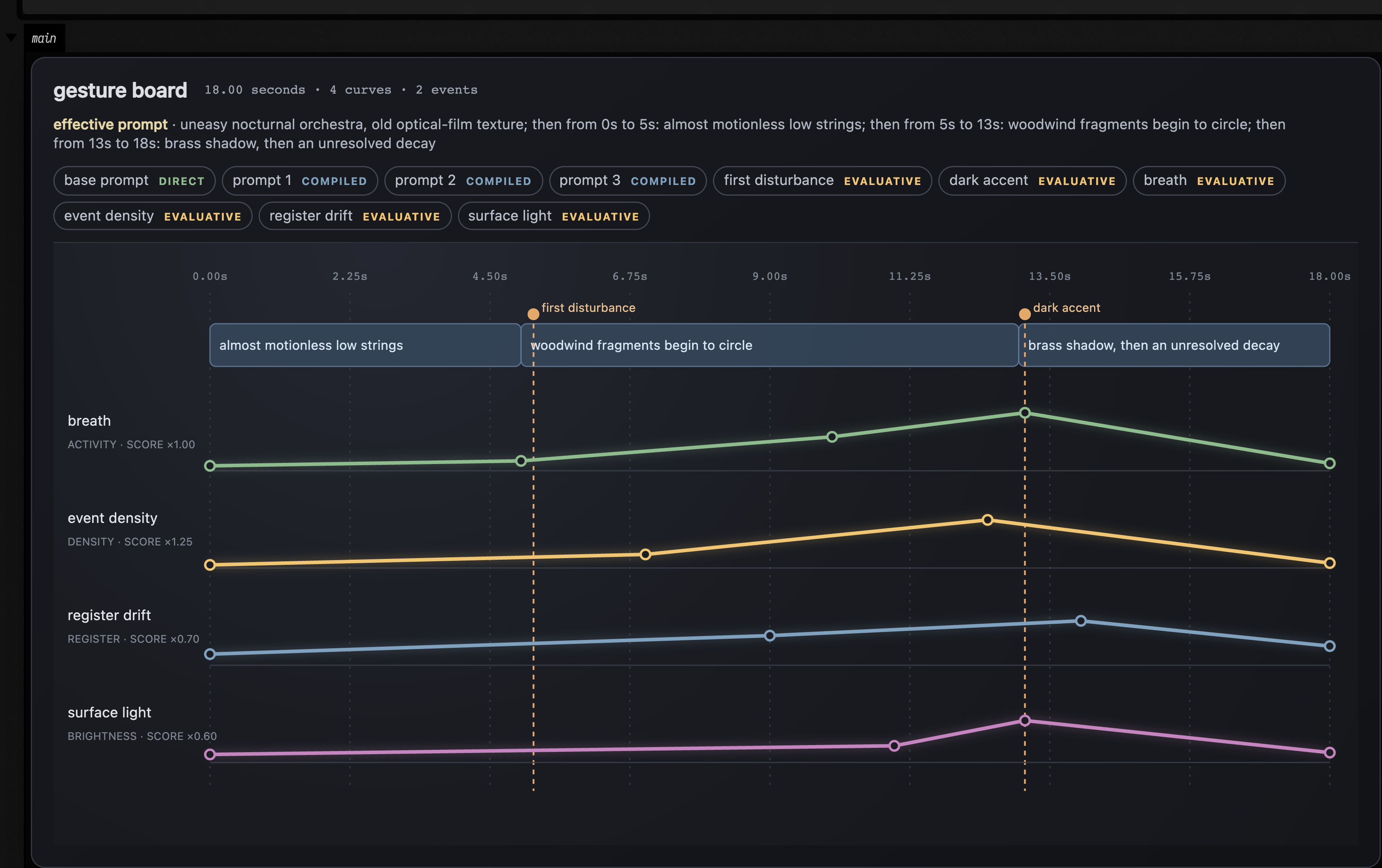
Each chip under the prompt names how its term reaches the sound, and each curve carries its score weight. The board is captured from the box on the gesture board page.
The rest of Field Audio AI
Start with the gesture board: it is the shortest runnable path from a drawing to eight candidates.
| Page | Start here when you want to |
|---|---|
| Gesture board | draw a shape in time and generate toward it |
| Beat and pitch analysis | find the beats, the tempo, or what note is sounding |
| Speech-reactive learned spaces | move a recording of speech through emotion2vec or WavLM |
| Short-time spectral spaces | do the same with no model and no GPU |
| MuScriptor transcription | turn a mixed recording into labelled notes and MIDI |
| Corpus microscope | find the other stretches that sound like this one |
| EnCodec round trip | work on the codec tokens themselves |
| Recorded-audio visualizers | put any of it on a shared playhead |
The analysis pages share one contract. The job that measures a recording is durable and content-addressed; everything downstream of it — the time range, the pooling, the distance, the projection — is an ordinary Field-side parameter that recomputes locally. Changing how you look at a recording does not re-run the analysis.