Drawn Strokes Become Paint
Every pen stroke on the drawing layer is a line of points, and a tablet pen records how hard it was
pressed at each one. notation reads both back, and PaintCanvas drags a simulated oil brush along
the points, pressing as hard as the pen did. The paint is mixed from tube colours, stays wet, smears
into whatever wet paint it crosses, and dries over simulated hours.
This meadow is 560 strokes on the drawing, painted back to front onto a red-ground oil canvas: a sky of long sweeps that warm from cobalt to Naples yellow, clouds scumbled in lead white, a field, then grass flicked up from the root so each blade thins as the pen lifts, and poppies on top. The grass goes into the field paint before it is dry and drags some of it along.
:::static
import kotlin.random.Random

// A meadow at evening, from 560 pen strokes on the drawing. The strokes are drawn by code here
// (a seeded random hand) into the region below; draw your own there instead and paint those.
val region = Rect(40.0, 1460.0, 1600.0, 1000.0)
val X = region.x
val Y = region.y
val rnd = Random(7)
fun r(a: Double, b: Double) = rnd.nextDouble(a, b)
fun sweep(x: Double, y: Double, w: Double, dy: Double = 0.0) =
    FLine()
        .moveTo(X + x, Y + y)
        .cubicTo(X + x + w * 0.3, Y + y - 20, X + x + w * 0.7, Y + y + 20, X + x + w, Y + y + dy)
notation {
    for (i in 0 until 18) stroke(
        sweep(r(-160.0, 0.0), 20.0 + i * 26 + r(-6.0, 6.0), 1760.0, r(-10.0, 10.0)), // sky
        name = "sky $i",
        pressure = { 0.5 + 0.5 * sin(PI * it) },
    )
    for (c in 0 until 5) { // clouds
        val cx = r(150.0, 1350.0)
        val cy = r(90.0, 300.0)
        for (k in 0 until 7) stroke(
            sweep(cx + r(-120.0, 80.0), cy + r(-35.0, 25.0), r(80.0, 220.0), 4.0),
            name = "cloud $c.$k",
            pressure = { 0.2 + 0.8 * sin(PI * it) },
        )
    }
    for (i in 0 until 5) stroke(
        sweep(-80.0, 500.0 + i * 10, 1760.0, -40.0), // far hills
        name = "hill $i",
        pressure = { 0.4 + 0.6 * sin(PI * it) },
    )
    for (i in 0 until 22) stroke(
        sweep(-80.0, 540.0 + i * 22, 1760.0), // the field
        name = "field $i",
        pressure = { 0.7 + 0.3 * sin(PI * it) },
    )
    for (i in 0 until 420) { // grass
        val y = r(560.0, 1000.0)
        val d = (y - 540) / 460
        val x = r(-20.0, 1620.0)
        val h = r(40.0, 120.0) + 300 * d * d
        val lean = r(-0.3, 0.5) * h
        stroke(
            FLine()
                .moveTo(X + x, Y + y)
                .cubicTo(
                    X + x + lean * 0.1,
                    Y + y - h * 0.5,
                    X + x + lean * 0.5,
                    Y + y - h * 0.9,
                    X + x + lean,
                    Y + y - h,
                ),
            name = "grass $i",
            pressure = { 1.0 - 0.95 * it },
        ) // flicked up from the root
    }
    for (i in 0 until 60) { // poppies
        val y = r(570.0, 990.0)
        val x = r(40.0, 1560.0)
        val s = 4.0 + 22 * (y - 540) / 460
        stroke(
            FLine()
                .moveTo(X + x - s, Y + y)
                .cubicTo(X + x - s * 0.3, Y + y - s, X + x + s * 0.5, Y + y - s * 0.8, X + x + s, Y + y + s * 0.2),
            name = "poppy $i",
            pressure = { 0.5 + 0.5 * sin(PI * it) },
        )
    }
}

:::fold paint them: a palette of tube paints per kind of stroke, back to front
val canvas = PaintCanvas(1200, aspect = 1.6, ground = PaintGround.OilRedGround, view = region)
val strokes = notation.strokes.filter { it.bounds.intersects(region) }
fun named(p: String) = strokes.filter { it.label?.startsWith(p) == true }
fun depth(s: Mark) = ((s.start!!.y - Y - 540) / 460).coerceIn(0.0, 1.0) // 0 at the horizon, 1 at the front
fun paint(s: Mark, b: PaintBrush, p: Double = 1.0, shake: Double = 1.0) =
    canvas.stroke(s.toFLine(), b, pressure = p..p, swell = s.pressuresAlong(32), shake = shake)

val sky = canvas.brush(BrushKind.Filbert, width = 60.0)
named("sky").forEachIndexed { i, s ->
    val t = i / 17.0 // cobalt at the top, warming to Naples yellow and a little rose at the horizon
    paint(
        s,
        sky.load(
            mapOf(
                "lead white" to 3.0,
                "cobalt blue" to 2.0 * (1 - t) * (1 - t),
                "Naples yellow" to 2.5 * t * t,
                "rose madder" to 0.4 * t,
            ),
            wipe = 0.5,
        ),
    )
}
val cloud = canvas.brush(BrushKind.HogFlat, width = 34.0)
named("cloud").forEach {
    paint(
        it,
        cloud.load(
            Tubes.mix(mapOf("lead white" to 4.0, "Naples yellow" to 0.4, "rose madder" to 0.1)),
            hiding = 0.5,
            wipe = 0.3,
        ),
        shake = 0.8,
    )
}
val hill = canvas.brush(BrushKind.HogFlat, width = 26.0)
named("hill").forEachIndexed { i, s ->
    paint(
        s,
        hill.load(
            mapOf("lead white" to 3.0 - i * 0.4, "cobalt blue" to 1.0, "green earth" to 1.0 + i * 0.4),
            wipe = 0.6,
        ),
    )
}
val field = canvas.brush(BrushKind.HogFlat, width = 50.0)
named("field").forEachIndexed { i, s ->
    val t = i / 21.0
    paint(
        s,
        field.load(
            mapOf(
                "green earth" to 2.0,
                "yellow ochre" to 2.0 * (1 - t),
                "raw umber" to 1.5 * t,
                "lead white" to 1.0 * (1 - t),
            ),
            wipe = 0.5,
        ),
    )
}
canvas.wait(40.0) // let the field set a little before the grass goes into it
val grass = canvas.brush(BrushKind.Round, width = 10.0)
val greens = [
    mapOf("viridian" to 1.0, "yellow ochre" to 1.5),
    mapOf("green earth" to 2.0, "chrome yellow" to 1.0),
    mapOf("viridian" to 1.0, "raw umber" to 1.0),
    mapOf("yellow ochre" to 2.0, "lead white" to 1.0),
    mapOf("Prussian blue" to 0.2, "chrome yellow" to 2.0),
    mapOf("Naples yellow" to 2.0, "green earth" to 1.0),
]
named("grass")
    .sortedBy { it.start!!.y }
    .forEachIndexed { i, s ->
        paint(s, grass.load(greens[i % greens.size], wipe = 0.5), 0.4 + 0.6 * depth(s), shake = 0.6)
    }
val poppy = canvas.brush(BrushKind.Filbert, width = 24.0)
named("poppy")
    .sortedBy { it.start!!.y }
    .forEach { s ->
        paint(
            s,
            poppy.load(mapOf("vermilion" to 3.0, "cadmium red" to 1.0, "lead white" to 0.2), wipe = 0.9),
            0.3 + 0.7 * depth(s),
        )
    }
canvas.dry()
canvas.glaze(rgb(0.6, 0.45, 0.2), coats = 0.12) // a thin warm varnish over the whole thing
:::endfold
display("main", canvas.png())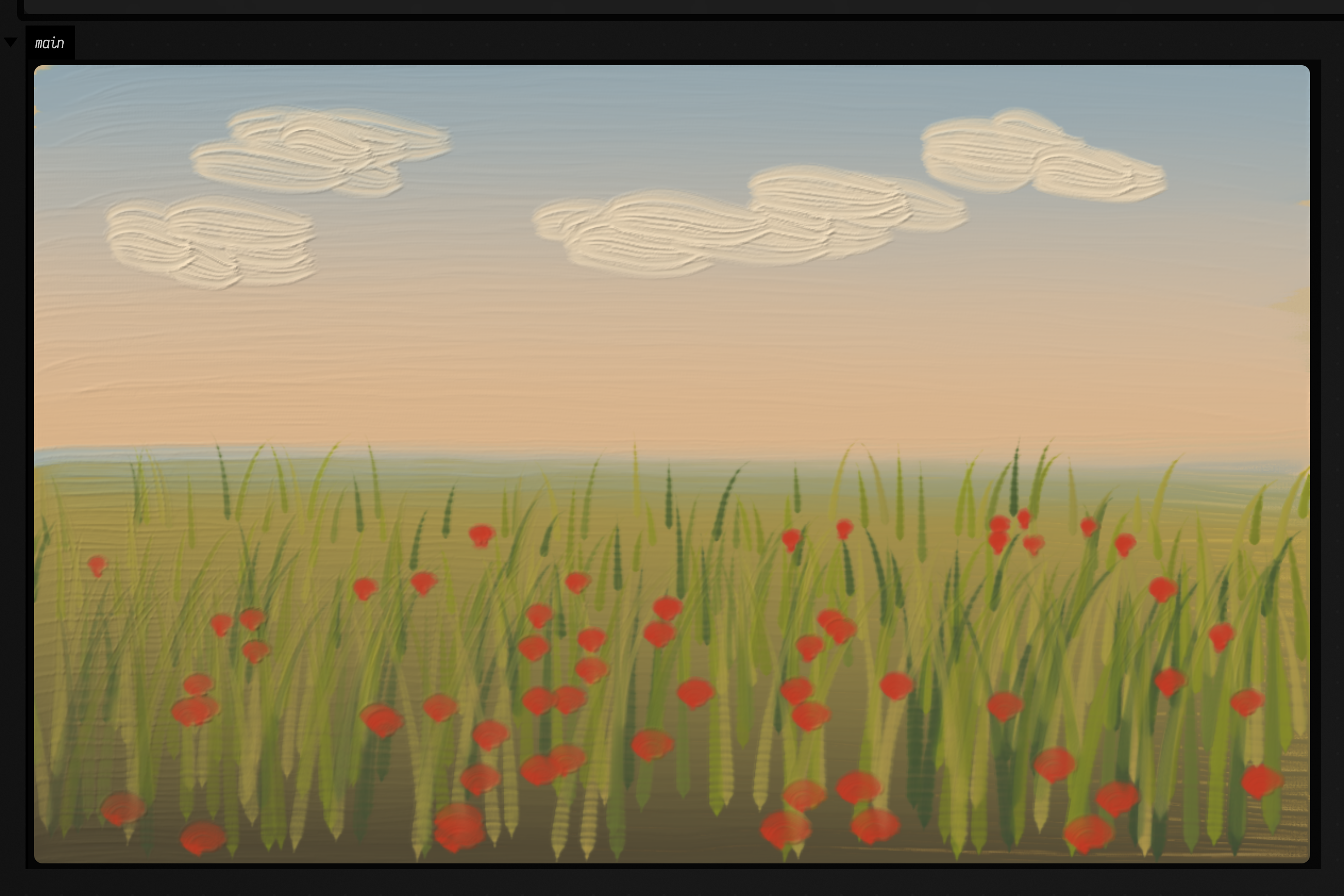
Code draws the strokes in this example. The painting box reads them from a region of the drawing
with notation.strokes.filter { it.bounds.intersects(region) }, so it can paint strokes you draw
there by hand too.
Step by step
The same materials, one action per frame. Two wet bands are crossed by a loaded brush, which mixes into them, and by a clean one, which only smears them; then the meadow is laid in from the back, sky, clouds, hills and field, a few grass blades and poppies at a time, and finished with the varnish:
:::static
import kotlin.random.Random

:::fold the meadow's 560 strokes, drawn into the drawing as in the first figure
val region = Rect(40.0, 1460.0, 1600.0, 1000.0)
val X = region.x
val Y = region.y
val rnd = Random(7)
fun r(a: Double, b: Double) = rnd.nextDouble(a, b)
fun sweep(x: Double, y: Double, w: Double, dy: Double = 0.0) =
    FLine()
        .moveTo(X + x, Y + y)
        .cubicTo(X + x + w * 0.3, Y + y - 20, X + x + w * 0.7, Y + y + 20, X + x + w, Y + y + dy)
notation {
    for (i in 0 until 18) stroke(
        sweep(r(-160.0, 0.0), 20.0 + i * 26 + r(-6.0, 6.0), 1760.0, r(-10.0, 10.0)), // sky
        name = "sky $i",
        pressure = { 0.5 + 0.5 * sin(PI * it) },
    )
    for (c in 0 until 5) { // clouds
        val cx = r(150.0, 1350.0)
        val cy = r(90.0, 300.0)
        for (k in 0 until 7) stroke(
            sweep(cx + r(-120.0, 80.0), cy + r(-35.0, 25.0), r(80.0, 220.0), 4.0),
            name = "cloud $c.$k",
            pressure = { 0.2 + 0.8 * sin(PI * it) },
        )
    }
    for (i in 0 until 5) stroke(
        sweep(-80.0, 500.0 + i * 10, 1760.0, -40.0), // far hills
        name = "hill $i",
        pressure = { 0.4 + 0.6 * sin(PI * it) },
    )
    for (i in 0 until 22) stroke(
        sweep(-80.0, 540.0 + i * 22, 1760.0), // the field
        name = "field $i",
        pressure = { 0.7 + 0.3 * sin(PI * it) },
    )
    for (i in 0 until 420) { // grass
        val y = r(560.0, 1000.0)
        val d = (y - 540) / 460
        val x = r(-20.0, 1620.0)
        val h = r(40.0, 120.0) + 300 * d * d
        val lean = r(-0.3, 0.5) * h
        stroke(
            FLine()
                .moveTo(X + x, Y + y)
                .cubicTo(
                    X + x + lean * 0.1,
                    Y + y - h * 0.5,
                    X + x + lean * 0.5,
                    Y + y - h * 0.9,
                    X + x + lean,
                    Y + y - h,
                ),
            name = "grass $i",
            pressure = { 1.0 - 0.95 * it },
        ) // flicked up from the root
    }
    for (i in 0 until 60) { // poppies
        val y = r(570.0, 990.0)
        val x = r(40.0, 1560.0)
        val s = 4.0 + 22 * (y - 540) / 460
        stroke(
            FLine()
                .moveTo(X + x - s, Y + y)
                .cubicTo(X + x - s * 0.3, Y + y - s, X + x + s * 0.5, Y + y - s * 0.8, X + x + s, Y + y + s * 0.2),
            name = "poppy $i",
            pressure = { 0.5 + 0.5 * sin(PI * it) },
        )
    }
}

:::endfold

// Every step below is one action on a real canvas; the loop takes one step per frame and shows it.
val steps = mutableListOf<Pair<String, () -> Unit>>()
val hold = 6 // frames to hold on a step worth seeing

// Act one: two wet bands, blue straight across them, then a clean brush dragged through.
val bands = PaintCanvas(900, aspect = 2.0)
var showing = bands
val band = bands.brush(BrushKind.HogFlat, width = 90.0)
steps +=
    "yellow" to
        {
            bands.stroke(
                FLine().moveTo(120, 170).cubicTo(400, 150, 650, 190, 900, 170),
                band.load(mapOf("cadmium yellow" to 1.0), wipe = 1.0),
                shake = 0.5,
            )
        }
steps +=
    "red" to
        {
            bands.stroke(
                FLine().moveTo(120, 340).cubicTo(400, 320, 650, 360, 900, 340),
                band.load(mapOf("vermilion" to 1.0), wipe = 1.0),
                shake = 0.5,
            )
        }
steps +=
    "blue, into the wet bands" to
        {
            bands.stroke(
                FLine().moveTo(330, 60).cubicTo(360, 200, 320, 320, 350, 450),
                bands.brush(BrushKind.HogFlat, width = 70.0).load(mapOf("ultramarine blue" to 1.0)),
                shake = 0.5,
            )
        }
steps +=
    "a clean brush, dragged through" to
        {
            bands.stroke(
                FLine().moveTo(680, 60).cubicTo(700, 200, 670, 320, 700, 460),
                bands.brush(BrushKind.HogFlat, width = 70.0),
                shake = 0.5,
            )
        }

:::fold act two: the meadow, back to front, a few strokes a frame, then the varnish
val canvas = PaintCanvas(900, aspect = 1.6, ground = PaintGround.OilRedGround, view = region)
steps += "a red-ground canvas" to { showing = canvas }
val strokes = notation.strokes.filter { it.bounds.intersects(region) }
val named: (String) -> List<Mark> = { p -> strokes.filter { it.label?.startsWith(p) == true } }
val depth: (Mark) -> Double = { s -> ((s.start!!.y - Y - 540) / 460).coerceIn(0.0, 1.0) }
val paint: (Mark, PaintBrush, Double, Double) -> Unit = { s, b, p, shake ->
    canvas.stroke(s.toFLine(), b, pressure = p..p, swell = s.pressuresAlong(32), shake = shake)
}
val sky = canvas.brush(BrushKind.Filbert, width = 60.0)
named("sky").forEachIndexed { i, s ->
    val t = i / 17.0
    steps +=
        "sky" to
            {
                paint(
                    s,
                    sky.load(
                        mapOf(
                            "lead white" to 3.0,
                            "cobalt blue" to 2.0 * (1 - t) * (1 - t),
                            "Naples yellow" to 2.5 * t * t,
                            "rose madder" to 0.4 * t,
                        ),
                        wipe = 0.5,
                    ),
                    1.0,
                    1.0,
                )
            }
}
val cloud = canvas.brush(BrushKind.HogFlat, width = 34.0)
named("cloud").chunked(4).forEach { group ->
    steps +=
        "clouds" to
            {
                group.forEach {
                    paint(
                        it,
                        cloud.load(
                            Tubes.mix(mapOf("lead white" to 4.0, "Naples yellow" to 0.4, "rose madder" to 0.1)),
                            hiding = 0.5,
                            wipe = 0.3,
                        ),
                        1.0,
                        0.8,
                    )
                }
            }
}
val hill = canvas.brush(BrushKind.HogFlat, width = 26.0)
steps +=
    "hills" to
        {
            named("hill").forEachIndexed { i, s ->
                paint(
                    s,
                    hill.load(
                        mapOf("lead white" to 3.0 - i * 0.4, "cobalt blue" to 1.0, "green earth" to 1.0 + i * 0.4),
                        wipe = 0.6,
                    ),
                    1.0,
                    1.0,
                )
            }
        }
val field = canvas.brush(BrushKind.HogFlat, width = 50.0)
named("field").withIndex().chunked(2).forEach { group ->
    steps +=
        "field" to
            {
                group.forEach { (i, s) ->
                    val t = i / 21.0
                    paint(
                        s,
                        field.load(
                            mapOf(
                                "green earth" to 2.0,
                                "yellow ochre" to 2.0 * (1 - t),
                                "raw umber" to 1.5 * t,
                                "lead white" to 1.0 * (1 - t),
                            ),
                            wipe = 0.5,
                        ),
                        1.0,
                        1.0,
                    )
                }
            }
}
steps += "forty minutes pass" to { canvas.wait(40.0) }
val grass = canvas.brush(BrushKind.Round, width = 10.0)
val greens = [
    mapOf("viridian" to 1.0, "yellow ochre" to 1.5),
    mapOf("green earth" to 2.0, "chrome yellow" to 1.0),
    mapOf("viridian" to 1.0, "raw umber" to 1.0),
    mapOf("yellow ochre" to 2.0, "lead white" to 1.0),
    mapOf("Prussian blue" to 0.2, "chrome yellow" to 2.0),
    mapOf("Naples yellow" to 2.0, "green earth" to 1.0),
]
named("grass")
    .sortedBy { it.start!!.y }
    .withIndex()
    .chunked(14)
    .forEach { group ->
        steps +=
            "grass" to
                {
                    group.forEach { (i, s) ->
                        paint(s, grass.load(greens[i % greens.size], wipe = 0.5), 0.4 + 0.6 * depth(s), 0.6)
                    }
                }
    }
val poppy = canvas.brush(BrushKind.Filbert, width = 24.0)
named("poppy")
    .sortedBy { it.start!!.y }
    .chunked(5)
    .forEach { group ->
        steps +=
            "poppies" to
                {
                    group.forEach { s ->
                        paint(
                            s,
                            poppy.load(
                                mapOf("vermilion" to 3.0, "cadmium red" to 1.0, "lead white" to 0.2),
                                wipe = 0.9,
                            ),
                            0.3 + 0.7 * depth(s),
                            1.0,
                        )
                    }
                }
    }
steps +=
    "dry, then a warm varnish" to
        {
            canvas.dry()
            canvas.glaze(rgb(0.6, 0.45, 0.2), coats = 0.12)
        }

:::endfold

val slow = setOf(
    "yellow",
    "red",
    "blue, into the wet bands",
    "a clean brush, dragged through",
    "a red-ground canvas",
    "dry, then a warm varnish",
)
val frames = steps.flatMap { s -> List(if (s.first in slow) hold else 1) { k -> if (k == 0) s else null } }
var at = 0
loop {
    if (at < frames.size) {
        frames[at]?.let { (label, act) ->
            act()
            display("main", showing.png(relief = 0.6))
            display("step", label)
        }
        at++
    } else end()
}
Three strokes, with pressure
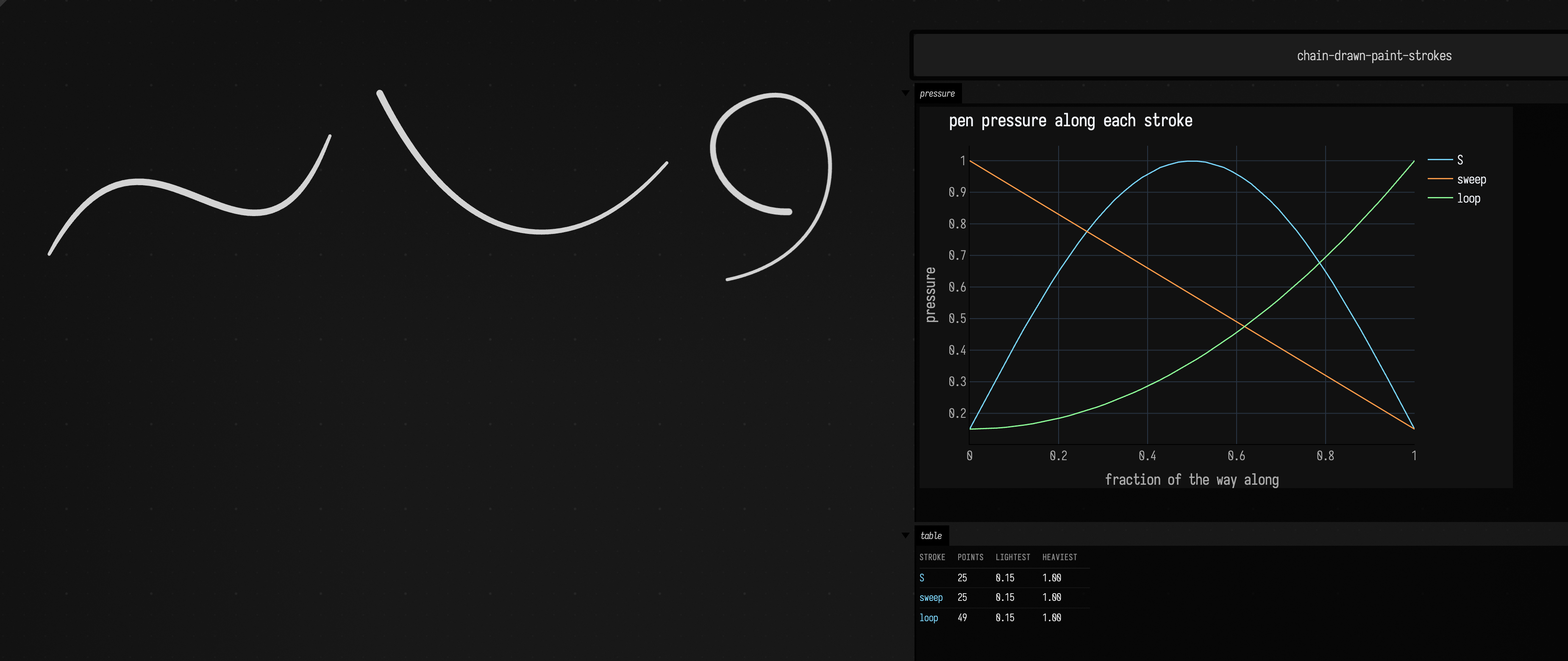
notation { stroke(...) } writes a stroke into the drawing. Its pressure argument gives the pen
pressure, 0 to 1, as a function of how far along the stroke the pen is. This box draws three: a wave
named S that is pressed hardest in the middle, a sweep that starts hard and lifts off, and a
loop that starts light and bears down as it curls in to its end. It reads them back and plots the
pressure along each. The figure shows the drawing on the left and the box with its output on the
right:
// Three pen strokes, drawn from code into the document's drawing, each with a pen pressure
// (0..1) as a function of how far along the stroke the pen is. Running it again replaces them.
notation {
    stroke(
        FLine().moveTo(80, 300).cubicTo(200, 60, 330, 420, 420, 140),
        name = "S",
        pressure = { 0.15 + 0.85 * sin(PI * it) },
    )
    stroke(
        FLine().moveTo(470, 110).cubicTo(560, 300, 700, 330, 820, 180),
        name = "sweep",
        pressure = { 1.0 - 0.85 * it },
    )
    stroke(
        FLine().moveTo(880, 330).cubicTo(1060, 300, 1020, 60, 900, 120).cubicTo(820, 160, 880, 260, 960, 250),
        name = "loop",
        pressure = { 0.15 + 0.85 * it * it },
    )
}
// Read back every stroke in this part of the drawing, with its pressure at 50 evenly spaced points.
val strokes = notation.strokes.filter { it.bounds.intersects(Rect(40.0, 40.0, 1040.0, 400.0)) }
showSignals(
    *strokes.map { (it.label ?: it.id) to it.pressuresAlong(50) }.toTypedArray(),
    x = (0 until 50).map { it / 49.0 },
    title = "pen pressure along each stroke",
    xTitle = "fraction of the way along",
    yTitle = "pressure",
    channel = "pressure",
)
markdown(
    "table",
    "| stroke | points | lightest | heaviest |\n|---|---|---|---|\n" +
        strokes.joinToString("\n") {
            "| ${it.label ?: "drawn"} | ${it.points.size} | %.2f | %.2f |"
                .format(it.pressures.minOrNull() ?: 0.0, it.pressures.maxOrNull() ?: 0.0)
        },
    width = 380,
)
pressures is the list Excalidraw keeps, one value per point. A pen records points closer together
where it moves slowly, so that list is not evenly spaced along the stroke. pressuresAlong(n) gives
the pressure at n points evenly spaced by distance, which is what a brush wants. A stroke drawn
with a mouse has no pressure, and both lists are empty.
Painted, pressing as the pen did
PaintCanvas(view = ...) stretches a rectangle of drawing coordinates over the whole canvas, so the
strokes need no conversion: toFLine() gives each one in drawing coordinates, and the drawing and
the canvas both have y growing downwards. A brush's swell is a list of pressure multipliers along
the stroke, so with the base pressure at 1, swell = pressuresAlong(64) presses the brush as the
pen pressed.
The top row is painted that way. In the middle row the pen's pressure is squared first, and in the bottom row the brush is held at one even pressure:
:::static
:::fold the same three strokes as above, drawn into this box's drawing
notation {
    stroke(
        FLine().moveTo(80, 300).cubicTo(200, 60, 330, 420, 420, 140),
        name = "S",
        pressure = { 0.15 + 0.85 * sin(PI * it) },
    )
    stroke(
        FLine().moveTo(470, 110).cubicTo(560, 300, 700, 330, 820, 180),
        name = "sweep",
        pressure = { 1.0 - 0.85 * it },
    )
    stroke(
        FLine().moveTo(880, 330).cubicTo(1060, 300, 1020, 60, 900, 120).cubicTo(820, 160, 880, 260, 960, 250),
        name = "loop",
        pressure = { 0.15 + 0.85 * it * it },
    )
}
:::endfold
// Every stroke in that region, painted three times, one row each: the brush
// pressing as the pen did; the pen's pressure squared, so light strokes go lighter; one even pressure.
val region = Rect(40.0, 40.0, 1040.0, 400.0)
val strokes = notation.strokes.filter { it.bounds.intersects(region) }
val colours = [
    mapOf("ultramarine blue" to 2.0, "bone black" to 0.3),
    mapOf("vermilion" to 1.0),
    mapOf("viridian" to 1.0, "chrome yellow" to 0.6),
]
val canvas = PaintCanvas(900, aspect = 0.9, view = Rect(40.0, 40.0, 1000.0, 1110.0))
val brush = canvas.brush(BrushKind.Round, width = 70.0)
fun lower(s: Mark, dy: Double) = s.toFLine() + vec(0.0, dy)
strokes.forEachIndexed { i, s ->
    val pen = s.pressuresAlong(64)
    brush.load(colours[i % 3], wipe = 1.0)
    canvas.stroke(s.toFLine(), brush, pressure = 1.0..1.0, swell = pen)
    brush.load(colours[i % 3], wipe = 1.0)
    canvas.stroke(lower(s, 360.0), brush, pressure = 1.0..1.0, swell = pen.map { it * it })
    brush.load(colours[i % 3], wipe = 1.0)
    canvas.stroke(lower(s, 720.0), brush, pressure = 0.6..0.6)
}
display("main", canvas.png())
notation.clear() // take the strokes down so they do not lie over the picture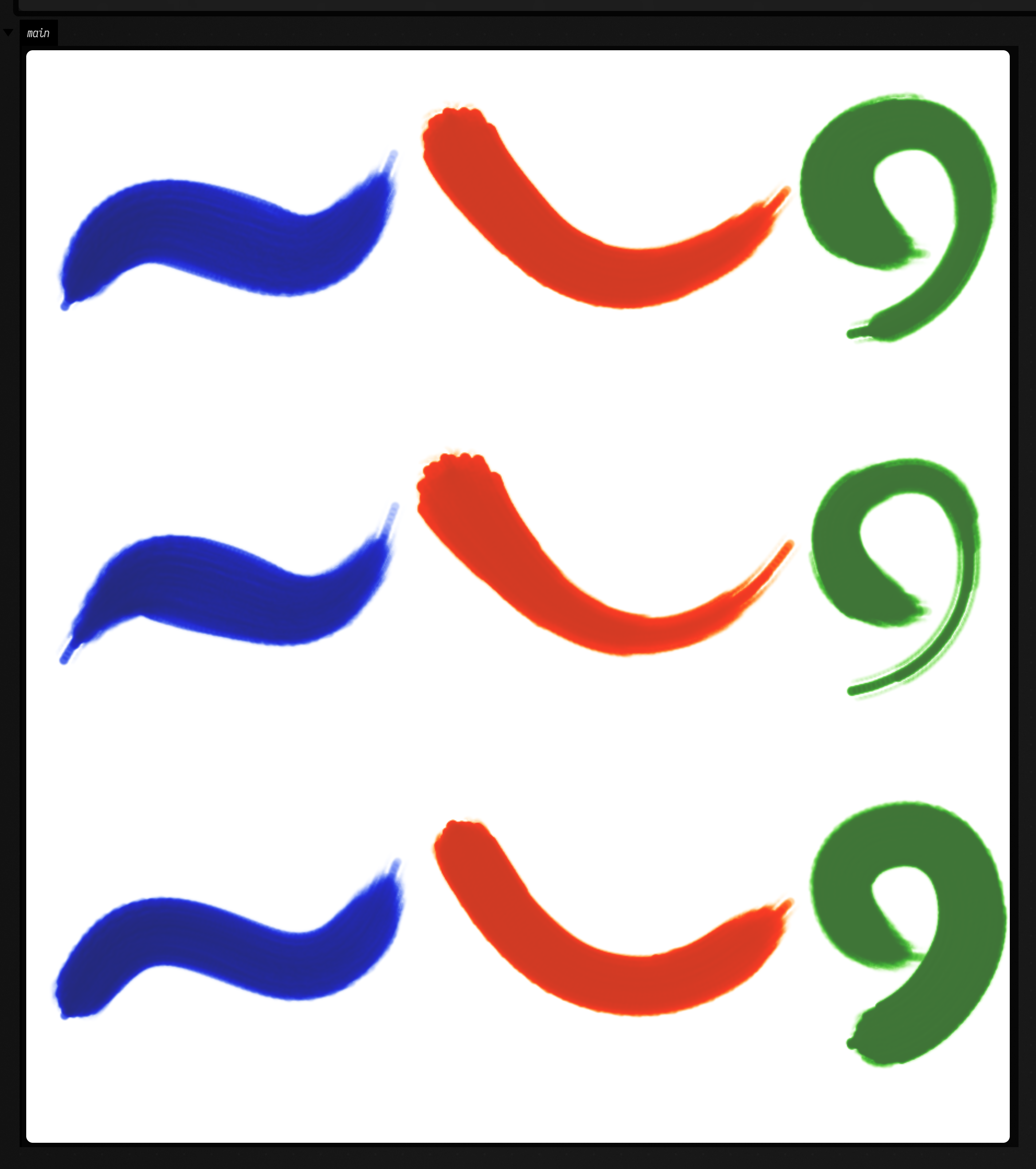
A round brush pressed as lightly as it goes still lays a band about a third of its full width, so painting straight from the pen gives a narrower range than the pen recorded. Squaring the pressure spreads the light end out: a stroke at half pressure paints at a quarter, and the lightest parts of a stroke thin to a few bristles. Any function of the pressure works here, and a curve like this one is what a drawing program's pressure setting is.
Strokes that cross
Wet paint picks up and mixes with paint already on the canvas. Here four pairs of yellow and red
bands are each crossed by one stroke. In the first, ultramarine goes straight
across the wet bands and turns green over the yellow and dark over the red. In the second the same
blue crosses the same bands after dry(), and sits on top of them as a transparent film. In the
third a clean, dry hog-hair brush with no paint of its own is dragged through: it picks up the
yellow and smears it down into the red. In the fourth a clean badger blender does the same more
softly:
:::static
// Four pairs of bands, yellow over red, each crossed by one vertical stroke.
notation {
    for (k in 0 until 4) {
        val x = 60.0 + k * 250
        stroke(
            FLine().moveTo(x, 560).cubicTo(x + 70, 545, x + 140, 575, x + 210, 560),
            name = "yellow $k",
            pressure = { 0.8 },
        )
        stroke(
            FLine().moveTo(x, 760).cubicTo(x + 70, 745, x + 140, 775, x + 210, 760),
            name = "red $k",
            pressure = { 0.8 },
        )
        stroke(
            FLine().moveTo(x + 95, 480).cubicTo(x + 120, 600, x + 90, 720, x + 115, 860),
            name = "across $k",
            pressure = { 0.5 + 0.5 * sin(PI * it) },
        )
    }
}
val canvas = PaintCanvas(900, aspect = 2.4, view = Rect(40.0, 460.0, 1000.0, 416.0))
fun paint(name: String, brush: PaintBrush) = notation.named(name)!!.let {
    canvas.stroke(it.toFLine(), brush, pressure = 1.0..1.0, swell = it.pressuresAlong(32), shake = 0.5)
}
val band = canvas.brush(BrushKind.HogFlat, width = 70.0)
for (k in 0 until 4) {
    paint("yellow $k", band.load(mapOf("cadmium yellow" to 1.0), wipe = 1.0))
    paint("red $k", band.load(mapOf("vermilion" to 1.0), wipe = 1.0))
}
// 1: blue straight across the wet bands, so the colours mix where they meet
paint("across 0", canvas.brush(BrushKind.HogFlat, width = 60.0).load(mapOf("ultramarine blue" to 1.0)))
// 3: a clean, dry hog-hair brush dragged through them: no paint of its own, it smears theirs
paint("across 2", canvas.brush(BrushKind.HogFlat, width = 60.0))
// 4: a clean badger blender, which only softens what is there
paint("across 3", canvas.brush(BrushKind.Badger, width = 60.0))
// 2: the same blue, after everything has dried
canvas.dry()
paint("across 1", canvas.brush(BrushKind.HogFlat, width = 60.0).load(mapOf("ultramarine blue" to 1.0)))
display("main", canvas.png())
notation.clear() // take the strokes down so they do not lie over the picture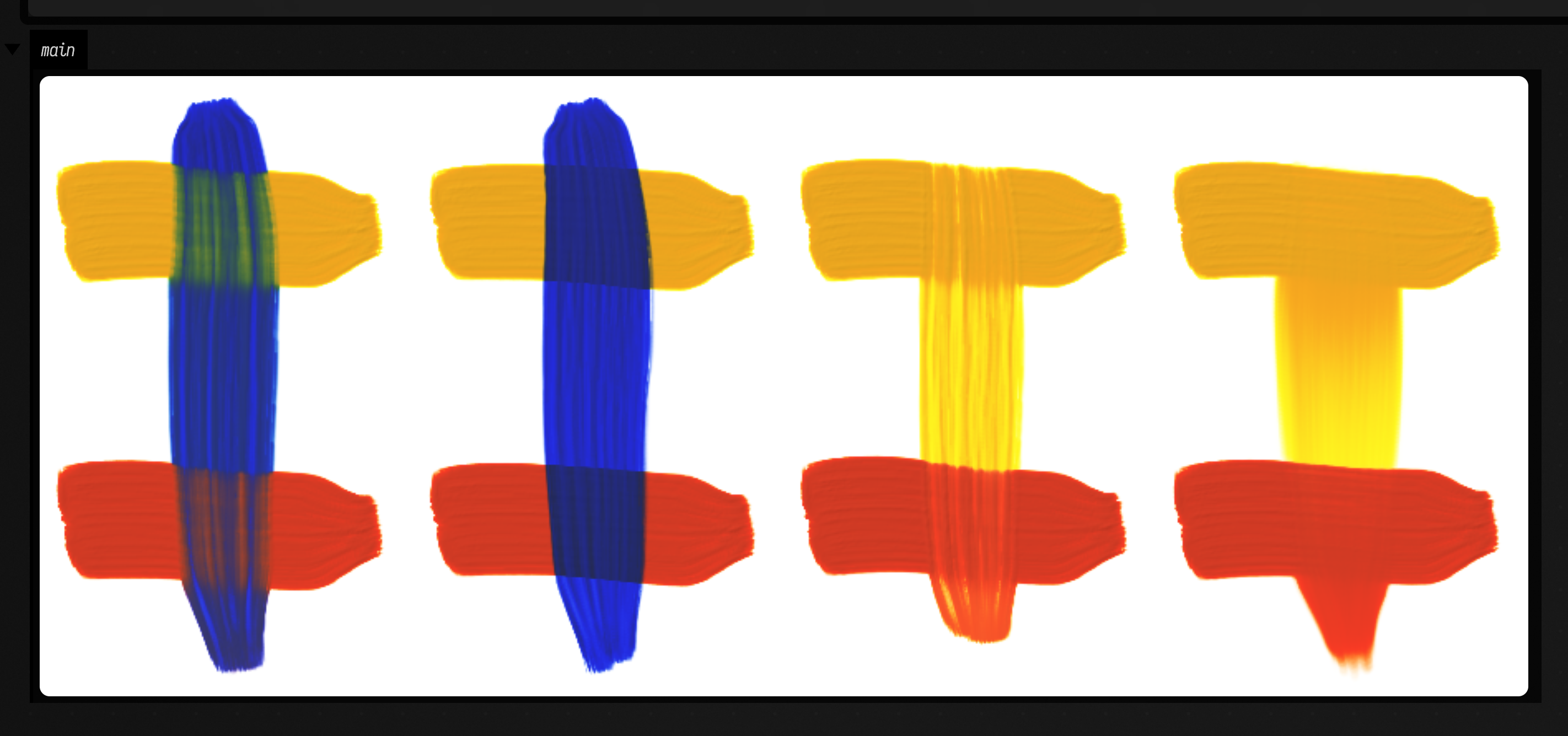
How long paint stays wet
wait(minutes) lets simulated time pass. This yellow band is crossed in blue straight away, and then
again after 2, 10, 33 and 100 hours:
:::static
// One yellow band, crossed in blue after longer and longer waits.
val hours = [0.0, 2.0, 10.0, 33.0, 100.0]
notation {
    stroke(FLine().moveTo(60, 1080).cubicTo(400, 1070, 700, 1090, 1020, 1080), name = "slow band", pressure = { 0.85 })
    hours.indices.forEach { i ->
        val x = 150.0 + i * 190
        stroke(FLine().moveTo(x, 960).lineTo(x + 20, 1200), name = "after $i", pressure = { 0.5 + 0.5 * sin(PI * it) })
    }
}
val canvas = PaintCanvas(900, aspect = 3.2, view = Rect(40.0, 940.0, 1000.0, 312.0))
fun paint(name: String, brush: PaintBrush) = notation.named(name)!!.let {
    canvas.stroke(it.toFLine(), brush, pressure = 1.0..1.0, swell = it.pressuresAlong(32), shake = 0.4)
}
paint("slow band", canvas.brush(BrushKind.HogFlat, width = 80.0).load(mapOf("cadmium yellow" to 1.0)))
var waited = 0.0
hours.forEachIndexed { i, h ->
    canvas.wait((h - waited) * 60)
    waited = h // simulated minutes
    paint("after $i", canvas.brush(BrushKind.HogFlat, width = 60.0).load(mapOf("ultramarine blue" to 1.0)))
}
display("main", canvas.png())
markdown("times", "crossed after " + hours.joinToString(", ") { "${it.toInt()} h" } + " (left to right)", width = 500)
notation.clear()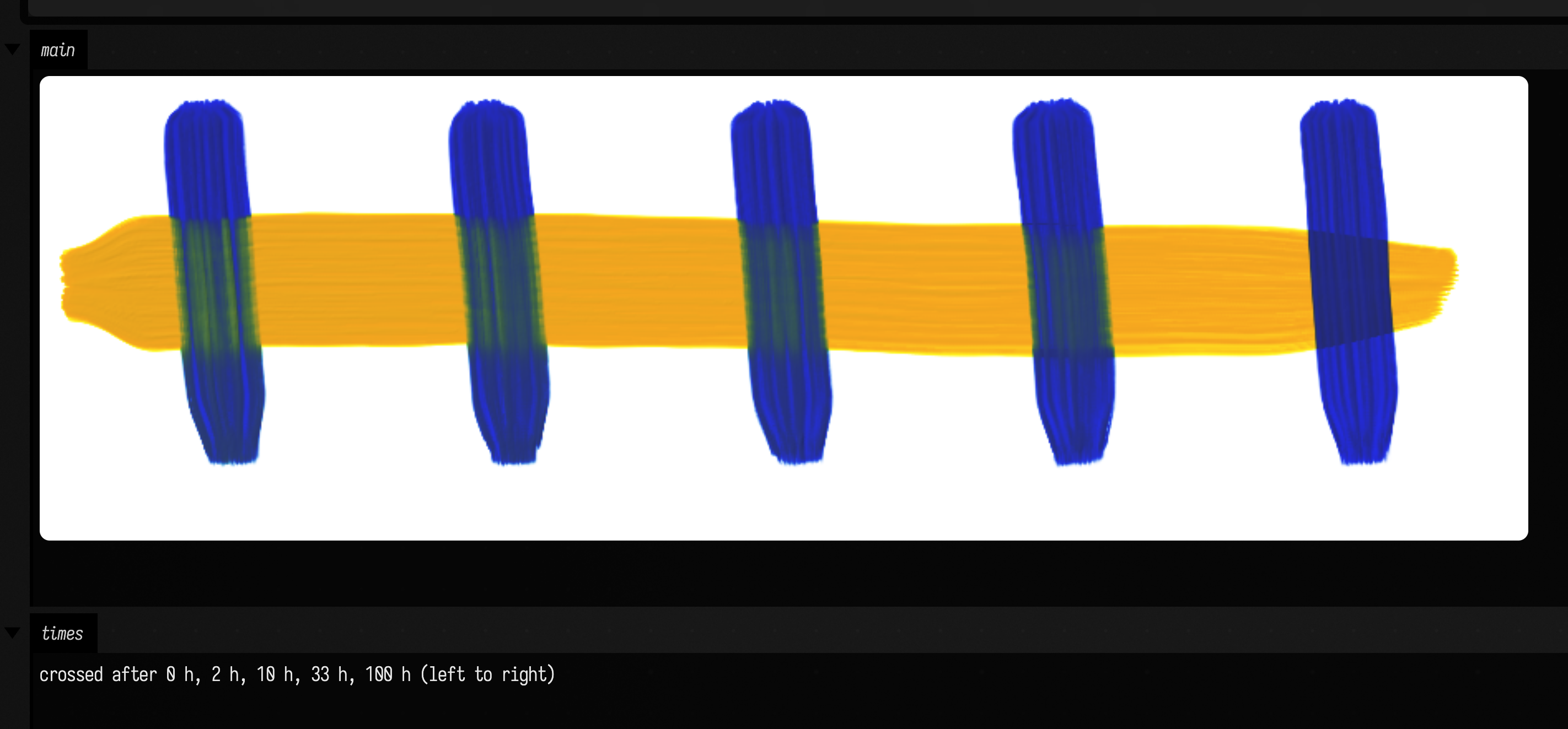
How fast a stroke dries depends on how thick it is and on its paint: lead white dries in about half
the time of an average paint and bone black in more than twice. dry() waits until every stroke is
touch-dry. Rendering does not change the canvas, so the strokes are still wet for the next one.
In pencil
canvas.draw(line, pencil, pressure = ...) takes the same kind of list, a pressure at evenly spaced
points along the line. Pressed lightly, a pencil leaves a pale grey line; pressed hard, a dark one.
The three strokes from the start of the page, in a 6B pencil on a 20 cm sheet:
:::static
:::fold the same three strokes as above, drawn into this box's drawing
notation {
    stroke(
        FLine().moveTo(80, 300).cubicTo(200, 60, 330, 420, 420, 140),
        name = "S",
        pressure = { 0.15 + 0.85 * sin(PI * it) },
    )
    stroke(
        FLine().moveTo(470, 110).cubicTo(560, 300, 700, 330, 820, 180),
        name = "sweep",
        pressure = { 1.0 - 0.85 * it },
    )
    stroke(
        FLine().moveTo(880, 330).cubicTo(1060, 300, 1020, 60, 900, 120).cubicTo(820, 160, 880, 260, 960, 250),
        name = "loop",
        pressure = { 0.15 + 0.85 * it * it },
    )
}
:::endfold
// The strokes in that region in a 6B pencil, on a 20 cm sheet, its pressure following the pen.
val region = Rect(40.0, 40.0, 1040.0, 400.0)
val canvas = PaintCanvas(900, aspect = 3.0, view = Rect(40.0, 40.0, 1040.0, 347.0), sizeMm = 200.0)
val pencil = canvas.pencil("6B")
for (s in notation.strokes.filter { it.bounds.intersects(region) }) canvas.draw(
    s.toFLine(),
    pencil,
    pressure = s.pressuresAlong(32).ifEmpty { [0.6] },
)
display("main", canvas.png())
notation.clear()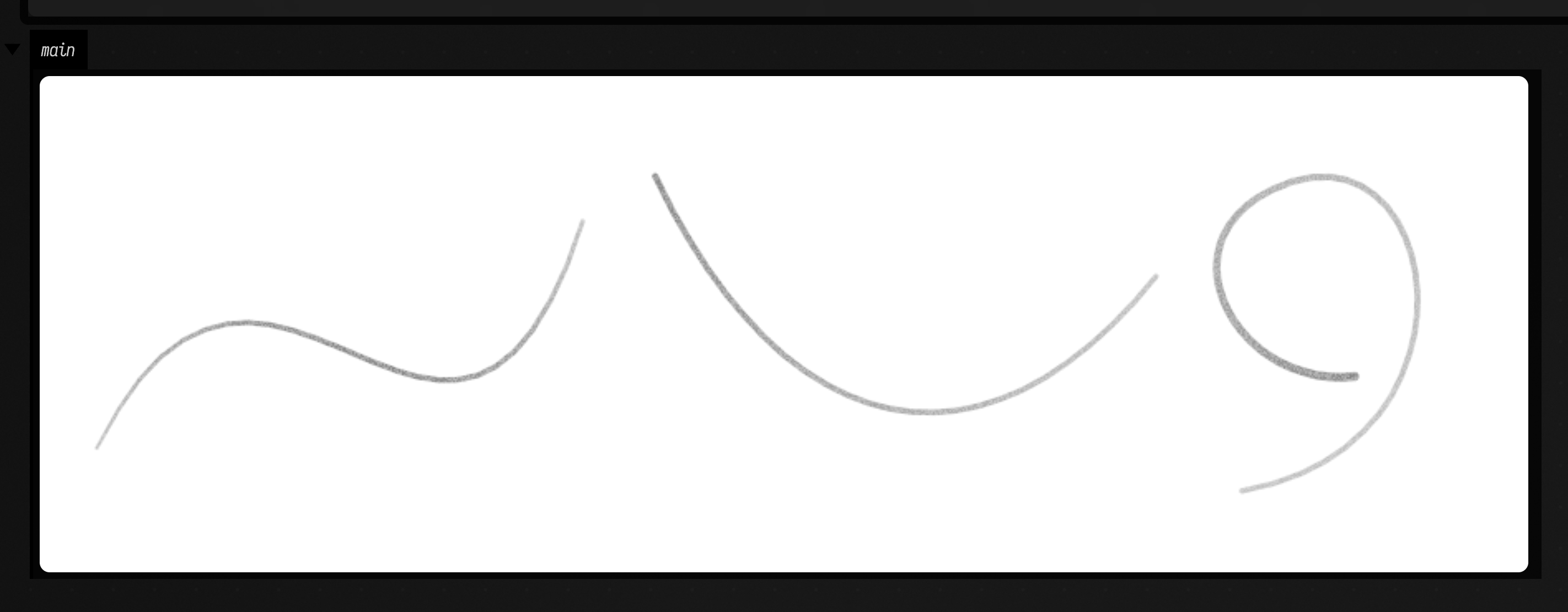
Drawing your own
Open the drawn_paint starting point and run its boxes in order: strokes,
paint, crossings, drying, meadow and pencil. Each reads the strokes in one region of the
drawing. To paint your own, press alt/option-d, choose the pen (p) and draw in a region, then run the
box that reads it. A tablet pen records pressure; a mouse does not, and for a mouse stroke
pressuresAlong is empty, so the brush paints at its base pressure. To make a canvas that fits
whatever you drew:
val drawn = notation.strokes.filter { it.handDrawn }
val view =
    drawn.map { it.bounds }.reduce { a, b -> a.union(b) }.let { Rect(it.x - 40, it.y - 40, it.w + 80, it.h + 80) }
val canvas = PaintCanvas(900, aspect = view.w / view.h, view = view)
Where each piece is documented
- Drawing and Notation for the drawing layer and
notation. - Paint and pencil from FLines for
PaintCanvas, brushes, tube paints, grounds, glazes and pencils, and for building the native library the paint figures need. - A Drawn Morph, Heard reads strokes from the same drawing as shapes to morph between.