Not Fade Away — Thoughts on Preserving Loops
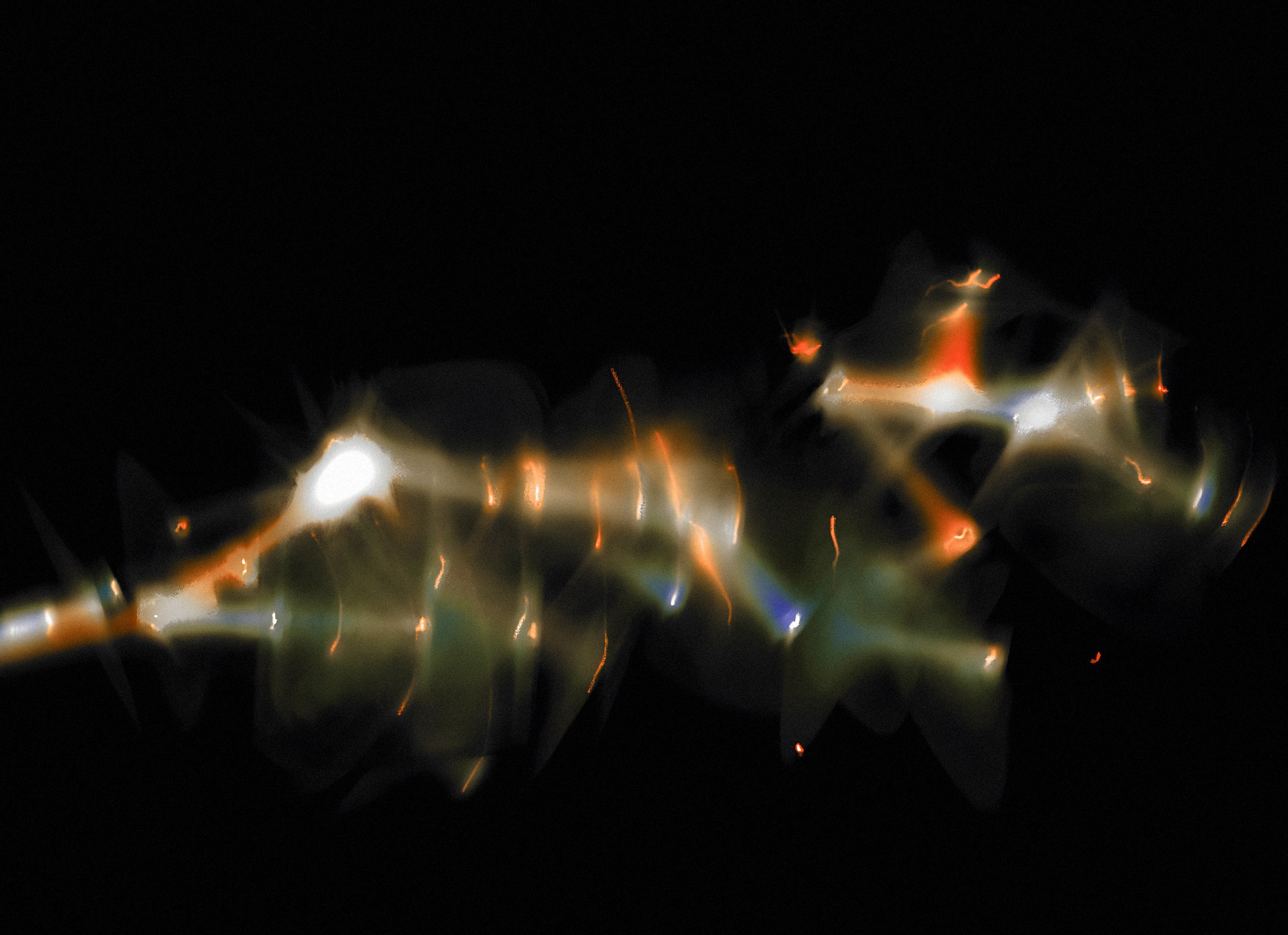
First published in Transmission in Motion: The Technologizing of Dance, ed. Maaike Bleeker (Routledge, 2016).
Descent
Following the death of his father, Rainer Maria Rilke discovered among his effects a daguerreotype that he’d not seen since a child. As a young man his father had sat still for the camera’s long exposure, dressed in his imperial officer uniform; now the son’s gaze was drawn to his father’s youthful hands, which rested on the hilt of his sword.
The poem he wrote in meditation on this portrait ends with the beautifully recursive lines: O quickly fading photo / in my more slowly fading hand.
Remains
Of the things Rilke describes in the poem, the hands of the father and of the son, and the photograph that links them, are fated to decay in short order — but the steel sword will persist. Metal outlasts both paper and flesh, and the sword will speak to remote descendants even if they have no prior knowledge of such a weapon.
In taking hold of a sword it’s natural to slip your hand into the sword’s grip, and the sharpness of the blade and the thrust it suggests will tell you what deadly purpose you might once have put it to.
Enshrined
On my first visit to Merce Cunningham’s loft, he showed me the little nook where John Cage had once worked, the space nearly filled with Cage’s desk. There, perched at a window above Sixth Avenue, Cage would compose his music and his texts, often letting chance dictate his decisions as he tried eluding his habits and his tastes. (This having long since become Cage’s habit, I wondered how well it could still have worked.)
In the last years of his life Cage had given pride of place on this desk to a computer, on which he could run simple programs written for his use to generate chance operations faster than he could with the old throw of the dice; now only six years later, this PC was already a relic.
Not unusual for a desk to be left just as it was when a great writer dies; in St. Petersburg, for example, one can find Dostoevsky’s desk untouched. And so it seemed natural to me at the time to find Cage’s desk in the same state as when he left it, and slightly startling when several years later it was not: the computer now gone. I never asked Merce why, but I imagine it was for completely practical reasons: the machine, left idle and quickly outmoded, would no longer have run.
(Of course another possibility, not to be ruled out, is that a museum or even a collector had acquired and enshrined it, its uselessness perhaps its selling-point.)
Lost transmission
Even with the manpower and funding of a government agency it’s hard to evade this process of information obsolescence; NASA can no longer read some of its own space exploration data dating back only to the 1970s, so quickly and irreversibly have data formats and storage media changed in the few intervening decades.
Imagine a science fiction story in which the alien messages so eagerly sought a decade later by the SETI Institute [Search for Extraterrestrial Intelligence] had been received and recorded but never recognized in the 1970s, and were now forever irretrievable in NASA’s decaying data-sets. Perhaps Stanislaw Lem could have done this justice, a small companion piece to his novel His Master’s Voice.
Now think whether this might really be the case in many human communications, where for example in a dance concert the audience may not yet have the eyes with which take in something radically new. Since live performance is in some sense unrepeatable, this means that these signals too are gone for good.
Last run
On the week these sentences are being written, the Cunningham Dance Company is performing certain works for the last time ever here in New York City.
Not long before his death, Merce had decided that his company would undergo one last farewell tour in his absence and then fold its tent, disbanding forever. The choreography itself will continue to survive as other dance companies license, learn, and perform it, but never again will the pieces be danced by a group overseen by Cunningham himself and without doubt these works will begin to deviate from the originals.
As in the children’s game of telephone, I imagine that the signal initiated at one end of the chain will eventually re-emerge almost unrecognizable at the other.
No resurrection
This deviation was a complaint even when Cunningham was alive and could direct the revival of his older dances. Those aficionados who could recall Merce’s own dancing would shake their heads when they watched even the best-trained and most naturally gifted dancers try to resurrect his roles. No one could match the original, and only much later did Merce explain to me why, not that the answer hadn’t dawned on me long before. It was an open secret of Loops.
Flung or cast
One of the pieces performed this week was BIPED, the best-known of Merce’s later works and one that he kept in his repertory right up from its creation in 1999 to now. This was the dance for which Shelley Eshkar and I had created the visual decor in the form of huge projections, and seeing it for the last time brought made me think.
At the time we were conscious that Merce, having collaborated with us first on our terms (the triptych installation Hand-drawn Spaces, 1998), had now invited us to collaborate on his, the dance stage; and so Shelley and I were intent on merging our non-dance sensibilities with the dance tradition that Merce had opened up so wide.
Hand-drawn Spaces had had us working with Merce much more closely than normally allowed in the Cage/Cunningham practice of parallel rather than intersecting collaborations. This was necessitated by our using a beta form of software that we all thought would be an interesting new way for Merce to create the virtual choreography we needed; since this was software he could not master on his own, we all worked together at the same screen.
During our sessions, we were surprised when Merce brought out a small collection of many-sided dice of a kind I recognized from my days as a schoolteacher in the 1980s — for these were the same dice I saw kids using to play the elaborate role-playing game of Dungeons and Dragons. Merce explained that he’d discovered that such dice were considerably faster to employ than the yarrow sticks traditionally cast by readers (perhaps better termed users?) of the Chinese Book of Changes as they determined which of 64 ideograms to consult next. It had been this ancient practice of divination and reading that had first inspired Cage’s use of chance operations.
This image of flung sticks remained with Shelley and me, so we created one of the virtual figures in BIPED to embody it. Constructed entirely of short straight lines, when this figure leaped it would fling its lines up into the air and then gather them back in on landing again. Up to then, Shelley and I had taken pains to limit our virtual figures to the constraints of human anatomy; this was our first step toward more abstract body systems that while remaining true to the underlying human movement propelling them managed to express that movement more freely. This abstracted anatomy took us a first step toward Loops.
Tools determinism
In watching the BIPED projections twelve years after creating them, I recognized with a touch of chagrin that a few elements of certain sequences came almost straight out of the box — the box in question being the commercial animation program 3DS Max. This Autodesk package contained as one of its plug-ins the biped figure animation software we’d been using since before its release, developed by close friends in the proverbial Silicon Valley garage before being acquired by the huge software company; the package also included the renderer with which we output our frames.
Some of these, as I said, bore the unmistakable imprint of the tool we’d made them with, more naively than I remembered. I was surprised only because this inevitable consequence was one I was now seeing in my own work; I’d long ago spotted it in others’. Oh, I’d say to myself, there’s that MaxMSP patch triggered again, and over there that seamless masking of layers proclaims its AfterEffects origin; as for that sleek mapping of data, that can only be Processing.
Later my colleague Marc Downie would give this effect a name: tools determinism.
Three asides
(i) If dancers are shaped by training and practice into human tools for their choreographers’ use, then this kind of tools determinism is evident, sometimes sadly, in the work of ex-company dancers — a post-Cunningham or post-Forsythe creation is often unmistakably (and unshakably) stamped by the original, even to the point of unwitting parody.
(ii) Cannot the same misfortune befall even the original artist who sticks too rigidly to a method or style?
(iii) Not necessarily a misfortune, though, because sometimes it is turned into the very opposite, a windfall, the market actually rewarding what we might deplore as a limitation. Repetition and consistency, after all, are the hallmarks of commercial branding.
Blurred distinction
A point of confusion, never quite clarified, arose in the public mind (and in ill-informed critics’) between Merce’s use of software and our own. When in old age Merce’s feet and ankles gave out and he could no longer create his phrases by dancing them, he had turned to a software program, then called LifeForms, to help generate these instead.
This proved to be an irresistible story, lapped up by many journalists and given prominent play: the grand old man of the avant-garde was in fact ever-young, always poised on the cutting edge. Perhaps abetted by publicists, some critics could later hardly resist attributing BIPED’s projections to Merce himself, blurring him with two younger unknowns.
Mechanisms of movement
This blurring obscured the fact that what Merce was seeking in the computer was the opposite of what we sought, no doubt because of the very different places we started out from — Merce from the body, we from the screen. To take Merce’s case first:
Trying to remove himself from the too-easy instincts and habits of the warm socialized human body, Merce embraced the colder schemes suggested to him by the rather primitive calculations of LifeForms. This program provided a very crude model of the body (with no inverse kinematics), and so its solutions even when mechanically possible were often anatomically impossible. Merce however delighted in having his dancers try adapting themselves to some of these unreachable poses, ones sometimes so implausible as to be beyond even his wide range of imaginings.
When I first started going to see Merce’s work — new to dance, I did not begin until the mid-90s — the tools determinism of LifeForms was in full effect (by the time of BIPED it had receded). In works like CRDSPCR (its name betraying its computer origin), the grace and flow ordinarily sought in dance were subverted by visibly artificial operations that directed the dancers’ motions in mechanical ways. It was a wrenching thing to watch, no doubt Merce’s intention, in particular because each dancer was rendered more cog or function than individual being. I remember being struck by the dancers’ sexlessness, again a quality rarely encountered in dance.
Interchangeability
I once wrote:
A curious thing about Hand-drawn Spaces: The movements we captured were truly detached from the dancers who had so brilliantly performed them, Jeannie Steele and Jared Phillips. The differences between the two in size and sex and style were annulled as Merce combined their captured phrases freely, making long passages in which one dancer's movements alternated frequently with the other's, both mapped to the same hand-drawn figure. Psychology and intention were absent from this choreographic process, for Merce used chance operations to see what phrase went next.
“Warming up the pixels”
This was Shelley’s humorous phrase, used to describe what we sought to do to the computer — in contrast to the computer’s computational chilliness that Merce had embraced. Cold perfection came easily to the computer, as did artificiality, and while new and exciting to Merce, these were old and oppressive to us.
What we wanted was what he had as a given in dance: the warmth of human presence, the individuality of human touch, the irregularity of human motion. And so we pursued what we called the hand-drawn line instead of the simple geometrical one, and we chose to motion-capture humans dancing rather than simulating flawless approximations of the same.
Bystander
In the motion-capture sessions for Hand-drawn Spaces and BIPED, Merce as dancer was reduced to a bystander’s role: he was there as choreographer only, supervising his dancers from a seat on the sidelines. This was an unacknowledged tragedy, for in his prime Cunningham had commanded the dance stage as no else ever would.
Even in old age Merce would shuffle onto the stage for cameo appearances in company Events. With his halo of white hair and expression of sage benevolence, he looked the part of the legend he’d become, which was enough to hold his audience not only rapt but rapturous. The trouble was that the solo movements he would then perform with his hands were hard to see clearly at a distance, especially with the other dancing going on all around him, so it was on faith that one took his solo to be great.
That this dance of the hands was great was one impetus behind our making Loops the digital artwork. We all silently aimed it at posterity.
Loops the dance
In 1971 Cunningham created Loops as a dance solo for himself; when he designated it as a “solo event,” he meant that its form was to continually adapt to the requirements of occasion and venue. Thus Loops had no fixed choreography, but was instead an improvisation — though this was a term that both Cunningham and Cage shied away from, perhaps because it implied the easy indulgences of informality and self-expression rather than the formal rigor they always sought.
Cunningham first performed Loops at the Museum of Modern Art in New York City, where he danced in front of the Jasper Johns painting entitled Map (after Buckminster Fuller’s Dymaxion Air Ocean World).
Loops got its name, Merce once told me, from the circular movements he could do with his wrists. Originally the piece was not restricted to the hands, but instead took different body parts through their variations one at a time — feet, head, trunk, leg, shoulder. He sometimes set this order by chance, but only
if I had time enough to learn it. Because when you use chance, as you probably know, it dislocates your memory, so you have to start all over again.
As Merce’s age advanced and his mobility diminished, he channeled the intricate movements of Loops into his fingers, hands, and arms alone.
In this form Loops became the signature solo work of Merce’s later career, one that he was never to set on any other dancer. He told us he wanted to keep it “my little secret.”
A larger secret
Loops is a markedly different kind of choreography from that which Cunningham set on his company dancers: its timing has an amazing intricacy not to be found elsewhere. (I’ve long been surprised that to my knowledge — admittedly limited — dance critics and scholars haven’t exclaimed over the difference between Cunningham’s solo and group choreography.) In my last extended conversation with Merce (in June 2007), I pressed him to account for this difference, which struck me as crucial.
Merce began by explaining that Loops is “not teachable.” This, he said, has to do with the particularity of any dancer — “everyone’s rhythm is different.” In Loops, he described ten movements happening at once, which you cannot perform by thinking them through on a given beat. Instead, he said, you have to skip all that somehow and simply do them in the interval you’ve given yourself. His unspoken implication was that other dancers couldn’t manage this — which made the dance unteachable.
Merce went on to explain that when setting choreography on his dancers, he’d found long ago that he had to teach to a beat, which “becomes a language to talk about time.” This accounted for something I’d found exceedingly odd in his company rehearsals. While I’d been expecting either silence or the sort of meter-less electronic music common in his performances, I was surprised to discover that in his classes a pianist would play old-fashioned show tunes that kept very simple time. The beat enabled his dancers to coordinate with one another as well as to memorize their movements more easily. As a consequence, their movements remained rhythmically much simpler than those Merce could conceive and perform himself.
So this provided another impetus to our project: how to convey Merce’s intricate timing when he was no longer able to perform it?
Motion capture
In 2000 we’d realized that motion-capture techniques had advanced far enough that we could capture Merce’s hand movements with the same accuracy as we had recorded his dancers’ full body dancing. And so we captured Merce performing Loops, and when he was done he declared this performance to be definitive, his final and finest expression of the dance.
Data in hand, though, Shelley and I at first did nothing. We put it in a drawer, so to speak, waiting to see if a future possibility might bring it to the life we were starting to imagine for it.
Cat’s cradle
Inspiration often comes to me from children’s games and activities. I think childhood is a resource we can continue to draw upon, for the possibilities that we close off for ourselves as we grow up and take the particular forks in our roads are still wide open in childhood, accessible to us not only through our individual memories but also by simply watching children at play.
For Loops I wanted to push the idea of abstracted identities that we had just started to explore in BIPED, and I started picturing the way the children’s game of cat’s cradle sets up fluctuating networks of string between the opposing fingers of each hand. So rather than just tracing the normal hierarchy of Merce’s hands from joint to joint, I wondered about a web of connections arising between the points of those hands.
At the same time Shelley and I had started to dream of a live and ever-changing version of the work, one that improvised itself in the same way that Cunningham did in his dance. At no time did we think of such a piece as documentation of the original but rather as an autonomous artwork that would exist — almost live — in parallel to it.
/entity
In 2000, the Kitchen in New York partnered with the MIT Media Lab to commission a series of new media works that would link artists in New York to engineers in Cambridge. The title of the show was to be ID/entity: portraits for the 21st century — the slash punctuation mark too cleverly postmodern for my liking at the time,though I must admit that on examining it now I see that the singling out of entity proved oddly prophetic in the case of Loops.
At the Lab, Shelley and I were introduced to Marc Downie, then a doctoral student there; by no means an engineer only, he was both artist and scientist. At our first meeting, I went on in vague and visionary mode about our perhaps impossible desire for the piece — which was to have each point of Merce’s hands treated as its own dancer of sorts, with the choreography between them emerging cat’s-cradle-style from their fleeting cross-connections. To which fanciful notion Marc merely nodded. He was currently programming AI frameworks for the emergent behavior of virtual wolves in a virtual wolf pack, and this proposal seemed a natural extension of that work.
Creatures
Marc’s word for artificially intelligent entities was creatures, and so that’s how we started designating the 48 moving points that comprised the motion capture data of Merce’s hands. Our creation of the artwork entailed setting up the conditions for these creatures’ decisions as they tracked the underlying motion; that is, we relinquished direct control in favor of emergent behavior.
Rather than looking at the collection of movements as a whole, Marc showed me that since aggregate behavior percolated up from each individual creature’s choices, it was best to imagine the array of choices it faced at any given moment. These included:
- how to shape its body: as expressed by the lines by which it could connect to other points. This meant its picking a topological rule to follow — to reconstruct the hierarchy of the hand, or to grab points as they came close in space, or to connect to a corresponding point on the opposite hand, and so on.
- how to move: in relation to the motion capture data: shall it lead or trail the motion, or cut corners, or preserve imaginary physical momentums?
- how to communicate: by sending signals out into the colony of points and attempting to exert persuasive influence (“be like me”) — which could cause rapid shifts of behavior and appearance, sometimes leading to local patches of agreement and coordination.
- how to appear: by picking from a blended continuum of line rendering styles, tuned, selected, and named (as “adjectives”) by the three of us, the artists.
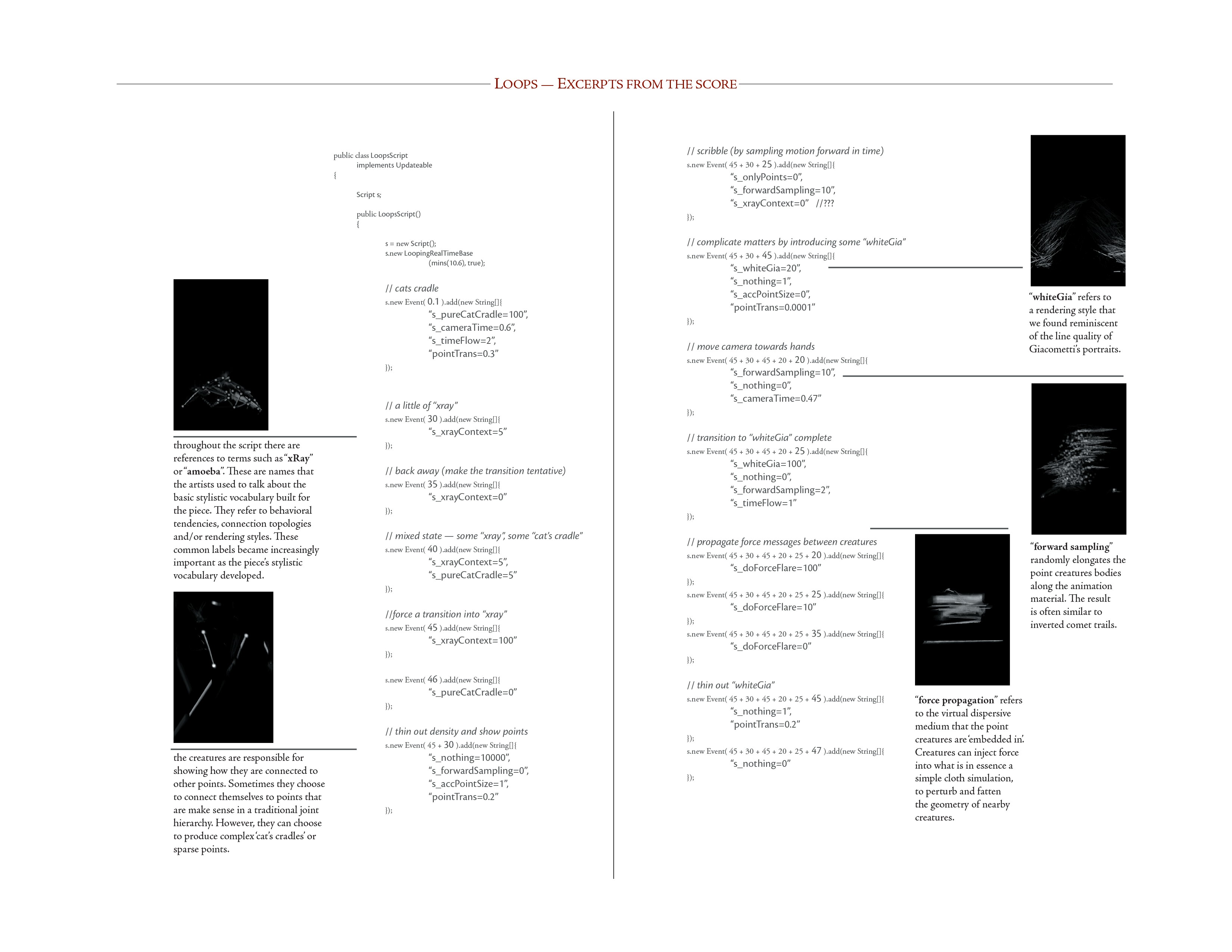
Loops — excerpt from the script
To structure the visual flow of Loops, Marc then created a scripting interface that allowed us to adjust its visual styles and AI decision-making in real-time. But again, our adjustments were not in the form of direct commands; instead, we shifted tendencies within the artwork’s autonomous system, where decisions were probabilistic rather than fixed. Among other things, we would adjust tolerances of boredom — which by our raising or lowering would influence the rate of change in the piece, not by fixed duration or rhythm but simply by proclivity.
This was for me very odd, for in order to think this through, I had had to posit that each creature had its own desires —
And that their desires were perhaps no more precisely determined by their programming (but also no less) than were my own by genetic code.
Recall
I learned long ago in working with children how telling it can be to pair voice with virtual drawing; but when I requested that Merce retell certain stories he’d told us in previous conversations, he demurred, saying it might sound too much like John Cage’s Indeterminacy and other pieces. A week or so later, however, Merce came back to me with a different idea — to read from the diary he’d kept over the three days of his first visit to Manhattan at age 17, a series of open-eyed snapshots of the city.
How fascinating it is to hear a young man’s earnest impressions read aloud in his own voice, but a voice some sixty years older and wiser. You get Manhattan then and now, the man then and now — and you’re as struck by the continuity as by the difference in each pairing.
Well, both are now gone, now gone in this now — the one fading away more slowly but no less certainly than the other.
Merce speaks, Cage listens
Since we had Merce talking, we then thought of John Cage listening, or perhaps his ghost. This gave rise to the second version of Loops in 2004, for which we created a live score. Our idea was to propel the intonation patterns of Merce’s reading into a virtual version of Cage’s prepared piano, which would trigger unexpected notes, often percussive.
We sought structures in the text that had both musical and linguistic functions, and were halfway between forms found in music and in language. Such forms included lists; comparisons; spatial relationships; and markings of time passages. We coupled our analysis of the narrated text to the sound of the narration by marking the onset and offset of each word in the voice recording.
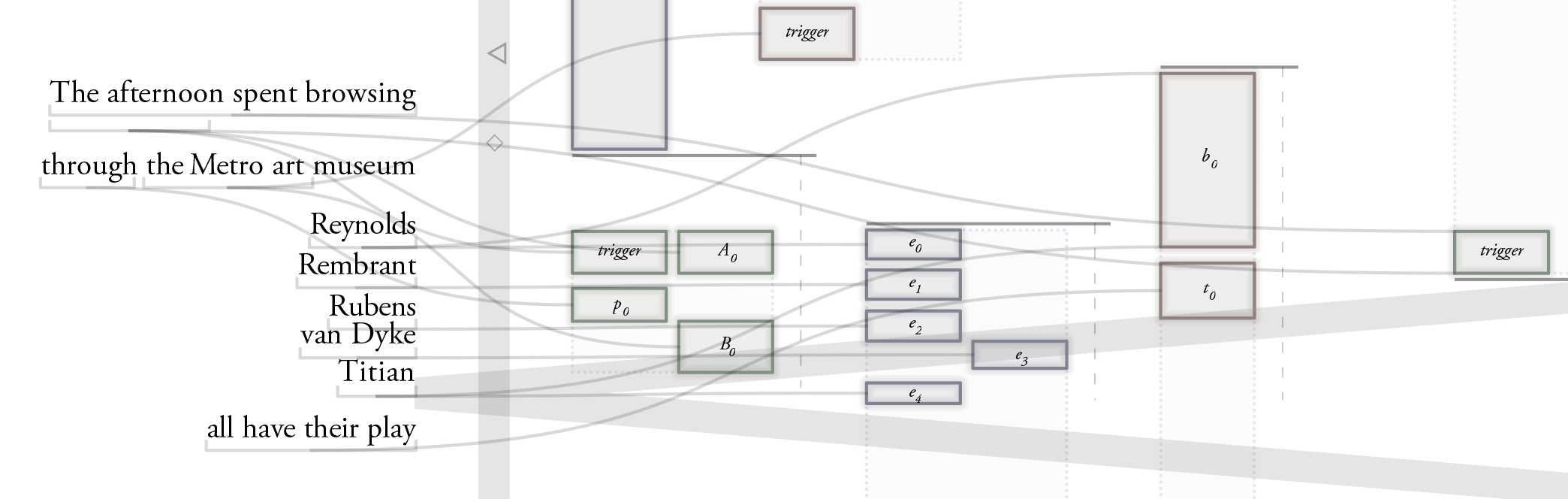
Loops — fragment of the score for the 2004 version
This fragment of the score illustrates the time periods during which the “sound creatures” could listen for opportunities. Each creature could then draw upon its vocabulary of possible actions that correspond metaphorically to the kinds of structures that trigger them:
- list-actions repeat their triggering elements while searching for a stable rhythm inside the elements;
- comparison-actions state their elements and then emphasize the differences between them;
- passage-actions state their first element and then continue to look for material that is sonically related until the close of their marked passage;
- return-actions compress material from their triggering element all the way back to where they “came from.”
In doing all this, the sound creatures must pay attention to each other as they opportunistically align, modify and perhaps even fight for space and relationships “on output.”
From the start Merce wanted his voice not to dominate the score, but rather for it to merge at times as rhythm and timbre with the music, and this was the effect we achieved. It occurred to me recently that listening to the Loops score is a bit like walking in a busy city, where your thoughts are often overtaken by and then submerged in a wash of new impressions.
Cultural ecology, endangered species
It is a convenient fiction that completed artworks exist in perfect and isolated purity, framed for eternity. But the truth is more entangled than that, for artworks both grow from, and survive within, what we might call a cultural ecology. And this ecology is itself a changing environment — it is an intricate system of balances and inter-dependencies that evolves (or devolves) over time.
The cultural ecology for Loops is a good case in point for it is under constant threat. As a dance, can it somehow last now that its sole performer has died? As a digital artwork, can it survive the rapid and inevitable obsolescence of its hardware and software?
Here is how we diagrammed the cultural ecology of Loops in 2008:
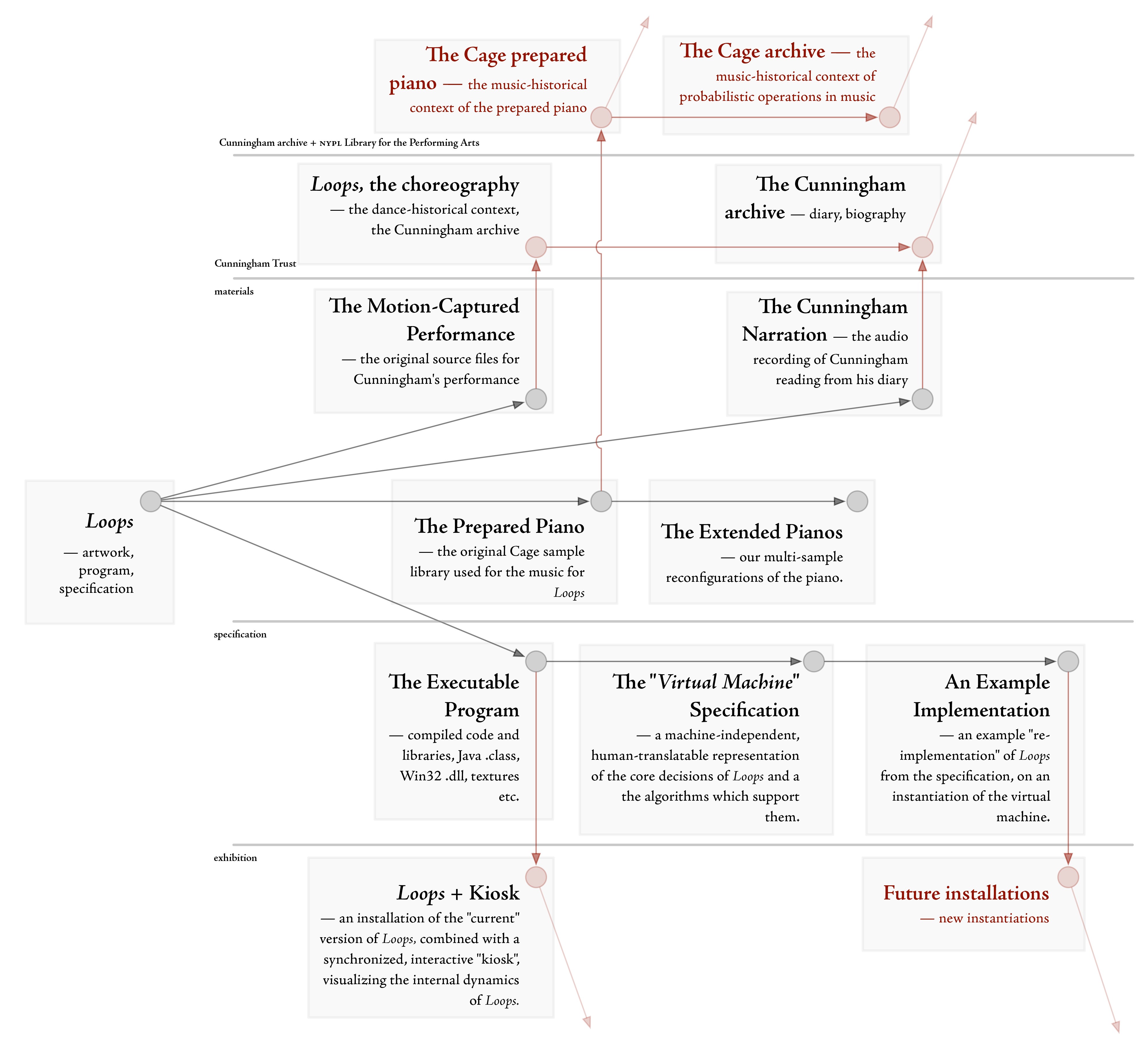
The cultural ecology of Loops, 2008
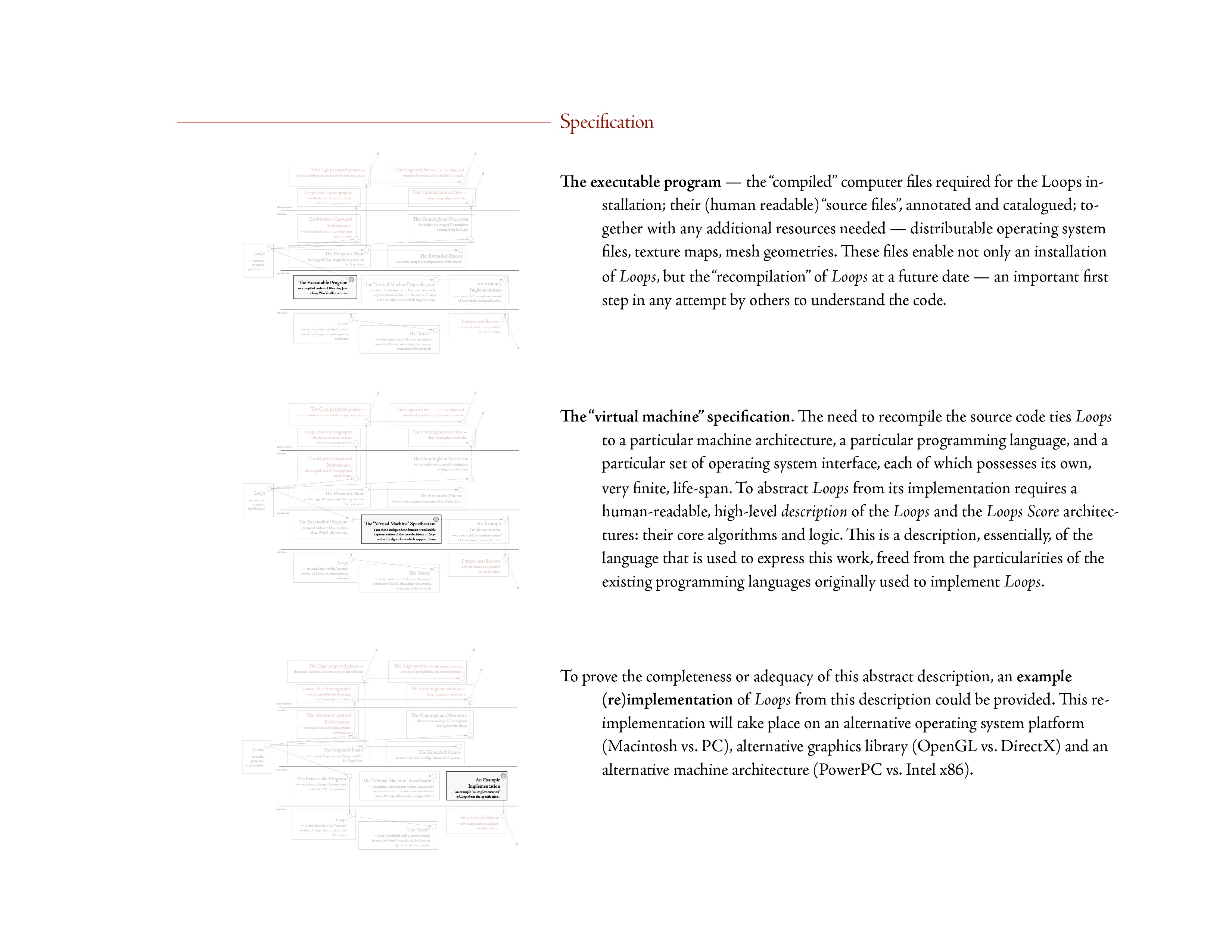
Loops living will: specification
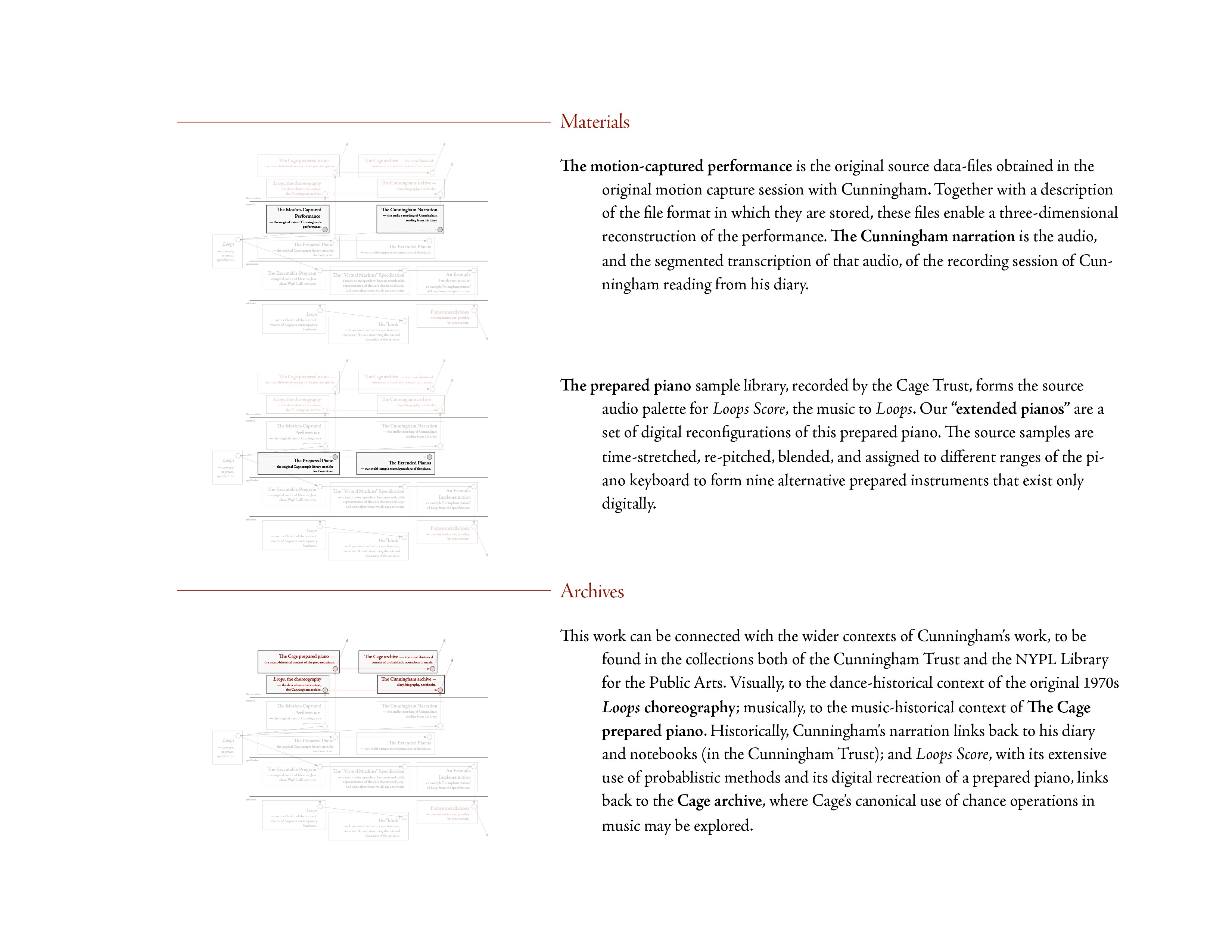
Loops living will: materials and archives
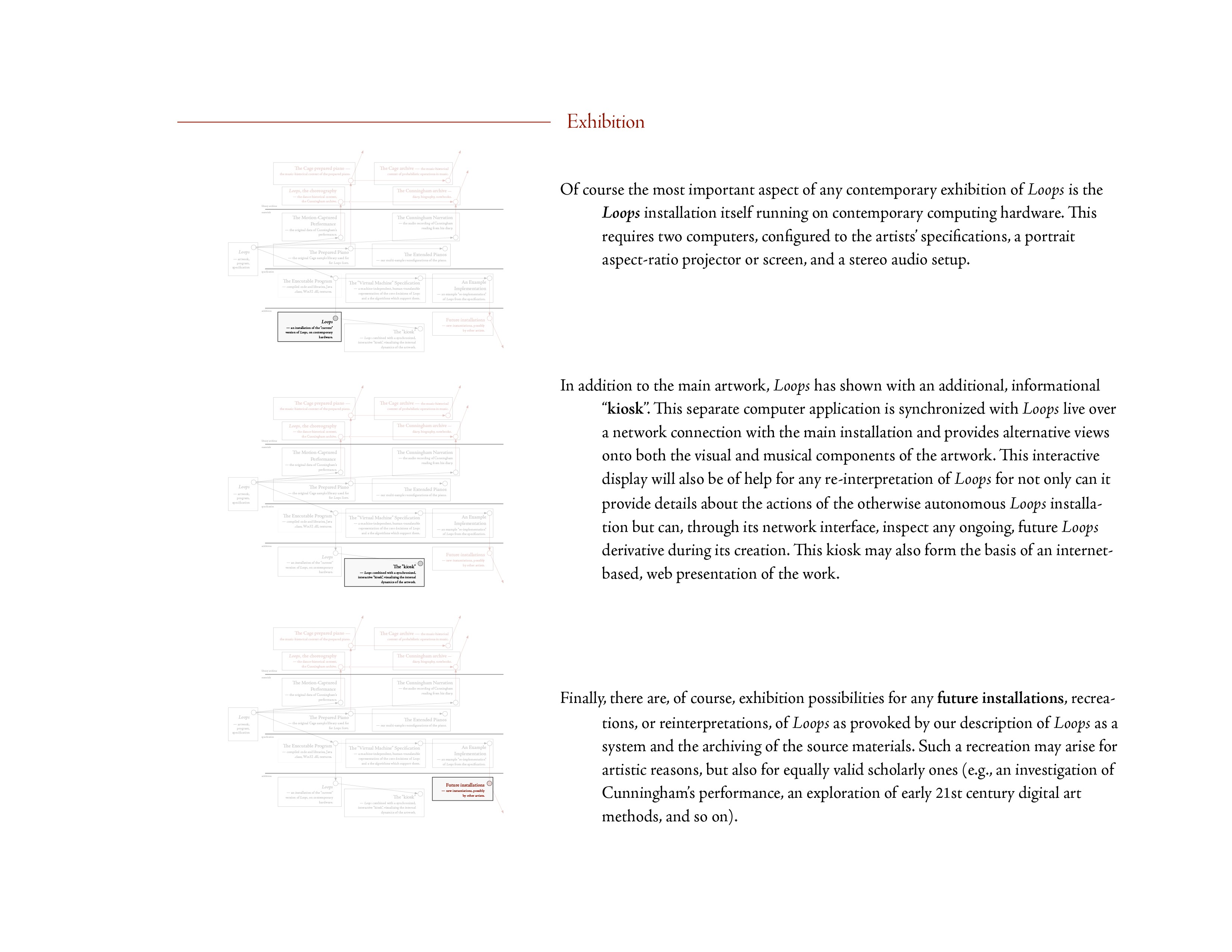
Loops living will: exhibitions
Living wills
In 2008, with support from the Mellon Foundation, we analyzed and confronted these problems directly. Our intent was not only to preserve and document the dance and the digital artwork, but also to create “living wills” for the choreography and the software that would allow their perpetuation – and propagation – far into the future.
Our approach resembled that of the Variable Media Initiative devised almost a decade ago by the Guggenheim Museum, the Pacific Film Archive, the Walker Art Center, the Franklin Furnace, and others. We shared their belief that artists need to start defining artworks independently of specific media, at least for preservation purposes. Our project, however, was considerably more complex than the existing variable media case studies, for we were to create strategies for preserving both a complex dance and a complex computer program – and for coordinating the two.
We had two goals: first, to enable both works to survive long into the future; and second, to allow students, scholars, and artists to examine both works with an unprecedented level of precision and with a rich awareness of context.
Dance data
Cunningham agreed to make his choreography of Loops available for non-commercial use under a Creative Commons license. And so we released video documentation of his performance as short from multiple cameras — and, more crucially, the digital motion-capture files themselves. These make it possible to examine Cunningham’s motion from any angle and from any distance, to speed up or slow down playback to any rate, to measure joint angles and their correlations, and even to perform sophisticated statistical analysis of the movement.
Open source code
At the same time we released as open source both the specific code for the 2008 implementation of Loops as well as the much larger programming environment, Field, that we have relied upon not only to create Loops but also all our other artworks since about 2001. This enables the study of the digital artwork not only by watching the runtime version, but also by examining its underlying code.
Our thought was such an approach would also address the practical problems of keeping the work running. After all, since we cannot foresee future formats, programs, computers, operating systems, displays, and so on – we must accept that all present equivalents will be obsolete in very short order.*
Our further idea was to allow future (and even contemporaneous) programmers to update the work as well as to create their own derivative artworks. We would enable them to forge creative reinterpretations of Loops in a fashion that going far beyond the present-day practice of “remixes,” which operate only on the surface rather than on the structure of the original work.
We’re entrusting the future preservation and perpetuation of Loops to unforeseen hands.
Data
One way to make a thing that can last through the ages is to make it out of nearly indestructible materials, as in the example of the ceremonial sword we considered earlier. We can also work to safeguard the material existence of the thing, as for example in museum conservation, where precious manuscripts and paintings are protected from heat, light, humidity, and touch.
A different approach is to make a thing whose form is permanent but whose materials are perishable — perishable but replaceable. Such is the case for certain sacred structures in Japan made out of wood. As the wood decays, it can simply be replaced. As Alexander Stille puts it:
Just as our bodies replace their old cells with new ones while we remain “ourselves,” the buildings would be constantly regenerated, remaining forever new and forever ancient.
And so none of the materials of the Ise Temple have ever been in place for more than twenty years, yet the Japanese can rightly regard the building as being thirteen hundred years old.
We’ve entered an age where many material things are vanishing into digital bits. Such bits, being merely an arrangement of ones and zeros, are in theory imperishable and infinitely reproducible; but not so in practice. Their environment — the computers and storage devices, the operating systems and programs on which they depend, — keeps changing, causing disruptions much more severe than those brought on by rain, snow, wind, and sun.
Even so, our only hope for preserving digital artworks lies with this idea: that we are true to their form rather than to their materiality.
http://openendedgroup.com/artworks/loops.html
Notes
- The beta software was called biped, which was also the term for its kinematic figures. The following year this gave Merce the title for BIPED (often mis-written in title case rather than all-caps).
- We have already encountered several obsolescences in the 10-year life of Loops to date; indeed, every time the work is exhibited, its code must be carefully adjusted to accommodate even small updates in commercial display drivers.